

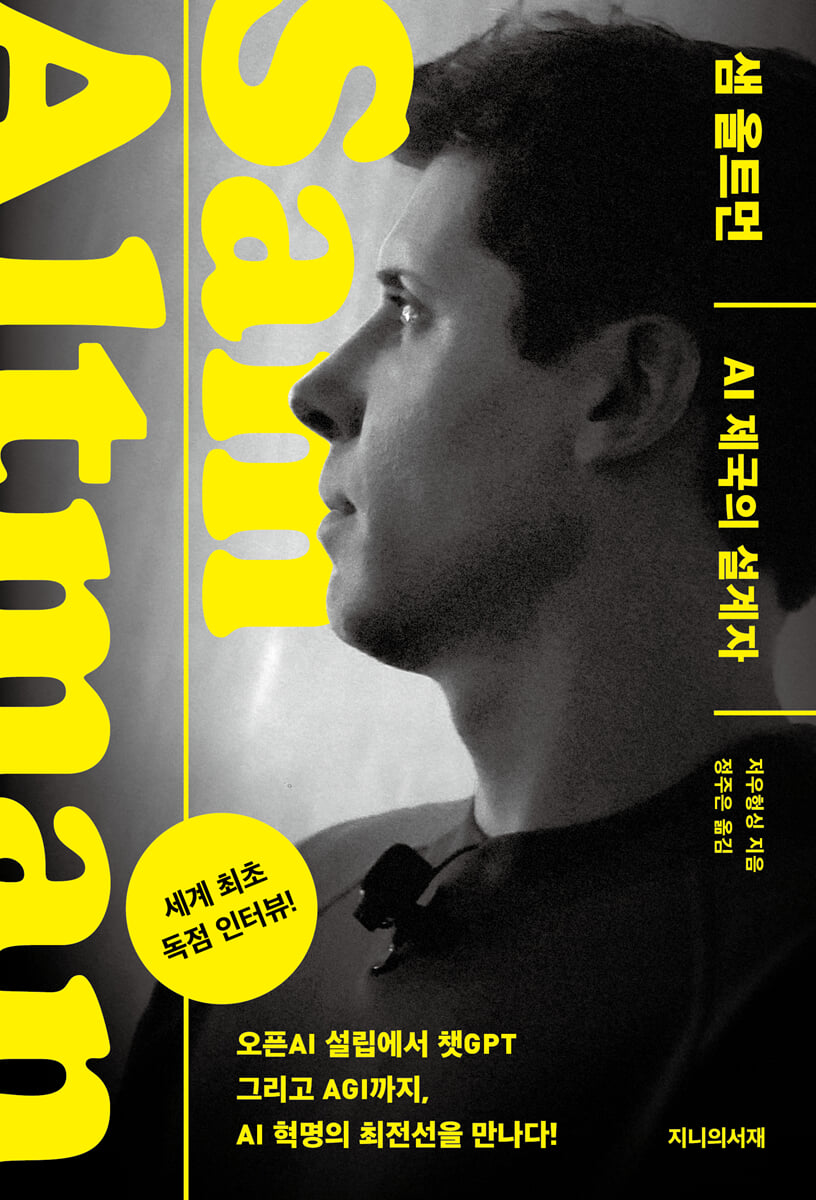
Sam Altman: Architect of the AI Empire
 |
Description
Book Introduction
OpenAI CEO Sam Altman, the world's first exclusive biography
A turbulent founding, dismissal, and reinstatement
And to the future of the superintelligence era
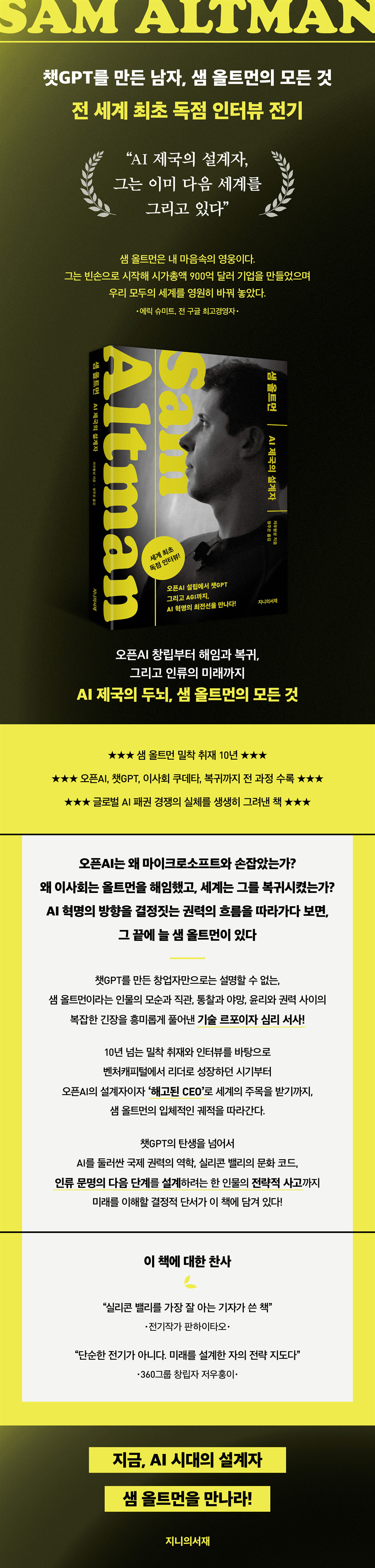
The Story of Sam Altman, the Man Who Shaped the Destiny of Humanity
“I am impressed by the detailed information contained in this book.
After retirement, I would be happy to participate in the second half of this biography.”
─ Sam Altman
An eight-year-old boy sat in front of a Macintosh computer he had received as a gift and muttered, “Someday this computer will be able to think.”
In his early 20s, he dropped out of Stanford University to become an entrepreneur, and by his mid-30s, he was emerging as a figure who changed the course of Silicon Valley.
The organization he created, led, was fired from, and then returned to is now the heart of the "AI empire" that is drawing global attention.
He is Sam Altman, the father of ChatGPT and a leader in the AI era.
His name is now mentioned beyond the realm of technology as a figure who determines the direction of civilization.
Human progress has always begun with 'forbidden challenges'.
The day Prometheus stole fire from the gods, mankind first began to overpower other animals.
When Robert Oppenheimer made atomic energy a reality, he had to leave behind the monologue, “I am death, the destroyer of worlds,” in exchange for gaining the power of God.
And now, humanity stands before another fire.
It is no longer heat energy or radiation.
It is a new 'fire' called 'Artificial General Intelligence (AGI)', a machine that thinks in language, infers intentions, and makes decisions.
And the human standing closest to this fire is Sam Altman.
This book, Sam Altman: Architect of the AI Empire, is not just a flat chronicle of one person.
This is a fascinating technical reportage and psychological narrative that depicts the contradictions and intuition of Sam Altman, the founder of ChatGPT, and the complex tensions between insight and ambition, ethics and power.
The author of this book, Zhou Hengxing, has covered Sam Altman in Silicon Valley for over a decade, capturing a three-dimensional picture of the man himself, from his rise as a leader in the world of venture capital to his moment as the architect of OpenAI and the "fired CEO" who made headlines around the world.
The author captivatingly shows how an introverted child prodigy grew into a world-class entrepreneur and how he gained power and connections at Y Combinator, a startup academy.
From the founding of OpenAI, to its collaboration and breakup with Elon Musk, to the behind-the-scenes story of ChatGPT's development, to its honeymoon with Microsoft, to its November 2023 board dismissal and dramatic comeback, readers will experience the true story unfolding on the front lines of Silicon Valley.
Above all, this book focuses more on the human desire and philosophy to create and control technology than on 'technology' itself.
Altman says AI is dangerous, yet he builds faster and more powerful AI, and he partners with big capital while promoting non-profit activities.
He is a being who simultaneously embraces ethical ideals and realistic speed, and the inner rift creates the most tense tension in this book.
In this book, we delve beyond simply understanding how ChatGPT came to be, delving into the international power landscape surrounding AI, the cultural codes within Silicon Valley, and the thoughts and strategies of one individual attempting to design the next stage of human civilization.
Sam Altman doesn't compete with a predetermined future.
He wants to design his own infinitely open future.
This book is a window into the blueprint of that infinite game.
We now stand at a crossroads, having to choose our future between 'humans who become gods' and 'machines who become humans.'
Perhaps the most crucial hints about the future that lies ahead of us are hidden in this book.
A turbulent founding, dismissal, and reinstatement
And to the future of the superintelligence era
The Story of Sam Altman, the Man Who Shaped the Destiny of Humanity
“I am impressed by the detailed information contained in this book.
After retirement, I would be happy to participate in the second half of this biography.”
─ Sam Altman
An eight-year-old boy sat in front of a Macintosh computer he had received as a gift and muttered, “Someday this computer will be able to think.”
In his early 20s, he dropped out of Stanford University to become an entrepreneur, and by his mid-30s, he was emerging as a figure who changed the course of Silicon Valley.
The organization he created, led, was fired from, and then returned to is now the heart of the "AI empire" that is drawing global attention.
He is Sam Altman, the father of ChatGPT and a leader in the AI era.
His name is now mentioned beyond the realm of technology as a figure who determines the direction of civilization.
Human progress has always begun with 'forbidden challenges'.
The day Prometheus stole fire from the gods, mankind first began to overpower other animals.
When Robert Oppenheimer made atomic energy a reality, he had to leave behind the monologue, “I am death, the destroyer of worlds,” in exchange for gaining the power of God.
And now, humanity stands before another fire.
It is no longer heat energy or radiation.
It is a new 'fire' called 'Artificial General Intelligence (AGI)', a machine that thinks in language, infers intentions, and makes decisions.
And the human standing closest to this fire is Sam Altman.
This book, Sam Altman: Architect of the AI Empire, is not just a flat chronicle of one person.
This is a fascinating technical reportage and psychological narrative that depicts the contradictions and intuition of Sam Altman, the founder of ChatGPT, and the complex tensions between insight and ambition, ethics and power.
The author of this book, Zhou Hengxing, has covered Sam Altman in Silicon Valley for over a decade, capturing a three-dimensional picture of the man himself, from his rise as a leader in the world of venture capital to his moment as the architect of OpenAI and the "fired CEO" who made headlines around the world.
The author captivatingly shows how an introverted child prodigy grew into a world-class entrepreneur and how he gained power and connections at Y Combinator, a startup academy.
From the founding of OpenAI, to its collaboration and breakup with Elon Musk, to the behind-the-scenes story of ChatGPT's development, to its honeymoon with Microsoft, to its November 2023 board dismissal and dramatic comeback, readers will experience the true story unfolding on the front lines of Silicon Valley.
Above all, this book focuses more on the human desire and philosophy to create and control technology than on 'technology' itself.
Altman says AI is dangerous, yet he builds faster and more powerful AI, and he partners with big capital while promoting non-profit activities.
He is a being who simultaneously embraces ethical ideals and realistic speed, and the inner rift creates the most tense tension in this book.
In this book, we delve beyond simply understanding how ChatGPT came to be, delving into the international power landscape surrounding AI, the cultural codes within Silicon Valley, and the thoughts and strategies of one individual attempting to design the next stage of human civilization.
Sam Altman doesn't compete with a predetermined future.
He wants to design his own infinitely open future.
This book is a window into the blueprint of that infinite game.
We now stand at a crossroads, having to choose our future between 'humans who become gods' and 'machines who become humans.'
Perhaps the most crucial hints about the future that lies ahead of us are hidden in this book.
index
Recommendation
Prologue.
A person who will decorate a page of history
PART 1.
From the birth of OpenAI to the development of ChatGPT
CHAP 1.
The AI revolution is creeping in
CHAP 2.
The founding of OpenAI
CHAP 3.
From 0 to 1
CHAP 4.
Standing tall as a leader in a life-or-death situation
CHAP 5.
CEO of the exhibition
PART 2.
Power game
CHAP 1.
Silicon Valley's 'Religious Wars'
CHAP 2.
Board of Directors' Conspiracy
CHAP 3.
The end of the ordeal
CHAP 4.
Finite and Infinite Games
PART 3.
The giraffe of Silicon Valley
CHAP 1.
Adolescence: From St. Louis to Silicon Valley
CHAP 2.
Startup Stage: Mastering the Deal
CHAP 3. The Head of YC: Into the Heart of Silicon Valley
CHAP 4. YC Remodeling: Moving Forward
CHAP 5.
The future Sam drew
Epilogue.
Why Oppenheimer?
Prologue.
A person who will decorate a page of history
PART 1.
From the birth of OpenAI to the development of ChatGPT
CHAP 1.
The AI revolution is creeping in
CHAP 2.
The founding of OpenAI
CHAP 3.
From 0 to 1
CHAP 4.
Standing tall as a leader in a life-or-death situation
CHAP 5.
CEO of the exhibition
PART 2.
Power game
CHAP 1.
Silicon Valley's 'Religious Wars'
CHAP 2.
Board of Directors' Conspiracy
CHAP 3.
The end of the ordeal
CHAP 4.
Finite and Infinite Games
PART 3.
The giraffe of Silicon Valley
CHAP 1.
Adolescence: From St. Louis to Silicon Valley
CHAP 2.
Startup Stage: Mastering the Deal
CHAP 3. The Head of YC: Into the Heart of Silicon Valley
CHAP 4. YC Remodeling: Moving Forward
CHAP 5.
The future Sam drew
Epilogue.
Why Oppenheimer?
Detailed image
Into the book
*** AI is a subfield of computer science, and research has only been going on for about 70 years.
However, its traces in history can be found in ancient myths.
Since the birth of human civilization, humans have always wanted to replicate and imitate themselves.
Talos, the bronze giant from Homer's ancient Greek epic poem "The Iliad," who defended Crete during the Trojan War, was the first humanoid robot modeled after a human.
*** Every moment in science, technology, and scientific history occurs only once.
The next Bill Gates won't develop an operating system.
A second Larry Page or Sergey Brin won't create a search engine.
The next Mark Zuckerberg won't create a social media platform.
If you follow them, you will learn nothing.
*** After many twists and turns, OpenAI has finally set sail.
In this precariously tottering little boat, Musk played the role of spiritual leader, Altman the canny planner, and Brockman the diligent executor.
And the talented Sutskever took charge of the research.
They set sail into uncharted waters, filled with ambition, a sense of unease, and no small amount of fear.
At that time, Musk was forty-four, Altman was thirty, and Sutskever and Brockman were twenty-nine and twenty-eight, respectively.
They were more like pirates than sailors.
Ahead of them, the massive armada of Google and Facebook was already in place.
With a large force and thorough preparations in place.
*** Sam Altman has always been that kind of guy.
Whether they were new employees or competitors, he always gave them praise and blessings.
But deep down he was confident.
Aside from Google, Anthropic is likely to be OpenAI's strongest competitor.
At Anthropic, Dario Amodei continued his research, prioritizing AI safety.
He believed that while developing advanced AI technologies, safety and control must come first. His philosophy was that AI could only benefit humanity within a safe and ethical framework.
*** The conflict between efficient accelerationism and efficient altruism is gradually escalating into a 'religious war' aimed at gaining ground in the battle of public opinion.
And once it infiltrates AI companies, it turns into a power struggle over ideology.
On the surface, the conflict between efficient accelerationism and efficient altruism appears to be a power struggle within a unique industry within a company. However, in reality, it is a clash over the path of AI development.
Efficient accelerationists raise the banner of "accelerationism" high and hope that AI will rapidly transform the world, guided by the technological elite.
Effective altruists, on the other hand, hope that AI will develop under human control, based on altruism.
*** “Sam, the board fired you.”
“What did you say?”
Altman asked again, wondering if he had misheard.
“The board fired you.
“We will announce it soon.”
*** Microsoft also threatened OpenAI.
Microsoft invested more than $10 billion in OpenAI in exchange for licensing technology developed by OpenAI.
Microsoft is already selling a copy of the OpenAI model on its Azure cloud service, a product that directly competes with the OpenAI model.
According to people familiar with the matter, Microsoft salespeople had been trying to steer OpenAI customers toward Azure products for months before the "coup," touting their products as more secure and their safeguards as compliant.
*** Following Lawrence Summers, the two parties also reached an agreement on the appointment of another board member.
Bret Taylor is a longtime Silicon Valley veteran who served as co-CEO of Salesforce and chairman of X, and was instrumental in Elon Musk's acquisition of X.
Altman also welcomed Brett Taylor.
Taylor has agreed to serve as chairman of the new board.
Now, Altman's return was just one step away.
*** Just when everyone was relieved that the problem was over, Elon Musk suddenly appeared and poured oil on the fire.
In fact, the very afternoon that Altman returned as CEO, Musk released a letter to X.
He introduced it as 'a letter sent to the board by anonymous former OpenAI employees.'
*** Sam was the brightest student in his class and extremely charming.
I hoped Sam wouldn't go into IT.
I wanted to become a writer because I was so creative and my writing skills were excellent.
No one could have predicted that OpenAI would have such a huge impact.
Now people know that Sam is better than us in most things.
*** Even Graham, a hacker philosopher, could not hide his sorrow.
Swartz's idealism and spirit of resistance are very similar to Graham's.
Graham's core philosophy, besides the entrepreneurial curve, had another: the hacker mentality.
The hacker mentality was Graham's way of changing the world.
Graham has previously said that he views YC from a hacker's perspective.
The goal was to cultivate more startups, ultimately aligning the world's mindset with that of the ambitious hackers he loved so dearly.
However, its traces in history can be found in ancient myths.
Since the birth of human civilization, humans have always wanted to replicate and imitate themselves.
Talos, the bronze giant from Homer's ancient Greek epic poem "The Iliad," who defended Crete during the Trojan War, was the first humanoid robot modeled after a human.
*** Every moment in science, technology, and scientific history occurs only once.
The next Bill Gates won't develop an operating system.
A second Larry Page or Sergey Brin won't create a search engine.
The next Mark Zuckerberg won't create a social media platform.
If you follow them, you will learn nothing.
*** After many twists and turns, OpenAI has finally set sail.
In this precariously tottering little boat, Musk played the role of spiritual leader, Altman the canny planner, and Brockman the diligent executor.
And the talented Sutskever took charge of the research.
They set sail into uncharted waters, filled with ambition, a sense of unease, and no small amount of fear.
At that time, Musk was forty-four, Altman was thirty, and Sutskever and Brockman were twenty-nine and twenty-eight, respectively.
They were more like pirates than sailors.
Ahead of them, the massive armada of Google and Facebook was already in place.
With a large force and thorough preparations in place.
*** Sam Altman has always been that kind of guy.
Whether they were new employees or competitors, he always gave them praise and blessings.
But deep down he was confident.
Aside from Google, Anthropic is likely to be OpenAI's strongest competitor.
At Anthropic, Dario Amodei continued his research, prioritizing AI safety.
He believed that while developing advanced AI technologies, safety and control must come first. His philosophy was that AI could only benefit humanity within a safe and ethical framework.
*** The conflict between efficient accelerationism and efficient altruism is gradually escalating into a 'religious war' aimed at gaining ground in the battle of public opinion.
And once it infiltrates AI companies, it turns into a power struggle over ideology.
On the surface, the conflict between efficient accelerationism and efficient altruism appears to be a power struggle within a unique industry within a company. However, in reality, it is a clash over the path of AI development.
Efficient accelerationists raise the banner of "accelerationism" high and hope that AI will rapidly transform the world, guided by the technological elite.
Effective altruists, on the other hand, hope that AI will develop under human control, based on altruism.
*** “Sam, the board fired you.”
“What did you say?”
Altman asked again, wondering if he had misheard.
“The board fired you.
“We will announce it soon.”
*** Microsoft also threatened OpenAI.
Microsoft invested more than $10 billion in OpenAI in exchange for licensing technology developed by OpenAI.
Microsoft is already selling a copy of the OpenAI model on its Azure cloud service, a product that directly competes with the OpenAI model.
According to people familiar with the matter, Microsoft salespeople had been trying to steer OpenAI customers toward Azure products for months before the "coup," touting their products as more secure and their safeguards as compliant.
*** Following Lawrence Summers, the two parties also reached an agreement on the appointment of another board member.
Bret Taylor is a longtime Silicon Valley veteran who served as co-CEO of Salesforce and chairman of X, and was instrumental in Elon Musk's acquisition of X.
Altman also welcomed Brett Taylor.
Taylor has agreed to serve as chairman of the new board.
Now, Altman's return was just one step away.
*** Just when everyone was relieved that the problem was over, Elon Musk suddenly appeared and poured oil on the fire.
In fact, the very afternoon that Altman returned as CEO, Musk released a letter to X.
He introduced it as 'a letter sent to the board by anonymous former OpenAI employees.'
*** Sam was the brightest student in his class and extremely charming.
I hoped Sam wouldn't go into IT.
I wanted to become a writer because I was so creative and my writing skills were excellent.
No one could have predicted that OpenAI would have such a huge impact.
Now people know that Sam is better than us in most things.
*** Even Graham, a hacker philosopher, could not hide his sorrow.
Swartz's idealism and spirit of resistance are very similar to Graham's.
Graham's core philosophy, besides the entrepreneurial curve, had another: the hacker mentality.
The hacker mentality was Graham's way of changing the world.
Graham has previously said that he views YC from a hacker's perspective.
The goal was to cultivate more startups, ultimately aligning the world's mindset with that of the ambitious hackers he loved so dearly.
--- From the text
Publisher's Review
From college dropout to Time magazine's CEO of the Year
The world's leader in artificial intelligence, the 'Oppenheimer' of the AI era
Sam Altman's creativity, foresight, execution, and business acumen
Everything You Need to Know About Sam Altman, the Brain of the AI Empire
The author of this book declares:
“He is not Oppenheimer.
“He’s closer to Augustus.” Many people call Sam Altman “the Oppenheimer of the AI era.”
This means that he is responsible for bringing a new fire, a dangerous technology called 'AI', to humanity.
But the author feels that this metaphor is lacking in something.
Oppenheimer created technology, but he did not design civilization.
Sam Altman, on the other hand, transcends technology and is the architect of a new order and empire. He's not someone who stole the divine fire of AI, but rather a designer who plans to rule a new world based on that fire—a figure like the Roman Emperor Augustus, who perfected the Pax Romana.
So how did Sam Altman become such a person?
This book unravels that process in a suspenseful Silicon Valley narrative.
An introverted boy raised in a middle-class Jewish family, he encountered a Macintosh computer at the age of eight and fell in love with programming.
He dropped out of college, started a business, and became the head of YC, a Silicon Valley startup incubator, at a young age.
Here, he discovers future unicorns, earns the trust of the tech elite, and soon begins to realize his vision by riding the wave of AI.
This book vividly captures the events and stories of the people at the heart of OpenAI, from its founding to its development, allowing readers to experience the turbulent history unfolding at the forefront of the AI revolution.
“We are making a god.
The question is, what kind of being is that god?
“No one knows yet”
The Birth of ChatGPT and Beyond: A Record of the Front Lines of the AI Revolution
The stage he chose was OpenAI.
Although he started out as a non-profit AI research institute with Elon Musk, Altman soon faced the reality of a lack of funding and made a bold decision.
By partially abandoning its non-profit structure and forming a strategic alliance with the giant capital Microsoft, OpenAI will become the core of an "AI empire" equipped with both technological and financial power.
One of the results was ChatGPT, which surprised the world.
But what makes this book truly interesting is not the technological success, but the human drama and philosophical conflict behind it.
In November 2023, OpenAI's board of directors abruptly dismissed Altman.
The incident, for which the reason for his dismissal was not even clear, made headlines around the world, and within days, he was reinstated as CEO with overwhelming internal support and Microsoft's mediation.
This dramatic event was not a simple power struggle.
It was a clash between AI speed and ethics, technology and control, ideals and capital.
Altman emphasizes publicness and safety while creating more powerful AI at a faster pace than anyone else.
He talks about ethics while attracting billions of dollars in investment, and he advocates open technology while never giving up technological leadership.
This book relentlessly traces how these contradictory attitudes work as a single strategy.
Is he a cold-blooded, ambitious man disguised as a benevolent figure, or is he truly a righteous challenger willing to take risks for the future? It's up to the reader to find the answer.
Those who design the future of humanity,
How should we prepare for the future after ChatGPT?
Above all, the author does not simply list chronological facts.
As a journalist who has closely covered Sam Altman in Silicon Valley for a long time, he poses the essential question of 'humanity in the AI era' based on Altman's words, actions, and interactions with those around him.
To whom should we entrust the direction of technology? When did technology become a power? And for whom and how should this power be wielded?
Sam Altman: Architect of the AI Empire is a book that contains answers to such questions.
Reading this book isn't just about learning the backstory of ChatGPT.
It's about understanding who holds the blueprint for humanity's next evolutionary step.
Perhaps Sam Altman was the first to get his hands on the blueprint.
This book is your chance to glimpse that map from up close.
And that opportunity may be the most urgent and desperately needed insight we have right now.
OpenAI and Microsoft, Anthropic and Amazon, DeepMind and Google
At the center of the fierce battle for AI leadership
After ChatGPT, here are some clues to the future.
● How does power shift in Silicon Valley?
● By whose hands is AI being designed?
● ChatGPT, what philosophy and ambition are hidden behind it?
● How is the AI three-way battle formed and unfolded?
The algorithms that run the world are becoming increasingly sophisticated, and their designers are no longer startup founders or university lab scientists.
AI companies like OpenAI, Anthropic, and DeepMind are now the three major players in the AI industry, competitively developing models that replicate human language, thinking, creativity, and even judgment.
Their technology goes beyond simply improving the quality of services; it has the power to replace search, translation, writing, programming, and even judgment itself.
Behind these AI companies are three giant IT empires.
OpenAI commercialized its cloud-based AI service through strategic investment and collaboration with Microsoft, while Anthropic joined the foundation model race with investments from both Amazon and Google.
Meanwhile, DeepMind is the oldest artificial intelligence research institute, acquired by Google (now Alphabet) in 2014.
While they may appear to be independent non-profits or research institutes, they are actually the vanguard of technological empires, each with its own unique capital, strategy, and worldview. As AI technology advances, a structure is forming in which those with the resources to train, deploy, and control it—namely, computing power, data, and capital—give increasingly absolute influence.
Sam Altman: Architect of the AI Empire offers a fascinating and in-depth look at the dynamics and underlying trends of the current AI industry through the eyes of a figure at the very center of this massive transformation.
Why did Microsoft invest billions in OpenAI, and what technologies did OpenAI hand over in return? Why did OpenAI's founders leave the company to found Anthropic, and why did Amazon and Google simultaneously make huge bets? And why did Google pursue disruptive innovation by integrating DeepMind with its internal AI organization?
This book chronicles the defining moments in the AI industry, from the inception of OpenAI to the emergence of ChatGPT, the board's dismissal and subsequent comeback drama, and the rise of Anthropic and DeepMind. It also meticulously illustrates how power dynamics are reorganized as technology evolves.
This is not just the story of one entrepreneur, but a narrative that depicts how a new technology called AI is redesigning the global economy, politics, ethics, and the fabric of everyday life.
In particular, the author closely tracks the landscape, informal meetings, and inter-company relationships within Silicon Valley, thereby capturing a dense "sense of the field" that is difficult to find in typical tech-related books.
AI is no longer just a technology.
Now that social infrastructure, information power, and philosophical standards have become axes, the future of humanity will take a completely different trajectory depending on who creates, trains, regulates, and monopolizes them.
And that future is being determined by three companies: OpenAI, Anthropic, and DeepMind, and the three tech empires that operate behind them.
Sam Altman: Architect of the AI Empire is a unique window into the inner workings of the people and organizations at the heart of this future.
We cannot navigate the coming AI era without understanding why they have joined forces, what they are building, and where they are headed.
This book will be the first key to understanding that future.
And we live in a time when that key is needed.
The world's leader in artificial intelligence, the 'Oppenheimer' of the AI era
Sam Altman's creativity, foresight, execution, and business acumen
Everything You Need to Know About Sam Altman, the Brain of the AI Empire
The author of this book declares:
“He is not Oppenheimer.
“He’s closer to Augustus.” Many people call Sam Altman “the Oppenheimer of the AI era.”
This means that he is responsible for bringing a new fire, a dangerous technology called 'AI', to humanity.
But the author feels that this metaphor is lacking in something.
Oppenheimer created technology, but he did not design civilization.
Sam Altman, on the other hand, transcends technology and is the architect of a new order and empire. He's not someone who stole the divine fire of AI, but rather a designer who plans to rule a new world based on that fire—a figure like the Roman Emperor Augustus, who perfected the Pax Romana.
So how did Sam Altman become such a person?
This book unravels that process in a suspenseful Silicon Valley narrative.
An introverted boy raised in a middle-class Jewish family, he encountered a Macintosh computer at the age of eight and fell in love with programming.
He dropped out of college, started a business, and became the head of YC, a Silicon Valley startup incubator, at a young age.
Here, he discovers future unicorns, earns the trust of the tech elite, and soon begins to realize his vision by riding the wave of AI.
This book vividly captures the events and stories of the people at the heart of OpenAI, from its founding to its development, allowing readers to experience the turbulent history unfolding at the forefront of the AI revolution.
“We are making a god.
The question is, what kind of being is that god?
“No one knows yet”
The Birth of ChatGPT and Beyond: A Record of the Front Lines of the AI Revolution
The stage he chose was OpenAI.
Although he started out as a non-profit AI research institute with Elon Musk, Altman soon faced the reality of a lack of funding and made a bold decision.
By partially abandoning its non-profit structure and forming a strategic alliance with the giant capital Microsoft, OpenAI will become the core of an "AI empire" equipped with both technological and financial power.
One of the results was ChatGPT, which surprised the world.
But what makes this book truly interesting is not the technological success, but the human drama and philosophical conflict behind it.
In November 2023, OpenAI's board of directors abruptly dismissed Altman.
The incident, for which the reason for his dismissal was not even clear, made headlines around the world, and within days, he was reinstated as CEO with overwhelming internal support and Microsoft's mediation.
This dramatic event was not a simple power struggle.
It was a clash between AI speed and ethics, technology and control, ideals and capital.
Altman emphasizes publicness and safety while creating more powerful AI at a faster pace than anyone else.
He talks about ethics while attracting billions of dollars in investment, and he advocates open technology while never giving up technological leadership.
This book relentlessly traces how these contradictory attitudes work as a single strategy.
Is he a cold-blooded, ambitious man disguised as a benevolent figure, or is he truly a righteous challenger willing to take risks for the future? It's up to the reader to find the answer.
Those who design the future of humanity,
How should we prepare for the future after ChatGPT?
Above all, the author does not simply list chronological facts.
As a journalist who has closely covered Sam Altman in Silicon Valley for a long time, he poses the essential question of 'humanity in the AI era' based on Altman's words, actions, and interactions with those around him.
To whom should we entrust the direction of technology? When did technology become a power? And for whom and how should this power be wielded?
Sam Altman: Architect of the AI Empire is a book that contains answers to such questions.
Reading this book isn't just about learning the backstory of ChatGPT.
It's about understanding who holds the blueprint for humanity's next evolutionary step.
Perhaps Sam Altman was the first to get his hands on the blueprint.
This book is your chance to glimpse that map from up close.
And that opportunity may be the most urgent and desperately needed insight we have right now.
OpenAI and Microsoft, Anthropic and Amazon, DeepMind and Google
At the center of the fierce battle for AI leadership
After ChatGPT, here are some clues to the future.
● How does power shift in Silicon Valley?
● By whose hands is AI being designed?
● ChatGPT, what philosophy and ambition are hidden behind it?
● How is the AI three-way battle formed and unfolded?
The algorithms that run the world are becoming increasingly sophisticated, and their designers are no longer startup founders or university lab scientists.
AI companies like OpenAI, Anthropic, and DeepMind are now the three major players in the AI industry, competitively developing models that replicate human language, thinking, creativity, and even judgment.
Their technology goes beyond simply improving the quality of services; it has the power to replace search, translation, writing, programming, and even judgment itself.
Behind these AI companies are three giant IT empires.
OpenAI commercialized its cloud-based AI service through strategic investment and collaboration with Microsoft, while Anthropic joined the foundation model race with investments from both Amazon and Google.
Meanwhile, DeepMind is the oldest artificial intelligence research institute, acquired by Google (now Alphabet) in 2014.
While they may appear to be independent non-profits or research institutes, they are actually the vanguard of technological empires, each with its own unique capital, strategy, and worldview. As AI technology advances, a structure is forming in which those with the resources to train, deploy, and control it—namely, computing power, data, and capital—give increasingly absolute influence.
Sam Altman: Architect of the AI Empire offers a fascinating and in-depth look at the dynamics and underlying trends of the current AI industry through the eyes of a figure at the very center of this massive transformation.
Why did Microsoft invest billions in OpenAI, and what technologies did OpenAI hand over in return? Why did OpenAI's founders leave the company to found Anthropic, and why did Amazon and Google simultaneously make huge bets? And why did Google pursue disruptive innovation by integrating DeepMind with its internal AI organization?
This book chronicles the defining moments in the AI industry, from the inception of OpenAI to the emergence of ChatGPT, the board's dismissal and subsequent comeback drama, and the rise of Anthropic and DeepMind. It also meticulously illustrates how power dynamics are reorganized as technology evolves.
This is not just the story of one entrepreneur, but a narrative that depicts how a new technology called AI is redesigning the global economy, politics, ethics, and the fabric of everyday life.
In particular, the author closely tracks the landscape, informal meetings, and inter-company relationships within Silicon Valley, thereby capturing a dense "sense of the field" that is difficult to find in typical tech-related books.
AI is no longer just a technology.
Now that social infrastructure, information power, and philosophical standards have become axes, the future of humanity will take a completely different trajectory depending on who creates, trains, regulates, and monopolizes them.
And that future is being determined by three companies: OpenAI, Anthropic, and DeepMind, and the three tech empires that operate behind them.
Sam Altman: Architect of the AI Empire is a unique window into the inner workings of the people and organizations at the heart of this future.
We cannot navigate the coming AI era without understanding why they have joined forces, what they are building, and where they are headed.
This book will be the first key to understanding that future.
And we live in a time when that key is needed.
GOODS SPECIFICS
- Date of issue: September 15, 2025
- Page count, weight, size: 384 pages | 153*225*30mm
- ISBN13: 9791194620150
- ISBN10: 1194620159
You may also like
카테고리
korean


korean

![ELLE 엘르 스페셜 에디션 A형 : 12월 [2025]](http://librairie.coreenne.fr/cdn/shop/files/b8e27a3de6c9538896439686c6b0e8fb.jpg?v=1766436872&width=3840)


