

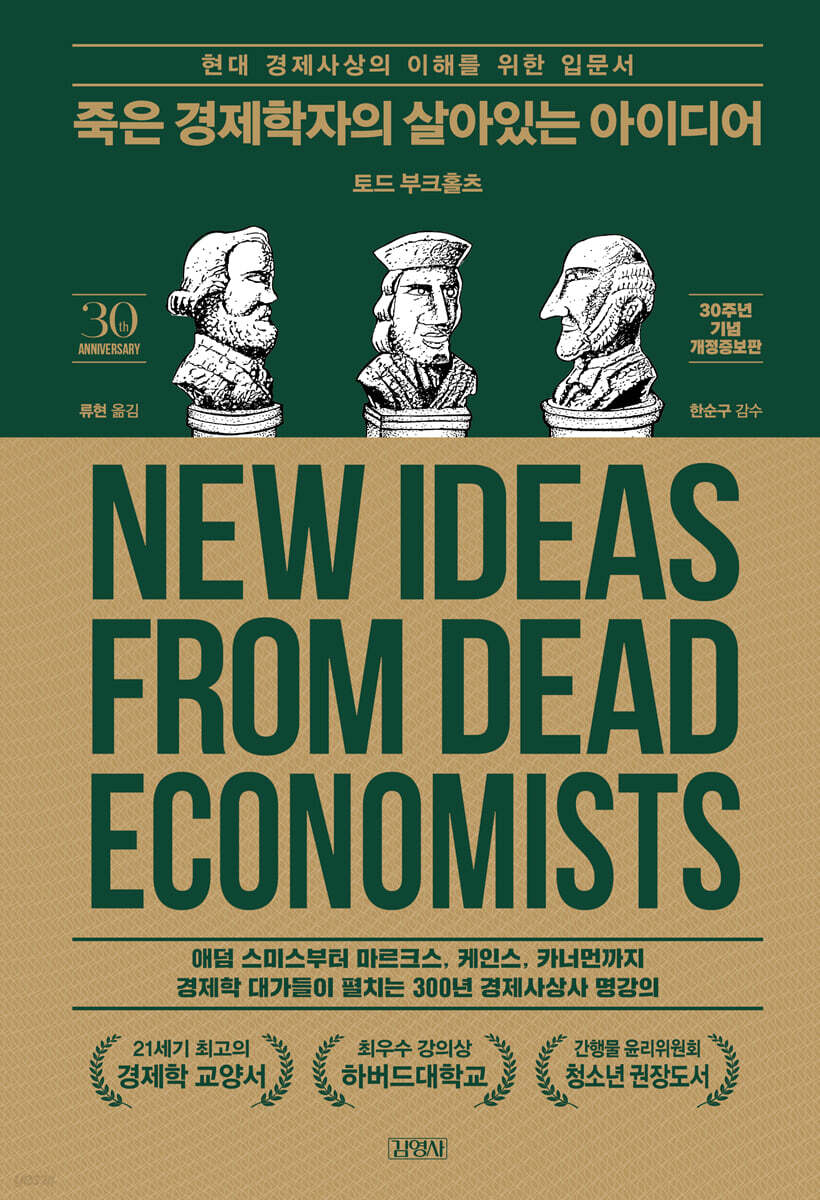
Living Ideas from Dead Economists
 |
Description
Book Introduction
Best Courses Chosen by Harvard University Students
A 21st-century classic adopted as a textbook by economists worldwide
Must-read books for students selected by current high school teachers
A renowned lecture that penetrates the vast currents of 300 years of economic history.
30th Anniversary Revised and Expanded Edition
The 21st century's best economics textbook is back with a new, revised edition.
From Adam Smith's Wealth of Nations to Malthus's population theory, Marshall's supply and demand curve, Lucas's theory of rational expectations, and Daniel Kahneman's behavioral economics.
This is the most accessible and authoritative economics textbook, containing the thoughts of the masters who have led 300 years of economics history in one volume. It has received favorable reviews as “a book that simultaneously captures depth and enjoyment,” and has become a must-read for economists, college students, and young people around the world.
Let's find a path to a more prosperous future in the still-living ideas of dead economists.
“This revised edition reflects the various changes that have occurred in our society over the past 30 years.
“It has been reborn as a book that is much easier to understand and more helpful for today’s young readers.”
Han Soon-gu (Professor of Economics, Yonsei University)
“If you’re only going to read one economics book, I highly recommend this one.”
Lawrence Summers (former U.S. Treasury Secretary)
“A book that kills two birds with one stone: depth and fun, while covering the specialized knowledge of economics!”
_National Review
A 21st-century classic adopted as a textbook by economists worldwide
Must-read books for students selected by current high school teachers
A renowned lecture that penetrates the vast currents of 300 years of economic history.
30th Anniversary Revised and Expanded Edition
The 21st century's best economics textbook is back with a new, revised edition.
From Adam Smith's Wealth of Nations to Malthus's population theory, Marshall's supply and demand curve, Lucas's theory of rational expectations, and Daniel Kahneman's behavioral economics.
This is the most accessible and authoritative economics textbook, containing the thoughts of the masters who have led 300 years of economics history in one volume. It has received favorable reviews as “a book that simultaneously captures depth and enjoyment,” and has become a must-read for economists, college students, and young people around the world.
Let's find a path to a more prosperous future in the still-living ideas of dead economists.
“This revised edition reflects the various changes that have occurred in our society over the past 30 years.
“It has been reborn as a book that is much easier to understand and more helpful for today’s young readers.”
Han Soon-gu (Professor of Economics, Yonsei University)
“If you’re only going to read one economics book, I highly recommend this one.”
Lawrence Summers (former U.S. Treasury Secretary)
“A book that kills two birds with one stone: depth and fun, while covering the specialized knowledge of economics!”
_National Review
- You can preview some of the book's contents.
Preview
index
Recommendation: A brilliant lecture that penetrates the vast currents of economic thought.
Introduction: Key Ideas for Meeting the New Economic Challenges of the 21st Century
1.
Economists in Trouble
2.
Adam Smith: The Founder of Economics
3.
Malthus: A Dark Prophet
4.
David Ricardo: The Embodiment of Free Trade
5.
John Stuart Mill: A Stormtrooper in Economics
6.
Karl Marx: The ill-fated revolutionary and heretic of economics
7.
Alfred Marshall: The Birth of Marginal Thinking
8.
Veblen & Galbraith: Institutionalists Caught in Their Own Net
9.
Keynes: The Savior of Economics
10.
Milton Friedman: The founder of monetarism, a rebellion against Keynes.
11.
James Buchanan: The founder of the public choice school of thought who proclaimed that politics is business.
12.
A bizarre world where rational expectations and uncertainty simultaneously reign supreme.
13.
Dark clouds and a ray of sunshine
Acknowledgements
Translator's Note
Reviewer's Note
main
Search
Introduction: Key Ideas for Meeting the New Economic Challenges of the 21st Century
1.
Economists in Trouble
2.
Adam Smith: The Founder of Economics
3.
Malthus: A Dark Prophet
4.
David Ricardo: The Embodiment of Free Trade
5.
John Stuart Mill: A Stormtrooper in Economics
6.
Karl Marx: The ill-fated revolutionary and heretic of economics
7.
Alfred Marshall: The Birth of Marginal Thinking
8.
Veblen & Galbraith: Institutionalists Caught in Their Own Net
9.
Keynes: The Savior of Economics
10.
Milton Friedman: The founder of monetarism, a rebellion against Keynes.
11.
James Buchanan: The founder of the public choice school of thought who proclaimed that politics is business.
12.
A bizarre world where rational expectations and uncertainty simultaneously reign supreme.
13.
Dark clouds and a ray of sunshine
Acknowledgements
Translator's Note
Reviewer's Note
main
Search
Detailed image

Into the book
Economists don't say which of these is bad and which is good.
They just tell us that we can't have them all at once.
Economics is the study of choice.
But it doesn't tell you what to choose.
They simply explain the consequences of your choices.
--- p.33
Adam Smith used the example of his coat as an example and said that the reason he can stay warm in the middle of winter is because it is the result of the combined labor of many workers: shepherds, wool sorters, dyers, spinners, weavers, merchants, and sailors (if any of the materials used to make the coat were imported).
What's even more surprising is that none of these workers know about each other's existence.
Of course, I don't know who Smith is or why he wants the coat.
--- p.82
Of the great economists covered in this book, David Ricardo is the only one who never went to university.
But he delved into economic theory with greater skill than any other scholar.
Also, he had never formally studied financial markets.
Yet he made millions of pounds investing in stocks.
Ricardo, who possessed both a brilliant mind and practical knowledge, was never outclassed by his opponents in any debate.
--- p.180
Who among us hasn't dreamed of paradise? The wealthy might seek it on a small tropical island.
Religious people will think that the afterlife, not this world, is paradise.
For optimists, tomorrow, not today, will be paradise.
John Stuart Mill hoped that if we fought for today, one day everyone would live happily together.
--- p.277
If Hegel's head was in the clouds, Marx wanted to rub his nose in the ground.
Marx said that history is rooted in the earth.
What does religion, ethics, or nationalism have to do with it?
Look out the window.
Look closely at how much human beings struggle and struggle just to survive.
There can be no history without humans.
And without bread there can be no man.
--- p.293
President Truman once called Galbraith to ask for his help in regulating wages and prices.
According to rumor, the young Galbraith replied:
“Sir, there are at least ten economists better qualified than I to do that job.” Then President Truman snapped and said:
“Who doesn’t know that? It’s not because no one wants to do it!” Galbraith accepted Truman’s request.
--- p.420
Becoming an economist is not easy.
Keynes defined a great economist in these brilliant words:
“A great economist must be as detached and upright as an artist, yet at times as worldly as a statesman.” The definition is plausible, but such a perfect economist has never existed.
--- p.690
In the long history of mankind, it cannot be said that humans who walk on two legs now are better off than when they walked on four legs.
Still, there must be something better about walking on two legs now than when I walked on four legs.
Let us give some comfort and confidence to the economists who have tried and are trying to find it, explain it, and convince us.
They just tell us that we can't have them all at once.
Economics is the study of choice.
But it doesn't tell you what to choose.
They simply explain the consequences of your choices.
--- p.33
Adam Smith used the example of his coat as an example and said that the reason he can stay warm in the middle of winter is because it is the result of the combined labor of many workers: shepherds, wool sorters, dyers, spinners, weavers, merchants, and sailors (if any of the materials used to make the coat were imported).
What's even more surprising is that none of these workers know about each other's existence.
Of course, I don't know who Smith is or why he wants the coat.
--- p.82
Of the great economists covered in this book, David Ricardo is the only one who never went to university.
But he delved into economic theory with greater skill than any other scholar.
Also, he had never formally studied financial markets.
Yet he made millions of pounds investing in stocks.
Ricardo, who possessed both a brilliant mind and practical knowledge, was never outclassed by his opponents in any debate.
--- p.180
Who among us hasn't dreamed of paradise? The wealthy might seek it on a small tropical island.
Religious people will think that the afterlife, not this world, is paradise.
For optimists, tomorrow, not today, will be paradise.
John Stuart Mill hoped that if we fought for today, one day everyone would live happily together.
--- p.277
If Hegel's head was in the clouds, Marx wanted to rub his nose in the ground.
Marx said that history is rooted in the earth.
What does religion, ethics, or nationalism have to do with it?
Look out the window.
Look closely at how much human beings struggle and struggle just to survive.
There can be no history without humans.
And without bread there can be no man.
--- p.293
President Truman once called Galbraith to ask for his help in regulating wages and prices.
According to rumor, the young Galbraith replied:
“Sir, there are at least ten economists better qualified than I to do that job.” Then President Truman snapped and said:
“Who doesn’t know that? It’s not because no one wants to do it!” Galbraith accepted Truman’s request.
--- p.420
Becoming an economist is not easy.
Keynes defined a great economist in these brilliant words:
“A great economist must be as detached and upright as an artist, yet at times as worldly as a statesman.” The definition is plausible, but such a perfect economist has never existed.
--- p.690
In the long history of mankind, it cannot be said that humans who walk on two legs now are better off than when they walked on four legs.
Still, there must be something better about walking on two legs now than when I walked on four legs.
Let us give some comfort and confidence to the economists who have tried and are trying to find it, explain it, and convince us.
--- p.705
Publisher's Review
★★★Best lectures chosen by Harvard University students
★★★A 21st-century classic adopted as a textbook by economists worldwide.
★★★ Must-read books for students selected by current high school teachers
A renowned lecture that penetrates the vast currents of 300 years of economic history.
30th Anniversary Revised and Expanded Edition
The 21st century's best economics textbook is back with a new, revised edition.
From Adam Smith's Wealth of Nations to Malthus's population theory, Marshall's supply and demand curve, Lucas's theory of rational expectations, and Daniel Kahneman's behavioral economics.
This is the most accessible and authoritative economics textbook, containing the thoughts of the masters who have led 300 years of economics history in one volume. It has received favorable reviews as “a book that simultaneously captures depth and enjoyment,” and has become a must-read for economists, college students, and young people around the world.
Author Todd Buchholz is a world-renowned economist who served as a White House economic advisor, Wall Street investment advisor, and fund manager.
This book is a compilation of his legendary lectures given at Harvard University, and has been a long-term bestseller translated into 15 countries since its first English edition was published in 1989.
The Korean version published in 1994 was listed as a recommended book for youth by the Publication Ethics Committee and as a recommended book for students at Seoul National University, KAIST, and Yonsei University.
From the 2008 financial crisis to the COVID-19 pandemic
Reflecting social changes and the latest research findings
The revised fourth edition reflects the social changes the world has experienced over the past decade.
The most notable changes are the two economic crises.
The 2008 financial crisis prompted neoliberals like Milton Friedman to examine the limits of the "invisible hand," and the COVID-19 pandemic since 2020 has brought home what a traditional society without free trade would have been like, while also revealing the influence of science and technology, as emphasized by Veblen.
Since the publication of this book, our society has had ample opportunity to apply and evaluate the wisdom of these great economic thinkers.
As we head into the mid-21st century, the world will face newer and more unpredictable challenges.
Readers who have devoured the economics bible, "Dead Economists' Living Ideas," will find other ideas that will live on for generations to come.
From Adam Smith to Marx, Keynes, and Kahneman
A compilation of the core ideas of economic geniuses who moved the world.
The economic problems we face today—from inflation, trade conflicts, and government regulation of businesses to solutions to poverty and disaster—have been debated for the past 300 years.
The fierce debates we see in the news and on social media are based on ideas put forward by early economists.
The argument that lobbying and price fixing by monopolistic companies should be prevented to protect consumers can be traced back to Adam Smith's "The Wealth of Nations," and the argument that the government should directly implement large-scale public works projects to lower unemployment and stimulate consumer sentiment during economic downturns is consistent with Keynes's letter to President Roosevelt.
When discussing the future of the market economy, people refer to Marx's 『Das Kapital』, whether they support it or criticize it.
Buchholz conveys the core and background of the economic ideas that created and drove capitalist society in a delightful manner.
If you only read one economics book, I highly recommend this one.
The human side of great economists,
A three-dimensional explanation of the background and process of creating great ideas.
Each chapter, which introduces the theories and ideas of economists along with their lives, unfolds in an exciting manner like a biography.
The situations and choices the characters face are accompanied by sharp commentary.
This is precisely why the world of economic learning led by Buchholz is so humane and practical.
The reason Malthus and Ricardo, who were friends at the same time, had academic conflicts is inferred from their differences in origins and occupations, and the reason why the diametrically opposed ideas of rationalism and romanticism could coexist within John Stuart Mill is found in the educational zeal of his utilitarian father, which bordered on abuse, and the resulting lack of affection.
Lucas exemplifies the rational human being who values rational and logical judgment, while Daniel Kahneman defends irrational behavior by considering psychological factors.
Marshall, who founded the world's first economics department, advised against using formulas, and taught that "it would be even better if you could explain it with real-life examples."
This book is a prime example of this.
Instead of using mathematical models or complex diagrams like typical economics textbooks, it lowers the barrier to economics through simple and clear explanations, analogies, and satire.
★★★A 21st-century classic adopted as a textbook by economists worldwide.
★★★ Must-read books for students selected by current high school teachers
A renowned lecture that penetrates the vast currents of 300 years of economic history.
30th Anniversary Revised and Expanded Edition
The 21st century's best economics textbook is back with a new, revised edition.
From Adam Smith's Wealth of Nations to Malthus's population theory, Marshall's supply and demand curve, Lucas's theory of rational expectations, and Daniel Kahneman's behavioral economics.
This is the most accessible and authoritative economics textbook, containing the thoughts of the masters who have led 300 years of economics history in one volume. It has received favorable reviews as “a book that simultaneously captures depth and enjoyment,” and has become a must-read for economists, college students, and young people around the world.
Author Todd Buchholz is a world-renowned economist who served as a White House economic advisor, Wall Street investment advisor, and fund manager.
This book is a compilation of his legendary lectures given at Harvard University, and has been a long-term bestseller translated into 15 countries since its first English edition was published in 1989.
The Korean version published in 1994 was listed as a recommended book for youth by the Publication Ethics Committee and as a recommended book for students at Seoul National University, KAIST, and Yonsei University.
From the 2008 financial crisis to the COVID-19 pandemic
Reflecting social changes and the latest research findings
The revised fourth edition reflects the social changes the world has experienced over the past decade.
The most notable changes are the two economic crises.
The 2008 financial crisis prompted neoliberals like Milton Friedman to examine the limits of the "invisible hand," and the COVID-19 pandemic since 2020 has brought home what a traditional society without free trade would have been like, while also revealing the influence of science and technology, as emphasized by Veblen.
Since the publication of this book, our society has had ample opportunity to apply and evaluate the wisdom of these great economic thinkers.
As we head into the mid-21st century, the world will face newer and more unpredictable challenges.
Readers who have devoured the economics bible, "Dead Economists' Living Ideas," will find other ideas that will live on for generations to come.
From Adam Smith to Marx, Keynes, and Kahneman
A compilation of the core ideas of economic geniuses who moved the world.
The economic problems we face today—from inflation, trade conflicts, and government regulation of businesses to solutions to poverty and disaster—have been debated for the past 300 years.
The fierce debates we see in the news and on social media are based on ideas put forward by early economists.
The argument that lobbying and price fixing by monopolistic companies should be prevented to protect consumers can be traced back to Adam Smith's "The Wealth of Nations," and the argument that the government should directly implement large-scale public works projects to lower unemployment and stimulate consumer sentiment during economic downturns is consistent with Keynes's letter to President Roosevelt.
When discussing the future of the market economy, people refer to Marx's 『Das Kapital』, whether they support it or criticize it.
Buchholz conveys the core and background of the economic ideas that created and drove capitalist society in a delightful manner.
If you only read one economics book, I highly recommend this one.
The human side of great economists,
A three-dimensional explanation of the background and process of creating great ideas.
Each chapter, which introduces the theories and ideas of economists along with their lives, unfolds in an exciting manner like a biography.
The situations and choices the characters face are accompanied by sharp commentary.
This is precisely why the world of economic learning led by Buchholz is so humane and practical.
The reason Malthus and Ricardo, who were friends at the same time, had academic conflicts is inferred from their differences in origins and occupations, and the reason why the diametrically opposed ideas of rationalism and romanticism could coexist within John Stuart Mill is found in the educational zeal of his utilitarian father, which bordered on abuse, and the resulting lack of affection.
Lucas exemplifies the rational human being who values rational and logical judgment, while Daniel Kahneman defends irrational behavior by considering psychological factors.
Marshall, who founded the world's first economics department, advised against using formulas, and taught that "it would be even better if you could explain it with real-life examples."
This book is a prime example of this.
Instead of using mathematical models or complex diagrams like typical economics textbooks, it lowers the barrier to economics through simple and clear explanations, analogies, and satire.
GOODS SPECIFICS
- Date of issue: September 11, 2023
- Format: Hardcover book binding method guide
- Page count, weight, size: 748 pages | 152*225*40mm
- ISBN13: 9788934965961
- ISBN10: 8934965967
You may also like
카테고리
korean


korean

![ELLE 엘르 스페셜 에디션 A형 : 12월 [2025]](http://librairie.coreenne.fr/cdn/shop/files/b8e27a3de6c9538896439686c6b0e8fb.jpg?v=1766436872&width=3840)


