

Chart technology
 |
Description
Book Introduction
Authentic technical analysis explained by the best analysts In recent years, the stock market has been going through difficult times due to the prolonged European fiscal crisis and the deepening global economic downturn. The market is unfolding in a completely different way than it did six years ago when this book came out. The stock market is evolving in a variety of ways without investors realizing it. To make a profit in the stock market, you need an objective perspective above all else. If you can master the basic theories and apply them to objectively interpret market signals, you will become a great investor. Many investors are under the illusion that anyone can do technical analysis and that they are actually good at it. However, in reality, in the absence of proper investment guidance, many investors are entering the battlefield of the stock market almost defenseless. The author explains the subject in a way that anyone can easily understand, drawing on diverse investment cases from both domestic and international sources and extensive knowledge of Eastern and Western humanities. Psychological analysis, which has recently been gaining attention as a third analysis method following fundamental and technical analysis, is explained through case studies to enhance readers' understanding. |
- You can preview some of the book's contents.
Preview
index
Recommendation_ Country Doctor Park Gyeong-cheol
In publishing a revised edition
Introduction
Part 1: About Technical Analysis
01.
What is technical analysis?
02.
Basic assumptions of technical analysis
-Market movements reflect everything.
-Stock prices move in trends.
-History repeats itself
03.
Criticism of Technical Analysis
-Self-fulfilling prophecy
-Is it possible to predict the future by analyzing past data?
-Random Walk Theory
04.
The Usefulness of Technical Analysis
-Visualized historical records to show price fluctuations
- Navigational Map of Dangerous Seas: Helps in Judging the Instability of Price Fluctuations
-Compare and analyze past events and price movements
- Flexibility in market and period selection
-Profit and loss management tool
-Charts are still useful even to those who don't believe in charts.
05.
The flow of technical analysis and technical analysts
-Recent trends in technical analysis
-Technical analysts
Part 2 Creating and drawing charts
01.
Types of charts
-Bar chart
-Candlestick chart
02.
Support and resistance lines
-Support and resistance
-Support and resistance lines
03.
Other analysis methods using lines
-Fibonacci lines and retracement ratios
Fibonacci Fan | Fibonacci Arc | Fibonacci Timeline | Fibonacci Retracement
-Gann theory
Part 3 What is a Trend?
01.
Basic concepts of trends
02.
trend line
-Uptrend line and downtrend line
-Drawing a trend line
-On the importance of trends
-Using trend lines and responding when they break through
03.
Channel Line
Part 4 Moving Averages
01.
The concept and pros and cons of moving averages
02.
Characteristics and types of moving averages
-5-day moving average
-20-day moving average
-60-day moving average
-120-day moving average
03.
Analysis method using moving average lines
- Directional analysis
-Array analysis
-Support line analysis
-Resistance line analysis
-Cross analysis
-Density analysis
- Correlation analysis
04.
Identifying trading points using moving averages
-JEGranville's 8 Laws
The Four Rules of Buying | The Four Rules of Selling
-Golden Cross and Dead Cross
-Disparity
05.
Trading strategy using moving averages
-When using one moving average line
-When using two moving averages
-When using three moving averages
Part 5 Pattern Analysis: Reversal Pattern
01.
About pattern analysis
02.
Check for reversal patterns
-The need for a previous trend
- Breakthrough of an important trend line
-The larger the pattern, the greater the possibility of price movement.
-Difference between ceiling type and floor type
-Volume is more important in an uptrend.
03.
Head & Shoulders Top Reversal
-Head and shoulder type composition and target price
Left shoulder | Head | Right shoulder | Neckline
-The formation process of the head and shoulders shape
-Head and Shoulders Trading Volume and Target
04.
Head & Shoulders Bottom
-Differences and similarities between head and shoulders and inverted head and shoulders
-Slope of the neckline
-Complex Head and Shoulder
-Things to keep in mind when analyzing
05.
Triple Top and Bottom
06.
Double Tops and Bottoms Pattern
07.
Rounding Top and Bottoms
08.
V-shaped and inverted V-shaped (Spike-shaped)
Part 6 Pattern Analysis: Continuation Pattern
01.
About the Continuation Pattern
02.
Triangle Pattern
-Types of triangle patterns
-Symmetric Triangle
Symmetrical Triangle Formation | Symmetrical Triangle Completion and Trend Reversion | Volume Trends | Price Target Setting | Symmetrical Triangles are Neutral
-The Ascending and Descending Triangles
-Broadening Formation
-Diamond shape
03.
Flags and Pennants
04.
Wedge Pattern
05.
Rectangle Pattern
06.
Swing Pattern (Swing Measured or Measured Move)
07.
GAP
-What is Gap?
-Four types of price gaps
Normal gap | Breakout gap | Progress gap | Consumption gap
-Island reversal
-Trading principles using price gaps
Part 7 About Candlestick Charts
01.
The origin of candlestick charts
02.
Creating and structuring candlestick charts
-Basic form
-Rising reversal pattern
-Rising continuation pattern
-Downward continuation pattern
-Bearing reversal pattern
Part 8 Indicator Analysis
01.
The concept of indicator analysis
02.
Pros and Cons of Indicator Analysis
03.
trend indicator
-Bollinger Bands
Calculation Method | Interpretation | Bollinger Bands Investment Strategies and Precautions
-Parabolic SAR (Parabolic Stop And Reverse)
Calculation Method | Interpretation | Parabolic Investment Strategy and Precautions
04.
Oscillator
-About the oscillator
Baseline Crossover | Overbought and Oversold | Understanding Divergence | Things to Watch Out for When Using Oscillators
-MACD (Moving Average Convergence & Divergence): Moving Average Convergence & Divergence Index
Calculation Method | Interpretation | MACD Investment Strategy and Precautions
-RSI (Relative Strength Index): Relative Strength Index
Calculation Method | Interpretation | RSI Investment Strategies and Precautions
-CCI (Commodity Channel Index)
Calculation Method | Interpretation | CCI Investment Strategies and Precautions
-Stochastics
Calculation Method | Interpretation | Stochastic Investment Strategies and Precautions
-ADR (Advaced Decline Ratio): rate of increase or decrease
Calculation Method | Interpretation | ADR Investment Strategies and Precautions
-VR (Volume Ratio): Transaction volume ratio analysis
Calculation Method | Interpretation | VR Investment Strategies and Precautions
-DMI (Directional Movement Index): Directional Movement Index
Calculation Method | Interpretation | DMI Investment Strategy and Precautions
-ADX (Average Directional Movement Index): Average Directional Movement Index
Calculation Method | Interpretation | ADX Investment Strategies and Precautions
-Indicator Application: ADVR
Part 9: Dow Theory and Elliott Wave Theory
01.
Dow Theory
-Prediction of the Great Depression based on Dow Theory
-Basic principles of Dow Theory
-Long-term trend progression process
The Three Phases of a Bull Market | The Three Phases of a Bear Market
-Criticism of Dow Theory
02.
Elliott Wave Principle
-History of Elliott Wave Theory
-Elliott Wave Theory and Dow Theory
-'Black Monday' and Elliott Wave Theory
-Three aspects of Elliott waves
-Pattern analysis
Basic Pattern Forms | Wave Classification | Characteristics of Each Wave | Expansion and Deformation of Propulsive Waves | Corrective Waves
- Analysis of other wave shapes 320
How to Distinguish Waves | The Law of Wave Change | Trend Lines | The Support Role of Wave 4
Elliott Wave Theory Trading Strategy 323
Trading Strategy in Wave 1 | Trading Strategy in Wave 2 | Trading Strategy in Wave 3 | Trading Strategy in Wave 4 | Trading Strategy in Wave 5
Trading Strategies in Corrective Waves 326
Trading Strategy in Wave A | Trading Strategy in Wave B | Trading Strategy in Wave C
-Ratio analysis
Some common wave ratios | adjustment ratios
-Time analysis
- Application and limitations of wave theory beyond stock analysis
-Robert Fractor, successor to Elliott Wave Theory
Part 10 Understanding the Ichimoku Kinko Hyo
01.
What is Ichimoku Kinko Hyo?
02.
Differences between Elliott Wave Theory and Ichimoku Kinko Hyo
03.
Components of the Ichimoku Kinko Hyo
-Conversion line
-base line
-Lagging span
- Leading span 1
- Leading Span 2
04.
Components and trading signals of the Ichimoku Kinko Hyo
-Relationship between conversion line and baseline
-Importance of baseline direction
-Reversal and improvement of the lagging span
-The role of the cloud
-The buying phase progresses on the Ichimoku Kinko Hyo.
05.
Ichimoku Kinko Hyo Time Theory
-Basic values
-Equivalent figures
-Change date prediction
-Things to note when predicting change dates
06.
Ichimoku Kinko Hyo wave theory
-Wave determination method
-Fundamental wave
-Intermediate wave
07.
Ichimoku Kinko Hyo Price Range Observation Theory
-V calculated value
-N calculated value
-E calculated value
-NT calculation value
-Limited price range
-S configuration point
-Betrayal
-How to use price range calculation
08.
Ichimoku Kinko Hyo Formation Theory
09.
Application of Ichimoku Kinko Hyo in the financial market
- Won/dollar analysis using Ichimoku Kinko Hyo
10.
Finishing the Ichimoku Kinko Hyo
Part 11: Investment Sentiment Analysis and Stock Price Cycles
01.
The History of Speculation, Crowd Psychology, and the Stock Market 392
02.
Concepts and History of Psychological Analysis 400
03.
Pros and Cons of Psychological Analysis 405
04.
Reverse thinking analysis
-The concept of reverse analysis
-Prerequisites for reverse analysis
- Key indicators for reverse thinking analysis
VIX and VXN | Roubini Index | Contrarian indicators from renowned US investment firms
05.
Behavioral science theory and human psychology
-critical distance
-The trap of inertia
-Collective flight phenomenon (panic phenomenon)
-Hyenas exist everywhere
-physical time
-Physical changes
-Cocooning
06.
Behavioral Finance
07.
Shape of the stock price cycle
-The limit cycle of price and emotion
-The impact of shock
-Form of adjustment
-Investor sentiment and price fluctuations
Part 12 Other Checklists for Technical Analysis
01.
Animals and technical analysts frequently mentioned in the stock market
02.
Phenomena to Watch for Stock Investment
-Street Economics
-Sweet foods and recession indicators
-Correlation between presidential elections and stock prices
-Sports jinx and stock prices
The Super Bowl Jinx | The Effect of Japanese and Korean Professional Baseball Champions
-Seasonal trends common to the Korean and US stock markets
03.
Intramarket and Intermarket Analysis
04.
Different Views on Stock Price Cycles
-George Soros's theory of autosuggestion
-The four phases of the business cycle and Elliott wave theory
-André Kostolany's egg theory
05.
Changes in sentiment according to stock price movements
06.
Things to check in technical analysis
07.
Useful technical analysis sites and technical checklists
References
In publishing a revised edition
Introduction
Part 1: About Technical Analysis
01.
What is technical analysis?
02.
Basic assumptions of technical analysis
-Market movements reflect everything.
-Stock prices move in trends.
-History repeats itself
03.
Criticism of Technical Analysis
-Self-fulfilling prophecy
-Is it possible to predict the future by analyzing past data?
-Random Walk Theory
04.
The Usefulness of Technical Analysis
-Visualized historical records to show price fluctuations
- Navigational Map of Dangerous Seas: Helps in Judging the Instability of Price Fluctuations
-Compare and analyze past events and price movements
- Flexibility in market and period selection
-Profit and loss management tool
-Charts are still useful even to those who don't believe in charts.
05.
The flow of technical analysis and technical analysts
-Recent trends in technical analysis
-Technical analysts
Part 2 Creating and drawing charts
01.
Types of charts
-Bar chart
-Candlestick chart
02.
Support and resistance lines
-Support and resistance
-Support and resistance lines
03.
Other analysis methods using lines
-Fibonacci lines and retracement ratios
Fibonacci Fan | Fibonacci Arc | Fibonacci Timeline | Fibonacci Retracement
-Gann theory
Part 3 What is a Trend?
01.
Basic concepts of trends
02.
trend line
-Uptrend line and downtrend line
-Drawing a trend line
-On the importance of trends
-Using trend lines and responding when they break through
03.
Channel Line
Part 4 Moving Averages
01.
The concept and pros and cons of moving averages
02.
Characteristics and types of moving averages
-5-day moving average
-20-day moving average
-60-day moving average
-120-day moving average
03.
Analysis method using moving average lines
- Directional analysis
-Array analysis
-Support line analysis
-Resistance line analysis
-Cross analysis
-Density analysis
- Correlation analysis
04.
Identifying trading points using moving averages
-JEGranville's 8 Laws
The Four Rules of Buying | The Four Rules of Selling
-Golden Cross and Dead Cross
-Disparity
05.
Trading strategy using moving averages
-When using one moving average line
-When using two moving averages
-When using three moving averages
Part 5 Pattern Analysis: Reversal Pattern
01.
About pattern analysis
02.
Check for reversal patterns
-The need for a previous trend
- Breakthrough of an important trend line
-The larger the pattern, the greater the possibility of price movement.
-Difference between ceiling type and floor type
-Volume is more important in an uptrend.
03.
Head & Shoulders Top Reversal
-Head and shoulder type composition and target price
Left shoulder | Head | Right shoulder | Neckline
-The formation process of the head and shoulders shape
-Head and Shoulders Trading Volume and Target
04.
Head & Shoulders Bottom
-Differences and similarities between head and shoulders and inverted head and shoulders
-Slope of the neckline
-Complex Head and Shoulder
-Things to keep in mind when analyzing
05.
Triple Top and Bottom
06.
Double Tops and Bottoms Pattern
07.
Rounding Top and Bottoms
08.
V-shaped and inverted V-shaped (Spike-shaped)
Part 6 Pattern Analysis: Continuation Pattern
01.
About the Continuation Pattern
02.
Triangle Pattern
-Types of triangle patterns
-Symmetric Triangle
Symmetrical Triangle Formation | Symmetrical Triangle Completion and Trend Reversion | Volume Trends | Price Target Setting | Symmetrical Triangles are Neutral
-The Ascending and Descending Triangles
-Broadening Formation
-Diamond shape
03.
Flags and Pennants
04.
Wedge Pattern
05.
Rectangle Pattern
06.
Swing Pattern (Swing Measured or Measured Move)
07.
GAP
-What is Gap?
-Four types of price gaps
Normal gap | Breakout gap | Progress gap | Consumption gap
-Island reversal
-Trading principles using price gaps
Part 7 About Candlestick Charts
01.
The origin of candlestick charts
02.
Creating and structuring candlestick charts
-Basic form
-Rising reversal pattern
-Rising continuation pattern
-Downward continuation pattern
-Bearing reversal pattern
Part 8 Indicator Analysis
01.
The concept of indicator analysis
02.
Pros and Cons of Indicator Analysis
03.
trend indicator
-Bollinger Bands
Calculation Method | Interpretation | Bollinger Bands Investment Strategies and Precautions
-Parabolic SAR (Parabolic Stop And Reverse)
Calculation Method | Interpretation | Parabolic Investment Strategy and Precautions
04.
Oscillator
-About the oscillator
Baseline Crossover | Overbought and Oversold | Understanding Divergence | Things to Watch Out for When Using Oscillators
-MACD (Moving Average Convergence & Divergence): Moving Average Convergence & Divergence Index
Calculation Method | Interpretation | MACD Investment Strategy and Precautions
-RSI (Relative Strength Index): Relative Strength Index
Calculation Method | Interpretation | RSI Investment Strategies and Precautions
-CCI (Commodity Channel Index)
Calculation Method | Interpretation | CCI Investment Strategies and Precautions
-Stochastics
Calculation Method | Interpretation | Stochastic Investment Strategies and Precautions
-ADR (Advaced Decline Ratio): rate of increase or decrease
Calculation Method | Interpretation | ADR Investment Strategies and Precautions
-VR (Volume Ratio): Transaction volume ratio analysis
Calculation Method | Interpretation | VR Investment Strategies and Precautions
-DMI (Directional Movement Index): Directional Movement Index
Calculation Method | Interpretation | DMI Investment Strategy and Precautions
-ADX (Average Directional Movement Index): Average Directional Movement Index
Calculation Method | Interpretation | ADX Investment Strategies and Precautions
-Indicator Application: ADVR
Part 9: Dow Theory and Elliott Wave Theory
01.
Dow Theory
-Prediction of the Great Depression based on Dow Theory
-Basic principles of Dow Theory
-Long-term trend progression process
The Three Phases of a Bull Market | The Three Phases of a Bear Market
-Criticism of Dow Theory
02.
Elliott Wave Principle
-History of Elliott Wave Theory
-Elliott Wave Theory and Dow Theory
-'Black Monday' and Elliott Wave Theory
-Three aspects of Elliott waves
-Pattern analysis
Basic Pattern Forms | Wave Classification | Characteristics of Each Wave | Expansion and Deformation of Propulsive Waves | Corrective Waves
- Analysis of other wave shapes 320
How to Distinguish Waves | The Law of Wave Change | Trend Lines | The Support Role of Wave 4
Elliott Wave Theory Trading Strategy 323
Trading Strategy in Wave 1 | Trading Strategy in Wave 2 | Trading Strategy in Wave 3 | Trading Strategy in Wave 4 | Trading Strategy in Wave 5
Trading Strategies in Corrective Waves 326
Trading Strategy in Wave A | Trading Strategy in Wave B | Trading Strategy in Wave C
-Ratio analysis
Some common wave ratios | adjustment ratios
-Time analysis
- Application and limitations of wave theory beyond stock analysis
-Robert Fractor, successor to Elliott Wave Theory
Part 10 Understanding the Ichimoku Kinko Hyo
01.
What is Ichimoku Kinko Hyo?
02.
Differences between Elliott Wave Theory and Ichimoku Kinko Hyo
03.
Components of the Ichimoku Kinko Hyo
-Conversion line
-base line
-Lagging span
- Leading span 1
- Leading Span 2
04.
Components and trading signals of the Ichimoku Kinko Hyo
-Relationship between conversion line and baseline
-Importance of baseline direction
-Reversal and improvement of the lagging span
-The role of the cloud
-The buying phase progresses on the Ichimoku Kinko Hyo.
05.
Ichimoku Kinko Hyo Time Theory
-Basic values
-Equivalent figures
-Change date prediction
-Things to note when predicting change dates
06.
Ichimoku Kinko Hyo wave theory
-Wave determination method
-Fundamental wave
-Intermediate wave
07.
Ichimoku Kinko Hyo Price Range Observation Theory
-V calculated value
-N calculated value
-E calculated value
-NT calculation value
-Limited price range
-S configuration point
-Betrayal
-How to use price range calculation
08.
Ichimoku Kinko Hyo Formation Theory
09.
Application of Ichimoku Kinko Hyo in the financial market
- Won/dollar analysis using Ichimoku Kinko Hyo
10.
Finishing the Ichimoku Kinko Hyo
Part 11: Investment Sentiment Analysis and Stock Price Cycles
01.
The History of Speculation, Crowd Psychology, and the Stock Market 392
02.
Concepts and History of Psychological Analysis 400
03.
Pros and Cons of Psychological Analysis 405
04.
Reverse thinking analysis
-The concept of reverse analysis
-Prerequisites for reverse analysis
- Key indicators for reverse thinking analysis
VIX and VXN | Roubini Index | Contrarian indicators from renowned US investment firms
05.
Behavioral science theory and human psychology
-critical distance
-The trap of inertia
-Collective flight phenomenon (panic phenomenon)
-Hyenas exist everywhere
-physical time
-Physical changes
-Cocooning
06.
Behavioral Finance
07.
Shape of the stock price cycle
-The limit cycle of price and emotion
-The impact of shock
-Form of adjustment
-Investor sentiment and price fluctuations
Part 12 Other Checklists for Technical Analysis
01.
Animals and technical analysts frequently mentioned in the stock market
02.
Phenomena to Watch for Stock Investment
-Street Economics
-Sweet foods and recession indicators
-Correlation between presidential elections and stock prices
-Sports jinx and stock prices
The Super Bowl Jinx | The Effect of Japanese and Korean Professional Baseball Champions
-Seasonal trends common to the Korean and US stock markets
03.
Intramarket and Intermarket Analysis
04.
Different Views on Stock Price Cycles
-George Soros's theory of autosuggestion
-The four phases of the business cycle and Elliott wave theory
-André Kostolany's egg theory
05.
Changes in sentiment according to stock price movements
06.
Things to check in technical analysis
07.
Useful technical analysis sites and technical checklists
References
Detailed image
Into the book
Ordinary investors who are new to stock investing are easily excited by the illusion that 'the stock market is large and there are many stocks to trade.'
This is because of the misconception that the more items there are, the more opportunities there will be.
However, if you are greedy and move from one sport to another like starving zebras that have found a pasture, you are likely to become prey to a skilled predator.
In behavioral finance, there is a theory called 'Choice under conflict'.
The gist of this theory is that when there are many choices, people tend to delay action or take no action at all.
In general, the increased freedom of choice makes people more anxious and confronts difficulties.
Therefore, if you are an investor who is new to stock investing, you need to narrow down your trading targets.
It is said that the number of stocks that an investor can manage is no more than five, and that a strategy of trading only three stocks is efficient.
If you can't find the right time to buy or sell a single stock, chasing after different stocks won't improve your odds.
The point is that it is more advantageous to know a small number of subjects thoroughly than to know a few subjects little by little.
---「「Part 1.
What is technical analysis? : 04.
The Usefulness of Technical Analysis
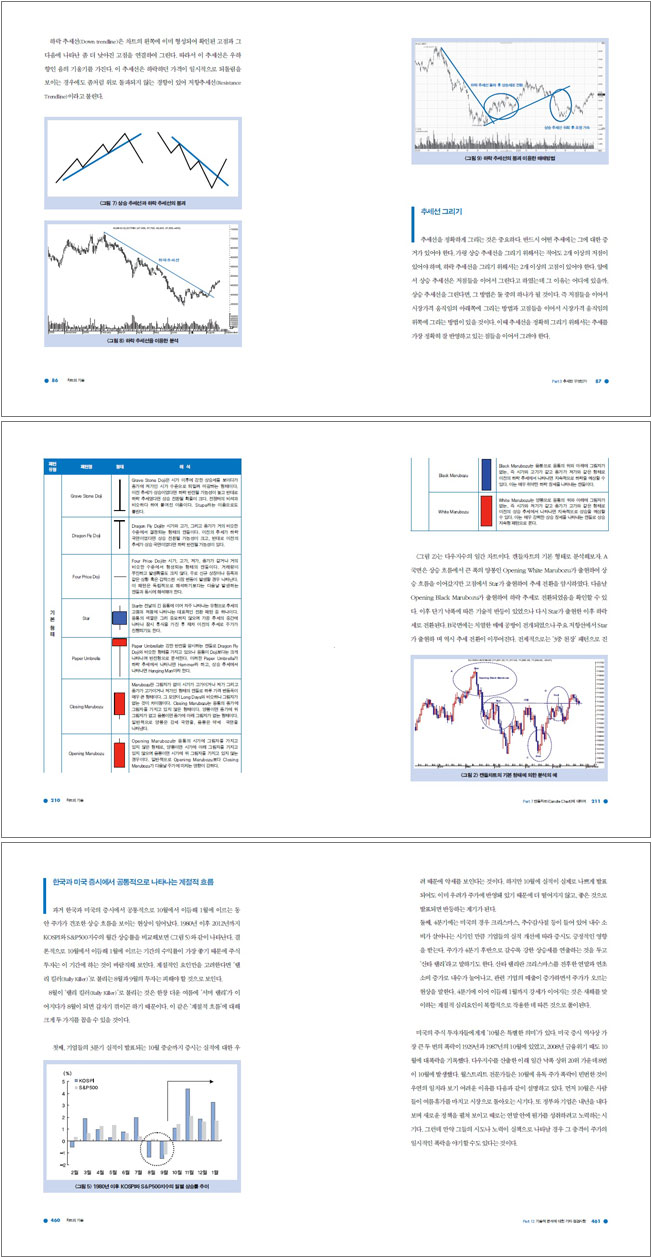
A resistance line is a market price level in the stock market where, if the market price rises above that level, the selling force is so strong that it can overwhelm the buying force.
Therefore, while the upward movement of the price is limited near the resistance line, the price movement turns downward or at least forms a consolidation phase just below the resistance line.
On the other hand, the support line is the opposite concept of the resistance line, and refers to the level at which, when the price in the stock market falls to a certain level, the buying force in response is strong enough to overwhelm the selling force.
Therefore, the downward price trend near the support line is supported, and the price movement turns upward or at least forms a consolidation phase just above the support line.
---「「Part 2.
Chart Creation and Lines: Support and Resistance Lines
When drawing a trend line, it should not be drawn by simply connecting the closing prices of the day. It should be drawn so that it includes all market price movements of the day, that is, both the lowest and highest points of the day.
However, when actually drawing a trend line, there are times when the market price during the day briefly deviates from the trend line.
This is the most difficult time for technical analysts to judge, as they face the dilemma of whether to revise the existing trend line and redraw it, or to ignore it as a temporary movement (false breakout).
The best way at this time would be to draw a new trend line when the existing trend line is broken, and then observe the subsequent market price movements to select one of them.
However, even if the price moves by breaking through the trend line, it is very difficult to immediately determine whether it is a true change in trend or a temporary breakout that will soon resume its previous movement.
At this time, there must be a standard to determine whether there has been a change in the existing trend.
---「「Part 3.
What is a Trend?: Using Trend Lines and Responding to Breakouts
Even if psychological analysis doesn't allow you to time your trades accurately, it can at least help you develop a broader perspective on market trends.
If you blindly listen to other people's opinions, you're more likely to follow the majority's lead and enter into trades late, potentially incurring losses. However, utilizing psychological analysis allows you to gauge market sentiment on your own, preventing losses from late market entry.
On the other hand, the shortcomings of psychological analysis are pointed out as follows.
First, it is difficult to accurately gather market opinion.
The stock market or commodity futures market, which we analyze, is large in scale, requiring us to gather the opinions of a large number of people. However, it is realistically very difficult to collect the opinions of the majority of market participants.
This is because of the misconception that the more items there are, the more opportunities there will be.
However, if you are greedy and move from one sport to another like starving zebras that have found a pasture, you are likely to become prey to a skilled predator.
In behavioral finance, there is a theory called 'Choice under conflict'.
The gist of this theory is that when there are many choices, people tend to delay action or take no action at all.
In general, the increased freedom of choice makes people more anxious and confronts difficulties.
Therefore, if you are an investor who is new to stock investing, you need to narrow down your trading targets.
It is said that the number of stocks that an investor can manage is no more than five, and that a strategy of trading only three stocks is efficient.
If you can't find the right time to buy or sell a single stock, chasing after different stocks won't improve your odds.
The point is that it is more advantageous to know a small number of subjects thoroughly than to know a few subjects little by little.
---「「Part 1.
What is technical analysis? : 04.
The Usefulness of Technical Analysis
A resistance line is a market price level in the stock market where, if the market price rises above that level, the selling force is so strong that it can overwhelm the buying force.
Therefore, while the upward movement of the price is limited near the resistance line, the price movement turns downward or at least forms a consolidation phase just below the resistance line.
On the other hand, the support line is the opposite concept of the resistance line, and refers to the level at which, when the price in the stock market falls to a certain level, the buying force in response is strong enough to overwhelm the selling force.
Therefore, the downward price trend near the support line is supported, and the price movement turns upward or at least forms a consolidation phase just above the support line.
---「「Part 2.
Chart Creation and Lines: Support and Resistance Lines
When drawing a trend line, it should not be drawn by simply connecting the closing prices of the day. It should be drawn so that it includes all market price movements of the day, that is, both the lowest and highest points of the day.
However, when actually drawing a trend line, there are times when the market price during the day briefly deviates from the trend line.
This is the most difficult time for technical analysts to judge, as they face the dilemma of whether to revise the existing trend line and redraw it, or to ignore it as a temporary movement (false breakout).
The best way at this time would be to draw a new trend line when the existing trend line is broken, and then observe the subsequent market price movements to select one of them.
However, even if the price moves by breaking through the trend line, it is very difficult to immediately determine whether it is a true change in trend or a temporary breakout that will soon resume its previous movement.
At this time, there must be a standard to determine whether there has been a change in the existing trend.
---「「Part 3.
What is a Trend?: Using Trend Lines and Responding to Breakouts
Even if psychological analysis doesn't allow you to time your trades accurately, it can at least help you develop a broader perspective on market trends.
If you blindly listen to other people's opinions, you're more likely to follow the majority's lead and enter into trades late, potentially incurring losses. However, utilizing psychological analysis allows you to gauge market sentiment on your own, preventing losses from late market entry.
On the other hand, the shortcomings of psychological analysis are pointed out as follows.
First, it is difficult to accurately gather market opinion.
The stock market or commodity futures market, which we analyze, is large in scale, requiring us to gather the opinions of a large number of people. However, it is realistically very difficult to collect the opinions of the majority of market participants.
---「Part 4.
Investment Sentiment Analysis and Stock Price Cycle Patterns: 03.
Pros and Cons of Psychoanalysis
Investment Sentiment Analysis and Stock Price Cycle Patterns: 03.
Pros and Cons of Psychoanalysis
Publisher's Review
Revised and Expanded Edition of the Bestseller in Technical Analysis, "The Art of Charting"
A book that serves as a compass to keep investors safe and keep them focused on their investments.
A Guide to Authentic Technical Analysis Explained by Top Analysts
As with any law of life, there are winners and losers in the stock market.
What is the difference between winners and losers?
It depends on whether you have learned the language of the market or not.
Technical analysis is a representative market language.
Based on over 20 years of practical and analytical experience in the field, "Chart Technology," which explains the history and theory of technical analysis through practical examples, has returned in a revised and expanded edition in 2013.
The author of this book, Kim Jeong-hwan, is currently in charge of investment strategy at Daewoo Securities Research Center, where he has worked on market analysis (technical analysis), small-cap, and holding company analysis.
He was selected as the best analyst by the Chosun Ilbo, Maeil Business Newspaper, Korea Economic Daily, and Herald Business Newspaper in 2001-2004 and 2010-2011.
My favorite author, André Kostolany, says, “The most important virtue of an investor is imagination.” His mottos include “Be humble before stocks” and “The market is always right.”
In recent years, the stock market has been going through difficult times due to the prolonged European fiscal crisis and the deepening global economic downturn.
The market is unfolding in a completely different way than it did six years ago when this book came out.
The stock market is evolving in a variety of ways without investors realizing it.
To make a profit in the stock market, you need an objective perspective above all else.
If you can master the basic theories and apply them to objectively interpret market signals, you will become a great investor.
In "The Art of Charting," the author uses a variety of domestic and international investment cases and extensive knowledge of Eastern and Western humanities to explain the concepts in a way that anyone can easily understand.
Psychological analysis, which has recently been gaining attention as a third analysis method following fundamental and technical analysis, is explained through case studies to enhance readers' understanding.
In particular, it introduces various theories such as behavioral finance and behavioral science theory.
Additionally, by adding current actual charts, comparative analysis of past and present data is possible.
A Textbook of Technical Analysis Recommended by a Country Doctor
“This book will undoubtedly become an important reference point in the history of technical analysis in Korea.
“This is a must-read textbook for investors.”
-Country doctor Park Gyeong-cheol
In the stock market, as in life, there are winners and losers.
What's interesting is that the stock market often moves in the opposite direction of human nature.
To understand this, you need to learn the language of the market.
In other words, the language of the stock market is technical analysis.
The advantage of technical analysis is that it allows you to identify the cyclical nature of the market and freely and meticulously select and focus on a method that suits you from among various analytical tools.
Additionally, by looking at the "big picture" in stock investing, you can analyze all markets, gain a better sense of how the market moves overall, and avoid the "narrow perspective" that comes from chasing only one outcome.
Technical analysis is the study of stock and market movements.
"Chart Technology" provides an easy-to-understand explanation of all the analytical tools used in technical analysis.
It provides useful information that you must know in technical analysis, including chart creation and analysis using lines, trends, moving averages, pattern analysis, indicator analysis, and candlestick charts.
However, many investors are under the illusion that anyone can do technical analysis and that they are actually good at it.
However, in reality, in the absence of proper investment guidance, many investors are entering the battlefield of the stock market almost defenseless.
Accordingly, "Chart Technology" is a book that serves as a compass to keep investors safe and keep them focused on their investments.
This book, "Chart Techniques," written by a top analyst, explains all the concepts of technical analysis and concludes with trading strategies and principles, making it a valuable guide to authentic technical analysis.
Explore the investment methods and history of technical analysis masters.
The first technical analysts of the early 20th century include Charles Dow and William Hamilton, editor of the Wall Street Journal.
After the Great Crash of 1929, he created a wave of chart analysis through his editorial titled "Trend Reversal."
Additionally, the innovative technical analysts who led the era called the golden age of charts in the 1930s, such as Shabaker, Lea, and Elliott, viewed charts as a record of supply and demand in the market.
It provides an interesting explanation of actual analysis cases by Louis Yamada, the most famous technical analyst in the U.S. today who advocated the '4-year cycle theory' of the U.S. stock market; Barton Biggs, who developed Morgan Stanley into a global investment firm; and Hidenobu Sasaki, Japan's top technical analyst.
The author presents the Dow Theory, which can be said to be the beginning of technical analysis, the Elliott Wave Theory, which is the core of technical analysis, and the Ichimoku Kinko Hyo, and explains only the essentials, from the basic concepts of each theory to trading strategies, through extensive knowledge and practical examples based on the author's experience.
Based on over 20 years of practical experience and analytical knowledge in the field, I am explaining the theory of technical analysis through practical examples.
The history of technical analysis and the investment methods of renowned experts are explained in an easily understandable manner, using diverse domestic and international investment cases and extensive knowledge of Eastern and Western humanities.
We will focus on psychological analysis, which is emerging as a third analytical method.
People identify with others by acting like the crowd.
When you are in a crowd, you feel safe and your existence as an individual is not revealed.
This behavior based on crowd psychology brought about unpredictable results.
The stock market is no exception; human psychology reacting to price changes follows certain laws.
Edwin Lefebvre's 1923 book, "Reminiscences of a Stockbroker," which explores the behavior of crowds, is an important source of contrarian thinking.
Alexander Elder, who pioneered a new field in technical analysis, empirically analyzes the importance of individual and group psychology in stock investment through "The Psychological Law of Investment."
In "Chart Technology," psychological analysis, which has recently gained popularity as a third analytical method following fundamental and technical analysis, is explained through case studies to enhance readers' understanding.
It clearly shows the influence of human psychology on stock prices, including analysis of investment sentiment and the shape of stock price cycles, the concept of contrarian analysis and key indicators, and the limit cycle of price and emotion.
Even if psychological analysis doesn't allow you to pinpoint the exact timing of a trade, it can at least help you develop a broader perspective on the flow of time.
In other words, by understanding the market sentiment, you can prevent the risk of loss due to late market participation.
This book introduces various theories, including behavioral finance and behavioral science, to easily explain all the analysis methods necessary for stock investment.
This book will undoubtedly become an important benchmark in the history of Korean technical analysis, and is a must-read for investors.
A book that serves as a compass to keep investors safe and keep them focused on their investments.
A Guide to Authentic Technical Analysis Explained by Top Analysts
As with any law of life, there are winners and losers in the stock market.
What is the difference between winners and losers?
It depends on whether you have learned the language of the market or not.
Technical analysis is a representative market language.
Based on over 20 years of practical and analytical experience in the field, "Chart Technology," which explains the history and theory of technical analysis through practical examples, has returned in a revised and expanded edition in 2013.
The author of this book, Kim Jeong-hwan, is currently in charge of investment strategy at Daewoo Securities Research Center, where he has worked on market analysis (technical analysis), small-cap, and holding company analysis.
He was selected as the best analyst by the Chosun Ilbo, Maeil Business Newspaper, Korea Economic Daily, and Herald Business Newspaper in 2001-2004 and 2010-2011.
My favorite author, André Kostolany, says, “The most important virtue of an investor is imagination.” His mottos include “Be humble before stocks” and “The market is always right.”
In recent years, the stock market has been going through difficult times due to the prolonged European fiscal crisis and the deepening global economic downturn.
The market is unfolding in a completely different way than it did six years ago when this book came out.
The stock market is evolving in a variety of ways without investors realizing it.
To make a profit in the stock market, you need an objective perspective above all else.
If you can master the basic theories and apply them to objectively interpret market signals, you will become a great investor.
In "The Art of Charting," the author uses a variety of domestic and international investment cases and extensive knowledge of Eastern and Western humanities to explain the concepts in a way that anyone can easily understand.
Psychological analysis, which has recently been gaining attention as a third analysis method following fundamental and technical analysis, is explained through case studies to enhance readers' understanding.
In particular, it introduces various theories such as behavioral finance and behavioral science theory.
Additionally, by adding current actual charts, comparative analysis of past and present data is possible.
A Textbook of Technical Analysis Recommended by a Country Doctor
“This book will undoubtedly become an important reference point in the history of technical analysis in Korea.
“This is a must-read textbook for investors.”
-Country doctor Park Gyeong-cheol
In the stock market, as in life, there are winners and losers.
What's interesting is that the stock market often moves in the opposite direction of human nature.
To understand this, you need to learn the language of the market.
In other words, the language of the stock market is technical analysis.
The advantage of technical analysis is that it allows you to identify the cyclical nature of the market and freely and meticulously select and focus on a method that suits you from among various analytical tools.
Additionally, by looking at the "big picture" in stock investing, you can analyze all markets, gain a better sense of how the market moves overall, and avoid the "narrow perspective" that comes from chasing only one outcome.
Technical analysis is the study of stock and market movements.
"Chart Technology" provides an easy-to-understand explanation of all the analytical tools used in technical analysis.
It provides useful information that you must know in technical analysis, including chart creation and analysis using lines, trends, moving averages, pattern analysis, indicator analysis, and candlestick charts.
However, many investors are under the illusion that anyone can do technical analysis and that they are actually good at it.
However, in reality, in the absence of proper investment guidance, many investors are entering the battlefield of the stock market almost defenseless.
Accordingly, "Chart Technology" is a book that serves as a compass to keep investors safe and keep them focused on their investments.
This book, "Chart Techniques," written by a top analyst, explains all the concepts of technical analysis and concludes with trading strategies and principles, making it a valuable guide to authentic technical analysis.
Explore the investment methods and history of technical analysis masters.
The first technical analysts of the early 20th century include Charles Dow and William Hamilton, editor of the Wall Street Journal.
After the Great Crash of 1929, he created a wave of chart analysis through his editorial titled "Trend Reversal."
Additionally, the innovative technical analysts who led the era called the golden age of charts in the 1930s, such as Shabaker, Lea, and Elliott, viewed charts as a record of supply and demand in the market.
It provides an interesting explanation of actual analysis cases by Louis Yamada, the most famous technical analyst in the U.S. today who advocated the '4-year cycle theory' of the U.S. stock market; Barton Biggs, who developed Morgan Stanley into a global investment firm; and Hidenobu Sasaki, Japan's top technical analyst.
The author presents the Dow Theory, which can be said to be the beginning of technical analysis, the Elliott Wave Theory, which is the core of technical analysis, and the Ichimoku Kinko Hyo, and explains only the essentials, from the basic concepts of each theory to trading strategies, through extensive knowledge and practical examples based on the author's experience.
Based on over 20 years of practical experience and analytical knowledge in the field, I am explaining the theory of technical analysis through practical examples.
The history of technical analysis and the investment methods of renowned experts are explained in an easily understandable manner, using diverse domestic and international investment cases and extensive knowledge of Eastern and Western humanities.
We will focus on psychological analysis, which is emerging as a third analytical method.
People identify with others by acting like the crowd.
When you are in a crowd, you feel safe and your existence as an individual is not revealed.
This behavior based on crowd psychology brought about unpredictable results.
The stock market is no exception; human psychology reacting to price changes follows certain laws.
Edwin Lefebvre's 1923 book, "Reminiscences of a Stockbroker," which explores the behavior of crowds, is an important source of contrarian thinking.
Alexander Elder, who pioneered a new field in technical analysis, empirically analyzes the importance of individual and group psychology in stock investment through "The Psychological Law of Investment."
In "Chart Technology," psychological analysis, which has recently gained popularity as a third analytical method following fundamental and technical analysis, is explained through case studies to enhance readers' understanding.
It clearly shows the influence of human psychology on stock prices, including analysis of investment sentiment and the shape of stock price cycles, the concept of contrarian analysis and key indicators, and the limit cycle of price and emotion.
Even if psychological analysis doesn't allow you to pinpoint the exact timing of a trade, it can at least help you develop a broader perspective on the flow of time.
In other words, by understanding the market sentiment, you can prevent the risk of loss due to late market participation.
This book introduces various theories, including behavioral finance and behavioral science, to easily explain all the analysis methods necessary for stock investment.
This book will undoubtedly become an important benchmark in the history of Korean technical analysis, and is a must-read for investors.
GOODS SPECIFICS
- Date of publication: June 20, 2013
- Page count, weight, size: 496 pages | 848g | 170*225*30mm
- ISBN13: 9788991998827
- ISBN10: 8991998828
You may also like
카테고리
korean


korean

![ELLE 엘르 스페셜 에디션 A형 : 12월 [2025]](http://librairie.coreenne.fr/cdn/shop/files/b8e27a3de6c9538896439686c6b0e8fb.jpg?v=1766436872&width=3840)


