

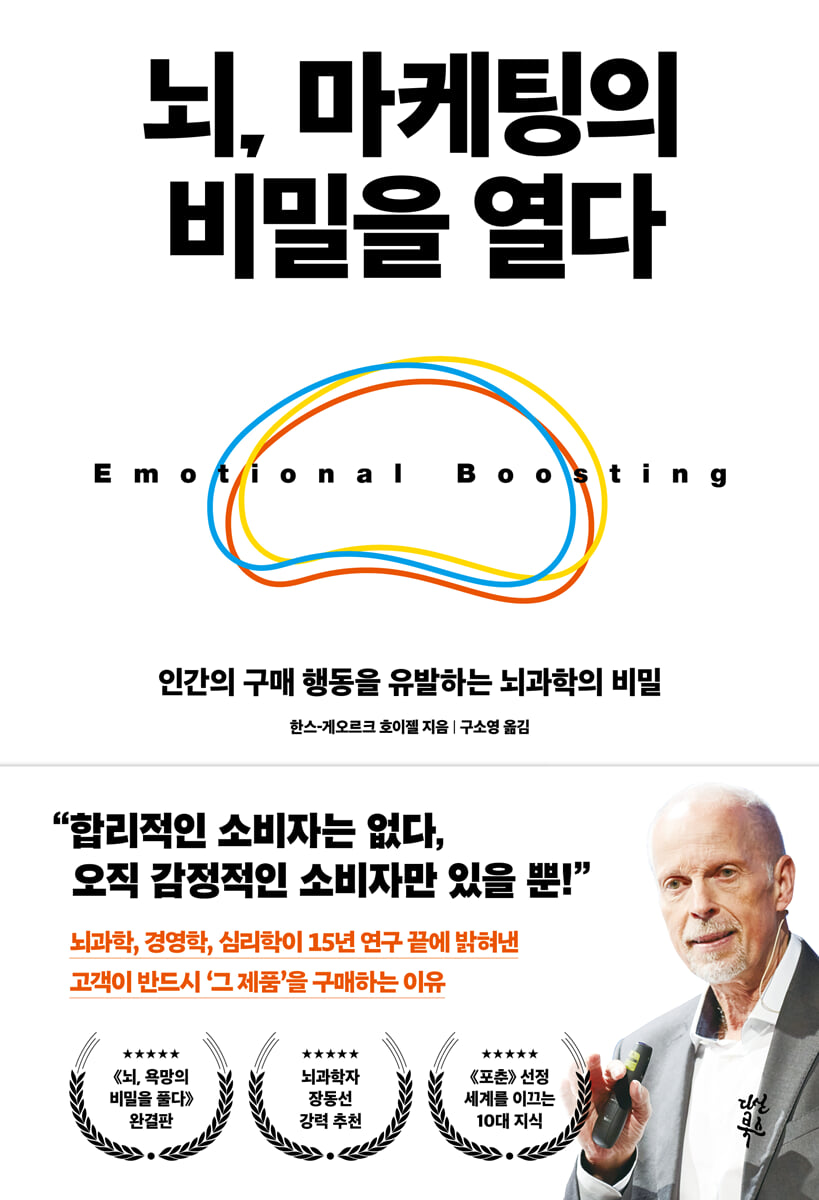
The Brain Unlocks the Secrets of Marketing
 |
Description
Book Introduction
“There is no rational consumer,
“There are only emotional consumers!”
Europe's top economist and psychologist has revealed this after 15 years of research.
Why Customers Definitely Buy 'That Product'
Apple, Nike, and Coca-Cola also have a way of eliciting the desires of their chosen consumers!
- The Complete Edition of "The Brain, Unraveling the Secrets of Desire"
- Neuroscientist Jang Dong-seon strongly recommends Joo Eon-gyu (Shin Saimdang)
- Fortune's Top 10 World-Leading Knowledge
Want to generate high sales regardless of the recession? Want to discover a marketing formula that works every time? Dr. Hans-Georg Heusel, a leading authority on neuromarketing and a marketing and branding advisor to leading global companies, has spent years researching this issue and developed a powerful marketing technique called "emotional enhancement."
It is an innovative marketing strategy that understands and utilizes consumers' thoughts and judgments to push the numerous purchase buttons in their minds.
The emotion system developed by Dr. Heusel allows us to interpret human innate tendencies and desires by categorizing them into three types: stimulation, control, and balance, thus helping us to clearly understand human consumption psychology, which has been vaguely assumed until now.
If the product you're trying to sell is an expensive luxury item, you'll need to target either the sensationalist consumer who wants to be different and new, or the controlling consumer who wants to show off their influence.
Conversely, when marketing reasonably priced functional products, you should target the stability-oriented, balanced type of consumer.
Neuromarketing has emerged as a mainstream marketing strategy in the market due to the remarkable effectiveness of systematic consumer analysis and corresponding marketing strategies.
Even amidst the recent global recession, companies like Apple and Nike, which have utilized neuromarketing, are achieving higher sales than before, and global companies are rushing to adopt this strategy.
If you're a marketer struggling with sales or persistently low sales, this book will hold the key to success.
“There are only emotional consumers!”
Europe's top economist and psychologist has revealed this after 15 years of research.
Why Customers Definitely Buy 'That Product'
Apple, Nike, and Coca-Cola also have a way of eliciting the desires of their chosen consumers!
- The Complete Edition of "The Brain, Unraveling the Secrets of Desire"
- Neuroscientist Jang Dong-seon strongly recommends Joo Eon-gyu (Shin Saimdang)
- Fortune's Top 10 World-Leading Knowledge
Want to generate high sales regardless of the recession? Want to discover a marketing formula that works every time? Dr. Hans-Georg Heusel, a leading authority on neuromarketing and a marketing and branding advisor to leading global companies, has spent years researching this issue and developed a powerful marketing technique called "emotional enhancement."
It is an innovative marketing strategy that understands and utilizes consumers' thoughts and judgments to push the numerous purchase buttons in their minds.
The emotion system developed by Dr. Heusel allows us to interpret human innate tendencies and desires by categorizing them into three types: stimulation, control, and balance, thus helping us to clearly understand human consumption psychology, which has been vaguely assumed until now.
If the product you're trying to sell is an expensive luxury item, you'll need to target either the sensationalist consumer who wants to be different and new, or the controlling consumer who wants to show off their influence.
Conversely, when marketing reasonably priced functional products, you should target the stability-oriented, balanced type of consumer.
Neuromarketing has emerged as a mainstream marketing strategy in the market due to the remarkable effectiveness of systematic consumer analysis and corresponding marketing strategies.
Even amidst the recent global recession, companies like Apple and Nike, which have utilized neuromarketing, are achieving higher sales than before, and global companies are rushing to adopt this strategy.
If you're a marketer struggling with sales or persistently low sales, this book will hold the key to success.
- You can preview some of the book's contents.
Preview
index
To Korean readers
Introduction - We buy what our brain likes, necessarily.
Chapter 1: Why Only Emotions Can Create Value
Chapter 2: How the Emotional Brain Functions
Chapter 3: Brands, Intrinsic Values and Motivations Perceived by Customers
Chapter 4: Design: Creating Products Where Small Differences Stand Out
Chapter 5: Five Emotional Types of Commerce and Shopping
Chapter 6: Optimizing the User Experience for Online Shopping
Chapter 7: Service: How to Meet Diverse Expectations
Chapter 8: Tailored Customer Strategies: Captivating Your Target Audience
Chapter 9: B2B: Engineers Are People Too
Chapter 10: Emotional Strengthening Strategies Using Customers and Employees
Appendix - Emotional Strengthening Strategies Checklist
Recommended books
Introduction - We buy what our brain likes, necessarily.
Chapter 1: Why Only Emotions Can Create Value
Chapter 2: How the Emotional Brain Functions
Chapter 3: Brands, Intrinsic Values and Motivations Perceived by Customers
Chapter 4: Design: Creating Products Where Small Differences Stand Out
Chapter 5: Five Emotional Types of Commerce and Shopping
Chapter 6: Optimizing the User Experience for Online Shopping
Chapter 7: Service: How to Meet Diverse Expectations
Chapter 8: Tailored Customer Strategies: Captivating Your Target Audience
Chapter 9: B2B: Engineers Are People Too
Chapter 10: Emotional Strengthening Strategies Using Customers and Employees
Appendix - Emotional Strengthening Strategies Checklist
Recommended books
Detailed image

Into the book
What is the greatest force that has moved, is moving, and will move humanity throughout all of history, past, present, and future? Something greater than fame, power, or money: emotion.
Emotions are the greatest driving force and purpose of human behavior.
We might think that humans make decisions based on rational judgment, but you'd be surprised to learn how much we are influenced by our emotions.
In this book, I will use brain science to show how emotions influence our judgment and introduce marketing methods that can be applied to the market.
This technique is called neuromarketing and is a combination of psychology, brain science, and economics.
It can be simply summarized as marketing that strengthens the emotions in the unconscious mind of consumers.
--- p.006, from the "Preface"
Many marketing books claim that the innovator who brings a completely new product to market wins the market and takes home the golden trophy.
There is no doubt that if you have an innovative idea, you can make a lot of money.
But on the other hand, it could be a complete failure.
The marketing graveyard is full of original products and ideas that were launched at the wrong time or didn't resonate.
The few brave innovators who are lucky enough to survive in the market are naturally highlighted as the main characters in business books.
In contrast, the innovators who were not lucky, although dozens of times more numerous than the protagonist, were forgotten by the market and buried in the graveyard of marketing.
There are many companies waiting and hoping for groundbreaking ideas.
But they completely overlook the fact that there is a much more certain path to market success: emotional amplification.
--- p.035, from “Chapter 1: Why Only Emotions Can Create Value”
For example, after a young man buys an 80-kilowatt car, he immediately starts thinking, "How much better would a 120-kilowatt car be?"
What about women? A young woman who buys a new dress at H&M soon begins to notice Prada or Gucci clothes.
This 'more and more' principle is the driving force of capitalism and the driving force of consumption.
Philosophers call this tragic cycle of life the "hamster wheel of pleasure."
The reason is that we hope for more but never reach our goals.
How does this phenomenon impact emotional reinforcement strategies? The answer is simple.
Make sure the competition for VIP seats in your customers' emotional brains never ends.
Even if a product or service stimulates the emotions of customers and makes them feel good about buying it, as time passes and they become accustomed to the product, their brain no longer secretes happiness hormones, and the product they purchased is eventually overtaken by other products in competition.
What was once an emotional influence on customers' purchasing decisions just a year ago has now become the market standard.
--- p.055, from “Chapter 2 How the Emotional Brain Functions”
Let's start with the fashion of the balance system.
The concept of 'fashion in vogue' will come into play.
What kind of fashion does this mean? It's a style that's widely displayed in discount clothing stores and easily seen on the streets.
This is a fashion mainly sought after by consumers who want to dress neatly but do not want to stand out.
Next, following the stimulus system, 'modern fashion' appears.
This is a new but not entirely unfamiliar fashion, inspired by the runways of Paris and London and applied to everyday life.
It is a fashion chosen by consumers who are looking for a style that is unique and expresses individuality, but is also somewhat accepted by the general public.
The stimulus system is mainly centered around 'unusual fashion'.
This is a fashion that is trendy and attracts attention for its unique personality.
However, it takes courage to wear this fashion because it is often shunned by the public.
Those who want to stand out can go one step further and try 'provocative fashion' that puts them in the realm of adventure.
Next, the fashion of the ruling system is characterized by the 'beauty of success and status'.
For men, this includes expensive suits and designer ties, and for women, it includes designer accessories with luxurious designs.
Fashion in this area socially expresses the desire to be recognized as high-status and powerful.
Additionally, people who prefer this fashion have a deep knowledge of fashion and pay attention to details to show off their status.
--- p.100~101, from “Chapter 3 Brand, Inner Value and Motivation Perceived by Customers”
If a wine store only has two types of wine on its shelves: a 10,000 won wine and a 30,000 won wine, 85% of customers will choose the cheaper 10,000 won wine.
But if you add another 60,000 won wine to the shelf, it's a completely different story.
The percentage of customers purchasing a 10,000 won wine drops to 70%, a 30,000 won wine is chosen by 28% of customers, and the remaining 2% buy the most expensive wine.
By setting different price points, wine stores were able to significantly increase customer purchases.
The reason this method works is because our brains are influenced by the reference price and tend to choose the middle value.
If there is a choice between an expensive product and a cheap product, customers will choose the cheap product, but when there are three choices, the situation changes.
Because of the newly added more expensive wines, wines that were originally perceived as expensive will unconsciously not feel so expensive, attracting attention.
Moreover, our brain tries to choose the middle ground, thinking, 'If it's a mid-priced product, it must be safe.'
--- p.190~192, from “Chapter 5: Five Emotional Types of Commerce and Shopping”
So what exactly is a "service that demonstrates interest"? The principle is relatively simple.
It refers to a service that gives the impression that the company or service treats the customer as a person and is genuinely interested in the customer's problems or requests.
In service industries where there is a lot of personal contact with customers, such as doctors, hairdressers, and artisans, this need can be met relatively easily, but in businesses with thousands or even millions of customers, there is a risk of simply assigning numbers to customers.
But there are also large companies that serve as models of 'service that shows interest'.
Let's take a look at the electricity supplier 'Yello Strom'.
Yellow Sturm values the principle of treating customers as important individuals, not just numbers.
It is especially significant for telephone counseling centers that directly respond to customers.
Customers ask questions, get answers, and apply for or cancel products or services over the phone.
While other companies' phone representatives are typically trained to answer customer questions and convey information effectively, Yellow Sturm's staff are trained to add a personal touch to conversations.
For example, “I hear a dog barking behind me.
Start with a short, personal conversation, asking, "What's your dog's name? What kind is it?"
We also consider it one of our service philosophies to be genuinely interested in our customers' problems and provide prompt feedback.
As a result, customers perceive Yellowstrom as a "friendly, humane, and caring company."
--- p.230~231, from “Chapter 7 Service: How to Satisfy All Diverse Expectations”
Soon after, the Limbic® approach was adopted by banks in their direct marketing efforts.
A consistent strategy for all customers may work a little for everyone, but it won't work perfectly for anyone.
Retirement planning products are particularly important for banks.
The main promotional slogan used for all customers is, "Join now and you can have peace of mind even after retirement."
First, we conducted a short workshop with retirement product managers to understand the internal emotional structure of pension products.
Although pensions are inherently a product that seeks balance, this alone is not enough to fully understand the emotional structure inherent in the product.
Customers have diverse motivations for enrolling in pension plans. They may be looking into products to "enjoy their retirement," worry about needing nursing care, or be interested in the tax benefits and attractive investment opportunities.
In addition to various motivations, we also analyzed savings and investment habits by Limbicⓡ type.
Hedonistic and adventurous customers are reluctant to commit to long-term contracts because they fear that life will bring temptations, while traditional, disciplined, and performance-oriented customers are more open to long-term contracts.
Based on these motivations and savings and investment habits, we established a basic product promotion direction and produced four types of promotional materials to be mailed.
Each promotional material was produced with very different images and text.
● Promotional materials targeting performance-oriented customers presented strategic aspects based on the product's basic functions, while also emphasizing that it is possible to lead a high-quality life even in old age.
● Promotional materials targeting open-minded, hedonistic, and adventurous customers emphasized that the savings can be used at any time and that the product allows them to prepare for retirement without financial constraints.
● Promotional materials targeting harmonious, traditional, and disciplined customers focused on a stable and comfortable retirement.
Bankers are good with numbers and are adept at using this ability to control situations.
So I wanted to know whether it was economically beneficial to try to 'type' customers.
To address the issue, we sent promotional material to some customers in the traditional way.
As a result, the response rate of customers who received promotional materials tailored to their type was 30% higher than that of customers who received promotional materials sent in bulk.
Emotions are the greatest driving force and purpose of human behavior.
We might think that humans make decisions based on rational judgment, but you'd be surprised to learn how much we are influenced by our emotions.
In this book, I will use brain science to show how emotions influence our judgment and introduce marketing methods that can be applied to the market.
This technique is called neuromarketing and is a combination of psychology, brain science, and economics.
It can be simply summarized as marketing that strengthens the emotions in the unconscious mind of consumers.
--- p.006, from the "Preface"
Many marketing books claim that the innovator who brings a completely new product to market wins the market and takes home the golden trophy.
There is no doubt that if you have an innovative idea, you can make a lot of money.
But on the other hand, it could be a complete failure.
The marketing graveyard is full of original products and ideas that were launched at the wrong time or didn't resonate.
The few brave innovators who are lucky enough to survive in the market are naturally highlighted as the main characters in business books.
In contrast, the innovators who were not lucky, although dozens of times more numerous than the protagonist, were forgotten by the market and buried in the graveyard of marketing.
There are many companies waiting and hoping for groundbreaking ideas.
But they completely overlook the fact that there is a much more certain path to market success: emotional amplification.
--- p.035, from “Chapter 1: Why Only Emotions Can Create Value”
For example, after a young man buys an 80-kilowatt car, he immediately starts thinking, "How much better would a 120-kilowatt car be?"
What about women? A young woman who buys a new dress at H&M soon begins to notice Prada or Gucci clothes.
This 'more and more' principle is the driving force of capitalism and the driving force of consumption.
Philosophers call this tragic cycle of life the "hamster wheel of pleasure."
The reason is that we hope for more but never reach our goals.
How does this phenomenon impact emotional reinforcement strategies? The answer is simple.
Make sure the competition for VIP seats in your customers' emotional brains never ends.
Even if a product or service stimulates the emotions of customers and makes them feel good about buying it, as time passes and they become accustomed to the product, their brain no longer secretes happiness hormones, and the product they purchased is eventually overtaken by other products in competition.
What was once an emotional influence on customers' purchasing decisions just a year ago has now become the market standard.
--- p.055, from “Chapter 2 How the Emotional Brain Functions”
Let's start with the fashion of the balance system.
The concept of 'fashion in vogue' will come into play.
What kind of fashion does this mean? It's a style that's widely displayed in discount clothing stores and easily seen on the streets.
This is a fashion mainly sought after by consumers who want to dress neatly but do not want to stand out.
Next, following the stimulus system, 'modern fashion' appears.
This is a new but not entirely unfamiliar fashion, inspired by the runways of Paris and London and applied to everyday life.
It is a fashion chosen by consumers who are looking for a style that is unique and expresses individuality, but is also somewhat accepted by the general public.
The stimulus system is mainly centered around 'unusual fashion'.
This is a fashion that is trendy and attracts attention for its unique personality.
However, it takes courage to wear this fashion because it is often shunned by the public.
Those who want to stand out can go one step further and try 'provocative fashion' that puts them in the realm of adventure.
Next, the fashion of the ruling system is characterized by the 'beauty of success and status'.
For men, this includes expensive suits and designer ties, and for women, it includes designer accessories with luxurious designs.
Fashion in this area socially expresses the desire to be recognized as high-status and powerful.
Additionally, people who prefer this fashion have a deep knowledge of fashion and pay attention to details to show off their status.
--- p.100~101, from “Chapter 3 Brand, Inner Value and Motivation Perceived by Customers”
If a wine store only has two types of wine on its shelves: a 10,000 won wine and a 30,000 won wine, 85% of customers will choose the cheaper 10,000 won wine.
But if you add another 60,000 won wine to the shelf, it's a completely different story.
The percentage of customers purchasing a 10,000 won wine drops to 70%, a 30,000 won wine is chosen by 28% of customers, and the remaining 2% buy the most expensive wine.
By setting different price points, wine stores were able to significantly increase customer purchases.
The reason this method works is because our brains are influenced by the reference price and tend to choose the middle value.
If there is a choice between an expensive product and a cheap product, customers will choose the cheap product, but when there are three choices, the situation changes.
Because of the newly added more expensive wines, wines that were originally perceived as expensive will unconsciously not feel so expensive, attracting attention.
Moreover, our brain tries to choose the middle ground, thinking, 'If it's a mid-priced product, it must be safe.'
--- p.190~192, from “Chapter 5: Five Emotional Types of Commerce and Shopping”
So what exactly is a "service that demonstrates interest"? The principle is relatively simple.
It refers to a service that gives the impression that the company or service treats the customer as a person and is genuinely interested in the customer's problems or requests.
In service industries where there is a lot of personal contact with customers, such as doctors, hairdressers, and artisans, this need can be met relatively easily, but in businesses with thousands or even millions of customers, there is a risk of simply assigning numbers to customers.
But there are also large companies that serve as models of 'service that shows interest'.
Let's take a look at the electricity supplier 'Yello Strom'.
Yellow Sturm values the principle of treating customers as important individuals, not just numbers.
It is especially significant for telephone counseling centers that directly respond to customers.
Customers ask questions, get answers, and apply for or cancel products or services over the phone.
While other companies' phone representatives are typically trained to answer customer questions and convey information effectively, Yellow Sturm's staff are trained to add a personal touch to conversations.
For example, “I hear a dog barking behind me.
Start with a short, personal conversation, asking, "What's your dog's name? What kind is it?"
We also consider it one of our service philosophies to be genuinely interested in our customers' problems and provide prompt feedback.
As a result, customers perceive Yellowstrom as a "friendly, humane, and caring company."
--- p.230~231, from “Chapter 7 Service: How to Satisfy All Diverse Expectations”
Soon after, the Limbic® approach was adopted by banks in their direct marketing efforts.
A consistent strategy for all customers may work a little for everyone, but it won't work perfectly for anyone.
Retirement planning products are particularly important for banks.
The main promotional slogan used for all customers is, "Join now and you can have peace of mind even after retirement."
First, we conducted a short workshop with retirement product managers to understand the internal emotional structure of pension products.
Although pensions are inherently a product that seeks balance, this alone is not enough to fully understand the emotional structure inherent in the product.
Customers have diverse motivations for enrolling in pension plans. They may be looking into products to "enjoy their retirement," worry about needing nursing care, or be interested in the tax benefits and attractive investment opportunities.
In addition to various motivations, we also analyzed savings and investment habits by Limbicⓡ type.
Hedonistic and adventurous customers are reluctant to commit to long-term contracts because they fear that life will bring temptations, while traditional, disciplined, and performance-oriented customers are more open to long-term contracts.
Based on these motivations and savings and investment habits, we established a basic product promotion direction and produced four types of promotional materials to be mailed.
Each promotional material was produced with very different images and text.
● Promotional materials targeting performance-oriented customers presented strategic aspects based on the product's basic functions, while also emphasizing that it is possible to lead a high-quality life even in old age.
● Promotional materials targeting open-minded, hedonistic, and adventurous customers emphasized that the savings can be used at any time and that the product allows them to prepare for retirement without financial constraints.
● Promotional materials targeting harmonious, traditional, and disciplined customers focused on a stable and comfortable retirement.
Bankers are good with numbers and are adept at using this ability to control situations.
So I wanted to know whether it was economically beneficial to try to 'type' customers.
To address the issue, we sent promotional material to some customers in the traditional way.
As a result, the response rate of customers who received promotional materials tailored to their type was 30% higher than that of customers who received promotional materials sent in bulk.
--- p.270~271, from “Chapter 8: Customer-tailored strategies, how to capture the hearts of target customers”
Publisher's Review
The answer to the question you've always wanted to know: "Why does it sell?"
Let's look around.
How many of the things we buy are actually necessary?
We are surrounded by things we bought because they were useless but pretty, to vent our frustrations after a hard day, or simply because life itself was fun.
We know we should spend wisely after rationally comparing and checking, but somehow our wallets open differently than we think.
What is it about our psychology that makes us swipe our credit cards even when we're trying not to buy? Hidden within this point, a point we've long overlooked, lies the answer to the question every marketer longs to understand: "Why do things sell?"
Dr. Hans-Georg Heusel, a German economics authority and psychologist, has studied brain science, psychology, and marketing for 15 years and has discovered that our decisions are influenced far more by emotions than by reason.
Many studies of patients with brain damage have found that patients with damage to the emotional processing areas of the brain are less able to make decisions, and that emotions play a central role in the brain.
In marketing, this finding is a revolutionary discovery.
This is because it allows us to finally understand the purchasing motivations of consumers, which we had only vaguely guessed about, and guide them in the way we want.
Anything that sells must move the emotions of the consumer.
Now, if you just know how to tap into the subconscious mind of your consumers, you can create the explosive sales you've been longing for and dreaming of.
How the World's Best Companies Drive Consumer Choice
Dr. Heusel says that emotions are sensors that tell us what we consider important and meaningful.
Therefore, in order to utilize emotions in marketing, we must first understand what system consumers' emotions follow.
Emotions are broadly divided into three main systems.
There are three systems: a balance system that seeks safety, a stimulation system that seeks novelty, and a dominance system that seeks power.
People with a developed balance system are emotionally moved by eco-friendly products like organic products or things that give a sense of trust, like the KC mark.
The type with a developed stimulation system is often an early adopter, fascinated by things they have never seen before.
The dominance system is similar to the stimulation system in that it wants to be different from others, but because it has a strong desire to be superior, it is greatly influenced by expensive or rare items that are difficult to obtain.
By examining the market through these three systems, we can understand the consumer psychology of customers along with the previously unseen power of emotions.
Luxury brands like Hermes and Gucci don't tell you how well they are made with good materials.
By simply touching the dominant system of consumers who want to be different from others, it creates higher added value than any other product.
Many people complain about the inconvenience caused by the high price policy, closed OS, and arbitrary service system, but Apple has become the world's number one company by utilizing both a balance and a stimulation system.
I.I. Combined, which owns three brands that have recently experienced explosive growth in Korea, including Gentle Monster, Tamburins, and Nudeake, has also succeeded by stimulating consumers' emotions by making them feel as if they are purchasing a work of art with its products.
Despite the remarkable success of emotional reinforcement marketing, many marketers still assume that consumers are rational.
So, we develop a marketing strategy that focuses only on discounts and features so that you can compare and judge rationally.
But as we saw earlier, there is something more important than that.
Consumers must face the fact that they are buying the emotions that products evoke.
Consumers don't just want products.
They want the brand to become one with them and for the emotions the product gives them to fill their hearts.
To achieve this, consumers are not only willing to buy the product, but also willing to pay a higher price.
A practical toolbox that will make you a better marketer.
Unlike other marketing books that focus on theory, this book is written with a focus on practice, so you can apply it immediately when needed.
It contains a variety of examples ranging from immediately applicable elements such as customer flow, displays, packaging, colors, and sounds to various industries.
Bayer, a pharmaceutical company, has found that its customers have a strong need for safety, a need for peace of mind that their drugs will not cause any harm, a system of balance.
In addition to the doctor's prescription, Bayer has created a special leaflet to provide reassurance.
It is used as a promotional tool to convey the product's advantages while also serving as a manual explaining the adverse effects.
With this simple instruction manual, Bayer more than doubled its sales.
Some companies have achieved high sales through control.
Aldi, a lifestyle shopping store, avoids displaying a wide variety of products and instead displays a carefully selected selection of quality products to avoid the confusion and uncertainty of customers who are overwhelmed by the number of choices.
The store layout was kept as neat as possible, which resulted in the image of a trustworthy store for customers, and a large number of loyal customers.
Kevin G., an American Hollywood writer and producer.
Boyd is literally the man who turned water into gold.
He met many stars and saw that they wanted to express their own individuality even in the smallest details.
He believed that even the smallest thing could generate sales if it satisfied the desire to be different from others, and based on this, he created a bottled water brand called Bling H2O.
Even though the ingredients were completely different from those of commercially available water, he planned to sell the water as a premium brand, bottled it in the highest quality crystal water bottles, and sold it only to select customers.
As a result, it was a huge success, being introduced not only at the biggest music awards in the United States but also at the Emmy Awards.
The diverse real-world marketing cases presented in this book provide valuable insights to marketers eager for new marketing tools.
The book's numerous case studies will demonstrate how to apply the concepts in real-world situations, providing readers seeking concrete solutions with the key to long-awaited success.
Let's look around.
How many of the things we buy are actually necessary?
We are surrounded by things we bought because they were useless but pretty, to vent our frustrations after a hard day, or simply because life itself was fun.
We know we should spend wisely after rationally comparing and checking, but somehow our wallets open differently than we think.
What is it about our psychology that makes us swipe our credit cards even when we're trying not to buy? Hidden within this point, a point we've long overlooked, lies the answer to the question every marketer longs to understand: "Why do things sell?"
Dr. Hans-Georg Heusel, a German economics authority and psychologist, has studied brain science, psychology, and marketing for 15 years and has discovered that our decisions are influenced far more by emotions than by reason.
Many studies of patients with brain damage have found that patients with damage to the emotional processing areas of the brain are less able to make decisions, and that emotions play a central role in the brain.
In marketing, this finding is a revolutionary discovery.
This is because it allows us to finally understand the purchasing motivations of consumers, which we had only vaguely guessed about, and guide them in the way we want.
Anything that sells must move the emotions of the consumer.
Now, if you just know how to tap into the subconscious mind of your consumers, you can create the explosive sales you've been longing for and dreaming of.
How the World's Best Companies Drive Consumer Choice
Dr. Heusel says that emotions are sensors that tell us what we consider important and meaningful.
Therefore, in order to utilize emotions in marketing, we must first understand what system consumers' emotions follow.
Emotions are broadly divided into three main systems.
There are three systems: a balance system that seeks safety, a stimulation system that seeks novelty, and a dominance system that seeks power.
People with a developed balance system are emotionally moved by eco-friendly products like organic products or things that give a sense of trust, like the KC mark.
The type with a developed stimulation system is often an early adopter, fascinated by things they have never seen before.
The dominance system is similar to the stimulation system in that it wants to be different from others, but because it has a strong desire to be superior, it is greatly influenced by expensive or rare items that are difficult to obtain.
By examining the market through these three systems, we can understand the consumer psychology of customers along with the previously unseen power of emotions.
Luxury brands like Hermes and Gucci don't tell you how well they are made with good materials.
By simply touching the dominant system of consumers who want to be different from others, it creates higher added value than any other product.
Many people complain about the inconvenience caused by the high price policy, closed OS, and arbitrary service system, but Apple has become the world's number one company by utilizing both a balance and a stimulation system.
I.I. Combined, which owns three brands that have recently experienced explosive growth in Korea, including Gentle Monster, Tamburins, and Nudeake, has also succeeded by stimulating consumers' emotions by making them feel as if they are purchasing a work of art with its products.
Despite the remarkable success of emotional reinforcement marketing, many marketers still assume that consumers are rational.
So, we develop a marketing strategy that focuses only on discounts and features so that you can compare and judge rationally.
But as we saw earlier, there is something more important than that.
Consumers must face the fact that they are buying the emotions that products evoke.
Consumers don't just want products.
They want the brand to become one with them and for the emotions the product gives them to fill their hearts.
To achieve this, consumers are not only willing to buy the product, but also willing to pay a higher price.
A practical toolbox that will make you a better marketer.
Unlike other marketing books that focus on theory, this book is written with a focus on practice, so you can apply it immediately when needed.
It contains a variety of examples ranging from immediately applicable elements such as customer flow, displays, packaging, colors, and sounds to various industries.
Bayer, a pharmaceutical company, has found that its customers have a strong need for safety, a need for peace of mind that their drugs will not cause any harm, a system of balance.
In addition to the doctor's prescription, Bayer has created a special leaflet to provide reassurance.
It is used as a promotional tool to convey the product's advantages while also serving as a manual explaining the adverse effects.
With this simple instruction manual, Bayer more than doubled its sales.
Some companies have achieved high sales through control.
Aldi, a lifestyle shopping store, avoids displaying a wide variety of products and instead displays a carefully selected selection of quality products to avoid the confusion and uncertainty of customers who are overwhelmed by the number of choices.
The store layout was kept as neat as possible, which resulted in the image of a trustworthy store for customers, and a large number of loyal customers.
Kevin G., an American Hollywood writer and producer.
Boyd is literally the man who turned water into gold.
He met many stars and saw that they wanted to express their own individuality even in the smallest details.
He believed that even the smallest thing could generate sales if it satisfied the desire to be different from others, and based on this, he created a bottled water brand called Bling H2O.
Even though the ingredients were completely different from those of commercially available water, he planned to sell the water as a premium brand, bottled it in the highest quality crystal water bottles, and sold it only to select customers.
As a result, it was a huge success, being introduced not only at the biggest music awards in the United States but also at the Emmy Awards.
The diverse real-world marketing cases presented in this book provide valuable insights to marketers eager for new marketing tools.
The book's numerous case studies will demonstrate how to apply the concepts in real-world situations, providing readers seeking concrete solutions with the key to long-awaited success.
GOODS SPECIFICS
- Date of issue: March 25, 2024
- Page count, weight, size: 332 pages | 618g | 152*224*20mm
- ISBN13: 9791130650838
- ISBN10: 1130650839
You may also like
카테고리
korean


korean

![ELLE 엘르 스페셜 에디션 A형 : 12월 [2025]](http://librairie.coreenne.fr/cdn/shop/files/b8e27a3de6c9538896439686c6b0e8fb.jpg?v=1766436872&width=3840)


