

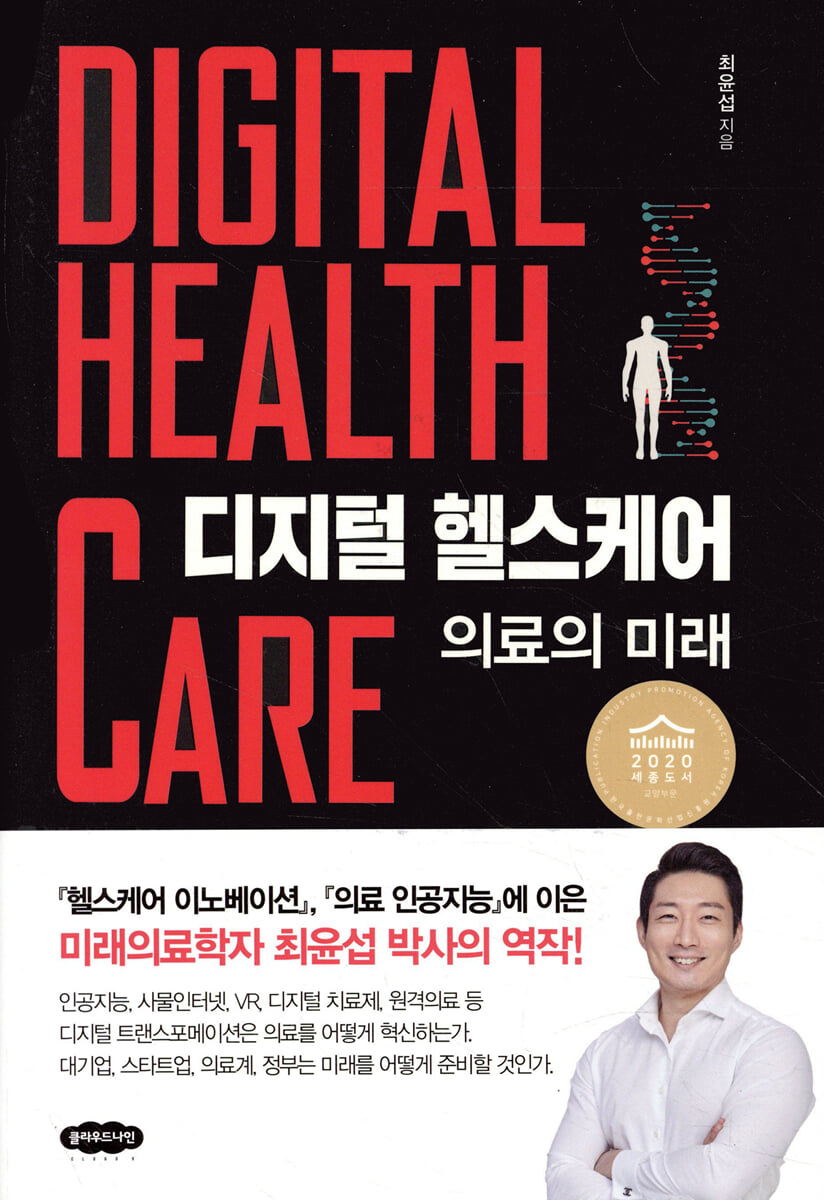
digital healthcare
 |
Description
Book Introduction
Digital innovations such as artificial intelligence, IoT, VR, and digital therapeutics How to Innovate Healthcare "Digital Healthcare: The Future of Medicine" is a comprehensive and detailed introduction to "digital healthcare," an innovative field born from the convergence of medical technology innovations such as artificial intelligence, the Internet of Things, and VR. Author Dr. Choi Yun-seop is a leading expert in the field of digital healthcare, and he was the first to introduce this field to Korea through active research, writing, and lectures. This masterpiece, written over five years and spanning over 700 pages, covers everything from the basic concepts of digital healthcare to cutting-edge technologies like medical artificial intelligence, digital therapeutics, and wearables, as well as sensitive issues like telemedicine, personal genetic information analysis, and regulatory innovation. Furthermore, it presents strategies for large corporations, pharmaceutical companies, startups, and investors to seize the opportunities of digital healthcare, along with sharp insights and specific recommendations for relevant authorities, including regulators. |
- You can preview some of the book's contents.
Preview
index
Introduction
People who helped with the writing
Part 1: Digital Healthcare is Coming
Chapter 1? In the face of the tsunami of change
· Exponential advancement of digital technology
· A tsunami of change sweeping through healthcare
· Will it change or be eliminated?
· Categories of digital healthcare
· The direction of digital healthcare
Chapter 2: Who's Leading Digital Healthcare?
· The first year of digital healthcare
· Collapsing industrial boundaries
· Startups, the protagonists of innovation
The Reality of Digital Healthcare in Korea
Chapter 3? Data, data, data!
· Human = Data
From evidence-based medicine to data-driven medicine
· Patients as a group vs.
Patient as an individual
· Data-Driven Medicine: The Case of Stanford Hospital
Chapter 4: Implementation of 4P Healthcare
· Personalized medicine
· Preventive and predictive medicine
Precision medicine
Part 2: How Digital Healthcare Is Implemented
Chapter 5: The Three Stages of Digital Healthcare
Step 1: Measure the data
Chapter 6: Smartphones: A Key Device in Healthcare Innovation
The future of healthcare is in your smartphone.
· Supercomputer vs.
smartphone
· Smartphone sensors
· Camera, doctor's eyes
· Instead of a stethoscope, a microphone
· Accelerometer and gyrometer
Apple ResearchKit, a smartphone medical research platform
· App for new drug development
· Smartphone + gadget
Chapter 7: Wearable Devices: Connecting Humans with Wearable Devices
· The era of wearable flood
· Why healthcare wearables?
· What can be measured with wearables
Activity level / heart rate / electrocardiogram / heart rate variability / body temperature / sleep / oxygen saturation / blood sugar / blood pressure / blood flow / respiratory rate / galvanic skin response / intraocular pressure / posture / medication / menstruation / air quality
Chapter 8: Everything You Need to Know About Personal Genetic Analysis
· Personal genetic information analysis
Digital technology and genetic information
The era of personal genetic information analysis
· Types of genetic information analysis
· 23andMe, a pioneer in personal genetic information analysis
· 23andMe's analysis items
· Analysis items of Pathway Genomics
Limitations of personal genetic information analysis
· Explosive increase in genetic information
· The History of DTC Through the Lens of 23andMe
(1) Created a sensation after its establishment (2006-2013)
(2) FDA's regulatory hammer (2013)
(3) Aiming for a comeback: Approval of DTC testing for carriers (2014-2015)
(4) Resumption of disease risk prediction DTC service (2017.
4)
(5) First approval of breast cancer genetic DTC service (2018.
3)
(6) Application of Pre-Cert regulations to disease risk genetic testing (2018.
6~)
Are DTC genetic tests really dangerous?
· Domestic DTC Status: Full Ban and Exceptional Permission
· Regulatory sandbox, peeing on the ground
The growing gap between global and domestic markets
Who owns my genetic information?
· From before birth to after death
Chapter 9: Digital Phenotype: Your Smartphone Knows If You're Depressed
· Digital phenotype
Your smartphone knows if you're depressed.
Mindstrong Health
· Digital phenotypes of SNS
· Identifying mental illness through Twitter
Instagram knows if you're depressed too.
· Digital phenotypes and expansion of medical data
Chapter 10: Patient-Derived Medical Data
Patient-Derived Medical Data: The Final Piece of the Puzzle
Who owns my medical data?
· Empowering patients through patient-derived data
· Implementation of participatory medicine
Step 2: Data Integration
Chapter 11: Integration of Healthcare Data
· To understand a person's health status
· The difficulty of integrating healthcare data
A platform that integrates all healthcare data.
· A journey of a thousand miles begins with a single step
Chapter 12: Healthcare Data Platforms: Apple and Validic
· Healthcare company, Apple
HealthKit, the Beginning of Apple Healthcare
· HealthKit: Integrating patient-derived medical data
Apple Health Records: Integrate your medical records
· Two major platforms in the Apple healthcare ecosystem
· Validic, a specialized healthcare data platform
· Differences from Apple HealthKit
· Vital Snap
· Current status of data platform
Chapter 13? If we collect all the data of everyone.
· Top-down research vs.
Bottom-up research
· Google Baseline Project
· All-of-Us Project
· 1 Million Wellness Project
Step 3: Data Analysis
Chapter 14? Big Data for Healthcare
· The era of data explosion
· Moneyball and Big Data in Healthcare
· A glimpse into the future of healthcare at hypermarkets
· How Target predicted customer pregnancy
Predicting asthma with big data
· Two Analysis Methods: Human and Artificial Intelligence
Chapter 15: Telemedicine: Remote Patient Monitoring
· Distinguish between telemedicine and telemedicine.
· Remote patient monitoring
· Remote monitoring of diabetic patients
· Challenges of remote patient monitoring
The need for artificial intelligence
Chapter 16: Telemedicine: Telemedicine
Telemedicine in Korea
· The growing US telemedicine market
· The uniqueness of the American healthcare system
· Telemedicine: An Alternative to a Collapsed Healthcare System?
Teladoc: America's first and largest telemedicine company
Teladoc's customers and revenue model
· The Use of Teladoc: The Case of Home Depot
· The Use of Teladoc: The Case of Rent-A-Center
· Various models of telemedicine (1): Smartphone data interpretation
· Various models of telemedicine (2): Remote second opinion
· The value of remote second opinions
· Various models of telemedicine (3): On-demand teleprescribing
· How well do telemedicine companies provide treatment?
· Study on the limitations and inaccuracy of remote dermatological consultations.
· If we train telemedicine specialists
· How to address telemedicine in Korea
· Telemedicine in Korea: A More Fundamental Problem
Chapter 17 Artificial Intelligence
· The pinnacle of digital healthcare
· Development of artificial intelligence
· Advances in deep learning
· Diagnose arrhythmia with a smartphone
· Artificial intelligence that surpasses cardiologists
· Data analysis and prediction in the intensive care unit
· Blood sugar management using artificial intelligence
Blood sugar management app using IBM Watson
· Sugar IQ Utilization Cases
The future of personalized blood sugar management
· Diet based on genetic information
Genetic information + Apple HealthKit + Watson = OME
Part 3: New Waves and Challenges in Digital Healthcare
Chapter 18? Digital Therapeutics, Another New Drug
Digital therapeutics are coming
Types of digital therapeutics
Digital Therapeutics and SaMD
· Pear Therapeutics, the first digital therapeutic
· Akili Interactive, a game for treating ADHD
· Prevent diabetes with an app
Omada Health, the largest diabetes prevention program
Noom, a weight loss and diabetes prevention startup
· Phobia treatment using VR
· VR-based PTSD treatment
Virtual Vietnam
XBOX games and Virtual Iraq
The Wizard of Oz
Treatment outcomes in Virtual Iraq
· Instead of control, VR
VR pain relief for burn patients
Applied VR, the 'VR Pharmacy'
· More digital therapeutics
Alzheimer's treatment app, DeTera Science
Depression treatment chatbot, Wobot
Sleep aid app, Big Health
· A road no one has ever walked before
Obstacle 1.
How to regulate
Obstacle 2.
Will I be eligible for insurance coverage?
Obstacle 3.
Will the doctor actually prescribe it?
Obstacle 4.
Should Patients Use Digital Therapeutics?
· The relationship between pharmaceutical companies and digital therapeutics
The future of digital therapeutics
Chapter 19: The Healthcare Wearable Dilemma: Where Is the Breakthrough?
Is the era of wearables over?
Valley of Death
Where is the breakthrough in wearables?
Will you go back?
The Healthcare Wearable Dilemma
· Do wearables really need to be accurate?
The most accurate wearable
Do wearables really need to be accurate?
· Sustained Usability: The Biggest Challenge for Wearables
Wearables: How Long Do They Last?
Fitbit active users
Two ways to solve the problem
Get lost in old habits
Apple Watch's high level of continuous usability
Is the Apple Watch a smartwatch?
Limitations of utilizing existing behaviors
Why Google Glass Failed: Its Confidence
Diabetes Paradox
What Determines Sustained Usability
· Wearables: How Will They Provide Utility?
Measurement alone is not enough
My Sleep Monitor (1) Aura Ring
My Sleep Monitor (2) Sleep Cycle
Wearables: Three Conditions for Utility
The Uses of Wearables: Six Types
· Medical Uses of Wearables
Wearable that measures seizures
What are the benefits of a Fitbit?
Clinical studies using activity trackers
Heart rate-based arrhythmia measurement
ECG and arrhythmia measurement on Apple Watch
Medical Uses, but More?
· The financial utility of wearables: Get paid for exercising hard.
Data-driven insurance
Financial incentives from insurance companies
Accuracy is important
· The Recreational Uses of Wearables: Pokémon GO and Peloton
Pokémon GO takes the world by storm
The Best Unintentional Healthcare App
It was so much fun that I couldn't help but write it
Peloton, the Netflix of Healthcare
User Experience Through Cult Culture
· Where is the breakthrough in wearables?
The three axes of wearables
Context must be taken into account
Indirect beneficiaries of utility
The paradox of healthcare utility
The breakthrough may not be wearables
Could Wearables Be the Future?
Part 4: The Road to the Future
Chapter 20: Where to Start in Big Business
· Is the future predictable?
· Why Korean conglomerates are taking a break
· Why Google does whatever it wants
· Choices for large corporations
Chapter 21: Pharmaceutical Companies: Digital Gives Them Wings
· 23andMe's genetic information database
· New drug development based on personal genetic information
· Development of new drugs for Parkinson's disease using genetic information
· Artificial intelligence-based new drug development
Atomwise, new drug development based on deep learning
· Recruiting clinical trial patients through IBM Watson
IBM Watson for New Drug Clinical Trials
· Data measurement of clinical participants outside the hospital
· Discovering side effects of new drugs through social media
· Antidepressant side effects discovered through patient-centered methods
Digital therapeutics: expanding the concept of "medicine."
Chapter 22: Insurance Companies: Fundamental Changes
· Activity-based health management service
· A new data-driven insurance company
· Post-mortem, passive insurance vs.
Preemptive, proactive insurance
· Utilization of digital therapeutics
· Digital phenotypes, bolder technologies
1.
Only clinically proven technologies should be used.
2.
Data ownership, security, and privacy issues
3.
Interpretation of whether it constitutes a medical act
· For a win-win model
Chapter 23? Adding cars and healthcare
· Automobiles as a healthcare platform
· Connected Cars and Healthcare Applications
· Data before boarding the car
· Take advantage of your car's unique strengths.
The future of automobiles and healthcare
Chapter 24: Startups: Becoming a Driver of Change
· Is the healthcare market really that big?
· We must create what is absolutely necessary.
· Understand the unique characteristics of the Korean healthcare system.
· Understand Korea's unique regulations
· Why hackathon items are pre-screened
· Medically valid problems and solutions
· Basis, basis, basis!
· The essence of the Theranos incident
· We need big ideas
· We need more startups.
· The government's role in this regard
Chapter 25: How to Regulate Innovation
· The Regulator's Dilemma
· Positive regulation vs.
negative regulation
· FDA's regulatory innovation for technological innovation
· Pre-Cert, the devil is in the details
· Lessons Learned from FDA's Regulatory Innovation
· Korea, where to start
· How many digital healthcare professionals does the Ministry of Food and Drug Safety have?
Whose decision is needed?
Concluding Remarks: 10 Recommendations for the Future of Digital Healthcare in Korea
References
People who helped with the writing
Part 1: Digital Healthcare is Coming
Chapter 1? In the face of the tsunami of change
· Exponential advancement of digital technology
· A tsunami of change sweeping through healthcare
· Will it change or be eliminated?
· Categories of digital healthcare
· The direction of digital healthcare
Chapter 2: Who's Leading Digital Healthcare?
· The first year of digital healthcare
· Collapsing industrial boundaries
· Startups, the protagonists of innovation
The Reality of Digital Healthcare in Korea
Chapter 3? Data, data, data!
· Human = Data
From evidence-based medicine to data-driven medicine
· Patients as a group vs.
Patient as an individual
· Data-Driven Medicine: The Case of Stanford Hospital
Chapter 4: Implementation of 4P Healthcare
· Personalized medicine
· Preventive and predictive medicine
Precision medicine
Part 2: How Digital Healthcare Is Implemented
Chapter 5: The Three Stages of Digital Healthcare
Step 1: Measure the data
Chapter 6: Smartphones: A Key Device in Healthcare Innovation
The future of healthcare is in your smartphone.
· Supercomputer vs.
smartphone
· Smartphone sensors
· Camera, doctor's eyes
· Instead of a stethoscope, a microphone
· Accelerometer and gyrometer
Apple ResearchKit, a smartphone medical research platform
· App for new drug development
· Smartphone + gadget
Chapter 7: Wearable Devices: Connecting Humans with Wearable Devices
· The era of wearable flood
· Why healthcare wearables?
· What can be measured with wearables
Activity level / heart rate / electrocardiogram / heart rate variability / body temperature / sleep / oxygen saturation / blood sugar / blood pressure / blood flow / respiratory rate / galvanic skin response / intraocular pressure / posture / medication / menstruation / air quality
Chapter 8: Everything You Need to Know About Personal Genetic Analysis
· Personal genetic information analysis
Digital technology and genetic information
The era of personal genetic information analysis
· Types of genetic information analysis
· 23andMe, a pioneer in personal genetic information analysis
· 23andMe's analysis items
· Analysis items of Pathway Genomics
Limitations of personal genetic information analysis
· Explosive increase in genetic information
· The History of DTC Through the Lens of 23andMe
(1) Created a sensation after its establishment (2006-2013)
(2) FDA's regulatory hammer (2013)
(3) Aiming for a comeback: Approval of DTC testing for carriers (2014-2015)
(4) Resumption of disease risk prediction DTC service (2017.
4)
(5) First approval of breast cancer genetic DTC service (2018.
3)
(6) Application of Pre-Cert regulations to disease risk genetic testing (2018.
6~)
Are DTC genetic tests really dangerous?
· Domestic DTC Status: Full Ban and Exceptional Permission
· Regulatory sandbox, peeing on the ground
The growing gap between global and domestic markets
Who owns my genetic information?
· From before birth to after death
Chapter 9: Digital Phenotype: Your Smartphone Knows If You're Depressed
· Digital phenotype
Your smartphone knows if you're depressed.
Mindstrong Health
· Digital phenotypes of SNS
· Identifying mental illness through Twitter
Instagram knows if you're depressed too.
· Digital phenotypes and expansion of medical data
Chapter 10: Patient-Derived Medical Data
Patient-Derived Medical Data: The Final Piece of the Puzzle
Who owns my medical data?
· Empowering patients through patient-derived data
· Implementation of participatory medicine
Step 2: Data Integration
Chapter 11: Integration of Healthcare Data
· To understand a person's health status
· The difficulty of integrating healthcare data
A platform that integrates all healthcare data.
· A journey of a thousand miles begins with a single step
Chapter 12: Healthcare Data Platforms: Apple and Validic
· Healthcare company, Apple
HealthKit, the Beginning of Apple Healthcare
· HealthKit: Integrating patient-derived medical data
Apple Health Records: Integrate your medical records
· Two major platforms in the Apple healthcare ecosystem
· Validic, a specialized healthcare data platform
· Differences from Apple HealthKit
· Vital Snap
· Current status of data platform
Chapter 13? If we collect all the data of everyone.
· Top-down research vs.
Bottom-up research
· Google Baseline Project
· All-of-Us Project
· 1 Million Wellness Project
Step 3: Data Analysis
Chapter 14? Big Data for Healthcare
· The era of data explosion
· Moneyball and Big Data in Healthcare
· A glimpse into the future of healthcare at hypermarkets
· How Target predicted customer pregnancy
Predicting asthma with big data
· Two Analysis Methods: Human and Artificial Intelligence
Chapter 15: Telemedicine: Remote Patient Monitoring
· Distinguish between telemedicine and telemedicine.
· Remote patient monitoring
· Remote monitoring of diabetic patients
· Challenges of remote patient monitoring
The need for artificial intelligence
Chapter 16: Telemedicine: Telemedicine
Telemedicine in Korea
· The growing US telemedicine market
· The uniqueness of the American healthcare system
· Telemedicine: An Alternative to a Collapsed Healthcare System?
Teladoc: America's first and largest telemedicine company
Teladoc's customers and revenue model
· The Use of Teladoc: The Case of Home Depot
· The Use of Teladoc: The Case of Rent-A-Center
· Various models of telemedicine (1): Smartphone data interpretation
· Various models of telemedicine (2): Remote second opinion
· The value of remote second opinions
· Various models of telemedicine (3): On-demand teleprescribing
· How well do telemedicine companies provide treatment?
· Study on the limitations and inaccuracy of remote dermatological consultations.
· If we train telemedicine specialists
· How to address telemedicine in Korea
· Telemedicine in Korea: A More Fundamental Problem
Chapter 17 Artificial Intelligence
· The pinnacle of digital healthcare
· Development of artificial intelligence
· Advances in deep learning
· Diagnose arrhythmia with a smartphone
· Artificial intelligence that surpasses cardiologists
· Data analysis and prediction in the intensive care unit
· Blood sugar management using artificial intelligence
Blood sugar management app using IBM Watson
· Sugar IQ Utilization Cases
The future of personalized blood sugar management
· Diet based on genetic information
Genetic information + Apple HealthKit + Watson = OME
Part 3: New Waves and Challenges in Digital Healthcare
Chapter 18? Digital Therapeutics, Another New Drug
Digital therapeutics are coming
Types of digital therapeutics
Digital Therapeutics and SaMD
· Pear Therapeutics, the first digital therapeutic
· Akili Interactive, a game for treating ADHD
· Prevent diabetes with an app
Omada Health, the largest diabetes prevention program
Noom, a weight loss and diabetes prevention startup
· Phobia treatment using VR
· VR-based PTSD treatment
Virtual Vietnam
XBOX games and Virtual Iraq
The Wizard of Oz
Treatment outcomes in Virtual Iraq
· Instead of control, VR
VR pain relief for burn patients
Applied VR, the 'VR Pharmacy'
· More digital therapeutics
Alzheimer's treatment app, DeTera Science
Depression treatment chatbot, Wobot
Sleep aid app, Big Health
· A road no one has ever walked before
Obstacle 1.
How to regulate
Obstacle 2.
Will I be eligible for insurance coverage?
Obstacle 3.
Will the doctor actually prescribe it?
Obstacle 4.
Should Patients Use Digital Therapeutics?
· The relationship between pharmaceutical companies and digital therapeutics
The future of digital therapeutics
Chapter 19: The Healthcare Wearable Dilemma: Where Is the Breakthrough?
Is the era of wearables over?
Valley of Death
Where is the breakthrough in wearables?
Will you go back?
The Healthcare Wearable Dilemma
· Do wearables really need to be accurate?
The most accurate wearable
Do wearables really need to be accurate?
· Sustained Usability: The Biggest Challenge for Wearables
Wearables: How Long Do They Last?
Fitbit active users
Two ways to solve the problem
Get lost in old habits
Apple Watch's high level of continuous usability
Is the Apple Watch a smartwatch?
Limitations of utilizing existing behaviors
Why Google Glass Failed: Its Confidence
Diabetes Paradox
What Determines Sustained Usability
· Wearables: How Will They Provide Utility?
Measurement alone is not enough
My Sleep Monitor (1) Aura Ring
My Sleep Monitor (2) Sleep Cycle
Wearables: Three Conditions for Utility
The Uses of Wearables: Six Types
· Medical Uses of Wearables
Wearable that measures seizures
What are the benefits of a Fitbit?
Clinical studies using activity trackers
Heart rate-based arrhythmia measurement
ECG and arrhythmia measurement on Apple Watch
Medical Uses, but More?
· The financial utility of wearables: Get paid for exercising hard.
Data-driven insurance
Financial incentives from insurance companies
Accuracy is important
· The Recreational Uses of Wearables: Pokémon GO and Peloton
Pokémon GO takes the world by storm
The Best Unintentional Healthcare App
It was so much fun that I couldn't help but write it
Peloton, the Netflix of Healthcare
User Experience Through Cult Culture
· Where is the breakthrough in wearables?
The three axes of wearables
Context must be taken into account
Indirect beneficiaries of utility
The paradox of healthcare utility
The breakthrough may not be wearables
Could Wearables Be the Future?
Part 4: The Road to the Future
Chapter 20: Where to Start in Big Business
· Is the future predictable?
· Why Korean conglomerates are taking a break
· Why Google does whatever it wants
· Choices for large corporations
Chapter 21: Pharmaceutical Companies: Digital Gives Them Wings
· 23andMe's genetic information database
· New drug development based on personal genetic information
· Development of new drugs for Parkinson's disease using genetic information
· Artificial intelligence-based new drug development
Atomwise, new drug development based on deep learning
· Recruiting clinical trial patients through IBM Watson
IBM Watson for New Drug Clinical Trials
· Data measurement of clinical participants outside the hospital
· Discovering side effects of new drugs through social media
· Antidepressant side effects discovered through patient-centered methods
Digital therapeutics: expanding the concept of "medicine."
Chapter 22: Insurance Companies: Fundamental Changes
· Activity-based health management service
· A new data-driven insurance company
· Post-mortem, passive insurance vs.
Preemptive, proactive insurance
· Utilization of digital therapeutics
· Digital phenotypes, bolder technologies
1.
Only clinically proven technologies should be used.
2.
Data ownership, security, and privacy issues
3.
Interpretation of whether it constitutes a medical act
· For a win-win model
Chapter 23? Adding cars and healthcare
· Automobiles as a healthcare platform
· Connected Cars and Healthcare Applications
· Data before boarding the car
· Take advantage of your car's unique strengths.
The future of automobiles and healthcare
Chapter 24: Startups: Becoming a Driver of Change
· Is the healthcare market really that big?
· We must create what is absolutely necessary.
· Understand the unique characteristics of the Korean healthcare system.
· Understand Korea's unique regulations
· Why hackathon items are pre-screened
· Medically valid problems and solutions
· Basis, basis, basis!
· The essence of the Theranos incident
· We need big ideas
· We need more startups.
· The government's role in this regard
Chapter 25: How to Regulate Innovation
· The Regulator's Dilemma
· Positive regulation vs.
negative regulation
· FDA's regulatory innovation for technological innovation
· Pre-Cert, the devil is in the details
· Lessons Learned from FDA's Regulatory Innovation
· Korea, where to start
· How many digital healthcare professionals does the Ministry of Food and Drug Safety have?
Whose decision is needed?
Concluding Remarks: 10 Recommendations for the Future of Digital Healthcare in Korea
References
Detailed image
.jpg)
Into the book
What I want to convey to readers through this book, above all else, is a “framework” or framework for how to approach this vast field of digital healthcare.
(Omitted) This field develops so rapidly that the detailed cases and figures presented in this book will eventually become outdated the moment you pick it up.
However, the overall framework for viewing this field will not change easily over time.
--- p.8
As mentioned earlier, there have been many changes in the digital healthcare sector in Korea over the past few years, but there is still a long way to go.
This field has been in a state of limbo for years amidst the extremely complex interests of a particularly large number of stakeholders, including industry, the medical community, relevant government agencies, and civic groups.
While some fields, such as telemedicine, are stuck in Korea's unique medical system and regulations, there are also fields, such as direct-to-consumer (DTC) personal genetic information analysis, where Korea's unique regulations continue to widen the gap with the global market.
--- p.10
But the transformation that medicine is facing today is completely different from that of the past.
(Omitted) The disruptive transformation that medicine is currently facing began from outside, a place that was considered completely separate from medicine.
The epicenter of this transformation is the development of digital technology.
--- p.29
I believe we are currently at one of the most exciting inflection points in the history of medicine.
--- p.37
Digital healthcare makes this possible.
By continuously obtaining data from patients in their daily lives and analyzing it, we can detect the onset or progression of a disease at an early stage and predict and prevent it.
Data measurement can utilize various sensors such as wearables, the Internet of Things, and smartphones, as well as SNS data.
To analyze the vast amounts of diverse data pouring in in real time, we will ultimately have no choice but to rely on the power of artificial intelligence.
--- p.72
The biggest problem, in my view, is that the standards used for regulation are completely different from the global regulatory framework, such as the FDA, or the standards commonly used in the industry.
A closer look at the list of genes in the Ministry of Health and Welfare's 2016 notification and 2019 announcement reveals a stark contrast to the industry-accepted classifications of diseases, drugs, carriers, wellness, and ancestry analysis, as previously explained using 23andMe as an example.
--- p.179
Can smartphone usage patterns reveal a person's health? Recent research suggests that simply observing how someone uses their smartphone or social network can reveal their health status and even the presence of disease.
--- p.185
What I mean by Apple having a "complete picture" in healthcare is that Apple is involved in various ways in all three stages of digital healthcare: measuring, integrating, and analyzing data.
--- p.233
Unfortunately, when issues related to telemedicine arise or discussions are held in Korea, terminology is often not well-defined, and the extent of development and research in this field is often not properly considered.
(Omitted) The reality in Korea is that we cannot even discuss telemedicine publicly.
In any case, properly understanding the field of telemedicine itself would be the first step toward solving the problem.
--- p.285
There is no hot potato that provokes as much backlash from the domestic medical community as telemedicine.
Furthermore, Korea is the only country in the world where telemedicine is explicitly and completely banned.
When we look at countries like the United States, where telemedicine is growing explosively, or Europe, China, or Japan, we can't help but wonder why telemedicine is being completely banned in Korea alone.
What on earth is the problem that this controversy keeps repeating itself?
How can we find a solution to the telemedicine problem?
--- p.327
In order to monitor and comprehensively analyze diverse data, including continuous data, in real time, the role of artificial intelligence is ultimately essential.
While research results on artificial intelligence are already pouring into various medical fields, the role of artificial intelligence in healthcare and medicine will only grow in the future.
In digital healthcare, which is completed through data measurement, integration, and analysis, artificial intelligence can be said to play a pivotal role.
--- p.339
But now we need to add one more type of medicine.
This is because a new type of medicine called 'digital therapeutics' is emerging.
(Omitted) Digital therapeutics is a field that literally uses digital technology itself as a medicine to treat patients.
--- p.370
I believe this is why large Korean companies have been hesitant to boldly enter the digital healthcare sector over the past few years, instead focusing on the "liver."
(Omitted) The large corporations I have met, regardless of whether they are in the electronics, manufacturing, pharmaceutical, insurance, commerce, or food materials industries, have been struggling for a long time with the question of ‘what to do’ but have been unable to find any clues.
This is because the wrong question is asked based on a wrong assumption.
--- p.545
If a large Korean company really wants to pursue digital healthcare, I think it would be a good idea to try something like Google.
--- p.545
Among various industries, pharmaceutical companies are arguably the ones benefiting the most from digital healthcare.
This is because digital healthcare technologies such as smartphones, wearables, genetic information analysis, digital phenotyping, and artificial intelligence, as mentioned above, can be applied to all stages of the new drug development process.
Utilizing this can shorten the time for new drug development, reduce costs, and even increase the probability of success.
Furthermore, digital therapeutics are expanding the very concept of medicine.
--- p.546
All of this ultimately becomes a significant factor that can fundamentally change insurance.
Previously, insurance was post-facto and passive.
The insurance company only intervenes after the insured has an accident, becomes ill, or receives treatment.
However, by leveraging digital healthcare, it can be transformed into a proactive and preemptive insurance.
This can be said to be a truly fundamental change.
--- p.570
However, one thing can be said for sure here.
If you don't clearly understand whether, how, and to what extent Korea's unique healthcare system—such as the healthcare delivery system, single health insurance, mandatory designation, new health technology assessment, Moon Jae-in care, and three-minute consultation—will impact your business, you are far from being prepared.
--- p.605
To put it more bluntly, many innovative examples from overseas are simply illegal in Korea.
This includes telemedicine, remote patient monitoring, drug delivery, and genetic DTC testing, which were previously discussed in this book.
(Omitted) In short, in the healthcare field, most of the businesses that are doing well in the US are illegal if imported directly into Korea.
Unfortunately, that is the reality.
--- p.607
Neither Silicon Valley's unicorns nor America's "new-age startups" were born under government leadership.
The private sector invested, the private sector started businesses, and the government simply cultivated the soil.
The relevant Korean ministries only need to cultivate the soil.
We need to innovate regulations, streamline them, make them clearer, more consistent, and create 'harmonized' regulations that are not too far removed from international regulations.
It also has to take the lead in coordinating the complex web of interests.
Innovation is innovation because you never know where or what will come from.
The very idea that the government will lead that innovation is arrogant and ignorant.
--- p.620
Korea's regulatory agencies must invest in expanding their expertise both qualitatively and quantitatively.
Furthermore, organizational changes are needed, such as establishing a dedicated digital healthcare department, like the FDA.
This is a very urgent and important matter.
--- p.634
If we are truly to move forward, we need fundamental solutions to these fundamental issues.
Such fundamental solutions are difficult to envision and difficult to implement.
But in reality, easily implemented stopgap measures will fail to bring about fundamental change, as they have done so far.
(Omitted) This field develops so rapidly that the detailed cases and figures presented in this book will eventually become outdated the moment you pick it up.
However, the overall framework for viewing this field will not change easily over time.
--- p.8
As mentioned earlier, there have been many changes in the digital healthcare sector in Korea over the past few years, but there is still a long way to go.
This field has been in a state of limbo for years amidst the extremely complex interests of a particularly large number of stakeholders, including industry, the medical community, relevant government agencies, and civic groups.
While some fields, such as telemedicine, are stuck in Korea's unique medical system and regulations, there are also fields, such as direct-to-consumer (DTC) personal genetic information analysis, where Korea's unique regulations continue to widen the gap with the global market.
--- p.10
But the transformation that medicine is facing today is completely different from that of the past.
(Omitted) The disruptive transformation that medicine is currently facing began from outside, a place that was considered completely separate from medicine.
The epicenter of this transformation is the development of digital technology.
--- p.29
I believe we are currently at one of the most exciting inflection points in the history of medicine.
--- p.37
Digital healthcare makes this possible.
By continuously obtaining data from patients in their daily lives and analyzing it, we can detect the onset or progression of a disease at an early stage and predict and prevent it.
Data measurement can utilize various sensors such as wearables, the Internet of Things, and smartphones, as well as SNS data.
To analyze the vast amounts of diverse data pouring in in real time, we will ultimately have no choice but to rely on the power of artificial intelligence.
--- p.72
The biggest problem, in my view, is that the standards used for regulation are completely different from the global regulatory framework, such as the FDA, or the standards commonly used in the industry.
A closer look at the list of genes in the Ministry of Health and Welfare's 2016 notification and 2019 announcement reveals a stark contrast to the industry-accepted classifications of diseases, drugs, carriers, wellness, and ancestry analysis, as previously explained using 23andMe as an example.
--- p.179
Can smartphone usage patterns reveal a person's health? Recent research suggests that simply observing how someone uses their smartphone or social network can reveal their health status and even the presence of disease.
--- p.185
What I mean by Apple having a "complete picture" in healthcare is that Apple is involved in various ways in all three stages of digital healthcare: measuring, integrating, and analyzing data.
--- p.233
Unfortunately, when issues related to telemedicine arise or discussions are held in Korea, terminology is often not well-defined, and the extent of development and research in this field is often not properly considered.
(Omitted) The reality in Korea is that we cannot even discuss telemedicine publicly.
In any case, properly understanding the field of telemedicine itself would be the first step toward solving the problem.
--- p.285
There is no hot potato that provokes as much backlash from the domestic medical community as telemedicine.
Furthermore, Korea is the only country in the world where telemedicine is explicitly and completely banned.
When we look at countries like the United States, where telemedicine is growing explosively, or Europe, China, or Japan, we can't help but wonder why telemedicine is being completely banned in Korea alone.
What on earth is the problem that this controversy keeps repeating itself?
How can we find a solution to the telemedicine problem?
--- p.327
In order to monitor and comprehensively analyze diverse data, including continuous data, in real time, the role of artificial intelligence is ultimately essential.
While research results on artificial intelligence are already pouring into various medical fields, the role of artificial intelligence in healthcare and medicine will only grow in the future.
In digital healthcare, which is completed through data measurement, integration, and analysis, artificial intelligence can be said to play a pivotal role.
--- p.339
But now we need to add one more type of medicine.
This is because a new type of medicine called 'digital therapeutics' is emerging.
(Omitted) Digital therapeutics is a field that literally uses digital technology itself as a medicine to treat patients.
--- p.370
I believe this is why large Korean companies have been hesitant to boldly enter the digital healthcare sector over the past few years, instead focusing on the "liver."
(Omitted) The large corporations I have met, regardless of whether they are in the electronics, manufacturing, pharmaceutical, insurance, commerce, or food materials industries, have been struggling for a long time with the question of ‘what to do’ but have been unable to find any clues.
This is because the wrong question is asked based on a wrong assumption.
--- p.545
If a large Korean company really wants to pursue digital healthcare, I think it would be a good idea to try something like Google.
--- p.545
Among various industries, pharmaceutical companies are arguably the ones benefiting the most from digital healthcare.
This is because digital healthcare technologies such as smartphones, wearables, genetic information analysis, digital phenotyping, and artificial intelligence, as mentioned above, can be applied to all stages of the new drug development process.
Utilizing this can shorten the time for new drug development, reduce costs, and even increase the probability of success.
Furthermore, digital therapeutics are expanding the very concept of medicine.
--- p.546
All of this ultimately becomes a significant factor that can fundamentally change insurance.
Previously, insurance was post-facto and passive.
The insurance company only intervenes after the insured has an accident, becomes ill, or receives treatment.
However, by leveraging digital healthcare, it can be transformed into a proactive and preemptive insurance.
This can be said to be a truly fundamental change.
--- p.570
However, one thing can be said for sure here.
If you don't clearly understand whether, how, and to what extent Korea's unique healthcare system—such as the healthcare delivery system, single health insurance, mandatory designation, new health technology assessment, Moon Jae-in care, and three-minute consultation—will impact your business, you are far from being prepared.
--- p.605
To put it more bluntly, many innovative examples from overseas are simply illegal in Korea.
This includes telemedicine, remote patient monitoring, drug delivery, and genetic DTC testing, which were previously discussed in this book.
(Omitted) In short, in the healthcare field, most of the businesses that are doing well in the US are illegal if imported directly into Korea.
Unfortunately, that is the reality.
--- p.607
Neither Silicon Valley's unicorns nor America's "new-age startups" were born under government leadership.
The private sector invested, the private sector started businesses, and the government simply cultivated the soil.
The relevant Korean ministries only need to cultivate the soil.
We need to innovate regulations, streamline them, make them clearer, more consistent, and create 'harmonized' regulations that are not too far removed from international regulations.
It also has to take the lead in coordinating the complex web of interests.
Innovation is innovation because you never know where or what will come from.
The very idea that the government will lead that innovation is arrogant and ignorant.
--- p.620
Korea's regulatory agencies must invest in expanding their expertise both qualitatively and quantitatively.
Furthermore, organizational changes are needed, such as establishing a dedicated digital healthcare department, like the FDA.
This is a very urgent and important matter.
--- p.634
If we are truly to move forward, we need fundamental solutions to these fundamental issues.
Such fundamental solutions are difficult to envision and difficult to implement.
But in reality, easily implemented stopgap measures will fail to bring about fundamental change, as they have done so far.
--- p.639
Publisher's Review
A masterpiece by future medical scientist Dr. Choi Yun-seop, following "Healthcare Innovation" and "Medical Artificial Intelligence"!
How digital innovations like AI, IoT, VR, and digital therapeutics are revolutionizing healthcare.
How will large corporations, startups, the medical community, and the government prepare for the future?
"Digital Healthcare: The Future of Medicine" is a comprehensive and detailed introduction to "digital healthcare," an innovative field born from the convergence of medical technology innovations such as artificial intelligence, the Internet of Things, and VR.
Author Dr. Choi Yun-seop is a leading expert in the field of digital healthcare, and he was the first to introduce this field to Korea through active research, writing, and lectures.
This masterpiece, written over five years and spanning over 700 pages, covers everything from the basic concepts of digital healthcare to cutting-edge technologies like medical artificial intelligence, digital therapeutics, and wearables, as well as sensitive issues like telemedicine, personal genetic information analysis, and regulatory innovation.
Furthermore, it presents strategies for large corporations, pharmaceutical companies, startups, and investors to seize the opportunities of digital healthcare, along with sharp insights and specific recommendations for relevant authorities, including regulators.
Part 1, "Digital Healthcare is Coming," provides a comprehensive introduction to this field.
It systematically presents the definition, categories, and basic concepts of digital healthcare, as well as key subfields.
Additionally, it raises issues by examining the current macro trends of the global digital healthcare industry and the current state of the domestic industry.
In particular, this book emphasizes 'data', explaining what data means and why it is important in the field of digital healthcare, and how digital healthcare based on data can implement the 4P medicine (preventive, predictive, personalized, and participatory medicine), which are key concepts of future healthcare.
Part 2, "How Digital Healthcare is Implemented," systematically introduces key subfields of the current digital healthcare field, with abundant case studies.
In particular, it is carried out according to the framework of data measurement, integration, and analysis, which is called the ‘3 stages of digital healthcare.’
Step 1, "Data Measurement," introduces areas such as smartphones, wearable devices, personal genetic information analysis, and digital phenotypes.
Step 2, "Data Integration," explains healthcare data platforms through examples from companies like Apple and introduces a groundbreaking new research paradigm that "collects all data from everyone," driven by companies like Google and the U.S. government.
Step 3, "Data Analysis," introduces the potential of big data medicine, the concept of telemedicine, examples, various issues and suggestions, and even medical artificial intelligence, the "finishing point of digital healthcare."
In Part 2, readers will learn not only the latest trends in specific areas of digital healthcare, but also how to systematically view this field.
Part 3, "New Waves and Challenges of Digital Healthcare," delves deeper into "digital therapeutics," which have recently been rapidly gaining attention in Korea, and "wearable devices," which are currently going through a dark period.
The field of "digital therapeutics," which is expanding the concept of medicine through digital technology innovation, is currently recognized as having great potential globally, but is still in its early stages.
In the chapter 'Digital Therapeutics, Another New Drug,' readers will gain a clear understanding of the concept of digital therapeutics, detailed case studies, and what needs to be addressed in the future.
Additionally, 'The Healthcare Wearable Dilemma' analyzes wearables, which were once highly anticipated but are now going through a dark period.
Using my unique framework and extensive case studies, I explore the dilemma that is driving the current wearables slump and how we can find a breakthrough to resolve it.
Part 4, "The Road to the Future," presents concrete plans for the digital healthcare ecosystem—large corporations, startups, insurers, pharmaceutical companies, and regulators—to seize opportunities and shape the future.
Drawing on my experience advising, collaborating, and investing with numerous pharmaceutical companies, insurance companies, investment firms, startups, and regulatory agencies over the past several years, I offer insights into the limitations faced by domestic digital healthcare stakeholders, the challenges they face, and even detailed strategies to address them.
In particular, practitioners in industry and government departments will find specific and practical solutions in this chapter to drive innovation in digital healthcare.
How digital innovations like AI, IoT, VR, and digital therapeutics are revolutionizing healthcare.
How will large corporations, startups, the medical community, and the government prepare for the future?
"Digital Healthcare: The Future of Medicine" is a comprehensive and detailed introduction to "digital healthcare," an innovative field born from the convergence of medical technology innovations such as artificial intelligence, the Internet of Things, and VR.
Author Dr. Choi Yun-seop is a leading expert in the field of digital healthcare, and he was the first to introduce this field to Korea through active research, writing, and lectures.
This masterpiece, written over five years and spanning over 700 pages, covers everything from the basic concepts of digital healthcare to cutting-edge technologies like medical artificial intelligence, digital therapeutics, and wearables, as well as sensitive issues like telemedicine, personal genetic information analysis, and regulatory innovation.
Furthermore, it presents strategies for large corporations, pharmaceutical companies, startups, and investors to seize the opportunities of digital healthcare, along with sharp insights and specific recommendations for relevant authorities, including regulators.
Part 1, "Digital Healthcare is Coming," provides a comprehensive introduction to this field.
It systematically presents the definition, categories, and basic concepts of digital healthcare, as well as key subfields.
Additionally, it raises issues by examining the current macro trends of the global digital healthcare industry and the current state of the domestic industry.
In particular, this book emphasizes 'data', explaining what data means and why it is important in the field of digital healthcare, and how digital healthcare based on data can implement the 4P medicine (preventive, predictive, personalized, and participatory medicine), which are key concepts of future healthcare.
Part 2, "How Digital Healthcare is Implemented," systematically introduces key subfields of the current digital healthcare field, with abundant case studies.
In particular, it is carried out according to the framework of data measurement, integration, and analysis, which is called the ‘3 stages of digital healthcare.’
Step 1, "Data Measurement," introduces areas such as smartphones, wearable devices, personal genetic information analysis, and digital phenotypes.
Step 2, "Data Integration," explains healthcare data platforms through examples from companies like Apple and introduces a groundbreaking new research paradigm that "collects all data from everyone," driven by companies like Google and the U.S. government.
Step 3, "Data Analysis," introduces the potential of big data medicine, the concept of telemedicine, examples, various issues and suggestions, and even medical artificial intelligence, the "finishing point of digital healthcare."
In Part 2, readers will learn not only the latest trends in specific areas of digital healthcare, but also how to systematically view this field.
Part 3, "New Waves and Challenges of Digital Healthcare," delves deeper into "digital therapeutics," which have recently been rapidly gaining attention in Korea, and "wearable devices," which are currently going through a dark period.
The field of "digital therapeutics," which is expanding the concept of medicine through digital technology innovation, is currently recognized as having great potential globally, but is still in its early stages.
In the chapter 'Digital Therapeutics, Another New Drug,' readers will gain a clear understanding of the concept of digital therapeutics, detailed case studies, and what needs to be addressed in the future.
Additionally, 'The Healthcare Wearable Dilemma' analyzes wearables, which were once highly anticipated but are now going through a dark period.
Using my unique framework and extensive case studies, I explore the dilemma that is driving the current wearables slump and how we can find a breakthrough to resolve it.
Part 4, "The Road to the Future," presents concrete plans for the digital healthcare ecosystem—large corporations, startups, insurers, pharmaceutical companies, and regulators—to seize opportunities and shape the future.
Drawing on my experience advising, collaborating, and investing with numerous pharmaceutical companies, insurance companies, investment firms, startups, and regulatory agencies over the past several years, I offer insights into the limitations faced by domestic digital healthcare stakeholders, the challenges they face, and even detailed strategies to address them.
In particular, practitioners in industry and government departments will find specific and practical solutions in this chapter to drive innovation in digital healthcare.
GOODS SPECIFICS
- Date of issue: January 10, 2020
- Format: Hardcover book binding method guide
- Page count, weight, size: 736 pages | 1,406g | 160*231*50mm
- ISBN13: 9791189430559
- ISBN10: 118943055X
You may also like
카테고리
korean


korean

![ELLE 엘르 스페셜 에디션 A형 : 12월 [2025]](http://librairie.coreenne.fr/cdn/shop/files/b8e27a3de6c9538896439686c6b0e8fb.jpg?v=1766436872&width=3840)


