

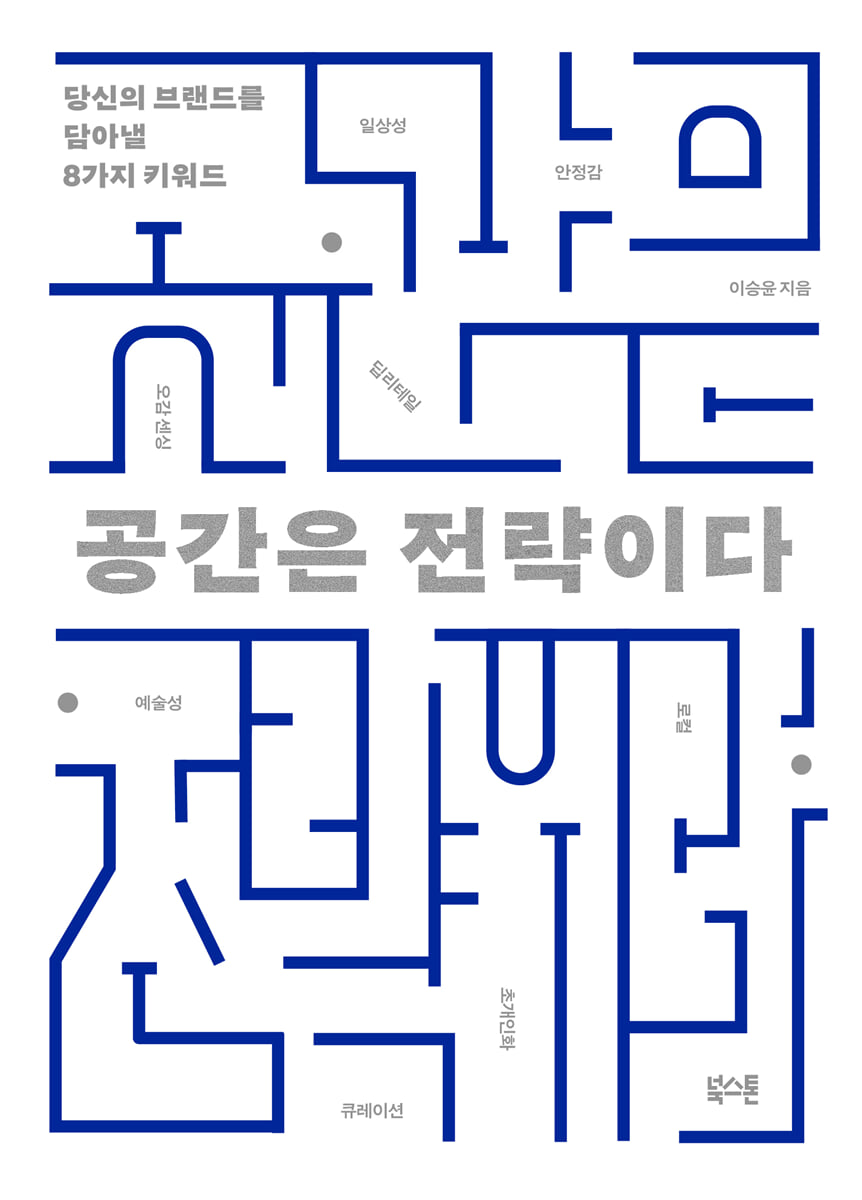
Space is strategy
 |
Description
Book Introduction
'What is your space saying right now?'
Professor Seungyoon Lee, a digital cultural psychologist, revealed
Practical strategies for building a brand beyond space
A brand's space is no longer just a store.
We are evolving into a strategic asset that communicates the brand's philosophy and identity, while designing experiences that stimulate customers' senses and permeate their daily lives.
However, there are still many spaces that are not remembered as brands no matter how stylishly decorated, and brands that try new experiences but do not lead to repeat consumption.
“Space is Strategy” finds the cause in the “absence of strategy.”
This book reinterprets offline space from the perspective of ‘strategy’ rather than ‘sense.’
Beyond Instagrammable spaces, we explore how brands can embody their emotional connections and philosophies with customers.
Professor Seungyoon Lee, who has consistently explored the points of contact where brands meet customers, designs eight strategies based on corporate consulting and consumer psychology research to determine how spaces can reveal the essence and value of a brand.
Professor Seungyoon Lee, a digital cultural psychologist, revealed
Practical strategies for building a brand beyond space
A brand's space is no longer just a store.
We are evolving into a strategic asset that communicates the brand's philosophy and identity, while designing experiences that stimulate customers' senses and permeate their daily lives.
However, there are still many spaces that are not remembered as brands no matter how stylishly decorated, and brands that try new experiences but do not lead to repeat consumption.
“Space is Strategy” finds the cause in the “absence of strategy.”
This book reinterprets offline space from the perspective of ‘strategy’ rather than ‘sense.’
Beyond Instagrammable spaces, we explore how brands can embody their emotional connections and philosophies with customers.
Professor Seungyoon Lee, who has consistently explored the points of contact where brands meet customers, designs eight strategies based on corporate consulting and consumer psychology research to determine how spaces can reveal the essence and value of a brand.
- You can preview some of the book's contents.
Preview
index
Prologue | The Evolving Offline: Why Brands Are Redesigning Spaces
Part 1.
Designing for Immersion
Chapter 1.
Everydayness: Familiar and comfortable spaces blur the lines between brand and everyday life.
A space more like home than home | Brands, proposing lifestyles
Chapter 2.
Artistry: Visually embodying sensitivity and aesthetics in space.
Brand Experiences Expand Through Art | Will Adding Art Lead to Purchases?
Part 2.
Designing for Empathy
Chapter 3.
Hyper-personalization: Designing experiences that go beyond "someone like me" to "just me."
How Brands Understand Me | Delivering Personalized Experiences Based on Your Tastes | Experiences Designed with Data
Chapter 4.
Curation: In an Age of Excess, How Can Brands Present "Standards for Selection?"
With so much choice, curation is key | Brands that sell "perspectives" will survive.
Part 3.
Designing a connection
Chapter 5.
Five Senses Sensing: The organic connection between the five senses determines a brand's impression.
How Brands Design for the Five Senses | Why F&B Brands Create Sense-Stimulating Spaces | Spatial Design that Integrates the Five Senses Leaves a Lasting Imprint on Your Brand
Chapter 6.
Deep Retail: Leveraging cutting-edge technology to seamlessly connect online and offline.
Deep Retail is Rising | The Evolution of Offline Spaces, Digital Innovation | Invisible Technology, Mobile Experiences | A Customer Experience Journey That Extends Beyond Space
Part 4.
Designing for Authenticity
Chapter 7.
Local: Content that captures local context is what differentiates your brand.
Creating Space with the Power of Locality | When Brands Embrace Locality, Their Storytelling Powers | Great Content Has the Power to Draw People
Chapter 8.
Security: Trust in a space comes from security, and security comes from authenticity.
A sense of space, missing from the digital realm | Spaces that foster solidarity expand brands | Showcase a brand's heritage
Epilogue | The Power of Space That Digital Cannot Overcome
Part 1.
Designing for Immersion
Chapter 1.
Everydayness: Familiar and comfortable spaces blur the lines between brand and everyday life.
A space more like home than home | Brands, proposing lifestyles
Chapter 2.
Artistry: Visually embodying sensitivity and aesthetics in space.
Brand Experiences Expand Through Art | Will Adding Art Lead to Purchases?
Part 2.
Designing for Empathy
Chapter 3.
Hyper-personalization: Designing experiences that go beyond "someone like me" to "just me."
How Brands Understand Me | Delivering Personalized Experiences Based on Your Tastes | Experiences Designed with Data
Chapter 4.
Curation: In an Age of Excess, How Can Brands Present "Standards for Selection?"
With so much choice, curation is key | Brands that sell "perspectives" will survive.
Part 3.
Designing a connection
Chapter 5.
Five Senses Sensing: The organic connection between the five senses determines a brand's impression.
How Brands Design for the Five Senses | Why F&B Brands Create Sense-Stimulating Spaces | Spatial Design that Integrates the Five Senses Leaves a Lasting Imprint on Your Brand
Chapter 6.
Deep Retail: Leveraging cutting-edge technology to seamlessly connect online and offline.
Deep Retail is Rising | The Evolution of Offline Spaces, Digital Innovation | Invisible Technology, Mobile Experiences | A Customer Experience Journey That Extends Beyond Space
Part 4.
Designing for Authenticity
Chapter 7.
Local: Content that captures local context is what differentiates your brand.
Creating Space with the Power of Locality | When Brands Embrace Locality, Their Storytelling Powers | Great Content Has the Power to Draw People
Chapter 8.
Security: Trust in a space comes from security, and security comes from authenticity.
A sense of space, missing from the digital realm | Spaces that foster solidarity expand brands | Showcase a brand's heritage
Epilogue | The Power of Space That Digital Cannot Overcome
Detailed image

Into the book
In today's offline spaces, 'what kind of experience is designed' has become much more important than simply 'what is sold.'
Rather than focusing on displaying and selling items, many retailers intentionally try to erase the feeling of a store or create a sensory retail space that feels “more like a home than a house.”
Rather than the location of a space, the key is the design of the content and experience that the space delivers, which is why consumers must visit the space in person.
---From the "Prologue"
There is a line in a poem that says, “You have to look closely to see the beauty.”
As this saying goes, companies need to make sure that customers can appreciate the value of their carefully crafted products for a longer period of time and in greater detail.
When we encounter a product by chance and its shining artistry stands out, we find ourselves interpreting and looking into the value behind it, even without being asked to do so.
In the process, you become immersed in the product and the emotional distance from the product naturally narrows.
This is precisely the strategic power of the artistic creation of space.
---From "Will the addition of art lead to purchases?"
While LG Electronics' Home Brew House is a space that combines beer with personalized experiences, 'Wine@EBISU', located in the Ebisu area of Tokyo, Japan, is a space that specializes in providing personalized experiences related to wine.
At Wine@Online, you can search for wine by genre as well as by region, and you can also search for restaurants based on the occasion you are drinking wine.
For example, if you purchase a wine that suits your spouse's taste perfectly for your 10th wedding anniversary from Wine@Online, the service will find the best Italian restaurant in the area that suits your spouse's taste and your wedding anniversary.
It doesn't stop there, they also offer a service that delivers wine to the restaurant according to the date and time of your reservation.
It truly gives the impression that the wine experience is tailored to each individual from A to Z.
---From "Providing personalized experiences based on tastes"
The important thing is not simply collecting data, but how we interpret that data and turn it into a sensory experience.
By being able to read an individual's context and translate it into a space in the brand's unique language, hyper-personalized experiences can extend beyond simple customization to powerful emotional connections.
In that sense, the strategic importance of offline spaces that can create direct interaction with individual customers will only grow in the future.
---From "Experiences of Taste Designed with Data"
Marketing strategies that stimulate the five senses in various ways in space are often called 'multisensory marketing'.
This is a strategy to design an experience that connects consumers more deeply with the brand by stimulating all five senses of the consumer.
The key is not simply to engage multiple senses, but to design a brand experience that deeply engraves itself in the minds of consumers through the synergy between the senses.
A space designed with elaborate attention to the five senses produces various effects.
Because senses are closely linked to human memory, experiencing a brand through diverse senses can help that brand become more strongly embedded in customers' long-term memories.
---From "Space design that integrates the five senses leaves a mark on the brand"
It is crucial to segment the customer experience itself and combine online and offline channels in a complementary manner.
Experts recommend a strategy that balances functional benefits online with experiential and sensory benefits offline.
For example, in the 'Explore' phase, customers can experience the functional satisfaction of being able to search, compare, and browse unlimited product information online.
---From "A Customer Experience Journey that Extends Beyond Space"
Ace Hotel's core goal is to go beyond simple lodging and become a kind of local hub, a place where outsiders and locals can naturally meet and experience the local culture.
So when building a hotel, most effort is put into the lobby.
When you visit Ace Hotel Kyoto, you'll find this long table in the lobby, 365 days a year, day and night, filled with locals reading books or working on their laptops over a cup of coffee.
The intention to convey local culture by making the lobby an open space where local residents can freely come and go and allowing guests to naturally immerse themselves in it can be seen.
---From "Creating Space with Local Power"
The core theme of Miyashita Park, beloved by the residents of Tokyo's Shibuya Ward, can be summarized in one word: "connection."
The front part of Miyashita Park was designed as a staircase to attract people tired of the complex commercial space of Shibuya.
People walking from Shibuya Station naturally encounter this huge staircase and climb it.
In short, it is an optimized route designed to connect Shibuya's existing commercial spaces and parks with the least amount of incongruity.
Rather than focusing on displaying and selling items, many retailers intentionally try to erase the feeling of a store or create a sensory retail space that feels “more like a home than a house.”
Rather than the location of a space, the key is the design of the content and experience that the space delivers, which is why consumers must visit the space in person.
---From the "Prologue"
There is a line in a poem that says, “You have to look closely to see the beauty.”
As this saying goes, companies need to make sure that customers can appreciate the value of their carefully crafted products for a longer period of time and in greater detail.
When we encounter a product by chance and its shining artistry stands out, we find ourselves interpreting and looking into the value behind it, even without being asked to do so.
In the process, you become immersed in the product and the emotional distance from the product naturally narrows.
This is precisely the strategic power of the artistic creation of space.
---From "Will the addition of art lead to purchases?"
While LG Electronics' Home Brew House is a space that combines beer with personalized experiences, 'Wine@EBISU', located in the Ebisu area of Tokyo, Japan, is a space that specializes in providing personalized experiences related to wine.
At Wine@Online, you can search for wine by genre as well as by region, and you can also search for restaurants based on the occasion you are drinking wine.
For example, if you purchase a wine that suits your spouse's taste perfectly for your 10th wedding anniversary from Wine@Online, the service will find the best Italian restaurant in the area that suits your spouse's taste and your wedding anniversary.
It doesn't stop there, they also offer a service that delivers wine to the restaurant according to the date and time of your reservation.
It truly gives the impression that the wine experience is tailored to each individual from A to Z.
---From "Providing personalized experiences based on tastes"
The important thing is not simply collecting data, but how we interpret that data and turn it into a sensory experience.
By being able to read an individual's context and translate it into a space in the brand's unique language, hyper-personalized experiences can extend beyond simple customization to powerful emotional connections.
In that sense, the strategic importance of offline spaces that can create direct interaction with individual customers will only grow in the future.
---From "Experiences of Taste Designed with Data"
Marketing strategies that stimulate the five senses in various ways in space are often called 'multisensory marketing'.
This is a strategy to design an experience that connects consumers more deeply with the brand by stimulating all five senses of the consumer.
The key is not simply to engage multiple senses, but to design a brand experience that deeply engraves itself in the minds of consumers through the synergy between the senses.
A space designed with elaborate attention to the five senses produces various effects.
Because senses are closely linked to human memory, experiencing a brand through diverse senses can help that brand become more strongly embedded in customers' long-term memories.
---From "Space design that integrates the five senses leaves a mark on the brand"
It is crucial to segment the customer experience itself and combine online and offline channels in a complementary manner.
Experts recommend a strategy that balances functional benefits online with experiential and sensory benefits offline.
For example, in the 'Explore' phase, customers can experience the functional satisfaction of being able to search, compare, and browse unlimited product information online.
---From "A Customer Experience Journey that Extends Beyond Space"
Ace Hotel's core goal is to go beyond simple lodging and become a kind of local hub, a place where outsiders and locals can naturally meet and experience the local culture.
So when building a hotel, most effort is put into the lobby.
When you visit Ace Hotel Kyoto, you'll find this long table in the lobby, 365 days a year, day and night, filled with locals reading books or working on their laptops over a cup of coffee.
The intention to convey local culture by making the lobby an open space where local residents can freely come and go and allowing guests to naturally immerse themselves in it can be seen.
---From "Creating Space with Local Power"
The core theme of Miyashita Park, beloved by the residents of Tokyo's Shibuya Ward, can be summarized in one word: "connection."
The front part of Miyashita Park was designed as a staircase to attract people tired of the complex commercial space of Shibuya.
People walking from Shibuya Station naturally encounter this huge staircase and climb it.
In short, it is an optimized route designed to connect Shibuya's existing commercial spaces and parks with the least amount of incongruity.
---From "A Sense That Doesn't Exist in Digital: Created by Space"
Publisher's Review
What does it take to transform a space from a one-time visitor to an unforgettable brand space?
Offline spaces are no longer limited to displaying products or providing services.
Space is now evolving into a 'strategic tool' for building relationships between customers and brands.
Customers intuitively experience the brand's philosophy and attitude in the space and consider how well it aligns with their lifestyle.
These changes mean that offline spaces must function as core assets of brand strategy.
In other words, space has become the forefront of visually revealing and sensually conveying the brand's identity and value.
However, many brands are not responding sufficiently to these changes.
Although it may be a sensually attractive space, it often fails to create an impressive brand experience because it lacks the brand identity.
This results in one-time customer visits that do not develop into loyal relationships.
After all, a brand cannot be memorable based on feelings alone.
“Space is Strategy” points out the essence of this gap.
As a digital cultural psychologist and experience designer who has advised numerous companies on their spaces, the author brings space back to the center of brand strategy.
From the Sulwhasoo flagship store, which connects a traditional hanok in Bukchon with a 1960s Western-style building, to the Tokyo Starbucks Reserve Roastery, designed as an experiential space that stimulates all five senses, to the urban regeneration case of Shimokitazawa, Tokyo, which added a brand space imbued with local character to the railroad tracks.
Through examples of how brand philosophy is naturally incorporated into space, we present a compelling solution for strategically implementing space.
From immersion to authenticity, four axes and eight strategies to perfect your brand space.
The greatest strength of this book is that it goes beyond simply listing trends, but systematizes the brand space into a structured strategy.
The author identifies four strategic axes and eight keywords to help offline spaces organically embody the brand's philosophy and customer experience.
Under the four axes of 'immersion, empathy, connection, and authenticity,' eight keywords are organically connected: 'everydayness,' 'artistic quality,' 'curation,' 'hyper-personalization,' 'sensing the five senses,' 'deep retail,' 'local,' and 'stability.'
Starting with immersion, building empathy, deepening connection, and moving toward a sense of stability, we establish strategic criteria for how spaces can three-dimensionally convey the brand's identity and experience.
These keywords, which may sound familiar at first glance, are read with a completely different depth in this book.
Part 1, "Immersive Space Strategy," explains how brands can seamlessly integrate into customers' daily lives while artistically embodying their own unique sensibilities.
Part 2, "Empathy-Based Spatial Strategy," addresses how brands respond to customers' emotions and curate their worldviews.
Part 3 presents a concrete "experience connection strategy" that expands brand experience by leveraging the five senses and cutting-edge technology, while Part 4 presents a "authenticity-based strategy" that builds trust based on locality and stability.
This strategy does not work independently.
They are organically intertwined in a single space and have a three-dimensional effect on the overall customer experience.
From the telecommunications, beauty, fashion, F&B, and hotel industries to urban regeneration and community projects, the author demonstrates through a variety of case studies that spatial strategy is the key to creating a memorable brand.
How Should Brand Spaces Evolve in Changing Times?
Even in an age where technology permeates our daily lives and industries, offline spaces will never disappear.
Rather, customers feel more intuitively in the space how the brand wants to relate to them.
Therefore, brand spaces must evolve into places that naturally blend into customers' daily lives while building sustainable trust.
In this book, the author clearly presents how to create a space that connects the brand's desire to be remembered and the customer's desire to be relatable.
For marketers, branding practitioners, and space planners who want to design the future of their brands through space, this book will be the most practical and insightful guide.
Offline spaces are no longer limited to displaying products or providing services.
Space is now evolving into a 'strategic tool' for building relationships between customers and brands.
Customers intuitively experience the brand's philosophy and attitude in the space and consider how well it aligns with their lifestyle.
These changes mean that offline spaces must function as core assets of brand strategy.
In other words, space has become the forefront of visually revealing and sensually conveying the brand's identity and value.
However, many brands are not responding sufficiently to these changes.
Although it may be a sensually attractive space, it often fails to create an impressive brand experience because it lacks the brand identity.
This results in one-time customer visits that do not develop into loyal relationships.
After all, a brand cannot be memorable based on feelings alone.
“Space is Strategy” points out the essence of this gap.
As a digital cultural psychologist and experience designer who has advised numerous companies on their spaces, the author brings space back to the center of brand strategy.
From the Sulwhasoo flagship store, which connects a traditional hanok in Bukchon with a 1960s Western-style building, to the Tokyo Starbucks Reserve Roastery, designed as an experiential space that stimulates all five senses, to the urban regeneration case of Shimokitazawa, Tokyo, which added a brand space imbued with local character to the railroad tracks.
Through examples of how brand philosophy is naturally incorporated into space, we present a compelling solution for strategically implementing space.
From immersion to authenticity, four axes and eight strategies to perfect your brand space.
The greatest strength of this book is that it goes beyond simply listing trends, but systematizes the brand space into a structured strategy.
The author identifies four strategic axes and eight keywords to help offline spaces organically embody the brand's philosophy and customer experience.
Under the four axes of 'immersion, empathy, connection, and authenticity,' eight keywords are organically connected: 'everydayness,' 'artistic quality,' 'curation,' 'hyper-personalization,' 'sensing the five senses,' 'deep retail,' 'local,' and 'stability.'
Starting with immersion, building empathy, deepening connection, and moving toward a sense of stability, we establish strategic criteria for how spaces can three-dimensionally convey the brand's identity and experience.
These keywords, which may sound familiar at first glance, are read with a completely different depth in this book.
Part 1, "Immersive Space Strategy," explains how brands can seamlessly integrate into customers' daily lives while artistically embodying their own unique sensibilities.
Part 2, "Empathy-Based Spatial Strategy," addresses how brands respond to customers' emotions and curate their worldviews.
Part 3 presents a concrete "experience connection strategy" that expands brand experience by leveraging the five senses and cutting-edge technology, while Part 4 presents a "authenticity-based strategy" that builds trust based on locality and stability.
This strategy does not work independently.
They are organically intertwined in a single space and have a three-dimensional effect on the overall customer experience.
From the telecommunications, beauty, fashion, F&B, and hotel industries to urban regeneration and community projects, the author demonstrates through a variety of case studies that spatial strategy is the key to creating a memorable brand.
How Should Brand Spaces Evolve in Changing Times?
Even in an age where technology permeates our daily lives and industries, offline spaces will never disappear.
Rather, customers feel more intuitively in the space how the brand wants to relate to them.
Therefore, brand spaces must evolve into places that naturally blend into customers' daily lives while building sustainable trust.
In this book, the author clearly presents how to create a space that connects the brand's desire to be remembered and the customer's desire to be relatable.
For marketers, branding practitioners, and space planners who want to design the future of their brands through space, this book will be the most practical and insightful guide.
GOODS SPECIFICS
- Date of issue: July 17, 2025
- Page count, weight, size: 320 pages | 492g | 146*203*20mm
- ISBN13: 9791193063989
- ISBN10: 1193063981
You may also like
카테고리
korean


korean

![ELLE 엘르 스페셜 에디션 A형 : 12월 [2025]](http://librairie.coreenne.fr/cdn/shop/files/b8e27a3de6c9538896439686c6b0e8fb.jpg?v=1766436872&width=3840)


