

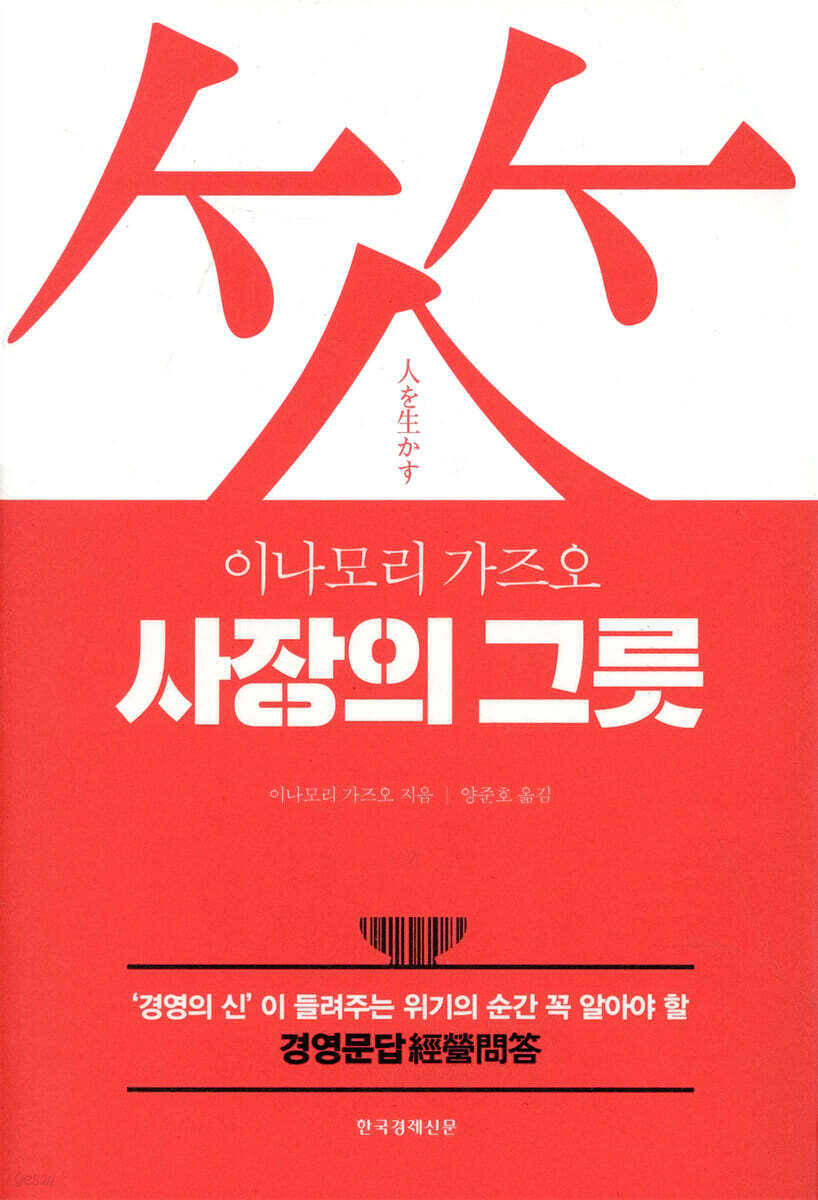
President Kazuo Inamori's dishes
 |
Description
Book Introduction
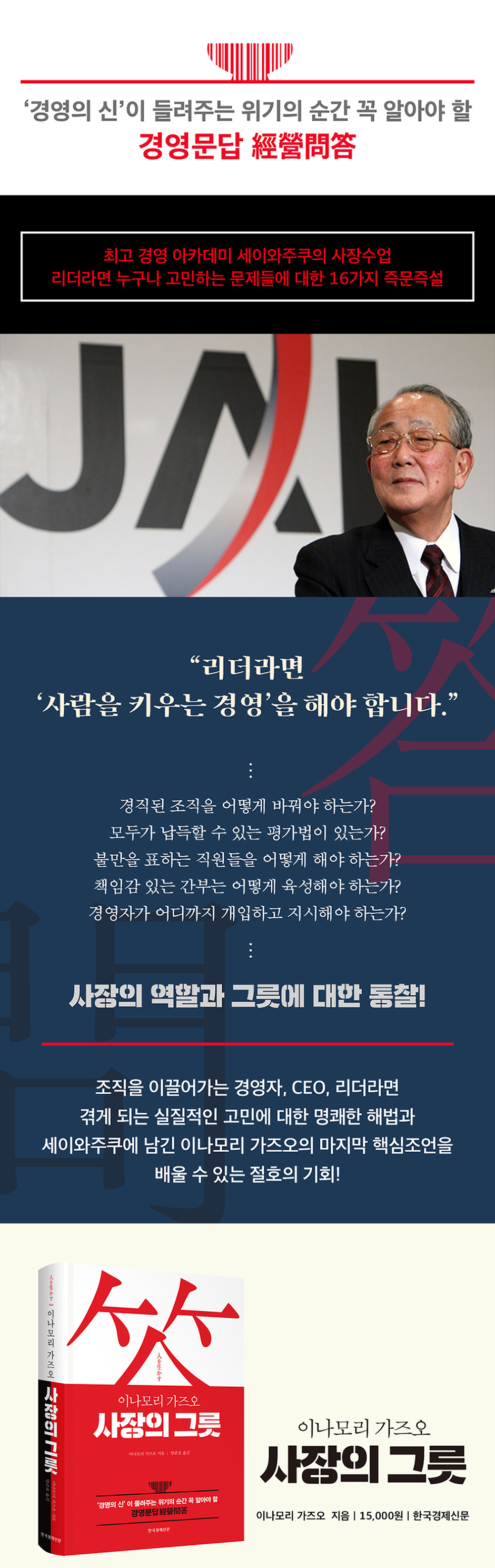
Ask Kazuo Inamori about "People-Cultivating Management."
Management Questions and Answers Every Leader Needs to Know in a Moment of Crisis
Clear solutions to the practical concerns faced by managers leading organizations.
Kazuo Inamori, the founder and honorary chairman of Kyocera, a world-renowned entrepreneur, and the most beloved Japanese businessman among Koreans.
This is a book titled "Lessons for CEOs," in which he, who has been respected as a "living god of management" for his sound life philosophy and exemplary attitude, clearly explains the things that CEOs and leaders who lead companies are most curious about.
Kazuo Inamori founded the management academy "Seiwajyuku" that bears his name, and has been running a "Management Q&A" program where he provides direct advice on the concerns and problems faced by the next generation of managers he met there, especially new managers leading second-generation small and medium-sized businesses.
This book contains his solution notes, which were compiled based on his own management philosophy and long-standing management know-how, and which did not spare warm encouragement, but also sometimes even sharp, direct criticism and sincere advice.
You will gain insight into the role and qualities of a top decision-maker who must enhance a company's productivity and efficiency, as well as hints for solutions that can help overcome the crises that any leader will face.
You will be able to obtain good guidance on the path of a true manager who can inject vitality into a company and develop it into a great organization.
Management Questions and Answers Every Leader Needs to Know in a Moment of Crisis
Clear solutions to the practical concerns faced by managers leading organizations.
Kazuo Inamori, the founder and honorary chairman of Kyocera, a world-renowned entrepreneur, and the most beloved Japanese businessman among Koreans.
This is a book titled "Lessons for CEOs," in which he, who has been respected as a "living god of management" for his sound life philosophy and exemplary attitude, clearly explains the things that CEOs and leaders who lead companies are most curious about.
Kazuo Inamori founded the management academy "Seiwajyuku" that bears his name, and has been running a "Management Q&A" program where he provides direct advice on the concerns and problems faced by the next generation of managers he met there, especially new managers leading second-generation small and medium-sized businesses.
This book contains his solution notes, which were compiled based on his own management philosophy and long-standing management know-how, and which did not spare warm encouragement, but also sometimes even sharp, direct criticism and sincere advice.
You will gain insight into the role and qualities of a top decision-maker who must enhance a company's productivity and efficiency, as well as hints for solutions that can help overcome the crises that any leader will face.
You will be able to obtain good guidance on the path of a true manager who can inject vitality into a company and develop it into a great organization.
- You can preview some of the book's contents.
Preview
index
Entering
Chapter 1.
How to Create a Vibrant Organization
-The invisible part makes the difference in competitiveness.
[Management Q&A 1] How can we change a rigid organization?
[Management Q&A 2] Is there an evaluation method that everyone can agree on?
[Management Q&A 3] How can we create a good corporate culture?
[Management Q&A 4] How to unite employees?
Chapter 2.
How to Motivate Your Employees
-Set your dream and light a fire in your heart.
[Management Q&A 5] How can we help employees in the 3D industry have dreams and pride?
[Management Q&A 6] What should I do with employees who express dissatisfaction?
[Management Q&A 7] How to instill management philosophy?
[Management Q&A 8] Should we emphasize teamwork or individuality?
Chapter 3.
How to develop executives who can manage together
-Create a co-manager
[Management Q&A 9] How will existing employees be treated when the company expands?
[Management Q&A 10] How should I handle executives with different abilities?
[Management Q&A 11] How can I improve my employees' management mindset?
[Management Q&A 12] How can we cultivate responsible executives?
Chapter 4.
How to Exercise Leadership
-Become a respected manager.
[Management Q&A 13] How do I establish criteria for value judgment as a manager?
[Management Q&A 14] Should managers be at the forefront?
[Management Q&A 15] How to convey the manager's will?
[Management Q&A 16] How can a young CEO effectively perform leadership?
Chapter 5.
What qualities should a CEO possess?
-10 Commandments of a Leader's Role
Chapter 1.
How to Create a Vibrant Organization
-The invisible part makes the difference in competitiveness.
[Management Q&A 1] How can we change a rigid organization?
[Management Q&A 2] Is there an evaluation method that everyone can agree on?
[Management Q&A 3] How can we create a good corporate culture?
[Management Q&A 4] How to unite employees?
Chapter 2.
How to Motivate Your Employees
-Set your dream and light a fire in your heart.
[Management Q&A 5] How can we help employees in the 3D industry have dreams and pride?
[Management Q&A 6] What should I do with employees who express dissatisfaction?
[Management Q&A 7] How to instill management philosophy?
[Management Q&A 8] Should we emphasize teamwork or individuality?
Chapter 3.
How to develop executives who can manage together
-Create a co-manager
[Management Q&A 9] How will existing employees be treated when the company expands?
[Management Q&A 10] How should I handle executives with different abilities?
[Management Q&A 11] How can I improve my employees' management mindset?
[Management Q&A 12] How can we cultivate responsible executives?
Chapter 4.
How to Exercise Leadership
-Become a respected manager.
[Management Q&A 13] How do I establish criteria for value judgment as a manager?
[Management Q&A 14] Should managers be at the forefront?
[Management Q&A 15] How to convey the manager's will?
[Management Q&A 16] How can a young CEO effectively perform leadership?
Chapter 5.
What qualities should a CEO possess?
-10 Commandments of a Leader's Role
Detailed image
Into the book
A great corporate culture is the foundation of small business growth.
For small and medium-sized enterprises, visible factors such as funding, facilities, and human resources are bound to be lacking compared to large corporations.
Small and medium-sized businesses should not take this reality for granted.
To become competitive as a company, you need to create an excellent corporate culture, an invisible part that large corporations do not pay much attention to.
Managers must make every effort to clearly define the company's mission and purpose, create a solid corporate culture, and align their values with those of their employees.
When a corporate culture is based on a strong management philosophy, employees will wholeheartedly support it and act voluntarily for the company's development.
--- p.17
The most important thing in management is to make a profit.
To do that, you need to go out into the field every day and become an expert in the field.
As you become a CEO, you need to have a clear understanding of what's missing, what's in place, and what the problems are.
When it comes to making a profit, the solution isn't in the hands of the employees.
You are the only one who can give you a solution.
There's no way a meeting will produce an answer.
Managers need to study and purchase on their own, and find out where things are cheap and where they are good.
That's why you have to work several times harder than the executives and know several times more.
--- p.58~59
Small and medium-sized businesses not only lack money but also technology, so the only people they can rely on are the employees who gather there.
So, we need to unite the hearts of those people around the CEO.
We need to capture the hearts of those employees so that they can say, “Our boss is really great.”
I believe that small businesses cannot succeed if they cannot retain their employees.
To attract employees, you must first know how to value them.
Of course, within the limits of possibility.
The company isn't even running properly yet, so they can't afford to pay ridiculously high salaries.
That's why we need to encourage them to work harder than any other company.
--- p.70~71
Employees will not comply with a one-sided demand to work hard, even at the expense of their families, just to protect the company and the manager's assets.
First of all, you can't ask people to work hard if you don't clearly convey what your company exists for.
Executives must be valued first and foremost.
It's not easy to ask people to sacrifice their families for the company, but if you value them and treat them well, they'll be the first to think, "Let's cooperate a little more for the company."
--- p.170~171
The reason I emphasize the importance of personality is because the CEO has to make the final decision.
When making that decision, what you decide with is the coordinate axis in your mind.
You have to refer to the coordinate axis in your mind and decide whether this is good or bad.
To do this, it is important to create a clear and correct coordinate axis.
The coordinate axis is the standard by which a person judges his or her values.
Value judgments are actually projections of personality.
Since you have great responsibility for management, you must develop your character into something great.
For small and medium-sized enterprises, visible factors such as funding, facilities, and human resources are bound to be lacking compared to large corporations.
Small and medium-sized businesses should not take this reality for granted.
To become competitive as a company, you need to create an excellent corporate culture, an invisible part that large corporations do not pay much attention to.
Managers must make every effort to clearly define the company's mission and purpose, create a solid corporate culture, and align their values with those of their employees.
When a corporate culture is based on a strong management philosophy, employees will wholeheartedly support it and act voluntarily for the company's development.
--- p.17
The most important thing in management is to make a profit.
To do that, you need to go out into the field every day and become an expert in the field.
As you become a CEO, you need to have a clear understanding of what's missing, what's in place, and what the problems are.
When it comes to making a profit, the solution isn't in the hands of the employees.
You are the only one who can give you a solution.
There's no way a meeting will produce an answer.
Managers need to study and purchase on their own, and find out where things are cheap and where they are good.
That's why you have to work several times harder than the executives and know several times more.
--- p.58~59
Small and medium-sized businesses not only lack money but also technology, so the only people they can rely on are the employees who gather there.
So, we need to unite the hearts of those people around the CEO.
We need to capture the hearts of those employees so that they can say, “Our boss is really great.”
I believe that small businesses cannot succeed if they cannot retain their employees.
To attract employees, you must first know how to value them.
Of course, within the limits of possibility.
The company isn't even running properly yet, so they can't afford to pay ridiculously high salaries.
That's why we need to encourage them to work harder than any other company.
--- p.70~71
Employees will not comply with a one-sided demand to work hard, even at the expense of their families, just to protect the company and the manager's assets.
First of all, you can't ask people to work hard if you don't clearly convey what your company exists for.
Executives must be valued first and foremost.
It's not easy to ask people to sacrifice their families for the company, but if you value them and treat them well, they'll be the first to think, "Let's cooperate a little more for the company."
--- p.170~171
The reason I emphasize the importance of personality is because the CEO has to make the final decision.
When making that decision, what you decide with is the coordinate axis in your mind.
You have to refer to the coordinate axis in your mind and decide whether this is good or bad.
To do this, it is important to create a clear and correct coordinate axis.
The coordinate axis is the standard by which a person judges his or her values.
Value judgments are actually projections of personality.
Since you have great responsibility for management, you must develop your character into something great.
--- p.207~208
Publisher's Review
What does Kazuo Inamori mean by "doing business"?
Seiwajyuku's CEO Class at the Top Management Academy
“You must become a leader who moves people’s hearts.”
How can we change a rigid culture and create a vibrant organization?
Should we emphasize teamwork across departments or emphasize individual individuality?
How can we cultivate responsible executives?
What kind of leadership truly motivates employees?
Aren't these the unchanging concerns every business leader faces at least once? The position of CEO involves anxiety about the future, whether the company is doing well or not. And when things aren't going well, there are worries about the present.
Because of this, young leaders and managers who dream of becoming future managers inevitably face more realistic concerns.
The book "The President's Vessel" has been published, providing cool-headed and detailed answers to the big and small concerns of such managers.
This book is a compilation of management Q&As in which Kazuo Inamori, a management guru, answered the concerns of the next generation of managers, especially second-generation managers, whom he met at the management academy 'Seiwajyuku' that he founded, based on his long management experience and management philosophy. Among the numerous Q&As, the book carefully selected and collected the contents related to talent development and organizational revitalization that any group leader faces.
This is a great opportunity to hear his final advice and message from Seiwajyuku, which concluded in 2019.
“Through Seiwajyuku, I have been conducting ‘Management Q&A,’ where I discuss the management philosophy that forms the basis of management, while also providing advice on management issues students face.
As a business leader, I pride myself on being able to answer the specific questions of Seiwajyuku students with pressing issues, drawing on my management philosophy and experience.
The core topic and content he devoted his heart and soul to answering these questions is based on the basic theme of "people-cultivating management," and he provides detailed consulting on specific field cases, broadly divided into areas such as vibrant organizational management, employee motivation, fostering responsible executives, and roles as a manager.
16 Concerns and Solutions to Problems Every Manager Concerns
A management guide for the next generation of managers who will lead the future.
For managers who want to change the culture of their organization but are concerned that their organization has become bureaucratic and rigid and that giving various instructions does not work well, I advise that rather than employees moving by just giving orders, the CEO himself should go out into the field and take the lead, explaining and persuading employees why it is not possible to do something now before giving instructions.
For managers who are concerned about whether there is a rank system and evaluation method that all employees can accept, there are always contradictions in the evaluation rules, and it is difficult to motivate and inspire employees with performance-based pay alone, so he urges the CEO to start by getting into the center of the organization and properly observing and understanding employees.
Every time you face difficult challenges in business, such as how to deal with disgruntled employees, how to deal with older executives, or how to improve a work environment with frequent turnover, you can receive help on what qualities you need to acquire and learn as a manager and top decision-maker who must increase the productivity and efficiency of your company.
The position of CEO is never easy.
It is a position that is bound to be even more burdensome and lonely, as it is a position that requires solving all problems and taking responsibility for all outcomes.
The more this happens, the more Kazuo Inamori emphasizes his 'vessel' as president.
That is why the 10 Commandments of a Leader's Role remind us of our original intentions as CEOs, which can be the most fundamental.
He mentions that proper management can only be achieved by remembering the purpose and significance of the business, recognizing why the company exists, having specific goals and plans, and adhering to fundamental philosophies such as not forcing self-sacrifice on employees, thinking of employees' happiness rather than personal gain, and winning the hearts of employees first.
Although organizations themselves are becoming increasingly systematized, the biggest concern for leaders leading organizations is "people," namely, "how to motivate employees and revitalize the organization?"
This book offers a glimpse into the insights of Kazuo Inamori, who has decades of management expertise. Through it, you will gain clear solutions and guidance on the role of leaders in revitalizing companies and developing them into excellent organizations, as well as the path of a true manager.
I highly recommend this book to all managers and leaders who are leading, or must lead, their companies in this chaotic era of economic crisis.
Seiwajyuku's CEO Class at the Top Management Academy
“You must become a leader who moves people’s hearts.”
How can we change a rigid culture and create a vibrant organization?
Should we emphasize teamwork across departments or emphasize individual individuality?
How can we cultivate responsible executives?
What kind of leadership truly motivates employees?
Aren't these the unchanging concerns every business leader faces at least once? The position of CEO involves anxiety about the future, whether the company is doing well or not. And when things aren't going well, there are worries about the present.
Because of this, young leaders and managers who dream of becoming future managers inevitably face more realistic concerns.
The book "The President's Vessel" has been published, providing cool-headed and detailed answers to the big and small concerns of such managers.
This book is a compilation of management Q&As in which Kazuo Inamori, a management guru, answered the concerns of the next generation of managers, especially second-generation managers, whom he met at the management academy 'Seiwajyuku' that he founded, based on his long management experience and management philosophy. Among the numerous Q&As, the book carefully selected and collected the contents related to talent development and organizational revitalization that any group leader faces.
This is a great opportunity to hear his final advice and message from Seiwajyuku, which concluded in 2019.
“Through Seiwajyuku, I have been conducting ‘Management Q&A,’ where I discuss the management philosophy that forms the basis of management, while also providing advice on management issues students face.
As a business leader, I pride myself on being able to answer the specific questions of Seiwajyuku students with pressing issues, drawing on my management philosophy and experience.
The core topic and content he devoted his heart and soul to answering these questions is based on the basic theme of "people-cultivating management," and he provides detailed consulting on specific field cases, broadly divided into areas such as vibrant organizational management, employee motivation, fostering responsible executives, and roles as a manager.
16 Concerns and Solutions to Problems Every Manager Concerns
A management guide for the next generation of managers who will lead the future.
For managers who want to change the culture of their organization but are concerned that their organization has become bureaucratic and rigid and that giving various instructions does not work well, I advise that rather than employees moving by just giving orders, the CEO himself should go out into the field and take the lead, explaining and persuading employees why it is not possible to do something now before giving instructions.
For managers who are concerned about whether there is a rank system and evaluation method that all employees can accept, there are always contradictions in the evaluation rules, and it is difficult to motivate and inspire employees with performance-based pay alone, so he urges the CEO to start by getting into the center of the organization and properly observing and understanding employees.
Every time you face difficult challenges in business, such as how to deal with disgruntled employees, how to deal with older executives, or how to improve a work environment with frequent turnover, you can receive help on what qualities you need to acquire and learn as a manager and top decision-maker who must increase the productivity and efficiency of your company.
The position of CEO is never easy.
It is a position that is bound to be even more burdensome and lonely, as it is a position that requires solving all problems and taking responsibility for all outcomes.
The more this happens, the more Kazuo Inamori emphasizes his 'vessel' as president.
That is why the 10 Commandments of a Leader's Role remind us of our original intentions as CEOs, which can be the most fundamental.
He mentions that proper management can only be achieved by remembering the purpose and significance of the business, recognizing why the company exists, having specific goals and plans, and adhering to fundamental philosophies such as not forcing self-sacrifice on employees, thinking of employees' happiness rather than personal gain, and winning the hearts of employees first.
Although organizations themselves are becoming increasingly systematized, the biggest concern for leaders leading organizations is "people," namely, "how to motivate employees and revitalize the organization?"
This book offers a glimpse into the insights of Kazuo Inamori, who has decades of management expertise. Through it, you will gain clear solutions and guidance on the role of leaders in revitalizing companies and developing them into excellent organizations, as well as the path of a true manager.
I highly recommend this book to all managers and leaders who are leading, or must lead, their companies in this chaotic era of economic crisis.
GOODS SPECIFICS
- Date of issue: January 28, 2020
- Format: Hardcover book binding method guide
- Page count, weight, size: 268 pages | 422g | 137*195*20mm
- ISBN13: 9788947545471
- ISBN10: 8947545473
You may also like
카테고리
korean


korean

![ELLE 엘르 스페셜 에디션 A형 : 12월 [2025]](http://librairie.coreenne.fr/cdn/shop/files/b8e27a3de6c9538896439686c6b0e8fb.jpg?v=1766436872&width=3840)


