

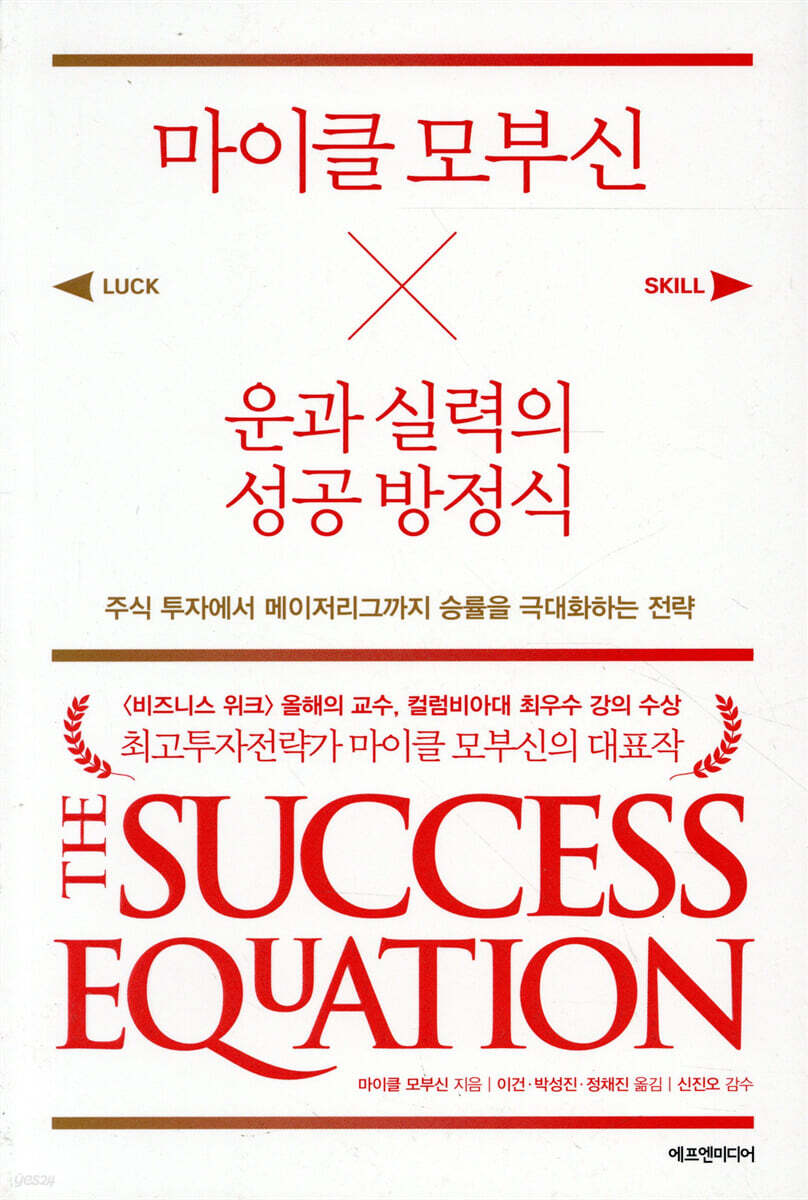
Michael Mauboussin's Success Equation of Luck and Skill
 |
Description
Book Introduction
Is success luck or skill?
A systematic and scientific method for distinguishing and dealing with luck and skill.
Is a company's performance or a stock investor's return a matter of luck or skill?
Are employment, income, and a baseball player's batting average determined by luck or skill?
The model answer we are familiar with is 'skill is the foundation, luck is a bonus.'
However, according to Columbia University professor Michael Mauboussin, the success of business and investments is largely influenced by luck.
In particular, stock investment performance, which is revealed in the short term, is closer to a game of poker, where luck has a greater influence than a game of chess, where skill is absolute.
An individual's employment and income are also influenced by the economic boom or bust of the year in which they graduated, and while the average batting skill has improved compared to the past, the impact of that skill on batting average has actually decreased.
This claim, which may seem a bit extreme, is supported by interesting real-life examples, various statistics, and rigorous analysis.
Michael Mauboussin's Success Equation of Luck and Skill emphasizes that in order to wisely deal with the world of luck and increase the possibility of success, we must 'manage luck' rather than 'leave it to luck.'
The book shows us how to deal with luck and find rational ways to manage it.
Distinguish between luck and skill, analyze their importance, and apply them to reality.
These distinctions, analyses, and applications are summarized in the final 11 chapters as '10 Ways to Improve Predictive Power'.
A systematic and scientific method for distinguishing and dealing with luck and skill.
Is a company's performance or a stock investor's return a matter of luck or skill?
Are employment, income, and a baseball player's batting average determined by luck or skill?
The model answer we are familiar with is 'skill is the foundation, luck is a bonus.'
However, according to Columbia University professor Michael Mauboussin, the success of business and investments is largely influenced by luck.
In particular, stock investment performance, which is revealed in the short term, is closer to a game of poker, where luck has a greater influence than a game of chess, where skill is absolute.
An individual's employment and income are also influenced by the economic boom or bust of the year in which they graduated, and while the average batting skill has improved compared to the past, the impact of that skill on batting average has actually decreased.
This claim, which may seem a bit extreme, is supported by interesting real-life examples, various statistics, and rigorous analysis.
Michael Mauboussin's Success Equation of Luck and Skill emphasizes that in order to wisely deal with the world of luck and increase the possibility of success, we must 'manage luck' rather than 'leave it to luck.'
The book shows us how to deal with luck and find rational ways to manage it.
Distinguish between luck and skill, analyze their importance, and apply them to reality.
These distinctions, analyses, and applications are summarized in the final 11 chapters as '10 Ways to Improve Predictive Power'.
- You can preview some of the book's contents.
Preview
index
Translator's Note: The Minor Differences That Separate Baekseok and Manseok
Recommendation_How to Use Luck in a Complex World
Preface: Getting a Job Thanks to the Trash Can
Part 1 Basics
Chapter 1: Distinguishing between luck and skill
A practical definition, not a philosophical debate
A chance event that affects an individual or group
Luck comes to those who are prepared?
Running skills and blackjack skills
The extremes of luck and skill
Sample size matters
Independence and path dependence
Taleb's Quadrant
Chapter 2: Prejudice against luck and prejudice against skill
The superstition of inevitability
Success Strategies You Shouldn't Imitate
Most research papers are wrong
Will my skills be maintained even if I change companies?
Chapter 3: The Luck-Skill Spectrum
Don't look for too long, look a lot
Two jars model
The better your skills, the more important luck becomes.
When does great success come?
ROIC reverts to the mean
Part 2 Analysis
Chapter 4: When to Wish for Good Luck and When to Work Hard
If the causal relationship is clear, trust your skills.
Can the results be sufficiently explained by luck?
If the items are the same, the influence of luck is similar.
As the player base grows, skills become more equalized.
What if we applied the luck-skill spectrum to investing?
Chapter 5: Skills Grow with Age
Peak performance age is a rare exception
Fluid intelligence and crystallized intelligence
Why Smart People Act Stupidly
Corporate performance also follows a life cycle.
Part 3 application
Chapter 6: Don't Underestimate Luck
Measuring Luck: Independent and Dependent Events
Power laws and power law generation mechanisms
The rich get richer and the poor get poorer due to luck
It's impossible to predict a hit.
People who don't acknowledge luck
Chapter 7: Conditions for Useful Statistics
Baseball Statistics for Consistency and Predictive Power
Follow and make up
Past investment performance does not guarantee future returns.
Statistics on sports, business, and investment
Chapter 8: How to Build Skills
Systematic training is important in the realm of skill.
Embrace the checklist in the middle ground between luck and skill.
In the realm of luck, focus on the process, not the outcome.
Stock valuation and investment size calculation
The temperament to make cool-headed decisions
The courage to break away from organizational conventions
Chapter 9: How to Deal with Luck
Lessons from David's Victory
Colonel Blotto Game
Add a battlefield
Great powers and weak countries
Investigating causality through small-scale experiments
The World of Black Swan
How to Live with Luck
Chapter 10: Misconceptions and Truths about the Concept of Regression to the Mean
The instinct to find causal relationships
Application of mean regression
Why is the team I support not as good as I thought?
Avoiding traps
Chapter 11: How to Improve Your Predictive Power
1.
Determine your field of activity on the skill-capability spectrum.
2.
Consider sample size, significance, and black swans.
3.
Always consider the null model
4.
Choose feedback and rewards carefully.
5.
Use postmortem thinking
6.
Develop ways to improve your skills
7.
Develop a strategy that suits the situation
8.
Make good use of mean regression
9.
Unearth useful statistics
10.
Recognize your limitations
Appendix_ Two techniques for estimating actual win rates using mean regression tendencies
Technique 1: Tom Tango's 2011 Major League Baseball Technique
Technique 2: James-Stein Estimator Formula
Calculate each team's winning percentage, standard deviation, and variance
Review_The equation for success is multiplication, not addition.
annotation
Recommendation_How to Use Luck in a Complex World
Preface: Getting a Job Thanks to the Trash Can
Part 1 Basics
Chapter 1: Distinguishing between luck and skill
A practical definition, not a philosophical debate
A chance event that affects an individual or group
Luck comes to those who are prepared?
Running skills and blackjack skills
The extremes of luck and skill
Sample size matters
Independence and path dependence
Taleb's Quadrant
Chapter 2: Prejudice against luck and prejudice against skill
The superstition of inevitability
Success Strategies You Shouldn't Imitate
Most research papers are wrong
Will my skills be maintained even if I change companies?
Chapter 3: The Luck-Skill Spectrum
Don't look for too long, look a lot
Two jars model
The better your skills, the more important luck becomes.
When does great success come?
ROIC reverts to the mean
Part 2 Analysis
Chapter 4: When to Wish for Good Luck and When to Work Hard
If the causal relationship is clear, trust your skills.
Can the results be sufficiently explained by luck?
If the items are the same, the influence of luck is similar.
As the player base grows, skills become more equalized.
What if we applied the luck-skill spectrum to investing?
Chapter 5: Skills Grow with Age
Peak performance age is a rare exception
Fluid intelligence and crystallized intelligence
Why Smart People Act Stupidly
Corporate performance also follows a life cycle.
Part 3 application
Chapter 6: Don't Underestimate Luck
Measuring Luck: Independent and Dependent Events
Power laws and power law generation mechanisms
The rich get richer and the poor get poorer due to luck
It's impossible to predict a hit.
People who don't acknowledge luck
Chapter 7: Conditions for Useful Statistics
Baseball Statistics for Consistency and Predictive Power
Follow and make up
Past investment performance does not guarantee future returns.
Statistics on sports, business, and investment
Chapter 8: How to Build Skills
Systematic training is important in the realm of skill.
Embrace the checklist in the middle ground between luck and skill.
In the realm of luck, focus on the process, not the outcome.
Stock valuation and investment size calculation
The temperament to make cool-headed decisions
The courage to break away from organizational conventions
Chapter 9: How to Deal with Luck
Lessons from David's Victory
Colonel Blotto Game
Add a battlefield
Great powers and weak countries
Investigating causality through small-scale experiments
The World of Black Swan
How to Live with Luck
Chapter 10: Misconceptions and Truths about the Concept of Regression to the Mean
The instinct to find causal relationships
Application of mean regression
Why is the team I support not as good as I thought?
Avoiding traps
Chapter 11: How to Improve Your Predictive Power
1.
Determine your field of activity on the skill-capability spectrum.
2.
Consider sample size, significance, and black swans.
3.
Always consider the null model
4.
Choose feedback and rewards carefully.
5.
Use postmortem thinking
6.
Develop ways to improve your skills
7.
Develop a strategy that suits the situation
8.
Make good use of mean regression
9.
Unearth useful statistics
10.
Recognize your limitations
Appendix_ Two techniques for estimating actual win rates using mean regression tendencies
Technique 1: Tom Tango's 2011 Major League Baseball Technique
Technique 2: James-Stein Estimator Formula
Calculate each team's winning percentage, standard deviation, and variance
Review_The equation for success is multiplication, not addition.
annotation
Into the book
People think that luck is fair to everyone in the long run.
If you look at it from a macro perspective, that might be true.
But on an individual level, that's not necessarily the case.
Depending on when you meet your luck, it can have a huge cumulative impact.
A typical example is the time of college graduation.
Students who graduate during a boom are more likely to find jobs and earn more than those who graduate during a recession.
--- p.39
Gregory Northcraft, a psychology professor at the University of Illinois, summarizes it this way:
“Often, experienced people think they are experts.
But in reality, experts have predictive models, but those with only a lot of experience don't." Skill and experience must be distinguished.
This is because only then can we predict the future through highly qualified experts.
And the accuracy of predictions is largely influenced by luck and skill.
--- p.46
When event B occurs after event A occurs, we often think that B occurred because of A.
Even Nassim Taleb, who has astutely analyzed the influence of luck on everyday life, admits that he himself falls into this error.
This is a case he experienced firsthand.
He takes a taxi to work every day, always entering through the building's main entrance.
One day, a taxi driver who didn't understand English at all took me to the wrong place, so I had to go in through the back door.
But on that very day, I made a huge profit from trading.
The next day, without knowing it, he told the knight to go to the place where he had gotten off the day before.
When I looked at myself in the elevator mirror, I saw that even my tie was the same as the day before.
It was believed that there was a strong correlation between backdoors, neckties and market movements.
--- p.63
The problem is that a company's performance is always influenced by luck, so not all good strategies lead to success, and not all bad strategies lead to failure.
Therefore, we should not analyze only successful companies and then claim that their strategies led to their success.
The right question to ask is, 'How many companies that have implemented this strategy have actually been successful?'
--- p.64
According to Groysberg's research, there have been 366 instances in which ranked analysts have changed companies over the past 20 years.
If an analyst's performance is solely determined by his or her own abilities, his or her performance will remain the same even if he or she changes companies.
However, the data analysis results were different.
Groysberg said.
“Star analysts who moved companies received higher salaries than those who did not, but their performance plummeted after the move and they remained in a slump for more than five years.” He explained this result by saying, “The reason star analysts were able to fully demonstrate their skills before moving companies was because they received optimal support from the company.”
--- p.67
The tendency to revert to the mean is also evident in investing.
John Bogle, a pioneer in the investment industry, divided mutual funds into four groups based on their performance in the 1990s and analyzed their performance from the 1990s to the 2000s.
However, the group that ranked first in performance in the 1990s saw its performance fall 7.8% below the benchmark thereafter, while the group that ranked fourth in performance in the 1990s saw its performance rise 7.8% above the benchmark thereafter.
This clear tendency to revert to the mean means that luck has a significant impact on investment.
This mean reversion tendency is not limited to mutual funds.
Mean reversion tends to occur in large-cap and small-cap stocks, value and growth stocks, and even in bonds, and it occurs across borders and around the world.
--- p.126
People are adept at deceiving themselves about their success.
Psychologists call this phenomenon egocentric attribution bias.
People say that even success in fields where luck is the key is the result of one's own special talent.
People think this way because they see themselves as somewhat competent.
We can do something and make something happen.
So I think I achieved success through my own skills.
On the other hand, failure is attributed to external factors such as bad luck.
--- p.183
To live with luck, we must remember Taleb's two messages.
First, we must acknowledge the limitations of our knowledge when it comes to events where probabilities are impossible to estimate and the costs are very high.
In other words, we must know that ‘we do not know.’
Next, in the fourth quadrant, you should be an option buyer, not an option seller.
In most cases, selling options is profitable, but it doesn't matter how often you make a profit.
Your measure of success should be how much money you make when you're right and how much money you lose when you're wrong.
--- p.260
If you want to have an open mind about the future, it's best to have an open mind about the past.
We must avoid the instinct to regard events that actually occurred as inevitable.
We think that it is enough to simply determine the causal relationship when an event occurs.
But the real world only shows one of many possibilities that could have unfolded differently.
When it rains after a rain-making ritual, the human brain perceives the ritual as having brought rain.
We know that the rain-making ritual does not bring rain, but we still perform it.
If you look at it from a macro perspective, that might be true.
But on an individual level, that's not necessarily the case.
Depending on when you meet your luck, it can have a huge cumulative impact.
A typical example is the time of college graduation.
Students who graduate during a boom are more likely to find jobs and earn more than those who graduate during a recession.
--- p.39
Gregory Northcraft, a psychology professor at the University of Illinois, summarizes it this way:
“Often, experienced people think they are experts.
But in reality, experts have predictive models, but those with only a lot of experience don't." Skill and experience must be distinguished.
This is because only then can we predict the future through highly qualified experts.
And the accuracy of predictions is largely influenced by luck and skill.
--- p.46
When event B occurs after event A occurs, we often think that B occurred because of A.
Even Nassim Taleb, who has astutely analyzed the influence of luck on everyday life, admits that he himself falls into this error.
This is a case he experienced firsthand.
He takes a taxi to work every day, always entering through the building's main entrance.
One day, a taxi driver who didn't understand English at all took me to the wrong place, so I had to go in through the back door.
But on that very day, I made a huge profit from trading.
The next day, without knowing it, he told the knight to go to the place where he had gotten off the day before.
When I looked at myself in the elevator mirror, I saw that even my tie was the same as the day before.
It was believed that there was a strong correlation between backdoors, neckties and market movements.
--- p.63
The problem is that a company's performance is always influenced by luck, so not all good strategies lead to success, and not all bad strategies lead to failure.
Therefore, we should not analyze only successful companies and then claim that their strategies led to their success.
The right question to ask is, 'How many companies that have implemented this strategy have actually been successful?'
--- p.64
According to Groysberg's research, there have been 366 instances in which ranked analysts have changed companies over the past 20 years.
If an analyst's performance is solely determined by his or her own abilities, his or her performance will remain the same even if he or she changes companies.
However, the data analysis results were different.
Groysberg said.
“Star analysts who moved companies received higher salaries than those who did not, but their performance plummeted after the move and they remained in a slump for more than five years.” He explained this result by saying, “The reason star analysts were able to fully demonstrate their skills before moving companies was because they received optimal support from the company.”
--- p.67
The tendency to revert to the mean is also evident in investing.
John Bogle, a pioneer in the investment industry, divided mutual funds into four groups based on their performance in the 1990s and analyzed their performance from the 1990s to the 2000s.
However, the group that ranked first in performance in the 1990s saw its performance fall 7.8% below the benchmark thereafter, while the group that ranked fourth in performance in the 1990s saw its performance rise 7.8% above the benchmark thereafter.
This clear tendency to revert to the mean means that luck has a significant impact on investment.
This mean reversion tendency is not limited to mutual funds.
Mean reversion tends to occur in large-cap and small-cap stocks, value and growth stocks, and even in bonds, and it occurs across borders and around the world.
--- p.126
People are adept at deceiving themselves about their success.
Psychologists call this phenomenon egocentric attribution bias.
People say that even success in fields where luck is the key is the result of one's own special talent.
People think this way because they see themselves as somewhat competent.
We can do something and make something happen.
So I think I achieved success through my own skills.
On the other hand, failure is attributed to external factors such as bad luck.
--- p.183
To live with luck, we must remember Taleb's two messages.
First, we must acknowledge the limitations of our knowledge when it comes to events where probabilities are impossible to estimate and the costs are very high.
In other words, we must know that ‘we do not know.’
Next, in the fourth quadrant, you should be an option buyer, not an option seller.
In most cases, selling options is profitable, but it doesn't matter how often you make a profit.
Your measure of success should be how much money you make when you're right and how much money you lose when you're wrong.
--- p.260
If you want to have an open mind about the future, it's best to have an open mind about the past.
We must avoid the instinct to regard events that actually occurred as inevitable.
We think that it is enough to simply determine the causal relationship when an event occurs.
But the real world only shows one of many possibilities that could have unfolded differently.
When it rains after a rain-making ritual, the human brain perceives the ritual as having brought rain.
We know that the rain-making ritual does not bring rain, but we still perform it.
--- p.306
Publisher's Review
Aren't you pouring your skills into the realm of luck?
Aren't you relying on luck in the realm of skill?
Winning the lottery is 100% a matter of luck.
It's foolish to search for a good lottery ticket or analyze previous winning numbers to combine them to win this week's numbers.
Even if there were 30 winners from one vendor, and even if a supercomputer calculated the sequence, my odds of winning would forever be 1 in 8,145,060.
Figure skating is 99% skill.
It is foolish to just send your child to classes and hope that their hidden talents will be discovered.
The talent of a first-class athlete is not discovered, but created through systematic training and feedback from excellent coaches.
But most of our life stories fall somewhere between the extremes of luck and skill.
The author argues that simply understanding where your field of activity falls on the skill-capability spectrum can provide profound insight into that activity.
How to determine your position on the luck-skill spectrum is specifically explained in Chapter 4 of this book, "When to Wish for Luck and When to Work Hard."
The front is my skill, the back is my bad luck?
Most of the rules we know for success are wrong.
People have a hard time distinguishing between luck and skill.
The moment the results come out, we forget about the influence of luck.
The biggest obstacle is our instinct to look for causality.
People get caught up in recent results.
They believe that the result is inevitable, brought about by their skill, by creating a plausible story by inserting causal relationships that do not actually exist.
For this reason, we analyze and emulate the management strategies of 'great companies' and hire analysts who have achieved outstanding results.
However, the companies featured in Jim Collins' best-selling book, Good to Great, went bankrupt or faced serious management difficulties in less than 10 years, and many of the analysts who moved to high-paying jobs were unable to escape the slump for more than 5 years (according to research by Boris Groysberg, a professor of organizational behavior at Harvard University).
Underestimating luck is due to ignorance of statistics and overlooking factors outside of one's ability, such as organizational environment.
Furthermore, the book argues that the novel The Da Vinci Code, the movie Titanic, and the painting Mona Lisa are unremarkable works and nothing more than "unexpected successes."
And the reason people attribute meaning to these lucky outcomes is explained by the self-centered attribution bias, which deceives oneself about success, and the attribution error, which ignores external circumstances and explains outcomes only in terms of internal characteristics such as the actor's ability.
Will you succeed by luck or fail by skill?
When I, who lack skill, compete against a more experienced opponent, I have to rely on luck.
David won the fight against Goliath because he did not confront him head-on and instead adopted a strategy that no one expected.
The underdog Texas Tech University football team used a variety of formations to complicate the game and achieve a high winning percentage.
In the 20th century, the probability of victory for weaker nations increased compared to the 19th century. This is because, realizing that they could not defeat a powerful nation through all-out war, they expanded the battlefield or employed alternative strategies and tactics such as guerrilla warfare.
Conversely, when I am sufficiently skilled and in an advantageous position, I must effectively match cause and effect to reduce the influence of luck.
The authors propose a fast and effective controlled experiment using this method.
It provides real-world examples of advertising, election campaigns, and other things to help you delve deeper into causality.
In a competitive situation, the strong must simplify the situation to solidify their advantage, and the weak must add randomness to dilute the strong's advantage.
The author demonstrates the usefulness of this strategy using real-world examples from sports, business, and war.
Three Ways to Improve Your Skills
Three Perspectives on Insight into the Realm of Luck
The author suggests three ways to improve your skills: systematic training, using checklists, and focusing on the process.
Performance in fields where luck is minimal, such as running, playing the violin, and chess, is determined by skill.
In fields where skill is crucial, there is no substitute for systematic training.
However, this method requires a lot of time and effort, and it is not fun, so it is not easy to maintain concentration.
The author emphasizes feedback (coaching) as a way to increase the effectiveness of systematic training.
In the middle ground between luck and skill, you need to embrace a checklist.
Surgery is a typical example.
The author emphasizes its importance by citing examples of how doctors have saved thousands of lives and hundreds of millions of dollars by using a simple checklist when inserting IV tubes.
Meanwhile, this checklist is widely used in activities with clear causal relationships, such as aviation and construction.
In fields where luck has a strong influence, you should focus on the process rather than focusing on the results.
In fields where skill is absolutely crucial, the process is directly reflected in the result, but in fields where luck is crucial, there is a disconnect between the process and the result.
So sometimes the process is good but the result is bad, and sometimes the process is bad but the result is good.
Still, if you go through a good process, there is a very high chance that it will lead to a good result.
Therefore, even in fields where luck is important, we must focus on the process.
This book uses stock investment as an example and explains the requirements for a "good process" from an analytical, psychological, and organizational perspective.
From an analytical perspective, we must identify the gap between value and price and seize advantageous opportunities. From a psychological perspective, we must invest time and effort in making the right decision rather than relying on intuition. From an organizational perspective, we must minimize the cost of conflict of interest by aligning the interests of the principal (shareholder) and the agent (manager).
Michael Mauboussin, a world authority on integration and complexity, summarized
10 Ways to Improve Your Forecasting Accuracy!
Distinguishing between luck and skill and finding rational ways to deal with luck is the key to improving predictive power.
Author Michael Mauboussin offers 10 ways to improve the accuracy of your predictions in fields where skill and luck play a role.
1.
Determine your field of activity on the skill-capability spectrum.
2.
Consider sample size, significance, and black swans.
3.
Always consider the null model
4.
Choose feedback and rewards carefully.
5.
Use postmortem thinking
6.
Develop ways to improve your skills
7.
Develop a strategy that suits the situation
8.
Make good use of mean regression
9.
Unearth useful statistics
10.
Recognize your limitations
Aren't you relying on luck in the realm of skill?
Winning the lottery is 100% a matter of luck.
It's foolish to search for a good lottery ticket or analyze previous winning numbers to combine them to win this week's numbers.
Even if there were 30 winners from one vendor, and even if a supercomputer calculated the sequence, my odds of winning would forever be 1 in 8,145,060.
Figure skating is 99% skill.
It is foolish to just send your child to classes and hope that their hidden talents will be discovered.
The talent of a first-class athlete is not discovered, but created through systematic training and feedback from excellent coaches.
But most of our life stories fall somewhere between the extremes of luck and skill.
The author argues that simply understanding where your field of activity falls on the skill-capability spectrum can provide profound insight into that activity.
How to determine your position on the luck-skill spectrum is specifically explained in Chapter 4 of this book, "When to Wish for Luck and When to Work Hard."
The front is my skill, the back is my bad luck?
Most of the rules we know for success are wrong.
People have a hard time distinguishing between luck and skill.
The moment the results come out, we forget about the influence of luck.
The biggest obstacle is our instinct to look for causality.
People get caught up in recent results.
They believe that the result is inevitable, brought about by their skill, by creating a plausible story by inserting causal relationships that do not actually exist.
For this reason, we analyze and emulate the management strategies of 'great companies' and hire analysts who have achieved outstanding results.
However, the companies featured in Jim Collins' best-selling book, Good to Great, went bankrupt or faced serious management difficulties in less than 10 years, and many of the analysts who moved to high-paying jobs were unable to escape the slump for more than 5 years (according to research by Boris Groysberg, a professor of organizational behavior at Harvard University).
Underestimating luck is due to ignorance of statistics and overlooking factors outside of one's ability, such as organizational environment.
Furthermore, the book argues that the novel The Da Vinci Code, the movie Titanic, and the painting Mona Lisa are unremarkable works and nothing more than "unexpected successes."
And the reason people attribute meaning to these lucky outcomes is explained by the self-centered attribution bias, which deceives oneself about success, and the attribution error, which ignores external circumstances and explains outcomes only in terms of internal characteristics such as the actor's ability.
Will you succeed by luck or fail by skill?
When I, who lack skill, compete against a more experienced opponent, I have to rely on luck.
David won the fight against Goliath because he did not confront him head-on and instead adopted a strategy that no one expected.
The underdog Texas Tech University football team used a variety of formations to complicate the game and achieve a high winning percentage.
In the 20th century, the probability of victory for weaker nations increased compared to the 19th century. This is because, realizing that they could not defeat a powerful nation through all-out war, they expanded the battlefield or employed alternative strategies and tactics such as guerrilla warfare.
Conversely, when I am sufficiently skilled and in an advantageous position, I must effectively match cause and effect to reduce the influence of luck.
The authors propose a fast and effective controlled experiment using this method.
It provides real-world examples of advertising, election campaigns, and other things to help you delve deeper into causality.
In a competitive situation, the strong must simplify the situation to solidify their advantage, and the weak must add randomness to dilute the strong's advantage.
The author demonstrates the usefulness of this strategy using real-world examples from sports, business, and war.
Three Ways to Improve Your Skills
Three Perspectives on Insight into the Realm of Luck
The author suggests three ways to improve your skills: systematic training, using checklists, and focusing on the process.
Performance in fields where luck is minimal, such as running, playing the violin, and chess, is determined by skill.
In fields where skill is crucial, there is no substitute for systematic training.
However, this method requires a lot of time and effort, and it is not fun, so it is not easy to maintain concentration.
The author emphasizes feedback (coaching) as a way to increase the effectiveness of systematic training.
In the middle ground between luck and skill, you need to embrace a checklist.
Surgery is a typical example.
The author emphasizes its importance by citing examples of how doctors have saved thousands of lives and hundreds of millions of dollars by using a simple checklist when inserting IV tubes.
Meanwhile, this checklist is widely used in activities with clear causal relationships, such as aviation and construction.
In fields where luck has a strong influence, you should focus on the process rather than focusing on the results.
In fields where skill is absolutely crucial, the process is directly reflected in the result, but in fields where luck is crucial, there is a disconnect between the process and the result.
So sometimes the process is good but the result is bad, and sometimes the process is bad but the result is good.
Still, if you go through a good process, there is a very high chance that it will lead to a good result.
Therefore, even in fields where luck is important, we must focus on the process.
This book uses stock investment as an example and explains the requirements for a "good process" from an analytical, psychological, and organizational perspective.
From an analytical perspective, we must identify the gap between value and price and seize advantageous opportunities. From a psychological perspective, we must invest time and effort in making the right decision rather than relying on intuition. From an organizational perspective, we must minimize the cost of conflict of interest by aligning the interests of the principal (shareholder) and the agent (manager).
Michael Mauboussin, a world authority on integration and complexity, summarized
10 Ways to Improve Your Forecasting Accuracy!
Distinguishing between luck and skill and finding rational ways to deal with luck is the key to improving predictive power.
Author Michael Mauboussin offers 10 ways to improve the accuracy of your predictions in fields where skill and luck play a role.
1.
Determine your field of activity on the skill-capability spectrum.
2.
Consider sample size, significance, and black swans.
3.
Always consider the null model
4.
Choose feedback and rewards carefully.
5.
Use postmortem thinking
6.
Develop ways to improve your skills
7.
Develop a strategy that suits the situation
8.
Make good use of mean regression
9.
Unearth useful statistics
10.
Recognize your limitations
GOODS SPECIFICS
- Date of publication: September 20, 2019
- Page count, weight, size: 352 pages | 546g | 142*210*21mm
- ISBN13: 9791188754205
- ISBN10: 1188754203
You may also like
카테고리
korean


korean

![ELLE 엘르 스페셜 에디션 A형 : 12월 [2025]](http://librairie.coreenne.fr/cdn/shop/files/b8e27a3de6c9538896439686c6b0e8fb.jpg?v=1766436872&width=3840)


