

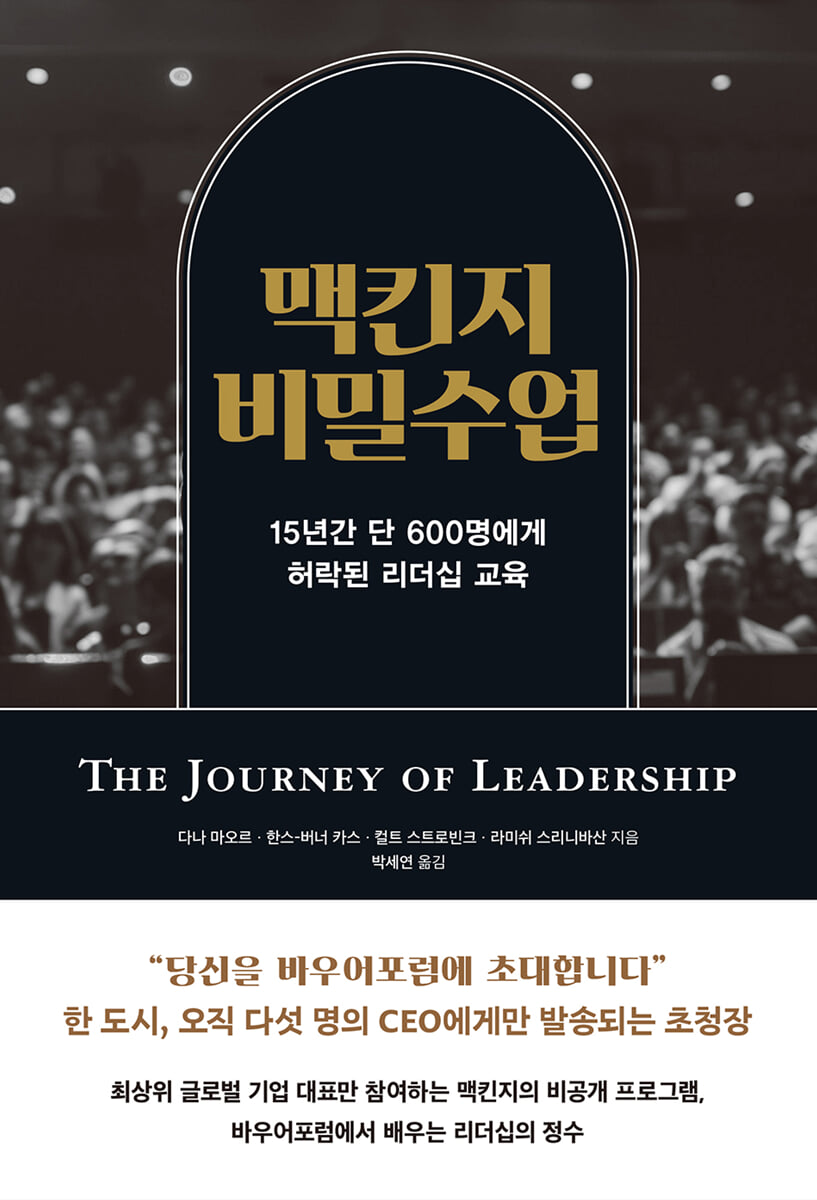
McKinsey Secret Class
 |
Description
Book Introduction
“You are invited to the Bauer Forum.”
BMW, PayPal, Ford, Novartis, Moderna, Bic, Nissan, Sunoco, etc.
McKinsey's private program, attended only by representatives of top global companies.
The Essence of Leadership Learned at the Bauer Forum
In an age of uncertainty, driven by the advancement of AI technology and the increasing complexity of multiple stakeholders, the impact a leader's judgment and actions have on an organization is paramount.
But while expectations for leadership are rising, real-world leaders are overwhelmed by the pressure, sometimes making poor choices and feeling frustrated.
To help alleviate these concerns, the book “McKinsey Secret Lessons” was published.
This book, based on the Bower Forum, a private CEO reboot program run by McKinsey, provides guidance on what true leadership is needed to run today's organizations.
The Bauer Forum began as a platform to discover and develop young, promising CEOs and has now expanded into a forum focused on management strategy and leadership for CEOs of global corporations.
It is a private program limited to invitation holders, and to date, more than 600 CEOs from leading global companies such as BMW, PayPal, Ford, Novartis, Moderna, BIC, Nissan, and Sunoco have participated (the organizations represented by the CEOs who participated in this program have over 14 million employees and annual sales of over $7.3 trillion).
"McKinsey Secrets" is a leadership masterclass that includes the concerns of prominent CEOs, their empathy and analysis, and solutions proposed by McKinsey coaches.
It is full of the rich experiences and business management cases of CEOs of global corporations, such as Moderna, which predicted the severity of COVID-19 by utilizing deep learning technology and decided to jump into producing a new vaccine for the entire organization; Delphi, which grew into a global automobile brand by maintaining a balance between human-centered leadership of motivation and imperial leadership of performance pressure; and Ford, which successfully turned a profit despite continuing losses by collecting open and honest opinions.
Furthermore, it goes beyond simply revealing the principles of leadership theory and strategy, providing a concrete checklist and including approximately 100 detailed approaches suggested by McKinsey coaches.
Anyone who dreams of growth as a leader, wondering how to bring about personal change and lead members of an organization, will find their answers in this book.
BMW, PayPal, Ford, Novartis, Moderna, Bic, Nissan, Sunoco, etc.
McKinsey's private program, attended only by representatives of top global companies.
The Essence of Leadership Learned at the Bauer Forum
In an age of uncertainty, driven by the advancement of AI technology and the increasing complexity of multiple stakeholders, the impact a leader's judgment and actions have on an organization is paramount.
But while expectations for leadership are rising, real-world leaders are overwhelmed by the pressure, sometimes making poor choices and feeling frustrated.
To help alleviate these concerns, the book “McKinsey Secret Lessons” was published.
This book, based on the Bower Forum, a private CEO reboot program run by McKinsey, provides guidance on what true leadership is needed to run today's organizations.
The Bauer Forum began as a platform to discover and develop young, promising CEOs and has now expanded into a forum focused on management strategy and leadership for CEOs of global corporations.
It is a private program limited to invitation holders, and to date, more than 600 CEOs from leading global companies such as BMW, PayPal, Ford, Novartis, Moderna, BIC, Nissan, and Sunoco have participated (the organizations represented by the CEOs who participated in this program have over 14 million employees and annual sales of over $7.3 trillion).
"McKinsey Secrets" is a leadership masterclass that includes the concerns of prominent CEOs, their empathy and analysis, and solutions proposed by McKinsey coaches.
It is full of the rich experiences and business management cases of CEOs of global corporations, such as Moderna, which predicted the severity of COVID-19 by utilizing deep learning technology and decided to jump into producing a new vaccine for the entire organization; Delphi, which grew into a global automobile brand by maintaining a balance between human-centered leadership of motivation and imperial leadership of performance pressure; and Ford, which successfully turned a profit despite continuing losses by collecting open and honest opinions.
Furthermore, it goes beyond simply revealing the principles of leadership theory and strategy, providing a concrete checklist and including approximately 100 detailed approaches suggested by McKinsey coaches.
Anyone who dreams of growth as a leader, wondering how to bring about personal change and lead members of an organization, will find their answers in this book.
- You can preview some of the book's contents.
Preview
index
Recommendation
Entering
Part 1.
Start with yourself
Chapter 1.
Humility: You're not the smartest person in the room.
Chapter 2.
Confidence: This is where you belong now.
Chapter 3.
Selflessness: Stop Trying to Prove Yourself
Chapter 4.
Vulnerability: Be Honest About Yourself
Chapter 5.
Resilience: What Matters Most After Failure
Chapter 6.
Flexibility: Move with agility
Part 2.
Go beyond yourself
Chapter 7.
Internalize your goals: Your limits are only what you set for yourself.
Chapter 8.
Inspiring Courage: Overcoming Fear
Chapter 9.
Delegating Authority: The Illusion of Control
Chapter 10.
Encouraging Truth-Telling: Everyone Has Secrets About Their Boss
Chapter 11.
Learning Without Fear: Practice Making Mistakes
Chapter 12.
Inspire Empathy: Take the initiative and express your interest.
conclusion.
The journey of leadership must continue.
Acknowledgements
supplement
main
Entering
Part 1.
Start with yourself
Chapter 1.
Humility: You're not the smartest person in the room.
Chapter 2.
Confidence: This is where you belong now.
Chapter 3.
Selflessness: Stop Trying to Prove Yourself
Chapter 4.
Vulnerability: Be Honest About Yourself
Chapter 5.
Resilience: What Matters Most After Failure
Chapter 6.
Flexibility: Move with agility
Part 2.
Go beyond yourself
Chapter 7.
Internalize your goals: Your limits are only what you set for yourself.
Chapter 8.
Inspiring Courage: Overcoming Fear
Chapter 9.
Delegating Authority: The Illusion of Control
Chapter 10.
Encouraging Truth-Telling: Everyone Has Secrets About Their Boss
Chapter 11.
Learning Without Fear: Practice Making Mistakes
Chapter 12.
Inspire Empathy: Take the initiative and express your interest.
conclusion.
The journey of leadership must continue.
Acknowledgements
supplement
main
Detailed image

Into the book
The journey of leadership is complex and nuanced.
First of all, personal growth is required.
Leaders must constantly learn, listen, and develop themselves as leaders by inspiring and engaging people.
Leadership is not only about performing endless tasks as an outstanding CEO, but also about understanding yourself as a human being and continuously developing yourself.
That is, changing yourself and others, that is the key.
--- p.14
The best leaders acknowledge that they don't have all the answers, and they frequently ask questions and listen to the answers of those around them.
Listening to others may seem like an easy task, but it's a very difficult skill for senior executives who have spent their careers rewarded for assertiveness, control, and confidence.
--- p.37
By revealing our vulnerabilities, we allow others to influence us, and at the same time, we gain support from others by sharing our hopes, fears, and concerns.
This attitude is a signal that you are strong, not weak.
--- p.111
Great leaders motivate through purpose.
But that's not the whole purpose.
Today's workers, especially millennials and Generation Z, want more.
But what do they really want? Feeding America CEO Claire Babineau-Fontenot always focuses on the "why" when recruiting or motivating employees.
She always has comfortable and honest conversations with her employees to understand their goals and intentions.
A leader's challenge is to understand what employees want out of life and figure out how to connect that to the company's strategy.
--- p.184
Once you've identified what needs to be prioritized, it's time to set a direction and take a step back.
In other words, rather than giving instructions to employees, you should ask them questions so that they think for themselves.
Leaders can share their experiences, but employees must find the answers to their own questions.
--- p.227
“We saw that list as a mix of the Declaration of Independence and the U.S. Constitution.
One executive said this:
“A lot of companies have an inspiring vision hanging on their wall, but no one puts it into practice,” Chapman replied.
“We will hang it not on the office walls, but in the hearts and minds of our employees.”
--- p.293
Leadership is ultimately about personal transformation and inspiring others to follow your journey while driving the change you want to see in the world.
First of all, personal growth is required.
Leaders must constantly learn, listen, and develop themselves as leaders by inspiring and engaging people.
Leadership is not only about performing endless tasks as an outstanding CEO, but also about understanding yourself as a human being and continuously developing yourself.
That is, changing yourself and others, that is the key.
--- p.14
The best leaders acknowledge that they don't have all the answers, and they frequently ask questions and listen to the answers of those around them.
Listening to others may seem like an easy task, but it's a very difficult skill for senior executives who have spent their careers rewarded for assertiveness, control, and confidence.
--- p.37
By revealing our vulnerabilities, we allow others to influence us, and at the same time, we gain support from others by sharing our hopes, fears, and concerns.
This attitude is a signal that you are strong, not weak.
--- p.111
Great leaders motivate through purpose.
But that's not the whole purpose.
Today's workers, especially millennials and Generation Z, want more.
But what do they really want? Feeding America CEO Claire Babineau-Fontenot always focuses on the "why" when recruiting or motivating employees.
She always has comfortable and honest conversations with her employees to understand their goals and intentions.
A leader's challenge is to understand what employees want out of life and figure out how to connect that to the company's strategy.
--- p.184
Once you've identified what needs to be prioritized, it's time to set a direction and take a step back.
In other words, rather than giving instructions to employees, you should ask them questions so that they think for themselves.
Leaders can share their experiences, but employees must find the answers to their own questions.
--- p.227
“We saw that list as a mix of the Declaration of Independence and the U.S. Constitution.
One executive said this:
“A lot of companies have an inspiring vision hanging on their wall, but no one puts it into practice,” Chapman replied.
“We will hang it not on the office walls, but in the hearts and minds of our employees.”
--- p.293
Leadership is ultimately about personal transformation and inspiring others to follow your journey while driving the change you want to see in the world.
--- p.328
Publisher's Review
What makes leaders who transform organizations different?
12 McKinsey Coaching Tips in One Book
Leadership Success Stories Verified by 24 Global CEOs
What concerns do the world's top CEOs and leaders have? Like other managers, they have common concerns.
“As the final decision maker, I feel too much pressure,” “There’s no one to ask for advice,” “I want to provide genuine motivation to my team members, not pressure them to achieve results,” etc.
In fact, one study found that 83 percent of leaders worldwide feel unprepared to lead.
"McKinsey Secret Lessons" vividly records the struggles and frustrations of leadership that CEOs candidly shared at the forum, as well as their journeys to overcome them.
Rather than simply providing management strategies or business management theories, the experiences of actual CEOs and the case-by-case advice and insights from McKinsey partners provide a fresh perspective on the essence of leadership.
For example, the successful experience of Moderna CEO Stéphane Bancel, who developed a COVID-19 vaccine by predicting the spread of the epidemic, shows how a leader can embrace opposing views while still ensuring that everyone in the organization works toward a common goal.
In late 2019, after reading an article about an unfamiliar type of flu outbreak in China, Bangcel closely analyzed previous epidemics and vaccine development practices and concluded that the new infectious disease would pose a serious threat to humanity.
Immediately after that, preparations to develop a vaccine began.
However, at the time, Moderna had only 800 employees and lacked the facilities to mass-produce the vaccine, so bold investment was necessary.
It was also possible that the vaccine might not be effective or might not receive approval from the Food and Drug Administration.
Moderna also had no experience in mass-producing vaccines.
But when Bangsel spoke about the possibility of failure, both internally and externally, he remained unwavering. Instead, he clearly communicated to his employees his goals and the direction the company should take.
Despite opposition from management and investors, he gained their agreement by believing that humanity could be saved through vaccine development.
Bancel's conviction energized the organization, uniting it in pursuit of a goal that transcended mere corporate profits and toward the safety of humanity.
Finally, Moderna achieved a vaccine development that would normally take years in less than a year.
Moderna's success story clearly demonstrates that even if today's leaders cannot control every variable in the corporate environment, the essence of leadership lies in reorganizing the organization around a single vision.
In particular, this book emphasizes the importance of 'confidence', one of the essential leadership requirements, and is a representative example of instilling 'courage' into an organization based on that confidence.
The 2006 Ford case also illustrates the influence of one leader.
Ford, which was facing a crisis due to persistent deficits, hired Alan Mulally, CEO of Boeing.
As soon as Mulally arrived at Ford, he established a standard that allowed for projects to be canceled midway, even if they had already been approved.
We felt that projects that were approved at management meetings had problems proceeding even if they were unprofitable or had the wrong direction.
The executives and managers who had passed the project were afraid to admit their mistakes.
Mulally, who recognized this, held regular meetings with executives to discuss the feasibility of projects, and as a result, Ford was transformed into an agile company capable of changing direction quickly.
A few years later, Ford managed to turn a profit.
During Mulally's tenure as CEO, Ford's stock price more than doubled.
He is credited with fundamentally changing Ford's corporate culture.
To understand what's happening now, leaders must look deep into their organizations.
While increasing accessibility and lowering the barriers to conversation are important, they are not enough.
As we saw in the Ford case, people don't tell their bosses the truth about their current situation for fear of being criticized or reprimanded.
_Page 248
Mindset, communication, resilience, empowerment…
Personal growth and organizational performance at the same time!
The Complete Guidebook for Forward-Looking Leaders
"McKinsey Secrets" is not simply a book of theories on how to lead an organization or how to get employees to follow you.
Rather, it is a book that depicts the process of CEOs gathering together to share their concerns and, based on empathy and analysis, to explore from within themselves the essence of leadership.
In Part 1, “Starting with Yourself,” the six essential qualities required of today’s leaders are defined as “humility,” “confidence,” “altruism,” “vulnerability,” “resilience,” and “flexibility.”
Leaders must constantly learn, listen, inspire passion in people, and engage with them, focusing on these six areas to continuously develop themselves as leaders.
The authors argue that leadership goes beyond simply influencing others; it is achieved through growing and continually developing as a person.
In other words, the key is to change yourself first before changing others.
If a leader has successfully transformed and developed himself from within, the next step is to influence the members of the organization beyond himself.
Part 2 of the book, "Beyond Yourself," focuses on the human aspect of how to transform organizations and their individual members by leveraging the six internal factors mentioned above.
This vivid example demonstrates how leaders can drive real change within their organizations, including creating a shared purpose across the organization, encouraging honest opinions, and instilling courage and empathy.
As the authors say, the best leadership is "not a skill, but a journey of endless self-improvement."
"McKinsey Secrets" provides concrete, practical examples of how to begin and continue that journey, offering readers the opportunity to reflect on themselves and grow into better leaders.
12 McKinsey Coaching Tips in One Book
Leadership Success Stories Verified by 24 Global CEOs
What concerns do the world's top CEOs and leaders have? Like other managers, they have common concerns.
“As the final decision maker, I feel too much pressure,” “There’s no one to ask for advice,” “I want to provide genuine motivation to my team members, not pressure them to achieve results,” etc.
In fact, one study found that 83 percent of leaders worldwide feel unprepared to lead.
"McKinsey Secret Lessons" vividly records the struggles and frustrations of leadership that CEOs candidly shared at the forum, as well as their journeys to overcome them.
Rather than simply providing management strategies or business management theories, the experiences of actual CEOs and the case-by-case advice and insights from McKinsey partners provide a fresh perspective on the essence of leadership.
For example, the successful experience of Moderna CEO Stéphane Bancel, who developed a COVID-19 vaccine by predicting the spread of the epidemic, shows how a leader can embrace opposing views while still ensuring that everyone in the organization works toward a common goal.
In late 2019, after reading an article about an unfamiliar type of flu outbreak in China, Bangcel closely analyzed previous epidemics and vaccine development practices and concluded that the new infectious disease would pose a serious threat to humanity.
Immediately after that, preparations to develop a vaccine began.
However, at the time, Moderna had only 800 employees and lacked the facilities to mass-produce the vaccine, so bold investment was necessary.
It was also possible that the vaccine might not be effective or might not receive approval from the Food and Drug Administration.
Moderna also had no experience in mass-producing vaccines.
But when Bangsel spoke about the possibility of failure, both internally and externally, he remained unwavering. Instead, he clearly communicated to his employees his goals and the direction the company should take.
Despite opposition from management and investors, he gained their agreement by believing that humanity could be saved through vaccine development.
Bancel's conviction energized the organization, uniting it in pursuit of a goal that transcended mere corporate profits and toward the safety of humanity.
Finally, Moderna achieved a vaccine development that would normally take years in less than a year.
Moderna's success story clearly demonstrates that even if today's leaders cannot control every variable in the corporate environment, the essence of leadership lies in reorganizing the organization around a single vision.
In particular, this book emphasizes the importance of 'confidence', one of the essential leadership requirements, and is a representative example of instilling 'courage' into an organization based on that confidence.
The 2006 Ford case also illustrates the influence of one leader.
Ford, which was facing a crisis due to persistent deficits, hired Alan Mulally, CEO of Boeing.
As soon as Mulally arrived at Ford, he established a standard that allowed for projects to be canceled midway, even if they had already been approved.
We felt that projects that were approved at management meetings had problems proceeding even if they were unprofitable or had the wrong direction.
The executives and managers who had passed the project were afraid to admit their mistakes.
Mulally, who recognized this, held regular meetings with executives to discuss the feasibility of projects, and as a result, Ford was transformed into an agile company capable of changing direction quickly.
A few years later, Ford managed to turn a profit.
During Mulally's tenure as CEO, Ford's stock price more than doubled.
He is credited with fundamentally changing Ford's corporate culture.
To understand what's happening now, leaders must look deep into their organizations.
While increasing accessibility and lowering the barriers to conversation are important, they are not enough.
As we saw in the Ford case, people don't tell their bosses the truth about their current situation for fear of being criticized or reprimanded.
_Page 248
Mindset, communication, resilience, empowerment…
Personal growth and organizational performance at the same time!
The Complete Guidebook for Forward-Looking Leaders
"McKinsey Secrets" is not simply a book of theories on how to lead an organization or how to get employees to follow you.
Rather, it is a book that depicts the process of CEOs gathering together to share their concerns and, based on empathy and analysis, to explore from within themselves the essence of leadership.
In Part 1, “Starting with Yourself,” the six essential qualities required of today’s leaders are defined as “humility,” “confidence,” “altruism,” “vulnerability,” “resilience,” and “flexibility.”
Leaders must constantly learn, listen, inspire passion in people, and engage with them, focusing on these six areas to continuously develop themselves as leaders.
The authors argue that leadership goes beyond simply influencing others; it is achieved through growing and continually developing as a person.
In other words, the key is to change yourself first before changing others.
If a leader has successfully transformed and developed himself from within, the next step is to influence the members of the organization beyond himself.
Part 2 of the book, "Beyond Yourself," focuses on the human aspect of how to transform organizations and their individual members by leveraging the six internal factors mentioned above.
This vivid example demonstrates how leaders can drive real change within their organizations, including creating a shared purpose across the organization, encouraging honest opinions, and instilling courage and empathy.
As the authors say, the best leadership is "not a skill, but a journey of endless self-improvement."
"McKinsey Secrets" provides concrete, practical examples of how to begin and continue that journey, offering readers the opportunity to reflect on themselves and grow into better leaders.
GOODS SPECIFICS
- Date of issue: September 17, 2025
- Page count, weight, size: 368 pages | 568g | 153*224*22mm
- ISBN13: 9791141613006
- ISBN10: 114161300X
You may also like
카테고리
korean


korean

![GQ KOREA Mark (Monthly): December [2025]](http://librairie.coreenne.fr/cdn/shop/files/8ef265dbbfbf186523ed75ba7319009d.jpg?v=1765340328&width=3840)


