

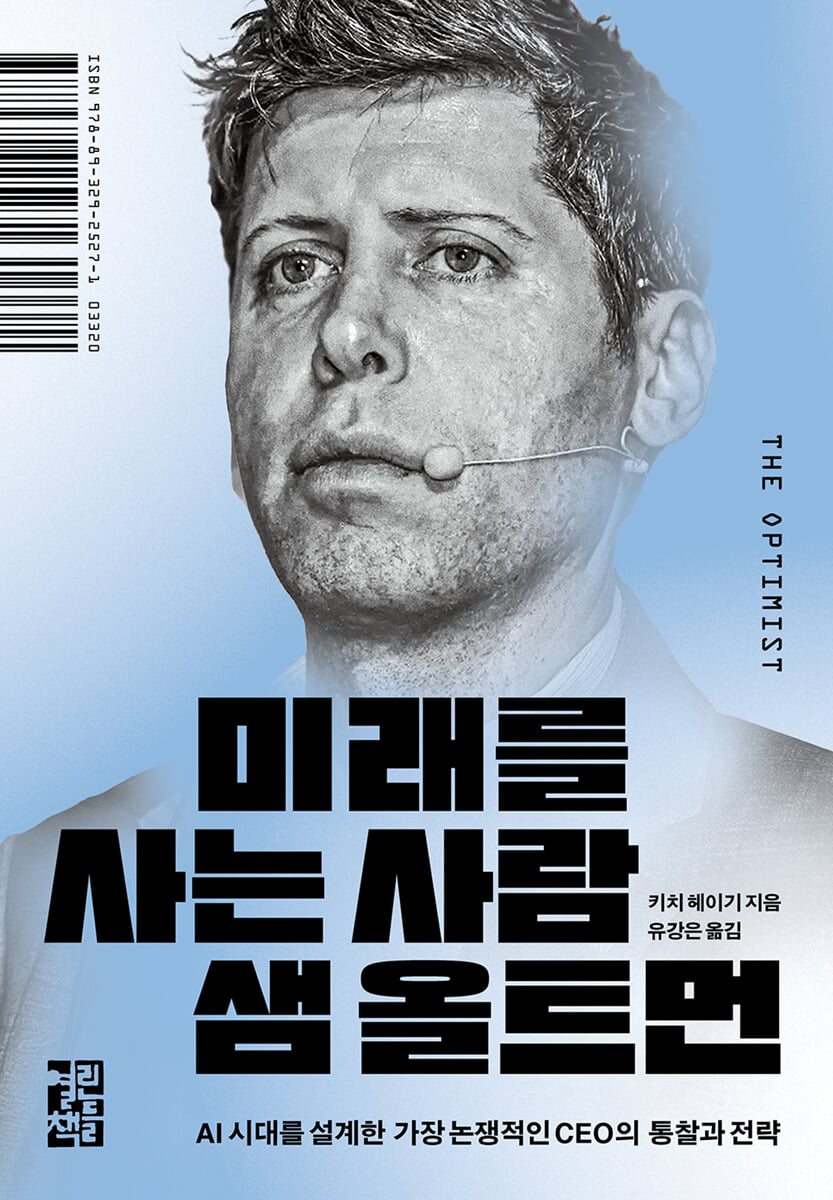
Sam Altman, the man who lives in the future
 |
Description
Book Introduction
- A word from MD
-
The name that changed the course of big techThe artificial intelligence revolution that shook the world began with a single message left on social media by Sam Altman: "ChatGPT Launch."
At the center of ChatGPT, which has become a signal that will change the future of technology, is Sam Altman, CEO of OpenAI.
A book that tells the story of his childhood and his rise to become a giant in the Big Tech industry.
July 25, 2025. Economics and Management PD Oh Da-eun
The charismatic self-contradiction of Sam Altman, who calls himself the messiah of the artificial intelligence era.
It contains everything and shows his true nature in detail.
Artificial intelligence is changing human society
A must-read for anyone worried about turning things around or even ending them.
― Steve Cole, Pulitzer Prize-winning journalist
Everything You Need to Know About Sam Altman, the Father of ChatGPT and CEO of OpenAI
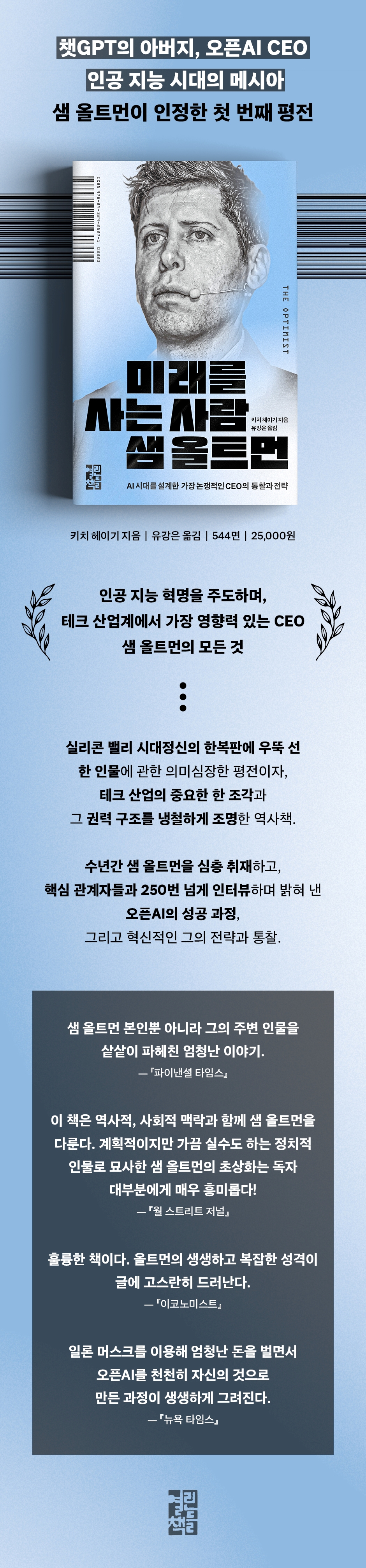
Sam Altman, a book that delves into everything about Sam Altman, one of the most influential people in the world today, has been published by Open Books.
Sam Altman, a young guru who best embodies the zeitgeist of Silicon Valley since Steve Jobs, who stands on the shoulders of Elon Musk and is a hot topic that Mark Zuckerberg is challenging, is currently at the forefront of the global revolution moving towards the era of super-AI.
He even has the will to enter politics in the future for the sake of humanity.
The person who dissected the great 40-year-old CEO Sam Altman was Wall Street Journal reporter Kitsch Hagy.
To find out who Altman really was, she conducted over 250 interviews with his family, friends, teachers, mentors, co-founders, colleagues, investors, portfolio companies, and others, as well as extensive conversations with Altman himself.
The resulting character is a clever deal-maker who values speed and enjoys risk.
Sam Altman believes in technological progress with an almost religious conviction, but sometimes it moves too fast for those around him to keep up, and he doesn't like confrontation, which sometimes leads to bigger conflicts.
But each time he fell, he came back stronger.
This book meticulously depicts the big and small moments of Sam Altman's growth, from his precocious childhood in St. Louis, his first failed startup attempt, his rise as a protégé and successor to legendary entrepreneur Paul Graham, to his rise as the CEO of the startup accelerator Y Combinator and a leading figure in Silicon Valley, to his founding of OpenAI and his selection of a small, elite team, and his struggles to remain a leader in artificial intelligence while fending off fierce competitors, including his old friend and now arch-enemy Elon Musk.
It contains everything and shows his true nature in detail.
Artificial intelligence is changing human society
A must-read for anyone worried about turning things around or even ending them.
― Steve Cole, Pulitzer Prize-winning journalist
Everything You Need to Know About Sam Altman, the Father of ChatGPT and CEO of OpenAI
Sam Altman, a book that delves into everything about Sam Altman, one of the most influential people in the world today, has been published by Open Books.
Sam Altman, a young guru who best embodies the zeitgeist of Silicon Valley since Steve Jobs, who stands on the shoulders of Elon Musk and is a hot topic that Mark Zuckerberg is challenging, is currently at the forefront of the global revolution moving towards the era of super-AI.
He even has the will to enter politics in the future for the sake of humanity.
The person who dissected the great 40-year-old CEO Sam Altman was Wall Street Journal reporter Kitsch Hagy.
To find out who Altman really was, she conducted over 250 interviews with his family, friends, teachers, mentors, co-founders, colleagues, investors, portfolio companies, and others, as well as extensive conversations with Altman himself.
The resulting character is a clever deal-maker who values speed and enjoys risk.
Sam Altman believes in technological progress with an almost religious conviction, but sometimes it moves too fast for those around him to keep up, and he doesn't like confrontation, which sometimes leads to bigger conflicts.
But each time he fell, he came back stronger.
This book meticulously depicts the big and small moments of Sam Altman's growth, from his precocious childhood in St. Louis, his first failed startup attempt, his rise as a protégé and successor to legendary entrepreneur Paul Graham, to his rise as the CEO of the startup accelerator Y Combinator and a leading figure in Silicon Valley, to his founding of OpenAI and his selection of a small, elite team, and his struggles to remain a leader in artificial intelligence while fending off fierce competitors, including his old friend and now arch-enemy Elon Musk.
- You can preview some of the book's contents.
Preview
index
prolog
Part 1 1985–2005
1 Chicago
2 St. Louis
3 [Where are you now?]
4 [Nerds among nerds]
Part 2 2005–2012
5 [Pause]
6 [Where are you now?]
7 From [Not so good] to [It's cool]
8. The Bad Guy Badge
Part 3 2012–2019
9 [Get on the Rocket]
10 [Sam Altman for President]
11 [Manhattan Project for AI]
12 Altruists
13 Turning to Profit
Part 4 2019-2024
14 products
15 ChatGPT
16 Temporary problems
17 Prometheus Released
Epilogue
Acknowledgements
main
Search
Part 1 1985–2005
1 Chicago
2 St. Louis
3 [Where are you now?]
4 [Nerds among nerds]
Part 2 2005–2012
5 [Pause]
6 [Where are you now?]
7 From [Not so good] to [It's cool]
8. The Bad Guy Badge
Part 3 2012–2019
9 [Get on the Rocket]
10 [Sam Altman for President]
11 [Manhattan Project for AI]
12 Altruists
13 Turning to Profit
Part 4 2019-2024
14 products
15 ChatGPT
16 Temporary problems
17 Prometheus Released
Epilogue
Acknowledgements
main
Search
Detailed image
Into the book
On a sunny evening in mid-November 2023, renowned venture capitalist Peter Thiel threw his gay husband, Matt Danzizen, a birthday party at YESS, an avant-garde Japanese restaurant housed in a century-old bank building in the Los Angeles Arts District.
---From the "first sentence"
Altman didn't actually write the code.
Instead, he was a prophet, an evangelist, and a deal maker.
In the 19th century, it would probably have been called an "entertainer."
His specialty, honed over years of advising and later running the top startup accelerator Y Combinator, is taking the near-impossible, convincing others that it's possible, and then raising a lot of money to make it happen.
--- p.13
“It wasn’t that long ago that almost no one believed in general artificial intelligence.
Even now, most people probably don't believe it.
But I see more people now willing to enjoy it.
Many parts of the world will go through what most people here have been going through in the past few years.
It's about wrestling with artificial intelligence.
This process is difficult.
It's exciting too.
It's also scary.
Because it is such a great thing.
So I think this process will unfold around the world over the next few years, and we'll try to be a guiding voice for a while."
--- p.23
After thinking about it for a while, I realized that I needed to first decide what I actually wanted to do.
I picked up a piece of paper that was lying around and scribbled down a list.
At the top of the list were, in order, artificial intelligence, nuclear energy, and education.
--- p.92
"Sam has a reputation for being far more business-savvy and success-driven than most," he added.
“That guy seemed like he came in a hurry.
And it seemed like he was going somewhere else.
--- p.122
Altman learned a fundamental lesson from this deal.
"It was about how you have to be persistent in whatever you do." Even after all these years, Weiner vividly remembers his first encounter with Altman.
“Anyone who met him at the time wished they had some of the talent he had.
I felt like I could do anything.
He was very optimistic.
He has both determination and an optimistic attitude.
“I have rarely been skeptical about anything.”
--- p.160
Thiel described Altman as not only “very, very smart,” but also “principled, rigorous, very balanced,” and “perhaps a little too optimistic.”
His charm was not, above all, what he knew, but who he knew.
--- p.218
But Graham had no doubts about Altman's talent and skill.
"He's one of those rare people who is frighteningly competent, yet fundamentally good.
People don't realize it, but these qualities are essential in early-stage investing.
--- p.238
“One of Sam’s qualities is that he does things right.
He seems to be drawn to messy and complex deals.
I'm actually excited about that kind of deal.
“More than anyone I know, he loves jumping into complex, chaotic situations and making deals and building relationships,” Huffman says.
--- p.259~260
Despite all the early failures, OpenAI knew it needed funding more than algorithms, and Sam Altman was the man they needed most at that moment.
--- p.378
These developments allowed Altman to make his most compelling argument yet: that he was playing a role in completely transforming society.
Working at Open AI reminds me every day of the scale of socio-economic change that is coming faster than most people realize.
Software that can think and learn will increasingly take over the work that people do today.
〉A lot more power will shift from labor to capital.
--- p.403
On November 30, 2022, Altman tweeted a short, concise statement in his signature all-lowercase style.
〈We are launching Chat GPT today.
Chat with us at the following address:
chat.openai.com.〉
--- p.424
That evening, Nadella tweeted that Microsoft would hire Altman and Brockman, and invited other OpenAI employees to join.
By dawn Monday, more than 700 of the company's 770 employees had signed a fiery letter demanding the reinstatement of Altman and Brockman and threatening to resign and join Microsoft if the board did not resign.
--- p.463
In the same interview, Altman sidestepped questions about his political aspirations, saying he was too busy working on artificial intelligence to think about such issues.
"To be honest, I don't have time for politics," he said. But Altman never gave up on his ambition.
--- p.466
He continued to add sentences that perhaps only he could write.
〈This will turn out to be the most important fact in all history to date.
We may have superintelligence in a few thousand days(!).
It may take longer, but I am confident we will get there.
---From the "first sentence"
Altman didn't actually write the code.
Instead, he was a prophet, an evangelist, and a deal maker.
In the 19th century, it would probably have been called an "entertainer."
His specialty, honed over years of advising and later running the top startup accelerator Y Combinator, is taking the near-impossible, convincing others that it's possible, and then raising a lot of money to make it happen.
--- p.13
“It wasn’t that long ago that almost no one believed in general artificial intelligence.
Even now, most people probably don't believe it.
But I see more people now willing to enjoy it.
Many parts of the world will go through what most people here have been going through in the past few years.
It's about wrestling with artificial intelligence.
This process is difficult.
It's exciting too.
It's also scary.
Because it is such a great thing.
So I think this process will unfold around the world over the next few years, and we'll try to be a guiding voice for a while."
--- p.23
After thinking about it for a while, I realized that I needed to first decide what I actually wanted to do.
I picked up a piece of paper that was lying around and scribbled down a list.
At the top of the list were, in order, artificial intelligence, nuclear energy, and education.
--- p.92
"Sam has a reputation for being far more business-savvy and success-driven than most," he added.
“That guy seemed like he came in a hurry.
And it seemed like he was going somewhere else.
--- p.122
Altman learned a fundamental lesson from this deal.
"It was about how you have to be persistent in whatever you do." Even after all these years, Weiner vividly remembers his first encounter with Altman.
“Anyone who met him at the time wished they had some of the talent he had.
I felt like I could do anything.
He was very optimistic.
He has both determination and an optimistic attitude.
“I have rarely been skeptical about anything.”
--- p.160
Thiel described Altman as not only “very, very smart,” but also “principled, rigorous, very balanced,” and “perhaps a little too optimistic.”
His charm was not, above all, what he knew, but who he knew.
--- p.218
But Graham had no doubts about Altman's talent and skill.
"He's one of those rare people who is frighteningly competent, yet fundamentally good.
People don't realize it, but these qualities are essential in early-stage investing.
--- p.238
“One of Sam’s qualities is that he does things right.
He seems to be drawn to messy and complex deals.
I'm actually excited about that kind of deal.
“More than anyone I know, he loves jumping into complex, chaotic situations and making deals and building relationships,” Huffman says.
--- p.259~260
Despite all the early failures, OpenAI knew it needed funding more than algorithms, and Sam Altman was the man they needed most at that moment.
--- p.378
These developments allowed Altman to make his most compelling argument yet: that he was playing a role in completely transforming society.
Working at Open AI reminds me every day of the scale of socio-economic change that is coming faster than most people realize.
Software that can think and learn will increasingly take over the work that people do today.
〉A lot more power will shift from labor to capital.
--- p.403
On November 30, 2022, Altman tweeted a short, concise statement in his signature all-lowercase style.
〈We are launching Chat GPT today.
Chat with us at the following address:
chat.openai.com.〉
--- p.424
That evening, Nadella tweeted that Microsoft would hire Altman and Brockman, and invited other OpenAI employees to join.
By dawn Monday, more than 700 of the company's 770 employees had signed a fiery letter demanding the reinstatement of Altman and Brockman and threatening to resign and join Microsoft if the board did not resign.
--- p.463
In the same interview, Altman sidestepped questions about his political aspirations, saying he was too busy working on artificial intelligence to think about such issues.
"To be honest, I don't have time for politics," he said. But Altman never gave up on his ambition.
--- p.466
He continued to add sentences that perhaps only he could write.
〈This will turn out to be the most important fact in all history to date.
We may have superintelligence in a few thousand days(!).
It may take longer, but I am confident we will get there.
--- p.498
Publisher's Review
How Big Tech's Top Leaders Are Thinking About the Future
Sam Altman is the CEO of one of the most notable AI companies in Korea.
The Lee Jae-myung administration, aiming to join the ranks of the "Top 3 AI Powerhouses," created a new position of Chief AI Officer and appointed Ha Jung-woo, former head of Naver's Cloud AI Innovation Center, as the first Chief Secretary for AI Future Planning.
It was also announced that Sam Altman would be invited to the APEC CEO Summit in October of this year.
That's not all.
Kitsch Heygi's book, "Sam Altman: The Man Who Lives for the Future," published in May, is scheduled to be published in 12 countries, including Korea, Germany, Japan, and China. In addition, "The Altman Upset," which follows Sam Altman's 2023 firing and subsequent return to the company five days later, is scheduled to be made into a movie by Amazon MGM Studios.
The reason why not only Korea but the entire world is watching Altman's every move is because, as a leader of the artificial intelligence revolution, he is living further into the future, faster than anyone else.
Sam Altman became his first startup CEO at the age of 19. As a venture capitalist and head of Y Combinator, he has helped build thousands of technology companies. He is also the person responsible for instantly improving our daily lives by launching ChatGPT, a conversational artificial intelligence service.
In addition to artificial intelligence, we also provide generous support to startups that address the future of humanity, such as nuclear fusion technology and hair loss.
Although it is the personal history of a successful CEO, it also provides an engaging account of OpenAI's success among countless startups that have since disappeared, as well as the outstanding Altmanian management style that earned him the support of over 700 employees and the board of directors who tried to oust him, the competencies and communication skills that an entrepreneur must possess, and how to gain insight as an investor.
Moreover, the behind-the-scenes stories of startups worth referencing are answered honestly by those with actual experience, so they also contain valuable inspiration from various big tech entrepreneurs that you won't find anywhere else.
Above all, Altman's optimistic mindset that [the future will be better] extends beyond the realm of entrepreneurship and extends to his personal life philosophy.
Therefore, we too can find answers to how to manage and run our lives through the strategies and insights that Sam Altman presents.
Sam Altman is the CEO of one of the most notable AI companies in Korea.
The Lee Jae-myung administration, aiming to join the ranks of the "Top 3 AI Powerhouses," created a new position of Chief AI Officer and appointed Ha Jung-woo, former head of Naver's Cloud AI Innovation Center, as the first Chief Secretary for AI Future Planning.
It was also announced that Sam Altman would be invited to the APEC CEO Summit in October of this year.
That's not all.
Kitsch Heygi's book, "Sam Altman: The Man Who Lives for the Future," published in May, is scheduled to be published in 12 countries, including Korea, Germany, Japan, and China. In addition, "The Altman Upset," which follows Sam Altman's 2023 firing and subsequent return to the company five days later, is scheduled to be made into a movie by Amazon MGM Studios.
The reason why not only Korea but the entire world is watching Altman's every move is because, as a leader of the artificial intelligence revolution, he is living further into the future, faster than anyone else.
Sam Altman became his first startup CEO at the age of 19. As a venture capitalist and head of Y Combinator, he has helped build thousands of technology companies. He is also the person responsible for instantly improving our daily lives by launching ChatGPT, a conversational artificial intelligence service.
In addition to artificial intelligence, we also provide generous support to startups that address the future of humanity, such as nuclear fusion technology and hair loss.
Although it is the personal history of a successful CEO, it also provides an engaging account of OpenAI's success among countless startups that have since disappeared, as well as the outstanding Altmanian management style that earned him the support of over 700 employees and the board of directors who tried to oust him, the competencies and communication skills that an entrepreneur must possess, and how to gain insight as an investor.
Moreover, the behind-the-scenes stories of startups worth referencing are answered honestly by those with actual experience, so they also contain valuable inspiration from various big tech entrepreneurs that you won't find anywhere else.
Above all, Altman's optimistic mindset that [the future will be better] extends beyond the realm of entrepreneurship and extends to his personal life philosophy.
Therefore, we too can find answers to how to manage and run our lives through the strategies and insights that Sam Altman presents.
GOODS SPECIFICS
- Date of issue: July 10, 2025
- Page count, weight, size: 544 pages | 854g | 153*217*37mm
- ISBN13: 9788932925271
- ISBN10: 8932925275
You may also like
카테고리
korean


korean

![ELLE 엘르 스페셜 에디션 A형 : 12월 [2025]](http://librairie.coreenne.fr/cdn/shop/files/b8e27a3de6c9538896439686c6b0e8fb.jpg?v=1766436872&width=3840)


