

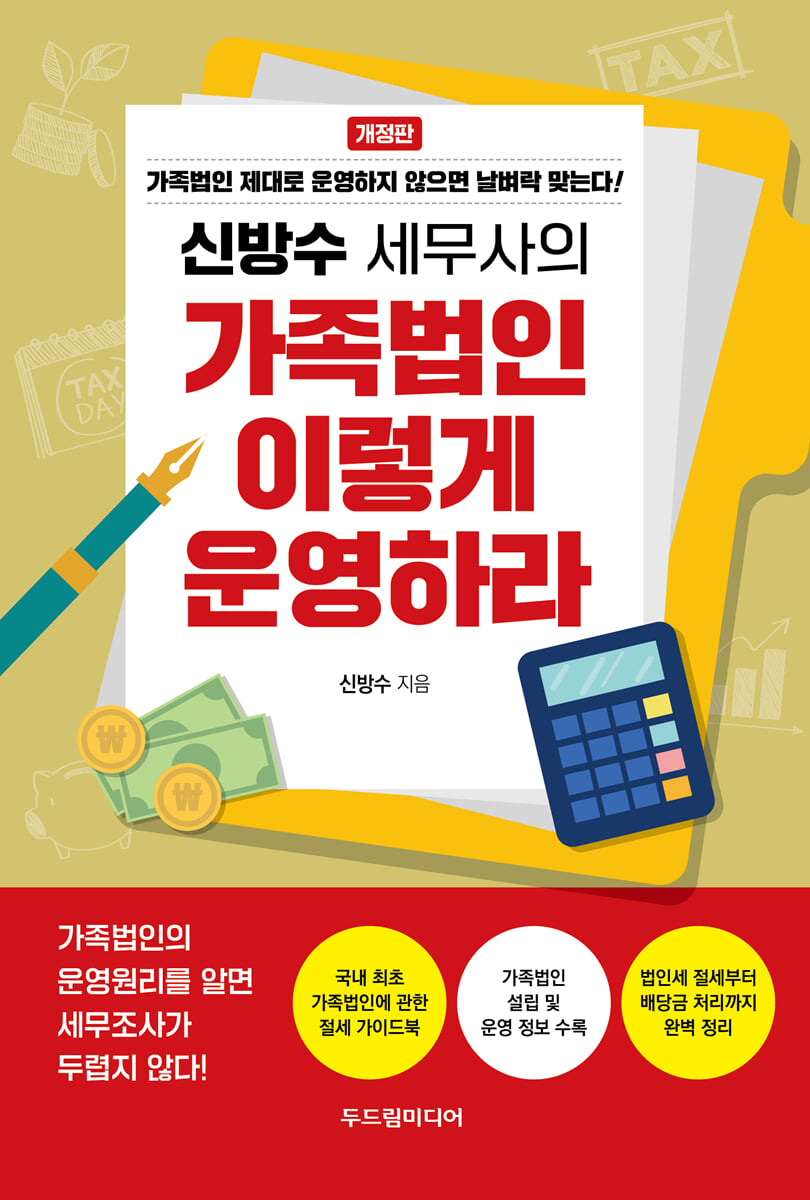
How to Run a Family Corporation, According to Tax Accountant Shin Bang-soo
 |
Description
Book Introduction
If you don't run your family corporation properly, you'll be struck by lightning!
A family corporation is a company that is run primarily by family members.
The advantage is that decision-making speed is fast and the burden of tax can be reduced.
However, there is also a disadvantage in that tax management is difficult because ownership and management are not separated.
If you use company money as you please, you may be subject to corporate tax, income tax, etc., and you may face difficulties due to a sudden tax audit.
This is what happens when a corporation is treated as if it were an individual, even though individuals and corporations are strictly distinguished under the law.
Therefore, even the smallest corporation can prevent these risks only by managing itself in accordance with the principles stipulated in commercial law and tax law.
Against this backdrop, this book was written to systematically convey the legal and tax information that family corporations need to know.
The first feature of this book is that it covers all tax issues necessary for operating a family corporation.
Second, we have made it easier to solve problems by providing various practical examples.
Third, it contains all the latest information specialized for family corporations.
Since the current tax system is mostly targeted at general corporations, it is often unreasonable to apply it directly to family corporations.
Therefore, family corporations need to properly manage their internal affairs in a way that suits their characteristics.
This book provides up-to-date information on fund management, executive compensation, dividend processing, inheritance, and gifts, minimizing tax issues and helping you properly manage your family corporation!
A family corporation is a company that is run primarily by family members.
The advantage is that decision-making speed is fast and the burden of tax can be reduced.
However, there is also a disadvantage in that tax management is difficult because ownership and management are not separated.
If you use company money as you please, you may be subject to corporate tax, income tax, etc., and you may face difficulties due to a sudden tax audit.
This is what happens when a corporation is treated as if it were an individual, even though individuals and corporations are strictly distinguished under the law.
Therefore, even the smallest corporation can prevent these risks only by managing itself in accordance with the principles stipulated in commercial law and tax law.
Against this backdrop, this book was written to systematically convey the legal and tax information that family corporations need to know.
The first feature of this book is that it covers all tax issues necessary for operating a family corporation.
Second, we have made it easier to solve problems by providing various practical examples.
Third, it contains all the latest information specialized for family corporations.
Since the current tax system is mostly targeted at general corporations, it is often unreasonable to apply it directly to family corporations.
Therefore, family corporations need to properly manage their internal affairs in a way that suits their characteristics.
This book provides up-to-date information on fund management, executive compensation, dividend processing, inheritance, and gifts, minimizing tax issues and helping you properly manage your family corporation!
index
Preface 4
Chapter 1.
Analysis of the benefits of family corporations
01.
Is a family corporation the right answer? · 14
02.
Pros and Cons of Sole Proprietorship · 16
03.
Pros and Cons of Incorporating a Business · 19
04.
Tips for Choosing Between Individual and Corporation Businesses · 23
05.
Decision to Convert a Sole Proprietorship to a Corporation · 29
[In-Depth Analysis] Taxes incurred when operating a family corporation · 36
Chapter 2.
How to Properly Establish a Family Corporation
01.
Comparison of Sole Proprietorships, Family Corporations, and General Corporations · 42
02.
How to Create a Family Corporation · 46
03.
Determining the scope of business purpose · 53
04.
Choosing Between a Joint Stock Company and a Limited Company · 55
05.
Determination of capital size · 60
06.
Method of Composing Shareholders (Members) · 64
07.
Decisions by Directors, CEO, and Auditors · 72
08.
Determination of Headquarters Location · 81
09.
Drafting and Amending the Articles of Incorporation · 88
10.
Establishment Registration, Establishment Report, and Business Registration · 94
[In-Depth Analysis 1] Incorporation and Operation Schedule · 99
[In-Depth Analysis 2] Regulations on Payment of Executive Bonuses and Executive Severance Pay (Including Severance Pay) · 102
[In-Depth Analysis 3] Tax Flow for New Corporations · 106
Chapter 3.
Family corporation fund management method
01.
Family Corporation Financing and Tax Issues · 112
02.
Use of Funds and Tax Issues · 117
03.
Tax Management Act on the Payment of Representative Director's Wages · 122
04.
Personal Loan (Deposit) Tax Management Act · 128
05.
Family Corporation Card Management Act · 132
[In-Depth Analysis 1] Evidence Management Act · 136
[In-Depth Analysis 2] Submission of Withholding Tax, Payment Statements, and Wage Statements · 139
Chapter 4.
How to handle expenses of a family corporation
01.
What is Cost? · 144
02.
Personnel Expense Management Act for Executives and Employees of Family Corporations · 147
03.
Things to Keep in Mind When Paying Executive Salaries · 154
04.
Things to Consider When Paying Salary to Family Members · 160
05.
Welfare Expenses Processing Method · 164
06.
How to Treat Gift Certificates as Corporate Business Expenses · 167
07.
How to Deduct Business Car Operating Expenses · 172
[In-Depth Analysis 1] Labor Cost Processing for Full-Time and Daily Workers · 178
[In-Depth Analysis 2] Management Guarantee Insurance Cost Processing Method · 182
Chapter 5.
Corporate tax savings method for family corporations
01.
Family Corporation Settlement Procedures · 188
02.
Structure and Calculation of Corporate Tax · 193
03.
Corporate Tax Savings Principles · 196
04.
Things to Consider When Handling Bonuses for Profit Adjustment · 202
05.
Family Corporations and Tax Reduction Systems · 207
[In-Depth Analysis 1] Tax Regulations on Real Estate Lease Corporations · 219
[In-Depth Analysis 2] Corporate Tax Review Form for Land and Other Transfer Income · 223
Chapter 6.
How to handle dividends from a family corporation
01.
Family Corporation Surplus and Tax Issues · 226
02.
Dividends and Tax Issues · 230
03.
Family Corporations and Dividend Practice · 238
[In-Depth Analysis] Stock Burn Plan to Reduce Surplus · 243
Chapter 7.
Family corporations and inheritance/gifts
01.
Inheritance, Gifts, and Tax Issues of Family Corporations · 248
02.
Tax Issues When Donating Personal Property to a Family Corporation · 253
03.
Tax Issues and Countermeasures When Inheriting Stock from a Family Corporation · 257
04.
Tax Issues and Countermeasures for Pre-Receiving Shares of a Family Corporation · 262
05.
Tax Issues and Countermeasures When Trading Family Corporation Stock · 266
[In-Depth Analysis 1] Things to Watch Out for When Moving Stocks · 273
[In-Depth Analysis 2] Stock Valuation and Utilization of Unlisted Companies · 274
[In-Depth Analysis 3] Tax Issues During Corporate Liquidation · 280
Chapter 1.
Analysis of the benefits of family corporations
01.
Is a family corporation the right answer? · 14
02.
Pros and Cons of Sole Proprietorship · 16
03.
Pros and Cons of Incorporating a Business · 19
04.
Tips for Choosing Between Individual and Corporation Businesses · 23
05.
Decision to Convert a Sole Proprietorship to a Corporation · 29
[In-Depth Analysis] Taxes incurred when operating a family corporation · 36
Chapter 2.
How to Properly Establish a Family Corporation
01.
Comparison of Sole Proprietorships, Family Corporations, and General Corporations · 42
02.
How to Create a Family Corporation · 46
03.
Determining the scope of business purpose · 53
04.
Choosing Between a Joint Stock Company and a Limited Company · 55
05.
Determination of capital size · 60
06.
Method of Composing Shareholders (Members) · 64
07.
Decisions by Directors, CEO, and Auditors · 72
08.
Determination of Headquarters Location · 81
09.
Drafting and Amending the Articles of Incorporation · 88
10.
Establishment Registration, Establishment Report, and Business Registration · 94
[In-Depth Analysis 1] Incorporation and Operation Schedule · 99
[In-Depth Analysis 2] Regulations on Payment of Executive Bonuses and Executive Severance Pay (Including Severance Pay) · 102
[In-Depth Analysis 3] Tax Flow for New Corporations · 106
Chapter 3.
Family corporation fund management method
01.
Family Corporation Financing and Tax Issues · 112
02.
Use of Funds and Tax Issues · 117
03.
Tax Management Act on the Payment of Representative Director's Wages · 122
04.
Personal Loan (Deposit) Tax Management Act · 128
05.
Family Corporation Card Management Act · 132
[In-Depth Analysis 1] Evidence Management Act · 136
[In-Depth Analysis 2] Submission of Withholding Tax, Payment Statements, and Wage Statements · 139
Chapter 4.
How to handle expenses of a family corporation
01.
What is Cost? · 144
02.
Personnel Expense Management Act for Executives and Employees of Family Corporations · 147
03.
Things to Keep in Mind When Paying Executive Salaries · 154
04.
Things to Consider When Paying Salary to Family Members · 160
05.
Welfare Expenses Processing Method · 164
06.
How to Treat Gift Certificates as Corporate Business Expenses · 167
07.
How to Deduct Business Car Operating Expenses · 172
[In-Depth Analysis 1] Labor Cost Processing for Full-Time and Daily Workers · 178
[In-Depth Analysis 2] Management Guarantee Insurance Cost Processing Method · 182
Chapter 5.
Corporate tax savings method for family corporations
01.
Family Corporation Settlement Procedures · 188
02.
Structure and Calculation of Corporate Tax · 193
03.
Corporate Tax Savings Principles · 196
04.
Things to Consider When Handling Bonuses for Profit Adjustment · 202
05.
Family Corporations and Tax Reduction Systems · 207
[In-Depth Analysis 1] Tax Regulations on Real Estate Lease Corporations · 219
[In-Depth Analysis 2] Corporate Tax Review Form for Land and Other Transfer Income · 223
Chapter 6.
How to handle dividends from a family corporation
01.
Family Corporation Surplus and Tax Issues · 226
02.
Dividends and Tax Issues · 230
03.
Family Corporations and Dividend Practice · 238
[In-Depth Analysis] Stock Burn Plan to Reduce Surplus · 243
Chapter 7.
Family corporations and inheritance/gifts
01.
Inheritance, Gifts, and Tax Issues of Family Corporations · 248
02.
Tax Issues When Donating Personal Property to a Family Corporation · 253
03.
Tax Issues and Countermeasures When Inheriting Stock from a Family Corporation · 257
04.
Tax Issues and Countermeasures for Pre-Receiving Shares of a Family Corporation · 262
05.
Tax Issues and Countermeasures When Trading Family Corporation Stock · 266
[In-Depth Analysis 1] Things to Watch Out for When Moving Stocks · 273
[In-Depth Analysis 2] Stock Valuation and Utilization of Unlisted Companies · 274
[In-Depth Analysis 3] Tax Issues During Corporate Liquidation · 280
Into the book
The corporate tax rate ranges from 9% to 24%, and theoretically, it can reach up to 24% (26.4% including local income tax).
It is likely that your taxes will be reduced by more than half compared to the previous individual (the surplus can still be retained).
For reference, the corporate tax rate for small, honest reporting corporations will be 19-24% starting in 2025.
This corporation refers to a family corporation whose main business is leasing, etc. and has less than 5 regular employees.
--- p.20
A one-person corporation or family corporation has one or more shareholders, some or all of whom become directors and run the company.
As a result, collusion between them is possible, and tax evasion is likely to occur frequently.
Accordingly, tax laws and other regulations are in place.
Therefore, when creating or operating a family corporation, you must be aware of the following risks.
1) Fund-related risks
· In principle, corporate funds must be deposited and withdrawn through the corporate account.
· Loans to a corporation must be recorded as borrowings.
· If a corporation borrows funds unrelated to its business, it is classified as a business-related payment, and the interest (4.6%) is considered income of the corporation under tax law, and this amount is considered a bonus to the user of the funds.
--- p.107
Even if it is a daily job, if it is reported as a freelance income earner, tax issues may arise.
Above all, there is a possibility of violating the Labor Standards Act.
Therefore, you must be careful as there are penalties such as fines for violating this.
Typically, full-time or daily workers have employment contracts or labor contracts, but freelancers do not have such contracts.
--- p.179
Tip.
Whether the CEO's bonus and salary are subject to inheritance tax
1.
advance payment
· From the CEO's perspective, the bonus is a debt that must be repaid to the corporation.
Therefore, it is of the nature to be deducted from the inherited property value.
· Even if it is a payment on the company ledger, it can be deducted as a debt only if it is an actual debt that the heir succeeds to after the date of commencement of inheritance.
· In this case, the payment deducted as a debt is subject to presumption of inheritance when the use of the money by the deceased is unknown.
Therefore, you must be careful about financial transactions during the 1-2 years prior to the commencement of inheritance.
It is likely that your taxes will be reduced by more than half compared to the previous individual (the surplus can still be retained).
For reference, the corporate tax rate for small, honest reporting corporations will be 19-24% starting in 2025.
This corporation refers to a family corporation whose main business is leasing, etc. and has less than 5 regular employees.
--- p.20
A one-person corporation or family corporation has one or more shareholders, some or all of whom become directors and run the company.
As a result, collusion between them is possible, and tax evasion is likely to occur frequently.
Accordingly, tax laws and other regulations are in place.
Therefore, when creating or operating a family corporation, you must be aware of the following risks.
1) Fund-related risks
· In principle, corporate funds must be deposited and withdrawn through the corporate account.
· Loans to a corporation must be recorded as borrowings.
· If a corporation borrows funds unrelated to its business, it is classified as a business-related payment, and the interest (4.6%) is considered income of the corporation under tax law, and this amount is considered a bonus to the user of the funds.
--- p.107
Even if it is a daily job, if it is reported as a freelance income earner, tax issues may arise.
Above all, there is a possibility of violating the Labor Standards Act.
Therefore, you must be careful as there are penalties such as fines for violating this.
Typically, full-time or daily workers have employment contracts or labor contracts, but freelancers do not have such contracts.
--- p.179
Tip.
Whether the CEO's bonus and salary are subject to inheritance tax
1.
advance payment
· From the CEO's perspective, the bonus is a debt that must be repaid to the corporation.
Therefore, it is of the nature to be deducted from the inherited property value.
· Even if it is a payment on the company ledger, it can be deducted as a debt only if it is an actual debt that the heir succeeds to after the date of commencement of inheritance.
· In this case, the payment deducted as a debt is subject to presumption of inheritance when the use of the money by the deceased is unknown.
Therefore, you must be careful about financial transactions during the 1-2 years prior to the commencement of inheritance.
--- p.251
Publisher's Review
Korea's first tax-saving guidebook for family corporations
If you understand the operating principles of a family corporation, you won't have to fear a tax audit! This book is Korea's first tax-saving guide for family corporations, providing a thorough overview of everything from corporate tax savings to dividend processing.
Chapter 1 analyzed the advantages of family corporations over individual businesses.
We hope that through this, you will be able to find a business model that suits you.
Chapter 2 deals with various issues surrounding the establishment of a family corporation.
In the case of family corporations, the number of directors is important, and the advantages of having two or fewer directors were emphasized.
Chapters 3 through 7 analyze various tax accounting issues that may arise when operating a family corporation.
Chapter 3 introduced the method of managing funds, and Chapter 4 covered how to handle everything from executive compensation to small expenses.
Chapter 5 examines corporate tax reduction methods, and Chapter 6 explains dividend processing methods.
Chapter 7 deals with family corporations and inheritance and gifts.
Corporations are subject to various regulations from establishment to liquidation, and difficulties may arise, such as the increased responsibility of the CEO.
Therefore, it is important to analyze the practical benefits of a family corporation and learn how to properly establish one to minimize tax risks.
Establish a solid tax-saving strategy with this book, which details everything from the establishment of a family corporation to its operation.
If you understand the operating principles of a family corporation, you won't have to fear a tax audit! This book is Korea's first tax-saving guide for family corporations, providing a thorough overview of everything from corporate tax savings to dividend processing.
Chapter 1 analyzed the advantages of family corporations over individual businesses.
We hope that through this, you will be able to find a business model that suits you.
Chapter 2 deals with various issues surrounding the establishment of a family corporation.
In the case of family corporations, the number of directors is important, and the advantages of having two or fewer directors were emphasized.
Chapters 3 through 7 analyze various tax accounting issues that may arise when operating a family corporation.
Chapter 3 introduced the method of managing funds, and Chapter 4 covered how to handle everything from executive compensation to small expenses.
Chapter 5 examines corporate tax reduction methods, and Chapter 6 explains dividend processing methods.
Chapter 7 deals with family corporations and inheritance and gifts.
Corporations are subject to various regulations from establishment to liquidation, and difficulties may arise, such as the increased responsibility of the CEO.
Therefore, it is important to analyze the practical benefits of a family corporation and learn how to properly establish one to minimize tax risks.
Establish a solid tax-saving strategy with this book, which details everything from the establishment of a family corporation to its operation.
GOODS SPECIFICS
- Date of issue: May 12, 2025
- Page count, weight, size: 292 pages | 152*225*20mm
- ISBN13: 9791194223740
- ISBN10: 1194223745
You may also like
카테고리
korean


korean

![ELLE 엘르 스페셜 에디션 A형 : 12월 [2025]](http://librairie.coreenne.fr/cdn/shop/files/b8e27a3de6c9538896439686c6b0e8fb.jpg?v=1766436872&width=3840)


