

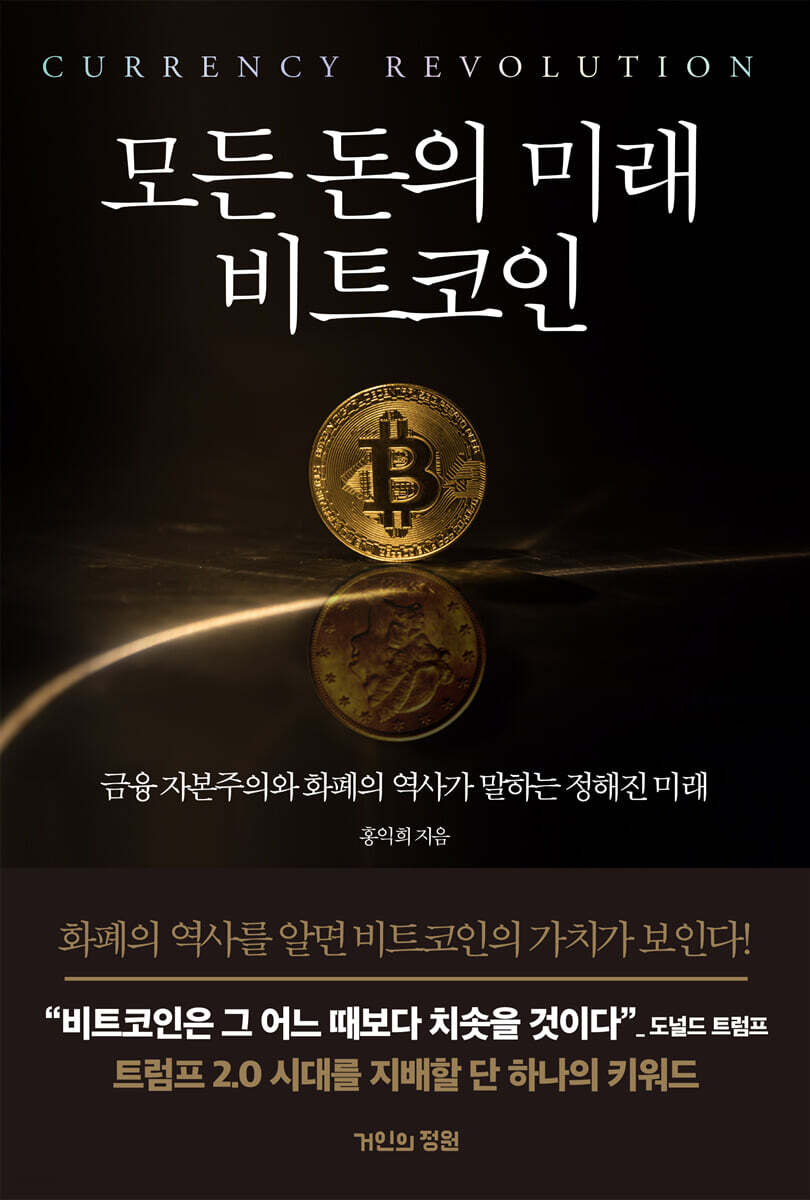
Bitcoin, the future of all money
 |
Description
Book Introduction
A new wave of digital finance begins, led by Trump.
The era of currency revolution where the key currency is replaced,
Read the new chapter of global finance that Bitcoin is changing!
· The diversification of reserve currencies and the diversification of currency types are beginning.
· To avoid being dragged into change, you must understand it in advance.
A major shift in financial capitalism predicted by global financial expert Hong Ik-hee.
This is a must-read for those looking to predict the future of the global financial market at a historic turning point and explore new investment opportunities.
This book offers a wide range of insights, from the history of financial capitalism to the historic moment of Bitcoin spot ETF approval in 2024 and the future of digital currency.
The author traces the evolution of monetary systems from the fall of the Roman Empire to the modern global financial crisis, and lucidly analyzes the nature of the ongoing monetary revolution.
In particular, it covers in detail the background and philosophical foundation of Bitcoin's birth, and keenly captures the structural changes that digital currency will bring to the financial market.
What's noteworthy is that it addresses the recent emergence of cryptocurrency as a key policy agenda in the US presidential election and the accelerating convergence of traditional finance and virtual asset markets.
Moreover, with Trump now elected as US President, diversification of reserve currencies and the variety of currency types are inevitable, and cryptocurrencies, including Bitcoin, are expected to play a key role in this process.
Beyond a simple investment guide, this book provides a macro perspective and practical insights for investors seeking to seize new opportunities in the evolving financial markets.
In particular, it presents a blueprint for the future currency market, characterized by "decentralization and diversification," and provides readers with the wisdom to proactively respond to upcoming changes.
The era of currency revolution where the key currency is replaced,
Read the new chapter of global finance that Bitcoin is changing!
· The diversification of reserve currencies and the diversification of currency types are beginning.
· To avoid being dragged into change, you must understand it in advance.
A major shift in financial capitalism predicted by global financial expert Hong Ik-hee.
This is a must-read for those looking to predict the future of the global financial market at a historic turning point and explore new investment opportunities.
This book offers a wide range of insights, from the history of financial capitalism to the historic moment of Bitcoin spot ETF approval in 2024 and the future of digital currency.
The author traces the evolution of monetary systems from the fall of the Roman Empire to the modern global financial crisis, and lucidly analyzes the nature of the ongoing monetary revolution.
In particular, it covers in detail the background and philosophical foundation of Bitcoin's birth, and keenly captures the structural changes that digital currency will bring to the financial market.
What's noteworthy is that it addresses the recent emergence of cryptocurrency as a key policy agenda in the US presidential election and the accelerating convergence of traditional finance and virtual asset markets.
Moreover, with Trump now elected as US President, diversification of reserve currencies and the variety of currency types are inevitable, and cryptocurrencies, including Bitcoin, are expected to play a key role in this process.
Beyond a simple investment guide, this book provides a macro perspective and practical insights for investors seeking to seize new opportunities in the evolving financial markets.
In particular, it presents a blueprint for the future currency market, characterized by "decentralization and diversification," and provides readers with the wisdom to proactively respond to upcoming changes.
- You can preview some of the book's contents.
Preview
index
Preface: Passing the Inflection Point of the Currency Revolution
Chapter 1: The History of Reserve Currency Collapse | Why We Should Be Wary of Inflation
Chapter 1: Patterns of Reserve Currency Collapse Revealed by History
Chapter 2: The Fall of the Roman Empire Caused by Hyperinflation
Chapter 3: The First Reserve Currency in the East: Kyocho
Chapter 4: The Recklessness of Financial Expansion That Also Destroyed the Spanish Empire
Chapter 2: The Prelude to a Currency Revolution | Why Economists Advocate for a World Currency
Chapter 1 Keynes's Wish: A World Currency
Chapter 2 The Collapse of the Bretton Woods System and the Shaken America
Chapter 3: The Fed's Submission and the Birth of the Core Inflation Index
Chapter 4: Paul Volcker, the Inflation Fighter Who Revitalized the U.S. Economy
Chapter 5: The Growing Inequality Between the Rich and the Poor
Chapter 3: Sacrifices of Hegemony | Japan's Lost 30 Years and Korea's IMF Crisis
Chapter 1: The Japanese Economy Ruined by the Currency War
Chapter 2: The Real Culprit of Japan's 'Lost 30 Years'
Chapter 3: The Aftermath of the Currency War that Engulfed Korea: The Truth Behind the IMF Crisis
Chapter 4: Korea Becomes a Hedge Fund Playground
Chapter 4: The Birth of Bitcoin | Jewish Cryptographers Challenging the Monetary and Financial Powers
Chapter 1: The Rise of the Jewish Cryptographer Chaum
Chapter 2: Bitcoin Pioneers and Cypherpunk Activists
Chapter 3: The Birth of eCash, the World's First Cryptocurrency
Chapter 4: Why Bitcoin Was Announced Anonymously
Chapter 5: Satoshi Nakamoto, the Veiled One
Chapter 5: The Spark of a Currency Revolution | The Correlation Between the Global Financial Crisis and the Emergence of Cryptocurrency
Chapter 1: The Reality of the 2008 Global Financial Crisis
Chapter 2: Derivatives, the Main Cause of the Global Financial Crisis
Chapter 3: Bitcoin: The Spark of a Currency Revolution
Chapter 4: The Expansion of the Cryptocurrency World with the Birth of Ripple and Ethereum
Chapter 6: The Changing Framework of Capitalism | From 'Financial Capitalism' to 'Inclusive Capitalism'
Chapter 1: Four Currency Wars Triggered by the United States
Chapter 2: The Origins of Income Inequality
Chapter 3 Rapidly Accelerating De-dollarization Amidst the Competition for Gold Hegemony
Chapter 4: The Truth About the Suppressed Price of Silver
Chapter 5: Inclusive Capitalism: Janet Yellen's Shocking Data
Chapter 7: The Future of Digital Currency | Diversification of Reserve Currencies and Currency Types
Chapter 1: The History of Fintech
Chapter 2: The Emergence of Central Bank Digital Currencies
Chapter 3: The Future of the Metaverse: Driven by AI and ChatGPT
Chapter 4 The Truth About Web 3.0
Chapter 5 From Platform Economy to Protocol Economy
Chapter 6: The Future of Token Securities and Asset Tokenization
Chapter 7: The Future of Stablecoins
Chapter 8 Expanding the Uses of the Bitcoin Network
Chapter 9: The Implications of Bitcoin Spot ETF Approval
Chapter 8: The Currency Revolution Has Already Begun | The Crumbling Dollar Stronghold
Chapter 1: The US's Self-Initiated De-dollarization and the Diversification of the Currency Payment System
Chapter 2: Currency Wars in the New Cold War
Chapter 3: Unsustainable US Fiscal Expansion Policy
Chapter 4 Decentralization of Reserve Currencies and Currency Diversification
Chapter 5: The Raging Currents of Modern History: Decentralization and Digitalization
Conclusion: A Decentralized, Diversified Future Currency Market
Chapter 1: The History of Reserve Currency Collapse | Why We Should Be Wary of Inflation
Chapter 1: Patterns of Reserve Currency Collapse Revealed by History
Chapter 2: The Fall of the Roman Empire Caused by Hyperinflation
Chapter 3: The First Reserve Currency in the East: Kyocho
Chapter 4: The Recklessness of Financial Expansion That Also Destroyed the Spanish Empire
Chapter 2: The Prelude to a Currency Revolution | Why Economists Advocate for a World Currency
Chapter 1 Keynes's Wish: A World Currency
Chapter 2 The Collapse of the Bretton Woods System and the Shaken America
Chapter 3: The Fed's Submission and the Birth of the Core Inflation Index
Chapter 4: Paul Volcker, the Inflation Fighter Who Revitalized the U.S. Economy
Chapter 5: The Growing Inequality Between the Rich and the Poor
Chapter 3: Sacrifices of Hegemony | Japan's Lost 30 Years and Korea's IMF Crisis
Chapter 1: The Japanese Economy Ruined by the Currency War
Chapter 2: The Real Culprit of Japan's 'Lost 30 Years'
Chapter 3: The Aftermath of the Currency War that Engulfed Korea: The Truth Behind the IMF Crisis
Chapter 4: Korea Becomes a Hedge Fund Playground
Chapter 4: The Birth of Bitcoin | Jewish Cryptographers Challenging the Monetary and Financial Powers
Chapter 1: The Rise of the Jewish Cryptographer Chaum
Chapter 2: Bitcoin Pioneers and Cypherpunk Activists
Chapter 3: The Birth of eCash, the World's First Cryptocurrency
Chapter 4: Why Bitcoin Was Announced Anonymously
Chapter 5: Satoshi Nakamoto, the Veiled One
Chapter 5: The Spark of a Currency Revolution | The Correlation Between the Global Financial Crisis and the Emergence of Cryptocurrency
Chapter 1: The Reality of the 2008 Global Financial Crisis
Chapter 2: Derivatives, the Main Cause of the Global Financial Crisis
Chapter 3: Bitcoin: The Spark of a Currency Revolution
Chapter 4: The Expansion of the Cryptocurrency World with the Birth of Ripple and Ethereum
Chapter 6: The Changing Framework of Capitalism | From 'Financial Capitalism' to 'Inclusive Capitalism'
Chapter 1: Four Currency Wars Triggered by the United States
Chapter 2: The Origins of Income Inequality
Chapter 3 Rapidly Accelerating De-dollarization Amidst the Competition for Gold Hegemony
Chapter 4: The Truth About the Suppressed Price of Silver
Chapter 5: Inclusive Capitalism: Janet Yellen's Shocking Data
Chapter 7: The Future of Digital Currency | Diversification of Reserve Currencies and Currency Types
Chapter 1: The History of Fintech
Chapter 2: The Emergence of Central Bank Digital Currencies
Chapter 3: The Future of the Metaverse: Driven by AI and ChatGPT
Chapter 4 The Truth About Web 3.0
Chapter 5 From Platform Economy to Protocol Economy
Chapter 6: The Future of Token Securities and Asset Tokenization
Chapter 7: The Future of Stablecoins
Chapter 8 Expanding the Uses of the Bitcoin Network
Chapter 9: The Implications of Bitcoin Spot ETF Approval
Chapter 8: The Currency Revolution Has Already Begun | The Crumbling Dollar Stronghold
Chapter 1: The US's Self-Initiated De-dollarization and the Diversification of the Currency Payment System
Chapter 2: Currency Wars in the New Cold War
Chapter 3: Unsustainable US Fiscal Expansion Policy
Chapter 4 Decentralization of Reserve Currencies and Currency Diversification
Chapter 5: The Raging Currents of Modern History: Decentralization and Digitalization
Conclusion: A Decentralized, Diversified Future Currency Market
Detailed image

Into the book
The spirit of the peace treaty that Innes envisioned was 'tolerance', he argued that reparations to Germany should not exceed $10 billion, and that it would be desirable for the United States to help Europe rebuild.
At the time, the book was translated into 12 languages and sold 100,000 copies within six months of its publication, but Keynes's proposal was ignored, and his ominous prediction became reality.
In the end, as he warned, the huge war reparations to Germany caused trouble.
Germany printed a huge amount of currency in the process of increasing exports to pay off reparations.
This increase in currency issuance eventually led to hyperinflation, which plunged society into extreme chaos.
Taking advantage of this gap, Hitler and the Nazis emerged, which led to World War II.
The cause of all these events was inflation.
The catastrophe of World War II was the result of Keynes's foresight being rejected.
--- p.59
The proportion of foreign capital in our country's bank stocks exceeds 60%.
The proportion of foreign stocks in large corporations, including Samsung Electronics, also exceeds 50%.
Most of them are Jewish capital.
Can we truly call our country's banks our own? We gained some things during the foreign exchange crisis, but we also lost a lot.
But you have to learn from it.
It should not be a history that has passed or flowed by, but a history that is currently breathing.
We must not forget the painful history.
--- p.160
At that time, computers were not yet popular, so no one thought about it.
Based on these concerns, Chaum created the concept of a 'digital currency' that could be exchanged over the Internet.
This is how the world's first untraceable virtual asset concept was born.
Based on this, he received a patent (patent number 4529870) for a ‘digital currency system protected by cryptography’ in 1980.
This later became the basis of cryptocurrencies.
In 1982, he published a paper titled "Blind Signatures for Untraceable Payments", further developing the theory of anonymous payments.
The payment protocol proposed in this paper anonymizes the sender's information and payment details, and obscures the information in a manner similar to a mixed network.
--- p.175
The goals that Bitcoin's creators are trying to achieve are very big.
Bitcoin's currency supply is set to increase according to a predetermined rule, so the amount of currency issued cannot be increased or decreased arbitrarily in the middle.
So, it is considered a currency without inflation risk like gold.
--- p.250
To this end, Buterin established a non-profit organization called the Ethereum Foundation in Switzerland in July 2014 and publicly sold Ether over a three-month period from July to September.
This marked the first public cryptocurrency sale, an Initial Coin Offering (ICO), which raises initial development funds from an unspecified number of investors to create a new cryptocurrency.
Approximately 31,500 Bitcoins were raised through an ICO that lasted 42 days.
Based on this, we devoted ourselves to research and development and finally officially released the Ethereum system on July 30, 2015.
Ethereum is a blockchain-based cryptocurrency, but it is more versatile, scalable, and compatible than Bitcoin.
--- p.265
MarketWatch estimates that China's gold reserves are two to three times larger than the 1,926 tons announced by the Chinese government.
Currently, the largest gold producer is China, producing 300 to 490 tonnes annually, representing 11.5 to 18% of the world's annual production of 2,700 tonnes.
On the other hand, it is also questionable whether the United States still holds more than 8,000 tons of gold.
The fact that the United States and China are reluctant to disclose accurate statistics on their gold reserves shows how intense the war of nerves over the gold market is.
As major foreign exchange reserve countries now prefer to hold gold instead of dollar-denominated assets whose real value is decreasing, the Chinese government's gold reserves will continue to increase.
The moment the gold reserves of the U.S. and Chinese governments reverse, there is a high possibility that the world gold market will change hands.
If people start to choose gold or Bitcoin over the dollar, which has a declining real value, sooner, the dollar could lose confidence in itself sooner than expected.
At the time, the book was translated into 12 languages and sold 100,000 copies within six months of its publication, but Keynes's proposal was ignored, and his ominous prediction became reality.
In the end, as he warned, the huge war reparations to Germany caused trouble.
Germany printed a huge amount of currency in the process of increasing exports to pay off reparations.
This increase in currency issuance eventually led to hyperinflation, which plunged society into extreme chaos.
Taking advantage of this gap, Hitler and the Nazis emerged, which led to World War II.
The cause of all these events was inflation.
The catastrophe of World War II was the result of Keynes's foresight being rejected.
--- p.59
The proportion of foreign capital in our country's bank stocks exceeds 60%.
The proportion of foreign stocks in large corporations, including Samsung Electronics, also exceeds 50%.
Most of them are Jewish capital.
Can we truly call our country's banks our own? We gained some things during the foreign exchange crisis, but we also lost a lot.
But you have to learn from it.
It should not be a history that has passed or flowed by, but a history that is currently breathing.
We must not forget the painful history.
--- p.160
At that time, computers were not yet popular, so no one thought about it.
Based on these concerns, Chaum created the concept of a 'digital currency' that could be exchanged over the Internet.
This is how the world's first untraceable virtual asset concept was born.
Based on this, he received a patent (patent number 4529870) for a ‘digital currency system protected by cryptography’ in 1980.
This later became the basis of cryptocurrencies.
In 1982, he published a paper titled "Blind Signatures for Untraceable Payments", further developing the theory of anonymous payments.
The payment protocol proposed in this paper anonymizes the sender's information and payment details, and obscures the information in a manner similar to a mixed network.
--- p.175
The goals that Bitcoin's creators are trying to achieve are very big.
Bitcoin's currency supply is set to increase according to a predetermined rule, so the amount of currency issued cannot be increased or decreased arbitrarily in the middle.
So, it is considered a currency without inflation risk like gold.
--- p.250
To this end, Buterin established a non-profit organization called the Ethereum Foundation in Switzerland in July 2014 and publicly sold Ether over a three-month period from July to September.
This marked the first public cryptocurrency sale, an Initial Coin Offering (ICO), which raises initial development funds from an unspecified number of investors to create a new cryptocurrency.
Approximately 31,500 Bitcoins were raised through an ICO that lasted 42 days.
Based on this, we devoted ourselves to research and development and finally officially released the Ethereum system on July 30, 2015.
Ethereum is a blockchain-based cryptocurrency, but it is more versatile, scalable, and compatible than Bitcoin.
--- p.265
MarketWatch estimates that China's gold reserves are two to three times larger than the 1,926 tons announced by the Chinese government.
Currently, the largest gold producer is China, producing 300 to 490 tonnes annually, representing 11.5 to 18% of the world's annual production of 2,700 tonnes.
On the other hand, it is also questionable whether the United States still holds more than 8,000 tons of gold.
The fact that the United States and China are reluctant to disclose accurate statistics on their gold reserves shows how intense the war of nerves over the gold market is.
As major foreign exchange reserve countries now prefer to hold gold instead of dollar-denominated assets whose real value is decreasing, the Chinese government's gold reserves will continue to increase.
The moment the gold reserves of the U.S. and Chinese governments reverse, there is a high possibility that the world gold market will change hands.
If people start to choose gold or Bitcoin over the dollar, which has a declining real value, sooner, the dollar could lose confidence in itself sooner than expected.
--- p.307
Publisher's Review
“Bitcoin isn’t just a cryptocurrency; it’s the driving force behind a monetary revolution!”
Beyond the fear of inflation, suggesting a new direction for global finance.
"A Must-Read for the Currency Revolution": Preparing for the Future at the Heart of Change
Join the new financial paradigm created by Bitcoin, stablecoins, and CBDCs!
Bitcoin is now more than just a cryptocurrency; it's driving changes in global finance, standing at the center of a new monetary revolution.
Born amid the chaos of the 2009 global financial crisis, Bitcoin is emerging as a challenge to the centralized financial system and a new alternative to address the instability caused by inflation and currency overprinting.
This book provides an easy-to-understand guide to understanding how Bitcoin collides, merges, and evolves with the traditional financial system.
Readers will be able to transparently predict the future of global finance through Bitcoin's philosophy, its historical background, and the changes in financial markets brought about by the approval of spot ETFs.
Moreover, the book explains how various digital assets, such as stablecoins and central bank digital currencies (CBDCs), are taking hold in financial markets.
In particular, stablecoins are becoming an essential element of the cryptocurrency market due to their low remittance fees, instantaneous transfers, and strengths as a bridge between fiat and cryptocurrencies.
As diverse crypto assets transform traditional finance and bring about new innovations, this book will help readers understand the context of these changes and understand the trends of global finance.
Trump and Bitcoin: The Dawn of a New Financial Order
The approval of a Bitcoin spot ETF in 2024 paves the way for the virtual asset to be traded like stocks.
This book explains how these changes are fostering the convergence of traditional finance and virtual asset markets.
As BlackRock CEO Larry Fink has said, tokenization of all financial assets will be the next step in the coming financial revolution. We must discover new opportunities in this changing market.
Trump, who was recently elected as the next US president, is so serious about coins that he has even issued his own coin, and has said that he will make Bitcoin a strategic national asset.
He is also the first president in the world to accept payment in Bitcoin.
Trump's move demonstrates that cryptocurrencies are moving beyond mere investment vehicles and establishing themselves as national strategic assets.
This also suggests that virtual assets like Bitcoin have the potential to play a major role in national economies and the global financial system in the future.
The History of the Collapse of Reserve Currencies and the Prelude to a Currency Revolution
The birth of Bitcoin was not simply a technological innovation, but a process of understanding the collapse of traditional reserve currencies and their patterns.
This book explains the impact of inflation and hyperinflation on the global economy and reserve currencies, and explores the instability of currency and its consequences through historical examples of reserve currency collapses, from the fall of the Roman Empire to the financial expansion of the Spanish Empire.
Based on these historical lessons, we can understand the background and necessity of the emergence of decentralized currencies like Bitcoin.
From Keynes's ideal of a world currency to the collapse of the Bretton Woods system and the development of the Federal Reserve's core inflation index, the need for a world currency, as advocated by economists, has become clearer over time.
Above all, it details how the perspectives of economists and their ideals in the prelude to a monetary revolution connect to current cryptocurrencies.
Through this perspective, readers can understand that the emergence of Bitcoin is not simply a technological innovation, but rather a long journey toward the evolution of currency, a dream humanity has long awaited.
Currency Diversification and the Future
Today, we are entering an era of currency diversification and diversified reserve currencies.
Not only Bitcoin, but also various currencies, including stablecoins and CBDCs, are competing and converging with each other.
In particular, with the approval of a Bitcoin ETF in the United States, cryptocurrencies have emerged as a politically significant issue, and with central banks around the world developing digital currencies, the monetary financial market is gradually becoming more decentralized.
This book helps readers understand the evolving financial landscape and offers ways to invest and prepare for the future within it.
Stablecoins are gaining attention as a global transaction and payment method due to their low remittance fees, fast transfer speeds, and reliable bridge between fiat and cryptocurrencies.
Moreover, stablecoins are establishing themselves as a crucial means of payment in the metaverse and DeFi markets, heralding significant changes in the financial market going forward.
This book delves into the role and future of these stablecoins, helping readers understand why they will be a key element of future finance.
It also provides insights into how stablecoins compete and cooperate with state-led CBDCs, such as the digital yuan, and what impact this competition will have on global financial markets.
Challenges and Opportunities for Future Currency Markets
Decentralization and digitalization of monetary and financial markets are fundamentally changing the existing monetary order.
Building on the global financial crisis and the resulting monetary revolution, let's examine how cryptocurrencies like Bitcoin, Ripple, and Ethereum are transforming the existing financial system.
Based on these insights, readers can gain a clear vision of how to recognize opportunities and challenges in the monetary and financial markets and adapt to these changes.
As we stand at the inflection point of a monetary revolution, this book will serve as a powerful guide for anyone seeking to prepare for the future of financial capitalism, showing them how to lead the change rather than be swept away by it.
By understanding how various digital currencies, including stablecoins, Bitcoin, and CBDCs, coexist and compete in the financial system, readers will gain insights and strategies that will enable them to stand at the center of change and play a leading role in the future of finance.
Beyond the fear of inflation, suggesting a new direction for global finance.
"A Must-Read for the Currency Revolution": Preparing for the Future at the Heart of Change
Join the new financial paradigm created by Bitcoin, stablecoins, and CBDCs!
Bitcoin is now more than just a cryptocurrency; it's driving changes in global finance, standing at the center of a new monetary revolution.
Born amid the chaos of the 2009 global financial crisis, Bitcoin is emerging as a challenge to the centralized financial system and a new alternative to address the instability caused by inflation and currency overprinting.
This book provides an easy-to-understand guide to understanding how Bitcoin collides, merges, and evolves with the traditional financial system.
Readers will be able to transparently predict the future of global finance through Bitcoin's philosophy, its historical background, and the changes in financial markets brought about by the approval of spot ETFs.
Moreover, the book explains how various digital assets, such as stablecoins and central bank digital currencies (CBDCs), are taking hold in financial markets.
In particular, stablecoins are becoming an essential element of the cryptocurrency market due to their low remittance fees, instantaneous transfers, and strengths as a bridge between fiat and cryptocurrencies.
As diverse crypto assets transform traditional finance and bring about new innovations, this book will help readers understand the context of these changes and understand the trends of global finance.
Trump and Bitcoin: The Dawn of a New Financial Order
The approval of a Bitcoin spot ETF in 2024 paves the way for the virtual asset to be traded like stocks.
This book explains how these changes are fostering the convergence of traditional finance and virtual asset markets.
As BlackRock CEO Larry Fink has said, tokenization of all financial assets will be the next step in the coming financial revolution. We must discover new opportunities in this changing market.
Trump, who was recently elected as the next US president, is so serious about coins that he has even issued his own coin, and has said that he will make Bitcoin a strategic national asset.
He is also the first president in the world to accept payment in Bitcoin.
Trump's move demonstrates that cryptocurrencies are moving beyond mere investment vehicles and establishing themselves as national strategic assets.
This also suggests that virtual assets like Bitcoin have the potential to play a major role in national economies and the global financial system in the future.
The History of the Collapse of Reserve Currencies and the Prelude to a Currency Revolution
The birth of Bitcoin was not simply a technological innovation, but a process of understanding the collapse of traditional reserve currencies and their patterns.
This book explains the impact of inflation and hyperinflation on the global economy and reserve currencies, and explores the instability of currency and its consequences through historical examples of reserve currency collapses, from the fall of the Roman Empire to the financial expansion of the Spanish Empire.
Based on these historical lessons, we can understand the background and necessity of the emergence of decentralized currencies like Bitcoin.
From Keynes's ideal of a world currency to the collapse of the Bretton Woods system and the development of the Federal Reserve's core inflation index, the need for a world currency, as advocated by economists, has become clearer over time.
Above all, it details how the perspectives of economists and their ideals in the prelude to a monetary revolution connect to current cryptocurrencies.
Through this perspective, readers can understand that the emergence of Bitcoin is not simply a technological innovation, but rather a long journey toward the evolution of currency, a dream humanity has long awaited.
Currency Diversification and the Future
Today, we are entering an era of currency diversification and diversified reserve currencies.
Not only Bitcoin, but also various currencies, including stablecoins and CBDCs, are competing and converging with each other.
In particular, with the approval of a Bitcoin ETF in the United States, cryptocurrencies have emerged as a politically significant issue, and with central banks around the world developing digital currencies, the monetary financial market is gradually becoming more decentralized.
This book helps readers understand the evolving financial landscape and offers ways to invest and prepare for the future within it.
Stablecoins are gaining attention as a global transaction and payment method due to their low remittance fees, fast transfer speeds, and reliable bridge between fiat and cryptocurrencies.
Moreover, stablecoins are establishing themselves as a crucial means of payment in the metaverse and DeFi markets, heralding significant changes in the financial market going forward.
This book delves into the role and future of these stablecoins, helping readers understand why they will be a key element of future finance.
It also provides insights into how stablecoins compete and cooperate with state-led CBDCs, such as the digital yuan, and what impact this competition will have on global financial markets.
Challenges and Opportunities for Future Currency Markets
Decentralization and digitalization of monetary and financial markets are fundamentally changing the existing monetary order.
Building on the global financial crisis and the resulting monetary revolution, let's examine how cryptocurrencies like Bitcoin, Ripple, and Ethereum are transforming the existing financial system.
Based on these insights, readers can gain a clear vision of how to recognize opportunities and challenges in the monetary and financial markets and adapt to these changes.
As we stand at the inflection point of a monetary revolution, this book will serve as a powerful guide for anyone seeking to prepare for the future of financial capitalism, showing them how to lead the change rather than be swept away by it.
By understanding how various digital currencies, including stablecoins, Bitcoin, and CBDCs, coexist and compete in the financial system, readers will gain insights and strategies that will enable them to stand at the center of change and play a leading role in the future of finance.
GOODS SPECIFICS
- Date of issue: November 29, 2024
- Page count, weight, size: 496 pages | 894g | 152*225*29mm
- ISBN13: 9791193869123
You may also like
카테고리
korean


korean

![GQ KOREA Mark (Monthly): December [2025]](http://librairie.coreenne.fr/cdn/shop/files/8ef265dbbfbf186523ed75ba7319009d.jpg?v=1765340328&width=3840)


