

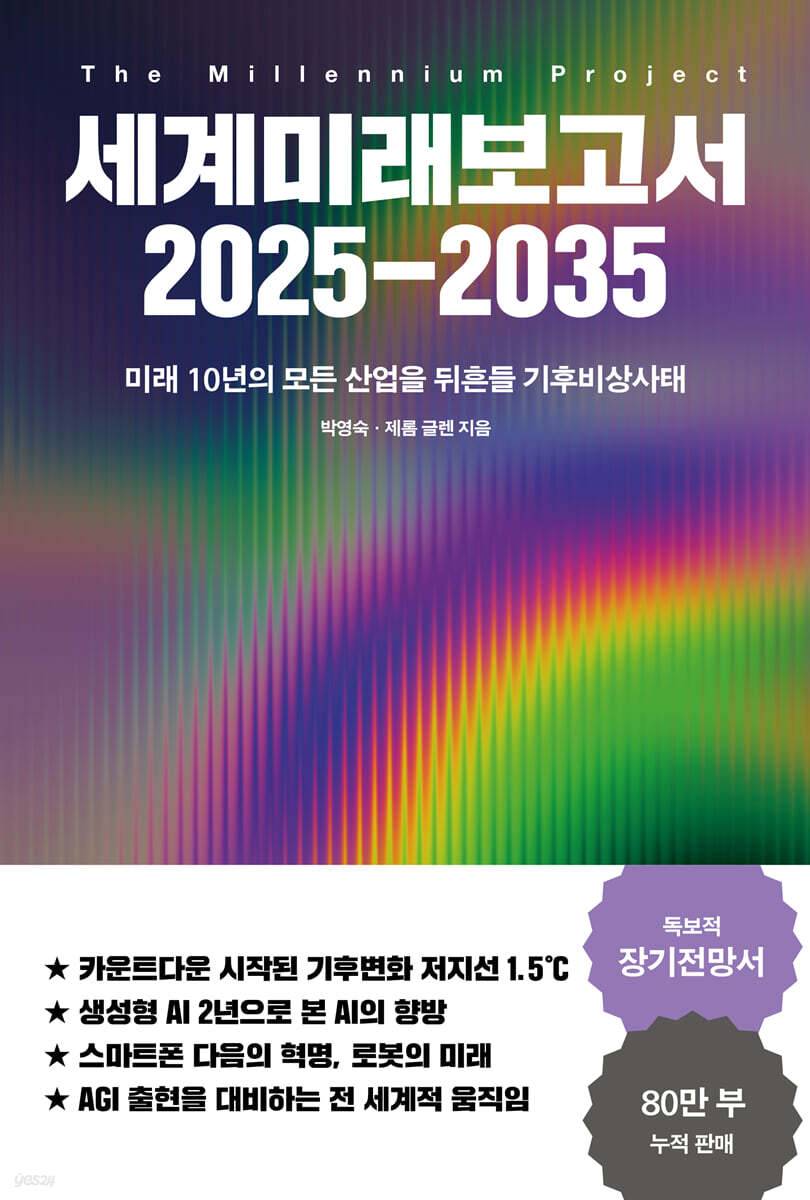
World Future Report 2025-2035
 |
Description
Book Introduction
The 2024 Nobel Prizes in Physics and Chemistry were won by AI in an unexpected twist.
The awards went to John Hopfield and Geoffrey Hinton, who pioneered machine learning, and Demis Hassabis and John Jumper, who developed the deep learning model AlphaFold.
But if you look at the details, it is not necessarily something that can be called unusual.
This is because the future is expected to see AI and humans working together to solve difficult problems that humans could not solve.
The development of AI is a notable megatrend.
The World Future Report series has focused on AI technology for about 10 years.
And this 『World Future Report 2025-2035』 introduces three main topics.
The current state of the climate emergency at a tipping point, a two-pronged future, the two-year trajectory of generative AI and the advent of AGI, and Android becoming an everyday appliance like our smartphones.
If you want to predict the future 10 years from now, you should pay attention to these three technologies.
The awards went to John Hopfield and Geoffrey Hinton, who pioneered machine learning, and Demis Hassabis and John Jumper, who developed the deep learning model AlphaFold.
But if you look at the details, it is not necessarily something that can be called unusual.
This is because the future is expected to see AI and humans working together to solve difficult problems that humans could not solve.
The development of AI is a notable megatrend.
The World Future Report series has focused on AI technology for about 10 years.
And this 『World Future Report 2025-2035』 introduces three main topics.
The current state of the climate emergency at a tipping point, a two-pronged future, the two-year trajectory of generative AI and the advent of AGI, and Android becoming an everyday appliance like our smartphones.
If you want to predict the future 10 years from now, you should pay attention to these three technologies.
- You can preview some of the book's contents.
Preview
index
| Author's Preface | The climate crisis isn't just an environmental issue; it's a problem for all industries.
Future Issue Robot 2050
PART 1.
Climate emergency
Chapter 1.
99% warming progress
1.
The severity of the Earth's highest temperatures, which are renewed every year
2.
Sea level rise and the beginning of extinction
3.
What happens if the Earth's temperature rises by 3°C?
4.
What is the temperature limit at which humans can survive?
5.
16 Tipping Points That Hold the Key to Climate Change
6.
The 1.5°C carbon budget will run out in 2029.
7.
Achieving net-zero emissions by 2050 has failed.
8.
Is it too late to stop climate change?
Chapter 2.
People looking for 1% hope
1.
Those responsible for climate damage
2.
Current Status of Carbon Neutrality
3.
A turning point to combat climate change
4. AI monitors climate change.
5. AI is the future of green energy.
6.
The Secret to the Surge in Renewable Energy Use
7.
The problem of renewable energy overproduction and negative prices
8.
How far have we come with large-scale batteries?
9.
Carbon capture and removal must also be achieved alongside carbon neutrality.
10.
Electric vehicle market share is approaching 100%.
11.
Transformation of carbon-intensive industries
12.
Additional information about climate change
PART 2.
artificial intelligence
Chapter 3.
AI becoming a reality
1. Concerns and Expectations About AI and Jobs
2.
Is Overheated AI Investment Sustainable?
3.
Problems revealed after two years
4. If you had to choose between AI development and combating climate change, which would you choose?
5.
AI that even evolves crime
6. Steps toward institutionalizing AI
7. AGI is closer than you think.
8. Can AI become conscious?
Chapter 4.
Two Years of Generative AI
1.
AI in Law: Will It Be Fairer Than Humans?
2.
AI in Education: Truly Equalizing Education
3.
AI in Healthcare: Improving Diagnosis Speed and Accuracy
4.
AI in Media: Good and Bad Choices
5.
AI in the Film Industry: 90% Production Cost Reduction
6.
AI in the Resources Sector: Developing Rare-Earth-Free Magnets
7.
AI in Healthcare: The Evolution of Smartwatches
8.
AI in Manufacturing: Watching Data in Action
9.
AI in the Space Industry: Accelerating Human Exploration of Mars
PART 3.
Next Technology
Chapter 5.
Advances in robotics
1.
After smartphones, humanoid robots
2.
A robotics revolution driven by generative AI
3.
Generative AI: Optimal for Robot Education
4.
Core technology for creating humanoids
5.
More and more human-like, android
Chapter 6. The AI Medical Revolution
1.
Midterm check of longevity escape velocity
2.
The secret behind 75% of the human body's protein has been revealed.
3.
Anti-aging and reversing aging
4.
A small robot that heals the body
5.
AI-designed new drugs that are 100 times faster and cheaper
6.
Augmented exoskeleton of the human body
Chapter 7.
Revolution in everyday life
1.
Hyperloop, the Realization of Hypersonic Transportation
2.
The first vertical takeoff and landing electric aircraft to carry passengers in 2025
3.
Self-driving cars are now safer than humans.
4.
3D-printed homes that can withstand extreme climates
5.
How far has vertical farming come?
6.
The effects of spaceflight on the human body
Appendix 1.
Millennium Project: Discussion on Phase 2 of the AGI Global Governance Framework
Appendix 2.
The Millennium Project: A Three-Step Virtual Scenario for Establishing AGI Global Governance
Future Issue Robot 2050
PART 1.
Climate emergency
Chapter 1.
99% warming progress
1.
The severity of the Earth's highest temperatures, which are renewed every year
2.
Sea level rise and the beginning of extinction
3.
What happens if the Earth's temperature rises by 3°C?
4.
What is the temperature limit at which humans can survive?
5.
16 Tipping Points That Hold the Key to Climate Change
6.
The 1.5°C carbon budget will run out in 2029.
7.
Achieving net-zero emissions by 2050 has failed.
8.
Is it too late to stop climate change?
Chapter 2.
People looking for 1% hope
1.
Those responsible for climate damage
2.
Current Status of Carbon Neutrality
3.
A turning point to combat climate change
4. AI monitors climate change.
5. AI is the future of green energy.
6.
The Secret to the Surge in Renewable Energy Use
7.
The problem of renewable energy overproduction and negative prices
8.
How far have we come with large-scale batteries?
9.
Carbon capture and removal must also be achieved alongside carbon neutrality.
10.
Electric vehicle market share is approaching 100%.
11.
Transformation of carbon-intensive industries
12.
Additional information about climate change
PART 2.
artificial intelligence
Chapter 3.
AI becoming a reality
1. Concerns and Expectations About AI and Jobs
2.
Is Overheated AI Investment Sustainable?
3.
Problems revealed after two years
4. If you had to choose between AI development and combating climate change, which would you choose?
5.
AI that even evolves crime
6. Steps toward institutionalizing AI
7. AGI is closer than you think.
8. Can AI become conscious?
Chapter 4.
Two Years of Generative AI
1.
AI in Law: Will It Be Fairer Than Humans?
2.
AI in Education: Truly Equalizing Education
3.
AI in Healthcare: Improving Diagnosis Speed and Accuracy
4.
AI in Media: Good and Bad Choices
5.
AI in the Film Industry: 90% Production Cost Reduction
6.
AI in the Resources Sector: Developing Rare-Earth-Free Magnets
7.
AI in Healthcare: The Evolution of Smartwatches
8.
AI in Manufacturing: Watching Data in Action
9.
AI in the Space Industry: Accelerating Human Exploration of Mars
PART 3.
Next Technology
Chapter 5.
Advances in robotics
1.
After smartphones, humanoid robots
2.
A robotics revolution driven by generative AI
3.
Generative AI: Optimal for Robot Education
4.
Core technology for creating humanoids
5.
More and more human-like, android
Chapter 6. The AI Medical Revolution
1.
Midterm check of longevity escape velocity
2.
The secret behind 75% of the human body's protein has been revealed.
3.
Anti-aging and reversing aging
4.
A small robot that heals the body
5.
AI-designed new drugs that are 100 times faster and cheaper
6.
Augmented exoskeleton of the human body
Chapter 7.
Revolution in everyday life
1.
Hyperloop, the Realization of Hypersonic Transportation
2.
The first vertical takeoff and landing electric aircraft to carry passengers in 2025
3.
Self-driving cars are now safer than humans.
4.
3D-printed homes that can withstand extreme climates
5.
How far has vertical farming come?
6.
The effects of spaceflight on the human body
Appendix 1.
Millennium Project: Discussion on Phase 2 of the AGI Global Governance Framework
Appendix 2.
The Millennium Project: A Three-Step Virtual Scenario for Establishing AGI Global Governance
Detailed image

Into the book
Just as our generation can't imagine life without the internet, and our parents couldn't imagine life without electricity, by 2050 young people will be unable to imagine life without robots.
Computer science will enable anyone to design and produce any type of robot in a robot factory by 2050, reducing the cost of manufacturing robots.
Inexpensive personal robotics kits will allow people to design and build their own robots as toys, companions, home repairs, and even cloned "people."
When that happens, what will people optimize AI robots for? This is no longer a philosophical play exploring the meaning of life, but a practical question that determines whether AI robots are programmed or selected.
By 2050, living with robots will be as common as living with smartphones today.
--- p.23
Climate change caused by carbon dioxide already in the atmosphere will reduce global GDP by about $38 trillion, or $20 trillion, by 2050, regardless of how aggressively humanity reduces its carbon emissions, experts said.
As of 2023, world GDP is estimated at approximately $104 trillion.
A study published in the journal Nature suggests that reducing greenhouse gas emissions as quickly as possible is crucial to avoiding even more devastating economic impacts after the mid-21st century.
The study shows that if the Earth warms more than 2°C above mid-19th century levels, the economic impacts of climate change could increase by tens of trillions of dollars per year by 2100.
The Earth's average surface temperature has already risen by 1.2°C, making heatwaves, droughts, floods and tropical storms more destructive due to rising sea levels.
--- pp.67-68
Microsoft, which invested in ChatGPT maker OpenAI and put generative AI at the core of its products, recently announced that its carbon dioxide emissions have increased by nearly 30% since 2020 due to data center expansion.
Google's carbon emissions increased by 13% in 2023 (up 48% from 2019), emitting 14.3 million tons of carbon dioxide.
This is equivalent to the emissions of 38 gas-fired power plants.
Google's carbon emissions surge is largely attributed to the expansion of its data centers, which require massive amounts of electricity to train and operate AI models.
In fact, Google data centers emitted 1 million tons of carbon in 2023 alone.
Major AI and data center companies like Amazon, Google, and Microsoft have been working to reduce their carbon footprints by purchasing massive amounts of renewable energy.
Both Google and Microsoft have set net-zero or negative emissions targets by 2030.
It also promised to run on pollution-free energy.
Amazon Web Services aims to become carbon-neutral by 2040.
However, the competition to develop AI has led to these companies' carbon emissions actually increasing.
The price for all this energy is paid not only by developers but also by the planet.
Energy-related carbon dioxide emissions will reach a record high of 37.4 billion tons in 2023. Is the energy and carbon emissions required to power AI worth it? How can we harness the boundless potential of AI without compromising the health of the planet?
--- pp.174-175
While humans cannot control how ASI will emerge and behave, we can establish national and international regulations governing how AGI will be created, licensed, used, and managed. The success of the transition from AGI to ASI will depend on how well the transition from ANI to AGI is managed. Without national and international regulations governing AGI, numerous AGIs from governments and corporations around the world could continuously rewrite their own code and interact with one another, creating many new forms of ASI beyond human control, understanding, and awareness.
This would be a nightmare that could lead to the end of human civilization, as warned by Stephen Hawking, Elon Musk, and Bill Gates.
To avoid this, governments, businesses, UN agencies, and academia around the world are coming together to safely guide this transition.
Even the United States and China are engaging in direct discussions about how to govern future forms of AI globally. Managing AGI could be the most complex and challenging governance challenge humanity has ever faced.
However, if managed well, AGI could bring great advancements to human life, including medicine, education, longevity, mitigating global warming, advancing science, and creating a more peaceful world.
Computer science will enable anyone to design and produce any type of robot in a robot factory by 2050, reducing the cost of manufacturing robots.
Inexpensive personal robotics kits will allow people to design and build their own robots as toys, companions, home repairs, and even cloned "people."
When that happens, what will people optimize AI robots for? This is no longer a philosophical play exploring the meaning of life, but a practical question that determines whether AI robots are programmed or selected.
By 2050, living with robots will be as common as living with smartphones today.
--- p.23
Climate change caused by carbon dioxide already in the atmosphere will reduce global GDP by about $38 trillion, or $20 trillion, by 2050, regardless of how aggressively humanity reduces its carbon emissions, experts said.
As of 2023, world GDP is estimated at approximately $104 trillion.
A study published in the journal Nature suggests that reducing greenhouse gas emissions as quickly as possible is crucial to avoiding even more devastating economic impacts after the mid-21st century.
The study shows that if the Earth warms more than 2°C above mid-19th century levels, the economic impacts of climate change could increase by tens of trillions of dollars per year by 2100.
The Earth's average surface temperature has already risen by 1.2°C, making heatwaves, droughts, floods and tropical storms more destructive due to rising sea levels.
--- pp.67-68
Microsoft, which invested in ChatGPT maker OpenAI and put generative AI at the core of its products, recently announced that its carbon dioxide emissions have increased by nearly 30% since 2020 due to data center expansion.
Google's carbon emissions increased by 13% in 2023 (up 48% from 2019), emitting 14.3 million tons of carbon dioxide.
This is equivalent to the emissions of 38 gas-fired power plants.
Google's carbon emissions surge is largely attributed to the expansion of its data centers, which require massive amounts of electricity to train and operate AI models.
In fact, Google data centers emitted 1 million tons of carbon in 2023 alone.
Major AI and data center companies like Amazon, Google, and Microsoft have been working to reduce their carbon footprints by purchasing massive amounts of renewable energy.
Both Google and Microsoft have set net-zero or negative emissions targets by 2030.
It also promised to run on pollution-free energy.
Amazon Web Services aims to become carbon-neutral by 2040.
However, the competition to develop AI has led to these companies' carbon emissions actually increasing.
The price for all this energy is paid not only by developers but also by the planet.
Energy-related carbon dioxide emissions will reach a record high of 37.4 billion tons in 2023. Is the energy and carbon emissions required to power AI worth it? How can we harness the boundless potential of AI without compromising the health of the planet?
--- pp.174-175
While humans cannot control how ASI will emerge and behave, we can establish national and international regulations governing how AGI will be created, licensed, used, and managed. The success of the transition from AGI to ASI will depend on how well the transition from ANI to AGI is managed. Without national and international regulations governing AGI, numerous AGIs from governments and corporations around the world could continuously rewrite their own code and interact with one another, creating many new forms of ASI beyond human control, understanding, and awareness.
This would be a nightmare that could lead to the end of human civilization, as warned by Stephen Hawking, Elon Musk, and Bill Gates.
To avoid this, governments, businesses, UN agencies, and academia around the world are coming together to safely guide this transition.
Even the United States and China are engaging in direct discussions about how to govern future forms of AI globally. Managing AGI could be the most complex and challenging governance challenge humanity has ever faced.
However, if managed well, AGI could bring great advancements to human life, including medicine, education, longevity, mitigating global warming, advancing science, and creating a more peaceful world.
--- pp.342-343
Publisher's Review
The 2024 Nobel Prize in Physics was awarded to Princeton University professor John Hopfield and University of Toronto professor Geoffrey Hinton for their work pioneering machine learning in AI using artificial neural networks.
And the Nobel Prize in Chemistry was awarded to Professor David Baker of the University of Washington, who developed the deep learning model AlphaFold and solved the secrets of protein structure, and to Demis Hassabis, CEO of Google DeepMind, and John Jumper, Director.
They were recognized for their contributions to solving long-standing challenges that humanity has struggled to solve through AI.
This is truly the year that AI swept the Nobel Prize.
The world is now crazy about AI.
Everyone is jumping into the boundless possibilities of AI.
However, the fierce development competition to dominate this market has begun to create side effects along with possibilities.
The "World Future Report 2025-2035" examines how AI has played a role in various industries around the world over the past two years, from the end of 2022, when generative AI was first introduced, to the present, and predicts how the future of each industry will change based on this.
We also looked at the side effects that have become apparent over the past two years, such as AI washing, intelligent crime, and the deterioration of content quality from generative AI.
Among them, a serious problem that we did not anticipate is carbon emissions.
▶ Moments of warming recorded for the first time in 100 years, since observations began, and in history.
The increased carbon emissions since industrialization have caused global warming, which is causing the Earth to suffer greatly.
Governments around the world, feeling a sense of crisis due to various natural disasters and the heat waves that occur every summer, have come together and agreed to limit global warming to 1.5℃ compared to pre-industrial levels.
Many companies that joined this effort also declared net-zero carbon emissions by 2030.
But by 2023, Google and Microsoft had become climate villains, increasing their carbon emissions.
The reason is none other than the competition in AI development.
Even when giving the same answer to a question, AI ChatGPT uses 10 times more energy than Google Search.
Considering the widespread adoption of Google's search function, the energy consumption that would result if it were replaced by generative AI is beyond imagination.
Google and Microsoft will each use more electricity in 2023 than the energy consumption of a single country.
There are 100 countries, including Iceland and Croatia, that use less energy than the two companies.
The resulting energy shortage is a problem, but if we continue to increase our use without switching to eco-friendly renewable energy, global warming caused by carbon emissions could ultimately lead to the extinction of humanity.
The World Future Report 2025-2035 focuses on the severity of climate change along with AI as its central theme.
The reason is that, as explained earlier, climate change and the development of AI are not separate.
Climate change has been considered a problem of the distant future or of other countries, but it has become increasingly serious and is no longer someone else's problem.
“There is no longer a need to explain climate change,” said Adil Najam, president of the World Wildlife Fund, emphasizing that we can see it firsthand by opening our windows.
The Guardian, a leading British daily newspaper, reported in 2014 that climate experts warned that the climate had already passed the 'point of no return'.
As the Guardian put it, global warming is not simply climate change, but a 'climate emergency'.
In particular, July 2024 is expected to be 1.48°C higher than pre-industrial levels, putting us just shy of the 1.5°C threshold needed for survival.
This book examines the overall climate emergency, discusses the maximum temperature at which humanity can survive, and discusses what will happen globally when the temperature rises above 1.5°C, with the opinions of experts from around the world.
We also examine the efforts of various industries, governments, and academia to prevent a climate emergency, including the status of the renewable energy transition, the development of carbon capture technology, and the use of AI to address climate issues.
▶Key technological trends from smartphones to chat GPT (generative AI) to robots
The "World Future Report 2025-2035" also examines next-generation technologies that will become key industries of the future, such as innovations in medical technology and the realization of new means of transportation, which we have always been interested in.
Among them, robotics technology is one that deserves attention.
Until now, robots were merely machines that moved according to input programs, but with the development of AI, robot development is also accelerating.
Robotics experts predict that by 2050, there will be more android robots than humans.
Android robots are attracting attention as a technology that will bring about innovations that will change our existing way of life, much like the advent of smartphones.
We can explore the expanded future of robots, from tiny robots like nanobots that heal the body inside the body as well as life companions, to giant robots that will serve as human habitats and workplaces in the ocean or space.
The World Future Report already introduced readers to the achievements of two fields that previously won the Nobel Prize: machine learning and DeepMind.
The various technologies and trends introduced this time will also become central technologies and noteworthy trends in the coming years.
I hope that through this book, readers will also have the opportunity to take a first look into the future.
And the Nobel Prize in Chemistry was awarded to Professor David Baker of the University of Washington, who developed the deep learning model AlphaFold and solved the secrets of protein structure, and to Demis Hassabis, CEO of Google DeepMind, and John Jumper, Director.
They were recognized for their contributions to solving long-standing challenges that humanity has struggled to solve through AI.
This is truly the year that AI swept the Nobel Prize.
The world is now crazy about AI.
Everyone is jumping into the boundless possibilities of AI.
However, the fierce development competition to dominate this market has begun to create side effects along with possibilities.
The "World Future Report 2025-2035" examines how AI has played a role in various industries around the world over the past two years, from the end of 2022, when generative AI was first introduced, to the present, and predicts how the future of each industry will change based on this.
We also looked at the side effects that have become apparent over the past two years, such as AI washing, intelligent crime, and the deterioration of content quality from generative AI.
Among them, a serious problem that we did not anticipate is carbon emissions.
▶ Moments of warming recorded for the first time in 100 years, since observations began, and in history.
The increased carbon emissions since industrialization have caused global warming, which is causing the Earth to suffer greatly.
Governments around the world, feeling a sense of crisis due to various natural disasters and the heat waves that occur every summer, have come together and agreed to limit global warming to 1.5℃ compared to pre-industrial levels.
Many companies that joined this effort also declared net-zero carbon emissions by 2030.
But by 2023, Google and Microsoft had become climate villains, increasing their carbon emissions.
The reason is none other than the competition in AI development.
Even when giving the same answer to a question, AI ChatGPT uses 10 times more energy than Google Search.
Considering the widespread adoption of Google's search function, the energy consumption that would result if it were replaced by generative AI is beyond imagination.
Google and Microsoft will each use more electricity in 2023 than the energy consumption of a single country.
There are 100 countries, including Iceland and Croatia, that use less energy than the two companies.
The resulting energy shortage is a problem, but if we continue to increase our use without switching to eco-friendly renewable energy, global warming caused by carbon emissions could ultimately lead to the extinction of humanity.
The World Future Report 2025-2035 focuses on the severity of climate change along with AI as its central theme.
The reason is that, as explained earlier, climate change and the development of AI are not separate.
Climate change has been considered a problem of the distant future or of other countries, but it has become increasingly serious and is no longer someone else's problem.
“There is no longer a need to explain climate change,” said Adil Najam, president of the World Wildlife Fund, emphasizing that we can see it firsthand by opening our windows.
The Guardian, a leading British daily newspaper, reported in 2014 that climate experts warned that the climate had already passed the 'point of no return'.
As the Guardian put it, global warming is not simply climate change, but a 'climate emergency'.
In particular, July 2024 is expected to be 1.48°C higher than pre-industrial levels, putting us just shy of the 1.5°C threshold needed for survival.
This book examines the overall climate emergency, discusses the maximum temperature at which humanity can survive, and discusses what will happen globally when the temperature rises above 1.5°C, with the opinions of experts from around the world.
We also examine the efforts of various industries, governments, and academia to prevent a climate emergency, including the status of the renewable energy transition, the development of carbon capture technology, and the use of AI to address climate issues.
▶Key technological trends from smartphones to chat GPT (generative AI) to robots
The "World Future Report 2025-2035" also examines next-generation technologies that will become key industries of the future, such as innovations in medical technology and the realization of new means of transportation, which we have always been interested in.
Among them, robotics technology is one that deserves attention.
Until now, robots were merely machines that moved according to input programs, but with the development of AI, robot development is also accelerating.
Robotics experts predict that by 2050, there will be more android robots than humans.
Android robots are attracting attention as a technology that will bring about innovations that will change our existing way of life, much like the advent of smartphones.
We can explore the expanded future of robots, from tiny robots like nanobots that heal the body inside the body as well as life companions, to giant robots that will serve as human habitats and workplaces in the ocean or space.
The World Future Report already introduced readers to the achievements of two fields that previously won the Nobel Prize: machine learning and DeepMind.
The various technologies and trends introduced this time will also become central technologies and noteworthy trends in the coming years.
I hope that through this book, readers will also have the opportunity to take a first look into the future.
GOODS SPECIFICS
- Date of issue: October 25, 2024
- Page count, weight, size: 400 pages | 702g | 152*225*19mm
- ISBN13: 9791170612001
- ISBN10: 1170612008
You may also like
카테고리
korean


korean

![ELLE 엘르 스페셜 에디션 A형 : 12월 [2025]](http://librairie.coreenne.fr/cdn/shop/files/b8e27a3de6c9538896439686c6b0e8fb.jpg?v=1766436872&width=3840)


