

Business Negotiation Theory
 |
Description
Book Introduction
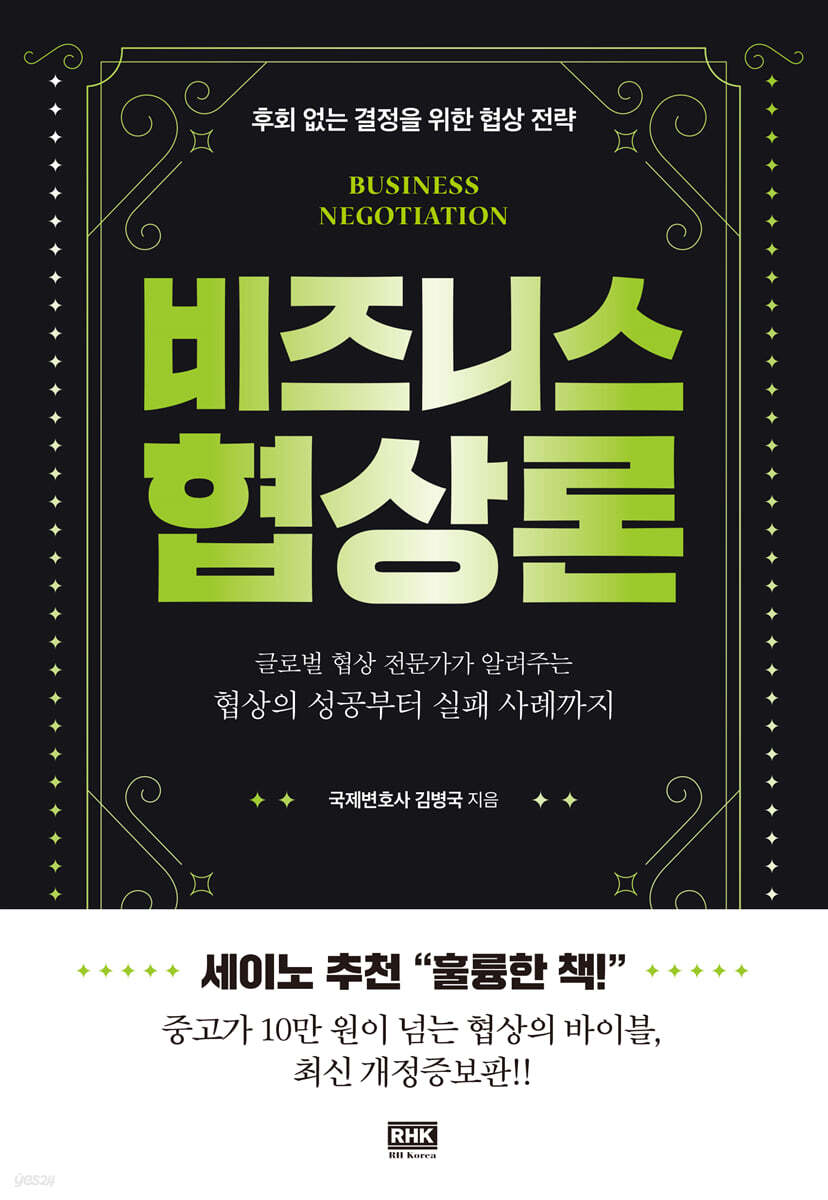
*** Recommended by bestselling author Seino: “A great book!” The latest revised and expanded edition has been published!! *** “Tell the truth, but not everything!” What a global negotiation expert tells you From successful to failed negotiations What comes to mind when you hear the word "negotiation"? Some people think of international diplomatic negotiations, while others think of negotiations between companies, driven by diverse interests. But not many people actually think about the fact that they are negotiating every single day. But we negotiate many aspects of our lives, whether small or big. Negotiation experts say that 80% of daily life is made up of negotiations. Negotiation is anything from bargaining while shopping to getting your business proposal approved by a client. Negotiating to get a higher salary is also a negotiation. In other words, any process of getting what I want from the other party is negotiation. Yet, we have never been properly taught how to negotiate, and we often think of negotiation as something only a few experts can do. That's why I keep hesitating and sometimes even feeling afraid when faced with a matter that requires negotiation. 《Business Negotiation》 is a negotiation guidebook for ordinary people like these. Since its first publication over 20 years ago, it has gained a reputation as the bible of "Korean-style negotiation" through word of mouth and has received rave reviews from many. Seino, who has long been a mentor in the field of self-development and has greatly influenced many people, also recommended this book in one word, saying, "Great book!" and commented that it should be read instead of vague negotiation books. However, after it went out of print, it was difficult to obtain the book, so used copies were sold at high prices, and even bound pirated copies were secretly traded. As a result, inquiries about republication of this book continued, and at the request of these readers, a latest revised edition was published. In the latest revised edition, outdated content has been refined to fit the present and examples have been added. |
- You can preview some of the book's contents.
Preview
index
The goal of negotiation is to win together.
Part 1: Negotiation Experts See the World Differently
Negotiator's Bill of Rights
Take your time
Don't say 'Yes' too easily
Negotiation works even in reconnaissance sales.
Negotiations that save each other
Negotiation is a process of finding common ground.
Remember the fight between David and Goliath
Make the most of your time
Get detailed pricing information
Offer an invisible premium
Always check your uncertain guesses.
Finding common denominators and growing the pie
The tactic of collecting dust to make a mountain
To the negotiators who show off their skills
Value judgments vary depending on the situation and person.
Learning from the IMF Negotiations
Have a backup plan ready
Water Ghost Operation Used in Negotiations
The more you know, the greater your gains.
Challenge authority and negotiate
Don't ruin your future by dwelling on the past.
Tell the truth, but not everything.
Do not leak unfavorable information
If you can't cut it, ask for a bonus
Take risks for greater gains
The choice of location determines success or failure.
Identify the organizational elements behind the opponent.
For those who want to start a new business
Part 2: 36 Strategies for Successful Negotiation
Make sure to hide what needs to be hidden.
Rather than pressuring your opponent, seek a roundabout way.
Don't take on the villain role
Take your time and wait for the perfect timing.
When you have the upper hand, be sure to attack your opponent.
Distract yourself from non-essential issues
Make it look like it's there even though it's not there
Accurately analyze the truth of the information
Don't miss out on the benefits of your opponent's internal strife.
Don't trust the other person's excessive kindness.
Sacrifice the small for the big
Make the unexpected gains your own with careful planning.
Deliberately leak information to detect the other person's reaction.
Don't be discouraged by one failure
Choose a time and place that is convenient for you.
Captivate the other person's heart with humanity
Make the other person feel valued
To subdue the opposing team, attack their leader.
Attack a strong opponent indirectly.
The other person's confusion is my strength.
In a critical situation, trick the other person and escape.
Handle even weak opponents with care
Analyze the other party's foreign relations
Save the other person's face and reputation.
Persuade others in creative ways
Give warnings indirectly
Feign innocence to reassure the other person.
Make sure your counterpart is deeply involved in the negotiation.
Sometimes threats are necessary
Don't assume failure just because you lost the initial initiative.
Understand your partner's tastes
Be willing to take risks and shake up your opponent.
Do your best to collect information and maintain security.
Find something that may be trivial to you, but is important to the other person.
Gather your strength in the face of a strong opponent
Sometimes it takes courage to declare a breakdown in negotiations.
Part 3: Now You're a Negotiation Expert
Negotiate actively to avoid being fooled.
When to Negotiate and When Not to Negotiate
It's only natural that negotiations will fail.
Part 1: Negotiation Experts See the World Differently
Negotiator's Bill of Rights
Take your time
Don't say 'Yes' too easily
Negotiation works even in reconnaissance sales.
Negotiations that save each other
Negotiation is a process of finding common ground.
Remember the fight between David and Goliath
Make the most of your time
Get detailed pricing information
Offer an invisible premium
Always check your uncertain guesses.
Finding common denominators and growing the pie
The tactic of collecting dust to make a mountain
To the negotiators who show off their skills
Value judgments vary depending on the situation and person.
Learning from the IMF Negotiations
Have a backup plan ready
Water Ghost Operation Used in Negotiations
The more you know, the greater your gains.
Challenge authority and negotiate
Don't ruin your future by dwelling on the past.
Tell the truth, but not everything.
Do not leak unfavorable information
If you can't cut it, ask for a bonus
Take risks for greater gains
The choice of location determines success or failure.
Identify the organizational elements behind the opponent.
For those who want to start a new business
Part 2: 36 Strategies for Successful Negotiation
Make sure to hide what needs to be hidden.
Rather than pressuring your opponent, seek a roundabout way.
Don't take on the villain role
Take your time and wait for the perfect timing.
When you have the upper hand, be sure to attack your opponent.
Distract yourself from non-essential issues
Make it look like it's there even though it's not there
Accurately analyze the truth of the information
Don't miss out on the benefits of your opponent's internal strife.
Don't trust the other person's excessive kindness.
Sacrifice the small for the big
Make the unexpected gains your own with careful planning.
Deliberately leak information to detect the other person's reaction.
Don't be discouraged by one failure
Choose a time and place that is convenient for you.
Captivate the other person's heart with humanity
Make the other person feel valued
To subdue the opposing team, attack their leader.
Attack a strong opponent indirectly.
The other person's confusion is my strength.
In a critical situation, trick the other person and escape.
Handle even weak opponents with care
Analyze the other party's foreign relations
Save the other person's face and reputation.
Persuade others in creative ways
Give warnings indirectly
Feign innocence to reassure the other person.
Make sure your counterpart is deeply involved in the negotiation.
Sometimes threats are necessary
Don't assume failure just because you lost the initial initiative.
Understand your partner's tastes
Be willing to take risks and shake up your opponent.
Do your best to collect information and maintain security.
Find something that may be trivial to you, but is important to the other person.
Gather your strength in the face of a strong opponent
Sometimes it takes courage to declare a breakdown in negotiations.
Part 3: Now You're a Negotiation Expert
Negotiate actively to avoid being fooled.
When to Negotiate and When Not to Negotiate
It's only natural that negotiations will fail.
Detailed image
Into the book
No matter how urgent it is, the habit of saying 'Yes' too quickly is absolutely forbidden in negotiations.
Regardless of how much weight the concession carries in the negotiation, if it appears simple and easy, the other party will use it as an opportunity to lead the negotiation at their own pace and demand more.
--- p.32
In negotiations where interpersonal relationships are paramount, such as between spouses, children, or friends, the goal is not to focus on "what results have been achieved?" but rather "can we create better interpersonal relationships through this negotiation?"
Yes, that's right.
In a relationship, the more important question is 'How will we build a good relationship?' than the more obvious question of 'What kind of car will we buy?'
(…) Sometimes negotiation is about pursuing a losing outcome to improve long-term relationships without being obsessed with short-term gains.
--- p.46
Negotiation is not a fight, it is about working together to find a solution.
Those who negotiate without understanding this simple principle are likely to end up in a disaster where both sides end up going their separate ways.
The result of the catastrophe is that both you and I suffer losses, and in the end, no one wins.
--- p.50
We must not give up on negotiations because of apparent power disadvantage.
When it appears that one party is clearly at a disadvantage compared to the other party, many people lose the will to negotiate and end up negotiating in a way that leaves room for whatever happens.
But in fact, what causes negotiations to fail is not their weakness, but their attitude of giving up.
--- p.56
When negotiating, there are times when it is difficult to make a decision right away.
(…) The stress of having to decide everything in this one negotiation today is a factor that infinitely lowers one’s position in the negotiation.
In such cases, you end up making unreasonable concessions and end up being dragged around by the other party.
Therefore, especially if the negotiations are going in a way that is unfavorable to you, you should blow the whistle for a break without delay.
And we must be able to turn the tide in the next negotiation.
--- p.61
Before coming to the department store, I, a so-called negotiation expert, realized that my assumption that "sale items have low margins, so there's no room for price negotiation" was seriously flawed.
It was only then that I realized that negotiating when purchasing items that were displayed in large quantities in the hopes of selling them off quickly during a sale period could be easier than when selling them at full price.
Just as it's essential to question the other party's words and actions, especially in negotiations, by asking, "What are their underlying intentions?", it's also essential to test the accuracy of your own assumptions about what the other party is thinking before sitting down at the negotiating table.
--- p.77
To negotiate effectively, you must understand that even seemingly similar negotiation subjects can have different values depending on the other party.
Keeping these facts in mind can help you conclude any negotiation on much more favorable terms than you might have anticipated.
--- p.104)
Experienced negotiators usually categorize various issues into three categories during the negotiation preparation stage:
The first is ‘absolutely non-negotiable issues.’
This is an issue that cannot be compromised at any cost, and it is better to break off negotiations than to compromise on this issue.
The second is 'a matter that can be exchanged for the other party's concessions if we try our best to keep it, but must obtain them.'
The third is ‘a matter in which it is okay to give in appropriately when the other party demands concessions.’
This issue can be freely discussed during negotiations with the other party, and one may even make a concession first to induce the other party to make a concession.
--- p.111
I have a rule that I always follow when negotiating.
It means that you will never lie by making up stories that are not true.
If a lie is exposed, your credibility as a negotiator will be irreparably damaged.
In negotiations, losing trust in the other party is a huge weakness.
Another rule of thumb when negotiating is to never reveal any information that is detrimental to you.
If necessary, select only partial truths and tell them to the other person.
Because I have learned through experience that telling only partial truths is much more effective than lying, and it doesn't cause any problems later on.
The negotiating table is different from the witness stand in a courtroom.
I don't need to tell the other person everything I have from beginning to end, and I shouldn't tell them anything.
--- p.145
During negotiations, we often see scenes where negotiations break down or conflicts between the two parties escalate for trivial reasons that cannot be rationally explained.
This happens more often, especially when people from our country negotiate with each other.
As American consultants have discovered, Koreans, who are face-conscious and emotional, will react emotionally when they feel slighted by the other party during a negotiation, regardless of the outcome.
When this kind of atmosphere is created, both parties begin to expend useless effort and emotions.
As a result, both parties suffer equal damage or have their relationships severed beyond repair due to the breakdown of negotiations.
--- p.259
Most people set limits on what they will compromise when preparing for a negotiation.
But even if it is a concession prepared like this, it cannot be given unless the other party asks for it.
Rather than expecting the other party to do something, negotiations need to be conducted by finding out what the other party is prepared to give and asking for it.
Regardless of how much weight the concession carries in the negotiation, if it appears simple and easy, the other party will use it as an opportunity to lead the negotiation at their own pace and demand more.
--- p.32
In negotiations where interpersonal relationships are paramount, such as between spouses, children, or friends, the goal is not to focus on "what results have been achieved?" but rather "can we create better interpersonal relationships through this negotiation?"
Yes, that's right.
In a relationship, the more important question is 'How will we build a good relationship?' than the more obvious question of 'What kind of car will we buy?'
(…) Sometimes negotiation is about pursuing a losing outcome to improve long-term relationships without being obsessed with short-term gains.
--- p.46
Negotiation is not a fight, it is about working together to find a solution.
Those who negotiate without understanding this simple principle are likely to end up in a disaster where both sides end up going their separate ways.
The result of the catastrophe is that both you and I suffer losses, and in the end, no one wins.
--- p.50
We must not give up on negotiations because of apparent power disadvantage.
When it appears that one party is clearly at a disadvantage compared to the other party, many people lose the will to negotiate and end up negotiating in a way that leaves room for whatever happens.
But in fact, what causes negotiations to fail is not their weakness, but their attitude of giving up.
--- p.56
When negotiating, there are times when it is difficult to make a decision right away.
(…) The stress of having to decide everything in this one negotiation today is a factor that infinitely lowers one’s position in the negotiation.
In such cases, you end up making unreasonable concessions and end up being dragged around by the other party.
Therefore, especially if the negotiations are going in a way that is unfavorable to you, you should blow the whistle for a break without delay.
And we must be able to turn the tide in the next negotiation.
--- p.61
Before coming to the department store, I, a so-called negotiation expert, realized that my assumption that "sale items have low margins, so there's no room for price negotiation" was seriously flawed.
It was only then that I realized that negotiating when purchasing items that were displayed in large quantities in the hopes of selling them off quickly during a sale period could be easier than when selling them at full price.
Just as it's essential to question the other party's words and actions, especially in negotiations, by asking, "What are their underlying intentions?", it's also essential to test the accuracy of your own assumptions about what the other party is thinking before sitting down at the negotiating table.
--- p.77
To negotiate effectively, you must understand that even seemingly similar negotiation subjects can have different values depending on the other party.
Keeping these facts in mind can help you conclude any negotiation on much more favorable terms than you might have anticipated.
--- p.104)
Experienced negotiators usually categorize various issues into three categories during the negotiation preparation stage:
The first is ‘absolutely non-negotiable issues.’
This is an issue that cannot be compromised at any cost, and it is better to break off negotiations than to compromise on this issue.
The second is 'a matter that can be exchanged for the other party's concessions if we try our best to keep it, but must obtain them.'
The third is ‘a matter in which it is okay to give in appropriately when the other party demands concessions.’
This issue can be freely discussed during negotiations with the other party, and one may even make a concession first to induce the other party to make a concession.
--- p.111
I have a rule that I always follow when negotiating.
It means that you will never lie by making up stories that are not true.
If a lie is exposed, your credibility as a negotiator will be irreparably damaged.
In negotiations, losing trust in the other party is a huge weakness.
Another rule of thumb when negotiating is to never reveal any information that is detrimental to you.
If necessary, select only partial truths and tell them to the other person.
Because I have learned through experience that telling only partial truths is much more effective than lying, and it doesn't cause any problems later on.
The negotiating table is different from the witness stand in a courtroom.
I don't need to tell the other person everything I have from beginning to end, and I shouldn't tell them anything.
--- p.145
During negotiations, we often see scenes where negotiations break down or conflicts between the two parties escalate for trivial reasons that cannot be rationally explained.
This happens more often, especially when people from our country negotiate with each other.
As American consultants have discovered, Koreans, who are face-conscious and emotional, will react emotionally when they feel slighted by the other party during a negotiation, regardless of the outcome.
When this kind of atmosphere is created, both parties begin to expend useless effort and emotions.
As a result, both parties suffer equal damage or have their relationships severed beyond repair due to the breakdown of negotiations.
--- p.259
Most people set limits on what they will compromise when preparing for a negotiation.
But even if it is a concession prepared like this, it cannot be given unless the other party asks for it.
Rather than expecting the other party to do something, negotiations need to be conducted by finding out what the other party is prepared to give and asking for it.
--- p.311
Publisher's Review
Find something that may be trivial to you, but is precious to the other person!
The art of win-win negotiation where both parties win
So why do people pay so much attention to this book and consistently recommend it? First and foremost, it's because it offers practical guidance optimized for Koreans.
The Western-style negotiation theories we have encountered so far focus only on the rational and logical aspects.
In addition, this book covers the emotional aspects that Koreans value.
By closely examining the emotional side that people often neglect at the negotiating table, we guide you to access hidden agendas and show you how to achieve a result that satisfies both parties.
Secondly, it is highly practical because it presents realistic examples that can be applied immediately in real-life situations.
In fact, it is no exaggeration to say that the basic principles of successful negotiations, such as the best time, collecting and analyzing the right information, and having the upper hand, are well-established.
This book provides easy-to-understand examples of how to put these basic principles into practice.
The scope also encompasses everything from negotiations for car or house purchase contracts that we commonly encounter in our daily lives, to conversations to narrow differences of opinion between family members such as spouses or children, to license introduction contracts, price negotiations, expressing one's opinion, and salary negotiations that we encounter in the workplace.
Another advantage is that the examples and persuasive techniques provided are very specific and can be applied to your own situation.
Such specific guidelines are possible thanks to the author's decades of experience in the field.
The author of this book, attorney Kim Byeong-guk, is an international lawyer and a global negotiation expert with a CPA license.
He has a wide range of legal and business knowledge, and has successfully led the company through on-site M&A, technology contract, and licensing agreement negotiations.
However, he says that he was able to understand and establish negotiation skills more deeply by applying them to various situations in real life.
Thanks to this, the negotiation techniques presented in this book can be used as a guide to resolving various challenges that arise before negotiation, while also helping us understand that negotiation has a greater impact on our lives than we might think.
The empirical rules based on principles are that powerful.
What the author emphasizes most is to abandon the 'attitude of trying to gain more by deceiving others.'
There is no greater loss to a negotiator than losing trust, so he never leaves out the advice to try to deceive others.
From another perspective, this also means that rather than just being anxious about winning, you should make an effort to find out what your opponent wants, no matter what.
The idea is that anything can have different values depending on the situation the person is in, so even if it seems trivial to me, it may be valuable to the other person. Creatively conceding something important to the other person that is commensurate with what I want to gain can create a win-win outcome where everyone wins.
The author introduces 36 specific negotiation strategies for this purpose, incorporating them into the 36 Strategic Plans of Military Strategy.
Anyone can fail in negotiations!
A Negotiator's Bill of Rights to Free You from the Fear of Negotiation
Meanwhile, what this book emphasizes as important is the attitude and posture of not giving up on negotiation.
The important thing is to emphasize that the goal is to get something better through negotiation, not to make a conclusion in negotiation itself the goal.
People often become anxious about concluding a negotiation, either out of fear of failure or out of a desire to waste the effort and money they have invested so far.
But I advise you to remember that you have the right to walk away from a negotiation and that you can fail at any time.
This attitude is not simply an endorsement of failure.
It is the creative problem-solving ability to find another way, another opportunity, another alternative.
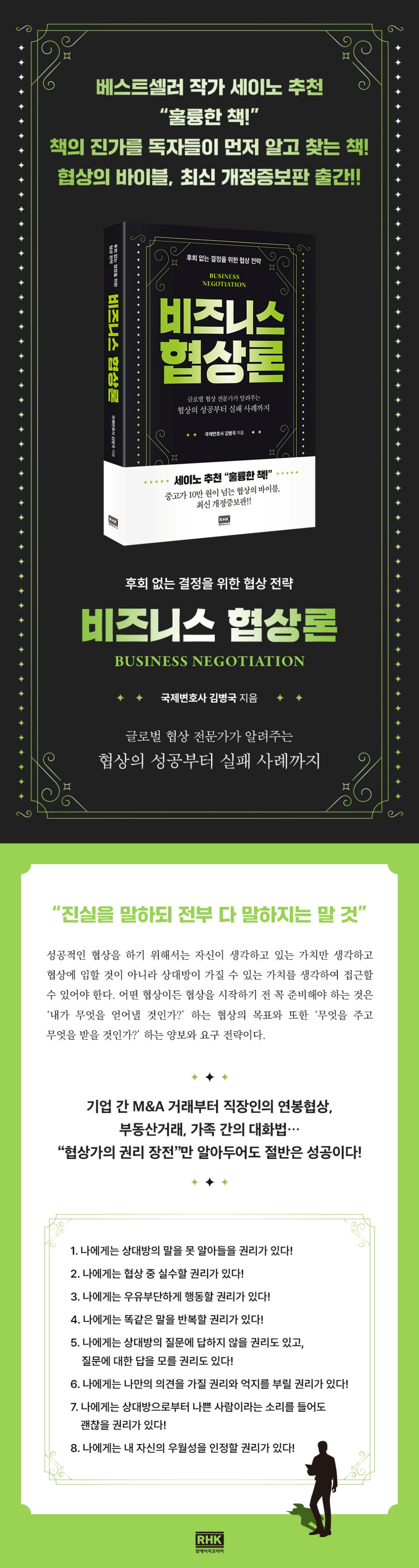
The author proudly publishes the mindset that underlies this as the 'Negotiator's Bill of Rights.'
This principle, which occupies the very first part of this book, is said to be half the success of negotiations. This bill of rights will help you let go of the fear of negotiation or the burden of negotiation breakdown and make the most rational decision in any situation.
Negotiator's Bill of Rights
Article 1 I have the right not to understand what others are saying.
Article 2: I have the right to make mistakes during negotiations.
Article 3: I have the right to be indecisive.
Article 4 I have the right to repeat the same thing.
Article 5 I have the right not to answer the other person's questions, and I have the right not to know the answer to a question.
Article 6 I have the right to my own opinions and to be assertive.
Article 7: I have the right to be okay with being called a bad person by others.
Article 8 I have the right to recognize my own superiority.
"Business Negotiation" will serve as a friendly guide to how to get what you want in the moments of choice and persuasion you face at every turn in work and life.
Furthermore, we will guide you through negotiation techniques that will help you achieve the best possible outcome for both parties without hurting their feelings, so you can find a path to long-term mutual success.
The art of win-win negotiation where both parties win
So why do people pay so much attention to this book and consistently recommend it? First and foremost, it's because it offers practical guidance optimized for Koreans.
The Western-style negotiation theories we have encountered so far focus only on the rational and logical aspects.
In addition, this book covers the emotional aspects that Koreans value.
By closely examining the emotional side that people often neglect at the negotiating table, we guide you to access hidden agendas and show you how to achieve a result that satisfies both parties.
Secondly, it is highly practical because it presents realistic examples that can be applied immediately in real-life situations.
In fact, it is no exaggeration to say that the basic principles of successful negotiations, such as the best time, collecting and analyzing the right information, and having the upper hand, are well-established.
This book provides easy-to-understand examples of how to put these basic principles into practice.
The scope also encompasses everything from negotiations for car or house purchase contracts that we commonly encounter in our daily lives, to conversations to narrow differences of opinion between family members such as spouses or children, to license introduction contracts, price negotiations, expressing one's opinion, and salary negotiations that we encounter in the workplace.
Another advantage is that the examples and persuasive techniques provided are very specific and can be applied to your own situation.
Such specific guidelines are possible thanks to the author's decades of experience in the field.
The author of this book, attorney Kim Byeong-guk, is an international lawyer and a global negotiation expert with a CPA license.
He has a wide range of legal and business knowledge, and has successfully led the company through on-site M&A, technology contract, and licensing agreement negotiations.
However, he says that he was able to understand and establish negotiation skills more deeply by applying them to various situations in real life.
Thanks to this, the negotiation techniques presented in this book can be used as a guide to resolving various challenges that arise before negotiation, while also helping us understand that negotiation has a greater impact on our lives than we might think.
The empirical rules based on principles are that powerful.
What the author emphasizes most is to abandon the 'attitude of trying to gain more by deceiving others.'
There is no greater loss to a negotiator than losing trust, so he never leaves out the advice to try to deceive others.
From another perspective, this also means that rather than just being anxious about winning, you should make an effort to find out what your opponent wants, no matter what.
The idea is that anything can have different values depending on the situation the person is in, so even if it seems trivial to me, it may be valuable to the other person. Creatively conceding something important to the other person that is commensurate with what I want to gain can create a win-win outcome where everyone wins.
The author introduces 36 specific negotiation strategies for this purpose, incorporating them into the 36 Strategic Plans of Military Strategy.
Anyone can fail in negotiations!
A Negotiator's Bill of Rights to Free You from the Fear of Negotiation
Meanwhile, what this book emphasizes as important is the attitude and posture of not giving up on negotiation.
The important thing is to emphasize that the goal is to get something better through negotiation, not to make a conclusion in negotiation itself the goal.
People often become anxious about concluding a negotiation, either out of fear of failure or out of a desire to waste the effort and money they have invested so far.
But I advise you to remember that you have the right to walk away from a negotiation and that you can fail at any time.
This attitude is not simply an endorsement of failure.
It is the creative problem-solving ability to find another way, another opportunity, another alternative.
The author proudly publishes the mindset that underlies this as the 'Negotiator's Bill of Rights.'
This principle, which occupies the very first part of this book, is said to be half the success of negotiations. This bill of rights will help you let go of the fear of negotiation or the burden of negotiation breakdown and make the most rational decision in any situation.
Negotiator's Bill of Rights
Article 1 I have the right not to understand what others are saying.
Article 2: I have the right to make mistakes during negotiations.
Article 3: I have the right to be indecisive.
Article 4 I have the right to repeat the same thing.
Article 5 I have the right not to answer the other person's questions, and I have the right not to know the answer to a question.
Article 6 I have the right to my own opinions and to be assertive.
Article 7: I have the right to be okay with being called a bad person by others.
Article 8 I have the right to recognize my own superiority.
"Business Negotiation" will serve as a friendly guide to how to get what you want in the moments of choice and persuasion you face at every turn in work and life.
Furthermore, we will guide you through negotiation techniques that will help you achieve the best possible outcome for both parties without hurting their feelings, so you can find a path to long-term mutual success.
GOODS SPECIFICS
- Date of issue: September 18, 2023
- Page count, weight, size: 328 pages | 514g | 145*215*20mm
- ISBN13: 9788925575940
- ISBN10: 8925575949
You may also like
카테고리
korean


korean

![ELLE 엘르 스페셜 에디션 A형 : 12월 [2025]](http://librairie.coreenne.fr/cdn/shop/files/b8e27a3de6c9538896439686c6b0e8fb.jpg?v=1766436872&width=3840)


