

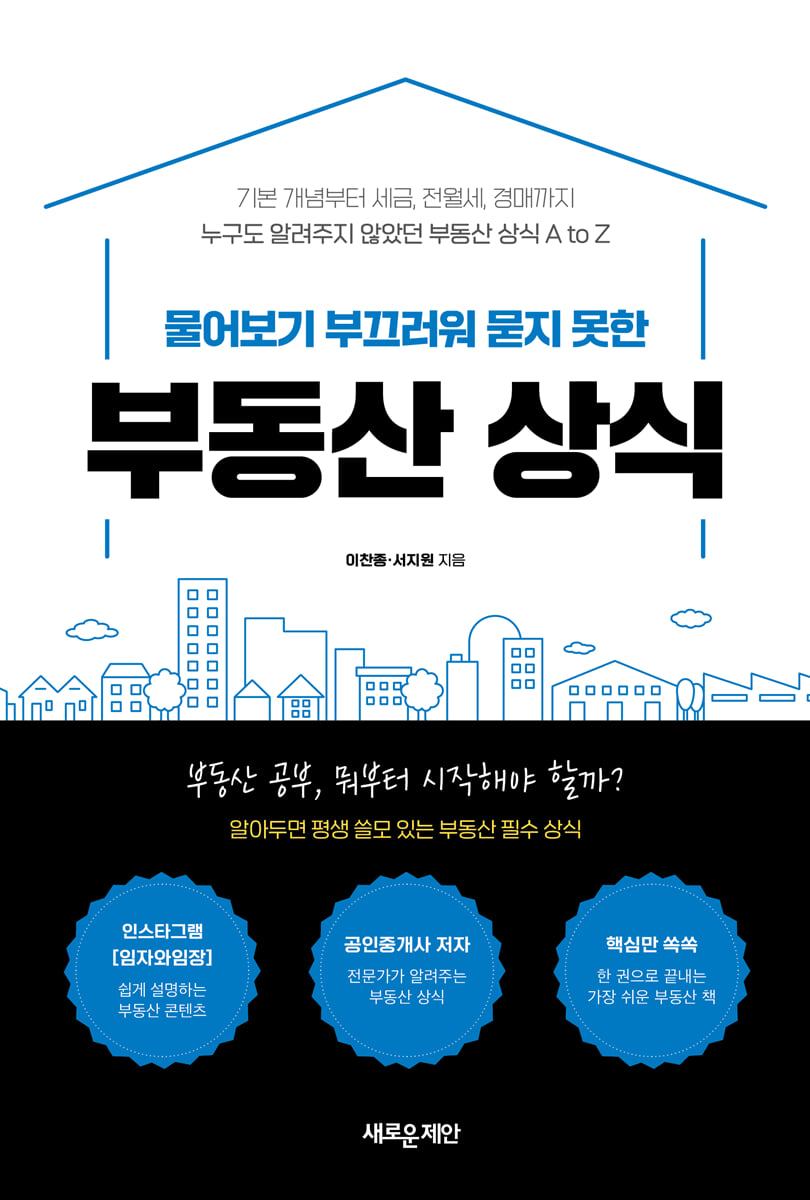
Real estate common sense that you're too embarrassed to ask
 |
Description
Book Introduction
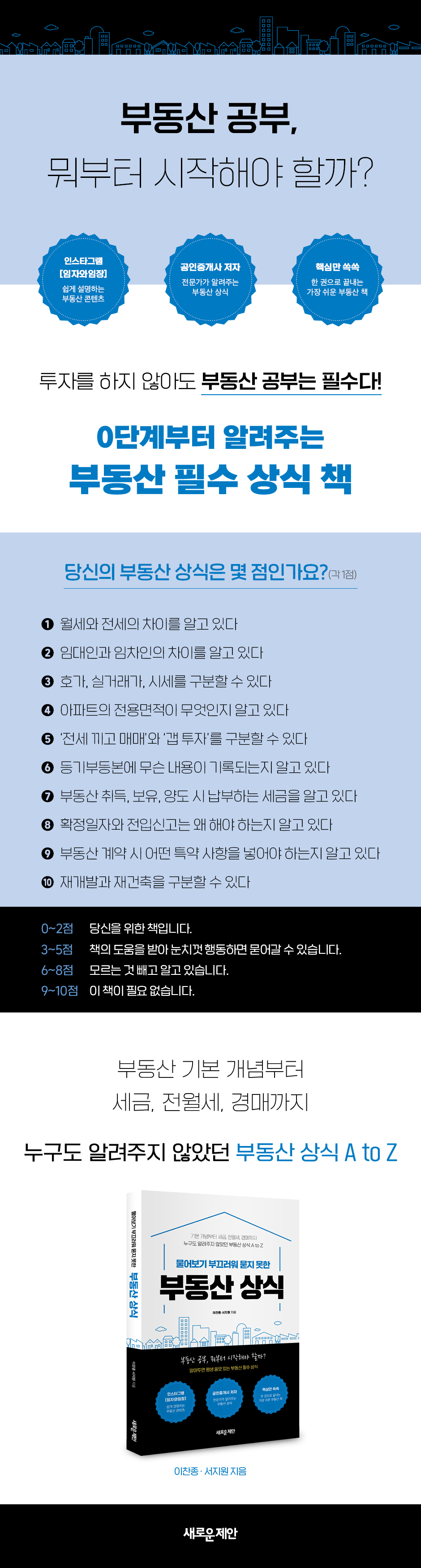
Even if you don't invest, studying real estate is essential!
Real estate knowledge is something you may never know if you don't take an interest in it and study it yourself.
Whether buying, selling, or investing, you will inevitably make a real estate transaction at least once in your life.
We've been hearing a lot of news about rental scams lately.
Real estate is something that you see as much as you know.
It is essential to study real estate at least to avoid losses.
Studying real estate, where should I start?
A friendly book that teaches you essential real estate knowledge from step 0!
Have you heard of a real estate registry transcript, but don't know what it is? Schools don't teach you what a real estate registry transcript, an essential document for real estate transactions, is.
I think you'll naturally learn everything when you grow up.
I understand that I need a house to live in, but it seems like everyone else knows what a jeonse (long-term deposit) and monthly rent are, why I need to report my move-in date and what's recorded in the real estate register, except me.
So there are questions I'm too embarrassed to ask.
The content of this book may be common knowledge to some people or easy information that can be obtained through an Internet search.
But, as the title of the book suggests, there may be people who are embarrassed to ask questions because they feel like they are the only ones who don't know something that everyone else knows as common sense.
I hope this book will be of some help to you in any real estate-related situations you may encounter in the future.
Real estate knowledge is something you may never know if you don't take an interest in it and study it yourself.
Whether buying, selling, or investing, you will inevitably make a real estate transaction at least once in your life.
We've been hearing a lot of news about rental scams lately.
Real estate is something that you see as much as you know.
It is essential to study real estate at least to avoid losses.
Studying real estate, where should I start?
A friendly book that teaches you essential real estate knowledge from step 0!
Have you heard of a real estate registry transcript, but don't know what it is? Schools don't teach you what a real estate registry transcript, an essential document for real estate transactions, is.
I think you'll naturally learn everything when you grow up.
I understand that I need a house to live in, but it seems like everyone else knows what a jeonse (long-term deposit) and monthly rent are, why I need to report my move-in date and what's recorded in the real estate register, except me.
So there are questions I'm too embarrassed to ask.
The content of this book may be common knowledge to some people or easy information that can be obtained through an Internet search.
But, as the title of the book suggests, there may be people who are embarrassed to ask questions because they feel like they are the only ones who don't know something that everyone else knows as common sense.
I hope this book will be of some help to you in any real estate-related situations you may encounter in the future.
- You can preview some of the book's contents.
Preview
index
Prologue
Chapter 1.
Real estate terms that can be used with real estate agents
1_What is the difference between ‘real estate’ and ‘licensed real estate agent’s office’?
2_Basic real estate terms you should know at least once
3_Is there a payment order? Deposit - Interim Payment - Balance
4_Various names for real estate prices
5_Same house, different area
6_Buying without knowing will cost you a tax bomb! Real estate regulation zones
7_The meaning of 'selling with a lease'
Chapter 2.
Essential Real Estate Concepts You Should Know
1_There are so many different types of real estate?
2_Real Estate Story: Registry
3_Real Estate Tax: What Do I Need to Know?
4_Not everyone can get a loan?
5_Certified real estate agent's commission: real estate brokerage commission
Useful Real Estate Apps and Sites to Know About
Chapter 3.
The Beginning of Real Estate Transactions: Jeonse and Wolse
1_I'll protect my deposit! Confirmation date and move-in report
2_Is it possible to get a loan for the monthly rent deposit?
3_Writing a Real Estate Lease Agreement: A to Z
4_If you are a small tenant, focus!
5_Let's assert our rights! Tenants' rights
Chapter 4.
Understanding the Concepts: Redevelopment and Reconstruction, Occupancy Rights and Sale Rights
1_Redevelopment and reconstruction, why are they so hot?
2_Redevelopment and reconstruction, which are difficult to explain even though we have heard of them.
3_For your future home! Occupancy rights and subscription rights
Chapter 5.
If you don't know, you'll lose out: Real Estate Auctions
1_What is a real estate auction?
2_Real Estate Auction to Protect My Money
3_A quick look at the real estate auction process
4_Essential Real Estate Auction Terms Explained Easily
supplement
Epilogue
Chapter 1.
Real estate terms that can be used with real estate agents
1_What is the difference between ‘real estate’ and ‘licensed real estate agent’s office’?
2_Basic real estate terms you should know at least once
3_Is there a payment order? Deposit - Interim Payment - Balance
4_Various names for real estate prices
5_Same house, different area
6_Buying without knowing will cost you a tax bomb! Real estate regulation zones
7_The meaning of 'selling with a lease'
Chapter 2.
Essential Real Estate Concepts You Should Know
1_There are so many different types of real estate?
2_Real Estate Story: Registry
3_Real Estate Tax: What Do I Need to Know?
4_Not everyone can get a loan?
5_Certified real estate agent's commission: real estate brokerage commission
Useful Real Estate Apps and Sites to Know About
Chapter 3.
The Beginning of Real Estate Transactions: Jeonse and Wolse
1_I'll protect my deposit! Confirmation date and move-in report
2_Is it possible to get a loan for the monthly rent deposit?
3_Writing a Real Estate Lease Agreement: A to Z
4_If you are a small tenant, focus!
5_Let's assert our rights! Tenants' rights
Chapter 4.
Understanding the Concepts: Redevelopment and Reconstruction, Occupancy Rights and Sale Rights
1_Redevelopment and reconstruction, why are they so hot?
2_Redevelopment and reconstruction, which are difficult to explain even though we have heard of them.
3_For your future home! Occupancy rights and subscription rights
Chapter 5.
If you don't know, you'll lose out: Real Estate Auctions
1_What is a real estate auction?
2_Real Estate Auction to Protect My Money
3_A quick look at the real estate auction process
4_Essential Real Estate Auction Terms Explained Easily
supplement
Epilogue
Detailed image
Into the book
Monthly rent and jeonse are ways of living by renting real estate without purchasing it.
If the tenant pays the landlord a deposit and monthly rent for the house, it is monthly rent, and if the tenant pays only the deposit without paying the monthly rent, it is jeonse.
In the sentence above, the phrase “If you pay monthly rent, it’s 40 out of 1,000 won” means that the deposit is 10 million won and the monthly rent is 400,000 won.
The deposit is money that is returned when you move out at the end of the contract period, and the monthly rent is a type of usage fee and is non-refundable.
The monthly rent deposit and monthly rent can be adjusted through agreement between the landlord and tenant, either by increasing the deposit and lowering the monthly rent, or vice versa.
--- p.20
First, the first stage is the deposit (10% of the sale price) paid at the beginning of the contract, the second stage is the interim payment (60% of the sale price) that is more than half of the total real estate price, and the third stage is the balance (30% of the sale price) that is paid after excluding the deposit and interim payment.
The ratio of the amount for each stage is a standard ratio, so it can be adjusted as long as the buyer and seller agree to it according to the situation, such as paying the down payment in two installments or paying a smaller deposit.
So how do you pay the deposit for a non-sale, monthly rent or jeonse lease? Typically, a 10% deposit is paid as a down payment, and 90% of the deposit is paid as the balance, with no down payment.
--- p.27
According to the above explanation, multi-family housing (one-room buildings) must be three stories or fewer, and multi-unit housing (villas) four stories or fewer. But what if the building I live in has five stories? How could it be built up to five stories? The reason is that the basement is not included in the floor count.
If it is a semi-basement villa that is formally called Unit 1○○, it may have a sign that says Unit 5○○ even though it is actually on the 4th floor.
Another reason is that if you look at the building register, most of the first floor units are neighborhood living facilities, or in other words, commercial spaces, but neighborhood living facilities are excluded from the floor count.
In summary, the room number is determined for convenience, and the basement and neighborhood living facilities are excluded from the floor number, so a one-room/villa building with five floors can be created.
--- p.68
When a person is born, a birth certificate is issued.
Likewise, when real estate is first built, a preservation registration, which is a birth certificate of the real estate, is made.
Additionally, as people live, the school they graduated from and the company they worked for are recorded in their school records and national health insurance acquisition records.
Likewise, real estate also has a document that records the life of the real estate, and this is the register (original copy of the register).
The register contains all information, from the preservation registration, which is the birth of real estate, to sales, leases, mortgage loans, lawsuits, and even the destruction registration, which is the death of real estate.
Anyone can view the register for a fee at the community center or the Supreme Court Internet Registry (www.iros.go.kr) website.
--- p.71
LTV stands for Loan To Value ratio.
Simply put, it is a figure that determines what percentage of the home price can be loaned.
Banks never want to lose money.
Therefore, borrowers must provide their assets to the bank as collateral to receive a loan.
Of course, you can't lend 100% of the value of the house just because you use the house as collateral.
So, banks set a standard called LTV to calculate the appropriate loan amount.
Here, the price of the house, or market price, is usually determined by the KB market price.
When a bank provides a loan using a house as collateral, there must be a standard for judging the price of the house, and most commercial banks use the KB market price as the standard.
--- p.125
A can lease is when there is little difference between the sale price and the lease price, or the lease price is actually higher than the sale price.
On the other hand, reverse rent is a comparison of the current rent and the past rent, and refers to a situation where the current market rent is lower than the past rent contracted with the existing tenant.
If the rent has dropped at the time the existing lease expires, the tenant will likely try to renew the contract at a lower rent rather than maintaining the existing rent.
Ultimately, the landlord is forced to return the reduced amount of the deposit to the tenant.
--- p.144
The confirmation date is automatically assigned when you report a housing lease at the local community center or online on the same day that the lease agreement is written.
Alternatively, you can obtain the confirmation date separately from the resident center in the area where the property is located or from the Supreme Court Internet Registration Office website.
When receiving a confirmation date from the community center, you must bring the original lease agreement and the identification card of the tenant who is the head of the household.
You can report your move-in on the day you move in, i.e., the day you move in, at the local community center or on the Government 24 website.
If you are reporting your move-in at the community center, you must bring your ID and the original lease agreement.
If the tenant pays the landlord a deposit and monthly rent for the house, it is monthly rent, and if the tenant pays only the deposit without paying the monthly rent, it is jeonse.
In the sentence above, the phrase “If you pay monthly rent, it’s 40 out of 1,000 won” means that the deposit is 10 million won and the monthly rent is 400,000 won.
The deposit is money that is returned when you move out at the end of the contract period, and the monthly rent is a type of usage fee and is non-refundable.
The monthly rent deposit and monthly rent can be adjusted through agreement between the landlord and tenant, either by increasing the deposit and lowering the monthly rent, or vice versa.
--- p.20
First, the first stage is the deposit (10% of the sale price) paid at the beginning of the contract, the second stage is the interim payment (60% of the sale price) that is more than half of the total real estate price, and the third stage is the balance (30% of the sale price) that is paid after excluding the deposit and interim payment.
The ratio of the amount for each stage is a standard ratio, so it can be adjusted as long as the buyer and seller agree to it according to the situation, such as paying the down payment in two installments or paying a smaller deposit.
So how do you pay the deposit for a non-sale, monthly rent or jeonse lease? Typically, a 10% deposit is paid as a down payment, and 90% of the deposit is paid as the balance, with no down payment.
--- p.27
According to the above explanation, multi-family housing (one-room buildings) must be three stories or fewer, and multi-unit housing (villas) four stories or fewer. But what if the building I live in has five stories? How could it be built up to five stories? The reason is that the basement is not included in the floor count.
If it is a semi-basement villa that is formally called Unit 1○○, it may have a sign that says Unit 5○○ even though it is actually on the 4th floor.
Another reason is that if you look at the building register, most of the first floor units are neighborhood living facilities, or in other words, commercial spaces, but neighborhood living facilities are excluded from the floor count.
In summary, the room number is determined for convenience, and the basement and neighborhood living facilities are excluded from the floor number, so a one-room/villa building with five floors can be created.
--- p.68
When a person is born, a birth certificate is issued.
Likewise, when real estate is first built, a preservation registration, which is a birth certificate of the real estate, is made.
Additionally, as people live, the school they graduated from and the company they worked for are recorded in their school records and national health insurance acquisition records.
Likewise, real estate also has a document that records the life of the real estate, and this is the register (original copy of the register).
The register contains all information, from the preservation registration, which is the birth of real estate, to sales, leases, mortgage loans, lawsuits, and even the destruction registration, which is the death of real estate.
Anyone can view the register for a fee at the community center or the Supreme Court Internet Registry (www.iros.go.kr) website.
--- p.71
LTV stands for Loan To Value ratio.
Simply put, it is a figure that determines what percentage of the home price can be loaned.
Banks never want to lose money.
Therefore, borrowers must provide their assets to the bank as collateral to receive a loan.
Of course, you can't lend 100% of the value of the house just because you use the house as collateral.
So, banks set a standard called LTV to calculate the appropriate loan amount.
Here, the price of the house, or market price, is usually determined by the KB market price.
When a bank provides a loan using a house as collateral, there must be a standard for judging the price of the house, and most commercial banks use the KB market price as the standard.
--- p.125
A can lease is when there is little difference between the sale price and the lease price, or the lease price is actually higher than the sale price.
On the other hand, reverse rent is a comparison of the current rent and the past rent, and refers to a situation where the current market rent is lower than the past rent contracted with the existing tenant.
If the rent has dropped at the time the existing lease expires, the tenant will likely try to renew the contract at a lower rent rather than maintaining the existing rent.
Ultimately, the landlord is forced to return the reduced amount of the deposit to the tenant.
--- p.144
The confirmation date is automatically assigned when you report a housing lease at the local community center or online on the same day that the lease agreement is written.
Alternatively, you can obtain the confirmation date separately from the resident center in the area where the property is located or from the Supreme Court Internet Registration Office website.
When receiving a confirmation date from the community center, you must bring the original lease agreement and the identification card of the tenant who is the head of the household.
You can report your move-in on the day you move in, i.e., the day you move in, at the local community center or on the Government 24 website.
If you are reporting your move-in at the community center, you must bring your ID and the original lease agreement.
--- p.164
Publisher's Review
When I was in my early twenties, I thought that real estate knowledge would come naturally when the time came.
But if you don't pay attention, it's knowledge you might never know.
How many times in your life do you actually have to sign a real estate contract? It's not as common as buying groceries at the supermarket.
So it's more unfamiliar.
Are you confused by the terms "buying" and "selling," "landlord" and "tenant"? You're not alone.
It's difficult for everyone who is making their first real estate transaction.
But real estate knowledge is not something that anyone can teach you one by one.
You have to figure it out for yourself as you live.
So we need a friendly real estate book that will teach us from step 0.
One of the most common questions I get is, “Where should I start learning about real estate?”
At first, it was really difficult to find a clear answer to this question.
The only advice I could give to someone who is just starting to study real estate was to 'read books', 'watch YouTube', and 'get some practical experience'.
But I knew.
Real estate books, YouTube videos, and news are all created with the assumption that you have basic real estate knowledge.
Just three years ago, I didn't even know the basics of real estate terminology.
Even when I read books or watched YouTube, there was a lot of content that I didn't understand.
So I wanted to create a book for myself three years ago.
This is a book that can help lay the foundation for those who are just starting to study real estate.
Now you can clearly answer the question, “Where should I start studying real estate?”
“Start your real estate studies with this book!”
From the prologue
But if you don't pay attention, it's knowledge you might never know.
How many times in your life do you actually have to sign a real estate contract? It's not as common as buying groceries at the supermarket.
So it's more unfamiliar.
Are you confused by the terms "buying" and "selling," "landlord" and "tenant"? You're not alone.
It's difficult for everyone who is making their first real estate transaction.
But real estate knowledge is not something that anyone can teach you one by one.
You have to figure it out for yourself as you live.
So we need a friendly real estate book that will teach us from step 0.
One of the most common questions I get is, “Where should I start learning about real estate?”
At first, it was really difficult to find a clear answer to this question.
The only advice I could give to someone who is just starting to study real estate was to 'read books', 'watch YouTube', and 'get some practical experience'.
But I knew.
Real estate books, YouTube videos, and news are all created with the assumption that you have basic real estate knowledge.
Just three years ago, I didn't even know the basics of real estate terminology.
Even when I read books or watched YouTube, there was a lot of content that I didn't understand.
So I wanted to create a book for myself three years ago.
This is a book that can help lay the foundation for those who are just starting to study real estate.
Now you can clearly answer the question, “Where should I start studying real estate?”
“Start your real estate studies with this book!”
From the prologue
GOODS SPECIFICS
- Date of issue: May 10, 2023
- Page count, weight, size: 240 pages | 420g | 152*225*13mm
- ISBN13: 9788955336429
- ISBN10: 895533642X
You may also like
카테고리
korean


korean

![ELLE 엘르 스페셜 에디션 A형 : 12월 [2025]](http://librairie.coreenne.fr/cdn/shop/files/b8e27a3de6c9538896439686c6b0e8fb.jpg?v=1766436872&width=3840)


