

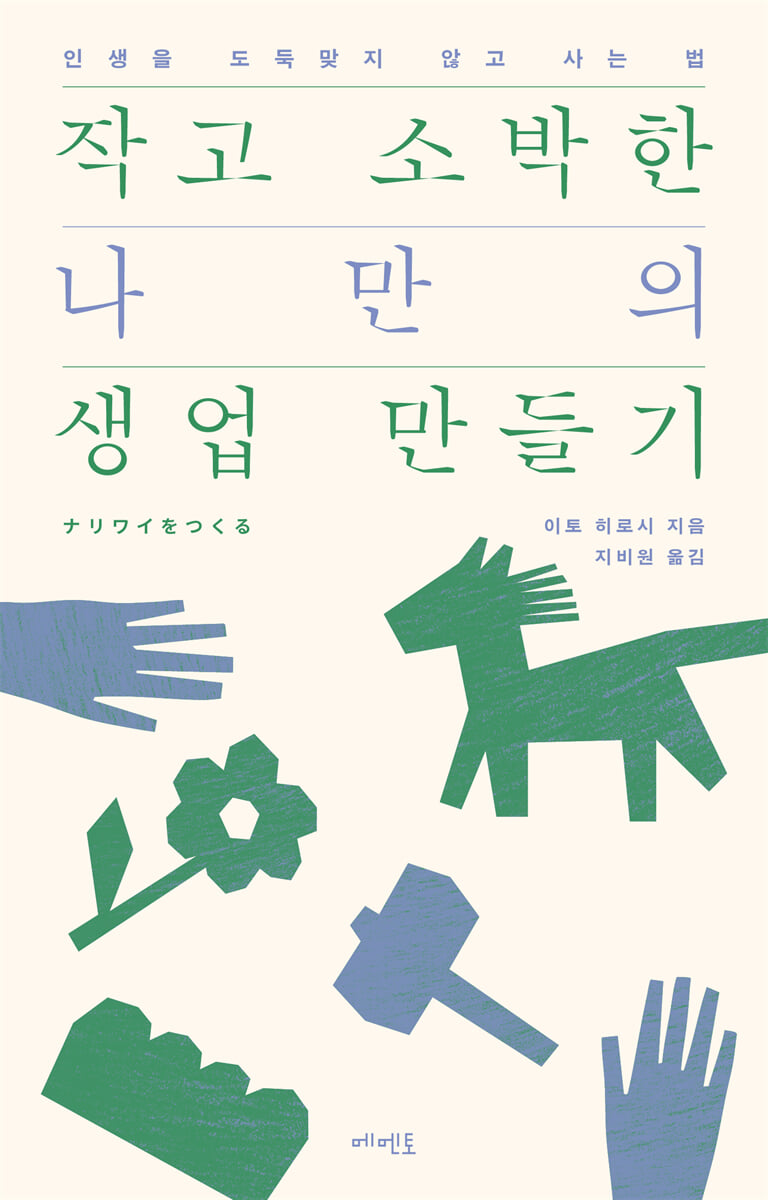
Creating my own small and simple livelihood
 |
Description
Book Introduction
- A word from MD
- Some of Marx's analyses are right and some are wrong.
Among them, the concept of alienation is still valid in modern society.
When people become alienated from the products and relations of production, they become alienated.
A life of alienation is depressing and helpless.
Here's a delightful attempt to integrate life and work.
You don't have to be an expert.
It is enough to become a businessperson.
- Son Min-gyu, Social and Political PD
“Is it natural to sacrifice one’s life for work?” Starting from this question, the author of this book, Hiroshi Ito, breaks away from the traditional labor of exchanging money for time and attempts a new type of labor where work and life become one.
"Creating My Own Small and Simple Livelihood" is a book that contains the philosophy and practice of 'livelihood' that he has accumulated through his own experiments.
The author graduated from the prestigious Kyoto University, but failed repeatedly in finding a job. He eventually resigned from a venture company he managed to join due to overwork and poor health and interpersonal relationships.
He turned to being a freelance journalist, but the decline of the magazine market left him with no way to make a living.
But after leaving his full-time job, he rediscovered his quirky and eccentric nature and was able to rebuild his life through small, diverse, guerrilla-style self-employment, what he calls his "livelihood."
A livelihood is a small, autonomous task that enriches and enriches life, and does not require special talent or large capital.
The author calls this a kind of 'microbial business model' that combines small things that are closely related to daily life.
As one of the author's "10 Principles of Business" suggests, "Help customers, but don't make them dependent," business is a new way of working that shows the path to independence through relationships and opens up the possibility of a warm economic unit where people, tired of competition and isolation, can live together.
This book is a report on his experiences developing seven different businesses from 2007 to 2012, and is also a delightful essay proposing an alternative way of life.
"Creating My Own Small and Simple Livelihood" is a book that contains the philosophy and practice of 'livelihood' that he has accumulated through his own experiments.
The author graduated from the prestigious Kyoto University, but failed repeatedly in finding a job. He eventually resigned from a venture company he managed to join due to overwork and poor health and interpersonal relationships.
He turned to being a freelance journalist, but the decline of the magazine market left him with no way to make a living.
But after leaving his full-time job, he rediscovered his quirky and eccentric nature and was able to rebuild his life through small, diverse, guerrilla-style self-employment, what he calls his "livelihood."
A livelihood is a small, autonomous task that enriches and enriches life, and does not require special talent or large capital.
The author calls this a kind of 'microbial business model' that combines small things that are closely related to daily life.
As one of the author's "10 Principles of Business" suggests, "Help customers, but don't make them dependent," business is a new way of working that shows the path to independence through relationships and opens up the possibility of a warm economic unit where people, tired of competition and isolation, can live together.
This book is a report on his experiences developing seven different businesses from 2007 to 2012, and is also a delightful essay proposing an alternative way of life.
- You can preview some of the book's contents.
Preview
index
To the revised Korean edition
Entering
Occupational Practice Problems
Chapter 1: What is a Livelihood?
The philosophy of small things that unite work and life
Work was originally something that one created oneself.
It's okay if you're not an expert
A "somehow" strategy that avoids a head-on confrontation
Even freelancers aren't free
Turn common sense upside down
The effect of reducing expenses and doubling your income
I don't participate in speed battles.
I tried it and it didn't work, so just say it and you're done
The starting point of my livelihood is myself
The company should allow its employees to have side jobs.
10 Principles of Business
Occupational Practice Problems
Chapter 2: Review and Reduce Expenses
Reduce your expenses for a lighter life
When you know the nature of anxiety, fear disappears.
Rearranging the values of life
Building an Independent Life Without Money
Building a Companionship Rather Than Insurance
Occupational Practice Problems
Chapter 3: Let's Create a Livelihood
Livelihood Creation Training 1: Predicting the Future
Three-Step Training Method for Predicting the Future
Livelihood Creation Training 2: Look Under Your Feet
Embarrassment often becomes the key to success.
Let's make it, not find it
Beyond inertia, with the imagination of an amateur
Occupational Practice Problems
Chapter 4: Let's Make a Living
"There are clues at the scene."
Standards for a reasonable price
Put the platform on my side
Breaking free from the trap of being a full-time professional and planning my own career
The power of a business that turns customers into colleagues
Life skills over salary
Occupational Practice Problems
Chapter 5: Work is More Fun When You Do It Together
The sense of 'do you hate it or not' is the standard
Is it true that there is no work in the countryside?
Health, pleasant conversation, fun play
We need a new way of working
Coming out
Translator's Note
Entering
Occupational Practice Problems
Chapter 1: What is a Livelihood?
The philosophy of small things that unite work and life
Work was originally something that one created oneself.
It's okay if you're not an expert
A "somehow" strategy that avoids a head-on confrontation
Even freelancers aren't free
Turn common sense upside down
The effect of reducing expenses and doubling your income
I don't participate in speed battles.
I tried it and it didn't work, so just say it and you're done
The starting point of my livelihood is myself
The company should allow its employees to have side jobs.
10 Principles of Business
Occupational Practice Problems
Chapter 2: Review and Reduce Expenses
Reduce your expenses for a lighter life
When you know the nature of anxiety, fear disappears.
Rearranging the values of life
Building an Independent Life Without Money
Building a Companionship Rather Than Insurance
Occupational Practice Problems
Chapter 3: Let's Create a Livelihood
Livelihood Creation Training 1: Predicting the Future
Three-Step Training Method for Predicting the Future
Livelihood Creation Training 2: Look Under Your Feet
Embarrassment often becomes the key to success.
Let's make it, not find it
Beyond inertia, with the imagination of an amateur
Occupational Practice Problems
Chapter 4: Let's Make a Living
"There are clues at the scene."
Standards for a reasonable price
Put the platform on my side
Breaking free from the trap of being a full-time professional and planning my own career
The power of a business that turns customers into colleagues
Life skills over salary
Occupational Practice Problems
Chapter 5: Work is More Fun When You Do It Together
The sense of 'do you hate it or not' is the standard
Is it true that there is no work in the countryside?
Health, pleasant conversation, fun play
We need a new way of working
Coming out
Translator's Note
Detailed image
Into the book
*The business model is microbial
“A business is about creating your own life by combining small tasks, and it is an attempt to transition from a dinosaur business model to a microbial business model.
“Starting a business might seem like it requires a lot of preparation and a grand system, but making a living is about finding specific ‘clues’ in everyday life and turning each small task into your own business.”
--- p.32
*Work was originally something that one created oneself.
“You can decide when to start a business by examining your own motivation and situation.
Starting a business is not just about creating a corporation.
If you create something yourself, it can already be called a startup.
Selling popcorn to make money is also a legitimate business venture.
“It’s not necessarily the case that starting a business requires a lot of preparation and a life-or-death commitment.”
--- p.52
*It's okay if you're not an expert
“It is necessary to increase the resolution of the senses by judging and viewing the difficulty and nature of the work through one’s own eyes.
With practice and training, most things can be accomplished.
Let's keep this point in mind.
“There is no need to be intimidated by the vested interests of experts.”
--- p.56
*Overturn common sense
“I heard that on the west coast of the United States, there is a system called CSA (Community Supported Agriculture).
This is a method of selling vegetables by receiving payment in advance through reservation.
It is a shift in thinking from “farming is my business” to “I act as a farm manager for the citizens.”
The system asks citizens what vegetables they want to eat, takes reservations, and allows citizens to directly participate during the busy times of planting seeds and harvesting.
“By breaking away from the existing system, the amount and direction of effort can change completely.”
--- p.65
*The effect of reducing expenses and doubling your income
“The starting point of a livelihood is to make a living on your own or through a personal network.
It is also a prerequisite that working increases self-sufficiency in life.
“As your income increases, your expenses decrease, which ultimately results in your income doubling.”
--- p.66
*The starting point of my livelihood is myself
"The decision to try something isn't based on a business perspective, but on personal criteria: Do I want to participate? Do I find it truly fun? Do I believe it will benefit the world?"
This attitude may seem amateurish in the business world, but the starting point of my career is always myself.” --- p.74
*The company should allow its employees to have side jobs.
Wouldn't allowing side jobs and increasing the number of employees with hands-on experience have a positive impact on the entire company? The experience of creating and operating something on your own changes your perspective and attitude toward work, and you make a tangible contribution to the organization.
In fact, designing such a flexible structure is where the manager's capabilities are revealed.
Conversely, a company that cannot even give its members a chance to breathe is bound to decline.”
--- p.79
*Don't overlook the influence of your daily environment.
“Some people work a separate job called ‘rice work’ to earn a living, and then later develop a strategy to make their life’s work what they want.
This strategy may seem realistic, but it is actually naive thinking.
“Because work for a living is also ‘work,’ the feelings that arise during the process seep into one’s inner self, and the influence is greater than one might think.”
--- p.93
*Making friends is more important than insurance
“Rather than insurance, it is more meaningful to have a farming friend who says, ‘I will feed you’ when times get tough.
If you want someone to say, "If you're in trouble, I'll feed you," you need to be able to say to someone, "If this friend is in trouble, I'll help him."
To do that, you need to create ‘colleagues’.
“A livelihood is a great way to make friends.”
--- p.107
*Change your perspective from 'why' to 'originally'
“In a business-oriented way of thinking, it is more appropriate to explore questions with the ‘original’ in mind rather than the ‘why.’
For example, rather than asking, "Why aren't cars selling?", ask, "Do we really need this many cars?", or rather than "How can I buy my dream home?", ask, "Do I really need a home loan?"
‘Wooden schoolhouse wedding’ is a business that came from this way of thinking.
It started with the question, ‘Can’t we have a wonderful wedding without spending a lot of money?’
--- pp.126-127
*Neither self-sufficiency nor combative competition
“For people who practice their profession, including myself, it is good to learn skills with a variety of people.
Livelihood is neither complete self-sufficiency nor a combative competition within a capitalist economy that prioritizes profit over life.
“I just aim to live a life where I can somehow make a living.”
--- p.163
*Advice for employees considering quitting their jobs
“If you are feeling disillusioned with corporate life, rather than thinking about quitting, try creating a living in your free time.
It is much healthier to leave a company when your work becomes too busy to go to work anymore.
Dramatic examples of people simply quitting their jobs are often highlighted in the media, but in reality, change is possible without such a commitment.”
“A business is about creating your own life by combining small tasks, and it is an attempt to transition from a dinosaur business model to a microbial business model.
“Starting a business might seem like it requires a lot of preparation and a grand system, but making a living is about finding specific ‘clues’ in everyday life and turning each small task into your own business.”
--- p.32
*Work was originally something that one created oneself.
“You can decide when to start a business by examining your own motivation and situation.
Starting a business is not just about creating a corporation.
If you create something yourself, it can already be called a startup.
Selling popcorn to make money is also a legitimate business venture.
“It’s not necessarily the case that starting a business requires a lot of preparation and a life-or-death commitment.”
--- p.52
*It's okay if you're not an expert
“It is necessary to increase the resolution of the senses by judging and viewing the difficulty and nature of the work through one’s own eyes.
With practice and training, most things can be accomplished.
Let's keep this point in mind.
“There is no need to be intimidated by the vested interests of experts.”
--- p.56
*Overturn common sense
“I heard that on the west coast of the United States, there is a system called CSA (Community Supported Agriculture).
This is a method of selling vegetables by receiving payment in advance through reservation.
It is a shift in thinking from “farming is my business” to “I act as a farm manager for the citizens.”
The system asks citizens what vegetables they want to eat, takes reservations, and allows citizens to directly participate during the busy times of planting seeds and harvesting.
“By breaking away from the existing system, the amount and direction of effort can change completely.”
--- p.65
*The effect of reducing expenses and doubling your income
“The starting point of a livelihood is to make a living on your own or through a personal network.
It is also a prerequisite that working increases self-sufficiency in life.
“As your income increases, your expenses decrease, which ultimately results in your income doubling.”
--- p.66
*The starting point of my livelihood is myself
"The decision to try something isn't based on a business perspective, but on personal criteria: Do I want to participate? Do I find it truly fun? Do I believe it will benefit the world?"
This attitude may seem amateurish in the business world, but the starting point of my career is always myself.” --- p.74
*The company should allow its employees to have side jobs.
Wouldn't allowing side jobs and increasing the number of employees with hands-on experience have a positive impact on the entire company? The experience of creating and operating something on your own changes your perspective and attitude toward work, and you make a tangible contribution to the organization.
In fact, designing such a flexible structure is where the manager's capabilities are revealed.
Conversely, a company that cannot even give its members a chance to breathe is bound to decline.”
--- p.79
*Don't overlook the influence of your daily environment.
“Some people work a separate job called ‘rice work’ to earn a living, and then later develop a strategy to make their life’s work what they want.
This strategy may seem realistic, but it is actually naive thinking.
“Because work for a living is also ‘work,’ the feelings that arise during the process seep into one’s inner self, and the influence is greater than one might think.”
--- p.93
*Making friends is more important than insurance
“Rather than insurance, it is more meaningful to have a farming friend who says, ‘I will feed you’ when times get tough.
If you want someone to say, "If you're in trouble, I'll feed you," you need to be able to say to someone, "If this friend is in trouble, I'll help him."
To do that, you need to create ‘colleagues’.
“A livelihood is a great way to make friends.”
--- p.107
*Change your perspective from 'why' to 'originally'
“In a business-oriented way of thinking, it is more appropriate to explore questions with the ‘original’ in mind rather than the ‘why.’
For example, rather than asking, "Why aren't cars selling?", ask, "Do we really need this many cars?", or rather than "How can I buy my dream home?", ask, "Do I really need a home loan?"
‘Wooden schoolhouse wedding’ is a business that came from this way of thinking.
It started with the question, ‘Can’t we have a wonderful wedding without spending a lot of money?’
--- pp.126-127
*Neither self-sufficiency nor combative competition
“For people who practice their profession, including myself, it is good to learn skills with a variety of people.
Livelihood is neither complete self-sufficiency nor a combative competition within a capitalist economy that prioritizes profit over life.
“I just aim to live a life where I can somehow make a living.”
--- p.163
*Advice for employees considering quitting their jobs
“If you are feeling disillusioned with corporate life, rather than thinking about quitting, try creating a living in your free time.
It is much healthier to leave a company when your work becomes too busy to go to work anymore.
Dramatic examples of people simply quitting their jobs are often highlighted in the media, but in reality, change is possible without such a commitment.”
--- p.179
Publisher's Review
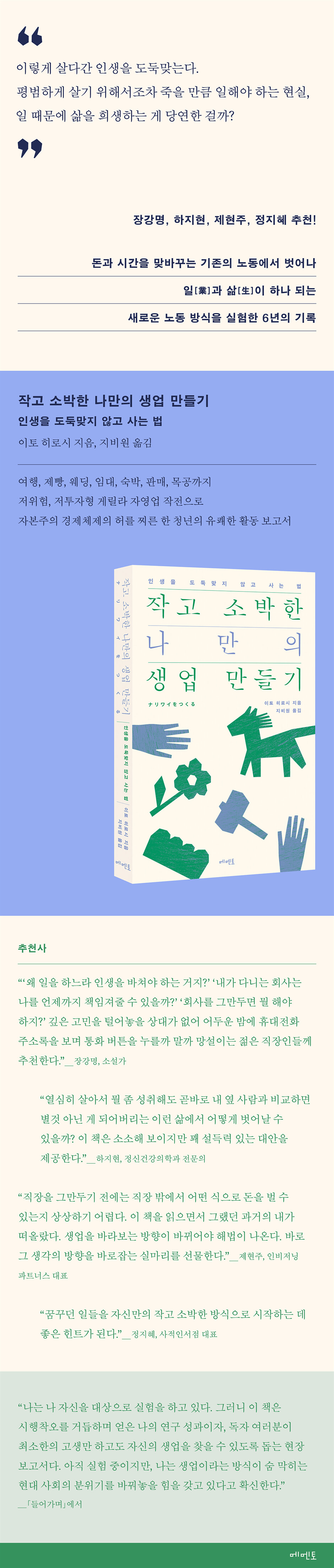
Recommended by Jang Kang-myeong, Ha Ji-hyun, Je Hyun-joo, and Jeong Ji-hye!
“I have no one to confide my deepest worries to, so I look at my phone address book in the dark of night.
“I recommend this book to young professionals who are hesitating whether to press the call button or not.”
─ Jang Gang-myeong, novelist
“In a life where no matter how much I achieve, if I compare it to the person next to me, it becomes nothing special.
How can we escape? This book offers a seemingly simple but quite compelling alternative.”
─ Ha Ji-hyun, psychiatrist
“Rather than providing answers, this book provides clues on how to think.”
Je Hyun-ju, CEO of Invisioning Partners
“It will be a good hint to start the things you have been dreaming of in your own small and simple way.”
─ Jeong Ji-hye, CEO of Private Bookstore
1.
“If you live like this, your life will be stolen.
The reality that you have to work yourself to death just to live a normal life.
“Is it natural to sacrifice one’s life for work?”
Breaking away from the traditional labor of exchanging money and time
A six-year record of experimenting with a new way of working that unites work and life.
Earning enough money to live, staying healthy, and enjoying enough leisure time is the dream of everyone living in modern society.
But the reality is harsh, and you have to work yourself to death just to live a normal life.
“Is it natural to sacrifice one’s life for work?” The author of this book, Hiroshi Ito, starts from this question and attempts a new kind of work where work and life become one, breaking away from the traditional labor of exchanging money and time.
"Creating My Own Small and Simple Livelihood" is a book that contains the philosophy and practice of 'livelihood' that he has personally practiced and accumulated.
The author graduated from the prestigious Kyoto University, but failed repeatedly in finding a job. He finally managed to get a job at a venture company, but he lost his health and interpersonal relationships due to overwork and eventually quit.
He turned to being a freelance journalist, but the decline of the magazine market left him with no way to make a living.
But after leaving his full-time job, he rediscovered his quirky and eccentric nature and was able to rebuild his life through small, diverse, guerrilla-style self-employment, what he calls his "livelihood."
The author started the 'Mongolian Real Life Experience Camp' in 2007 to experience the nomadic life, and has since run a bakery that bakes bread in a wood-fired oven, helped with plum farm work and product planning, sold fresh flower arrangements made by grandmothers in the mountains, planned and operated weddings in wooden buildings, and operated a shared atelier, all of which are unique and have made a living.
They all have in common what the author calls “peaceful guerrilla operations,” which are low-risk, low-investment operations that avoid the fierce competition of capitalism.
The author argues that by increasing self-sufficiency and reducing living expenses, you can earn several hundred thousand yen (several million won) annually or even earn a small amount each month by combining several small businesses to make a living.
"Creating My Own Small and Simple Livelihood" is a report on his experiences developing seven different businesses in travel, baking, weddings, rentals, accommodations, sales, and woodworking from 2007 to 2012, and is a delightful essay proposing alternative ways of working and a self-sufficient life.
As of 2025, the author is still actively running about ten businesses, large and small, in various fields such as food, clothing, shelter, education, and travel.
(* This book is a revised edition of the popular 2015 book, “Creating a Small and Simple Livelihood of My Own,” which was completely revised and includes a Korean preface.)
2.
Not a 'full-time job' that eats away at life
As a ‘livelihood’ that makes life fulfilling
A delightful report on a young man's activities that exposed the weaknesses of the capitalist economic system.
Most people take for granted the idea of sacrificing their lives for work.
The author points out 'professionalization' as the biggest problem in life, where everything is mortgaged to work.
In traditional times, people's livelihoods changed with the seasons, and they made a living by combining various jobs.
Artisans such as carpenters, potters, and blacksmiths also had their main occupations, farming from spring to fall, and making straw sandals from rice straw in the winter.
However, as the economy grew rapidly, the number of industries shrank and certain industries grew larger, narrowing job options and forcing people to work in fierce competition.
In Japan, the number of occupations decreased dramatically from 35,000 in the 1920s to 2,167 in 2012.
The 'subsistence lifestyle' proposed by the author is a new way of life and work that breaks free from the framework of the industrial era.
Modern people live a life where work and personal life are separated, and their self-sufficiency has greatly declined.
It wasn't that long ago that we lived by taking care of basic necessities ourselves.
So, rather, efforts to become self-sufficient in the services necessary for living can lead to a livelihood.
People often say that starting a business requires a lot of money, planning skills, special talent, and the determination to put your life on the line.
However, contrary to this common belief, a livelihood is a small, autonomous task that enriches and enriches life, and does not require special talent or large capital.
The author calls this a kind of 'microbial business model' that combines small things that are closely related to daily life.
3.
For those tired of competition and isolation
Communicating the possibility of a warm economic unit where people live together
A livelihood is more than just a means of making money; it is a gateway to a new community that connects people.
The author's efforts to help out at a friend's plum orchard during harvest season and to participate in product development, as well as selling fresh flower arrangements made by grandmothers in a marginal village with few young people, all stemmed from the simple motive of "wanting to help the people I've met along the way."
The wedding business is also planned from the beginning with a designer, and the wedding officiant is an acquaintance of the bride and groom.
The shared atelier started with the simple idea of sharing a large office, and users worked together to repair and decorate it.
When you're learning skills like laying floors, painting, or dismantling concrete block walls while renovating your home, you'll be playing with people.
In this way, occupation naturally brings people together and always creates small joys among them.
The author believes that the most effective way to learn any skill is for people to teach and learn together.
In fact, in his 'Floor Laying Workshop', the teacher and the student help each other to broaden the overall understanding of flooring.
As one of the "10 Principles of Business" says, "Help customers, but don't make them dependent," it breaks down the barriers between customers and colleagues, while opening the way for them to become independent within the relationship.
This new form of work, which shows the possibility of a warm economic unit where people, tired of competition and isolation, can live together, is called 'livelihood'.
“I have no one to confide my deepest worries to, so I look at my phone address book in the dark of night.
“I recommend this book to young professionals who are hesitating whether to press the call button or not.”
─ Jang Gang-myeong, novelist
“In a life where no matter how much I achieve, if I compare it to the person next to me, it becomes nothing special.
How can we escape? This book offers a seemingly simple but quite compelling alternative.”
─ Ha Ji-hyun, psychiatrist
“Rather than providing answers, this book provides clues on how to think.”
Je Hyun-ju, CEO of Invisioning Partners
“It will be a good hint to start the things you have been dreaming of in your own small and simple way.”
─ Jeong Ji-hye, CEO of Private Bookstore
1.
“If you live like this, your life will be stolen.
The reality that you have to work yourself to death just to live a normal life.
“Is it natural to sacrifice one’s life for work?”
Breaking away from the traditional labor of exchanging money and time
A six-year record of experimenting with a new way of working that unites work and life.
Earning enough money to live, staying healthy, and enjoying enough leisure time is the dream of everyone living in modern society.
But the reality is harsh, and you have to work yourself to death just to live a normal life.
“Is it natural to sacrifice one’s life for work?” The author of this book, Hiroshi Ito, starts from this question and attempts a new kind of work where work and life become one, breaking away from the traditional labor of exchanging money and time.
"Creating My Own Small and Simple Livelihood" is a book that contains the philosophy and practice of 'livelihood' that he has personally practiced and accumulated.
The author graduated from the prestigious Kyoto University, but failed repeatedly in finding a job. He finally managed to get a job at a venture company, but he lost his health and interpersonal relationships due to overwork and eventually quit.
He turned to being a freelance journalist, but the decline of the magazine market left him with no way to make a living.
But after leaving his full-time job, he rediscovered his quirky and eccentric nature and was able to rebuild his life through small, diverse, guerrilla-style self-employment, what he calls his "livelihood."
The author started the 'Mongolian Real Life Experience Camp' in 2007 to experience the nomadic life, and has since run a bakery that bakes bread in a wood-fired oven, helped with plum farm work and product planning, sold fresh flower arrangements made by grandmothers in the mountains, planned and operated weddings in wooden buildings, and operated a shared atelier, all of which are unique and have made a living.
They all have in common what the author calls “peaceful guerrilla operations,” which are low-risk, low-investment operations that avoid the fierce competition of capitalism.
The author argues that by increasing self-sufficiency and reducing living expenses, you can earn several hundred thousand yen (several million won) annually or even earn a small amount each month by combining several small businesses to make a living.
"Creating My Own Small and Simple Livelihood" is a report on his experiences developing seven different businesses in travel, baking, weddings, rentals, accommodations, sales, and woodworking from 2007 to 2012, and is a delightful essay proposing alternative ways of working and a self-sufficient life.
As of 2025, the author is still actively running about ten businesses, large and small, in various fields such as food, clothing, shelter, education, and travel.
(* This book is a revised edition of the popular 2015 book, “Creating a Small and Simple Livelihood of My Own,” which was completely revised and includes a Korean preface.)
2.
Not a 'full-time job' that eats away at life
As a ‘livelihood’ that makes life fulfilling
A delightful report on a young man's activities that exposed the weaknesses of the capitalist economic system.
Most people take for granted the idea of sacrificing their lives for work.
The author points out 'professionalization' as the biggest problem in life, where everything is mortgaged to work.
In traditional times, people's livelihoods changed with the seasons, and they made a living by combining various jobs.
Artisans such as carpenters, potters, and blacksmiths also had their main occupations, farming from spring to fall, and making straw sandals from rice straw in the winter.
However, as the economy grew rapidly, the number of industries shrank and certain industries grew larger, narrowing job options and forcing people to work in fierce competition.
In Japan, the number of occupations decreased dramatically from 35,000 in the 1920s to 2,167 in 2012.
The 'subsistence lifestyle' proposed by the author is a new way of life and work that breaks free from the framework of the industrial era.
Modern people live a life where work and personal life are separated, and their self-sufficiency has greatly declined.
It wasn't that long ago that we lived by taking care of basic necessities ourselves.
So, rather, efforts to become self-sufficient in the services necessary for living can lead to a livelihood.
People often say that starting a business requires a lot of money, planning skills, special talent, and the determination to put your life on the line.
However, contrary to this common belief, a livelihood is a small, autonomous task that enriches and enriches life, and does not require special talent or large capital.
The author calls this a kind of 'microbial business model' that combines small things that are closely related to daily life.
3.
For those tired of competition and isolation
Communicating the possibility of a warm economic unit where people live together
A livelihood is more than just a means of making money; it is a gateway to a new community that connects people.
The author's efforts to help out at a friend's plum orchard during harvest season and to participate in product development, as well as selling fresh flower arrangements made by grandmothers in a marginal village with few young people, all stemmed from the simple motive of "wanting to help the people I've met along the way."
The wedding business is also planned from the beginning with a designer, and the wedding officiant is an acquaintance of the bride and groom.
The shared atelier started with the simple idea of sharing a large office, and users worked together to repair and decorate it.
When you're learning skills like laying floors, painting, or dismantling concrete block walls while renovating your home, you'll be playing with people.
In this way, occupation naturally brings people together and always creates small joys among them.
The author believes that the most effective way to learn any skill is for people to teach and learn together.
In fact, in his 'Floor Laying Workshop', the teacher and the student help each other to broaden the overall understanding of flooring.
As one of the "10 Principles of Business" says, "Help customers, but don't make them dependent," it breaks down the barriers between customers and colleagues, while opening the way for them to become independent within the relationship.
This new form of work, which shows the possibility of a warm economic unit where people, tired of competition and isolation, can live together, is called 'livelihood'.
GOODS SPECIFICS
- Date of issue: August 25, 2025
- Page count, weight, size: 208 pages | 254g | 128*200*16mm
- ISBN13: 9791192099477
You may also like
카테고리
korean


korean

![ELLE 엘르 스페셜 에디션 A형 : 12월 [2025]](http://librairie.coreenne.fr/cdn/shop/files/b8e27a3de6c9538896439686c6b0e8fb.jpg?v=1766436872&width=3840)


