

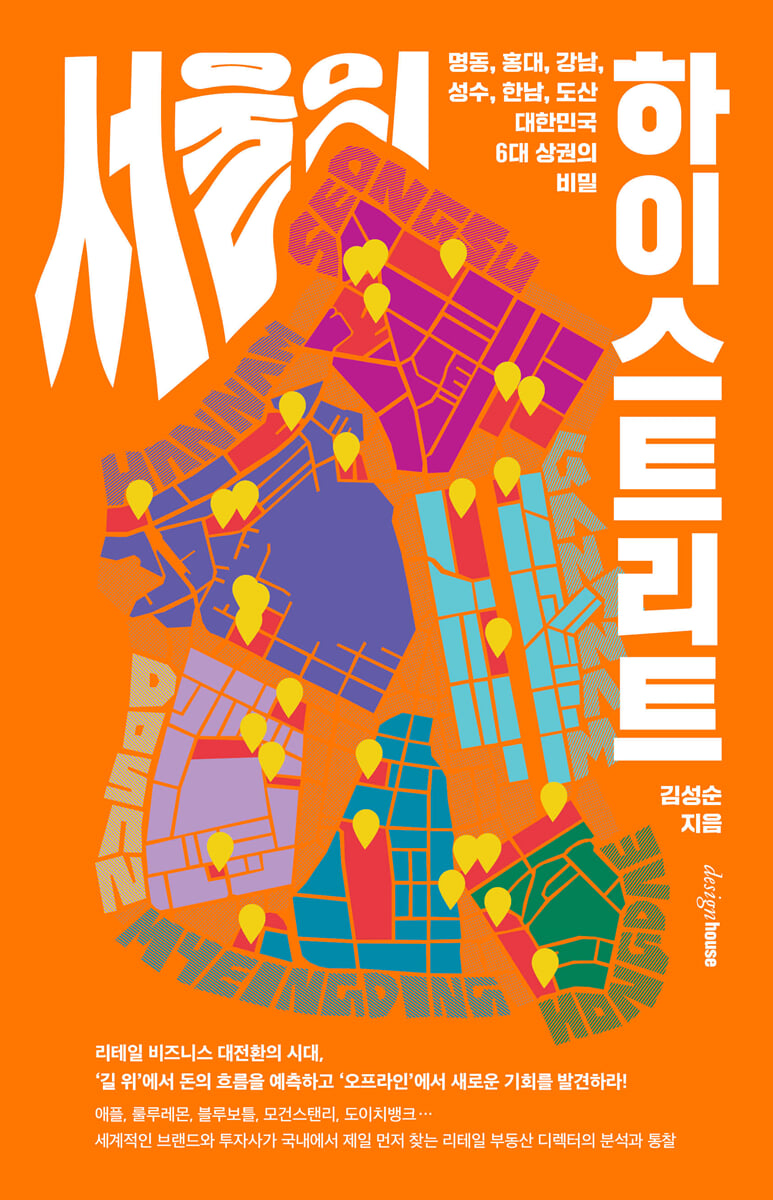
High Street in Seoul
 |
Description
Book Introduction
An era of great transformation in the retail business,
Predict money flows 'on the road' and discover new opportunities 'offline'!
Apple, Lululemon, Blue Bottle, Morgan Stanley, Deutsche Bank…
The first place that global brands and investors seek out in Korea
Analysis and Insights from a Retail Real Estate Director
Offline retail is not dead.
And it will continue to do so.
While more self-employed people are closing their businesses than during the global financial crisis or COVID-19, some businesses are thriving amidst the recession.
Walking through bustling Seoul districts like Seongsu or Myeongdong, the sheer number of people and the constant stream of products makes it hard to believe we're trapped in the shackles of a recession.
Amidst widespread expectations of a bleak future for the retail industry, especially as online shopping overwhelmingly dominates, the author of "Seoul's High Street" finds clues to business growth in stores brimming with vibrant atmosphere in bustling downtown areas.
Author Kim Seong-sun is a vice president at Cushman & Wakefield (C&W), a real estate services firm, and has advised on real estate development, investment, and sales, as well as directly planning and operating commercial facilities.
Under his leadership, global brands such as Apple and Blue Bottle entered the domestic market, and luxury brands such as Tiffany & Co. and Fendi, as well as SPA brands such as Zara and H&M, opened flagship stores.
Not only brands, but also complex commercial facilities such as D Tower and Paradise City were touched by his touch.
Having witnessed the ups and downs of various commercial districts and the rise and fall of brands, along with the changes in the retail industry, he offers guidance on how to use offline retail based on his expertise, field experience, and wisdom gained through extensive experience.
Predict money flows 'on the road' and discover new opportunities 'offline'!
Apple, Lululemon, Blue Bottle, Morgan Stanley, Deutsche Bank…
The first place that global brands and investors seek out in Korea
Analysis and Insights from a Retail Real Estate Director
Offline retail is not dead.
And it will continue to do so.
While more self-employed people are closing their businesses than during the global financial crisis or COVID-19, some businesses are thriving amidst the recession.
Walking through bustling Seoul districts like Seongsu or Myeongdong, the sheer number of people and the constant stream of products makes it hard to believe we're trapped in the shackles of a recession.
Amidst widespread expectations of a bleak future for the retail industry, especially as online shopping overwhelmingly dominates, the author of "Seoul's High Street" finds clues to business growth in stores brimming with vibrant atmosphere in bustling downtown areas.
Author Kim Seong-sun is a vice president at Cushman & Wakefield (C&W), a real estate services firm, and has advised on real estate development, investment, and sales, as well as directly planning and operating commercial facilities.
Under his leadership, global brands such as Apple and Blue Bottle entered the domestic market, and luxury brands such as Tiffany & Co. and Fendi, as well as SPA brands such as Zara and H&M, opened flagship stores.
Not only brands, but also complex commercial facilities such as D Tower and Paradise City were touched by his touch.
Having witnessed the ups and downs of various commercial districts and the rise and fall of brands, along with the changes in the retail industry, he offers guidance on how to use offline retail based on his expertise, field experience, and wisdom gained through extensive experience.
- You can preview some of the book's contents.
Preview
index
Introduction: The Present and Future of the High Streets That Made Seoul
Chapter 1: Value Add: Strategies for Maximizing the Value of Commercial Real Estate
1. The Three Major Investors in Commercial Real Estate
2 What is value-add and how is it implemented?
3 Mega High Street Value Adds: Data-Driven, Large-Scale Investments
4. Value-Add Strategy through Hotels: The Hotel Industry is on the Verge of Qualitative Change Beyond Quantitative Supply
5. Neo High Street's Value Add: Information Creation Based on Cultural Sensitivity
〉 Balancing between institutional investors and individual wealthy individuals_ Lee Hye-won, CEO of Star Road Asset Management
Chapter 2: Anchor: The Anchor of Connection that Connects Footsteps and Heart
1. Changing Retail and the Evolution of Anchors
2 Mega High Street Anchors: From Global Brand Flagships to Street Stalls
3 Neo High Street Anchors: A New Brand's Debut
Chapter 3: Façade: A Comprehensive Set of Brand Strategies That Become the Face of a Commercial District
1. Shifting Retail Paradigms and the Rise of Facades
2 Facades that became media
Facade Strategies for the 3 Mega High Streets and Neo High Streets
4 Futuristic Facade
〉 The marketing leverage of facades proven by Musinsa_ Park Ji-won, Musinsa offline general manager
Chapter 4: Pandemic: Retail's Time Machine, Accelerated by a Decade
1. Restructuring the Retail Ecosystem
2. Shift of power
3 Reasons why traditional commercial districts are collapsing and emerging commercial districts are taking off
4 The resilience and growth potential of the high street
Chapter 5 Layers: The Ties of Time and Culture That Create Commercial Competitiveness
1. Life cycle of a commercial district
2 Mega and Neo, the Limited Class and the Ambition Class
3 Myeongdong, a living legacy of the Korean economy
4 Hannam, a hybrid of global culture and conglomerate culture
The Future Value of Commercial Districts Determined by Social Infrastructure_ Sanginvestment CEO Sangwoong Han
Chapter 6: The Dragon's Gate: The Flag of a Successful Brand, Symbolizing Wealth and Authority
1. The six major high streets that became the gateway to success.
2. Myeongdong, Hongdae, and Gangnam: Symbols of Commercial Success and Authority
3. Signs of unique value that differentiates it from the established ones
4. Changes in distribution channels and the emergence of new gateways
〉 The Economics of Dosan and Hannam Commercial Districts Through a 17-Year Brand Journey_ Kang Jae-young, CEO of Unipair
Chapter 7 K: The New Engine of the High Street, K-Wave
1 South Korea in the swamp of recession
2. The 'Glocal' Market and the Korean Wave Generation
3 K-Anchors Who Became the Destination of Visits
4 Mega High Streets Become Hubs for Medical Tourism
〉 A new wave of K-Clinic where cultural experiences coexist_ Director Lee Ji-eun of Ppeum Global Clinic
Chapter 8: Connections: Where Time, Era, People, and Brands Intersect
1. Similarity between commercial districts and organizations
2. Commerce as a process of civilization
3. Identity created by inclusive and selective connections
Concluding remarks: People who breathe life into space
References
Chapter 1: Value Add: Strategies for Maximizing the Value of Commercial Real Estate
1. The Three Major Investors in Commercial Real Estate
2 What is value-add and how is it implemented?
3 Mega High Street Value Adds: Data-Driven, Large-Scale Investments
4. Value-Add Strategy through Hotels: The Hotel Industry is on the Verge of Qualitative Change Beyond Quantitative Supply
5. Neo High Street's Value Add: Information Creation Based on Cultural Sensitivity
〉 Balancing between institutional investors and individual wealthy individuals_ Lee Hye-won, CEO of Star Road Asset Management
Chapter 2: Anchor: The Anchor of Connection that Connects Footsteps and Heart
1. Changing Retail and the Evolution of Anchors
2 Mega High Street Anchors: From Global Brand Flagships to Street Stalls
3 Neo High Street Anchors: A New Brand's Debut
Chapter 3: Façade: A Comprehensive Set of Brand Strategies That Become the Face of a Commercial District
1. Shifting Retail Paradigms and the Rise of Facades
2 Facades that became media
Facade Strategies for the 3 Mega High Streets and Neo High Streets
4 Futuristic Facade
〉 The marketing leverage of facades proven by Musinsa_ Park Ji-won, Musinsa offline general manager
Chapter 4: Pandemic: Retail's Time Machine, Accelerated by a Decade
1. Restructuring the Retail Ecosystem
2. Shift of power
3 Reasons why traditional commercial districts are collapsing and emerging commercial districts are taking off
4 The resilience and growth potential of the high street
Chapter 5 Layers: The Ties of Time and Culture That Create Commercial Competitiveness
1. Life cycle of a commercial district
2 Mega and Neo, the Limited Class and the Ambition Class
3 Myeongdong, a living legacy of the Korean economy
4 Hannam, a hybrid of global culture and conglomerate culture
The Future Value of Commercial Districts Determined by Social Infrastructure_ Sanginvestment CEO Sangwoong Han
Chapter 6: The Dragon's Gate: The Flag of a Successful Brand, Symbolizing Wealth and Authority
1. The six major high streets that became the gateway to success.
2. Myeongdong, Hongdae, and Gangnam: Symbols of Commercial Success and Authority
3. Signs of unique value that differentiates it from the established ones
4. Changes in distribution channels and the emergence of new gateways
〉 The Economics of Dosan and Hannam Commercial Districts Through a 17-Year Brand Journey_ Kang Jae-young, CEO of Unipair
Chapter 7 K: The New Engine of the High Street, K-Wave
1 South Korea in the swamp of recession
2. The 'Glocal' Market and the Korean Wave Generation
3 K-Anchors Who Became the Destination of Visits
4 Mega High Streets Become Hubs for Medical Tourism
〉 A new wave of K-Clinic where cultural experiences coexist_ Director Lee Ji-eun of Ppeum Global Clinic
Chapter 8: Connections: Where Time, Era, People, and Brands Intersect
1. Similarity between commercial districts and organizations
2. Commerce as a process of civilization
3. Identity created by inclusive and selective connections
Concluding remarks: People who breathe life into space
References
Detailed image

Into the book
As the pandemic began, the era of Retail 4.0 arrived, adding insult to injury.
From the era of department stores to the era of shopping centers, from the era of e-commerce to the era of online and offline convergence, we have arrived.
In the midst of that chaotic transition, the market was shaken and we were left in turmoil.
It's unfortunate that the pace of change in retail has been so rapid and intense, but I believe the flow of change itself is natural.
Great transformations that shake civilization do not come with a kind face.
---From "Introductory Remarks"
The two-story, 70-pyeong (approximately 230 square meters) detached house, built in the 1970s, was one of the old houses lined up in the alley behind the main street.
Lemaire reborn the building as a modern space while respecting the structural characteristics and accumulated time of the existing building.
The functional space for living has been transformed into a showroom that embodies the brand's belief that "true style lies in everyday life, not fantasy" through the opening of Lemaire.
The Lemaire flagship is noteworthy for its organic harmony between brand identity and regionality.
---From "Chapter 1 Value Add"
Experiential retail is more like a functional showroom that allows customers to experience products or services firsthand and make a purchase decision.
Nowadays, we buy all the products we need for our daily lives online rather than offline.
Among these, electronic products, including massage chairs, bed mattresses, and high-performance speakers, are items with high consumer involvement.
Brands with high consumer engagement have created experiential retail to activate customers' 'product experience.'
Afterwards, a communication space model that evolved beyond the product experience showroom gained popularity among consumers: experiential retail.
---From "Chapter 2 Anchor"
Dosan's London Bagel Museum and Starbucks Reserve Premium, Seongsu's Natural Salt Bread in Seongsu and Betong, and Hannam's Anthracite are representative F&B stores of Neo High Street.
The emotional atmosphere and interior, unique menu, and unique service provided by people rather than kiosks attract people.
It's worth considering why people are willing to wait in line for stores that aren't large or flashy and often lack automated services, and what humans truly need in this "age of convenience."
---From "Chapter 3 Facade"
Why did the pandemic exert such a differential impact on different commercial districts? It's likely due to differences in the characteristics of each commercial district, its core consumer base, tenant composition, and, most importantly, its internal economic structure.
Rent systems, ownership structures, capital intensity, and stakeholder decision-making tendencies create the invisible order of commercial districts.
The invisible order of the market has directly impacted the high street's response and resilience during the pandemic.
---From "Chapter 4: Pandemic"
There are also exceptional cases that destroy the life cycle of a commercial district.
Seongsu did not follow the typical commercial development pattern, but rather followed a path of compressed growth.
It takes more than 10 years for a commercial district to grow from infancy to adulthood, but Seongsu remained in infancy for a long time and then grew rapidly to enter the highest stage of commercial district development.
Symbolic anchors like Daerim Warehouse, the strategic entry of luxury brands like Dior Seongsu, the offline expansion of Musinsa, a dinosaur in the fashion platform industry, and pop-up culture, which has become a medium for disseminating information and content, have all led to Seongsu's remarkable leap forward.
---From "Chapter 5 Layers"
In today's commercial ecosystem, the survival and prosperity of a brand is achieved within a highly competitive environment.
In the retail industry, a brand's decision to open a regular store or flagship store in a specific commercial district is not simply a matter of location selection; it is a crucial decision that demonstrates the brand's uniqueness and strategic position within the market.
Whether rent is cheap or expensive, located in prime Seoul location or in a remote outskirt, commercial districts are platforms that connect brands and consumers.
From the era of department stores to the era of shopping centers, from the era of e-commerce to the era of online and offline convergence, we have arrived.
In the midst of that chaotic transition, the market was shaken and we were left in turmoil.
It's unfortunate that the pace of change in retail has been so rapid and intense, but I believe the flow of change itself is natural.
Great transformations that shake civilization do not come with a kind face.
---From "Introductory Remarks"
The two-story, 70-pyeong (approximately 230 square meters) detached house, built in the 1970s, was one of the old houses lined up in the alley behind the main street.
Lemaire reborn the building as a modern space while respecting the structural characteristics and accumulated time of the existing building.
The functional space for living has been transformed into a showroom that embodies the brand's belief that "true style lies in everyday life, not fantasy" through the opening of Lemaire.
The Lemaire flagship is noteworthy for its organic harmony between brand identity and regionality.
---From "Chapter 1 Value Add"
Experiential retail is more like a functional showroom that allows customers to experience products or services firsthand and make a purchase decision.
Nowadays, we buy all the products we need for our daily lives online rather than offline.
Among these, electronic products, including massage chairs, bed mattresses, and high-performance speakers, are items with high consumer involvement.
Brands with high consumer engagement have created experiential retail to activate customers' 'product experience.'
Afterwards, a communication space model that evolved beyond the product experience showroom gained popularity among consumers: experiential retail.
---From "Chapter 2 Anchor"
Dosan's London Bagel Museum and Starbucks Reserve Premium, Seongsu's Natural Salt Bread in Seongsu and Betong, and Hannam's Anthracite are representative F&B stores of Neo High Street.
The emotional atmosphere and interior, unique menu, and unique service provided by people rather than kiosks attract people.
It's worth considering why people are willing to wait in line for stores that aren't large or flashy and often lack automated services, and what humans truly need in this "age of convenience."
---From "Chapter 3 Facade"
Why did the pandemic exert such a differential impact on different commercial districts? It's likely due to differences in the characteristics of each commercial district, its core consumer base, tenant composition, and, most importantly, its internal economic structure.
Rent systems, ownership structures, capital intensity, and stakeholder decision-making tendencies create the invisible order of commercial districts.
The invisible order of the market has directly impacted the high street's response and resilience during the pandemic.
---From "Chapter 4: Pandemic"
There are also exceptional cases that destroy the life cycle of a commercial district.
Seongsu did not follow the typical commercial development pattern, but rather followed a path of compressed growth.
It takes more than 10 years for a commercial district to grow from infancy to adulthood, but Seongsu remained in infancy for a long time and then grew rapidly to enter the highest stage of commercial district development.
Symbolic anchors like Daerim Warehouse, the strategic entry of luxury brands like Dior Seongsu, the offline expansion of Musinsa, a dinosaur in the fashion platform industry, and pop-up culture, which has become a medium for disseminating information and content, have all led to Seongsu's remarkable leap forward.
---From "Chapter 5 Layers"
In today's commercial ecosystem, the survival and prosperity of a brand is achieved within a highly competitive environment.
In the retail industry, a brand's decision to open a regular store or flagship store in a specific commercial district is not simply a matter of location selection; it is a crucial decision that demonstrates the brand's uniqueness and strategic position within the market.
Whether rent is cheap or expensive, located in prime Seoul location or in a remote outskirt, commercial districts are platforms that connect brands and consumers.
---From "Chapter 6: The Dragon's Gate"
Publisher's Review
An era of great transformation in the retail business,
Predict money flows 'on the road' and discover new opportunities 'offline'!
Apple, Lululemon, Blue Bottle, Morgan Stanley, Deutsche Bank…
The first place that global brands and investors seek out in Korea
Analysis and Insights from a Retail Real Estate Director
Offline retail is not dead.
And it will continue to do so.
While more self-employed people are closing their businesses than during the global financial crisis or COVID-19, some businesses are thriving amidst the recession.
Walking through bustling Seoul districts like Seongsu or Myeongdong, the sheer number of people and the constant stream of products makes it hard to believe we're trapped in the shackles of a recession.
Amidst widespread expectations of a bleak future for the retail industry, especially as online shopping overwhelmingly dominates, the author of "Seoul's High Street" finds clues to business growth in stores in bustling downtown areas brimming with energy.
Author Kim Seong-sun is a vice president at Cushman & Wakefield (C&W), a real estate services firm, and has advised on real estate development, investment, and sales, as well as directly planning and operating commercial facilities.
Under his leadership, global brands such as Apple and Blue Bottle entered the domestic market, and luxury brands such as Tiffany & Co. and Fendi, as well as SPA brands such as Zara and H&M, opened flagship stores.
Not only brands, but also complex commercial facilities such as D Tower and Paradise City were touched by his touch.
Having witnessed the ups and downs of various commercial districts and the rise and fall of brands, along with the changes in the retail industry, he offers guidance on how to use offline retail based on his expertise, field experience, and wisdom gained through extensive experience.
We explore the secrets of the brands and buildings that continue to attract people to Seoul's six major "high streets," which continue to thrive even amidst the prolonged recession.
The author, who views investors and building owners as symbiotic partners rather than adversaries with tenants, explains eight phenomena that deserve attention from all stakeholders in the retail real estate industry without being biased.
We will look at 'value-add', a strategy to maximize profits by increasing real estate value; 'anchor', a symbol that attracts people; 'facade', which has become the face of a brand and a medium for strengthening identity; 'pandemic', which has decisively changed the function of retail; 'layer', the socio-cultural capital of the high street; the 'dragon gate' phenomenon of the high street, which has become an incubator for new brands and a seal that strengthens the authority of existing brands; 'K', Korean cultural content that has become a global trend; and the characteristics of the high street, which strengthens its power by 'connecting' or 'disconnecting' the times and people.
By following the changing consumption patterns and capital flows that permeate the six major high streets of Seoul, a megacity with a population of 10 million, the future of the global market can be glimpsed.
“Now, the changes in consumption patterns that permeate the city and
“Read the new flow of capital”
Retail businesses mired in recession seek a breakthrough in offline markets.
Why did Apple, a brand favored by Generation Z, choose Myeongdong over Seongsu? Why did Dior, a synonym for luxury, choose to open a pop-up in Seongsu instead of a department store? Understanding why landmark brands choose specific commercial districts and how the appeal of those districts enhances their brand value can help us better understand the retail market.
As a retail real estate director, the author has worked on small projects, such as bringing brands into buildings, remodeling or rebuilding buildings to revive dying ones, and planning large-scale complexes like D Tower. Using commercial real estate as a material, the author unfolds stories about the history of commercial districts, the evolution of retail, trends, brand strategies, consumer psychology, and technological innovation.
The six major high streets in Seoul covered in this book are places that exemplify the current state of offline retail in the post-pandemic era.
As we move from the era of department stores to the era of shopping centers, and from the era of e-commerce to the era of online-offline convergence, the high street is also rapidly changing.
Korea's top high streets—Myeongdong, Hongdae, Gangnam, Seongsu, Hannam, and Dosan—address the situation innovatively while maintaining their own unique expressions.
Each commercial district has its own distinct character: Myeongdong, with its street vendors, foreign tourists, and global brand flagships; Seongsu, with its unique character created by pop-ups, Generation Z, and the atmosphere of an old factory district; and Hannam, with its sophisticated mix of high-end culture and K-fashion.
But there is something that groups these places together as one category: high streets.
These are core industries, authenticity and topicality, originality and disruptiveness, resilience, background power, cultural infrastructure, and accessibility.
A fresh perspective on the present and future of retail real estate in South Korea.
Retail Blueprint for Optimal Location, Optimal Space, and Optimal Strategy
Jaja divides six commercial districts into Mega High Street and Neo High Street based on nine attributes.
The traditional commercial districts of Myeongdong, Hongdae, and Gangnam, where the Apple Store, the pinnacle of retail, is located, are divided into Mega High Street, and the emerging commercial districts of Seongsu, Hannam, and Dosan, which are popular with the 2030 generation and remain a hot topic, are divided into Neo High Street.
Traditional and emerging commercial districts contrast in many ways.
Even within the same high street, buildings in Gangnam and Myeongdong are tall and have large areas, while buildings in Seongsu and Dosan boast distinctive exteriors rather than increasing volume.
This is in line with the strategic value-add that maximizes the value of commercial real estate.
The resources that attract people, the anchors, are also different.
In Myeongdong, the flagship stores of global brands will be anchored, while in Hannam, the flagship stores of the most popular brands will be anchored.
As offline retail has evolved from a space where products are sold to a space where people can experience something special, the façade, which serves as the face and billboard of the brand, has also become important.
In Myeongdong and Gangnam, brand messages are displayed through facades that reveal the brand's authority, economic power, and premium value, like Louis Vuitton and Gucci, while in Seongsu and Hannam, brand messages are displayed through facades that emphasize the brand's originality and individuality, like Tamburins.
The competitiveness of a commercial district comes from layers, which are socio-cultural capital.
The consumption patterns of the wealthy consumers in Myeongdong and Gangnam and the young people visiting Seongsu are bound to be different.
To cater to this consumer base, mega high streets will feature department stores and luxury brands, while neo high streets will feature organic stores and independent bookstores.
While established brands open flagships in mega high streets to enhance their brand status, emerging brands open flagships in neo-high streets like Dosan to establish a unique identity and generate buzz.
Bringing people together, reviving the brand,
How streets that transform cities are created
It is difficult to say which of the two commercial districts, Mega and Neo, is more developed, as they both have different characteristics in many ways.
The reason why Seongsu, Hannam, and Dosan, which were small in scale just a few years ago, were able to leap forward to stand shoulder to shoulder with Mega was, ironically, because of the pandemic.
The pandemic has not simply accelerated the development of online platforms; it has also reshaped the landscape of consumer behavior, distribution channels, and commercial value.
There is one more thing that has opened up new horizons for commercial districts.
It's the Korean Wave.
As the Korean Wave expands beyond dramas and K-pop to encompass beauty, fashion, and clinics, commercial districts are also being reorganized to reflect the needs of foreign tourists.
In this way, commercial districts neither grow nor decline on their own.
Identity is built according to the times, the surrounding environment, and the culture.
If you take a close look at the cityscape of a busy street, you will realize that many elements other than shops and visitors make up the streetscape.
Buildings big and small, eye-catching facades, street food, busking – everything old and new – make up the High Street.
In addition, invisible investors, operators, and developers are also among the main players driving change behind the scenes.
The High Street, where all these elements are connected, is constantly interacting and transforming.
The author's story, which vividly describes the process by which people gather and streets are formed, is ultimately no different from an analysis of the commercial ecosystem.
For those struggling with the rapidly evolving retail market, this book will help you prepare for and respond to the future, based on exceptional analysis and insights into the evolution of real estate, shifting consumer experiences, brand spatial strategies, and survival strategies in an economic downturn.
Predict money flows 'on the road' and discover new opportunities 'offline'!
Apple, Lululemon, Blue Bottle, Morgan Stanley, Deutsche Bank…
The first place that global brands and investors seek out in Korea
Analysis and Insights from a Retail Real Estate Director
Offline retail is not dead.
And it will continue to do so.
While more self-employed people are closing their businesses than during the global financial crisis or COVID-19, some businesses are thriving amidst the recession.
Walking through bustling Seoul districts like Seongsu or Myeongdong, the sheer number of people and the constant stream of products makes it hard to believe we're trapped in the shackles of a recession.
Amidst widespread expectations of a bleak future for the retail industry, especially as online shopping overwhelmingly dominates, the author of "Seoul's High Street" finds clues to business growth in stores in bustling downtown areas brimming with energy.
Author Kim Seong-sun is a vice president at Cushman & Wakefield (C&W), a real estate services firm, and has advised on real estate development, investment, and sales, as well as directly planning and operating commercial facilities.
Under his leadership, global brands such as Apple and Blue Bottle entered the domestic market, and luxury brands such as Tiffany & Co. and Fendi, as well as SPA brands such as Zara and H&M, opened flagship stores.
Not only brands, but also complex commercial facilities such as D Tower and Paradise City were touched by his touch.
Having witnessed the ups and downs of various commercial districts and the rise and fall of brands, along with the changes in the retail industry, he offers guidance on how to use offline retail based on his expertise, field experience, and wisdom gained through extensive experience.
We explore the secrets of the brands and buildings that continue to attract people to Seoul's six major "high streets," which continue to thrive even amidst the prolonged recession.
The author, who views investors and building owners as symbiotic partners rather than adversaries with tenants, explains eight phenomena that deserve attention from all stakeholders in the retail real estate industry without being biased.
We will look at 'value-add', a strategy to maximize profits by increasing real estate value; 'anchor', a symbol that attracts people; 'facade', which has become the face of a brand and a medium for strengthening identity; 'pandemic', which has decisively changed the function of retail; 'layer', the socio-cultural capital of the high street; the 'dragon gate' phenomenon of the high street, which has become an incubator for new brands and a seal that strengthens the authority of existing brands; 'K', Korean cultural content that has become a global trend; and the characteristics of the high street, which strengthens its power by 'connecting' or 'disconnecting' the times and people.
By following the changing consumption patterns and capital flows that permeate the six major high streets of Seoul, a megacity with a population of 10 million, the future of the global market can be glimpsed.
“Now, the changes in consumption patterns that permeate the city and
“Read the new flow of capital”
Retail businesses mired in recession seek a breakthrough in offline markets.
Why did Apple, a brand favored by Generation Z, choose Myeongdong over Seongsu? Why did Dior, a synonym for luxury, choose to open a pop-up in Seongsu instead of a department store? Understanding why landmark brands choose specific commercial districts and how the appeal of those districts enhances their brand value can help us better understand the retail market.
As a retail real estate director, the author has worked on small projects, such as bringing brands into buildings, remodeling or rebuilding buildings to revive dying ones, and planning large-scale complexes like D Tower. Using commercial real estate as a material, the author unfolds stories about the history of commercial districts, the evolution of retail, trends, brand strategies, consumer psychology, and technological innovation.
The six major high streets in Seoul covered in this book are places that exemplify the current state of offline retail in the post-pandemic era.
As we move from the era of department stores to the era of shopping centers, and from the era of e-commerce to the era of online-offline convergence, the high street is also rapidly changing.
Korea's top high streets—Myeongdong, Hongdae, Gangnam, Seongsu, Hannam, and Dosan—address the situation innovatively while maintaining their own unique expressions.
Each commercial district has its own distinct character: Myeongdong, with its street vendors, foreign tourists, and global brand flagships; Seongsu, with its unique character created by pop-ups, Generation Z, and the atmosphere of an old factory district; and Hannam, with its sophisticated mix of high-end culture and K-fashion.
But there is something that groups these places together as one category: high streets.
These are core industries, authenticity and topicality, originality and disruptiveness, resilience, background power, cultural infrastructure, and accessibility.
A fresh perspective on the present and future of retail real estate in South Korea.
Retail Blueprint for Optimal Location, Optimal Space, and Optimal Strategy
Jaja divides six commercial districts into Mega High Street and Neo High Street based on nine attributes.
The traditional commercial districts of Myeongdong, Hongdae, and Gangnam, where the Apple Store, the pinnacle of retail, is located, are divided into Mega High Street, and the emerging commercial districts of Seongsu, Hannam, and Dosan, which are popular with the 2030 generation and remain a hot topic, are divided into Neo High Street.
Traditional and emerging commercial districts contrast in many ways.
Even within the same high street, buildings in Gangnam and Myeongdong are tall and have large areas, while buildings in Seongsu and Dosan boast distinctive exteriors rather than increasing volume.
This is in line with the strategic value-add that maximizes the value of commercial real estate.
The resources that attract people, the anchors, are also different.
In Myeongdong, the flagship stores of global brands will be anchored, while in Hannam, the flagship stores of the most popular brands will be anchored.
As offline retail has evolved from a space where products are sold to a space where people can experience something special, the façade, which serves as the face and billboard of the brand, has also become important.
In Myeongdong and Gangnam, brand messages are displayed through facades that reveal the brand's authority, economic power, and premium value, like Louis Vuitton and Gucci, while in Seongsu and Hannam, brand messages are displayed through facades that emphasize the brand's originality and individuality, like Tamburins.
The competitiveness of a commercial district comes from layers, which are socio-cultural capital.
The consumption patterns of the wealthy consumers in Myeongdong and Gangnam and the young people visiting Seongsu are bound to be different.
To cater to this consumer base, mega high streets will feature department stores and luxury brands, while neo high streets will feature organic stores and independent bookstores.
While established brands open flagships in mega high streets to enhance their brand status, emerging brands open flagships in neo-high streets like Dosan to establish a unique identity and generate buzz.
Bringing people together, reviving the brand,
How streets that transform cities are created
It is difficult to say which of the two commercial districts, Mega and Neo, is more developed, as they both have different characteristics in many ways.
The reason why Seongsu, Hannam, and Dosan, which were small in scale just a few years ago, were able to leap forward to stand shoulder to shoulder with Mega was, ironically, because of the pandemic.
The pandemic has not simply accelerated the development of online platforms; it has also reshaped the landscape of consumer behavior, distribution channels, and commercial value.
There is one more thing that has opened up new horizons for commercial districts.
It's the Korean Wave.
As the Korean Wave expands beyond dramas and K-pop to encompass beauty, fashion, and clinics, commercial districts are also being reorganized to reflect the needs of foreign tourists.
In this way, commercial districts neither grow nor decline on their own.
Identity is built according to the times, the surrounding environment, and the culture.
If you take a close look at the cityscape of a busy street, you will realize that many elements other than shops and visitors make up the streetscape.
Buildings big and small, eye-catching facades, street food, busking – everything old and new – make up the High Street.
In addition, invisible investors, operators, and developers are also among the main players driving change behind the scenes.
The High Street, where all these elements are connected, is constantly interacting and transforming.
The author's story, which vividly describes the process by which people gather and streets are formed, is ultimately no different from an analysis of the commercial ecosystem.
For those struggling with the rapidly evolving retail market, this book will help you prepare for and respond to the future, based on exceptional analysis and insights into the evolution of real estate, shifting consumer experiences, brand spatial strategies, and survival strategies in an economic downturn.
GOODS SPECIFICS
- Date of issue: July 3, 2025
- Page count, weight, size: 256 pages | 538g | 145*225*19mm
- ISBN13: 9788970413211
- ISBN10: 8970413219
You may also like
카테고리
korean


korean

![ELLE 엘르 스페셜 에디션 A형 : 12월 [2025]](http://librairie.coreenne.fr/cdn/shop/files/b8e27a3de6c9538896439686c6b0e8fb.jpg?v=1766436872&width=3840)


