

Mineral Wars
 |
Description
Book Introduction
“Can the United States overcome its mineral crisis?
“Can we rise again as a superpower?”
Industry, technology, supply chain, and environmental issues surrounding minerals
Fascinating non-fiction that captures vivid reality
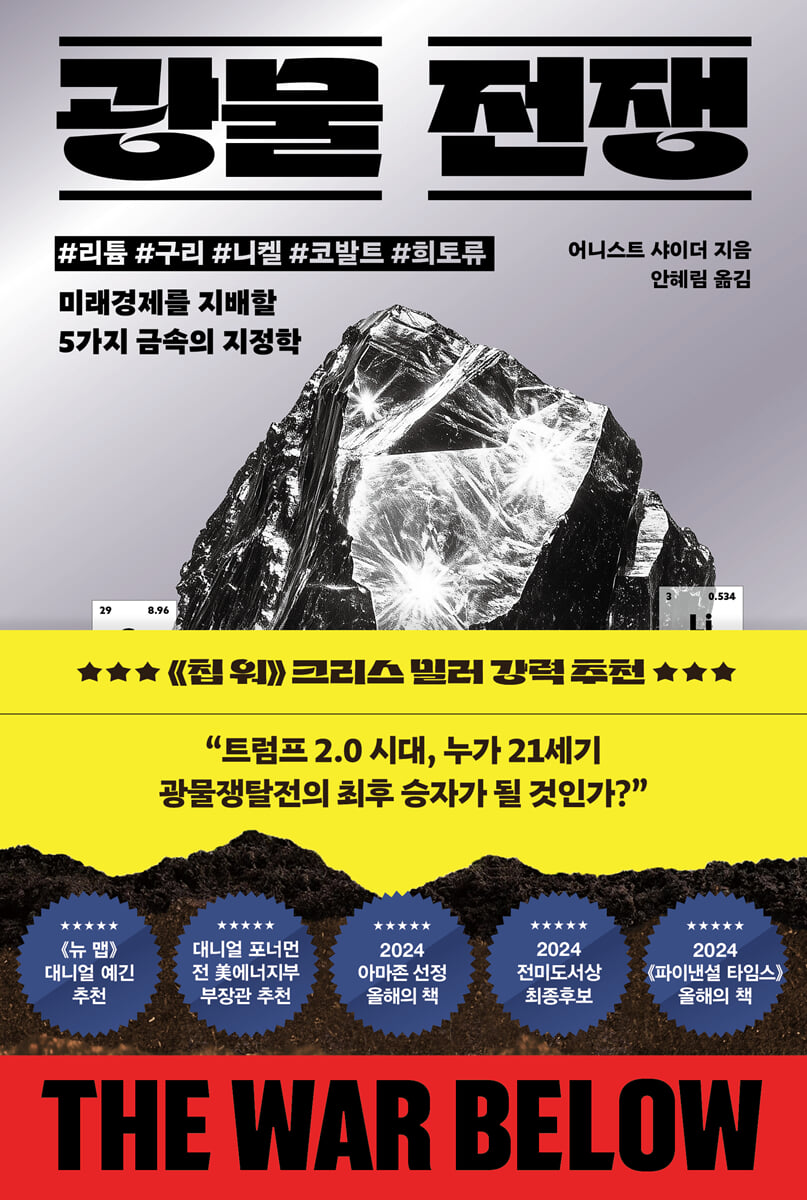
A book that addresses the fierce competition surrounding key minerals at the heart of the transition to eco-friendly energy, which has become central to various industries.
This book analyzes the geopolitical competition over five metals (lithium, nickel, copper, cobalt, and rare earth elements) centered in the United States, covering mine development, major corporate activities, environmental issues, and regulatory policies.
Because it covers global mineral-related companies and new technologies, it also allows you to understand investment opportunities and risks.
Following the Paris Agreement, the world is moving toward carbon neutrality, and upon taking office, Trump revealed his ambitions for minerals in Ukraine, Denmark, and Canada.
In addition, from Europe to South America, everyone is engaged in a scramble for minerals in response to China's resource hegemony and global competition.
This trend is complex.
First, the mining industry, which had been losing popularity due to environmental destruction and astronomical costs, is now receiving attention again.
Today, extracting essential minerals from the earth offers a chance to seize the new wealth opportunities of electrification, a bulwark for our nation's energy security, and, paradoxically, a hope for combating climate change.
Secondly, there are those who still question all this, especially those who oppose mining development, arguing that it will destroy not only the livelihoods that have been maintained for generations, but also the ecosystem.
Finally, the struggle of each country to dominate the supply chain to secure new energy hegemony is accelerating the mineral war.
The author, an energy expert for Reuters, objectively reports on the stories of people involved in conflicts and conflicts in mines in the United States, Bolivia, Congo, and China, firsthand.
We examine changes in the international situation surrounding key minerals through projects such as the Tenke cobalt mine in Congo and the Baiyun'ebo rare earth mine in China, and we examine DLE technology, which has recently been attracting increasing attention, through projects such as the Uyuni lithium project in Bolivia.
Combining engaging explanations and interviews about industry and technology, this book presents a compelling, dramatic account of the global mineral war unfolding right now.
“Can we rise again as a superpower?”
Industry, technology, supply chain, and environmental issues surrounding minerals
Fascinating non-fiction that captures vivid reality
A book that addresses the fierce competition surrounding key minerals at the heart of the transition to eco-friendly energy, which has become central to various industries.
This book analyzes the geopolitical competition over five metals (lithium, nickel, copper, cobalt, and rare earth elements) centered in the United States, covering mine development, major corporate activities, environmental issues, and regulatory policies.
Because it covers global mineral-related companies and new technologies, it also allows you to understand investment opportunities and risks.
Following the Paris Agreement, the world is moving toward carbon neutrality, and upon taking office, Trump revealed his ambitions for minerals in Ukraine, Denmark, and Canada.
In addition, from Europe to South America, everyone is engaged in a scramble for minerals in response to China's resource hegemony and global competition.
This trend is complex.
First, the mining industry, which had been losing popularity due to environmental destruction and astronomical costs, is now receiving attention again.
Today, extracting essential minerals from the earth offers a chance to seize the new wealth opportunities of electrification, a bulwark for our nation's energy security, and, paradoxically, a hope for combating climate change.
Secondly, there are those who still question all this, especially those who oppose mining development, arguing that it will destroy not only the livelihoods that have been maintained for generations, but also the ecosystem.
Finally, the struggle of each country to dominate the supply chain to secure new energy hegemony is accelerating the mineral war.
The author, an energy expert for Reuters, objectively reports on the stories of people involved in conflicts and conflicts in mines in the United States, Bolivia, Congo, and China, firsthand.
We examine changes in the international situation surrounding key minerals through projects such as the Tenke cobalt mine in Congo and the Baiyun'ebo rare earth mine in China, and we examine DLE technology, which has recently been attracting increasing attention, through projects such as the Uyuni lithium project in Bolivia.
Combining engaging explanations and interviews about industry and technology, this book presents a compelling, dramatic account of the global mineral war unfolding right now.
- You can preview some of the book's contents.
Preview
index
Forewords 9 | Praise for this Book 16 | Preface to the Korean Edition 20 | Maps 26
Introduction: A Little Flower that Predicts a Cold-Cutting Choice 28
Introduction: A Turning Point for New Energy 34
CHAPTER 1 The Lithium Jackpot in Nevada
Callaway's Challenge 61 | Key to Saving the Planet 66
CHAPTER 2 Conflicts Surrounding Sacred Land
Someone's Gotta Do It 84ㅣHome of Angels and Gods 92ㅣRio Tinto in Crisis, Inside and Out 104ㅣBiden's Promise 113
CHAPTER 3: Transparent Mining Project
Principles for Responsible Mining 127 | Promise for a Better Tomorrow 134
CHAPTER 4 The Carbon Footprint of Leaf Blowers
What can I replace it with? 140ㅣUntil it comes to our garden 142
CHAPTER 5: The Chaos Created by Minnesota's Copper Mines and the White House
The White House's Hesitation 152 | Belief in Safe Mines 163
CHAPTER 6 China's Rare Earths
Rare Earth Hunters 176 | Middle Eastern Oil, China's Rare Earths 185 | The New Owner of the Mountain Pass Mine 196 | The Economic Cold War with Eco-Friendly Weapons 205
CHAPTER 7: The United States Trapped in the Maze of Mineral Self-Reliance
Trump's Order Resonates Through Sacramento 219 | Wilbert's Beliefs 231 | The Lithium Industry's Tug-of-War 245
CHAPTER 8 Salmon and Antimony
Can Salmon Return? 263 | Paulson's Plan 273 | The Pebble Project and Alaska 278
CHAPTER 9 400,000 Electric Vehicles vs. TM's Buckwheat
TM's Buckwheat and Survival 296 | People Fighting to Protect What's Precious 301 | The World's Harsh Reality 313
CHAPTER 10: Tesla and the Guardians of the Gaston Mine
Piedmont's Ties with Tesla 324 | Standing Up to Protect the Land 329 | Another Game Changer 338
CHAPTER 11 Unfair Cobalt and China
North America's Copper King, Freeport McMoRan 353 | Apaches Supplying Water to the Mine 359 | Children of the Cobalt Mines 368
CHAPTER 12: Waste Batteries and the Birth of Urban Mines
iPhone Disassembling Robot 382 | Seeds of Eco-Friendly Energy Transition 387
CHAPTER 13 The Alchemy of Creating Clean Lithium
Scientists Obsessed with Lithium 405 | Bubba's Challenge 413
CHAPTER 14 The Struggle for Resources Surrounding Bolivia
Bolivia's Jewel 432 | A Young Entrepreneur Meets a White Whale 441 | Knocking on Uyuni's Door 447 | Lee Geon's Pledge 455
CHAPTER 15 The Fate of Little Flowers
Shrimp Caught in a Whale Fight 468 | Vacation on Buckwheat Island 471
The Endless Choice 475
Acknowledgments 487 | Release: The Quiet War, the Dilemma of Transition 491 | Notes 496 | Index 570
Introduction: A Little Flower that Predicts a Cold-Cutting Choice 28
Introduction: A Turning Point for New Energy 34
CHAPTER 1 The Lithium Jackpot in Nevada
Callaway's Challenge 61 | Key to Saving the Planet 66
CHAPTER 2 Conflicts Surrounding Sacred Land
Someone's Gotta Do It 84ㅣHome of Angels and Gods 92ㅣRio Tinto in Crisis, Inside and Out 104ㅣBiden's Promise 113
CHAPTER 3: Transparent Mining Project
Principles for Responsible Mining 127 | Promise for a Better Tomorrow 134
CHAPTER 4 The Carbon Footprint of Leaf Blowers
What can I replace it with? 140ㅣUntil it comes to our garden 142
CHAPTER 5: The Chaos Created by Minnesota's Copper Mines and the White House
The White House's Hesitation 152 | Belief in Safe Mines 163
CHAPTER 6 China's Rare Earths
Rare Earth Hunters 176 | Middle Eastern Oil, China's Rare Earths 185 | The New Owner of the Mountain Pass Mine 196 | The Economic Cold War with Eco-Friendly Weapons 205
CHAPTER 7: The United States Trapped in the Maze of Mineral Self-Reliance
Trump's Order Resonates Through Sacramento 219 | Wilbert's Beliefs 231 | The Lithium Industry's Tug-of-War 245
CHAPTER 8 Salmon and Antimony
Can Salmon Return? 263 | Paulson's Plan 273 | The Pebble Project and Alaska 278
CHAPTER 9 400,000 Electric Vehicles vs. TM's Buckwheat
TM's Buckwheat and Survival 296 | People Fighting to Protect What's Precious 301 | The World's Harsh Reality 313
CHAPTER 10: Tesla and the Guardians of the Gaston Mine
Piedmont's Ties with Tesla 324 | Standing Up to Protect the Land 329 | Another Game Changer 338
CHAPTER 11 Unfair Cobalt and China
North America's Copper King, Freeport McMoRan 353 | Apaches Supplying Water to the Mine 359 | Children of the Cobalt Mines 368
CHAPTER 12: Waste Batteries and the Birth of Urban Mines
iPhone Disassembling Robot 382 | Seeds of Eco-Friendly Energy Transition 387
CHAPTER 13 The Alchemy of Creating Clean Lithium
Scientists Obsessed with Lithium 405 | Bubba's Challenge 413
CHAPTER 14 The Struggle for Resources Surrounding Bolivia
Bolivia's Jewel 432 | A Young Entrepreneur Meets a White Whale 441 | Knocking on Uyuni's Door 447 | Lee Geon's Pledge 455
CHAPTER 15 The Fate of Little Flowers
Shrimp Caught in a Whale Fight 468 | Vacation on Buckwheat Island 471
The Endless Choice 475
Acknowledgments 487 | Release: The Quiet War, the Dilemma of Transition 491 | Notes 496 | Index 570
Detailed image

Into the book
The United States pioneered a modern rare earths industry in the years following World War II, but then watched as the entire industry gradually shifted to China.
Today, China controls the mining and processing of key elements needed to produce magnets, which are used to convert energy into motion.
Without rare earths, there would be no wind turbines, Tesla cars, F-35 fighter jets, or any other cutting-edge equipment that utilizes special magnets made from rare earths.
China threatened to block rare earth exports to the United States in 2019.
There is only one rare earth mine in the United States and no processing facilities.
---From the "Preface"
Callaway's request changed his fate.
A few weeks later, as the 2016 U.S. presidential election was heating up and Democratic candidate Hillary Clinton was calling climate change “the urgent threat and essential challenge of our time,” a geologist who had worked with him called.
Lithium Ridge was not only a site for scientific experiments, but also contained an estimated 1.46 trillion tonnes of lithium.
It was the second-largest lithium deposit in the United States.
There was also boron, a chemical used to make soap and other consumer goods.
---From "Chapter 1: The Lithium Jackpot in Nevada"
Noji asked who would care about environmental destruction if there were high-paying jobs available.
It was a completely black-and-white logic, and to some extent, it was a logic that relied on the evil deeds of past mining companies.
But he didn't have to go back too far to find significant examples of environmental damage to support his argument.
He argued that the very proposal to develop the mine was a sign of a lifestyle that was solely concerned with money.
“It means that everything that remains here will disappear.
“The water, the light, the beauty of nature, the things that bring people back here, and then the sacredness and sanctity of this land.”
---From "Chapter 2: Conflict Surrounding the Sacred Land"
Ahead of the 2020 election, Trump was looking to win Minnesota, a state he narrowly lost in 2016.
But after Trump lost the election, President Biden brought a familiar face back into the equation.
Bill Sack became Secretary of Agriculture again.
(This is where the Washington bureaucracy gets even more complex, so let's focus.) The USDA, under Vilsack's leadership, oversees the Forest Service, which manages the surface of the Boundary Waters region.
However, the authority to control underground copper, cobalt and nickel deposits and to approve plans to mine the minerals lies with the Bureau of Land Management, a division of the Department of the Interior.
The White House can ban mining in the area for 20 years, but only Congress has the power to ban it permanently.
The Twin Metals drama eventually reached the U.S. Congress.
---From "Chapter 5: The Chaos Created by the Minnesota Copper Mines and the White House"
In 1951, the year Molykov bought his "birthday gift rights" outside Las Vegas, Columbia University in New York awarded Xu Guangxian a doctorate in chemistry.
He previously received a master's degree in chemistry from Washington University in St. Louis in 1949.
The U.S. Congress was about to pass a law that would prevent students who had studied in the U.S. from returning to the newly established People's Republic of China.
Xu Guangxian and his wife, chemist Gao Xiaoxia, left New York for China, where Xu Guangxian had found a job at Peking University.46 The couple, who had been pursuing research in their home country, were imprisoned for six years during the Cultural Revolution.
After being released, Xu Guangxian devoted himself to rare earth research, focusing particularly on praseodymium and rubidium.
In the mid-1970s, it was discovered that China had the world's largest deposits of rare earth elements.
Thanks to Xu Guangxian's research, China was able to accelerate the processing and separation of its own rare earth elements.
---From "Chapter 6: China Devours Rare Earth Elements"
Evans noted that other environmental groups, including the Sierra Club and the Center for Biological Diversity, did not oppose the Sacramento project.
He said he believed Wilbert's attacks were, to some extent, attacks on the Biden administration.
Evans has been alleging on social media that rare earth projects in the United States are being funded by Chinese and other governments, and has even seriously suggested, without evidence, that Wilbert is also receiving funding from the same source.
For example, the Chinese government has been linked to online attacks on rare earth projects in Texas and Oklahoma.
---From "Chapter 7: America Trapped in the Maze of Mineral Self-Reliance"
Daisy, a robot designed and built to quickly disassemble an iPhone into its glass and aluminum frame, battery, and other components, has been introduced.
“If the mining industry cares about climate, water, and responsible sourcing, they need to understand that they need to be innovative,” Jackson argued.
Daisy is part of Apple's plan to become a so-called closed-loop manufacturer, one that adheres to the principles of the "circular economy."
Dismantling old electronics to create new ones theoretically reduces the need to develop new mines.
Given the growing global appetite for electronics, this may seem more like an ambitious aspiration than a practical goal.
But aiming for a circular economy would help reduce the endless cycle of consumption and disposal, ultimately easing the burden on a planet increasingly strained by its resources.
---From "Chapter 12: Waste Batteries and the Birth of Urban Mines"
At the time, Tesla was receiving lithium-ion battery cells from Panasonic.
It was also scouting for suitable land to build a gigafactory in the United States to assemble its cars.
Rumors were swirling that Southern California was a perfect fit for Musk and the big electric car companies.
Wouldn't it be even better if Tesla could source lithium locally? But Bubba had no way to approach Musk.
He drafted a three-page presentation and began racking his brain about how to approach this elusive CEO.
Bubba soon learned that one of his acquaintances was in contact with a Wall Street analyst who might know how to contact Musk.
In early 2014, Bubba delivered his presentation through this loose network, praying that it would reach its intended destination.
It was a success.
---From "Chapter 13: The Alchemy of Creating Clean Lithium"
That same month, the Bolivian government selected a consortium led by Chinese battery manufacturer CATL as the contractor to help produce lithium in Uyuni.
The United States, under the IRA, decided to extend the electric vehicle tax credit only to lithium produced in countries with which it has a free trade agreement, but Bolivia does not have a free trade agreement with the United States, so it has less incentive to partner with American companies.
Bolivians hoped they would finally be able to produce their own lithium and supply it to the world.
However, the risk factor was that CATL had no previous experience producing lithium.
Today, China controls the mining and processing of key elements needed to produce magnets, which are used to convert energy into motion.
Without rare earths, there would be no wind turbines, Tesla cars, F-35 fighter jets, or any other cutting-edge equipment that utilizes special magnets made from rare earths.
China threatened to block rare earth exports to the United States in 2019.
There is only one rare earth mine in the United States and no processing facilities.
---From the "Preface"
Callaway's request changed his fate.
A few weeks later, as the 2016 U.S. presidential election was heating up and Democratic candidate Hillary Clinton was calling climate change “the urgent threat and essential challenge of our time,” a geologist who had worked with him called.
Lithium Ridge was not only a site for scientific experiments, but also contained an estimated 1.46 trillion tonnes of lithium.
It was the second-largest lithium deposit in the United States.
There was also boron, a chemical used to make soap and other consumer goods.
---From "Chapter 1: The Lithium Jackpot in Nevada"
Noji asked who would care about environmental destruction if there were high-paying jobs available.
It was a completely black-and-white logic, and to some extent, it was a logic that relied on the evil deeds of past mining companies.
But he didn't have to go back too far to find significant examples of environmental damage to support his argument.
He argued that the very proposal to develop the mine was a sign of a lifestyle that was solely concerned with money.
“It means that everything that remains here will disappear.
“The water, the light, the beauty of nature, the things that bring people back here, and then the sacredness and sanctity of this land.”
---From "Chapter 2: Conflict Surrounding the Sacred Land"
Ahead of the 2020 election, Trump was looking to win Minnesota, a state he narrowly lost in 2016.
But after Trump lost the election, President Biden brought a familiar face back into the equation.
Bill Sack became Secretary of Agriculture again.
(This is where the Washington bureaucracy gets even more complex, so let's focus.) The USDA, under Vilsack's leadership, oversees the Forest Service, which manages the surface of the Boundary Waters region.
However, the authority to control underground copper, cobalt and nickel deposits and to approve plans to mine the minerals lies with the Bureau of Land Management, a division of the Department of the Interior.
The White House can ban mining in the area for 20 years, but only Congress has the power to ban it permanently.
The Twin Metals drama eventually reached the U.S. Congress.
---From "Chapter 5: The Chaos Created by the Minnesota Copper Mines and the White House"
In 1951, the year Molykov bought his "birthday gift rights" outside Las Vegas, Columbia University in New York awarded Xu Guangxian a doctorate in chemistry.
He previously received a master's degree in chemistry from Washington University in St. Louis in 1949.
The U.S. Congress was about to pass a law that would prevent students who had studied in the U.S. from returning to the newly established People's Republic of China.
Xu Guangxian and his wife, chemist Gao Xiaoxia, left New York for China, where Xu Guangxian had found a job at Peking University.46 The couple, who had been pursuing research in their home country, were imprisoned for six years during the Cultural Revolution.
After being released, Xu Guangxian devoted himself to rare earth research, focusing particularly on praseodymium and rubidium.
In the mid-1970s, it was discovered that China had the world's largest deposits of rare earth elements.
Thanks to Xu Guangxian's research, China was able to accelerate the processing and separation of its own rare earth elements.
---From "Chapter 6: China Devours Rare Earth Elements"
Evans noted that other environmental groups, including the Sierra Club and the Center for Biological Diversity, did not oppose the Sacramento project.
He said he believed Wilbert's attacks were, to some extent, attacks on the Biden administration.
Evans has been alleging on social media that rare earth projects in the United States are being funded by Chinese and other governments, and has even seriously suggested, without evidence, that Wilbert is also receiving funding from the same source.
For example, the Chinese government has been linked to online attacks on rare earth projects in Texas and Oklahoma.
---From "Chapter 7: America Trapped in the Maze of Mineral Self-Reliance"
Daisy, a robot designed and built to quickly disassemble an iPhone into its glass and aluminum frame, battery, and other components, has been introduced.
“If the mining industry cares about climate, water, and responsible sourcing, they need to understand that they need to be innovative,” Jackson argued.
Daisy is part of Apple's plan to become a so-called closed-loop manufacturer, one that adheres to the principles of the "circular economy."
Dismantling old electronics to create new ones theoretically reduces the need to develop new mines.
Given the growing global appetite for electronics, this may seem more like an ambitious aspiration than a practical goal.
But aiming for a circular economy would help reduce the endless cycle of consumption and disposal, ultimately easing the burden on a planet increasingly strained by its resources.
---From "Chapter 12: Waste Batteries and the Birth of Urban Mines"
At the time, Tesla was receiving lithium-ion battery cells from Panasonic.
It was also scouting for suitable land to build a gigafactory in the United States to assemble its cars.
Rumors were swirling that Southern California was a perfect fit for Musk and the big electric car companies.
Wouldn't it be even better if Tesla could source lithium locally? But Bubba had no way to approach Musk.
He drafted a three-page presentation and began racking his brain about how to approach this elusive CEO.
Bubba soon learned that one of his acquaintances was in contact with a Wall Street analyst who might know how to contact Musk.
In early 2014, Bubba delivered his presentation through this loose network, praying that it would reach its intended destination.
It was a success.
---From "Chapter 13: The Alchemy of Creating Clean Lithium"
That same month, the Bolivian government selected a consortium led by Chinese battery manufacturer CATL as the contractor to help produce lithium in Uyuni.
The United States, under the IRA, decided to extend the electric vehicle tax credit only to lithium produced in countries with which it has a free trade agreement, but Bolivia does not have a free trade agreement with the United States, so it has less incentive to partner with American companies.
Bolivians hoped they would finally be able to produce their own lithium and supply it to the world.
However, the risk factor was that CATL had no previous experience producing lithium.
---From "The Words That Come Out"
Publisher's Review
The United States is overflowing with essential minerals, but cannot mine any of them.
Falling into the maze of mineral independence
“We will take Greenland.
“100%.” Even before taking office for his second term, US President Trump repeatedly stated that he would annex Canada as the 51st state of the United States and purchase Greenland, a Danish territory.
This remark cannot be dismissed as a simple gimmick by Trump because of the "critical minerals" crisis the United States is currently facing.
Demand for key minerals such as lithium, copper, nickel, cobalt, and rare earth elements, which are essential for solar power generation and electric vehicle batteries, is skyrocketing worldwide.
However, the United States relies on imports for 50-100% of 41 of the 50 critical minerals designated by the US Geological Survey (USGS).
As a result, mine development and resource acquisition strategies have become urgent to secure a stable supply chain.
Ironically, the United States has vast natural resources that are 'sleeping'.
Nevada's Lithium Ridge mine holds an estimated 1.46 trillion tonnes of lithium, and Arizona's Resolution mine could supply 25% of the copper consumed in the United States.
The United States is one of the few countries that "owns" virtually every key mineral in the world, including the Twin Metals nickel and copper mine in Minnesota and the Mountain Pass rare earth mine in California.
Yet, not a single new mine has opened in the past few decades.
Why on earth can we not develop this despite having so many resources? The answer is simple.
Because this is 'America'.
China can just implement its national agenda, but the US is different.
No mineral can be mined without passing the strict environmental standards of regulatory agencies.
The Department of the Interior requires more than 40 environmental studies, must go through the Bureau of Land Management's environmental report review process, and must also go through a public comment process, a process that is impossible to predict how long it will take.
Even if the president personally approves a mine operation and the Department of Energy provides a loan, the project can be delayed indefinitely if environmental groups file a lawsuit.
In fact, the American company Piedmont Lithium signed a contract with Tesla to develop a hard rock lithium mine, and its stock price soared tenfold, but it was not granted permission due to opposition from local residents.
Even Trump, conscious of environmental issues, halted the Pebble Copper Project in Alaska.
To uncover this reality, the author personally visits each region where there are 'sleeping mines'.
We meet with local residents, major companies, and government officials to hear their real voices and explore ways to escape the maze of energy security and environmental issues.
Who are the miners and who are the ones blocking them? What strategy is China adopting to counter America's mineral independence? Can the White House truly make a decision regarding mineral mining in the United States? On our journey to find solutions to these complex issues, we uncover the true nature of the mineral war.
Nature and indigenous peoples being trampled and destroyed for electric cars vs.
A new wealth opportunity and a way to revitalize a declining area
The iPhone continues to become lighter and last longer thanks to lithium-ion batteries.
The haptic engine that causes the iPhone to vibrate when you press it contains rare earth magnets.
However, few people know where the key minerals that go into it, such as lithium, nickel, cobalt, and rare earth elements, come from.
In a 2019 survey, more than a quarter of Americans said they had never even heard of the term “rare earths.”
The key minerals essential for not only the smartphones we always hold in our hands, but also laptops, electric cars, wind turbines, and fighter jets, are all mined in mines.
Many people may think of mining as an old, fading industry, but modern mining is a hot business item that companies from all over the world are flocking to.
In particular, the United States is highly competitive in the hopes of hitting the jackpot, as mining fees for minerals are “free” “as long as you obtain a permit” thanks to the Mining Act of 1872.
Most 'mines' are located in remote mountainous areas, in places with beautiful natural scenery such as national parks or tourist sites, or in places such as religious sacred sites of indigenous people.
But mining requires digging thousands of vertical shafts several kilometers deep, sometimes creating open-pit mines with holes so large they can be captured on satellite images.
Billions of liters of water are used in the process each year, and mine tailings dams, which contain toxic waste from mining, are considered a major cause of regional destruction.
This is why local residents, who live only a stone's throw from the mine, environmental groups trying to protect rare flora and fauna, and those who defend religious sites oppose mining in the United States, despite China's "weaponization of minerals."
This situation is happening all over the world.
Chile uses 65% of its water resources for mining, and the collapse of a tailings dam at the Brumadinho mine in Brazil killed about 300 people.
In Congo's cobalt mines, children are abused and hand-mined to extract cobalt, which ends up in our smartphones and electric cars.
Behind the ideal of switching to eco-friendly energy to prevent climate change lies this dilemma.
In particular, as the author mentioned in the preface to the Korean edition, Korea will not be able to avoid this problem as the world's largest tungsten mine, the Sangdong Mine in Yeongwol, Gangwon Province, will be acquired by the Canadian tungsten company Almonty Industries in 2024.
Will we avoid being left behind in the mineral competition, or will we protect the environment we pass on to future generations? Will we inject economic vitality into declining regions, or will we prioritize the safety of our residents? The author goes beyond posing the question and seeks out those already seeking solutions.
We visit Tiffany & Co., which discovered the "Transparent Mine Project," the inventors of DLE technology that extracts lithium from salt lakes without the need for tailings dams, and recycling companies that mine minerals from electronic devices, and everyone wonders if a "good way" is possible.
Countries that use resources as weapons to reshape the world order
Can the US overcome its mineral crisis and become a superpower again?
In 2021, after the United States finally ended its "war on terror" that began 20 years ago and withdrew from Afghanistan, a Chinese company quietly visited the capital, Kabul.
They began negotiations with the Taliban to develop Mes Aynak, the world's largest copper deposit, and after 16 years of waiting, they succeeded in breaking ground on the mine in July 2024.
Over the past two decades, China has monopolized supply chains by rapidly seizing control of mines around the world as part of its Belt and Road Initiative.
China is 'sweeping up' the Tenke cobalt mine in Congo, six lithium mines in Argentina, lithium development rights in the Uyuni Salt Flats in Bolivia, and even rare earths produced at Mountain Pass, the only rare earth mine in the United States.
Today, China accounts for approximately 70% of global rare earth mining and 90% of global processing, and controls 59% of global lithium processing and 73% of global cobalt processing.
China also accounts for 148 of the world's 200 lithium-ion battery factories, or 78%.
The United States is witnessing before its eyes its dependence on the Organization of Petroleum Exporting Countries (OPEC) shifting to dependence on countries like China, Indonesia, and Chile, which control key minerals.
China, which has taken the lead in minerals, is catching up with the US's 'military power' gap by restricting exports of rare earth elements used in defense industries such as fighter jets.
Today, we have reached a point where we can completely nip competitors and companies in the bud by reducing or expanding the supply of key minerals.
Former Chinese leader Deng Xiaoping said in 1987, “The Middle East has oil, and China has rare earth elements.”
His successor, Jiang Zemin, argued in 1999 that China should "develop and utilize rare earths and turn the advantages gained from these resources into economic advantages."
Today, China's mineral weaponization is a strategy they have been preparing for a full '50 years'.
And on the other side, there is the United States, which is caught in a dilemma by insisting on the need for a transition to eco-friendly energy to stop climate change, but cannot mine anything because of environmental pollution.
Can the United States resolve this paradoxical predicament and reclaim its "superpower" status? As the world's largest battery producer, we face the inevitable consequences of war. What options do we have? It's time to find answers to the profound questions of our time posed by the "Minerals Wars."
Falling into the maze of mineral independence
“We will take Greenland.
“100%.” Even before taking office for his second term, US President Trump repeatedly stated that he would annex Canada as the 51st state of the United States and purchase Greenland, a Danish territory.
This remark cannot be dismissed as a simple gimmick by Trump because of the "critical minerals" crisis the United States is currently facing.
Demand for key minerals such as lithium, copper, nickel, cobalt, and rare earth elements, which are essential for solar power generation and electric vehicle batteries, is skyrocketing worldwide.
However, the United States relies on imports for 50-100% of 41 of the 50 critical minerals designated by the US Geological Survey (USGS).
As a result, mine development and resource acquisition strategies have become urgent to secure a stable supply chain.
Ironically, the United States has vast natural resources that are 'sleeping'.
Nevada's Lithium Ridge mine holds an estimated 1.46 trillion tonnes of lithium, and Arizona's Resolution mine could supply 25% of the copper consumed in the United States.
The United States is one of the few countries that "owns" virtually every key mineral in the world, including the Twin Metals nickel and copper mine in Minnesota and the Mountain Pass rare earth mine in California.
Yet, not a single new mine has opened in the past few decades.
Why on earth can we not develop this despite having so many resources? The answer is simple.
Because this is 'America'.
China can just implement its national agenda, but the US is different.
No mineral can be mined without passing the strict environmental standards of regulatory agencies.
The Department of the Interior requires more than 40 environmental studies, must go through the Bureau of Land Management's environmental report review process, and must also go through a public comment process, a process that is impossible to predict how long it will take.
Even if the president personally approves a mine operation and the Department of Energy provides a loan, the project can be delayed indefinitely if environmental groups file a lawsuit.
In fact, the American company Piedmont Lithium signed a contract with Tesla to develop a hard rock lithium mine, and its stock price soared tenfold, but it was not granted permission due to opposition from local residents.
Even Trump, conscious of environmental issues, halted the Pebble Copper Project in Alaska.
To uncover this reality, the author personally visits each region where there are 'sleeping mines'.
We meet with local residents, major companies, and government officials to hear their real voices and explore ways to escape the maze of energy security and environmental issues.
Who are the miners and who are the ones blocking them? What strategy is China adopting to counter America's mineral independence? Can the White House truly make a decision regarding mineral mining in the United States? On our journey to find solutions to these complex issues, we uncover the true nature of the mineral war.
Nature and indigenous peoples being trampled and destroyed for electric cars vs.
A new wealth opportunity and a way to revitalize a declining area
The iPhone continues to become lighter and last longer thanks to lithium-ion batteries.
The haptic engine that causes the iPhone to vibrate when you press it contains rare earth magnets.
However, few people know where the key minerals that go into it, such as lithium, nickel, cobalt, and rare earth elements, come from.
In a 2019 survey, more than a quarter of Americans said they had never even heard of the term “rare earths.”
The key minerals essential for not only the smartphones we always hold in our hands, but also laptops, electric cars, wind turbines, and fighter jets, are all mined in mines.
Many people may think of mining as an old, fading industry, but modern mining is a hot business item that companies from all over the world are flocking to.
In particular, the United States is highly competitive in the hopes of hitting the jackpot, as mining fees for minerals are “free” “as long as you obtain a permit” thanks to the Mining Act of 1872.
Most 'mines' are located in remote mountainous areas, in places with beautiful natural scenery such as national parks or tourist sites, or in places such as religious sacred sites of indigenous people.
But mining requires digging thousands of vertical shafts several kilometers deep, sometimes creating open-pit mines with holes so large they can be captured on satellite images.
Billions of liters of water are used in the process each year, and mine tailings dams, which contain toxic waste from mining, are considered a major cause of regional destruction.
This is why local residents, who live only a stone's throw from the mine, environmental groups trying to protect rare flora and fauna, and those who defend religious sites oppose mining in the United States, despite China's "weaponization of minerals."
This situation is happening all over the world.
Chile uses 65% of its water resources for mining, and the collapse of a tailings dam at the Brumadinho mine in Brazil killed about 300 people.
In Congo's cobalt mines, children are abused and hand-mined to extract cobalt, which ends up in our smartphones and electric cars.
Behind the ideal of switching to eco-friendly energy to prevent climate change lies this dilemma.
In particular, as the author mentioned in the preface to the Korean edition, Korea will not be able to avoid this problem as the world's largest tungsten mine, the Sangdong Mine in Yeongwol, Gangwon Province, will be acquired by the Canadian tungsten company Almonty Industries in 2024.
Will we avoid being left behind in the mineral competition, or will we protect the environment we pass on to future generations? Will we inject economic vitality into declining regions, or will we prioritize the safety of our residents? The author goes beyond posing the question and seeks out those already seeking solutions.
We visit Tiffany & Co., which discovered the "Transparent Mine Project," the inventors of DLE technology that extracts lithium from salt lakes without the need for tailings dams, and recycling companies that mine minerals from electronic devices, and everyone wonders if a "good way" is possible.
Countries that use resources as weapons to reshape the world order
Can the US overcome its mineral crisis and become a superpower again?
In 2021, after the United States finally ended its "war on terror" that began 20 years ago and withdrew from Afghanistan, a Chinese company quietly visited the capital, Kabul.
They began negotiations with the Taliban to develop Mes Aynak, the world's largest copper deposit, and after 16 years of waiting, they succeeded in breaking ground on the mine in July 2024.
Over the past two decades, China has monopolized supply chains by rapidly seizing control of mines around the world as part of its Belt and Road Initiative.
China is 'sweeping up' the Tenke cobalt mine in Congo, six lithium mines in Argentina, lithium development rights in the Uyuni Salt Flats in Bolivia, and even rare earths produced at Mountain Pass, the only rare earth mine in the United States.
Today, China accounts for approximately 70% of global rare earth mining and 90% of global processing, and controls 59% of global lithium processing and 73% of global cobalt processing.
China also accounts for 148 of the world's 200 lithium-ion battery factories, or 78%.
The United States is witnessing before its eyes its dependence on the Organization of Petroleum Exporting Countries (OPEC) shifting to dependence on countries like China, Indonesia, and Chile, which control key minerals.
China, which has taken the lead in minerals, is catching up with the US's 'military power' gap by restricting exports of rare earth elements used in defense industries such as fighter jets.
Today, we have reached a point where we can completely nip competitors and companies in the bud by reducing or expanding the supply of key minerals.
Former Chinese leader Deng Xiaoping said in 1987, “The Middle East has oil, and China has rare earth elements.”
His successor, Jiang Zemin, argued in 1999 that China should "develop and utilize rare earths and turn the advantages gained from these resources into economic advantages."
Today, China's mineral weaponization is a strategy they have been preparing for a full '50 years'.
And on the other side, there is the United States, which is caught in a dilemma by insisting on the need for a transition to eco-friendly energy to stop climate change, but cannot mine anything because of environmental pollution.
Can the United States resolve this paradoxical predicament and reclaim its "superpower" status? As the world's largest battery producer, we face the inevitable consequences of war. What options do we have? It's time to find answers to the profound questions of our time posed by the "Minerals Wars."
GOODS SPECIFICS
- Date of issue: May 21, 2025
- Page count, weight, size: 584 pages | 802g | 149*220*30mm
- ISBN13: 9791171714216
- ISBN10: 1171714211
You may also like
카테고리
korean


korean

![ELLE 엘르 스페셜 에디션 A형 : 12월 [2025]](http://librairie.coreenne.fr/cdn/shop/files/b8e27a3de6c9538896439686c6b0e8fb.jpg?v=1766436872&width=3840)


