

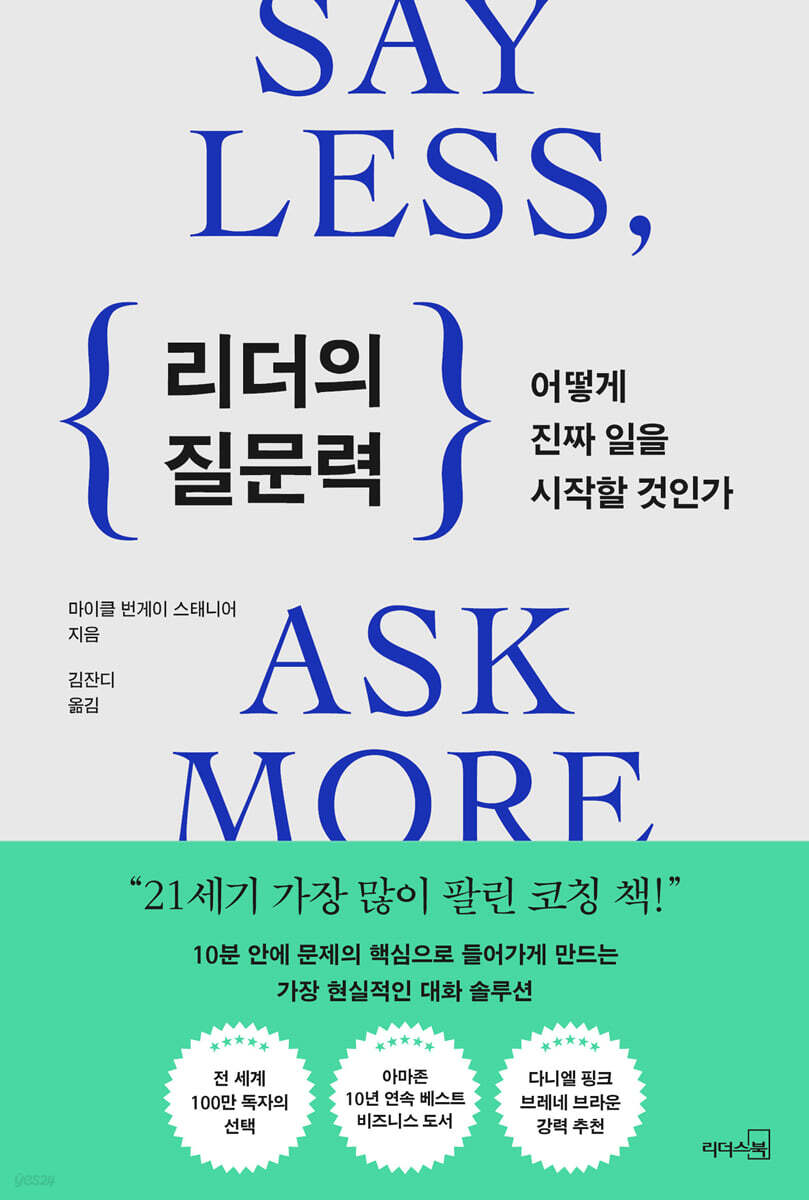
A leader's questioning power
 |
Description
Book Introduction
“Google, Microsoft, Meta, X, Pepsi…
Why do so many global business leaders take his classes?”
Michael Bungay Stanier, a leadership guru who has captivated a million readers worldwide.
A masterpiece that culminates 30 years of leadership coaching experience.
*** The best-selling coaching book of the 21st century!
*** Amazon's Best Business Book for 10 Years in a Row
*** #1 Wall Street Journal Bestseller
*** Highly recommended by Shin Soo-jung, Jeong Kyeong-hwa, Daniel Pink, and Brené Brown
Michael Bungay Stanier, a global leadership expert who has consulted for numerous companies including Google, Microsoft, Meta, and X, has published “The Leader’s Questioning Power”, which is a compilation of all the know-how and insights on leadership and coaching that he has researched for over 30 years.
This book, which became an Amazon and Wall Street Journal bestseller immediately after its publication and sold over 1 million copies worldwide, explains effective coaching techniques based on neuroscience and behavioral economics using the very simple tool of 'questioning.'
He asserts that the most important role of a leader is the ability to “draw out the other person’s potential through questions,” and explains how to develop members and lead them to do their real work properly through the “7 questioning methods.”
From how to make an impact with your first question, to the know-how to draw more out of your counterpart's answer, to the final question that boosts their morale and motivates them at work and in life, this book covers how to produce the best output in just 10 minutes.
The seven questions in this book are ultimately designed to change human behavior and form new habits, and can be used as tools for the growth of not only members but also the leader himself.
If you desperately want to grow yourself and your organization, discover a new leadership paradigm through this book.
Why do so many global business leaders take his classes?”
Michael Bungay Stanier, a leadership guru who has captivated a million readers worldwide.
A masterpiece that culminates 30 years of leadership coaching experience.
*** The best-selling coaching book of the 21st century!
*** Amazon's Best Business Book for 10 Years in a Row
*** #1 Wall Street Journal Bestseller
*** Highly recommended by Shin Soo-jung, Jeong Kyeong-hwa, Daniel Pink, and Brené Brown
Michael Bungay Stanier, a global leadership expert who has consulted for numerous companies including Google, Microsoft, Meta, and X, has published “The Leader’s Questioning Power”, which is a compilation of all the know-how and insights on leadership and coaching that he has researched for over 30 years.
This book, which became an Amazon and Wall Street Journal bestseller immediately after its publication and sold over 1 million copies worldwide, explains effective coaching techniques based on neuroscience and behavioral economics using the very simple tool of 'questioning.'
He asserts that the most important role of a leader is the ability to “draw out the other person’s potential through questions,” and explains how to develop members and lead them to do their real work properly through the “7 questioning methods.”
From how to make an impact with your first question, to the know-how to draw more out of your counterpart's answer, to the final question that boosts their morale and motivates them at work and in life, this book covers how to produce the best output in just 10 minutes.
The seven questions in this book are ultimately designed to change human behavior and form new habits, and can be used as tools for the growth of not only members but also the leader himself.
If you desperately want to grow yourself and your organization, discover a new leadership paradigm through this book.
- You can preview some of the book's contents.
Preview
index
Praise for this book
prolog
Part 1: What Makes a Leader Who Changes People Different?
01 | Traps that Effective Leaders Can Fall Into
Why Your Coaching Failed
3 Vicious Cycles in the Workplace
7 Questions to Get You Started with 'Real' Work
02 | Principles and Formulas for Changing Behavior
5 Key Elements for Creating New Habits
3 Steps to Changing Your Habits
Change is always met with resistance.
● Questioning Lesson | Ask only one question at a time
Part 2: 7 Communication Strategies for Creating Great Output
01 | Conversation-Breaking Questions
Conversation starter question: “What’s on your mind these days?”
Coaching that drives performance vs. coaching that helps development
Focusing the Conversation with the 3P Model
When you try to buy a red car, all you see is red cars.
● Questioning Skills Class | Ask Direct Questions
02 | A Question That Opens Up Possibilities
A question that opens up possibilities: “And what else?”
Taming the Advice Monster Within Me
The more choices you have, the harder it is to make a decision.
Track the true intentions
● Questioning Skills Class | Is it necessary to ask investigative questions?
03 | A Question That Cuts to the Core
If you try to fix it yourself, the train will derail.
A poignant question: “What’s really challenging for you here?”
How Questions Clear the Fog
From 'performance' to 'development'
Two words: 'to you'
● Questioning Skills Class | Stick to Questions That Start with "What"
● Coaching practice
04 | A Question That Digs into the Essence
A question that digs deep: “What do you want?”
Untangling the tangled web of wants and needs
How Your Brain Changes When You're Asked a Powerful Question
Using the four factors that help the brain assess situations: TERA
Once you see the destination, the process becomes easier.
● Questioning Skills Class | Don't Be Awkward to Silence
05 | Lazy Questions
When a leader's best efforts create the worst results
What is your role?
Lazy question: “How can I help you?”
How to Avoid the Savior's Trap
A conversation that broadens the scope of responses
● Questioning Skills Class | Listen carefully to the other person's answers.
06 | Strategic Questions
Busyness is not a measure of success.
Strategic question: “If you said ‘yes’ to this, what would you say ‘no’ to?”
When to say “no”
How to say “no”
5 Strategic Questions for Victory
What to take and what to discard
● Questioning Skills Lesson | Respond to the Other Person's Answer
07 | Enlightening Questions
How do people learn?
An enlightening question: “What was most beneficial to you?”
A powerful weapon that helps your opponents grow
What we actually remember
● Questioning Class | Ask questions using all available means
Epilogue
Acknowledgements
References
Appendix 1 | Recommended Books to Read Together
Appendix 2 | Learning Coaching Habits Through Video
prolog
Part 1: What Makes a Leader Who Changes People Different?
01 | Traps that Effective Leaders Can Fall Into
Why Your Coaching Failed
3 Vicious Cycles in the Workplace
7 Questions to Get You Started with 'Real' Work
02 | Principles and Formulas for Changing Behavior
5 Key Elements for Creating New Habits
3 Steps to Changing Your Habits
Change is always met with resistance.
● Questioning Lesson | Ask only one question at a time
Part 2: 7 Communication Strategies for Creating Great Output
01 | Conversation-Breaking Questions
Conversation starter question: “What’s on your mind these days?”
Coaching that drives performance vs. coaching that helps development
Focusing the Conversation with the 3P Model
When you try to buy a red car, all you see is red cars.
● Questioning Skills Class | Ask Direct Questions
02 | A Question That Opens Up Possibilities
A question that opens up possibilities: “And what else?”
Taming the Advice Monster Within Me
The more choices you have, the harder it is to make a decision.
Track the true intentions
● Questioning Skills Class | Is it necessary to ask investigative questions?
03 | A Question That Cuts to the Core
If you try to fix it yourself, the train will derail.
A poignant question: “What’s really challenging for you here?”
How Questions Clear the Fog
From 'performance' to 'development'
Two words: 'to you'
● Questioning Skills Class | Stick to Questions That Start with "What"
● Coaching practice
04 | A Question That Digs into the Essence
A question that digs deep: “What do you want?”
Untangling the tangled web of wants and needs
How Your Brain Changes When You're Asked a Powerful Question
Using the four factors that help the brain assess situations: TERA
Once you see the destination, the process becomes easier.
● Questioning Skills Class | Don't Be Awkward to Silence
05 | Lazy Questions
When a leader's best efforts create the worst results
What is your role?
Lazy question: “How can I help you?”
How to Avoid the Savior's Trap
A conversation that broadens the scope of responses
● Questioning Skills Class | Listen carefully to the other person's answers.
06 | Strategic Questions
Busyness is not a measure of success.
Strategic question: “If you said ‘yes’ to this, what would you say ‘no’ to?”
When to say “no”
How to say “no”
5 Strategic Questions for Victory
What to take and what to discard
● Questioning Skills Lesson | Respond to the Other Person's Answer
07 | Enlightening Questions
How do people learn?
An enlightening question: “What was most beneficial to you?”
A powerful weapon that helps your opponents grow
What we actually remember
● Questioning Class | Ask questions using all available means
Epilogue
Acknowledgements
References
Appendix 1 | Recommended Books to Read Together
Appendix 2 | Learning Coaching Habits Through Video
Detailed image

Into the book
Conversation-opening questions help open up any conversation and start it with a clear focus.
The Possibility Question is one of the best coaching questions available, enhancing the effectiveness of the other six questions and allowing leaders to leverage it for self-management.
The purpose of probing and piercing questions is to get to the heart of the matter and focus on what really matters.
Lazy questions save the leader time, strategic questions save the people working with him time.
A thought-provoking question is what concludes a coaching session and makes you feel like your conversation was beneficial.
--- p.29
Contrary to popular belief, the advice to “give less advice and ask more questions” is actually a rather difficult guideline to put into practice.
Our bodies are deeply ingrained in the habit of quickly slipping into advisor or expert mode, or answer/solve/correct mode.
It's not surprising at all.
Today, as businesses prioritize answers and certainty, and work and life become more complex, more people feel a greater sense of burden, uncertainty, and anxiety than ever before.
When we come to terms with this reality, our brains show a strong preference for clear and definite objects.
So, naturally, you come to like advice.
Even bad advice feels more comfortable than vague questions.
--- p.71
It's important to remember that when people talk about problems they face, it's unlikely that they are the real problem.
If you jump in to solve it, the train will derail in three directions.
First, we wrestle with the wrong problem.
Second, you try to do the work that the team should be doing.
Third, the work itself is not handled properly.
--- p.88
Performance coaching is a term commonly applied to everyday problem-solving management.
Coaching that helps people develop goes beyond simply solving problems, shifting the focus to the person trying to solve the problem.
As mentioned before, there is a difference between the fire itself and the person trying to put it out.
Simply by adding "you" to the end of every question as much as possible, you can shift everyday conversations from performance-oriented to development-oriented.
Of course, there are still problems to be solved.
However, adding 'to you' often allows individuals to gain additional insight, which in turn leads to growth and improved capabilities.
--- p.99
“The biggest problem in communication is the illusion that one party understands the other.” It’s common for conversation participants to assume they know what the other wants, and this often leads to a derailed conversation.
But there is hope.
Understanding that wants and needs are different can help you set sail more smoothly.
--- p.114
A storm of thoughts races through your mind.
I'm worried about what to ask next.
Or maybe you're just thinking about how to end the conversation quickly.
You might be wondering if it's your turn to cook tonight, whether you have enough garlic in the pantry, or whether you should buy some on the way home.
Either way, we need to break free from repetitive and meaningless habits.
The most effective action to take after asking a question is to truly listen to the answer.
My friend, I hope you continue to be curious.
--- pp.148-149
It's always uncomfortable to say "no" to a request.
Because the object of rejection is actually a person.
These days, people are so entangled with each other that we often find ourselves in troublesome situations, such as being misunderstood as having crushed someone's hopes, stepping on someone's foot, or being rudely abandoned by someone.
In a world where you can make something happen even if it doesn't work, there is one secret.
As we've seen when discussing ghost coaching in other contexts, you can create a non-human "third party" to say "no."
For example, you could write down the other person's request on a piece of paper or a flip chart, point to it, and say, "I'm sorry, but I can't give you that."
It's a little better than "I'm sorry, but I can't accommodate your request."
Say “yes” to people, but “no” to things.
--- pp.162-163
“Creation is the act of creating (and sharing) new ideas and your own connections to existing ideas.
…our memory improves when we take the time to create knowledge by trying to find answers, rather than simply reading about it.” So, in short, the effectiveness of advice is overrated.
To be clear, the likelihood that advice will reach the hippocampus, the region of the brain that encodes memories, is limited.
But if I ask the question and you generate your own answer, the chances are greatly increased.
--- p.177
If you incorporate these seven key questions into your daily repertoire and conversations when managing people, you'll find yourself working less hard, making a bigger impact, earning a good reputation with both your subordinates and your boss, and achieving positive results in your career and throughout your life.
I absolutely believe it.
But the real secret is developing the habit of being curious.
If you want to bring about the most powerful change in yourself that will help you, here's how.
Let's reduce advice and be curious.
Let's find our own questions and our own voice.
And above all, let's develop our own coaching habits.
The Possibility Question is one of the best coaching questions available, enhancing the effectiveness of the other six questions and allowing leaders to leverage it for self-management.
The purpose of probing and piercing questions is to get to the heart of the matter and focus on what really matters.
Lazy questions save the leader time, strategic questions save the people working with him time.
A thought-provoking question is what concludes a coaching session and makes you feel like your conversation was beneficial.
--- p.29
Contrary to popular belief, the advice to “give less advice and ask more questions” is actually a rather difficult guideline to put into practice.
Our bodies are deeply ingrained in the habit of quickly slipping into advisor or expert mode, or answer/solve/correct mode.
It's not surprising at all.
Today, as businesses prioritize answers and certainty, and work and life become more complex, more people feel a greater sense of burden, uncertainty, and anxiety than ever before.
When we come to terms with this reality, our brains show a strong preference for clear and definite objects.
So, naturally, you come to like advice.
Even bad advice feels more comfortable than vague questions.
--- p.71
It's important to remember that when people talk about problems they face, it's unlikely that they are the real problem.
If you jump in to solve it, the train will derail in three directions.
First, we wrestle with the wrong problem.
Second, you try to do the work that the team should be doing.
Third, the work itself is not handled properly.
--- p.88
Performance coaching is a term commonly applied to everyday problem-solving management.
Coaching that helps people develop goes beyond simply solving problems, shifting the focus to the person trying to solve the problem.
As mentioned before, there is a difference between the fire itself and the person trying to put it out.
Simply by adding "you" to the end of every question as much as possible, you can shift everyday conversations from performance-oriented to development-oriented.
Of course, there are still problems to be solved.
However, adding 'to you' often allows individuals to gain additional insight, which in turn leads to growth and improved capabilities.
--- p.99
“The biggest problem in communication is the illusion that one party understands the other.” It’s common for conversation participants to assume they know what the other wants, and this often leads to a derailed conversation.
But there is hope.
Understanding that wants and needs are different can help you set sail more smoothly.
--- p.114
A storm of thoughts races through your mind.
I'm worried about what to ask next.
Or maybe you're just thinking about how to end the conversation quickly.
You might be wondering if it's your turn to cook tonight, whether you have enough garlic in the pantry, or whether you should buy some on the way home.
Either way, we need to break free from repetitive and meaningless habits.
The most effective action to take after asking a question is to truly listen to the answer.
My friend, I hope you continue to be curious.
--- pp.148-149
It's always uncomfortable to say "no" to a request.
Because the object of rejection is actually a person.
These days, people are so entangled with each other that we often find ourselves in troublesome situations, such as being misunderstood as having crushed someone's hopes, stepping on someone's foot, or being rudely abandoned by someone.
In a world where you can make something happen even if it doesn't work, there is one secret.
As we've seen when discussing ghost coaching in other contexts, you can create a non-human "third party" to say "no."
For example, you could write down the other person's request on a piece of paper or a flip chart, point to it, and say, "I'm sorry, but I can't give you that."
It's a little better than "I'm sorry, but I can't accommodate your request."
Say “yes” to people, but “no” to things.
--- pp.162-163
“Creation is the act of creating (and sharing) new ideas and your own connections to existing ideas.
…our memory improves when we take the time to create knowledge by trying to find answers, rather than simply reading about it.” So, in short, the effectiveness of advice is overrated.
To be clear, the likelihood that advice will reach the hippocampus, the region of the brain that encodes memories, is limited.
But if I ask the question and you generate your own answer, the chances are greatly increased.
--- p.177
If you incorporate these seven key questions into your daily repertoire and conversations when managing people, you'll find yourself working less hard, making a bigger impact, earning a good reputation with both your subordinates and your boss, and achieving positive results in your career and throughout your life.
I absolutely believe it.
But the real secret is developing the habit of being curious.
If you want to bring about the most powerful change in yourself that will help you, here's how.
Let's reduce advice and be curious.
Let's find our own questions and our own voice.
And above all, let's develop our own coaching habits.
--- p.194
Publisher's Review
If the leader tries to fix it himself, the train will derail!
The best-selling coaching bible that has awakened leaders around the world.
If the leader tries to fix it himself, the train called the organization will derail.
A leader is not someone who repairs the train directly, but someone who guides the team members to properly do their part so that the train can run smoothly.
However, it is not realistically easy to provide individual guidance tailored to each member and provide feedback appropriate to the situation.
Ultimately, the leader takes on the role of a 'savior', and the more he does so, the more the team loses its autonomy and stagnates, a vicious cycle that repeats itself.
The same goes for companies that move the world.
Michael Bungay Stanier, a global leadership expert who has consulted for numerous companies including Google, Microsoft, Meta, and X, has published "The Leader's Questioning Power" by compiling all the know-how and insights he has gained through his research.
The core of the leadership coaching presented in this book is simple.
The idea is to reduce directives and advice and ask questions.
To create an organization where "real work gets done properly," we must not just instill the leader's answers, but rather elicit and nurture diverse responses from members.
This book, which became an Amazon and Wall Street Journal bestseller immediately after its publication in 2016 and sold over 1 million copies worldwide, condenses effective coaching techniques based on neuroscience and behavioral economics into seven key questions and makes them easy for anyone to put into practice.
“Ask seven questions in one conversation.”
“The first answer is not the real answer.”
Everything you need to know about "Question Coaching," which changes your partner's behavior and unlocks their potential.
Part 1 begins with a story about how leaders who work hard alone and do their jobs well can ruin an organization.
Through various cases, it vividly shows that a leader's inertial instructions and hasty interventions can hinder the growth of an organization and, instead, cause an overload on the leader's work.
And it details the '5-step formula for behavior change' that can help you break the old habit of constantly giving instructions and advice instead of asking questions.
Part 2 provides a detailed explanation of how to ask questions that will help members grow.
From how to make an impact with your first question, to the know-how to draw more stories from the other person's answers, to the closing that boosts the other person's morale and motivates them in work and life, this book contains seven questioning methods that will produce the best output in just 10 minutes.
Let's look at some of them. 'Conversation Openers' are questions that teach you how to get deep conversations going in a short amount of time.
We'll guide you through techniques for focusing conversations through ongoing projects and more.
'Questions that open up possibilities' are meant to uncover the other person's hidden intentions in the conversation.
He also talks about how dangerous it is for leaders to be convinced they have the right answers, and how to tame the "advice monster."
Finally, 'enlightening questions' are questions that give team members more autonomy and help them figure out how to solve problems on their own.
This question ultimately becomes a powerful tool for organizational growth by increasing member engagement and keeping the organization at its most agile.
The less you direct and the more you ask questions, the more potential you can draw out from the other person.
This simple truth is what this book aims to achieve.
A leader who brings out possibilities, not a leader who seeks answers.
The Essence of Coaching for All of Us
The author says that coaching techniques centered on 'listening' and 'exploration' will bring about change not only in the workplace but also in everyday life.
It is a reliable guidepost that guides you in a better direction when dealing with subordinates, customers, business partners, in a training setting while teaching students, or even in informal moments with your spouse or children.
"The Leader's Questioning Power" suggests that rather than relying on the advice, counsel, and instructions that storm through your head, you should genuinely listen to others and be curious.
There is wisdom in conversation, but if you don't pay attention, it's difficult to find value.
Although waiting for others to grow can sometimes be tedious or require patience, when others take a step forward, the leader's job becomes easier and more effective.
A leader's efforts to help others and unlock their potential will ultimately lead to his own development.
The best-selling coaching bible that has awakened leaders around the world.
If the leader tries to fix it himself, the train called the organization will derail.
A leader is not someone who repairs the train directly, but someone who guides the team members to properly do their part so that the train can run smoothly.
However, it is not realistically easy to provide individual guidance tailored to each member and provide feedback appropriate to the situation.
Ultimately, the leader takes on the role of a 'savior', and the more he does so, the more the team loses its autonomy and stagnates, a vicious cycle that repeats itself.
The same goes for companies that move the world.
Michael Bungay Stanier, a global leadership expert who has consulted for numerous companies including Google, Microsoft, Meta, and X, has published "The Leader's Questioning Power" by compiling all the know-how and insights he has gained through his research.
The core of the leadership coaching presented in this book is simple.
The idea is to reduce directives and advice and ask questions.
To create an organization where "real work gets done properly," we must not just instill the leader's answers, but rather elicit and nurture diverse responses from members.
This book, which became an Amazon and Wall Street Journal bestseller immediately after its publication in 2016 and sold over 1 million copies worldwide, condenses effective coaching techniques based on neuroscience and behavioral economics into seven key questions and makes them easy for anyone to put into practice.
“Ask seven questions in one conversation.”
“The first answer is not the real answer.”
Everything you need to know about "Question Coaching," which changes your partner's behavior and unlocks their potential.
Part 1 begins with a story about how leaders who work hard alone and do their jobs well can ruin an organization.
Through various cases, it vividly shows that a leader's inertial instructions and hasty interventions can hinder the growth of an organization and, instead, cause an overload on the leader's work.
And it details the '5-step formula for behavior change' that can help you break the old habit of constantly giving instructions and advice instead of asking questions.
Part 2 provides a detailed explanation of how to ask questions that will help members grow.
From how to make an impact with your first question, to the know-how to draw more stories from the other person's answers, to the closing that boosts the other person's morale and motivates them in work and life, this book contains seven questioning methods that will produce the best output in just 10 minutes.
Let's look at some of them. 'Conversation Openers' are questions that teach you how to get deep conversations going in a short amount of time.
We'll guide you through techniques for focusing conversations through ongoing projects and more.
'Questions that open up possibilities' are meant to uncover the other person's hidden intentions in the conversation.
He also talks about how dangerous it is for leaders to be convinced they have the right answers, and how to tame the "advice monster."
Finally, 'enlightening questions' are questions that give team members more autonomy and help them figure out how to solve problems on their own.
This question ultimately becomes a powerful tool for organizational growth by increasing member engagement and keeping the organization at its most agile.
The less you direct and the more you ask questions, the more potential you can draw out from the other person.
This simple truth is what this book aims to achieve.
A leader who brings out possibilities, not a leader who seeks answers.
The Essence of Coaching for All of Us
The author says that coaching techniques centered on 'listening' and 'exploration' will bring about change not only in the workplace but also in everyday life.
It is a reliable guidepost that guides you in a better direction when dealing with subordinates, customers, business partners, in a training setting while teaching students, or even in informal moments with your spouse or children.
"The Leader's Questioning Power" suggests that rather than relying on the advice, counsel, and instructions that storm through your head, you should genuinely listen to others and be curious.
There is wisdom in conversation, but if you don't pay attention, it's difficult to find value.
Although waiting for others to grow can sometimes be tedious or require patience, when others take a step forward, the leader's job becomes easier and more effective.
A leader's efforts to help others and unlock their potential will ultimately lead to his own development.
GOODS SPECIFICS
- Date of issue: January 24, 2025
- Page count, weight, size: 208 pages | 316g | 135*200*13mm
- ISBN13: 9788901292496
- ISBN10: 8901292491
You may also like
카테고리
korean


korean

![GQ KOREA Mark (Monthly): December [2025]](http://librairie.coreenne.fr/cdn/shop/files/8ef265dbbfbf186523ed75ba7319009d.jpg?v=1765340328&width=3840)


