

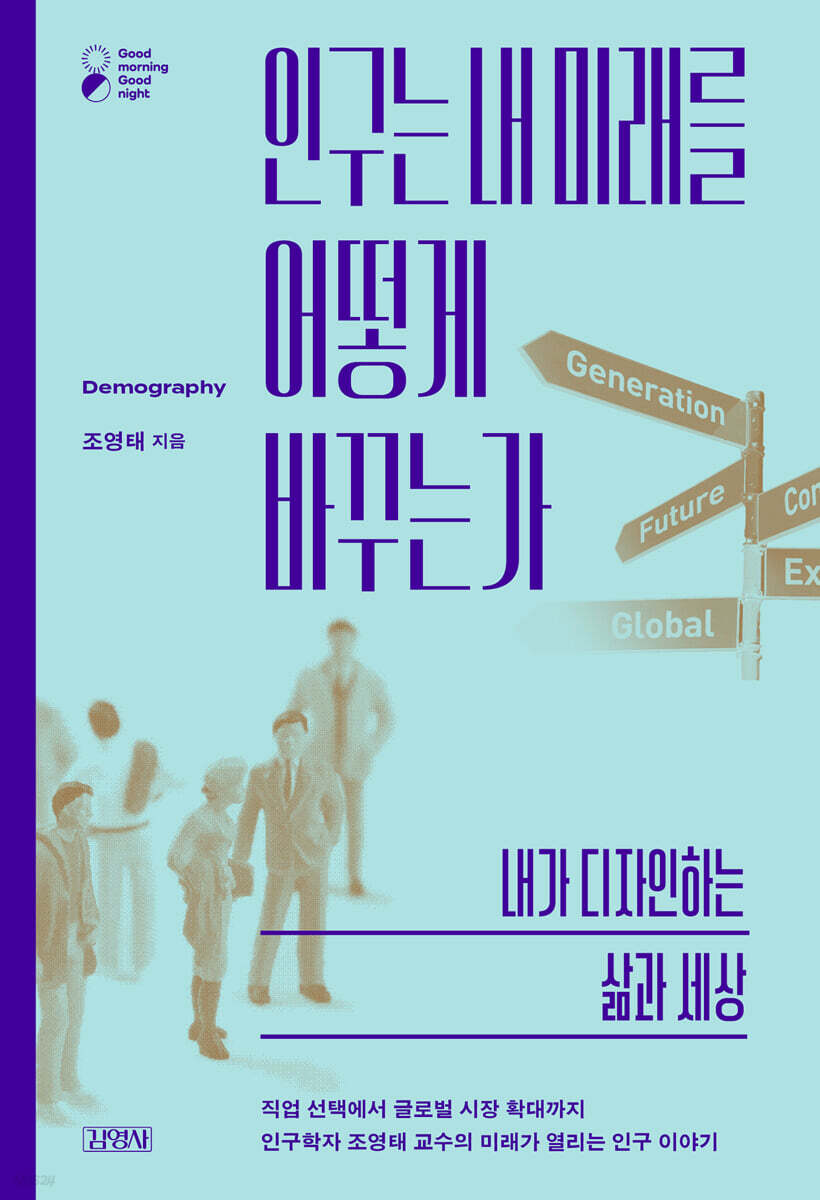
How Population Changes My Future
 |
Description
Book Introduction
The crisis, opportunity, and possibility of a definite future called population decline
Professor Young-Tae Cho, the leading authority on demography
A Population Story That Opens the Future
Is the destined future of population decline truly a crisis? What should we do to prepare for the future of ourselves and our families? Professor Cho Young-tae, Korea's leading authority on demography, has published a new book, "How Population Changes My Future."
This new work shows what opportunities and possibilities are available to me and my family in the face of the crisis of population decline.
The author emphasizes that individuals living today and dreaming of tomorrow can also utilize population data to prepare for future careers, plan businesses, and educate their children.
From basic demographic concepts to population structure changes, the global well-off generation, and future market forecasts, this book covers the core of demographics you need to know to design a sustainable future.
This is the eighteenth book in the 'Good Morning, Good Night' series, created by leading scholars and researchers in each field for future generations.
Professor Young-Tae Cho, the leading authority on demography
A Population Story That Opens the Future
Is the destined future of population decline truly a crisis? What should we do to prepare for the future of ourselves and our families? Professor Cho Young-tae, Korea's leading authority on demography, has published a new book, "How Population Changes My Future."
This new work shows what opportunities and possibilities are available to me and my family in the face of the crisis of population decline.
The author emphasizes that individuals living today and dreaming of tomorrow can also utilize population data to prepare for future careers, plan businesses, and educate their children.
From basic demographic concepts to population structure changes, the global well-off generation, and future market forecasts, this book covers the core of demographics you need to know to design a sustainable future.
This is the eighteenth book in the 'Good Morning, Good Night' series, created by leading scholars and researchers in each field for future generations.
- You can preview some of the book's contents.
Preview
index
prolog
Chapter 1: Knowing the Population Opens the Future
1.
The future of the irreplaceable population
2.
Targeting future markets through demographics
3.
Predicting Future Jobs with Population Change
4.
Finding an individual's career in a predetermined future
Q&A
Chapter 2: Global Jalpa is Coming
1. A world where those who sell well are the main characters, even more so than MZ.
2.
Jalpa's global code
3.
Who will take the lead in global culture?
Q&A
Chapter 3: Why Should We Know Demography?
1.
Population born, population moving, population dying
2.
Demography cuts across many disciplines.
3.
The founder of modern demography: Malthus
4.
As it turns out, it's a population phenomenon!
5.
Demography: Why is it important?
6.
Why is our country's birth rate so low?
Q&A
Epilogue
References
Chapter 1: Knowing the Population Opens the Future
1.
The future of the irreplaceable population
2.
Targeting future markets through demographics
3.
Predicting Future Jobs with Population Change
4.
Finding an individual's career in a predetermined future
Q&A
Chapter 2: Global Jalpa is Coming
1. A world where those who sell well are the main characters, even more so than MZ.
2.
Jalpa's global code
3.
Who will take the lead in global culture?
Q&A
Chapter 3: Why Should We Know Demography?
1.
Population born, population moving, population dying
2.
Demography cuts across many disciplines.
3.
The founder of modern demography: Malthus
4.
As it turns out, it's a population phenomenon!
5.
Demography: Why is it important?
6.
Why is our country's birth rate so low?
Q&A
Epilogue
References
Detailed image
.jpg)
Into the book
How we view population depends on which aspect of it we consider, and whether we consider the impact of population to be limited to a single country or to a global one.
There is also a great deal of room for diverse uses, depending on how the population itself is interpreted.
Not only at the national and societal level, but also for businesses operating in the market and for individuals living today and preparing for tomorrow, the population can be utilized quite usefully.
--- p.8 From "Prologue"
Another advantage of demography is that it considers not only the quantitative but also the qualitative aspects of population change.
Although the number of marriages has decreased, it has confirmed that some people are getting married and having children.
He explained that although the number of children born has decreased, the market for children's products has, on the contrary, grown.
The same phenomenon is occurring in the marriage market.
Newlyweds usually belong to the middle or upper class with a high socioeconomic level.
So, S Electronics positioned the 'B○○○' brand as a premium home appliance, and this strategy was a huge success.
--- p.28 From “Chapter 1: Knowing the Population Opens the Future”
The fact that the Jalpa generation is global suggests that the global market in the future may be significantly different from what it is now.
Although the number of jalpa in our country is small, it is said that the global jalpa is the largest in history.
However, the values and culture they enjoy have been formed on a global scale.
The size of the market that can be shared will be incomparably larger than it is now.
Until now, if you were doing business overseas, you had to know the characteristics of that country, whether it was the United States or China.
Because what Koreans, Chinese, and Americans like are different.
However, in a market led by the globalized Jalpa generation, if something that the Korean Jalpa generation likes appears, the Jalpa from the US and China will also like it.
--- p.85 From “Chapter 2: Global Jalpa is Coming”
By predicting the population and its future evolution, we can determine whether competition is too intense or too weak, allowing for long-term social order, given the total amount of resources available. This is the reason demography studies populations and its fundamental philosophy.
In short, demography is the study of the balance between population and resources.
--- p.108 From Chapter 3, “Why Should We Know Demography?”
Can only the state prepare? No.
It is something that both individuals and businesses can and must do.
Let's consider whether it would be better to continue living according to existing practices, or to anticipate the future situation determined by the population and plan a new way of living accordingly.
There is also a great deal of room for diverse uses, depending on how the population itself is interpreted.
Not only at the national and societal level, but also for businesses operating in the market and for individuals living today and preparing for tomorrow, the population can be utilized quite usefully.
--- p.8 From "Prologue"
Another advantage of demography is that it considers not only the quantitative but also the qualitative aspects of population change.
Although the number of marriages has decreased, it has confirmed that some people are getting married and having children.
He explained that although the number of children born has decreased, the market for children's products has, on the contrary, grown.
The same phenomenon is occurring in the marriage market.
Newlyweds usually belong to the middle or upper class with a high socioeconomic level.
So, S Electronics positioned the 'B○○○' brand as a premium home appliance, and this strategy was a huge success.
--- p.28 From “Chapter 1: Knowing the Population Opens the Future”
The fact that the Jalpa generation is global suggests that the global market in the future may be significantly different from what it is now.
Although the number of jalpa in our country is small, it is said that the global jalpa is the largest in history.
However, the values and culture they enjoy have been formed on a global scale.
The size of the market that can be shared will be incomparably larger than it is now.
Until now, if you were doing business overseas, you had to know the characteristics of that country, whether it was the United States or China.
Because what Koreans, Chinese, and Americans like are different.
However, in a market led by the globalized Jalpa generation, if something that the Korean Jalpa generation likes appears, the Jalpa from the US and China will also like it.
--- p.85 From “Chapter 2: Global Jalpa is Coming”
By predicting the population and its future evolution, we can determine whether competition is too intense or too weak, allowing for long-term social order, given the total amount of resources available. This is the reason demography studies populations and its fundamental philosophy.
In short, demography is the study of the balance between population and resources.
--- p.108 From Chapter 3, “Why Should We Know Demography?”
Can only the state prepare? No.
It is something that both individuals and businesses can and must do.
Let's consider whether it would be better to continue living according to existing practices, or to anticipate the future situation determined by the population and plan a new way of living accordingly.
--- p.132 From “Chapter 3: Why Should We Know Demography?”
Publisher's Review
I can design my future with population.
From career choice to global market expansion
Demography classes to design a sustainable future for myself and my family
In 2023, the total fertility rate in South Korea will be 0.72, one in five people will be over 65, and more than half of the population (50.8%) will live in the metropolitan area.
The press and media simply present numbers to explain population phenomena such as low birth rates, aging populations, and concentration in metropolitan areas, repeatedly conveying the message that the problem is the declining population.
But is the destined future of population decline truly a crisis? What should I do to prepare for the future for myself and my family?
Professor Young-Tae Cho (Director of the Population Policy Research Center at Seoul National University), the leading authority on demography in Korea, has published a new book titled “How Population Changes My Future.”
This new work shows what opportunities and possibilities are available to me and my family in the face of the crisis of population decline.
The author emphasizes that individuals living today and dreaming of tomorrow can also utilize population data to prepare for future careers, plan businesses, and educate their children.
From basic demographic concepts to population structure changes, the global well-off generation, and future market forecasts, this book covers the core of demographics you need to know to design a sustainable future.
ㆍCan the population decrease in the AI era?
ㆍIs the declining population a problem?
ㆍWhat are good jobs and good workplaces in a future with a declining population?
ㆍWhat are the characteristics of the global well-off generation?
ㆍWhy are scalability and convergence important in future markets?
Population is not just a number
Understanding Today and the Future through Population Structure and Population Change
The author emphasizes that the future of society can be accurately predicted because the framework, flow, scale, direction, and timing of social change are determined by population changes such as births, migration, and deaths, and that this allows for planning one's own future.
To imagine how our future will unfold, we must examine qualitative characteristics, such as population structure, in addition to the quantitative characteristic of a declining overall population.
Even if the population size is the same, if the population structure that makes up the entire population is different, social phenomena and market situations will unfold completely differently.
For example, if the number of births decreases, it is easy to assume that the future infant and child-related market will also show a downward trend.
However, our country's market for maternity and childcare products continues to grow in size.
Looking at the characteristics of the population with children, they have a high socioeconomic level, high purchasing power, make extensive preparations to have children, and have high expectations for their children (prepared parents-perfect children syndrome).
The market for baby and childcare products has become premium due to the desire to give the best to one's children.
Even if the population declines, it is believed that there will be no disruption to production as AI will replace the workforce.
However, the mechanism by which a country creates its wealth should not be viewed solely from the perspective of the number of people and productivity.
To lead the global value chain, we must go beyond simply utilizing science and technology like AI and be able to create it.
Nurturing creative young talents who will lead the R&D field is more important than increasing or decreasing the population.
In the era of convergence, in the future market
How will the job paradigm change?
The author predicts that the current severe job shortage will turn into a recruiting crisis by 2026, with companies fiercely competing to secure talent.
Just because there are so many jobs doesn't mean that all future jobs will be good jobs.
In the future, society and markets will change rapidly, making it difficult to secure competitiveness with only knowledge in one field.
It must have convergence and expandability to continuously create added value through linkage with other fields.
Even professions that have been coveted since previous generations, such as lawyers and doctors, are affected by the population structure.
As the proportion of the elderly population increases, the number of civil and criminal lawsuits is unlikely to decrease or at least increase, and future generations of seniors will likely take better care of their health and use less medical services than today's seniors.
Professionals such as lawyers and medical professionals must also seek expansion and convergence based on their expertise.
To ensure scalability and convergence, we must expand our scope of operations beyond the domestic market to a global scale with a large market size.
For example, the bio industry is growing in size in the global market.
Legal professionals can build a legal infrastructure that will allow Korean biotech companies to enter the market, while medical professionals can integrate and expand their expertise as physician-scientists, creating a foundation for the bioindustry.
Global Jalpa is coming
A world where Jalpa, not MZ, is the main character
The youth generation is usually referred to as MZ, a combination of the Millennial generation (born 1986-1996) and Generation Z (born 1997-2012).
The author says that the two generations cannot be lumped together because they have different life cycles and exhibit completely different characteristics.
We introduce the 'Z-alpha' generation, a combination of Generation Z and Generation Alpha (born after 2013), as the new mainstay of youth.
Although the number of Jalpas in Korea is small, the Jalpa generation, which is the largest in the global society, will be at the center of the global economy.
As the first generation to have grown up with smartphones since infancy, they are inherently global because they share culture simultaneously through YouTube, social media, and OTT platforms.
The author's definition of global does not mean living abroad, but rather that one's sphere of activity is not limited to a single region but spreads across various countries.
Whether you're a company or an individual, creating products and content that appeal to global consumers will inevitably lead to growth.
To understand the global market, you must ultimately understand Korea's Jalpa well.
In the future, in the global market, it will not be only leading countries like the United States that will lead culture, but the phenomenon of convergence, where cultures become unified, will become more prominent.
Although Korea's number of well-selling content is small, as evidenced by the status of K-content, it is leading the direction of global culture and content.
If they like it, it will easily expand to the global well-off generation, but if they don't show interest, the expansion of the content will be minimal.
From Malthus's population theory to the population story that opens the door to the future.
Why should we know about demography?
Demography, which began with Malthus's theory, which first academically established the relationship between population and resources, is an interdisciplinary and applied discipline that interacts with health science, sociology, economics, environmental studies, and even natural science and engineering.
In addition to the low birth rate and aging population that come to mind when we think of 'population,' population phenomena occur on a wide scale in our daily lives, although we may not be aware of them.
The author presents a colorful overview of the impact of population on our lives, including comparisons of different social classes based on median age, the burden of social support based on population structure, and the relationship between generations, economic activity, and health policy.
As a member of society, an individual must understand society in order to envision his or her own life.
To understand society, we must ultimately understand people, the basic unit that makes up society.
To understand people, it is essential to analyze the demographic structure to which they belong.
Population is an important criterion for understanding social and market changes and predicting the future.
This book will serve as a guide for future generations seeking to discover new opportunities and possibilities based on population.
Today's culture, future wisdom, every day
The 'Good Morning, Good Night' series, a knowledge library that starts in the morning and ends in the evening.
'Good Morning, Good Night' sets a new standard for knowledge in the 21st century.
Written by the best writers, we share wisdom on how to view the world.
We take a look at where we are, what changes we are facing, and what we need to prepare for.
The world is changing.
The paradigm is shifting in all fields.
These are uncertain times, where we don't know what will happen tomorrow.
What choices will you make in the face of the great tide of change?
Will you fall into crisis because you can't read the changes, or will you actively respond to the changes and create opportunities?
Where do we stand, what changes are we facing, and what should we prepare for?
Leading scholars and researchers from each field have come together to create a comprehensive collection of knowledge and culture for future generations.
This knowledge library historically examines the changes and issues facing us in this era of transition across all fields, including the humanities, social sciences, economics, natural sciences, and the arts, and comprehensively examines phenomena and their essence to seek solutions and alternatives.
It is a paperback book that can be read by all generations, from middle school students to college students and the general public, and contains core knowledge and culture in one volume, so you can keep it close by and refer to it every day.
The 'Good Morning, Good Night' library will present a new standard for 21st century knowledge and serve as a guide to providing wisdom for viewing the world.
We await you, seeking wisdom and insight.
From career choice to global market expansion
Demography classes to design a sustainable future for myself and my family
In 2023, the total fertility rate in South Korea will be 0.72, one in five people will be over 65, and more than half of the population (50.8%) will live in the metropolitan area.
The press and media simply present numbers to explain population phenomena such as low birth rates, aging populations, and concentration in metropolitan areas, repeatedly conveying the message that the problem is the declining population.
But is the destined future of population decline truly a crisis? What should I do to prepare for the future for myself and my family?
Professor Young-Tae Cho (Director of the Population Policy Research Center at Seoul National University), the leading authority on demography in Korea, has published a new book titled “How Population Changes My Future.”
This new work shows what opportunities and possibilities are available to me and my family in the face of the crisis of population decline.
The author emphasizes that individuals living today and dreaming of tomorrow can also utilize population data to prepare for future careers, plan businesses, and educate their children.
From basic demographic concepts to population structure changes, the global well-off generation, and future market forecasts, this book covers the core of demographics you need to know to design a sustainable future.
ㆍCan the population decrease in the AI era?
ㆍIs the declining population a problem?
ㆍWhat are good jobs and good workplaces in a future with a declining population?
ㆍWhat are the characteristics of the global well-off generation?
ㆍWhy are scalability and convergence important in future markets?
Population is not just a number
Understanding Today and the Future through Population Structure and Population Change
The author emphasizes that the future of society can be accurately predicted because the framework, flow, scale, direction, and timing of social change are determined by population changes such as births, migration, and deaths, and that this allows for planning one's own future.
To imagine how our future will unfold, we must examine qualitative characteristics, such as population structure, in addition to the quantitative characteristic of a declining overall population.
Even if the population size is the same, if the population structure that makes up the entire population is different, social phenomena and market situations will unfold completely differently.
For example, if the number of births decreases, it is easy to assume that the future infant and child-related market will also show a downward trend.
However, our country's market for maternity and childcare products continues to grow in size.
Looking at the characteristics of the population with children, they have a high socioeconomic level, high purchasing power, make extensive preparations to have children, and have high expectations for their children (prepared parents-perfect children syndrome).
The market for baby and childcare products has become premium due to the desire to give the best to one's children.
Even if the population declines, it is believed that there will be no disruption to production as AI will replace the workforce.
However, the mechanism by which a country creates its wealth should not be viewed solely from the perspective of the number of people and productivity.
To lead the global value chain, we must go beyond simply utilizing science and technology like AI and be able to create it.
Nurturing creative young talents who will lead the R&D field is more important than increasing or decreasing the population.
In the era of convergence, in the future market
How will the job paradigm change?
The author predicts that the current severe job shortage will turn into a recruiting crisis by 2026, with companies fiercely competing to secure talent.
Just because there are so many jobs doesn't mean that all future jobs will be good jobs.
In the future, society and markets will change rapidly, making it difficult to secure competitiveness with only knowledge in one field.
It must have convergence and expandability to continuously create added value through linkage with other fields.
Even professions that have been coveted since previous generations, such as lawyers and doctors, are affected by the population structure.
As the proportion of the elderly population increases, the number of civil and criminal lawsuits is unlikely to decrease or at least increase, and future generations of seniors will likely take better care of their health and use less medical services than today's seniors.
Professionals such as lawyers and medical professionals must also seek expansion and convergence based on their expertise.
To ensure scalability and convergence, we must expand our scope of operations beyond the domestic market to a global scale with a large market size.
For example, the bio industry is growing in size in the global market.
Legal professionals can build a legal infrastructure that will allow Korean biotech companies to enter the market, while medical professionals can integrate and expand their expertise as physician-scientists, creating a foundation for the bioindustry.
Global Jalpa is coming
A world where Jalpa, not MZ, is the main character
The youth generation is usually referred to as MZ, a combination of the Millennial generation (born 1986-1996) and Generation Z (born 1997-2012).
The author says that the two generations cannot be lumped together because they have different life cycles and exhibit completely different characteristics.
We introduce the 'Z-alpha' generation, a combination of Generation Z and Generation Alpha (born after 2013), as the new mainstay of youth.
Although the number of Jalpas in Korea is small, the Jalpa generation, which is the largest in the global society, will be at the center of the global economy.
As the first generation to have grown up with smartphones since infancy, they are inherently global because they share culture simultaneously through YouTube, social media, and OTT platforms.
The author's definition of global does not mean living abroad, but rather that one's sphere of activity is not limited to a single region but spreads across various countries.
Whether you're a company or an individual, creating products and content that appeal to global consumers will inevitably lead to growth.
To understand the global market, you must ultimately understand Korea's Jalpa well.
In the future, in the global market, it will not be only leading countries like the United States that will lead culture, but the phenomenon of convergence, where cultures become unified, will become more prominent.
Although Korea's number of well-selling content is small, as evidenced by the status of K-content, it is leading the direction of global culture and content.
If they like it, it will easily expand to the global well-off generation, but if they don't show interest, the expansion of the content will be minimal.
From Malthus's population theory to the population story that opens the door to the future.
Why should we know about demography?
Demography, which began with Malthus's theory, which first academically established the relationship between population and resources, is an interdisciplinary and applied discipline that interacts with health science, sociology, economics, environmental studies, and even natural science and engineering.
In addition to the low birth rate and aging population that come to mind when we think of 'population,' population phenomena occur on a wide scale in our daily lives, although we may not be aware of them.
The author presents a colorful overview of the impact of population on our lives, including comparisons of different social classes based on median age, the burden of social support based on population structure, and the relationship between generations, economic activity, and health policy.
As a member of society, an individual must understand society in order to envision his or her own life.
To understand society, we must ultimately understand people, the basic unit that makes up society.
To understand people, it is essential to analyze the demographic structure to which they belong.
Population is an important criterion for understanding social and market changes and predicting the future.
This book will serve as a guide for future generations seeking to discover new opportunities and possibilities based on population.
Today's culture, future wisdom, every day
The 'Good Morning, Good Night' series, a knowledge library that starts in the morning and ends in the evening.
'Good Morning, Good Night' sets a new standard for knowledge in the 21st century.
Written by the best writers, we share wisdom on how to view the world.
We take a look at where we are, what changes we are facing, and what we need to prepare for.
The world is changing.
The paradigm is shifting in all fields.
These are uncertain times, where we don't know what will happen tomorrow.
What choices will you make in the face of the great tide of change?
Will you fall into crisis because you can't read the changes, or will you actively respond to the changes and create opportunities?
Where do we stand, what changes are we facing, and what should we prepare for?
Leading scholars and researchers from each field have come together to create a comprehensive collection of knowledge and culture for future generations.
This knowledge library historically examines the changes and issues facing us in this era of transition across all fields, including the humanities, social sciences, economics, natural sciences, and the arts, and comprehensively examines phenomena and their essence to seek solutions and alternatives.
It is a paperback book that can be read by all generations, from middle school students to college students and the general public, and contains core knowledge and culture in one volume, so you can keep it close by and refer to it every day.
The 'Good Morning, Good Night' library will present a new standard for 21st century knowledge and serve as a guide to providing wisdom for viewing the world.
We await you, seeking wisdom and insight.
GOODS SPECIFICS
- Date of issue: December 27, 2024
- Page count, weight, size: 160 pages | 132*193*20mm
- ISBN13: 9791173320392
- ISBN10: 1173320393
You may also like
카테고리
korean


korean

![GQ KOREA Mark (Monthly): December [2025]](http://librairie.coreenne.fr/cdn/shop/files/8ef265dbbfbf186523ed75ba7319009d.jpg?v=1765340328&width=3840)


