

Jin-ki Choi's Economic Common Sense, Starting Today
 |
Description
Book Introduction
The latest revised edition of Choi Jin-ki's Jumbled Economic Sense
『Choi Jin-ki's Economic Common Sense Starting Today』 contains 500 pieces of economic common sense carefully selected by top economics lecturer Choi Jin-ki, organized in an easy and fun way for the entire nation to understand.
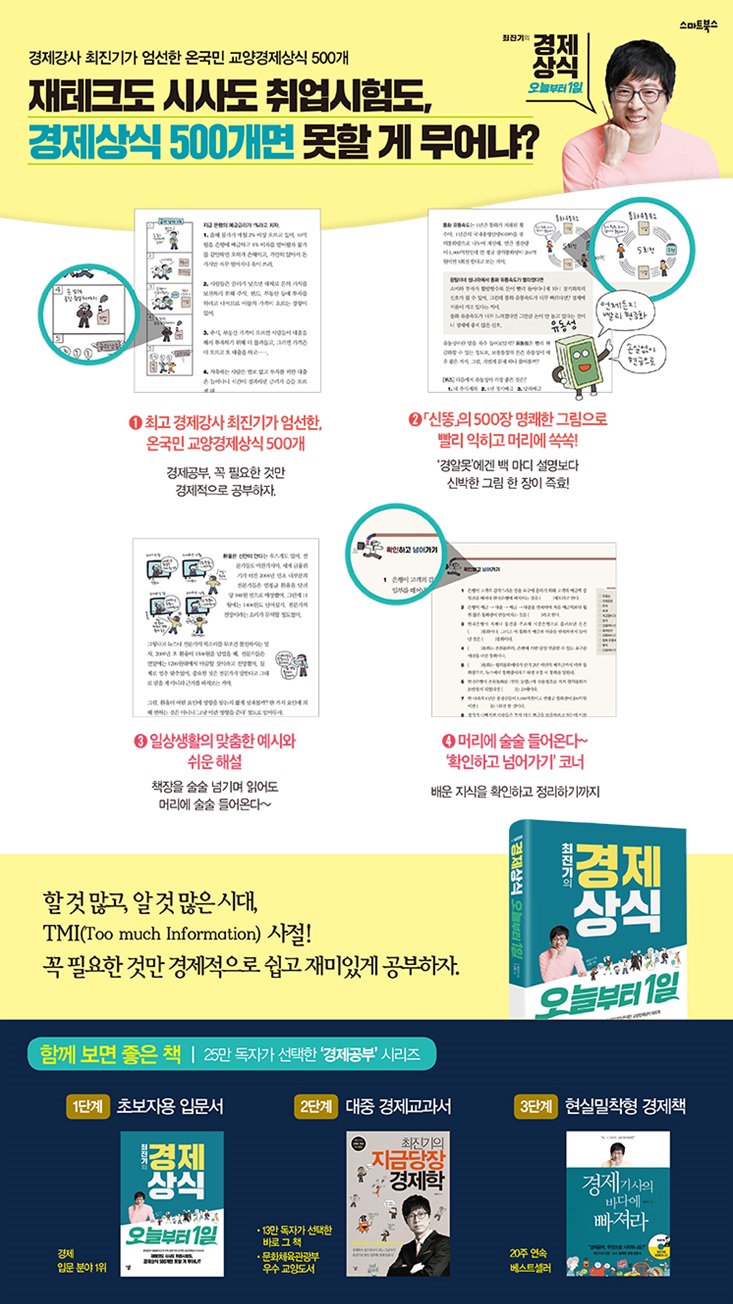
With examples frequently appearing in economic news, easy explanations, and 500 ingenious illustrations from "Shin Ddong," you can easily flip through the pages and enjoy reading, and the knowledge will stick in your head.
It is also structured so that you can remember it for a long time with the ‘Problem’ and ‘Check and Move On’ corners.
It will be of great help to job seekers, high school students preparing for business school entrance exams, those preparing for promotion exams, and readers who are investing.
In an age of so much to do and so much to know, say no to TMI (Too Much Information)! Study economics with "Choi Jin-ki's Economic Common Sense: Starting Today" and learn only the essentials, in an easy, fun, and economically savvy way.
『Choi Jin-ki's Economic Common Sense Starting Today』 contains 500 pieces of economic common sense carefully selected by top economics lecturer Choi Jin-ki, organized in an easy and fun way for the entire nation to understand.
With examples frequently appearing in economic news, easy explanations, and 500 ingenious illustrations from "Shin Ddong," you can easily flip through the pages and enjoy reading, and the knowledge will stick in your head.
It is also structured so that you can remember it for a long time with the ‘Problem’ and ‘Check and Move On’ corners.
It will be of great help to job seekers, high school students preparing for business school entrance exams, those preparing for promotion exams, and readers who are investing.
In an age of so much to do and so much to know, say no to TMI (Too Much Information)! Study economics with "Choi Jin-ki's Economic Common Sense: Starting Today" and learn only the essentials, in an easy, fun, and economically savvy way.
- You can preview some of the book's contents.
Preview
index
ingress
1.
Never study economics?
Government: "Eight, be quiet! Stop it!"
Big business: "Don't study economics like this, you're going to die!"
Financial firms: "Leave your economic studies to us."
Investors: "Don't let them know what I'm doing."
2.
Carrots and Sticks—Greed and Barriers
3.
The economy is a matrix
4.
Economics: Learn it in 6 months and use it for 60 years.
5.
So where do I start?
6.
Open, the map of economic studies
Chapter 1: Developing Economic Knowledge Even High School Students Can Understand
1.
If you boil economics down to one line,
2.
Goods and services are cooked in various ways
3.
Four players in the economic system are ready, land
4.
Let's choose production, distribution, and consumption.
5.
The consumption effect is noisy
6.
Demand, the law of demand is creeping in
7.
There are exceptions to the law of demand.
8.
Supply, exceptions to the law of supply
9.
The price elasticity of demand is tight
10.
The price elasticity of supply is loose
11.
If you recite the law of supply and demand
12.
Economies of scale are a bit tricky
13.
Price differentiation varies widely
14.
Four markets are fiercely contested
15.
The market failure is blunt
16.
Lowest price, highest price, attention!
▶ Check and move on
Chapter 2 Interest rates fluctuate
1.
Interest rates are discriminatory
2.
Interest rates fluctuate
3.
Interest rates, the standard for all investments
4.
Hands up, standard! Base rate
5.
The three musketeers of short-term interest rates, come out!
6.
Long-term interest rates are sluggish
7.
The bank is in danger
8.
Financial institutions are hot and bothersome
Interest rate names/Financial products/Financial institutions
▶ Check and move on
Chapter 3 Bonds are thudding
1.
Nice to meet you, Chaejo
2.
The bond market is booming
3.
Bond interest rates fluctuate
4.
There are many different types of bonds
5.
Bonds come in a variety of forms
6.
Corporate bonds come in all shapes and sizes
7.
Interest rate signals, all you need to know is this!
▶ Check and move on
Chapter 4: The currency is bubbling
1.
Money is constantly changing
2.
The currency is inflated
3.
The amount of money has increased, the amount of money has decreased
4.
Currency types are divided into stages
5.
How fast and how much money
6.
Inflation is coming
7.
Ouch, hot! Hyperinflation
8.
Deflation is upon us
9.
Reflation
10.
Stagflation is a dilemma
▶ Check and move on
Chapter 5: A Glimpse of Economic Policy
1.
The game is up and down
2.
The business cycle is also diverse
3.
Interference of economic policy
4.
Bank of Korea, Gyeonggi-do, stand up
5.
Step aside, the government has stepped in.
6.
The tax cut policy is sneaky
7.
The trickle down effect is hilarious
8.
Money loosening, wrong direction
9.
The economic impact simulation is ridiculous
10.
The economic policy tone is hot
11.
Deregulation is going slowly
▶ Check and move on
Chapter 6: Economic indicators are noisy
1.
The indicators and indices are clearly
2. Which country has the best GDP?
3.
Economic growth rate fluctuates
4.
Potential growth rate is creepy
5.
The economic index is fluctuating
6.
The economic sentiment index is quick to notice
7.
The price index is fluctuating
8.
Unemployment rate is a blind eye
Introduction to the book "Choi Jin-gi's Economic Common Sense: Starting Today"
9.
Jobless growth is dizzying
10.
Per capita national income is so high
11.
Income distribution is booming
12.
Household debt is on the rise
13.
The balance of payments is carefully
14.
The national debt is skyrocketing
▶ Check and move on
Chapter 7: The exchange rate is fluctuating
1.
Foreign currency at a glance
2.
The exchange rate fluctuates
3.
Foreign exchange market, changing inside and out
4.
The exchange rate has been changed twice
5.
The offshore market is in shambles
6.
Currency strength, weakness
7.
Exchange rate rises and falls
8.
The exchange rate difference is fluctuating
9.
Foreigners bought and sold at the exchange rate.
10.
The world's exchange rate gates are closing in on each other
11.
Exchange rate fluctuations are volatile
12.
Fixed exchange rate, floating exchange rate
13.
Foreign exchange reserves fluctuate
14.
If there is a difference in currency swap and foreign exchange reserves,
15.
The government is secretly taking advantage of the foreign exchange market.
▶ Check and move on
Chapter 8: The world economy at a glance!
1.
The core of the Korean economy at a glance
2.
The reserve currency is a magic wand
3.
The US dollar is soaring
4.
The Triffin Dilemma is stuck
5.
Global imbalances are at stake
6.
Yen carry, dollar carry are swinging
7.
The euro is fluctuating
8.
The yen is being pushed back
9.
US indicators are stagnant
10.
International interest rates are fluctuating
11.
Credit ratings and CDS premiums are alarming.
12.
International oil prices are fluctuating
13.
The raw materials market is bustling
▶ Check and move on
Chapter 9: The stock market is noisy
1.
The stock market is in disarray
2.
The stock index is unclear
3.
It's blatantly on the market news
4.
Stocks are diverse
5.
Margin call is ringing
6.
Foreigners are having fun
7.
The stock chart is confusing
8.
Short selling is booming
9.
The accounting books are hot
10.
Stocks, are they expensive or cheap?
11.
Gift trading is a mess
12.
Options trading is shaky
13.
Program trading price suddenly
▶ Check and move on
1.
Never study economics?
Government: "Eight, be quiet! Stop it!"
Big business: "Don't study economics like this, you're going to die!"
Financial firms: "Leave your economic studies to us."
Investors: "Don't let them know what I'm doing."
2.
Carrots and Sticks—Greed and Barriers
3.
The economy is a matrix
4.
Economics: Learn it in 6 months and use it for 60 years.
5.
So where do I start?
6.
Open, the map of economic studies
Chapter 1: Developing Economic Knowledge Even High School Students Can Understand
1.
If you boil economics down to one line,
2.
Goods and services are cooked in various ways
3.
Four players in the economic system are ready, land
4.
Let's choose production, distribution, and consumption.
5.
The consumption effect is noisy
6.
Demand, the law of demand is creeping in
7.
There are exceptions to the law of demand.
8.
Supply, exceptions to the law of supply
9.
The price elasticity of demand is tight
10.
The price elasticity of supply is loose
11.
If you recite the law of supply and demand
12.
Economies of scale are a bit tricky
13.
Price differentiation varies widely
14.
Four markets are fiercely contested
15.
The market failure is blunt
16.
Lowest price, highest price, attention!
▶ Check and move on
Chapter 2 Interest rates fluctuate
1.
Interest rates are discriminatory
2.
Interest rates fluctuate
3.
Interest rates, the standard for all investments
4.
Hands up, standard! Base rate
5.
The three musketeers of short-term interest rates, come out!
6.
Long-term interest rates are sluggish
7.
The bank is in danger
8.
Financial institutions are hot and bothersome
Interest rate names/Financial products/Financial institutions
▶ Check and move on
Chapter 3 Bonds are thudding
1.
Nice to meet you, Chaejo
2.
The bond market is booming
3.
Bond interest rates fluctuate
4.
There are many different types of bonds
5.
Bonds come in a variety of forms
6.
Corporate bonds come in all shapes and sizes
7.
Interest rate signals, all you need to know is this!
▶ Check and move on
Chapter 4: The currency is bubbling
1.
Money is constantly changing
2.
The currency is inflated
3.
The amount of money has increased, the amount of money has decreased
4.
Currency types are divided into stages
5.
How fast and how much money
6.
Inflation is coming
7.
Ouch, hot! Hyperinflation
8.
Deflation is upon us
9.
Reflation
10.
Stagflation is a dilemma
▶ Check and move on
Chapter 5: A Glimpse of Economic Policy
1.
The game is up and down
2.
The business cycle is also diverse
3.
Interference of economic policy
4.
Bank of Korea, Gyeonggi-do, stand up
5.
Step aside, the government has stepped in.
6.
The tax cut policy is sneaky
7.
The trickle down effect is hilarious
8.
Money loosening, wrong direction
9.
The economic impact simulation is ridiculous
10.
The economic policy tone is hot
11.
Deregulation is going slowly
▶ Check and move on
Chapter 6: Economic indicators are noisy
1.
The indicators and indices are clearly
2. Which country has the best GDP?
3.
Economic growth rate fluctuates
4.
Potential growth rate is creepy
5.
The economic index is fluctuating
6.
The economic sentiment index is quick to notice
7.
The price index is fluctuating
8.
Unemployment rate is a blind eye
Introduction to the book "Choi Jin-gi's Economic Common Sense: Starting Today"
9.
Jobless growth is dizzying
10.
Per capita national income is so high
11.
Income distribution is booming
12.
Household debt is on the rise
13.
The balance of payments is carefully
14.
The national debt is skyrocketing
▶ Check and move on
Chapter 7: The exchange rate is fluctuating
1.
Foreign currency at a glance
2.
The exchange rate fluctuates
3.
Foreign exchange market, changing inside and out
4.
The exchange rate has been changed twice
5.
The offshore market is in shambles
6.
Currency strength, weakness
7.
Exchange rate rises and falls
8.
The exchange rate difference is fluctuating
9.
Foreigners bought and sold at the exchange rate.
10.
The world's exchange rate gates are closing in on each other
11.
Exchange rate fluctuations are volatile
12.
Fixed exchange rate, floating exchange rate
13.
Foreign exchange reserves fluctuate
14.
If there is a difference in currency swap and foreign exchange reserves,
15.
The government is secretly taking advantage of the foreign exchange market.
▶ Check and move on
Chapter 8: The world economy at a glance!
1.
The core of the Korean economy at a glance
2.
The reserve currency is a magic wand
3.
The US dollar is soaring
4.
The Triffin Dilemma is stuck
5.
Global imbalances are at stake
6.
Yen carry, dollar carry are swinging
7.
The euro is fluctuating
8.
The yen is being pushed back
9.
US indicators are stagnant
10.
International interest rates are fluctuating
11.
Credit ratings and CDS premiums are alarming.
12.
International oil prices are fluctuating
13.
The raw materials market is bustling
▶ Check and move on
Chapter 9: The stock market is noisy
1.
The stock market is in disarray
2.
The stock index is unclear
3.
It's blatantly on the market news
4.
Stocks are diverse
5.
Margin call is ringing
6.
Foreigners are having fun
7.
The stock chart is confusing
8.
Short selling is booming
9.
The accounting books are hot
10.
Stocks, are they expensive or cheap?
11.
Gift trading is a mess
12.
Options trading is shaky
13.
Program trading price suddenly
▶ Check and move on
Detailed image
Into the book
For a long time, I've been thinking about writing an economics book that's easy to understand and accessible, yet has a very solid foundation, for those taking their first steps into economics.
I wanted to write a book that even people who are not interested in economics and find it difficult and hesitant can easily access.
But it wasn't as easy as I thought.
This is because it was not simply about an interesting story, but it had to properly explain the basic economic common sense that is truly necessary.
This is why this book was planned two years ago but was published late after a long period of hardship.
--- p.
5
Studying economics is something you learn in 6 months and use for 60 years.
It may be difficult to overcome the wall of unfamiliar economic terms and concepts at first, but if you study hard for about six months and become able to read economic articles fluently, studying economics becomes much easier and more fun.
I hope that through this book, you will be able to experience the true joy of studying economics.
Economics is the discipline closest to our lives.
And it is the most transparent window through which we can see the truth.
--- p.7
This is what I've felt while teaching economics for over a thousand hours.
1.
There are often times when the same explanation needs to be repeated.
That's why I'm explaining the concept and telling the story in case people without a foundation might not understand.
Even if you only have the basics, you will be able to make progress quickly...
2.
When I first read economics, I often look up economic terms, but the explanations are often more difficult.
I don't immediately understand what it means.
3.
Of course, there are books that explain things in an easy-to-understand way, but there aren't many books that systematically organize the basic knowledge you need to know.
No matter what field you enter, the most important thing is the basic knowledge that underpins that field.
4.
While giving economics lectures and writing, there were many times when I felt regretful, thinking, “Ah, if I just showed this with a picture, the readers would understand it more quickly...”
I wanted to write a book that even people who are not interested in economics and find it difficult and hesitant can easily access.
But it wasn't as easy as I thought.
This is because it was not simply about an interesting story, but it had to properly explain the basic economic common sense that is truly necessary.
This is why this book was planned two years ago but was published late after a long period of hardship.
--- p.
5
Studying economics is something you learn in 6 months and use for 60 years.
It may be difficult to overcome the wall of unfamiliar economic terms and concepts at first, but if you study hard for about six months and become able to read economic articles fluently, studying economics becomes much easier and more fun.
I hope that through this book, you will be able to experience the true joy of studying economics.
Economics is the discipline closest to our lives.
And it is the most transparent window through which we can see the truth.
--- p.7
This is what I've felt while teaching economics for over a thousand hours.
1.
There are often times when the same explanation needs to be repeated.
That's why I'm explaining the concept and telling the story in case people without a foundation might not understand.
Even if you only have the basics, you will be able to make progress quickly...
2.
When I first read economics, I often look up economic terms, but the explanations are often more difficult.
I don't immediately understand what it means.
3.
Of course, there are books that explain things in an easy-to-understand way, but there aren't many books that systematically organize the basic knowledge you need to know.
No matter what field you enter, the most important thing is the basic knowledge that underpins that field.
4.
While giving economics lectures and writing, there were many times when I felt regretful, thinking, “Ah, if I just showed this with a picture, the readers would understand it more quickly...”
--- pp.27~28
Publisher's Review
Korea's top economics lecturer, Choi Jin-ki, carefully selected 500 pieces of economic common sense for the entire nation. In an era where there is so much to do and know, say no to TMI (Too Much Information)!
Korea's top economics lecturer, Jin-ki Choi, has selected 500 pieces of economic common sense for the entire nation.
Studying economics, let's study only what is absolutely necessary.
Learn quickly and memorize it with the fresh illustrations of "Shin-ddong"!
For those who don't know much about the subject, a clear picture is better than a hundred words of explanation!
With an economic IQ of 30, if "Shindong" understands it, the entire nation will! Thanks to Shindong's 500 ingenious illustrations, economic concepts will become readily apparent.
Let's take the quick and easy shortcut to studying general economics.
Remember for a long time with customized examples and easy explanations.
Economic concepts are not something that can be learned by force.
Tailored examples and easy-to-understand explanations of the Korean and global economies, as well as everyday life, help you remember the book for a long time even after reading it once.
Additionally, it helps us understand economic trends by showing how various characters, such as the ordinary person Na Jae-pal, the businessman Na Jae-beol, and foreign investors, make decisions and act in real economic situations.
A book that teaches you economic news and articles from the field.
The economy surrounds our lives, and economic terms and common sense are woven together like warp and weft.
『Choi Jin-ki's Economic Common Sense Starting Today』 is not a book that simply lists and explains economic terms.
Based on a vast amount of actual economic news from newspapers and broadcasts spanning over 20 years, from 1996 to the present, you can learn economic terms that frequently appear during economic booms and recessions, organized by topic.
Right in your head, all the way to the [Check and Move On] corner
This book is designed to help beginners in economics build a solid foundation of economic knowledge.
Step 1: Understand the episodes and easy explanations with Shinddong's pictures, then step 2: Confirm the knowledge learned through the problems at each peak, and step 3: Organize once more through the 'Check and Move On' corner at the end of each chapter.
Just by following the three-step study method in this book, you can solidify your foundation in economic knowledge.
"How can we learn economics more efficiently?" "Choi Jin-ki's Economic Common Sense: Starting Today" is a book that begins with a simple, yet at the same time, very challenging, problem awareness and goal.
An easy book for beginners in economics to read first, a book that is easy to understand but has a solid foundation, and a book that is easy to understand and remember with illustrations.
Studying economics, let's study only what is absolutely necessary.
Let's take the first step with "Choi Jin-gi's Economic Common Sense, Starting Today".
Korea's top economics lecturer, Jin-ki Choi, has selected 500 pieces of economic common sense for the entire nation.
Studying economics, let's study only what is absolutely necessary.
Learn quickly and memorize it with the fresh illustrations of "Shin-ddong"!
For those who don't know much about the subject, a clear picture is better than a hundred words of explanation!
With an economic IQ of 30, if "Shindong" understands it, the entire nation will! Thanks to Shindong's 500 ingenious illustrations, economic concepts will become readily apparent.
Let's take the quick and easy shortcut to studying general economics.
Remember for a long time with customized examples and easy explanations.
Economic concepts are not something that can be learned by force.
Tailored examples and easy-to-understand explanations of the Korean and global economies, as well as everyday life, help you remember the book for a long time even after reading it once.
Additionally, it helps us understand economic trends by showing how various characters, such as the ordinary person Na Jae-pal, the businessman Na Jae-beol, and foreign investors, make decisions and act in real economic situations.
A book that teaches you economic news and articles from the field.
The economy surrounds our lives, and economic terms and common sense are woven together like warp and weft.
『Choi Jin-ki's Economic Common Sense Starting Today』 is not a book that simply lists and explains economic terms.
Based on a vast amount of actual economic news from newspapers and broadcasts spanning over 20 years, from 1996 to the present, you can learn economic terms that frequently appear during economic booms and recessions, organized by topic.
Right in your head, all the way to the [Check and Move On] corner
This book is designed to help beginners in economics build a solid foundation of economic knowledge.
Step 1: Understand the episodes and easy explanations with Shinddong's pictures, then step 2: Confirm the knowledge learned through the problems at each peak, and step 3: Organize once more through the 'Check and Move On' corner at the end of each chapter.
Just by following the three-step study method in this book, you can solidify your foundation in economic knowledge.
"How can we learn economics more efficiently?" "Choi Jin-ki's Economic Common Sense: Starting Today" is a book that begins with a simple, yet at the same time, very challenging, problem awareness and goal.
An easy book for beginners in economics to read first, a book that is easy to understand but has a solid foundation, and a book that is easy to understand and remember with illustrations.
Studying economics, let's study only what is absolutely necessary.
Let's take the first step with "Choi Jin-gi's Economic Common Sense, Starting Today".
GOODS SPECIFICS
- Date of issue: August 9, 2018
- Pages, weight, size: 391 pages | 694g | 170*240*20mm
- ISBN13: 9791185541815
- ISBN10: 1185541810
You may also like
카테고리
korean


korean

![GQ KOREA Mark (Monthly): December [2025]](http://librairie.coreenne.fr/cdn/shop/files/8ef265dbbfbf186523ed75ba7319009d.jpg?v=1765340328&width=3840)


