

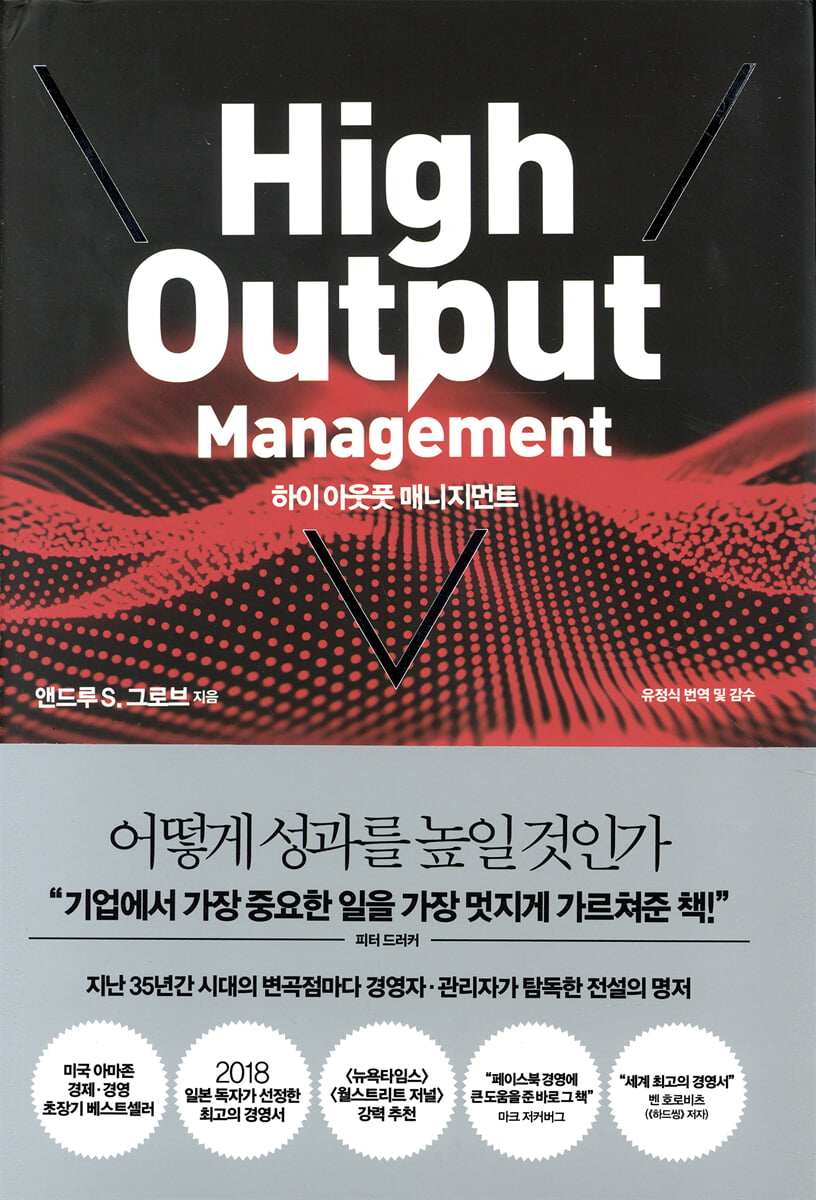
High Output Management
 |
Description
Book Introduction
A long-time Amazon bestseller in the US, and the best business book selected by Japanese readers in 2018.
Praised by media outlets around the world, including the New York Times and the Wall Street Journal.
First edition published in 1983, second edition published in 1995, third edition published in 2015
Andrew Grove, Chairman of Intel, who has been read by managers and administrators at every turning point of the times
The legendary masterpiece he wrote himself is finally being republished.
“The fundamentals of management never change!”
"In an era of change that does not tolerate complacency or laxity, what should companies do and what should managers do?" A new book that answers this question has been republished by Cheonglim Publishing.
It is called “High Output Management.”
This book, which has been a legendary masterpiece that Silicon Valley executives and managers have been devouring at every turning point of the times for the past 35 years since its first publication in 1983, is called the best masterpiece that contains the know-how of a manager directly from Andrew Grove, the legendary CEO of Silicon Valley and Intel.
Andrew Grove says that the most important role for raising productivity, which has become the new goal of companies, is the role of middle managers, and he includes specific management methods based on his own experience in this book.
In an age of unpredictability brought about by technological advancements, the fundamentals of management remain unchanged even after countless years.
Praised by media outlets around the world, including the New York Times and the Wall Street Journal.
First edition published in 1983, second edition published in 1995, third edition published in 2015
Andrew Grove, Chairman of Intel, who has been read by managers and administrators at every turning point of the times
The legendary masterpiece he wrote himself is finally being republished.
“The fundamentals of management never change!”
"In an era of change that does not tolerate complacency or laxity, what should companies do and what should managers do?" A new book that answers this question has been republished by Cheonglim Publishing.
It is called “High Output Management.”
This book, which has been a legendary masterpiece that Silicon Valley executives and managers have been devouring at every turning point of the times for the past 35 years since its first publication in 1983, is called the best masterpiece that contains the know-how of a manager directly from Andrew Grove, the legendary CEO of Silicon Valley and Intel.
Andrew Grove says that the most important role for raising productivity, which has become the new goal of companies, is the role of middle managers, and he includes specific management methods based on his own experience in this book.
In an age of unpredictability brought about by technological advancements, the fundamentals of management remain unchanged even after countless years.
- You can preview some of the book's contents.
Preview
index
Republishing this book┃The power to increase productivity in a new era
Recommended Articles┃How to Become a High-Performing Manager
PART 1: The Breakfast Factory Story
Chapter 1: The Basics of Production: Making Breakfast
Setting the Limit Stage | Basic Types of Production Activities | The Difference Between Ideal and Reality | Adding Value
Chapter 2: Managing the Breakfast Factory
Finding the Right Metrics | The Black Box That Distinguishes the Production Process | Controlling Future Results | Ensuring Quality
How to improve productivity
PART 2: MANAGEMENT IS A TEAM GAME
Chapter 3: Leverage in Management
What is management work? | The actual work of managers | The leverage of management activities | Improving management activity rate: Speed it up | Inherent leverage: How many employees should you have | Work interruption: The chronic problem of management work
Chapter 4: Means of Management: Meetings
Process-Oriented Meetings|Mission-Oriented Meetings
Chapter 5 Decision Making
The Ideal Model | Peer Group Syndrome | Struggling to Get Results: Six Questions
Chapter 6: Today's Actions for Tomorrow's Results: Planning
Creating a Planning Process | The Output of the Planning Process | Managing Through Goals: Applying the Planning Process to Everyday Work
PART 3 MANAGING A TEAM OF TEAM
Chapter 7: The Growth of the Breakfast Factory
We need a new way of working
Chapter 8 Hybrid Organizations
Organizational Form | Characteristics of Hybrid Organizations
Chapter 9 Double Reporting
Who Should Factory Security Guards Report To? | How to Make Your Hybrid Organization Work | Two-Faced Organizations
Chapter 10: Methods of Control
Principles of the Free Market System | Contractual Obligations | Cultural Values | The Role of Managers | The Most Appropriate Control Method | Work Control Methods
PART 4 PLAYER
Chapter 11: Management Techniques Learned from Sports
Physiological needs | Safety needs | Social needs | Recognition needs | Self-actualization needs | Feedback on money and work | Fear of failure that hinders self-actualization | How to lead to self-actualization
Chapter 12 Management Skills According to Maturity Level in Business
Management Style and Management Leverage | Becoming a Good Manager Isn't Easy
Chapter 13: A Manager's Biggest Role: Performance Appraisal
Why is it a problem? | Evaluating performance | Points to consider when communicating evaluation results | How to effectively communicate performance evaluation | Steps to solving the problem | Evaluation of excellent employees | Other thoughts and practices
Chapter 14: The Hardest Task: Interviewing and Reluctantly Resigning
When interviewing | When an employee quits
Chapter 15: Rewarding through Feedback
Considerations When Designing a Performance-Based Pay System | Base Pay System Methods | Meaning of Promotion
Chapter 16: Why Employee Training Is a Manager's Responsibility
Who Should Educate? | My Teaching Method
One more thing
Acknowledgements┃People who helped with this book
As technology advances, the power of management grows.
annotation
Recommended Articles┃How to Become a High-Performing Manager
PART 1: The Breakfast Factory Story
Chapter 1: The Basics of Production: Making Breakfast
Setting the Limit Stage | Basic Types of Production Activities | The Difference Between Ideal and Reality | Adding Value
Chapter 2: Managing the Breakfast Factory
Finding the Right Metrics | The Black Box That Distinguishes the Production Process | Controlling Future Results | Ensuring Quality
How to improve productivity
PART 2: MANAGEMENT IS A TEAM GAME
Chapter 3: Leverage in Management
What is management work? | The actual work of managers | The leverage of management activities | Improving management activity rate: Speed it up | Inherent leverage: How many employees should you have | Work interruption: The chronic problem of management work
Chapter 4: Means of Management: Meetings
Process-Oriented Meetings|Mission-Oriented Meetings
Chapter 5 Decision Making
The Ideal Model | Peer Group Syndrome | Struggling to Get Results: Six Questions
Chapter 6: Today's Actions for Tomorrow's Results: Planning
Creating a Planning Process | The Output of the Planning Process | Managing Through Goals: Applying the Planning Process to Everyday Work
PART 3 MANAGING A TEAM OF TEAM
Chapter 7: The Growth of the Breakfast Factory
We need a new way of working
Chapter 8 Hybrid Organizations
Organizational Form | Characteristics of Hybrid Organizations
Chapter 9 Double Reporting
Who Should Factory Security Guards Report To? | How to Make Your Hybrid Organization Work | Two-Faced Organizations
Chapter 10: Methods of Control
Principles of the Free Market System | Contractual Obligations | Cultural Values | The Role of Managers | The Most Appropriate Control Method | Work Control Methods
PART 4 PLAYER
Chapter 11: Management Techniques Learned from Sports
Physiological needs | Safety needs | Social needs | Recognition needs | Self-actualization needs | Feedback on money and work | Fear of failure that hinders self-actualization | How to lead to self-actualization
Chapter 12 Management Skills According to Maturity Level in Business
Management Style and Management Leverage | Becoming a Good Manager Isn't Easy
Chapter 13: A Manager's Biggest Role: Performance Appraisal
Why is it a problem? | Evaluating performance | Points to consider when communicating evaluation results | How to effectively communicate performance evaluation | Steps to solving the problem | Evaluation of excellent employees | Other thoughts and practices
Chapter 14: The Hardest Task: Interviewing and Reluctantly Resigning
When interviewing | When an employee quits
Chapter 15: Rewarding through Feedback
Considerations When Designing a Performance-Based Pay System | Base Pay System Methods | Meaning of Promotion
Chapter 16: Why Employee Training Is a Manager's Responsibility
Who Should Educate? | My Teaching Method
One more thing
Acknowledgements┃People who helped with this book
As technology advances, the power of management grows.
annotation
Detailed image

Into the book
Basically, what we always have to be careful about is detecting and resolving problems in the production process at the 'lowestvalue' stage whenever possible.
Therefore, spoiled eggs should be detected and returned when delivered, not when provided to the customer.
Likewise, unqualified candidates must be eliminated in advance during campus interviews before the prospective employees visit the headquarters.
This will save you money on head office visits and save time for both applicants and interviewers.
Additionally, rather than trying to find performance problems by examining the completed compiler, we should try to find performance problems in advance by examining each unit that makes up the compiler.
--- p.
52
For task simplification to be truly realized, the question must be asked: “Why is each step performed?”
Most of the time, you'll realize that there are a lot of steps in your workflow that exist for no reason.
Such unnecessary steps exist for reasons of convention or formality without any practical effect.
Remember, the U.S. Embassy in London, the "visa factory," doesn't have to process every single applicant.
So, regardless of why a step exists, you should always ask yourself, “Why is this step necessary?” for each step, and ask yourself, “Couldn’t I do the job without this step?”
Intel was able to reduce a significant number of administrative steps by approximately 30% overall.
--- pp.
78~79
A significant portion of a manager's job is to allocate (deploy) resources such as people, money, and capital.
But if I had to pick one most important resource that managers must allocate every day, it would be time.
In theory, money, manpower, and capital are available at any time, but time is an absolutely limited resource.
Therefore, considerable care is required in allocating and using time.
In my opinion, how you manage your time is the most important factor for a leader who wants to be a role model for his or her employees.
--- p.
95
How far ahead should planners look? Intel develops long-term strategic plans annually, looking ahead five years.
But when should these plans really be focused on? Next year.
What needs to be done in the year after next can be re-established during next year's long-term planning process.
Plan for the next few years, but remember to only implement the parts of your plan that apply between now and the time of the next plan.
The rest can be reviewed later.
Be careful not to plan too frequently, as you need time to evaluate the ramifications of your decisions and determine whether they are moving forward on the right path.
Because such feedback is an essential element in formulating future plans.
--- p.
159
The answer lies with middle managers.
First, their number is sufficient to cover the entire scope of a company's operations, and second, they are very close to the problem of creating and consuming internal resources.
For middle managers to successfully perform these "high-leverage" tasks, two things are necessary.
First, as long as they work in a hybrid organization, they must accept the inevitability of the hybrid organizational form.
Second, they must develop and become comfortable with how to effectively manage hybrid organizations.
--- p.
182
Ultimately, managers are responsible for the outcomes of those who report to them (i.e., their employees).
Additionally, managers cannot delegate tasks effectively to employees if they do not share common values.
One of my colleagues, who had always excelled at his job, wanted to hire a younger employee to take over his existing duties while he focused on a new endeavor.
But the employee did not do his job well.
My colleague's reaction was this:
“That guy has to learn from his mistakes.
“That’s how you learn on the job!” The problem here is that the customer is paying for the employee’s ‘educational expenses.’
This method is completely wrong.
The responsibility for employee training lies entirely with superiors, and the burden should not be passed on to internal or external customers.
--- p.
235
Evaluating employee performance is a very difficult task.
Because there is no single, foolproof way to perfectly measure and characterize an employee's performance.
There must be a clear outcome that can be captured through evaluation, but most work involves activities that are not directly linked to an outcome.
However, even if you know that you cannot evaluate objectively, you should evaluate your employees' performance by giving appropriate weight to such activities.
Managing and supervising employees is like walking a tightrope.
We must be objective, but at the same time we must not be afraid to make judgments based on subjective grounds.
To make evaluations easy, managers must know exactly what is expected of employees.
This way, you can determine whether your employees are performing their jobs according to your expectations.
The biggest problem with most evaluations is that managers don't clearly define what they want from their employees.
If you don't know what you want, you'll never get it.
Therefore, spoiled eggs should be detected and returned when delivered, not when provided to the customer.
Likewise, unqualified candidates must be eliminated in advance during campus interviews before the prospective employees visit the headquarters.
This will save you money on head office visits and save time for both applicants and interviewers.
Additionally, rather than trying to find performance problems by examining the completed compiler, we should try to find performance problems in advance by examining each unit that makes up the compiler.
--- p.
52
For task simplification to be truly realized, the question must be asked: “Why is each step performed?”
Most of the time, you'll realize that there are a lot of steps in your workflow that exist for no reason.
Such unnecessary steps exist for reasons of convention or formality without any practical effect.
Remember, the U.S. Embassy in London, the "visa factory," doesn't have to process every single applicant.
So, regardless of why a step exists, you should always ask yourself, “Why is this step necessary?” for each step, and ask yourself, “Couldn’t I do the job without this step?”
Intel was able to reduce a significant number of administrative steps by approximately 30% overall.
--- pp.
78~79
A significant portion of a manager's job is to allocate (deploy) resources such as people, money, and capital.
But if I had to pick one most important resource that managers must allocate every day, it would be time.
In theory, money, manpower, and capital are available at any time, but time is an absolutely limited resource.
Therefore, considerable care is required in allocating and using time.
In my opinion, how you manage your time is the most important factor for a leader who wants to be a role model for his or her employees.
--- p.
95
How far ahead should planners look? Intel develops long-term strategic plans annually, looking ahead five years.
But when should these plans really be focused on? Next year.
What needs to be done in the year after next can be re-established during next year's long-term planning process.
Plan for the next few years, but remember to only implement the parts of your plan that apply between now and the time of the next plan.
The rest can be reviewed later.
Be careful not to plan too frequently, as you need time to evaluate the ramifications of your decisions and determine whether they are moving forward on the right path.
Because such feedback is an essential element in formulating future plans.
--- p.
159
The answer lies with middle managers.
First, their number is sufficient to cover the entire scope of a company's operations, and second, they are very close to the problem of creating and consuming internal resources.
For middle managers to successfully perform these "high-leverage" tasks, two things are necessary.
First, as long as they work in a hybrid organization, they must accept the inevitability of the hybrid organizational form.
Second, they must develop and become comfortable with how to effectively manage hybrid organizations.
--- p.
182
Ultimately, managers are responsible for the outcomes of those who report to them (i.e., their employees).
Additionally, managers cannot delegate tasks effectively to employees if they do not share common values.
One of my colleagues, who had always excelled at his job, wanted to hire a younger employee to take over his existing duties while he focused on a new endeavor.
But the employee did not do his job well.
My colleague's reaction was this:
“That guy has to learn from his mistakes.
“That’s how you learn on the job!” The problem here is that the customer is paying for the employee’s ‘educational expenses.’
This method is completely wrong.
The responsibility for employee training lies entirely with superiors, and the burden should not be passed on to internal or external customers.
--- p.
235
Evaluating employee performance is a very difficult task.
Because there is no single, foolproof way to perfectly measure and characterize an employee's performance.
There must be a clear outcome that can be captured through evaluation, but most work involves activities that are not directly linked to an outcome.
However, even if you know that you cannot evaluate objectively, you should evaluate your employees' performance by giving appropriate weight to such activities.
Managing and supervising employees is like walking a tightrope.
We must be objective, but at the same time we must not be afraid to make judgments based on subjective grounds.
To make evaluations easy, managers must know exactly what is expected of employees.
This way, you can determine whether your employees are performing their jobs according to your expectations.
The biggest problem with most evaluations is that managers don't clearly define what they want from their employees.
If you don't know what you want, you'll never get it.
--- p.
244
244
Publisher's Review
"The world's best business book!" "The book that helped me run Facebook!"
: A book strongly recommended by Silicon Valley's top executives, including Ben Horowitz, Mark Zuckerberg, and Marc Andreessen.
Intel, the company that has achieved the greatest transformation in business history.
The dramatic transition of a company founded more than a decade ago from the memory business to the microprocessor business has become an unprecedented legend in the history of Silicon Valley.
The person who spearheaded and created this legend is Andrew Grove, author of High Output Management.
It is no exaggeration to say that there is no outstanding manager in Silicon Valley or around the world who does not know this book.
Top venture capitalists have handed out copies of this book to executives in the companies they've invested in, and those aspiring to be successful in Silicon Valley have devoured it.
Ben Horowitz, author of Hard Things and the author of the book's third edition, praised the book, saying, "This is the best management book in the world!" Mark Zuckerberg, CEO of Facebook, who brought people together around the world, strongly recommended the book, saying, "This is the book that helped me the most in managing Facebook!"
Even Peter Drucker, known as the god of management, praised the contents of this book during his lifetime, saying, “It teaches the most important things in business in the most wonderful way.”
[The New York Times], [The Wall Street Journal], [The San Francisco Chronicle] and other leading international media outlets have praised this book as the best book since its publication, and even in 2018, 35 years later, it was selected as the best management book by Japanese readers, demonstrating that its contents remain relevant in a changing world.
This is a must-read for managers who run organizations and anyone who wants to achieve results.
“Management is not leadership, it’s productivity!”
: Management Skills Learned from Silicon Valley Legend and Intel CEO Andrew Grove
When Andrew Grove took over as CEO, Intel had revenue of $1.9 billion and net income of $248 million.
By 1998, the year he left office, Intel's revenue had grown to $25.1 billion and net income to $6.9 billion.
Intel, which achieved an exponential compound annual growth rate, became the sixth most profitable company in the world at the time.
The widely known 'Intel Inside' became the best marketing strategy developed at that time.
How did Andrew Grove, the master strategist and manager who transformed Intel into a legendary Silicon Valley company, manage his organization? Contrary to popular management books, Grove argues that the true virtue of management lies not in leadership, but in productivity.
Managers are not evaluated on their leadership.
It is evaluated by the productivity of the organization.
This book covers everything from the importance of management to meeting methods and personnel evaluation criteria, providing practical answers to questions that every manager ponders.
Andrew Grove says that companies and managers must learn to create more value to survive, and he provides specific methods for organizations to improve performance.
10 Innovative and Practical Management Techniques from Andrew Grove
√ Makes work 'faster' for productivity
√ Create a structure that increases business leverage.
√ Create a report to collect information
√ Lead team meetings for decision-making
√ Exchange information through one-on-one interviews.
√ Share work status through operational review meetings.
√ Map out your company's future with mission-oriented meetings.
√ Share your knowledge with your employees
√ Evaluate employee performance
√ Train employees through feedback
“How to improve performance!”
: Everything about organizational management that develops talent and maximizes productivity.
Intel's innovation stemmed from Andrew Grove's relentless obsession with productivity.
He strengthened Intel's ability to innovate by properly measuring performance within the organization and linking compensation to it. In the process, he promoted executives in the microprocessor business unit to management and granted stock options to all employees, thereby developing talent and increasing productivity.
If Peter Drucker summarized the theory of organizational management to achieve performance, Andrew Grove has incorporated his actual experiences into this book to present the practical methods of organizational management.
After reading the book, you will have a clearer understanding of what managers really need to do and how to achieve results.
This book states that “a manager’s performance is the performance of the organization he manages and influences,” and offers innovative yet practical advice on what managers can do to improve the performance of their teams.
A manager's output = what he manages and what he influences
Organizational outcomes + outcomes of related organizations
So, with countless tasks piling up every day, what should managers focus on most? Tasks with high "management leverage."
'Management leverage' is a term that measures how much influence a manager exerts on improving the team's performance. To increase management productivity, you need to select tasks with high leverage.
For this purpose, one-on-one interviews between managers and employees are of utmost importance.
Drawing on his experience with Intel's innovations, Andrew Grove suggests that all middle managers can be more productive by "applying production methods," "leveraging managerial leverage," and "instilling in employees an athlete's drive to achieve peak performance."
And his claim has already been proven through Intel's innovation.
That's why this book has been lauded by countless managers for 35 years.
The specific methods of practical management presented in this book have universality that transcends 35 years.
This is a must-read for middle managers to ensure organizational performance and to survive in this era of change by enhancing individual performance.
35 Years of High Output Management's Praise
"The most brilliant book on the most important things in business!" - Peter Drucker
"The book that helped me a lot in running Facebook!" _Mark Zuckerberg (Facebook CEO)
"This is arguably the world's best management book!" —Ben Horowitz, author of "Hard Things"
“What can the best companies in Silicon Valley do?
Andrew Grove has built the best management model.” - Marc Andreessen (browser inventor, co-founder of Andreessen Horowitz)
“A book rich in advice and examples, this is well worth reading for managers.”_[The Wall Street Journal]
“It’s a great book.
“It’s a basic prescription that demonstrates the fundamentals of a very effective management style.” _[San Francisco Chronicle]
“An organizational 'tour guide' for managers at all levels, an incredibly complete handbook for creating work, giving direction to employees, and developing them.”_[The New York Times]
: A book strongly recommended by Silicon Valley's top executives, including Ben Horowitz, Mark Zuckerberg, and Marc Andreessen.
Intel, the company that has achieved the greatest transformation in business history.
The dramatic transition of a company founded more than a decade ago from the memory business to the microprocessor business has become an unprecedented legend in the history of Silicon Valley.
The person who spearheaded and created this legend is Andrew Grove, author of High Output Management.
It is no exaggeration to say that there is no outstanding manager in Silicon Valley or around the world who does not know this book.
Top venture capitalists have handed out copies of this book to executives in the companies they've invested in, and those aspiring to be successful in Silicon Valley have devoured it.
Ben Horowitz, author of Hard Things and the author of the book's third edition, praised the book, saying, "This is the best management book in the world!" Mark Zuckerberg, CEO of Facebook, who brought people together around the world, strongly recommended the book, saying, "This is the book that helped me the most in managing Facebook!"
Even Peter Drucker, known as the god of management, praised the contents of this book during his lifetime, saying, “It teaches the most important things in business in the most wonderful way.”
[The New York Times], [The Wall Street Journal], [The San Francisco Chronicle] and other leading international media outlets have praised this book as the best book since its publication, and even in 2018, 35 years later, it was selected as the best management book by Japanese readers, demonstrating that its contents remain relevant in a changing world.
This is a must-read for managers who run organizations and anyone who wants to achieve results.
“Management is not leadership, it’s productivity!”
: Management Skills Learned from Silicon Valley Legend and Intel CEO Andrew Grove
When Andrew Grove took over as CEO, Intel had revenue of $1.9 billion and net income of $248 million.
By 1998, the year he left office, Intel's revenue had grown to $25.1 billion and net income to $6.9 billion.
Intel, which achieved an exponential compound annual growth rate, became the sixth most profitable company in the world at the time.
The widely known 'Intel Inside' became the best marketing strategy developed at that time.
How did Andrew Grove, the master strategist and manager who transformed Intel into a legendary Silicon Valley company, manage his organization? Contrary to popular management books, Grove argues that the true virtue of management lies not in leadership, but in productivity.
Managers are not evaluated on their leadership.
It is evaluated by the productivity of the organization.
This book covers everything from the importance of management to meeting methods and personnel evaluation criteria, providing practical answers to questions that every manager ponders.
Andrew Grove says that companies and managers must learn to create more value to survive, and he provides specific methods for organizations to improve performance.
10 Innovative and Practical Management Techniques from Andrew Grove
√ Makes work 'faster' for productivity
√ Create a structure that increases business leverage.
√ Create a report to collect information
√ Lead team meetings for decision-making
√ Exchange information through one-on-one interviews.
√ Share work status through operational review meetings.
√ Map out your company's future with mission-oriented meetings.
√ Share your knowledge with your employees
√ Evaluate employee performance
√ Train employees through feedback
“How to improve performance!”
: Everything about organizational management that develops talent and maximizes productivity.
Intel's innovation stemmed from Andrew Grove's relentless obsession with productivity.
He strengthened Intel's ability to innovate by properly measuring performance within the organization and linking compensation to it. In the process, he promoted executives in the microprocessor business unit to management and granted stock options to all employees, thereby developing talent and increasing productivity.
If Peter Drucker summarized the theory of organizational management to achieve performance, Andrew Grove has incorporated his actual experiences into this book to present the practical methods of organizational management.
After reading the book, you will have a clearer understanding of what managers really need to do and how to achieve results.
This book states that “a manager’s performance is the performance of the organization he manages and influences,” and offers innovative yet practical advice on what managers can do to improve the performance of their teams.
A manager's output = what he manages and what he influences
Organizational outcomes + outcomes of related organizations
So, with countless tasks piling up every day, what should managers focus on most? Tasks with high "management leverage."
'Management leverage' is a term that measures how much influence a manager exerts on improving the team's performance. To increase management productivity, you need to select tasks with high leverage.
For this purpose, one-on-one interviews between managers and employees are of utmost importance.
Drawing on his experience with Intel's innovations, Andrew Grove suggests that all middle managers can be more productive by "applying production methods," "leveraging managerial leverage," and "instilling in employees an athlete's drive to achieve peak performance."
And his claim has already been proven through Intel's innovation.
That's why this book has been lauded by countless managers for 35 years.
The specific methods of practical management presented in this book have universality that transcends 35 years.
This is a must-read for middle managers to ensure organizational performance and to survive in this era of change by enhancing individual performance.
35 Years of High Output Management's Praise
"The most brilliant book on the most important things in business!" - Peter Drucker
"The book that helped me a lot in running Facebook!" _Mark Zuckerberg (Facebook CEO)
"This is arguably the world's best management book!" —Ben Horowitz, author of "Hard Things"
“What can the best companies in Silicon Valley do?
Andrew Grove has built the best management model.” - Marc Andreessen (browser inventor, co-founder of Andreessen Horowitz)
“A book rich in advice and examples, this is well worth reading for managers.”_[The Wall Street Journal]
“It’s a great book.
“It’s a basic prescription that demonstrates the fundamentals of a very effective management style.” _[San Francisco Chronicle]
“An organizational 'tour guide' for managers at all levels, an incredibly complete handbook for creating work, giving direction to employees, and developing them.”_[The New York Times]
GOODS SPECIFICS
- Date of publication: June 22, 2018
- Format: Hardcover book binding method guide
- Page count, weight, size: 308 pages | 666g | 160*230*22mm
- ISBN13: 9788935212187
- ISBN10: 8935212180
You may also like
카테고리
korean


korean

![GQ KOREA Mark (Monthly): December [2025]](http://librairie.coreenne.fr/cdn/shop/files/8ef265dbbfbf186523ed75ba7319009d.jpg?v=1765340328&width=3840)


