

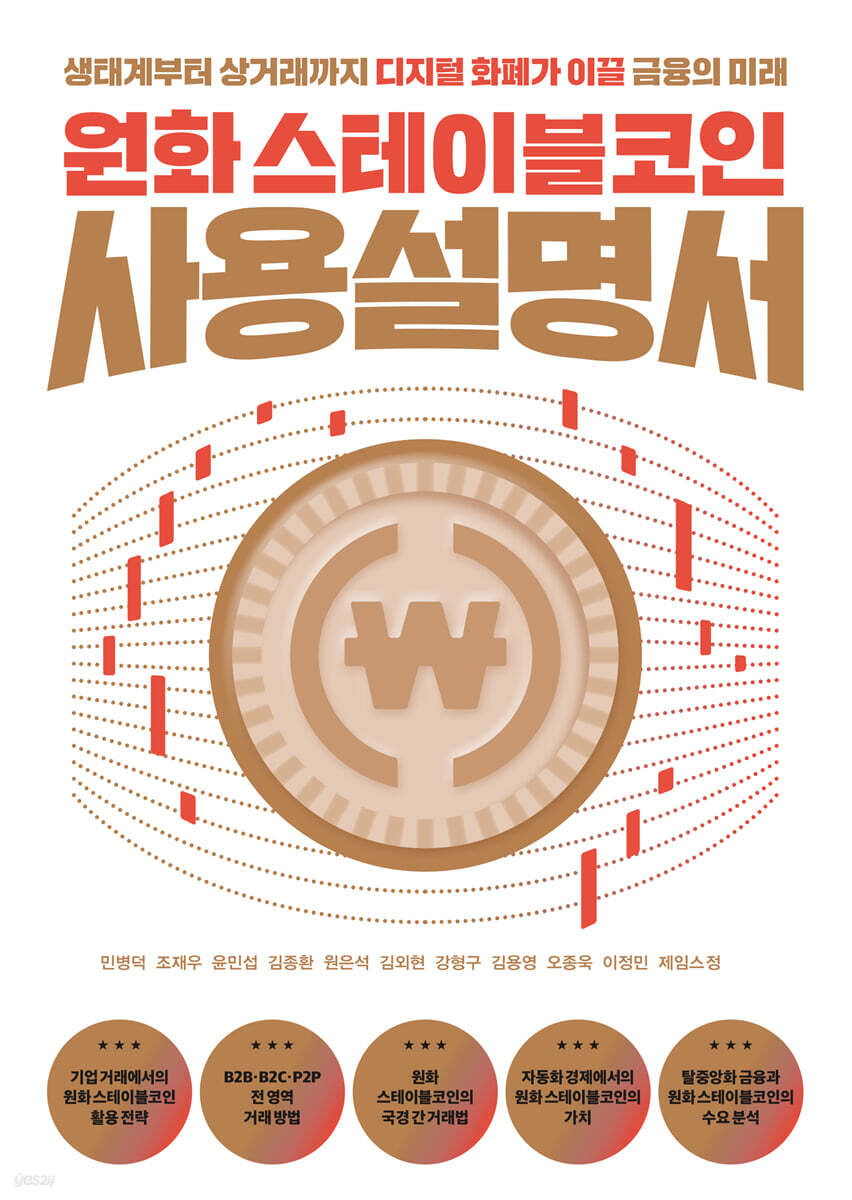
Won Stablecoin User Guide
 |
Description
Book Introduction
A massive change that no one, not banks, corporations, or individuals can avoid.
"The era of won stablecoins has begun!"
A Guide to Korea's First Won-Dated Stablecoin
The global financial market is now emerging as a battleground for the "stablecoin war."
As dollar-backed stablecoins rapidly spread across international payments and investment markets, solidifying their new financial hegemony, the "won stablecoin" is emerging as an alternative that will seize financial hegemony and shape the future of our economy.
Amid criticism that the issue remains limited to institutional discussions and a whirlwind of attempts to ride the current, a book has been published that, for the first time in Korea, explains what a "won stablecoin" is and suggests how businesses, individuals, and the financial sector should understand and handle it to enhance its commercial value.
"The Won Stablecoin User Guide" contains answers to many questions, curiosities, and prospects surrounding the Won Stablecoin.
"The era of won stablecoins has begun!"
A Guide to Korea's First Won-Dated Stablecoin
The global financial market is now emerging as a battleground for the "stablecoin war."
As dollar-backed stablecoins rapidly spread across international payments and investment markets, solidifying their new financial hegemony, the "won stablecoin" is emerging as an alternative that will seize financial hegemony and shape the future of our economy.
Amid criticism that the issue remains limited to institutional discussions and a whirlwind of attempts to ride the current, a book has been published that, for the first time in Korea, explains what a "won stablecoin" is and suggests how businesses, individuals, and the financial sector should understand and handle it to enhance its commercial value.
"The Won Stablecoin User Guide" contains answers to many questions, curiosities, and prospects surrounding the Won Stablecoin.
- You can preview some of the book's contents.
Preview
index
Getting Started: The Dawn of Digital Won
Part 1: Understanding the Won Stablecoin Ecosystem
Chapter 1: What is a Stablecoin?
How Won Stablecoins Maintain Their Value
- Smart contracts and stablecoins
Core infrastructure: wallets, exchanges, and cashout services (On/Off Ramps)
Chapter 2: Global Law and Systems, and Korea
- International changes in the regulatory environment for digital assets
- Current status of digital asset regulations in Korea
The "Digital Asset Basic Act" marks the beginning of a leap forward for the global digital asset market.
- Debate over allowing stablecoin issuance
- The Bank of Korea's digital currency project
- Who issues stablecoins?
- Regulatory compliance requirements for the introduction of Korean Won stablecoins
- Stablecoin issuance and the role of issuance partners
- Stablecoins and Foreign Exchange Transactions Act
Part 2: How can Korean Won stablecoins be used?
Chapter 3: The Benefits of Won-Denominated Stablecoins and Why Businesses Should Adopt Them
- The business environment surrounding the company
Innovation in Fund Management: Real-Time Liquidity Management
- Internal supply chain innovation: Improving efficiency across manufacturing, logistics, and sales departments.
- Advancement of global supply chain management
The Future of Won Stablecoins and Corporate Innovation Roadmap
Chapter 4: Stablecoins: A New Payment Infrastructure for Businesses and Individuals
B2B transactions and stablecoins
- B2C and stablecoins
- P2P and stablecoins
Chapter 5: Stablecoins and the Global Economy
- Limitations of existing cross-border trading systems
Cross-border trade is not a new goal.
- Reality of cross-border stablecoin transactions
- Utilizing stablecoins for cross-border transactions
The Future of Cross-Border Stablecoin Trading
The era of borderless digital currency
Chapter 6: Won Stablecoins and the Machine-to-Machine Economy
- What is a machine economy?
- x402: The key to machine-to-machine automated payments via the web
- A2A protocol: secure agent-to-agent interaction
- Why a won-based stablecoin?
- Case studies of using Korean Won stablecoins in the machine economy
- Future tasks
Why there's no alternative to stablecoins in a machine economy.
Part 3: In-Depth Application of Won-Denominated Stablecoins and Future Outlook
Chapter 7: The Essential Gateway to Decentralized Finance (DeFi)
The Path to Global Decentralized Finance: Won Stablecoins
- Loan and deposit services utilizing won-based assets
Liquidity provision and yield farming for KRW-based trading pairs.
- Tokenization of Korean real assets (RWAs), such as real estate and art.
Chapter 8: Limitations Facing Won Stablecoins and the Path Beyond
- Questions faced at the crossroads of innovation
- User experience and technical barriers
Security: The Pitfalls of Smart Contracts and Asset Custody
- Triple Trouble with Scalability and National Currency
- Institutional and cognitive barriers
- Obstacles are compasses that point the way.
Chapter 9: Conditions for Gaining Public Trust
- Stablecoin cases that undermined public trust
- Strategies for popularizing stablecoins
- Balance between trust and innovation
In conclusion: Digital transactions are completed with KRW stablecoin payments.
Editor's Note
Appendix: Glossary
Part 1: Understanding the Won Stablecoin Ecosystem
Chapter 1: What is a Stablecoin?
How Won Stablecoins Maintain Their Value
- Smart contracts and stablecoins
Core infrastructure: wallets, exchanges, and cashout services (On/Off Ramps)
Chapter 2: Global Law and Systems, and Korea
- International changes in the regulatory environment for digital assets
- Current status of digital asset regulations in Korea
The "Digital Asset Basic Act" marks the beginning of a leap forward for the global digital asset market.
- Debate over allowing stablecoin issuance
- The Bank of Korea's digital currency project
- Who issues stablecoins?
- Regulatory compliance requirements for the introduction of Korean Won stablecoins
- Stablecoin issuance and the role of issuance partners
- Stablecoins and Foreign Exchange Transactions Act
Part 2: How can Korean Won stablecoins be used?
Chapter 3: The Benefits of Won-Denominated Stablecoins and Why Businesses Should Adopt Them
- The business environment surrounding the company
Innovation in Fund Management: Real-Time Liquidity Management
- Internal supply chain innovation: Improving efficiency across manufacturing, logistics, and sales departments.
- Advancement of global supply chain management
The Future of Won Stablecoins and Corporate Innovation Roadmap
Chapter 4: Stablecoins: A New Payment Infrastructure for Businesses and Individuals
B2B transactions and stablecoins
- B2C and stablecoins
- P2P and stablecoins
Chapter 5: Stablecoins and the Global Economy
- Limitations of existing cross-border trading systems
Cross-border trade is not a new goal.
- Reality of cross-border stablecoin transactions
- Utilizing stablecoins for cross-border transactions
The Future of Cross-Border Stablecoin Trading
The era of borderless digital currency
Chapter 6: Won Stablecoins and the Machine-to-Machine Economy
- What is a machine economy?
- x402: The key to machine-to-machine automated payments via the web
- A2A protocol: secure agent-to-agent interaction
- Why a won-based stablecoin?
- Case studies of using Korean Won stablecoins in the machine economy
- Future tasks
Why there's no alternative to stablecoins in a machine economy.
Part 3: In-Depth Application of Won-Denominated Stablecoins and Future Outlook
Chapter 7: The Essential Gateway to Decentralized Finance (DeFi)
The Path to Global Decentralized Finance: Won Stablecoins
- Loan and deposit services utilizing won-based assets
Liquidity provision and yield farming for KRW-based trading pairs.
- Tokenization of Korean real assets (RWAs), such as real estate and art.
Chapter 8: Limitations Facing Won Stablecoins and the Path Beyond
- Questions faced at the crossroads of innovation
- User experience and technical barriers
Security: The Pitfalls of Smart Contracts and Asset Custody
- Triple Trouble with Scalability and National Currency
- Institutional and cognitive barriers
- Obstacles are compasses that point the way.
Chapter 9: Conditions for Gaining Public Trust
- Stablecoin cases that undermined public trust
- Strategies for popularizing stablecoins
- Balance between trust and innovation
In conclusion: Digital transactions are completed with KRW stablecoin payments.
Editor's Note
Appendix: Glossary
Detailed image

Into the book
The Korean Won stablecoin transfers the value of the Korean Won to the digital world.
It is not simply about creating a new payment method, but rather an attempt to extend the real economic value of the won and national monetary sovereignty into the digital ecosystem.
This means that South Korea's monetary sovereignty can also operate on a blockchain-based global network.
The global competitive landscape cannot be ignored either.
The United States is already developing dollar-based stablecoins as a global payment method, and China is pursuing the internationalization of its currency using the digital yuan.
In this context, to preserve the won's presence and further expand its uses, it is essential to create a digital won-based ecosystem.
Now is the time to design that dawn.
--- p.5-7, from “Getting Started”
Blockchain developers have long been exploring ways to create digital assets with a constant value.
The result is a stablecoin.
Most stablecoins are pegged to the US dollar and are designed to maintain their value per dollar.
Won stablecoins are created based on this principle and are linked to a specific won value, such as 1,000 won or 1 won.
…The biggest advantage of the won stablecoin is its familiarity with Korean users.
Using dollar stablecoins involves taking on the risk of exchange rate fluctuations.
If you buy a dollar stablecoin when the dollar is worth 1,300 won, and later the dollar becomes 1,200 won, you will incur a loss in Korean won terms.
However, using a won stablecoin allows you to store value reliably without this exchange rate risk.
--- p.36, from Chapter 1, “What is a Stablecoin?”
Since President Lee Jae-myung was elected in the 21st presidential election, legislative support has begun to be provided to advance the digital asset market into the G2.
Most notable is the 'Basic Digital Asset Act', proposed by Representative Min Byeong-deok on June 11, 2025.
The 'Basic Digital Asset Act' is a comprehensive law on digital assets, and its content is so extensive that it can be called Korea's 'MiCA'.
The "Basic Digital Asset Act" encompasses not only matters related to the issuance and transaction support of digital assets, but also the entire digital asset ecosystem, including types of businesses related to digital assets, user protection systems, and regulations on unfair trade practices.
--- p.66, from “Chapter 2 Global Law and Systems, and Korea”
What exciting things will happen when blockchain and stablecoins are applied internally within a company? First, corporate operations will become much more efficient as the flow of money becomes transparent and managed automatically.
Things that currently require manual processing or complex systems can now be handled automatically thanks to blockchain-based “smart money” (programmable money).
…Third, a won-backed stablecoin could serve as a bridge for Korean companies to transact more quickly and easily in overseas markets.
If you use it reliably within your company and gain experience, you can gradually apply it to external transactions, creating new business opportunities.
--- p.105-160, from “Chapter 3: Benefits of Won Stablecoins and Why Companies Should Adopt Them”
Utilizing stablecoins as a means of payment and settlement will support even small transactions down to the decimal point and simplify the brokerage process.
Additionally, real-time settlement and automatic contract execution are possible, eliminating several steps previously considered essential.
…As the potential of stablecoins to address the inefficiencies of existing payment systems, such as the two-to-three day delay in receiving payments and the high fixed fees, is highlighted, the use of stablecoins in the B2C sector is expected to rapidly expand in the future.
--- p.140, from “Chapter 4 Stablecoins, a New Payment Infrastructure Used by Businesses and Individuals”
Stablecoins revolutionize this complex process.
This method, called the 'stablecoin sandwich', has a simple structure like a sandwich.
Like bread-filling-bread, it is composed of three stages: fiat currency-stablecoin-fiat currency.
…The ten use cases we've explored illustrate the concrete changes a won stablecoin could bring to the Korean economy.
An instant payment system for auto parts exporters, a global direct sales platform for K-beauty brands, low-cost remittances back home for Vietnamese workers, access to global talent for IT startups, and even integrated management for K-pop fan clubs—all of these are future possibilities made possible by the won stablecoin.
--- p.200, from “Chapter 5 Stablecoins and the Global Economy”
Introducing a won-backed stablecoin has the advantage of reducing dependence on the dollar and preserving the digital sovereignty of the won.
First, trading with the Korean Won stablecoin allows you to conduct domestic transactions without worrying about exchange rate fluctuations or foreign exchange fees.
For example, if electric vehicles and charging stations in Korea accept KRW stablecoins instead of dollars for payment, it will have the same effect as using KRW in the real economy.
This would allow the Korean won to be used naturally in the digital environment, allowing the Korean economy to maintain its own currency base even as it digitalizes.
In the long term, the emergence of a won-backed stablecoin will significantly increase the usability and scalability of the won in the digital environment.
--- p.217, from “Chapter 6: Won Stablecoins and the Machine-to-Machine Economy”
More importantly, it is an automatically executing program called a smart contract.
The process of “If A provides collateral, the loan is paid to B, and if the collateral value falls, the loan amount is recovered and the loan liquidation process is initiated” is a process that requires a lot of complicated documents and approvals in existing banks, and the execution itself takes from several weeks to several months.
However, with smart contracts, you can program them by setting just a few conditions and the transaction will be executed automatically without human intervention.
…a won-denominated stablecoin is essential to revitalize decentralized finance.
The Korean Won stablecoin is a key piece of infrastructure that allows Korean investors to participate in the decentralized finance ecosystem without the risk of exchange rate fluctuations.
--- p.243, from “Chapter 7: Essential Gateways to Decentralized Finance (DeFi)”
The security of stablecoins can be broadly divided into two axes.
The first axis is the vulnerability of smart contracts.
Smart contracts are automated promises and financial agreements that run on the blockchain.
Everything from transaction approvals, collateral management, deposit management, interest payments, and even liquidation conditions is driven by code.
While this allows the world to follow the same rules without human intervention, the code carries the risk that a single line of error or vulnerability could lead to immediate asset theft.
The second axis is the issue of asset storage.
The stability of a stablecoin's value ultimately depends on its asset storage.
No matter how much you shout '1 coin = 1 won', it is meaningless if you cannot actually deposit and manage that 1 won safely.
--- p.292-293, from "Chapter 8: Limitations Facing Won Stablecoins and the Path Beyond"
Past instances of algorithmic stablecoins collapsing and their exploitation as a means of money laundering in financial frauds have left the public with concerns about value volatility, hacking, and a lack of transparency.
However, collateral-based stablecoins, pegged to fiat currencies or safe assets, ensure price stability and can play a key role in expanding the digital financial ecosystem, including global remittances and payments.
Especially in countries with limited financial access, it is recognized as a valuable means of inclusive finance, and has the potential to drive future social and economic change.
…Therefore, to restore trust and stabilize the market, it is necessary to establish a comprehensive safety net that goes beyond simply mitigating risk, strengthening the accountability of issuers, ensuring transparency, and ensuring the resilience of operating systems.
It is not simply about creating a new payment method, but rather an attempt to extend the real economic value of the won and national monetary sovereignty into the digital ecosystem.
This means that South Korea's monetary sovereignty can also operate on a blockchain-based global network.
The global competitive landscape cannot be ignored either.
The United States is already developing dollar-based stablecoins as a global payment method, and China is pursuing the internationalization of its currency using the digital yuan.
In this context, to preserve the won's presence and further expand its uses, it is essential to create a digital won-based ecosystem.
Now is the time to design that dawn.
--- p.5-7, from “Getting Started”
Blockchain developers have long been exploring ways to create digital assets with a constant value.
The result is a stablecoin.
Most stablecoins are pegged to the US dollar and are designed to maintain their value per dollar.
Won stablecoins are created based on this principle and are linked to a specific won value, such as 1,000 won or 1 won.
…The biggest advantage of the won stablecoin is its familiarity with Korean users.
Using dollar stablecoins involves taking on the risk of exchange rate fluctuations.
If you buy a dollar stablecoin when the dollar is worth 1,300 won, and later the dollar becomes 1,200 won, you will incur a loss in Korean won terms.
However, using a won stablecoin allows you to store value reliably without this exchange rate risk.
--- p.36, from Chapter 1, “What is a Stablecoin?”
Since President Lee Jae-myung was elected in the 21st presidential election, legislative support has begun to be provided to advance the digital asset market into the G2.
Most notable is the 'Basic Digital Asset Act', proposed by Representative Min Byeong-deok on June 11, 2025.
The 'Basic Digital Asset Act' is a comprehensive law on digital assets, and its content is so extensive that it can be called Korea's 'MiCA'.
The "Basic Digital Asset Act" encompasses not only matters related to the issuance and transaction support of digital assets, but also the entire digital asset ecosystem, including types of businesses related to digital assets, user protection systems, and regulations on unfair trade practices.
--- p.66, from “Chapter 2 Global Law and Systems, and Korea”
What exciting things will happen when blockchain and stablecoins are applied internally within a company? First, corporate operations will become much more efficient as the flow of money becomes transparent and managed automatically.
Things that currently require manual processing or complex systems can now be handled automatically thanks to blockchain-based “smart money” (programmable money).
…Third, a won-backed stablecoin could serve as a bridge for Korean companies to transact more quickly and easily in overseas markets.
If you use it reliably within your company and gain experience, you can gradually apply it to external transactions, creating new business opportunities.
--- p.105-160, from “Chapter 3: Benefits of Won Stablecoins and Why Companies Should Adopt Them”
Utilizing stablecoins as a means of payment and settlement will support even small transactions down to the decimal point and simplify the brokerage process.
Additionally, real-time settlement and automatic contract execution are possible, eliminating several steps previously considered essential.
…As the potential of stablecoins to address the inefficiencies of existing payment systems, such as the two-to-three day delay in receiving payments and the high fixed fees, is highlighted, the use of stablecoins in the B2C sector is expected to rapidly expand in the future.
--- p.140, from “Chapter 4 Stablecoins, a New Payment Infrastructure Used by Businesses and Individuals”
Stablecoins revolutionize this complex process.
This method, called the 'stablecoin sandwich', has a simple structure like a sandwich.
Like bread-filling-bread, it is composed of three stages: fiat currency-stablecoin-fiat currency.
…The ten use cases we've explored illustrate the concrete changes a won stablecoin could bring to the Korean economy.
An instant payment system for auto parts exporters, a global direct sales platform for K-beauty brands, low-cost remittances back home for Vietnamese workers, access to global talent for IT startups, and even integrated management for K-pop fan clubs—all of these are future possibilities made possible by the won stablecoin.
--- p.200, from “Chapter 5 Stablecoins and the Global Economy”
Introducing a won-backed stablecoin has the advantage of reducing dependence on the dollar and preserving the digital sovereignty of the won.
First, trading with the Korean Won stablecoin allows you to conduct domestic transactions without worrying about exchange rate fluctuations or foreign exchange fees.
For example, if electric vehicles and charging stations in Korea accept KRW stablecoins instead of dollars for payment, it will have the same effect as using KRW in the real economy.
This would allow the Korean won to be used naturally in the digital environment, allowing the Korean economy to maintain its own currency base even as it digitalizes.
In the long term, the emergence of a won-backed stablecoin will significantly increase the usability and scalability of the won in the digital environment.
--- p.217, from “Chapter 6: Won Stablecoins and the Machine-to-Machine Economy”
More importantly, it is an automatically executing program called a smart contract.
The process of “If A provides collateral, the loan is paid to B, and if the collateral value falls, the loan amount is recovered and the loan liquidation process is initiated” is a process that requires a lot of complicated documents and approvals in existing banks, and the execution itself takes from several weeks to several months.
However, with smart contracts, you can program them by setting just a few conditions and the transaction will be executed automatically without human intervention.
…a won-denominated stablecoin is essential to revitalize decentralized finance.
The Korean Won stablecoin is a key piece of infrastructure that allows Korean investors to participate in the decentralized finance ecosystem without the risk of exchange rate fluctuations.
--- p.243, from “Chapter 7: Essential Gateways to Decentralized Finance (DeFi)”
The security of stablecoins can be broadly divided into two axes.
The first axis is the vulnerability of smart contracts.
Smart contracts are automated promises and financial agreements that run on the blockchain.
Everything from transaction approvals, collateral management, deposit management, interest payments, and even liquidation conditions is driven by code.
While this allows the world to follow the same rules without human intervention, the code carries the risk that a single line of error or vulnerability could lead to immediate asset theft.
The second axis is the issue of asset storage.
The stability of a stablecoin's value ultimately depends on its asset storage.
No matter how much you shout '1 coin = 1 won', it is meaningless if you cannot actually deposit and manage that 1 won safely.
--- p.292-293, from "Chapter 8: Limitations Facing Won Stablecoins and the Path Beyond"
Past instances of algorithmic stablecoins collapsing and their exploitation as a means of money laundering in financial frauds have left the public with concerns about value volatility, hacking, and a lack of transparency.
However, collateral-based stablecoins, pegged to fiat currencies or safe assets, ensure price stability and can play a key role in expanding the digital financial ecosystem, including global remittances and payments.
Especially in countries with limited financial access, it is recognized as a valuable means of inclusive finance, and has the potential to drive future social and economic change.
…Therefore, to restore trust and stabilize the market, it is necessary to establish a comprehensive safety net that goes beyond simply mitigating risk, strengthening the accountability of issuers, ensuring transparency, and ensuring the resilience of operating systems.
--- p.330-331, from “Chapter 9: Conditions for Gaining Public Trust”
Publisher's Review
A global game changer that will shape the future of money.
Faster than cash, more flexible than banks
Everything You Need to Know About the Won Stablecoin Era
“Now is the time to think about speed.
The United States is pushing for the internationalization of its currency with a dollar stablecoin, while China is pushing for the digital yuan.
If the Korean won continues like this, its influence will inevitably become increasingly limited.
The economic impact of the won stablecoin is also clear.
According to one study, if Samsung Electronics were to use a won stablecoin for its overseas branch settlements, it would achieve annual cost savings of at least 150 billion won.
If this were expanded to the entire group, the ripple effect would be beyond imagination.
The same goes for small and medium-sized businesses.
Using stablecoins as a means of payment reduces the burden of fees, which in turn eases the burden of business operations.
Companies reduce financial costs, and the competitiveness of the national economy as a whole is further strengthened.
Ultimately, the introduction of a won stablecoin is a necessary choice for Korea to preserve its monetary sovereignty and expand its economic territory.”
Representative Min Byeong-deok of the Democratic Party of Korea, who is the central figure in the "Won Stablecoin User Manual" and the driving force behind the implementation of Korea's "Won Stablecoin," states this in the book's introduction.
As the chairman of the Digital Asset Committee of Lee Jae-myung's presidential campaign committee in the 21st presidential election, Rep. Min asserted that "KRW stablecoins are a form of monetary sovereignty," and that the KRW stablecoin market should be established as soon as possible.
In this vein, I co-wrote this book with members of the Digital Asset Committee, who came together to share the value of the "KRW stablecoin" with a wider audience.
A massive change that no one, not banks, corporations, or individuals can avoid.
The hot topic of debate in the 2025 presidential election: the ‘won stablecoin’
Definition, regulatory environment, use by businesses and individuals, and future prospects
The "Won Stablecoin User Manual" is divided into nine chapters.
In Chapter 1, "What is a Stablecoin?", Professor Jae-Woo Cho of the Department of Social Sciences at Hansung University explains why stablecoins, which stand for "stable coins," are gaining attention despite their low price.
Chapter 2, "Global Law and Systems, and Korea," explores the evolution of digital assets and stablecoin systems, led by Yoon Min-seop, director of the Digital Consumer Research Institute.
In Chapter 3, "The Benefits of Won-Denominated Stablecoins and Why Companies Should Adopt Them," Kim Jong-hwan, senior advisor at Blocko and well-known for predicting the Terra-Luna incident, explains the changes that can occur when stablecoins are used for internal corporate transactions.
Chapter 4, "Stablecoins: A New Payment Infrastructure for Businesses and Individuals," led by Professor Won Eun-seok of Mokwon University's College of Cultural Contents, examines the role of stablecoins in various businesses.
In Chapter 5, "Stablecoins and the Global Economy," Kim Oe-hyun, East Asia editor-in-chief of BeinCrypto, examines how a "won stablecoin" can strengthen the global competitiveness of the Korean economy, presenting specific examples.
In Chapter 6, "Won Stablecoins and the Machine-to-Machine Economy," Professor Kang Hyung-gu of Hanyang University's Department of Business Administration explains the importance of stablecoins in an AI-connected internet environment and how value transfers between AIs.
Chapter 7, "The Essential Gateway to Decentralized Finance (DeFi)," introduces ways for MBloc Company CSO Yongyoung Kim to understand the potential and risks of a KRW-based decentralized ecosystem.
In Chapter 8, "The Limitations Facing Won Stablecoins and the Path Beyond," we explore the challenges stablecoins must overcome with Oh Jong-wook, CEO of Waybridge.
Chapter 9, "Conditions for Gaining Public Trust," features Lee Jeong-min, a research fellow at the Korea Financial Consumer Protection Foundation, examining the damage suffered by existing stablecoin users and discussing consumer protection strategies.
“If we seize this opportunity with thorough preparation and bold challenges, we will soon see digital won proudly utilized on the global stage.
Now is the time to take a step toward that future.
“A digital G2 Korea is right in front of us,” said Min Byeong-deok, a member of the Democratic Party of Korea, in the epilogue.
I hope to share with many readers the path, challenges, and vision for the "won stablecoin."
Faster than cash, more flexible than banks
Everything You Need to Know About the Won Stablecoin Era
“Now is the time to think about speed.
The United States is pushing for the internationalization of its currency with a dollar stablecoin, while China is pushing for the digital yuan.
If the Korean won continues like this, its influence will inevitably become increasingly limited.
The economic impact of the won stablecoin is also clear.
According to one study, if Samsung Electronics were to use a won stablecoin for its overseas branch settlements, it would achieve annual cost savings of at least 150 billion won.
If this were expanded to the entire group, the ripple effect would be beyond imagination.
The same goes for small and medium-sized businesses.
Using stablecoins as a means of payment reduces the burden of fees, which in turn eases the burden of business operations.
Companies reduce financial costs, and the competitiveness of the national economy as a whole is further strengthened.
Ultimately, the introduction of a won stablecoin is a necessary choice for Korea to preserve its monetary sovereignty and expand its economic territory.”
Representative Min Byeong-deok of the Democratic Party of Korea, who is the central figure in the "Won Stablecoin User Manual" and the driving force behind the implementation of Korea's "Won Stablecoin," states this in the book's introduction.
As the chairman of the Digital Asset Committee of Lee Jae-myung's presidential campaign committee in the 21st presidential election, Rep. Min asserted that "KRW stablecoins are a form of monetary sovereignty," and that the KRW stablecoin market should be established as soon as possible.
In this vein, I co-wrote this book with members of the Digital Asset Committee, who came together to share the value of the "KRW stablecoin" with a wider audience.
A massive change that no one, not banks, corporations, or individuals can avoid.
The hot topic of debate in the 2025 presidential election: the ‘won stablecoin’
Definition, regulatory environment, use by businesses and individuals, and future prospects
The "Won Stablecoin User Manual" is divided into nine chapters.
In Chapter 1, "What is a Stablecoin?", Professor Jae-Woo Cho of the Department of Social Sciences at Hansung University explains why stablecoins, which stand for "stable coins," are gaining attention despite their low price.
Chapter 2, "Global Law and Systems, and Korea," explores the evolution of digital assets and stablecoin systems, led by Yoon Min-seop, director of the Digital Consumer Research Institute.
In Chapter 3, "The Benefits of Won-Denominated Stablecoins and Why Companies Should Adopt Them," Kim Jong-hwan, senior advisor at Blocko and well-known for predicting the Terra-Luna incident, explains the changes that can occur when stablecoins are used for internal corporate transactions.
Chapter 4, "Stablecoins: A New Payment Infrastructure for Businesses and Individuals," led by Professor Won Eun-seok of Mokwon University's College of Cultural Contents, examines the role of stablecoins in various businesses.
In Chapter 5, "Stablecoins and the Global Economy," Kim Oe-hyun, East Asia editor-in-chief of BeinCrypto, examines how a "won stablecoin" can strengthen the global competitiveness of the Korean economy, presenting specific examples.
In Chapter 6, "Won Stablecoins and the Machine-to-Machine Economy," Professor Kang Hyung-gu of Hanyang University's Department of Business Administration explains the importance of stablecoins in an AI-connected internet environment and how value transfers between AIs.
Chapter 7, "The Essential Gateway to Decentralized Finance (DeFi)," introduces ways for MBloc Company CSO Yongyoung Kim to understand the potential and risks of a KRW-based decentralized ecosystem.
In Chapter 8, "The Limitations Facing Won Stablecoins and the Path Beyond," we explore the challenges stablecoins must overcome with Oh Jong-wook, CEO of Waybridge.
Chapter 9, "Conditions for Gaining Public Trust," features Lee Jeong-min, a research fellow at the Korea Financial Consumer Protection Foundation, examining the damage suffered by existing stablecoin users and discussing consumer protection strategies.
“If we seize this opportunity with thorough preparation and bold challenges, we will soon see digital won proudly utilized on the global stage.
Now is the time to take a step toward that future.
“A digital G2 Korea is right in front of us,” said Min Byeong-deok, a member of the Democratic Party of Korea, in the epilogue.
I hope to share with many readers the path, challenges, and vision for the "won stablecoin."
GOODS SPECIFICS
- Date of issue: September 11, 2025
- Page count, weight, size: 360 pages | 145*205*30mm
- ISBN13: 9791199442221
- ISBN10: 1199442224
You may also like
카테고리
korean


korean

![ELLE 엘르 스페셜 에디션 A형 : 12월 [2025]](http://librairie.coreenne.fr/cdn/shop/files/b8e27a3de6c9538896439686c6b0e8fb.jpg?v=1766436872&width=3840)


