

A convincingly absurd idea
 |
Description
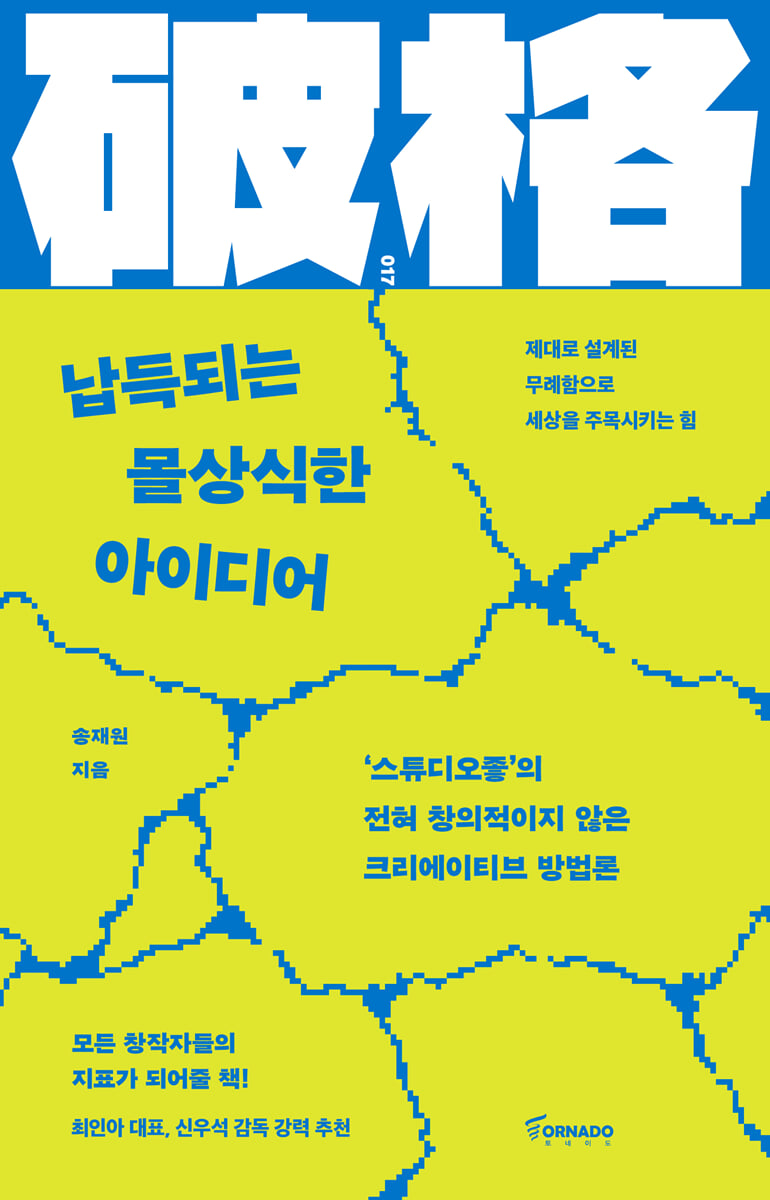
Book Introduction
"You have to step outside the box to see something new."
With its lively avant-garde nature, brand worldview, and maximization of heritage,
The creative design of Studio Jot, which has captivated the Korean advertising industry.
A book that will serve as a guide for all creators!
CEO Choi In-ah, Director Shin Woo-seok, Stussy Marketer,
Highly recommended by designers Kim Ki-jo and Yoo Jun-ho.
From the prince of the Binggrae kingdom, Binggraeus, to the supporting role of the Miwon series, which reinterprets the seasoning MSG, Studio Good is captivating the Korean advertising world with its lively avant-garde style, brand worldview, and maximization of heritage.
This book contains the 'creative methodology' of Studio Jo's CEO Song Jae-won, which easily goes beyond conventional wisdom and produces unfamiliar yet convincing results.
He emphasizes that creativity is not something that falls from the sky or is accomplished through innate talent, but rather a skill that can be trained, and teaches how to design creativity through analysis and structure.
In this book, he focuses on three keywords: "unconventional," "creative," and "relevant." He explains how these elements interlock and complement each other, leading to high-quality results, using his solid methodology and abundant case studies.
This book is a guide for people in advertising, marketing, branding, video, design, and any field that requires creativity.
It's especially useful for college students and junior professionals entering the creative industry, providing practical insights and tools that can be applied even to seemingly unrelated jobs.
Anyone can train and realize the practice of convincing and absurd ideas that are created through 'design' rather than simple 'feeling'.
This book will serve as the most practical starting point for those seeking to grasp the clue.
With its lively avant-garde nature, brand worldview, and maximization of heritage,
The creative design of Studio Jot, which has captivated the Korean advertising industry.
A book that will serve as a guide for all creators!
CEO Choi In-ah, Director Shin Woo-seok, Stussy Marketer,
Highly recommended by designers Kim Ki-jo and Yoo Jun-ho.
From the prince of the Binggrae kingdom, Binggraeus, to the supporting role of the Miwon series, which reinterprets the seasoning MSG, Studio Good is captivating the Korean advertising world with its lively avant-garde style, brand worldview, and maximization of heritage.
This book contains the 'creative methodology' of Studio Jo's CEO Song Jae-won, which easily goes beyond conventional wisdom and produces unfamiliar yet convincing results.
He emphasizes that creativity is not something that falls from the sky or is accomplished through innate talent, but rather a skill that can be trained, and teaches how to design creativity through analysis and structure.
In this book, he focuses on three keywords: "unconventional," "creative," and "relevant." He explains how these elements interlock and complement each other, leading to high-quality results, using his solid methodology and abundant case studies.
This book is a guide for people in advertising, marketing, branding, video, design, and any field that requires creativity.
It's especially useful for college students and junior professionals entering the creative industry, providing practical insights and tools that can be applied even to seemingly unrelated jobs.
Anyone can train and realize the practice of convincing and absurd ideas that are created through 'design' rather than simple 'feeling'.
This book will serve as the most practical starting point for those seeking to grasp the clue.
- You can preview some of the book's contents.
Preview
index
Recommendation
Entering
Chapter 1 Breakthrough
One powerful blow
Broken Standards | Reset Button | Mutations | Finding the Boundary | Creating Singularities | The Brain Can't Resist Disruption
Crossing the line
The Power of Formalism | Formalism is the Fundamental Skill | Creators Acquire Formalism | Each Boundary | Unbreakable Formalism | The Thickness of the Boundary: Unconventional Difficulty | The Boundary of the Public | Critics and the Public | Crossing the Redundant Boundary | The Boundary Between Craftsmanship and Showmanship | Buried in Formalism: Mannerism
Breaking the wall
How a Singularity Becomes a Breakthrough | Timing and Location of Breakthroughs | The Ratio of Breakthroughs: Three Strategies | Gentle Breakthroughs | Ignorant Breakthroughs: Beginner's Luck | Unexpected Breakthroughs: Substandard | A Party of Breakthroughs | The Fatigue of Breakthroughs | The Cycle of Breakthroughs and Formalities
After breaking it
The Intention of Breakthrough | The Acceptance of Breakthrough | The Aftershock of Breakthrough | Awe | Breakthrough Success: Three Conditions | To the Heart of the Beast
NEXT LEVEL
A Comprehensive Inspection Framework for Breakthrough Design
Chapter 2 Creative
Creativity ≠ Creation
something new | something novel
The basic formula of creativity
1.
A → A' is used differently: Twist | 2.
Mix A+ B: Mix | 3.
Changing B + A to C + A: Variation | 4.
Flipping A to -A: Reverse Thinking | 5.
Subtract 'B' from A+B: Subtract | 6.
B(A)B → C(A)C: Reframe
Six Conditions of Creativity
First condition: There are two or more choices
Inspired | Expanding Career Options | Training 1.
Expanding Basic Options for Beginners | Training 2.
Reference Factoring | Know-How: The Best Choices | Why Are We Creative?
Second condition: a unique choice
What are non-traditional choices for consumers? | Training 1.
Learning the Typical Choices | The Creator's Touch | Sharpening Your Sense | Training 2.
Exploring Other Fields | TT-Type Talent | Unconventional Courage | Training 3.
Validating Atypical Choices, Feedback | Public Feedback | Symptoms of Feedback Avoidance | Training 4.
Creating surplus time
Third condition: superior performance
Solutions When There Is No Answer | Solutions When There Is an Answer | Two Types of Expected Outcomes | Training 1.
Proposing with Quantitative Results | Training 2.
Proposing a cost-saving proposal | Training 3.
Proposing with sincere performance (intention) | Jjajan - Let's throw away fantasy
Fourth condition: feasibility
Making Creative Composition Feasible | Considering Skills | Considering Collaborators' Capabilities and Conditions | Eliminating Better Options | Training 1.
Focusing your resources where they matter | Training 2.
Exploiting Constraints | Training 3.
Using Deadlines as Tools | Feasibility Conclusion
Fifth Condition: Social Recognition
Recognition as the first | Plagiarism, homage, parody | Creativity carries responsibility | Social recognition also changes | Receiving 'recognition' from target groups | Creative becomes a unique word | Creative becomes a creation
Sixth Condition: Sustainability
Components of Sustainable Creativity | Analyzing the Structure of Sustainability | Unconventional Sustainable Options | The Duality of Sustainability | Training 1.
Achieving 'Differentiation + Sustainability' Simultaneously | Training 2.
Reducing Resource Deployment | Training 3.
Constantly Supplying Variation Elements | Training 4.
Keep collaboration in mind from the start | Training 5.
Stay in Touch with Consumers | Sustainability Checklist
NEXT LEVEL
Chapter 3 Relevance
Relevance = connection
Links | Links of Humor | Links of Empathy | Links of Trust | Links of Money | Links of Different Things | Links of Misunderstanding and Fabrication | Links of Memes | Creatives Designing Relevance
Design of the connection
The Purpose of Relevance Design | Simultaneous Connectivity Design: Intersection | Connectivity Design for Google Doodles | Minimal Relevance Design | Singularity Created with Relevance | Designing First Impressions | Initial Imagination: Link 1 | The Battle of Mental Connections | Reconstructing the Link of Desire
Internal Links: Completeness and Identity
Internal Relevance = Completeness | Designing for structural integrity | The formality created by completeness | Connecting justification and expression | The creativity of internal Relevance | Binggraeus and Binggrae's Relevance | Relevance of "Would You Turn Off the Lights?" | Unique Relevance | Relevance of trust: Connecting consistently | The difficulty and scarcity of multiple Relevance | The interior must be organized to connect with the outside.
External Links: Temptation and Expansion
Relevance: A Breakthrough | Relevance with Two Entrances | Relevance: The Fame | Relevance: The Model | Relevance: Collaboration | A Giant Link | Relevance and Brand Expansion | Creating a Middle Link: Guinness World Records & Michelin Guide | Dispersing Links | Replacing Relevance | Revitalizing Relevance: Heritage | Rotten Relevance: Shackles | Controlling Unintentional Relevance | Turning Stigma into a Brand
Relevance Training
Relevance Self-Assessment: Becoming a Black-and-White Chef | Target Persona Setting Methodology | Rebranding Relevance | Relevance in Your Resume | Relevance for Newcomers | Relevance Brainstorming | Relevance Checklist | Connecting with Non-Humans | The Role of Proposals and Drafts: Easily Understanding from a Relevance Perspective | Relevance Conclusion
Chapter 4 Formalities
The new master of formality
The Battle for Sustainability | The Weakness of Formality | The Swamp of Self-Replication | The Moat Against Copycats | The Update of the Tactic | Self-Destruction for Sustainability | The Pillars of Formality: Brand Philosophy | Managing the Links of Formality | Influence
In conclusion
People who inspired me
Entering
Chapter 1 Breakthrough
One powerful blow
Broken Standards | Reset Button | Mutations | Finding the Boundary | Creating Singularities | The Brain Can't Resist Disruption
Crossing the line
The Power of Formalism | Formalism is the Fundamental Skill | Creators Acquire Formalism | Each Boundary | Unbreakable Formalism | The Thickness of the Boundary: Unconventional Difficulty | The Boundary of the Public | Critics and the Public | Crossing the Redundant Boundary | The Boundary Between Craftsmanship and Showmanship | Buried in Formalism: Mannerism
Breaking the wall
How a Singularity Becomes a Breakthrough | Timing and Location of Breakthroughs | The Ratio of Breakthroughs: Three Strategies | Gentle Breakthroughs | Ignorant Breakthroughs: Beginner's Luck | Unexpected Breakthroughs: Substandard | A Party of Breakthroughs | The Fatigue of Breakthroughs | The Cycle of Breakthroughs and Formalities
After breaking it
The Intention of Breakthrough | The Acceptance of Breakthrough | The Aftershock of Breakthrough | Awe | Breakthrough Success: Three Conditions | To the Heart of the Beast
NEXT LEVEL
A Comprehensive Inspection Framework for Breakthrough Design
Chapter 2 Creative
Creativity ≠ Creation
something new | something novel
The basic formula of creativity
1.
A → A' is used differently: Twist | 2.
Mix A+ B: Mix | 3.
Changing B + A to C + A: Variation | 4.
Flipping A to -A: Reverse Thinking | 5.
Subtract 'B' from A+B: Subtract | 6.
B(A)B → C(A)C: Reframe
Six Conditions of Creativity
First condition: There are two or more choices
Inspired | Expanding Career Options | Training 1.
Expanding Basic Options for Beginners | Training 2.
Reference Factoring | Know-How: The Best Choices | Why Are We Creative?
Second condition: a unique choice
What are non-traditional choices for consumers? | Training 1.
Learning the Typical Choices | The Creator's Touch | Sharpening Your Sense | Training 2.
Exploring Other Fields | TT-Type Talent | Unconventional Courage | Training 3.
Validating Atypical Choices, Feedback | Public Feedback | Symptoms of Feedback Avoidance | Training 4.
Creating surplus time
Third condition: superior performance
Solutions When There Is No Answer | Solutions When There Is an Answer | Two Types of Expected Outcomes | Training 1.
Proposing with Quantitative Results | Training 2.
Proposing a cost-saving proposal | Training 3.
Proposing with sincere performance (intention) | Jjajan - Let's throw away fantasy
Fourth condition: feasibility
Making Creative Composition Feasible | Considering Skills | Considering Collaborators' Capabilities and Conditions | Eliminating Better Options | Training 1.
Focusing your resources where they matter | Training 2.
Exploiting Constraints | Training 3.
Using Deadlines as Tools | Feasibility Conclusion
Fifth Condition: Social Recognition
Recognition as the first | Plagiarism, homage, parody | Creativity carries responsibility | Social recognition also changes | Receiving 'recognition' from target groups | Creative becomes a unique word | Creative becomes a creation
Sixth Condition: Sustainability
Components of Sustainable Creativity | Analyzing the Structure of Sustainability | Unconventional Sustainable Options | The Duality of Sustainability | Training 1.
Achieving 'Differentiation + Sustainability' Simultaneously | Training 2.
Reducing Resource Deployment | Training 3.
Constantly Supplying Variation Elements | Training 4.
Keep collaboration in mind from the start | Training 5.
Stay in Touch with Consumers | Sustainability Checklist
NEXT LEVEL
Chapter 3 Relevance
Relevance = connection
Links | Links of Humor | Links of Empathy | Links of Trust | Links of Money | Links of Different Things | Links of Misunderstanding and Fabrication | Links of Memes | Creatives Designing Relevance
Design of the connection
The Purpose of Relevance Design | Simultaneous Connectivity Design: Intersection | Connectivity Design for Google Doodles | Minimal Relevance Design | Singularity Created with Relevance | Designing First Impressions | Initial Imagination: Link 1 | The Battle of Mental Connections | Reconstructing the Link of Desire
Internal Links: Completeness and Identity
Internal Relevance = Completeness | Designing for structural integrity | The formality created by completeness | Connecting justification and expression | The creativity of internal Relevance | Binggraeus and Binggrae's Relevance | Relevance of "Would You Turn Off the Lights?" | Unique Relevance | Relevance of trust: Connecting consistently | The difficulty and scarcity of multiple Relevance | The interior must be organized to connect with the outside.
External Links: Temptation and Expansion
Relevance: A Breakthrough | Relevance with Two Entrances | Relevance: The Fame | Relevance: The Model | Relevance: Collaboration | A Giant Link | Relevance and Brand Expansion | Creating a Middle Link: Guinness World Records & Michelin Guide | Dispersing Links | Replacing Relevance | Revitalizing Relevance: Heritage | Rotten Relevance: Shackles | Controlling Unintentional Relevance | Turning Stigma into a Brand
Relevance Training
Relevance Self-Assessment: Becoming a Black-and-White Chef | Target Persona Setting Methodology | Rebranding Relevance | Relevance in Your Resume | Relevance for Newcomers | Relevance Brainstorming | Relevance Checklist | Connecting with Non-Humans | The Role of Proposals and Drafts: Easily Understanding from a Relevance Perspective | Relevance Conclusion
Chapter 4 Formalities
The new master of formality
The Battle for Sustainability | The Weakness of Formality | The Swamp of Self-Replication | The Moat Against Copycats | The Update of the Tactic | Self-Destruction for Sustainability | The Pillars of Formality: Brand Philosophy | Managing the Links of Formality | Influence
In conclusion
People who inspired me
Detailed image

Into the book
The degree to which a piece is completed depends on how deeply the creator understands the format.
The saying, 'Imitation is the mother of creation' means that the process of 'imitation' that absorbs formality becomes the foundation for creating 'breakthrough'.
However, while innovation is a goal that every creator aspires to, it is difficult to actually achieve.
Opportunities don't come often.
Most creative works are decided by subtle differences in who has more refined formality.
It's really just a difference.
The real breakthrough comes when the creator, having achieved that level of sophistication, tries to break away from convention to create something unique.
It is an 'escape' that creates completely new value by boldly overturning and reinterpreting what has been imitated, rather than simply repeating it.
The adage, "Opportunity favors the prepared mind," means that only creators who have meticulously refined their craft can create a "breakthrough."
--- p.48~49
Therefore, creators must find a balance between redundant boundaries.
A good break doesn't involve crossing every boundary, but rather selectively crossing a few key boundaries.
Trying to cross all boundaries at once is somewhat risky.
Conversely, if you are too eager to faithfully maintain all boundaries, you may end up crossing none.
Just as an orchestra conductor adjusts the dynamics of his instruments to create beautiful harmony, a creative work must also adjust its dynamics to determine which boundaries to cross.
Creators must always ask themselves:
What overlapping boundaries does my work straddle? How deeply do I understand the formality of each boundary? Which boundaries should I boldly cross, and which should I adhere to formality?
--- p.66
What do we perceive as "creative"? It's not simply "different" or "new."
It feels like surprise added to the newness.
It is a positive surprise that is new but accepted without cognitive dissonance.
In fact, most of the ideas we perceive as creative are not new at all.
It's just a combination of elements we already knew, or a slightly different twist.
For example, the 'Fosbury Flop' technique is representative in the high jump event.
The traditional high jump involved jumping forward or sideways, but Dick Fosbury was the first to jump lying on his back.
Fosbury won an Olympic gold medal with this idea, and it has since become the standard for high jumping.
In fact, what Fosbury attempted was not a special technique, but rather a change in the 'direction of leaping'.
--- p.123
You can extract multiple choices from a single reference.
Remove unnecessary parts from references that are a mix of various elements.
Rather than simply saving it because it 'feels good', we disassemble the structure and use it like a 'part'.
It breaks down the essential elements of a reference into smaller units, much like factoring in mathematics.
In this way, ‘extracted inspiration’ becomes the ‘component’ of an idea.
You can assemble it freely like Lego blocks.
You can also mix parts from Reference A with parts from Reference B.
Factorization should be as short and clear as possible, with keywords and a single representative image.
If you remember it as a sentence that is too long or an image that is vague, it will be difficult to transform it or combine it with other parts later.
--- p.145
The common insight from these cases is clear.
The effectiveness of your creative work depends on where you place your connection points.
Ogilvy's signs changed people's emotions, 'Got Milk?' changed consumer perception, and 'Think different' changed the fate of a brand.
It didn't just grab attention with its unique creative flair; it changed perceptions and brought real benefits to the brand.
Truly great creative isn't just one sentence or one scene that grabs the attention of consumers.
It should include designing connections that benefit the brand.
There are three questions you should consider before your creatives go out into the world.
“Is it fresh enough?”, “Where is it connected?”, “What does the brand gain from that connection?”
--- p.253
This is why videos containing excessive brand information are called 'first birthday party videos'.
This means that it is full of content that is only meaningful to the brand and of no interest to the viewer (consumer).
In first impression design, what's important is not 'what I want to say', but 'what the other person wants to hear'.
'Maker voice' - that is, a message that is meaningful only from the perspective of the speaker (brand) must be translated into 'consumer language' that is of interest to the recipient.
An important psychological factor at this time is rapport.
Rapport refers to a state of emotional connection and emotional synchronization with another person.
Once rapport is established, the other person becomes more engaged and responds quickly to persuasion.
Competent counselors build connections through a variety of methods, including utilizing the client's (patient's) language directly or establishing a sense of empathy by matching cultural codes.
--- p.265
This is a very well designed example of Relevance-Creative.
JC Deco's goal was to prove the 'effectiveness of subway billboards.'
Instead of simply discounting advertising costs or using famous models, they focused on their core value: the attention on the billboard itself.
Choosing a "100-year-old grandmother"—the polar opposite of the most typical influencer model—was a deliberate break.
People reacted as expected, and this unusual choice dramatically demonstrated the billboard's impact.
If we had used typical young and beautiful models, it would have been difficult to attract such explosive interest.
The campaign ultimately won awards at various international advertising festivals, redefining Relevance's value as an "outdoor subway advertising" for the advertising industry and marketers.
--- p.293
The 'Banana Milk' character is mainly in the color of the product, light yellow, and her costume is shaped like a jar.
In keeping with the status of this product, it is set as a ‘god’ within the worldview, and the design is based on a green ring (product package lid) + white cane (straw) motif on top of its head.
The 'Bibibik' character has a skin color that is identical to the original product's color, an appearance that expresses the muscularity of ice cream that has been frozen solid in the refrigerator, and a 'farmer' setting that connects him to raw ingredients such as red beans and pumpkin.
His belt and costume also follow the graphics and colors of the package.
In this way, the design of Relevance, which connects the intersection of Binggrae and the romance fantasy genre, makes even concepts that may seem out of place convincing to consumers.
We created a youthful image for the brand, one that resonated with both consumers and internal employees.
--- p.307
This sentence encapsulates the entire concept of this book: ‘unconventional × creative × relevance.’
Creativity without innovation is just a 'packaging renewal', Relevance without creativity is a 'plain model answer', innovation without Relevance is a 'one-day happening', Relevance without innovation is 'tired sympathy', innovation without creativity is 'brain dead', and creativity without Relevance is a 'new product with no interest'.
But when these three elements are organically combined, the creation shakes the world and leaves a deep resonance in people's hearts.
Ultimately, I believe the most important skill a creator must possess is a perspective that centers on the world and the consumer, not on oneself.
When you start thinking about how your creations will connect with the world, creativity becomes a trainable muscle, not a random inspiration or a divine revelation.
From then on, the creative process will change completely.
The saying, 'Imitation is the mother of creation' means that the process of 'imitation' that absorbs formality becomes the foundation for creating 'breakthrough'.
However, while innovation is a goal that every creator aspires to, it is difficult to actually achieve.
Opportunities don't come often.
Most creative works are decided by subtle differences in who has more refined formality.
It's really just a difference.
The real breakthrough comes when the creator, having achieved that level of sophistication, tries to break away from convention to create something unique.
It is an 'escape' that creates completely new value by boldly overturning and reinterpreting what has been imitated, rather than simply repeating it.
The adage, "Opportunity favors the prepared mind," means that only creators who have meticulously refined their craft can create a "breakthrough."
--- p.48~49
Therefore, creators must find a balance between redundant boundaries.
A good break doesn't involve crossing every boundary, but rather selectively crossing a few key boundaries.
Trying to cross all boundaries at once is somewhat risky.
Conversely, if you are too eager to faithfully maintain all boundaries, you may end up crossing none.
Just as an orchestra conductor adjusts the dynamics of his instruments to create beautiful harmony, a creative work must also adjust its dynamics to determine which boundaries to cross.
Creators must always ask themselves:
What overlapping boundaries does my work straddle? How deeply do I understand the formality of each boundary? Which boundaries should I boldly cross, and which should I adhere to formality?
--- p.66
What do we perceive as "creative"? It's not simply "different" or "new."
It feels like surprise added to the newness.
It is a positive surprise that is new but accepted without cognitive dissonance.
In fact, most of the ideas we perceive as creative are not new at all.
It's just a combination of elements we already knew, or a slightly different twist.
For example, the 'Fosbury Flop' technique is representative in the high jump event.
The traditional high jump involved jumping forward or sideways, but Dick Fosbury was the first to jump lying on his back.
Fosbury won an Olympic gold medal with this idea, and it has since become the standard for high jumping.
In fact, what Fosbury attempted was not a special technique, but rather a change in the 'direction of leaping'.
--- p.123
You can extract multiple choices from a single reference.
Remove unnecessary parts from references that are a mix of various elements.
Rather than simply saving it because it 'feels good', we disassemble the structure and use it like a 'part'.
It breaks down the essential elements of a reference into smaller units, much like factoring in mathematics.
In this way, ‘extracted inspiration’ becomes the ‘component’ of an idea.
You can assemble it freely like Lego blocks.
You can also mix parts from Reference A with parts from Reference B.
Factorization should be as short and clear as possible, with keywords and a single representative image.
If you remember it as a sentence that is too long or an image that is vague, it will be difficult to transform it or combine it with other parts later.
--- p.145
The common insight from these cases is clear.
The effectiveness of your creative work depends on where you place your connection points.
Ogilvy's signs changed people's emotions, 'Got Milk?' changed consumer perception, and 'Think different' changed the fate of a brand.
It didn't just grab attention with its unique creative flair; it changed perceptions and brought real benefits to the brand.
Truly great creative isn't just one sentence or one scene that grabs the attention of consumers.
It should include designing connections that benefit the brand.
There are three questions you should consider before your creatives go out into the world.
“Is it fresh enough?”, “Where is it connected?”, “What does the brand gain from that connection?”
--- p.253
This is why videos containing excessive brand information are called 'first birthday party videos'.
This means that it is full of content that is only meaningful to the brand and of no interest to the viewer (consumer).
In first impression design, what's important is not 'what I want to say', but 'what the other person wants to hear'.
'Maker voice' - that is, a message that is meaningful only from the perspective of the speaker (brand) must be translated into 'consumer language' that is of interest to the recipient.
An important psychological factor at this time is rapport.
Rapport refers to a state of emotional connection and emotional synchronization with another person.
Once rapport is established, the other person becomes more engaged and responds quickly to persuasion.
Competent counselors build connections through a variety of methods, including utilizing the client's (patient's) language directly or establishing a sense of empathy by matching cultural codes.
--- p.265
This is a very well designed example of Relevance-Creative.
JC Deco's goal was to prove the 'effectiveness of subway billboards.'
Instead of simply discounting advertising costs or using famous models, they focused on their core value: the attention on the billboard itself.
Choosing a "100-year-old grandmother"—the polar opposite of the most typical influencer model—was a deliberate break.
People reacted as expected, and this unusual choice dramatically demonstrated the billboard's impact.
If we had used typical young and beautiful models, it would have been difficult to attract such explosive interest.
The campaign ultimately won awards at various international advertising festivals, redefining Relevance's value as an "outdoor subway advertising" for the advertising industry and marketers.
--- p.293
The 'Banana Milk' character is mainly in the color of the product, light yellow, and her costume is shaped like a jar.
In keeping with the status of this product, it is set as a ‘god’ within the worldview, and the design is based on a green ring (product package lid) + white cane (straw) motif on top of its head.
The 'Bibibik' character has a skin color that is identical to the original product's color, an appearance that expresses the muscularity of ice cream that has been frozen solid in the refrigerator, and a 'farmer' setting that connects him to raw ingredients such as red beans and pumpkin.
His belt and costume also follow the graphics and colors of the package.
In this way, the design of Relevance, which connects the intersection of Binggrae and the romance fantasy genre, makes even concepts that may seem out of place convincing to consumers.
We created a youthful image for the brand, one that resonated with both consumers and internal employees.
--- p.307
This sentence encapsulates the entire concept of this book: ‘unconventional × creative × relevance.’
Creativity without innovation is just a 'packaging renewal', Relevance without creativity is a 'plain model answer', innovation without Relevance is a 'one-day happening', Relevance without innovation is 'tired sympathy', innovation without creativity is 'brain dead', and creativity without Relevance is a 'new product with no interest'.
But when these three elements are organically combined, the creation shakes the world and leaves a deep resonance in people's hearts.
Ultimately, I believe the most important skill a creator must possess is a perspective that centers on the world and the consumer, not on oneself.
When you start thinking about how your creations will connect with the world, creativity becomes a trainable muscle, not a random inspiration or a divine revelation.
From then on, the creative process will change completely.
--- p.398
Publisher's Review
Who the hell made this ad?
We make it good!
From Binggeureus to the Miwon supporting series
The creative design method of Studio Jot that has captivated the Korean advertising world.
Prince Binggrae, who rules the Binggrae Kingdom, is a character that personifies Binggrae's representative product, Banana Flavored Milk. Binggrae is more than just a mascot; he is also a brand ambassador who communicates directly with consumers.
Who created this novel character? It's none other than the advertising agency Studio Jode.
As the name of the company, which contains the bold ambition of ‘making it good’, suggests, each of the advertisements they create, including Studio Good’s ‘Binggeureus’, ‘Saero Gumi’, a thousand-year-old gumiho who drinks soju instead of a human liver, ‘Miwon’, a perennial supporting character, and ‘Buldak Bokkeum Myeon’, a warrior who came to punish the old farts of the ramen industry, are creating a buzz with basic views starting in the millions.
This kind of groundbreaking concept and unfamiliar yet persuasive directing has become a symbol of Studio Jo.
Their results, which are loved for being funny, novel, challenging, out of the ordinary, and relatable, go beyond topicality and lead to quantitative results such as actual purchase conversion and improved brand image.
Studio Jo is a company that creates real impact through creative content like this.
This book contains the story of what creativity is and how it is created, which CEO Song Jae-won, who is the CEO and director of Studio Jo, has been thinking about and researching since his days at Jeil Planning.
How are ideas that capture the world's attention developed?
Catch the 'Breakthrough × Creative × Relevance'
The author sums up this book in one word: "a breakthrough designed to be understood."
This is because high-quality creative work that catches the world's attention does not come from inspiration that falls from the sky, divine power, or innate talent, but from a break from the ordinary that is meticulously designed through analysis and structure.
The three key elements he emphasizes are ‘unconventional’, ‘creative’, and ‘relevant’.
Breakthrough is an influence that breaks the world's standards and formalities.
Only a carefully planned, not a simple shock, disruption can capture the public's attention and leave a lasting impression on their memory.
And for this kind of innovation to be effective, it must be supported by creative planning and execution capabilities.
In addition, the story must be tightly structured with relatable elements that the target audience can relate to.
You have to develop the sense that if you deliver this message to this person in this way, it will stick.
Only a completed creation made in this way can elicit people's understanding and response.
In this book, he explains, through specific methodologies and abundant examples, how these three elements interlock and complement each other, leading to high-quality results.
Inspiration doesn't just fall from the sky.
A creative methodology that is not creative at all
This book is rich in case studies from a variety of fields, including advertising and marketing, branding, design, film, drama, games, music, art, sports, and social media content.
But this book is not simply a collection of examples of things that are doing well and selling well.
The author systematically organizes and explains a creative methodology that has never been heard anywhere else, starting with what constitutes a breakthrough, classifying breakthroughs by difficulty and nature, covering the six formulas of creativity that deal with how to generate ideas, the six conditions for completing them, and the role, design, and expansion of Relevance that connects them.
Like a hard-working senior who holds a completed recipe book and tells you exactly where to start and how to proceed, making it stick in your head and heart.
A book that will serve as a guide for all creators!
CEO Choi In-ah, Director Shin Woo-seok, Stussy Marketer,
Highly recommended by designers Kim Ki-jo and Yoo Jun-ho.
We are all creators.
The author intended this book to contain universal operating principles applicable to all creative fields, rather than know-how that can only be used in a specific field.
This book will be particularly helpful to college students and junior creators who wish to enter a creative field.
I hope this book will help you understand how disruption works, how creativity goes beyond the senses and becomes a subject of analysis and training, and how Relevance adds depth to creative works.
CEO Choi In-ah especially recommended this book, saying, "It's a book that young creators can learn a lot from," and graphic designer Kim Ki-jo said, "It's a navigational guide that will show you the coordinates of your thoughts on the boundless sea of creation."
This book will be a most helpful guide for all those embarking on the great voyage of creation.
I believe that all the experiences of wandering between formality and unconventionality, and of trial and error, will become creative assets.
When you try something new, I hope you can focus on the endless possibilities it will create rather than fear.
May your unconventionality change the times and become a new standard._From the text
We make it good!
From Binggeureus to the Miwon supporting series
The creative design method of Studio Jot that has captivated the Korean advertising world.
Prince Binggrae, who rules the Binggrae Kingdom, is a character that personifies Binggrae's representative product, Banana Flavored Milk. Binggrae is more than just a mascot; he is also a brand ambassador who communicates directly with consumers.
Who created this novel character? It's none other than the advertising agency Studio Jode.
As the name of the company, which contains the bold ambition of ‘making it good’, suggests, each of the advertisements they create, including Studio Good’s ‘Binggeureus’, ‘Saero Gumi’, a thousand-year-old gumiho who drinks soju instead of a human liver, ‘Miwon’, a perennial supporting character, and ‘Buldak Bokkeum Myeon’, a warrior who came to punish the old farts of the ramen industry, are creating a buzz with basic views starting in the millions.
This kind of groundbreaking concept and unfamiliar yet persuasive directing has become a symbol of Studio Jo.
Their results, which are loved for being funny, novel, challenging, out of the ordinary, and relatable, go beyond topicality and lead to quantitative results such as actual purchase conversion and improved brand image.
Studio Jo is a company that creates real impact through creative content like this.
This book contains the story of what creativity is and how it is created, which CEO Song Jae-won, who is the CEO and director of Studio Jo, has been thinking about and researching since his days at Jeil Planning.
How are ideas that capture the world's attention developed?
Catch the 'Breakthrough × Creative × Relevance'
The author sums up this book in one word: "a breakthrough designed to be understood."
This is because high-quality creative work that catches the world's attention does not come from inspiration that falls from the sky, divine power, or innate talent, but from a break from the ordinary that is meticulously designed through analysis and structure.
The three key elements he emphasizes are ‘unconventional’, ‘creative’, and ‘relevant’.
Breakthrough is an influence that breaks the world's standards and formalities.
Only a carefully planned, not a simple shock, disruption can capture the public's attention and leave a lasting impression on their memory.
And for this kind of innovation to be effective, it must be supported by creative planning and execution capabilities.
In addition, the story must be tightly structured with relatable elements that the target audience can relate to.
You have to develop the sense that if you deliver this message to this person in this way, it will stick.
Only a completed creation made in this way can elicit people's understanding and response.
In this book, he explains, through specific methodologies and abundant examples, how these three elements interlock and complement each other, leading to high-quality results.
Inspiration doesn't just fall from the sky.
A creative methodology that is not creative at all
This book is rich in case studies from a variety of fields, including advertising and marketing, branding, design, film, drama, games, music, art, sports, and social media content.
But this book is not simply a collection of examples of things that are doing well and selling well.
The author systematically organizes and explains a creative methodology that has never been heard anywhere else, starting with what constitutes a breakthrough, classifying breakthroughs by difficulty and nature, covering the six formulas of creativity that deal with how to generate ideas, the six conditions for completing them, and the role, design, and expansion of Relevance that connects them.
Like a hard-working senior who holds a completed recipe book and tells you exactly where to start and how to proceed, making it stick in your head and heart.
A book that will serve as a guide for all creators!
CEO Choi In-ah, Director Shin Woo-seok, Stussy Marketer,
Highly recommended by designers Kim Ki-jo and Yoo Jun-ho.
We are all creators.
The author intended this book to contain universal operating principles applicable to all creative fields, rather than know-how that can only be used in a specific field.
This book will be particularly helpful to college students and junior creators who wish to enter a creative field.
I hope this book will help you understand how disruption works, how creativity goes beyond the senses and becomes a subject of analysis and training, and how Relevance adds depth to creative works.
CEO Choi In-ah especially recommended this book, saying, "It's a book that young creators can learn a lot from," and graphic designer Kim Ki-jo said, "It's a navigational guide that will show you the coordinates of your thoughts on the boundless sea of creation."
This book will be a most helpful guide for all those embarking on the great voyage of creation.
I believe that all the experiences of wandering between formality and unconventionality, and of trial and error, will become creative assets.
When you try something new, I hope you can focus on the endless possibilities it will create rather than fear.
May your unconventionality change the times and become a new standard._From the text
GOODS SPECIFICS
- Date of issue: August 25, 2025
- Page count, weight, size: 404 pages | 650g | 140*215*25mm
- ISBN13: 9791158513252
- ISBN10: 1158513259
You may also like
카테고리
korean


korean

![ELLE 엘르 스페셜 에디션 A형 : 12월 [2025]](http://librairie.coreenne.fr/cdn/shop/files/b8e27a3de6c9538896439686c6b0e8fb.jpg?v=1766436872&width=3840)


