

Seth Godin's Strategy Lessons
 |
Description
Book Introduction
- A word from MD
-
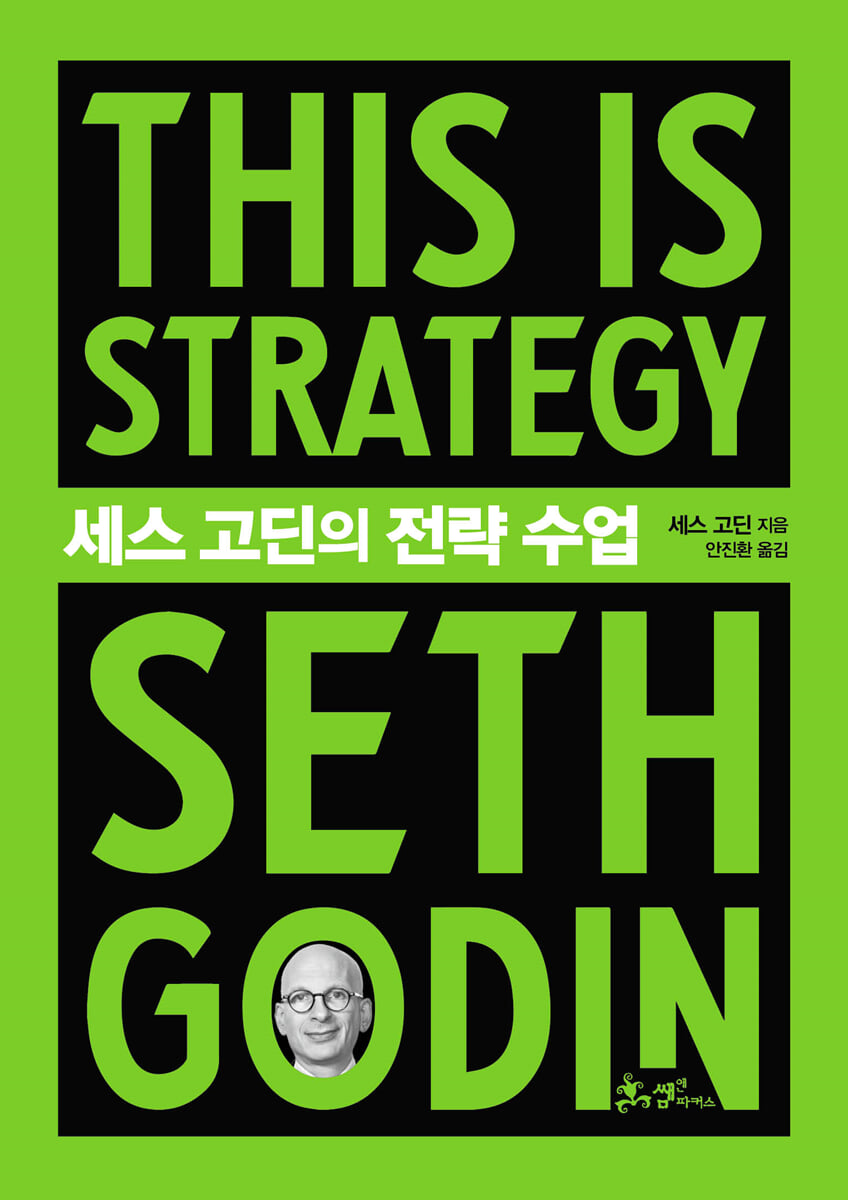
Strategy is not just a plan, it's a philosophy.Seth Godin, a world-renowned marketing guru, emphasizes the importance of AI's ability to create impact that cannot be replicated to cope with an uncertain future.
This power comes from strategy.
It offers in-depth reflection on the philosophical dimensions of strategy that drive system change and decision-making.
January 7, 2025. Economics and Management PD Oh Da-eun
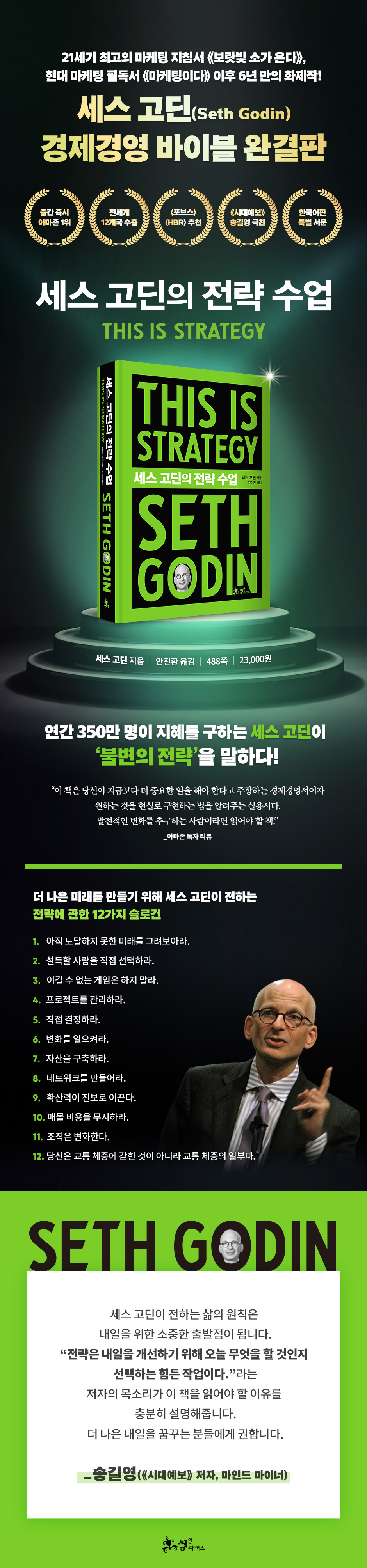
***** Ranked #1 on Amazon immediately after publication, licensed to 12 countries, highly recommended by Forbes and HBR
***** The complete economics and management bible, following 『The Purple Cow is Coming』 and 『Marketing is』
Seth Godin, who receives answers from 3.5 million people annually, talks about his 'timeless strategy'!
For over 30 years, Seth Godin has stood out as a strategist who has revolutionized modern business by breaking away from traditional marketing methods and emphasizing a creative, customer-centric approach.
In the early days of the Internet, the company he founded, Yoyodyne, pioneered the direction and methodology of online marketing and opened the door to online commerce.
Without him, neither Amazon nor Coupang would have emerged.
In today's world, where AI is emerging, the international political landscape is rapidly changing, and the entire industrial ecosystem is being turned upside down, Seth Godin's voice is drawing attention.
He says.
“I guess I need to come up with a strategy first.” Instead of presenting a few rules or guidelines as the correct answer, Seth Godin’s Strategy Class talks about strategy as a sophisticated way of thinking about dealing with uncertainty.
He refines his unique, unexpected intuition into a practical approach called strategy, and teaches us how to apply it to our lives and businesses.
From college entrance exams to retirement planning, from business idea selection to branding, from human resources to accounting, you'll gain a proven path forward for individuals and organizations.
***** The complete economics and management bible, following 『The Purple Cow is Coming』 and 『Marketing is』
Seth Godin, who receives answers from 3.5 million people annually, talks about his 'timeless strategy'!
For over 30 years, Seth Godin has stood out as a strategist who has revolutionized modern business by breaking away from traditional marketing methods and emphasizing a creative, customer-centric approach.
In the early days of the Internet, the company he founded, Yoyodyne, pioneered the direction and methodology of online marketing and opened the door to online commerce.
Without him, neither Amazon nor Coupang would have emerged.
In today's world, where AI is emerging, the international political landscape is rapidly changing, and the entire industrial ecosystem is being turned upside down, Seth Godin's voice is drawing attention.
He says.
“I guess I need to come up with a strategy first.” Instead of presenting a few rules or guidelines as the correct answer, Seth Godin’s Strategy Class talks about strategy as a sophisticated way of thinking about dealing with uncertainty.
He refines his unique, unexpected intuition into a practical approach called strategy, and teaches us how to apply it to our lives and businesses.
From college entrance exams to retirement planning, from business idea selection to branding, from human resources to accounting, you'll gain a proven path forward for individuals and organizations.
- You can preview some of the book's contents.
Preview
index
Preface to the Korean edition
prolog
How to use this book
1 Strategy is a philosophy of 'being so' | 2 Four closely intertwined elements | 3 What do people want? | 4 “Take what you can” is not a strategy | 5 Are you waiting for direction? | 6 The path forward must be precise | 7 Sophisticated strategies are always different | 8 Systems persist beyond sight | 9 We live in a solar system | 10 Systems provide value | 11 Is it a building or a road? | 12 Invisible helpers (and mysterious destroyers) | 13 Can you see the river? | 14 Which group are you in? | 15 Successful systems | 16 Reality is not Lego | 17 Two misconceptions about systems | 18 Natural systems, artificial systems, and complex systems | 19 What makes a system? | 20 The Sustainability of Systems | 21 From Fine Porcelain to Underwater Headphones | 22 Duncan Hines (and Nina Zagat) | 23 All Dogs Are Mongrels | 24 How the Media Changed University Rankings | 25 The Position of the Meter | 26 The Chocolate System | 27 A Tough Game | 28 Every Strategy Has a Game | 29 We Are All Time Travelers | 30 The Flow of Time | 31 There Is a Way | 32 The Real Meaning of 'Simplification' | 33 Useful Strategies and Avoidance Tendencies | 34 There Is No Fruit in Low Places | 35 Rome Was Built in a Day | 36 One Telephone is Useless | 37 The Myth of the Deserted Island | 38 Cities Are Contagious | 39 Analysis of the Last Minute | 40 Strategy and Tactics | 41 Towards Strategic Practice | 42 Projects and Work Are Different | 43 The Following Things may require strategy | 44 Slowly, with patience | 45 Plants make people happy | 46 Seat belts save lives | 47 Airbnb is lost | 48 Egg cooking video | 49 Esther who changed the world | 50 Shining a light on blind spots | 51 Big problems need small solutions | 52 Spreading the word (aka 'selfish shouting') | 53 You can't just pick any card | 54 You can enjoy freedom as much as you want | 55 A clear understanding of business models | 56 And time passes | 57 Passion and business models | 58 Our circle and the current circle | 59 Can I sell a product that only I want? | 60 Next Guest, Best Guest | 61 A Clear Understanding of Strategy | 62 A Blueprint is a Statement | 63 Sharing Strategy: The Modern Business Plan | 64 Intuition is Strategy Without Explanation | 65 The Truth About Effort | 66 Resilience and Leverage | 67 Barely Working… | 68 The Minimum Audience You Can Attract | 69 What Happens Next? | 70 A Conspiracy to Kill All the Whales? | 71 Where there is demand, there is not always a market | 72 Thinking beyond windmills | 73 Starting without a strategy | 74 Some reasons we avoid strategy | 75 A framework for strategy | 76 Creating the conditions for change | 77 Twelve slogans | 78 Invisible systems and unintended consequences | 79 We are not plankton | 80 Strategic marketing | 81 No time to waste | 82 Strategy and purpose | 83 “Should” can be a trap | 84 Do you have a blueprint? | 85 Strategic patience | 86 Strategy is the partner of freedom | 87 Lottery tickets are not a strategy | 88 Nostalgia for the future | 89 Given jobs vs.
Strategic Work | 90 Create Tension | 91 The World's Fastest Cyclist | 92 When Did Apple Become Apple? | 93 When Did Netflix Become Netflix? | 94 When Did David Bowie Become David Bowie? | 95 What Is Your Strategy? | 96 What Does Strategic Thinking Mean? | 97 Tactics Are Not Strategy | 98 What Is a Feedback Loop? | 99 Time is not free | 100 Avoiding consequentialist bias | 101 Systems, not parts | 102 Thinking about 'status' | 103 Status in Hollywood | 104 The output of systems | 105 Systems often distort intentions | 106 The birth of Appia | 107 Perpetuating injustice | 108 Toxic systems | 109 You can do anything, but you can't do everything | 110 About being judged | 111 Choose your customers, choose your future | 112 Choose your competition, choose your future | 113 Check the source of recognition, choose your future | 114 Choose your distribution method, choose your future | 115 News, ideas, and changes in distribution | 116 It's hard to catch 'everyone' | 117 What do you want? | 118 What does it want? | 119 Conditions for Runaway | 120 Things That Expand | 121 Working for the System | 122 Who's in Charge? | 123 Snapshots and Videos | 124 The Day I Met Derek Sivers | 125 Emperor Penguins, Crowds, and Fear | 126 If You Want to Start a Fire | 127 Five Steps to Achieving Wide-Range Change | 128 Sandhill Road | 129 '100' is a Great Starting Point | 130 Why Don't the Dynamics of Organ Donation Change? | 131 Avoid the Unbelievers | 132 Understanding Early Adopters | 133 Time is the Overlooked Axis | 134 Get Familiar with Snapshots | 135 Acknowledge the Half-Life Gap | 136 The Underestimated Power of Diffusion | 137 Surfing the Waves Easier When You See the Pattern | 138 Understanding the Chasm | 139 The Need for Scaffolding | 140 Scaffolding and Marketing | 141 The Dilemma of Leverage Systems | 142 Treat the Unusual Differently | 143 Targeting the Masses | 144 The Quality Misconception | 145 Useful Criticism | 146 Defining 'Better' Clearly | 147 Questions to Ask Yourself When Deciding Whether to Adopt | 148 Short-Term Games and Long-Term Games | 149 Infinite or Finite? | 150 Scarcity or Abundance? | 151 Domination or Solidarity? | 152 Giving vs.
Repaying | 153 Maintenance? Replacement? Possibility? | 154 Games of Skill, Luck, and Privilege | 155 Games with Multiple Objectives | 156 Things You Must Do Before You Start | 157 Don't Bet on Games You Can't Win | 158 There Is No Independent Strategy | 159 Grabbing the Last Donut | 160 Systems Flourish and Wither | 161 To Get to New York | 162 Everything's Permitted If You Meet the Standards | 163 Feeding the System | 164 Systems You Shouldn't Participate in | 165 Let Size Be Magic | 166 How NPR Was Overtaken by Podcasts | 167 Healthy Selfishness | 168 The Most Important Part of What We Do | 169 Voluntary Choice | 170 "If You Do It, I Will..." | 171 Incorporating Strategy into Marketing | 172 Living in a Van | 173 Some Acorns Become Oak Trees | 174 Systems have different goals | 175 One way to solve problems is to change the system | 176 Our choices are already decided | 177 What does the system respond to? | 178 The paradox of fungibility and uniqueness | 179 Exhaustive competition | 180 Understanding genres | 181 Medium vs.
Message | 182 Thinking about price | 183 You need empathy to develop a strategy | 184 Dorothy and her friends | 185 Everyone is always right | 186 All sustainable systems engage in feedback loops | 187 The unpredictable variable in all feedback loops is delay | 188 Systems + game theory + feedback loops | 189 Accepting constraints | 190 Who benefits? | 191 Six traps of systems | 192 Moses' manipulation | 193 The sustainability of resilient systems | 194 Attempts to make me an addict | 195 Limit your surrogate indicators | 196 Systems reveal themselves when forced to change | 197 Can I see the organizational chart? | 198 What are the drivers of change? | 199 Identifying the Agents of Change | 200 Telegraphs and Skyscrapers | 201 Cheese Cartels | 202 A Brief History of Jaywalking | 203 What to Say? | 204 Who Says “Yes”? | 205 How to Use the System | 206 The Person in Front of You Right Now Is Part of the System | 207 Some Ways Systems Work | 208 Types of Sophisticated Strategies | 209 Bringing Change to the System | 210 Luck Isn’t Fair in the Long Run | 211 Leverage and Overextension of Strategy | 212 Intention and Side Effects | 213 Systemic Disruption | 214 Gatekeepers | 215 Types of Tensions | 216 What to Say? | 217 Tesla Fables: Ludicrous Mode and the Clown Car | 218 Competitive Advantage | 219 Metcalfe's Law Awaits You | 220 The First Rule | 221 Action vs.
Desire | 222 System replacement is tempting | 223 Revolution is rare | 224 Games are for children who enjoy themselves | 225 Two invisible desires | 226 About cheaper things | 227 The strengthening of the tribal instinct | 228 Downward competition and substitutes | 229 Finding the invisible hand | 230 Examples of systems maintained by tension | 231 Which hat should I wear? | 232 Weather forecasts are predictions | 233 It might not go well | 234 Back to the rhinoceros story | 235 Who rolls the dice? | 236 Who will be waiting for you at the airport? | 237 Understanding Statistics and Polls | 238 Best Practices and the Status Quo | 239 The Problem of Analogy and 'Almost' | 240 Cheerleaders and Coaches | 241 Convergence to the Center | 242 Understanding the 2x2 Positioning Grid | 243 Positioning for Success | 244 Moving to the Middle (or Not Moving) | 245 Going Where Your Competitors Can't or Won't Go | 246 What Does 'Everyone' Mean? | 247 Spreading the Word | 248 Expanding and Improving | 249 A Half-Built Ship Doesn't Help | 250 Review Early Enough | 251 The Last Minute | 252 Every “Yes” Leads to Many “Nos” | 253 Understanding Retailers | 254 Giving Intention to Projects | 255 Successful Projects | 256 Three Project Traps | 257 Intentional Communication | 258 Risks Are Inevitable | 259 Constraints Are Gifts | 260 What Are You Building? | 261 Problems Are Opportunities | 262 A Simple Structure for Decision-Making | 263 Explore Multiple Options | 264 Even Good Choices Can Fail | 265 Hidden Decisions Grow Moldy | 266 Compared to What? | 267 The $10,000 Difference | 268 Thoughts on Money | 269 The 'No Regrets' Strategy and the Kinds of Games We Play | 270 Why It's Hard to Talk About Decisions | 271 The Paralysis Caused by Obsession with Results | 272 The Right Way to Focus on the Survivor | 273 Regression to the Mean | 274 Better Decisions and Better Results | 275 Indecision is the Easy Way | 276 Assets are Tools | 277 Assets Over Time | 278 What Kind of Hammer Should You Buy? | 279 Community Action | 280 Harmful Inventions | 281 The Old Myth of Self-Control | 282 A Strategic Approach to the Most Urgent Change of Our Time | 283 Letting the Market Fix What the Market Has Broken | 284 Harnessing Insatiable Desire | 285 What We Should Do | 286 Brainwashing Is Real | 287 It's a Journey, Not an Event | 288 Relentless Pressure and Relentless Procrastination | 289 Organizational Failure | 290 Asynchrony Is a Superpower | 291 Ignoring Sunk Costs: A Simple, Uncomfortable Idea | 292 What Does It Mean to Be 'Wrong'? | 293 Tomorrow Is Another Opportunity | 294 Ignore the Clown Who Broke His Promises | 295 What Should I Wear on Wednesday? | 296 Our Way | 297 Questions That Shape Strategy
Acknowledgements
prolog
How to use this book
1 Strategy is a philosophy of 'being so' | 2 Four closely intertwined elements | 3 What do people want? | 4 “Take what you can” is not a strategy | 5 Are you waiting for direction? | 6 The path forward must be precise | 7 Sophisticated strategies are always different | 8 Systems persist beyond sight | 9 We live in a solar system | 10 Systems provide value | 11 Is it a building or a road? | 12 Invisible helpers (and mysterious destroyers) | 13 Can you see the river? | 14 Which group are you in? | 15 Successful systems | 16 Reality is not Lego | 17 Two misconceptions about systems | 18 Natural systems, artificial systems, and complex systems | 19 What makes a system? | 20 The Sustainability of Systems | 21 From Fine Porcelain to Underwater Headphones | 22 Duncan Hines (and Nina Zagat) | 23 All Dogs Are Mongrels | 24 How the Media Changed University Rankings | 25 The Position of the Meter | 26 The Chocolate System | 27 A Tough Game | 28 Every Strategy Has a Game | 29 We Are All Time Travelers | 30 The Flow of Time | 31 There Is a Way | 32 The Real Meaning of 'Simplification' | 33 Useful Strategies and Avoidance Tendencies | 34 There Is No Fruit in Low Places | 35 Rome Was Built in a Day | 36 One Telephone is Useless | 37 The Myth of the Deserted Island | 38 Cities Are Contagious | 39 Analysis of the Last Minute | 40 Strategy and Tactics | 41 Towards Strategic Practice | 42 Projects and Work Are Different | 43 The Following Things may require strategy | 44 Slowly, with patience | 45 Plants make people happy | 46 Seat belts save lives | 47 Airbnb is lost | 48 Egg cooking video | 49 Esther who changed the world | 50 Shining a light on blind spots | 51 Big problems need small solutions | 52 Spreading the word (aka 'selfish shouting') | 53 You can't just pick any card | 54 You can enjoy freedom as much as you want | 55 A clear understanding of business models | 56 And time passes | 57 Passion and business models | 58 Our circle and the current circle | 59 Can I sell a product that only I want? | 60 Next Guest, Best Guest | 61 A Clear Understanding of Strategy | 62 A Blueprint is a Statement | 63 Sharing Strategy: The Modern Business Plan | 64 Intuition is Strategy Without Explanation | 65 The Truth About Effort | 66 Resilience and Leverage | 67 Barely Working… | 68 The Minimum Audience You Can Attract | 69 What Happens Next? | 70 A Conspiracy to Kill All the Whales? | 71 Where there is demand, there is not always a market | 72 Thinking beyond windmills | 73 Starting without a strategy | 74 Some reasons we avoid strategy | 75 A framework for strategy | 76 Creating the conditions for change | 77 Twelve slogans | 78 Invisible systems and unintended consequences | 79 We are not plankton | 80 Strategic marketing | 81 No time to waste | 82 Strategy and purpose | 83 “Should” can be a trap | 84 Do you have a blueprint? | 85 Strategic patience | 86 Strategy is the partner of freedom | 87 Lottery tickets are not a strategy | 88 Nostalgia for the future | 89 Given jobs vs.
Strategic Work | 90 Create Tension | 91 The World's Fastest Cyclist | 92 When Did Apple Become Apple? | 93 When Did Netflix Become Netflix? | 94 When Did David Bowie Become David Bowie? | 95 What Is Your Strategy? | 96 What Does Strategic Thinking Mean? | 97 Tactics Are Not Strategy | 98 What Is a Feedback Loop? | 99 Time is not free | 100 Avoiding consequentialist bias | 101 Systems, not parts | 102 Thinking about 'status' | 103 Status in Hollywood | 104 The output of systems | 105 Systems often distort intentions | 106 The birth of Appia | 107 Perpetuating injustice | 108 Toxic systems | 109 You can do anything, but you can't do everything | 110 About being judged | 111 Choose your customers, choose your future | 112 Choose your competition, choose your future | 113 Check the source of recognition, choose your future | 114 Choose your distribution method, choose your future | 115 News, ideas, and changes in distribution | 116 It's hard to catch 'everyone' | 117 What do you want? | 118 What does it want? | 119 Conditions for Runaway | 120 Things That Expand | 121 Working for the System | 122 Who's in Charge? | 123 Snapshots and Videos | 124 The Day I Met Derek Sivers | 125 Emperor Penguins, Crowds, and Fear | 126 If You Want to Start a Fire | 127 Five Steps to Achieving Wide-Range Change | 128 Sandhill Road | 129 '100' is a Great Starting Point | 130 Why Don't the Dynamics of Organ Donation Change? | 131 Avoid the Unbelievers | 132 Understanding Early Adopters | 133 Time is the Overlooked Axis | 134 Get Familiar with Snapshots | 135 Acknowledge the Half-Life Gap | 136 The Underestimated Power of Diffusion | 137 Surfing the Waves Easier When You See the Pattern | 138 Understanding the Chasm | 139 The Need for Scaffolding | 140 Scaffolding and Marketing | 141 The Dilemma of Leverage Systems | 142 Treat the Unusual Differently | 143 Targeting the Masses | 144 The Quality Misconception | 145 Useful Criticism | 146 Defining 'Better' Clearly | 147 Questions to Ask Yourself When Deciding Whether to Adopt | 148 Short-Term Games and Long-Term Games | 149 Infinite or Finite? | 150 Scarcity or Abundance? | 151 Domination or Solidarity? | 152 Giving vs.
Repaying | 153 Maintenance? Replacement? Possibility? | 154 Games of Skill, Luck, and Privilege | 155 Games with Multiple Objectives | 156 Things You Must Do Before You Start | 157 Don't Bet on Games You Can't Win | 158 There Is No Independent Strategy | 159 Grabbing the Last Donut | 160 Systems Flourish and Wither | 161 To Get to New York | 162 Everything's Permitted If You Meet the Standards | 163 Feeding the System | 164 Systems You Shouldn't Participate in | 165 Let Size Be Magic | 166 How NPR Was Overtaken by Podcasts | 167 Healthy Selfishness | 168 The Most Important Part of What We Do | 169 Voluntary Choice | 170 "If You Do It, I Will..." | 171 Incorporating Strategy into Marketing | 172 Living in a Van | 173 Some Acorns Become Oak Trees | 174 Systems have different goals | 175 One way to solve problems is to change the system | 176 Our choices are already decided | 177 What does the system respond to? | 178 The paradox of fungibility and uniqueness | 179 Exhaustive competition | 180 Understanding genres | 181 Medium vs.
Message | 182 Thinking about price | 183 You need empathy to develop a strategy | 184 Dorothy and her friends | 185 Everyone is always right | 186 All sustainable systems engage in feedback loops | 187 The unpredictable variable in all feedback loops is delay | 188 Systems + game theory + feedback loops | 189 Accepting constraints | 190 Who benefits? | 191 Six traps of systems | 192 Moses' manipulation | 193 The sustainability of resilient systems | 194 Attempts to make me an addict | 195 Limit your surrogate indicators | 196 Systems reveal themselves when forced to change | 197 Can I see the organizational chart? | 198 What are the drivers of change? | 199 Identifying the Agents of Change | 200 Telegraphs and Skyscrapers | 201 Cheese Cartels | 202 A Brief History of Jaywalking | 203 What to Say? | 204 Who Says “Yes”? | 205 How to Use the System | 206 The Person in Front of You Right Now Is Part of the System | 207 Some Ways Systems Work | 208 Types of Sophisticated Strategies | 209 Bringing Change to the System | 210 Luck Isn’t Fair in the Long Run | 211 Leverage and Overextension of Strategy | 212 Intention and Side Effects | 213 Systemic Disruption | 214 Gatekeepers | 215 Types of Tensions | 216 What to Say? | 217 Tesla Fables: Ludicrous Mode and the Clown Car | 218 Competitive Advantage | 219 Metcalfe's Law Awaits You | 220 The First Rule | 221 Action vs.
Desire | 222 System replacement is tempting | 223 Revolution is rare | 224 Games are for children who enjoy themselves | 225 Two invisible desires | 226 About cheaper things | 227 The strengthening of the tribal instinct | 228 Downward competition and substitutes | 229 Finding the invisible hand | 230 Examples of systems maintained by tension | 231 Which hat should I wear? | 232 Weather forecasts are predictions | 233 It might not go well | 234 Back to the rhinoceros story | 235 Who rolls the dice? | 236 Who will be waiting for you at the airport? | 237 Understanding Statistics and Polls | 238 Best Practices and the Status Quo | 239 The Problem of Analogy and 'Almost' | 240 Cheerleaders and Coaches | 241 Convergence to the Center | 242 Understanding the 2x2 Positioning Grid | 243 Positioning for Success | 244 Moving to the Middle (or Not Moving) | 245 Going Where Your Competitors Can't or Won't Go | 246 What Does 'Everyone' Mean? | 247 Spreading the Word | 248 Expanding and Improving | 249 A Half-Built Ship Doesn't Help | 250 Review Early Enough | 251 The Last Minute | 252 Every “Yes” Leads to Many “Nos” | 253 Understanding Retailers | 254 Giving Intention to Projects | 255 Successful Projects | 256 Three Project Traps | 257 Intentional Communication | 258 Risks Are Inevitable | 259 Constraints Are Gifts | 260 What Are You Building? | 261 Problems Are Opportunities | 262 A Simple Structure for Decision-Making | 263 Explore Multiple Options | 264 Even Good Choices Can Fail | 265 Hidden Decisions Grow Moldy | 266 Compared to What? | 267 The $10,000 Difference | 268 Thoughts on Money | 269 The 'No Regrets' Strategy and the Kinds of Games We Play | 270 Why It's Hard to Talk About Decisions | 271 The Paralysis Caused by Obsession with Results | 272 The Right Way to Focus on the Survivor | 273 Regression to the Mean | 274 Better Decisions and Better Results | 275 Indecision is the Easy Way | 276 Assets are Tools | 277 Assets Over Time | 278 What Kind of Hammer Should You Buy? | 279 Community Action | 280 Harmful Inventions | 281 The Old Myth of Self-Control | 282 A Strategic Approach to the Most Urgent Change of Our Time | 283 Letting the Market Fix What the Market Has Broken | 284 Harnessing Insatiable Desire | 285 What We Should Do | 286 Brainwashing Is Real | 287 It's a Journey, Not an Event | 288 Relentless Pressure and Relentless Procrastination | 289 Organizational Failure | 290 Asynchrony Is a Superpower | 291 Ignoring Sunk Costs: A Simple, Uncomfortable Idea | 292 What Does It Mean to Be 'Wrong'? | 293 Tomorrow Is Another Opportunity | 294 Ignore the Clown Who Broke His Promises | 295 What Should I Wear on Wednesday? | 296 Our Way | 297 Questions That Shape Strategy
Acknowledgements
Detailed image
Into the book
Better waves make better surfers.
The first useful skill for surfing is choosing the right place and time to surf.
The systems of our lives are like waves, making things easier or more difficult.
Working within the system is like having an enthusiastic and skilled assistant who always helps you do your job better.
On the other hand, if someone works against the system, it can feel like they are intentionally trying to undermine the project.
Michelin was confident it had achieved a billion-dollar innovation with the launch of its puncture-resistant tire.
It was a better product for drivers, automakers, and the auto industry.
But after a few years, the project was discontinued.
Business professor Ron Adner noted that local tire shops, auto repair shops, and garages, which required rigorous training and new equipment, were not actively involved in the project at the outset.
Michelin ignored this situation.
When this link was missing, customers had a difficult time getting tire service.
And it was not uncommon to go to replace worn or damaged puncture-resistant tires only to be urged to buy regular tires.
Disappointed customers filed complaints, some even suing the automakers.
It's easy to blame selfish auto mechanics, but the real problem lies with the auto industry complex, a system reluctant to embrace rapid change, a tendency to maintain the status quo or return to the status quo.
--- p.35, from “The Invisible Helper (and the Mysterious Destroyer)”
· The system gives us unlimited power.
· The system gives us no power.
We cannot command the system to follow our wishes.
This is why we need a strategy.
One of the false myths of our culture is that each of us can enjoy unlimited agency if we just work hard enough, demand enough, and assert ourselves enough.
But the system resists or rebels against change.
The power you have lies somewhere between infinity and zero (0).
You may have been an insignificant part of the system, adapting to the environment, or (worse) a victim of the system.
But we are never helpless.
Individuals who rally others together through perseverance and generosity change the world, and it happens every day.
With the right strategy and resources, we can sometimes (if not always) exert influence.
(…) If we take the time and focus, we can find the levers that will change important systems.
--- pp.38-39, from “Two Misunderstandings About the System”
Any game contains the following elements:
Players, rules, scarcity, choices, feedback loops, outcomes.
Calling our projects games allows us to objectify our work, allows us to be flexible in our approach, and, most importantly, gives us the opportunity to discuss our projects.
(…) Here are some common facts about the game:
· A game isn't something you have to enjoy.
· Whether we realize it or not, we are playing a game, and understanding the game helps us play better.
· The outcome of a game often has nothing to do with how much I want to win.
· Each player has a different perspective on the game.
· Some games are easy to quit, but some last forever.
· Even if they play the same game, not all players follow the same rules or have the same goals.
(…)
· Most games are unfair, and some are simply unwinnable.
· The most valuable skill in one game may be useless in another.
· Some games get easier the more you win, while others get harder the more you win.
· You do not have to participate in every game given.
· Multiplayer games are sometimes disguised as two-player games.
· We often spend more time figuring out how to win at the game we're playing than we do figuring out which game to play in the first place.
--- pp.57-58, from “Every Strategy Has a Game”
Someone will win the Mega Millions lottery.
But it won't be you or me.
Too often, we act as if we're buying a lottery ticket with a slim chance of winning.
This approach is unlikely to produce consistently better long-term results than consistent, ongoing strategic work.
A strategy is a blueprint for where we are headed.
It's more than just a goal.
It is a careful declaration of how we view the world, how we understand systems, and how likely it is that our claims will be realized.
A blueprint describes how current efforts will translate into impact later.
It is built around empathy for others and the power to drive meaningful achievements.
And it holds you accountable by continually drawing out improvements from yourself and your colleagues and refining the blueprint.
On the other hand, the lottery, while alluringly shiny, is ultimately a dead end.
Even if we win, we cannot take the initiative in the winning process and we cannot experience the learning process.
--- pp.135-136, from “The Lottery is Not a Strategy”
Flowers want bees to visit, and fruits want birds to eat them.
Although they clearly have no conscious intention, this 'desire' drives their evolution over generations.
The more they get what they want, the more something unfolds.
The same goes for products and organizations.
Your smartphone wants your attention.
As much as possible, or more.
It draws your attention to the outside world by constantly creating anxiety, causing fear, or providing satisfaction, and by invading the intimacy of the 'here' and the magic of the 'now.'
What hospitals want is for all beds to be full, but not overcrowded.
It also makes top doctors feel secure in their positions.
Of course, I sincerely hope that things like iatrogenic infections or medical malpractice lawsuits do not occur.
What most companies want is for their senior executives to be well compensated and respected.
What the Internet wants is for us to leave a trace of every piece of data we use, all the time.
Kevin Kelly said in his book, The Impact of Technology:
“The easiest way to understand how technology is changing our world is to imagine it as another species evolving to fill its own niche and expand its own.
--- pp.176-178, from “What Does It Want?”
The climb to the summit of Mount Everest is legendary.
It begins with a nine-day walk from the city of Lukla to base camp.
During those nine days, the climbers climbed about 300 meters in altitude each day through forests and meadows, stopping to rest at teahouses along the way.
On these long hikes, climbers acclimatize to the altitude, build momentum, and amplify their sense of mission.
Few people give up on the 10th day because of the sunk costs.
In fact, on the final stretch leading to the summit, climbers sometimes wait in line for hours.
Other mountains start out much steeper in this final section, so while the overall difficulty may not be high, accessibility may be reduced.
On such mountains, some people return home as soon as they see the cliff.
“Scaffolding is the cultural and organizational support we receive early in the adoption of a new idea or practice.” The scaffolding for Everest climbing is Lukla.
It's a friendly, open, and popular starting point.
(…) When you first start out, you need a stepping stone.
But the real power of scaffolding comes when you realize that you can provide scaffolding to others.
If the change you seek depends on the participation of others, making it compelling and easy to participate is your most important and only task.
--- pp.214-216, from “The Necessity of Stairs”
This is one of the most profound and difficult lessons learned in any MBA program.
“Ignore sunk costs.” The money and effort you put in yesterday should have no bearing on tomorrow’s decisions.
Each decision must be made anew.
Let's take a simple example.
A deposit of $10,000 was paid to secure production equipment for a specific device at a cost of $1 per unit.
And I waited on the waiting list for a year.
However, just a few days before that machine was due to ship, a new machine was released that could produce the device for 5 cents.
This equipment can pay for itself in just a few weeks.
But doing so would make the $10,000 deposit and the time spent waiting on the waiting list meaningless.
What should I do?
It is clear that trying to protect money already spent will result in greater losses.
Of course, you have to ignore the deposit and make a new decision.
(…) Every effort has an opportunity cost, and sometimes that effort can become an asset.
But if that asset is no longer helpful, you should boldly let it go, along with any regrets about the effort you put into it, and move forward again toward the change you originally aimed for.
The first useful skill for surfing is choosing the right place and time to surf.
The systems of our lives are like waves, making things easier or more difficult.
Working within the system is like having an enthusiastic and skilled assistant who always helps you do your job better.
On the other hand, if someone works against the system, it can feel like they are intentionally trying to undermine the project.
Michelin was confident it had achieved a billion-dollar innovation with the launch of its puncture-resistant tire.
It was a better product for drivers, automakers, and the auto industry.
But after a few years, the project was discontinued.
Business professor Ron Adner noted that local tire shops, auto repair shops, and garages, which required rigorous training and new equipment, were not actively involved in the project at the outset.
Michelin ignored this situation.
When this link was missing, customers had a difficult time getting tire service.
And it was not uncommon to go to replace worn or damaged puncture-resistant tires only to be urged to buy regular tires.
Disappointed customers filed complaints, some even suing the automakers.
It's easy to blame selfish auto mechanics, but the real problem lies with the auto industry complex, a system reluctant to embrace rapid change, a tendency to maintain the status quo or return to the status quo.
--- p.35, from “The Invisible Helper (and the Mysterious Destroyer)”
· The system gives us unlimited power.
· The system gives us no power.
We cannot command the system to follow our wishes.
This is why we need a strategy.
One of the false myths of our culture is that each of us can enjoy unlimited agency if we just work hard enough, demand enough, and assert ourselves enough.
But the system resists or rebels against change.
The power you have lies somewhere between infinity and zero (0).
You may have been an insignificant part of the system, adapting to the environment, or (worse) a victim of the system.
But we are never helpless.
Individuals who rally others together through perseverance and generosity change the world, and it happens every day.
With the right strategy and resources, we can sometimes (if not always) exert influence.
(…) If we take the time and focus, we can find the levers that will change important systems.
--- pp.38-39, from “Two Misunderstandings About the System”
Any game contains the following elements:
Players, rules, scarcity, choices, feedback loops, outcomes.
Calling our projects games allows us to objectify our work, allows us to be flexible in our approach, and, most importantly, gives us the opportunity to discuss our projects.
(…) Here are some common facts about the game:
· A game isn't something you have to enjoy.
· Whether we realize it or not, we are playing a game, and understanding the game helps us play better.
· The outcome of a game often has nothing to do with how much I want to win.
· Each player has a different perspective on the game.
· Some games are easy to quit, but some last forever.
· Even if they play the same game, not all players follow the same rules or have the same goals.
(…)
· Most games are unfair, and some are simply unwinnable.
· The most valuable skill in one game may be useless in another.
· Some games get easier the more you win, while others get harder the more you win.
· You do not have to participate in every game given.
· Multiplayer games are sometimes disguised as two-player games.
· We often spend more time figuring out how to win at the game we're playing than we do figuring out which game to play in the first place.
--- pp.57-58, from “Every Strategy Has a Game”
Someone will win the Mega Millions lottery.
But it won't be you or me.
Too often, we act as if we're buying a lottery ticket with a slim chance of winning.
This approach is unlikely to produce consistently better long-term results than consistent, ongoing strategic work.
A strategy is a blueprint for where we are headed.
It's more than just a goal.
It is a careful declaration of how we view the world, how we understand systems, and how likely it is that our claims will be realized.
A blueprint describes how current efforts will translate into impact later.
It is built around empathy for others and the power to drive meaningful achievements.
And it holds you accountable by continually drawing out improvements from yourself and your colleagues and refining the blueprint.
On the other hand, the lottery, while alluringly shiny, is ultimately a dead end.
Even if we win, we cannot take the initiative in the winning process and we cannot experience the learning process.
--- pp.135-136, from “The Lottery is Not a Strategy”
Flowers want bees to visit, and fruits want birds to eat them.
Although they clearly have no conscious intention, this 'desire' drives their evolution over generations.
The more they get what they want, the more something unfolds.
The same goes for products and organizations.
Your smartphone wants your attention.
As much as possible, or more.
It draws your attention to the outside world by constantly creating anxiety, causing fear, or providing satisfaction, and by invading the intimacy of the 'here' and the magic of the 'now.'
What hospitals want is for all beds to be full, but not overcrowded.
It also makes top doctors feel secure in their positions.
Of course, I sincerely hope that things like iatrogenic infections or medical malpractice lawsuits do not occur.
What most companies want is for their senior executives to be well compensated and respected.
What the Internet wants is for us to leave a trace of every piece of data we use, all the time.
Kevin Kelly said in his book, The Impact of Technology:
“The easiest way to understand how technology is changing our world is to imagine it as another species evolving to fill its own niche and expand its own.
--- pp.176-178, from “What Does It Want?”
The climb to the summit of Mount Everest is legendary.
It begins with a nine-day walk from the city of Lukla to base camp.
During those nine days, the climbers climbed about 300 meters in altitude each day through forests and meadows, stopping to rest at teahouses along the way.
On these long hikes, climbers acclimatize to the altitude, build momentum, and amplify their sense of mission.
Few people give up on the 10th day because of the sunk costs.
In fact, on the final stretch leading to the summit, climbers sometimes wait in line for hours.
Other mountains start out much steeper in this final section, so while the overall difficulty may not be high, accessibility may be reduced.
On such mountains, some people return home as soon as they see the cliff.
“Scaffolding is the cultural and organizational support we receive early in the adoption of a new idea or practice.” The scaffolding for Everest climbing is Lukla.
It's a friendly, open, and popular starting point.
(…) When you first start out, you need a stepping stone.
But the real power of scaffolding comes when you realize that you can provide scaffolding to others.
If the change you seek depends on the participation of others, making it compelling and easy to participate is your most important and only task.
--- pp.214-216, from “The Necessity of Stairs”
This is one of the most profound and difficult lessons learned in any MBA program.
“Ignore sunk costs.” The money and effort you put in yesterday should have no bearing on tomorrow’s decisions.
Each decision must be made anew.
Let's take a simple example.
A deposit of $10,000 was paid to secure production equipment for a specific device at a cost of $1 per unit.
And I waited on the waiting list for a year.
However, just a few days before that machine was due to ship, a new machine was released that could produce the device for 5 cents.
This equipment can pay for itself in just a few weeks.
But doing so would make the $10,000 deposit and the time spent waiting on the waiting list meaningless.
What should I do?
It is clear that trying to protect money already spent will result in greater losses.
Of course, you have to ignore the deposit and make a new decision.
(…) Every effort has an opportunity cost, and sometimes that effort can become an asset.
But if that asset is no longer helpful, you should boldly let it go, along with any regrets about the effort you put into it, and move forward again toward the change you originally aimed for.
--- pp.464-465, from “Ignoring Sunk Costs: A Simple, But Inconvenient Idea”
Publisher's Review
Why Seth Godin, the greatest business leader of the century, emphasizes "strategy."
Strategy used to be the preserve of big-picture movers and shakers like politicians, defense ministers, and corporate executives.
But is strategy only necessary for maintaining power or sustaining a business? Anything that requires change requires proactive strategy.
In other words, strategy is necessary for everyone who wants to improve a situation, and strategy has the power to shape systems and culture.
Culture is created when we continually signal and evoke the message, both internally and externally, that “this is our way.”
Therefore, strategy becomes the one absolute thing among countless choices.
Seth Godin has been called “the world’s greatest business leader” by Forbes, “the ultimate change agent” by The New York Times, and “an innovative thinker in business strategy” by The Wall Street Journal.
Seth's Blog, which he runs, is one of the most influential blogs in the world, attracting over 10,000 daily visitors and 3.5 million annually, seeking answers and insights. In today's world, where the rise of AI and the rapidly changing global landscape are upending entire industrial ecosystems, the strategies he offers are drawing global attention.
Seth Godin defines strategy as “a philosophy that guides decision-making, an opportunity to change before the future, and a way for human effort to work.”
Seth Godin says in his masterpiece, "Strategy Lessons: The Ultimate Strategy," written six years after his best-selling book, "Marketing," that four key elements must be organically considered to form a strategy.
Instead of going against desire, ride the wave of desire.
People and systems will work for you!
The first is ‘time’.
If you take the time and focus, you can find the levers to change the system.
As long as the direction is clear, time will steadily expand its influence and bring results before our eyes.
If we look at how Facebook first established itself in the market, it was initially just an on-campus community for Harvard University students.
However, after securing enough users at Harvard, it expanded to Ivy League universities, and then to surrounding schools, eventually dominating the SNS market.
It took Facebook only 10 months to reach 1 million users.
A few years later, YouTuber Mr. Beast
The video, produced by Beast, reached 1 million views in just two days.
Time is the invisible driving force of strategy.
The second is 'game'.
It is different from games that assume rules that everyone agrees on, such as sports or online games.
The number of participants is variable, and each has its own set of rules and tactics.
Seth Godin says that to create sustainable and impactful games, you need to create win-win games that are “based on abundance” rather than scarcity.
Then the participants think that it is for their own good and try to help me win the game.
Platforms like Carrot Market are a prime example of win-win games that seek to ensure victory for all participants.
Sellers can make money by disposing of unwanted items, buyers can purchase desired items at lower prices than new ones, and trust capital in the community is activated.
The third is ‘empathy.’
Empathy here does not mean unconditionally accepting and empathizing with the person I am trying to persuade.
Empathy, as Seth Godin puts it, is a mindset that recognizes that "others don't fundamentally think like us, have different values and statuses, and act in their own self-interest even when it seems like they're helping us."
This mindset helps you objectively identify the colleagues you'll be collaborating with and the customers you'll be dealing with, and effectively allocate limited resources to persuade them.
Crucially, it allows others to contribute to the process and outcome I desire without compromising their own desires.
Empathy is the beginning of a process of helping people find what they want, rather than making them want something.
The fourth is ‘system’.
Seth Godin's strategy is to leverage systems or create new ones.
Systems are not limited to large organizations like countries or corporations.
Starbucks stores, religious practices, the chocolate industry, even dating culture are all part of the system.
These systems provide a 'game' that rewards individuals with a sense of belonging and status over 'time', and they sustain the system by encouraging people to pursue what they want through their unique ability to 'empathize'.
Seth Godin calls this series of processes “culture.”
Creating a culture is like replacing the engine of a system.
Seth Godin's Strategy Class is a book that explores how to build this engine well and make it run as smoothly as possible.
Song Gil-young, author of "Sidae Yebo," praises Korea's top translator, Ahn Jin-hwan!
Korea is a country with a strong belief that one must live according to the system.
Social pressures to conform to the system and avoid change do not easily leave room for innovation and creativity.
But countless systems have held innovators back when faced with the right strategy.
For example, the weekly magazine U.S. News & World Report, which had been struggling to rank third for years behind Time and Newsweek, changed the American college evaluation system by ranking American universities.
Journalist Ton van der Kuken reports on worker exploitation and cutthroat discount competition in cocoa-producing countries.
Frustrated with the unchanging system, he founded Tony's Chocolonely, an ethical chocolate company.
Thanks to consumers who sympathized with the story and its public interest, the company has grown into the largest chocolate manufacturer in the Netherlands.
This book contains strategic thinking and numerous success stories that have revolutionized industries, built businesses, and created meaningful change.
Another unique feature of 『Seth Godin's Strategy Class』 is that it was translated by Jin-Hwan Ahn, a professional translator who has translated many of Seth Godin's books, including monumental books such as 『Nudge』, 『Stick!』, and 『Rich Dad Poor Dad』.
He called this book “Seth Godin’s best book,” and painstakingly translated it so that readers could truly experience the author’s characteristically direct and blunt message.
So reading this book is the quickest way to invite Seth Godin into your room, and it will be a shortcut to thinking bigger, bolder, and different.
Strategy used to be the preserve of big-picture movers and shakers like politicians, defense ministers, and corporate executives.
But is strategy only necessary for maintaining power or sustaining a business? Anything that requires change requires proactive strategy.
In other words, strategy is necessary for everyone who wants to improve a situation, and strategy has the power to shape systems and culture.
Culture is created when we continually signal and evoke the message, both internally and externally, that “this is our way.”
Therefore, strategy becomes the one absolute thing among countless choices.
Seth Godin has been called “the world’s greatest business leader” by Forbes, “the ultimate change agent” by The New York Times, and “an innovative thinker in business strategy” by The Wall Street Journal.
Seth's Blog, which he runs, is one of the most influential blogs in the world, attracting over 10,000 daily visitors and 3.5 million annually, seeking answers and insights. In today's world, where the rise of AI and the rapidly changing global landscape are upending entire industrial ecosystems, the strategies he offers are drawing global attention.
Seth Godin defines strategy as “a philosophy that guides decision-making, an opportunity to change before the future, and a way for human effort to work.”
Seth Godin says in his masterpiece, "Strategy Lessons: The Ultimate Strategy," written six years after his best-selling book, "Marketing," that four key elements must be organically considered to form a strategy.
Instead of going against desire, ride the wave of desire.
People and systems will work for you!
The first is ‘time’.
If you take the time and focus, you can find the levers to change the system.
As long as the direction is clear, time will steadily expand its influence and bring results before our eyes.
If we look at how Facebook first established itself in the market, it was initially just an on-campus community for Harvard University students.
However, after securing enough users at Harvard, it expanded to Ivy League universities, and then to surrounding schools, eventually dominating the SNS market.
It took Facebook only 10 months to reach 1 million users.
A few years later, YouTuber Mr. Beast
The video, produced by Beast, reached 1 million views in just two days.
Time is the invisible driving force of strategy.
The second is 'game'.
It is different from games that assume rules that everyone agrees on, such as sports or online games.
The number of participants is variable, and each has its own set of rules and tactics.
Seth Godin says that to create sustainable and impactful games, you need to create win-win games that are “based on abundance” rather than scarcity.
Then the participants think that it is for their own good and try to help me win the game.
Platforms like Carrot Market are a prime example of win-win games that seek to ensure victory for all participants.
Sellers can make money by disposing of unwanted items, buyers can purchase desired items at lower prices than new ones, and trust capital in the community is activated.
The third is ‘empathy.’
Empathy here does not mean unconditionally accepting and empathizing with the person I am trying to persuade.
Empathy, as Seth Godin puts it, is a mindset that recognizes that "others don't fundamentally think like us, have different values and statuses, and act in their own self-interest even when it seems like they're helping us."
This mindset helps you objectively identify the colleagues you'll be collaborating with and the customers you'll be dealing with, and effectively allocate limited resources to persuade them.
Crucially, it allows others to contribute to the process and outcome I desire without compromising their own desires.
Empathy is the beginning of a process of helping people find what they want, rather than making them want something.
The fourth is ‘system’.
Seth Godin's strategy is to leverage systems or create new ones.
Systems are not limited to large organizations like countries or corporations.
Starbucks stores, religious practices, the chocolate industry, even dating culture are all part of the system.
These systems provide a 'game' that rewards individuals with a sense of belonging and status over 'time', and they sustain the system by encouraging people to pursue what they want through their unique ability to 'empathize'.
Seth Godin calls this series of processes “culture.”
Creating a culture is like replacing the engine of a system.
Seth Godin's Strategy Class is a book that explores how to build this engine well and make it run as smoothly as possible.
Song Gil-young, author of "Sidae Yebo," praises Korea's top translator, Ahn Jin-hwan!
Korea is a country with a strong belief that one must live according to the system.
Social pressures to conform to the system and avoid change do not easily leave room for innovation and creativity.
But countless systems have held innovators back when faced with the right strategy.
For example, the weekly magazine U.S. News & World Report, which had been struggling to rank third for years behind Time and Newsweek, changed the American college evaluation system by ranking American universities.
Journalist Ton van der Kuken reports on worker exploitation and cutthroat discount competition in cocoa-producing countries.
Frustrated with the unchanging system, he founded Tony's Chocolonely, an ethical chocolate company.
Thanks to consumers who sympathized with the story and its public interest, the company has grown into the largest chocolate manufacturer in the Netherlands.
This book contains strategic thinking and numerous success stories that have revolutionized industries, built businesses, and created meaningful change.
Another unique feature of 『Seth Godin's Strategy Class』 is that it was translated by Jin-Hwan Ahn, a professional translator who has translated many of Seth Godin's books, including monumental books such as 『Nudge』, 『Stick!』, and 『Rich Dad Poor Dad』.
He called this book “Seth Godin’s best book,” and painstakingly translated it so that readers could truly experience the author’s characteristically direct and blunt message.
So reading this book is the quickest way to invite Seth Godin into your room, and it will be a shortcut to thinking bigger, bolder, and different.
GOODS SPECIFICS
- Date of issue: January 2, 2025
- Format: Hardcover book binding method guide
- Page count, weight, size: 488 pages | 580g | 128*180*34mm
- ISBN13: 9791194246503
- ISBN10: 1194246508
You may also like
카테고리
korean


korean

![ELLE 엘르 스페셜 에디션 A형 : 12월 [2025]](http://librairie.coreenne.fr/cdn/shop/files/b8e27a3de6c9538896439686c6b0e8fb.jpg?v=1766436872&width=3840)


