

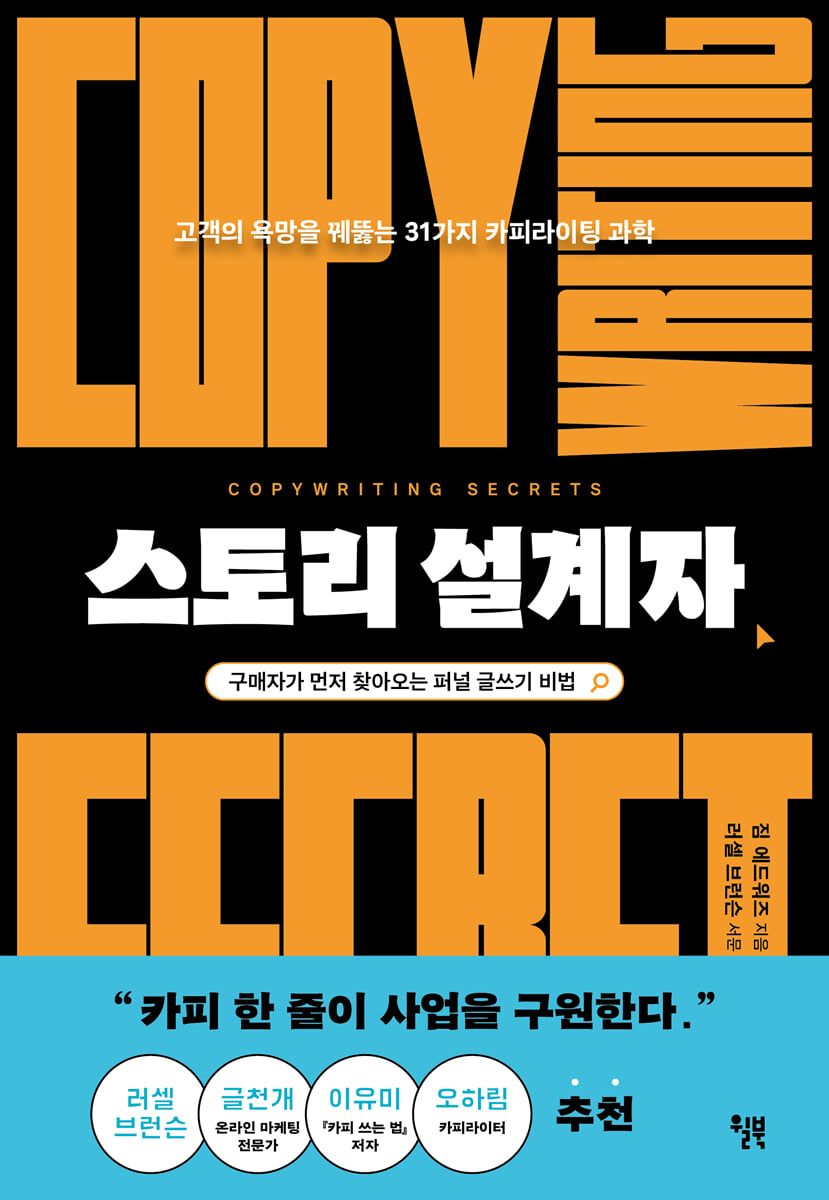
Story Designer
 |
Description
Book Introduction
*** 31 Copywriting Skills to Instantly Capture Your Customers' Hearts *** Highly recommended by Russell Brunson, 'Marketing Designer', online marketing expert Geulcheongae, and copywriters Lee Yumi and Oh Harim. *** "A dense collection of logical arguments, informative stories, and strategies that can be applied directly to practice." *** The fourth volume in the online business bible series, "Science of Startups," which began with "Marketing Designer." "The product is so great, why isn't it selling?" The most unsettling moment for business owners is when their confidence in their product doesn't translate into sales. The root of the problem isn't quality or price, but sales copywriting! A book has been published that will instantly solve this problem. This is the new book, "The Story Designer," by Jim Edwards, who, along with Russell Brunson, author of "The Marketing Designer," has helped thousands of entrepreneurs earn tens of millions of dollars by selling products, coaching, and software. Does my product truly excite customers? The 1% most businesses lack, and the key to making big money, is the ability to create a compelling desire in customers that compels them to buy. A one-page promotional site, a 10-minute promotional video, and ultimately, a single line of copy can make or break a business. This book presents 31 secrets that anyone can use to easily write copy, even if they have never held a pen before. “Copywriting is about composition and strategy.” The reason many people struggle with copywriting is because they try to write “just like” ordinary writing. The author says that before you just try to write copy, you need to get started. First, you need to understand that copy is a combination of many elements, from the headline to the call to action (CTA), and that there are patterns and formulas. This book introduces various strategies, such as 'headline templates', 'creating a customer avatar, FRED', and 'stealth closing'. In conclusion, the author answers questions frequently asked during actual lectures one by one. "Is fear-based negative copy more effective at converting customers than positive copy?" "How quickly should I get my product to customers after launch?" This book goes beyond simple copywriting to teach sales itself. Here you'll learn how to apply sales techniques in writing and speaking, and how to drive customer action—from clicks and site visits to form completions and phone calls to purchases. |
- You can preview some of the book's contents.
Preview
index
Praise poured in for this book
Introduction | The Art of Persuasion: Opening Wallets - Russell Brunson
introduction
PART 1.
Mindset: The Difference Between Copywriting and Ordinary Writing
SECRET 1 What is copywriting?
SECRET 2 Life-Changing Sales Copy
SECRET 3 10 Strong Reasons to Buy
SECRET 4 Customers Don't Care About You
SECRET 5 Copywriting Mindset
PART 2.
Mastering the Pattern: A Copy Formula Anyone Can Follow
SECRET 6 Headline Template
SECRET 7 Hot/Warm/Cold Traffic Sources
SECRET 8 FRED
SECRET 9 Bullet Formula
The Real Reason to Open a SECRET 10 Wallet
SECRET 11 A/B Split Testing
SECRET 12 Market Research
SECRET 13 Customer-Centric Conversations
SECRET 14 Useful Strategies When You Don't Have a Recommender
SECRET 15 3 Sales Formulas That Never Fail
PART 3.
Implementing a Strategy: You Can't Make Money by Being Half-assed
SECRET 16 Effective Sales Letter Format
SECRET 17 13 Elements of a Sales Letter
SECRET 18 Email Teaser
SECRET 19 Draft Writing
SECRET 20 Story
SECRET 21 Loved or Hated
SECRET 22 Product Promise
SECRET 23 Fixing Bad Copy
SECRET 24 Negative Strategy
SECRET 25 Stealth Closing
PART 4.
Going further: Get into your customer's mind.
SECRET 26: The Reality of Copywriting Outsourcing
SECRET 27 The Magic Desk
SECRET 28 The Purpose of Online Advertising
SECRET 29 Hook Point
SECRET 30 Swipe File
SECRET 31 Copy Refining
Conclusion: Everything You Need to Know About Sales Copywriting
Introduction | The Art of Persuasion: Opening Wallets - Russell Brunson
introduction
PART 1.
Mindset: The Difference Between Copywriting and Ordinary Writing
SECRET 1 What is copywriting?
SECRET 2 Life-Changing Sales Copy
SECRET 3 10 Strong Reasons to Buy
SECRET 4 Customers Don't Care About You
SECRET 5 Copywriting Mindset
PART 2.
Mastering the Pattern: A Copy Formula Anyone Can Follow
SECRET 6 Headline Template
SECRET 7 Hot/Warm/Cold Traffic Sources
SECRET 8 FRED
SECRET 9 Bullet Formula
The Real Reason to Open a SECRET 10 Wallet
SECRET 11 A/B Split Testing
SECRET 12 Market Research
SECRET 13 Customer-Centric Conversations
SECRET 14 Useful Strategies When You Don't Have a Recommender
SECRET 15 3 Sales Formulas That Never Fail
PART 3.
Implementing a Strategy: You Can't Make Money by Being Half-assed
SECRET 16 Effective Sales Letter Format
SECRET 17 13 Elements of a Sales Letter
SECRET 18 Email Teaser
SECRET 19 Draft Writing
SECRET 20 Story
SECRET 21 Loved or Hated
SECRET 22 Product Promise
SECRET 23 Fixing Bad Copy
SECRET 24 Negative Strategy
SECRET 25 Stealth Closing
PART 4.
Going further: Get into your customer's mind.
SECRET 26: The Reality of Copywriting Outsourcing
SECRET 27 The Magic Desk
SECRET 28 The Purpose of Online Advertising
SECRET 29 Hook Point
SECRET 30 Swipe File
SECRET 31 Copy Refining
Conclusion: Everything You Need to Know About Sales Copywriting
Detailed image

Into the book
How do you grab people's attention? How do you make them read without it feeling like a sales pitch? You have to address their fears.
Desire must be touched.
You have to use the language they use.
It should feel like you're talking to a friend or trusted advisor.
--- p.21, from 「SECRET 1: What is Copywriting?」
The third effective headline template that grabs people's attention is the one that mentions 'mistakes.'
People are terribly afraid of making mistakes.
In school we learn that mistakes are bad.
If you make a mistake on a test, you will get a bad grade.
It's understandable why people get so worked up over mistakes! You can capitalize on this by creating headlines that clearly identify the mistake and grab people's attention.
--- p.61, from 「SECRET 6: Headline Template」
Understanding your audience is more about figuring out who to exclude than who to include.
I'd rather reach 10,000 people with a focused, specific sales message than spend a fortune on sales copy for a product they won't buy to 100,000 people who are only mildly interested.
--- p.78, from 「SECRET 8: FRED」
People who write 5-star reviews are often just enthusiastic fans, while 1-star reviewers are usually dissatisfied know-it-alls.
Two-, three-, and four-star reviewers are the most helpful because they write descriptions like, "I like this because it's good, but I'm not happy because it's not like this."
Taking these people's opinions into account can help you write your sales copy.
--- p.118, from 「SECRET 12: Market Research」
Most customers come across sales letters in a slightly hypnotic state.
I can barely focus on what you're saying, what you're showing, or what's written.
Most people are lost in thoughts like, 'I wonder what's on X' or 'What should I have for dinner?'
At this point you need to shock people into stopping what they are doing and focusing on you.
--- p.158, from "SECRET 17: 13 Elements of a Sales Letter"
The fourth way to make people "crave" with your content is to show them how to do something themselves or through a painstaking process.
Then you can sell a tool or simple solution that does this for you.
It's like showing someone how to dig a well with a shovel and a ladder.
After teaching you the entire process of making a well, he says this at the end.
“Congratulations! You have now mastered the art of digging a well.
“If it’s okay, I’ll explain the machine called an ‘excavator’ for just five minutes.”
--- p.188, from "SECRET 20: Story"
In no case should you tell your customers that they are the reason you did not get the results you wanted.
Of course, the reason people can't lose weight is because they don't think about getting up from the table before grabbing their third cheeseburger.
But I never say it out loud.
I would say this:
“It’s not your fault.
Because of the misinformation you've been receiving, you've been misinformed about the relationship between carbohydrates, proteins, and vegetables.
“If you just change your diet, you will start losing weight.”
--- p.203, from "SECRET 22: Product Promise"
Your offer should look like it's selling a product worth a few dollars for a few tens of cents.
I want you to think like this.
Someone said, “I’ll sell you dollar bills for 10 cents each, and you’ll get whatever you want.
If you were to ask, “How much would you like to buy?” you would answer, “As much as possible.”
We need to make our customers feel exactly like this.
--- p.215, from "SECRET 23: Fixing Bad Copy"
Everyone in the world has their thoughts tuned to the frequency of just one radio station.
The station's call sign is WIIFM, which stands for "What's In It For Me?"
Your ability to tune into the frequency of these radio stations has a tremendous impact on whether you succeed or fail in life.
--- p.244, from 「SECRET 27: The Magic Desk」
The sole purpose of online advertising is to get your target audience to stop what they're doing and click.
Besides this, all the other weird people who say things like online advertising is branding and such are not true.
The sole purpose of online advertising is to capture the attention of your target audience and get them to click.
--- p.255, from 「SECRET 28: The Purpose of Online Advertising」
A unique strength (USP) is a concept that describes what differentiates your product or service from other similar items.
The hook is a very short story that piques curiosity about this distinguishing element.
Let me give you an example.
If the USP is '90 percent of long drive problems can be fixed with a 3-minute video', the hook would be 'One-legged golfer surpasses Tiger Woods' driving distance record'.
--- p.268, from 「SECRET 29: Hook Point」
If possible, you should create a perfect proposal before you even create a product to sell.
When writing copy for an already finished product, critical thinking often pops up and asks, "Is this true?"
I much prefer to create a really great offer and great sales copy, and then build a product that meets or even surpasses it.
At this point, the copy becomes a blueprint for product creation, not a product description.
Desire must be touched.
You have to use the language they use.
It should feel like you're talking to a friend or trusted advisor.
--- p.21, from 「SECRET 1: What is Copywriting?」
The third effective headline template that grabs people's attention is the one that mentions 'mistakes.'
People are terribly afraid of making mistakes.
In school we learn that mistakes are bad.
If you make a mistake on a test, you will get a bad grade.
It's understandable why people get so worked up over mistakes! You can capitalize on this by creating headlines that clearly identify the mistake and grab people's attention.
--- p.61, from 「SECRET 6: Headline Template」
Understanding your audience is more about figuring out who to exclude than who to include.
I'd rather reach 10,000 people with a focused, specific sales message than spend a fortune on sales copy for a product they won't buy to 100,000 people who are only mildly interested.
--- p.78, from 「SECRET 8: FRED」
People who write 5-star reviews are often just enthusiastic fans, while 1-star reviewers are usually dissatisfied know-it-alls.
Two-, three-, and four-star reviewers are the most helpful because they write descriptions like, "I like this because it's good, but I'm not happy because it's not like this."
Taking these people's opinions into account can help you write your sales copy.
--- p.118, from 「SECRET 12: Market Research」
Most customers come across sales letters in a slightly hypnotic state.
I can barely focus on what you're saying, what you're showing, or what's written.
Most people are lost in thoughts like, 'I wonder what's on X' or 'What should I have for dinner?'
At this point you need to shock people into stopping what they are doing and focusing on you.
--- p.158, from "SECRET 17: 13 Elements of a Sales Letter"
The fourth way to make people "crave" with your content is to show them how to do something themselves or through a painstaking process.
Then you can sell a tool or simple solution that does this for you.
It's like showing someone how to dig a well with a shovel and a ladder.
After teaching you the entire process of making a well, he says this at the end.
“Congratulations! You have now mastered the art of digging a well.
“If it’s okay, I’ll explain the machine called an ‘excavator’ for just five minutes.”
--- p.188, from "SECRET 20: Story"
In no case should you tell your customers that they are the reason you did not get the results you wanted.
Of course, the reason people can't lose weight is because they don't think about getting up from the table before grabbing their third cheeseburger.
But I never say it out loud.
I would say this:
“It’s not your fault.
Because of the misinformation you've been receiving, you've been misinformed about the relationship between carbohydrates, proteins, and vegetables.
“If you just change your diet, you will start losing weight.”
--- p.203, from "SECRET 22: Product Promise"
Your offer should look like it's selling a product worth a few dollars for a few tens of cents.
I want you to think like this.
Someone said, “I’ll sell you dollar bills for 10 cents each, and you’ll get whatever you want.
If you were to ask, “How much would you like to buy?” you would answer, “As much as possible.”
We need to make our customers feel exactly like this.
--- p.215, from "SECRET 23: Fixing Bad Copy"
Everyone in the world has their thoughts tuned to the frequency of just one radio station.
The station's call sign is WIIFM, which stands for "What's In It For Me?"
Your ability to tune into the frequency of these radio stations has a tremendous impact on whether you succeed or fail in life.
--- p.244, from 「SECRET 27: The Magic Desk」
The sole purpose of online advertising is to get your target audience to stop what they're doing and click.
Besides this, all the other weird people who say things like online advertising is branding and such are not true.
The sole purpose of online advertising is to capture the attention of your target audience and get them to click.
--- p.255, from 「SECRET 28: The Purpose of Online Advertising」
A unique strength (USP) is a concept that describes what differentiates your product or service from other similar items.
The hook is a very short story that piques curiosity about this distinguishing element.
Let me give you an example.
If the USP is '90 percent of long drive problems can be fixed with a 3-minute video', the hook would be 'One-legged golfer surpasses Tiger Woods' driving distance record'.
--- p.268, from 「SECRET 29: Hook Point」
If possible, you should create a perfect proposal before you even create a product to sell.
When writing copy for an already finished product, critical thinking often pops up and asks, "Is this true?"
I much prefer to create a really great offer and great sales copy, and then build a product that meets or even surpasses it.
At this point, the copy becomes a blueprint for product creation, not a product description.
--- p.289, from "Conclusion: Everything You Need to Know About Sales Copywriting"
Publisher's Review
Will my ad be in the exclusive 0.5%?
The Secret to Copywriting That Gets Customers to Pay Attention and Open Their Wallets First
People are exposed to an average of 193 ads per day.
Most people, as soon as they see the ad, think, 'What is this?
They will just brush it off as an advertisement.
According to research by eyeo, a German online advertising monetization and filtering solutions company, the number of users blocking online ads worldwide is currently 900 million and is continuing to grow, and the resulting loss is expected to reach $54 billion by 2024.
If you're just starting out in business or a novice marketer trying to improve your performance, you're at a significant disadvantage from the start.
Among over 200 ads, what's the key to the one ad that manages to capture customer attention without being ignored, the one that breaks the 0.5 percent barrier? A highly functional product/service? A low price? A tight funnel? A massive list of potential customers? Wrong.
What's needed now is 'sales copywriting' that tells a story that makes people want your product and buy it on their own.
Sales expert Jim Edwards' new book, "The Story Designer," addresses this challenge.
The author was one of the first in the world to sell e-books through an online funnel in 1997, generating huge sales and being featured in major media outlets such as The New York Times and Entrepreneur. He also co-founded the copywriting solution 'Funnel Scripts' with Russell Brunson, author of 'Marketing Architect', and has helped thousands of businesspeople write copy, generating tens of millions of dollars in sales.
This book reveals 31 secrets of copywriting, uncovered through the author's decades of sales experience.
What the copywriting master says
3 Common Mistakes Beginner Entrepreneurs and Marketers Make
1.
Are customers interested in me?: Think back to when you bought something.
What do you care about? You only care if it's worth the money you paid, if you get it when you want it, and if it satisfies your needs.
The seller doesn't care at all whether you had a good day or not.
Therefore, the author advises to shift your perspective to one that is 100 percent customer-centric.
Here's one tip:
Find the words 'I, I, my, we, our' in the copy and change them to 'you, your, your'.
2.
Do people value functionality?: For example, if you ask them to write copy for a power drill, they'll usually write something like this:
18 volt charger, lithium-ion battery, 13 different sizes of bits… .
This is so boring it makes me yawn! This kind of feature should be in the spec sheet.
This book argues that drilling should also be approached emotionally.
“People buy with emotion and rationalize their purchases with reason.” This drill should make you feel cool and competent.
It should also be emotionally charged, such as, “There is a magnet on the front of the drill, so you can avoid accidents where your child gets a screw stuck in their head.”
3.
Create the product first, copywriting later?: The secret to rapidly increasing sales is perfecting the copy before creating the product.
If you write the copy later, you will end up with negative thoughts like, 'Am I exaggerating too much?' and end up glossing over the writing.
Conversely, if you write the copy in advance, it becomes a blueprint for creating the product, not just a manual.
The author explains that this also provides an advantage in discussions with developers and designers.
When developers complain, “That feature is hard to create,” you can confidently say, “We already proposed it to the customer, so we have to implement it somehow!”
This is not a copy book
"The Essential Survival Guide for Today's Businesses and Self-Employed" —Geulcheongae (Online Marketing Expert)
This book actually goes beyond simple copywriting and introduces 31 sales skills.
What is the purpose of online advertising? How does copywriting differ from ordinary writing? By simply following the author's patterns—including problem/complaint/solution, before/after/bridge, and various sales formulas, as well as useful strategies when no testimonials are available—anyone can easily write compelling copy and double or triple their sales.
But there are people who worry about this.
“What I’m selling isn’t the latest, flashiest gadget or influencer talk, but something as insignificant as a plastic stick or a scrap of paper. Can I still put some cool copy on it?” Yes, you can.
Whether the product is great or simple, the rules do not change.
If you follow the contents of the book carefully, you can make customers want your product.
In particular, this book offers useful advice that fits perfectly with today's business reality of 'outsourcing public relations.'
Most companies, even large ones, take it for granted that copywriting should be outsourced.
"I don't write copy because I'm the boss, I'm a designer, I'm a general manager." This article details the problems that these thoughts can cause and how to deal with them.
The conclusion is this.
It is much more efficient to write the copy yourself.
If you have 『Story Designer』, you will acquire the know-how very quickly.
The Secret to Copywriting That Gets Customers to Pay Attention and Open Their Wallets First
People are exposed to an average of 193 ads per day.
Most people, as soon as they see the ad, think, 'What is this?
They will just brush it off as an advertisement.
According to research by eyeo, a German online advertising monetization and filtering solutions company, the number of users blocking online ads worldwide is currently 900 million and is continuing to grow, and the resulting loss is expected to reach $54 billion by 2024.
If you're just starting out in business or a novice marketer trying to improve your performance, you're at a significant disadvantage from the start.
Among over 200 ads, what's the key to the one ad that manages to capture customer attention without being ignored, the one that breaks the 0.5 percent barrier? A highly functional product/service? A low price? A tight funnel? A massive list of potential customers? Wrong.
What's needed now is 'sales copywriting' that tells a story that makes people want your product and buy it on their own.
Sales expert Jim Edwards' new book, "The Story Designer," addresses this challenge.
The author was one of the first in the world to sell e-books through an online funnel in 1997, generating huge sales and being featured in major media outlets such as The New York Times and Entrepreneur. He also co-founded the copywriting solution 'Funnel Scripts' with Russell Brunson, author of 'Marketing Architect', and has helped thousands of businesspeople write copy, generating tens of millions of dollars in sales.
This book reveals 31 secrets of copywriting, uncovered through the author's decades of sales experience.
What the copywriting master says
3 Common Mistakes Beginner Entrepreneurs and Marketers Make
1.
Are customers interested in me?: Think back to when you bought something.
What do you care about? You only care if it's worth the money you paid, if you get it when you want it, and if it satisfies your needs.
The seller doesn't care at all whether you had a good day or not.
Therefore, the author advises to shift your perspective to one that is 100 percent customer-centric.
Here's one tip:
Find the words 'I, I, my, we, our' in the copy and change them to 'you, your, your'.
2.
Do people value functionality?: For example, if you ask them to write copy for a power drill, they'll usually write something like this:
18 volt charger, lithium-ion battery, 13 different sizes of bits… .
This is so boring it makes me yawn! This kind of feature should be in the spec sheet.
This book argues that drilling should also be approached emotionally.
“People buy with emotion and rationalize their purchases with reason.” This drill should make you feel cool and competent.
It should also be emotionally charged, such as, “There is a magnet on the front of the drill, so you can avoid accidents where your child gets a screw stuck in their head.”
3.
Create the product first, copywriting later?: The secret to rapidly increasing sales is perfecting the copy before creating the product.
If you write the copy later, you will end up with negative thoughts like, 'Am I exaggerating too much?' and end up glossing over the writing.
Conversely, if you write the copy in advance, it becomes a blueprint for creating the product, not just a manual.
The author explains that this also provides an advantage in discussions with developers and designers.
When developers complain, “That feature is hard to create,” you can confidently say, “We already proposed it to the customer, so we have to implement it somehow!”
This is not a copy book
"The Essential Survival Guide for Today's Businesses and Self-Employed" —Geulcheongae (Online Marketing Expert)
This book actually goes beyond simple copywriting and introduces 31 sales skills.
What is the purpose of online advertising? How does copywriting differ from ordinary writing? By simply following the author's patterns—including problem/complaint/solution, before/after/bridge, and various sales formulas, as well as useful strategies when no testimonials are available—anyone can easily write compelling copy and double or triple their sales.
But there are people who worry about this.
“What I’m selling isn’t the latest, flashiest gadget or influencer talk, but something as insignificant as a plastic stick or a scrap of paper. Can I still put some cool copy on it?” Yes, you can.
Whether the product is great or simple, the rules do not change.
If you follow the contents of the book carefully, you can make customers want your product.
In particular, this book offers useful advice that fits perfectly with today's business reality of 'outsourcing public relations.'
Most companies, even large ones, take it for granted that copywriting should be outsourced.
"I don't write copy because I'm the boss, I'm a designer, I'm a general manager." This article details the problems that these thoughts can cause and how to deal with them.
The conclusion is this.
It is much more efficient to write the copy yourself.
If you have 『Story Designer』, you will acquire the know-how very quickly.
GOODS SPECIFICS
- Date of issue: August 30, 2024
- Page count, weight, size: 312 pages | 478g | 152*220*20mm
- ISBN13: 9791155817629
- ISBN10: 1155817621
You may also like
카테고리
korean


korean

![ELLE 엘르 스페셜 에디션 A형 : 12월 [2025]](http://librairie.coreenne.fr/cdn/shop/files/b8e27a3de6c9538896439686c6b0e8fb.jpg?v=1766436872&width=3840)


