

Magic Investment Scenario
 |
Description
Book Introduction
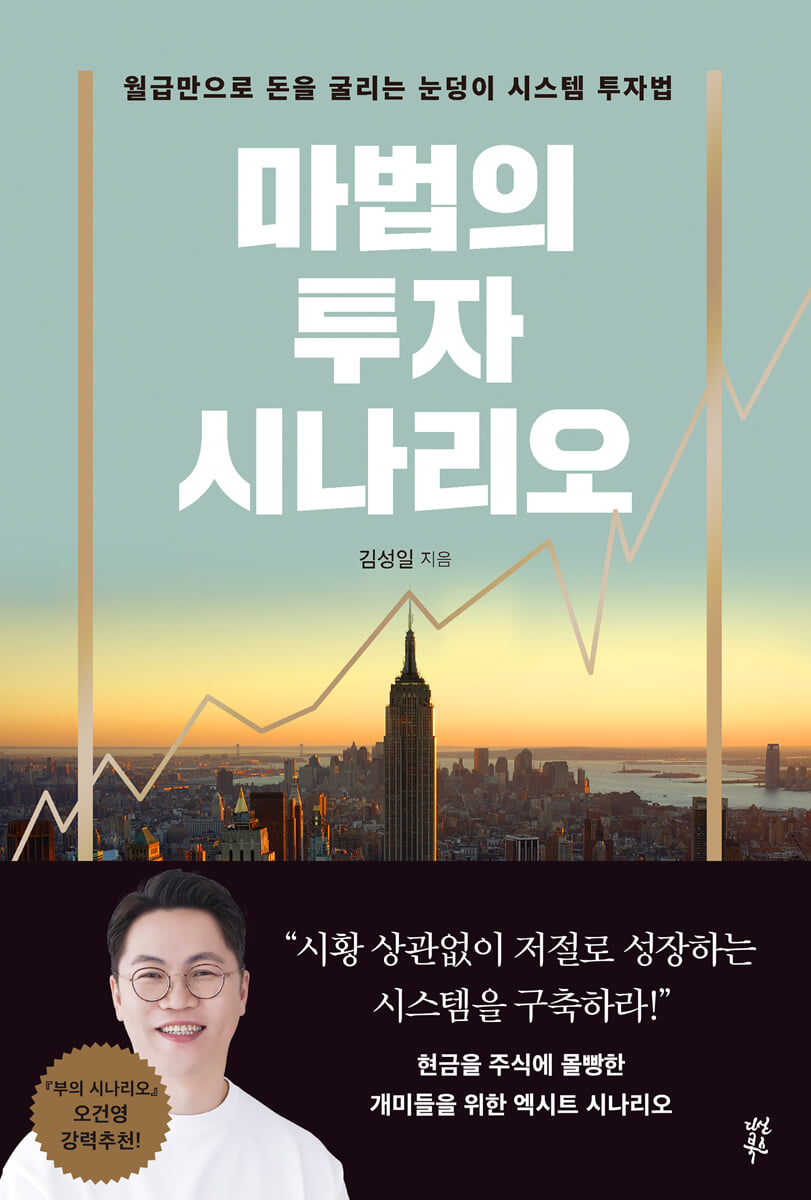
“Growing on its own regardless of market conditions “Build a system!” Exit Scenario for Retailers Who Have Piled Up Cash in Stocks *** Highly recommended by Hong Chun-wook, Oh Geon-young, Hong Jin-chae, and Kang Hwan-guk *** The latest work by Kim Seong-il, author of 『Magic Money Rolling』 and 『Magic Pension Rolling』 Kim Seong-il, author of 『Magic Money Rolling』 and 『Magic Pension Rolling』, has returned after three years with 『Magic Investment Scenario』, a book that contains the 'snowball system investment method' for ordinary individual investors whose money is tied up in investment assets such as real estate and stocks. Among the self-proclaimed investment experts who have boasted over the past few years that they can predict the future of the investment market, the author's "portfolio investment strategy" is fully contained, as he has quietly continued to invest, generating steady returns of around 8% per year even during the worst bear market of all time. How did the author maintain annual returns of over 8%, regardless of market conditions, even amidst challenging investment environments like inflation, interest rate hikes, and prolonged recession? This book offers a proven portfolio investment strategy encompassing all major investment markets—Korean stocks, U.S. stocks, Korean government bonds, U.S. Treasury bonds, cash equivalents, and gold—and explains it in an easy-to-understand, scenario-like manner. If you're an investor who, swept up in the surrounding atmosphere during the record-breaking bull market of the past few years, invested all your assets in stocks and suffered huge losses, or if your money was tied up in an account under duress, the author's "magic investment scenario" in this book will help you learn how to consistently generate profits with peace of mind, regardless of economic conditions. |
- You can preview some of the book's contents.
Preview
index
Intro_ Don't try to predict the market!
Prologue: If you only have 1 million won, now is the time to draw up an investment scenario.
Part 1: Question Your Investment Style
[Investment Myths We've Believe So Firmly]
“No matter what, a savings account is the safest, right?”
The First Investment Lie: To You Who Said You Could Never Fail
[Superstition 1] Blue Chip Stocks - Long-term Investing in 'Major Stocks'?
[Superstition 2] Dividend Stocks - Prepare for retirement with stable, high dividends?
[Myth 3] US Stocks - Anyone can become rich if they just hold onto their investments for 10 years?
The Second Investment Lie: To You Who Said, "I'm Above Average"
[Superstition 4] Accumulated Investment - The 'Accumulated' Investment You Know Is Not Accumulated Investment
[Superstition 5] Seed money - Don't invest until you have saved 100 million won?
[Myth 6] Short-term investment - 'Short-term' investment yields better returns than 'long-term' investment?
The Third Investing Lie: For Those Who Believe They Can Beat the Market
[Superstition 7] Trend_ Can you really make money if you know the theme stocks before others?
[Superstition 8] Technical Analysis - Can you see a 'pattern' when you look at a chart?
[Superstition 9] Expert_ Find a trustworthy investment mentor?
[Superstition 10] AI Investment - Just as AlphaGo beat Lee Sedol, AI is also good at investing?
The Fourth Investment Lie: For Those Who Want to Take Shortcuts
[Superstition 11] Debt-to-Leverage to Become Independent from Your Salary?
[Superstition 12] Timing - Find the best trading moment?
[Superstition 13] Future Prediction: How Accurate Are Securities Firms' Market Forecasts?
The second system does not betray
[6 Magical Investment Scenarios for Attracting Wealth Without Worrying About Market Conditions]
“Is there a way to invest with peace of mind, without being swayed by the market?”
System One: Six Key Scenarios for Diversification
[Scenario 1] Negative and Positive Correlations: Focus on the "Chemistry" Between Assets
*Heroes' party play × correlation
[Scenario 2] 6040 Portfolio - Simplicity is Power
*First and Second Heroes × Stocks and Bonds
[Scenario 3] Jewish Trichotomy: Cash is Not Trash
*Third Hero × Cash Asset
[Scenario 4] Permanent Portfolio - A Savior to Protect Your Assets Until the Last Moment
*Fourth Hero × Gold
[Scenario 5] GAA Portfolio: Invest in both the US and Korea.
*Heroes' first ultimate move × Global investment
[Scenario 6] K-GAA Portfolio: Link the benefits of a strong dollar to your portfolio.
*Heroes' second ultimate attack × Illusion exposure
Part 3: There is no such thing as a second failure.
[10 Exit Scenarios to Rebuild Collapsed Assets]
“Is it okay to start investing at a time like this?”
Second System: Two Scenarios for Different Investment Situations
[Scenario 7] Responding to High Prices: An Investment Method for Making Money Even in High Prices Like the 1970s and 1980s
[Scenario 8] Preparing for a Long-Term Recession: A Safe Portfolio Unaffected by the "Lost 20 Years"
Third System: Four Scenarios Based on Investor Inclination
[Scenario 9] Offensive: How to Use Leverage Wisely
[Scenario 10] Stable: Choose from three portfolios based on your risk tolerance.
[Scenario 11] Retirement Planning - Investing 500,000 Won a Month and Earning 1.87 Million Won a Month for Life
[Scenario 12] Office Worker: An Investment Method That Benefits from Diversification in Minimal Time
Fourth System: Two Proven Scenarios with Successful References
[Scenario 13] Super Portfolio - Investing as easily as adjusting ramen water with Tobin's Separation Theorem
[Scenario 14] US Asset Allocation ETFs and Global Pension Funds: How Will Global Portfolios Worth Billions of Dollars Perform?
System Five: Two Scenarios for Maximizing Profitability
[Scenario 15] Pension System: Building a Tax-Saving Portfolio with Pension Savings Funds and IRP Accounts
[Scenario 16] Rebalancing: A Simple Way to Turn Market Volatility to Your Side
Appendix_ How to Calculate My 'True Return'
Prologue: If you only have 1 million won, now is the time to draw up an investment scenario.
Part 1: Question Your Investment Style
[Investment Myths We've Believe So Firmly]
“No matter what, a savings account is the safest, right?”
The First Investment Lie: To You Who Said You Could Never Fail
[Superstition 1] Blue Chip Stocks - Long-term Investing in 'Major Stocks'?
[Superstition 2] Dividend Stocks - Prepare for retirement with stable, high dividends?
[Myth 3] US Stocks - Anyone can become rich if they just hold onto their investments for 10 years?
The Second Investment Lie: To You Who Said, "I'm Above Average"
[Superstition 4] Accumulated Investment - The 'Accumulated' Investment You Know Is Not Accumulated Investment
[Superstition 5] Seed money - Don't invest until you have saved 100 million won?
[Myth 6] Short-term investment - 'Short-term' investment yields better returns than 'long-term' investment?
The Third Investing Lie: For Those Who Believe They Can Beat the Market
[Superstition 7] Trend_ Can you really make money if you know the theme stocks before others?
[Superstition 8] Technical Analysis - Can you see a 'pattern' when you look at a chart?
[Superstition 9] Expert_ Find a trustworthy investment mentor?
[Superstition 10] AI Investment - Just as AlphaGo beat Lee Sedol, AI is also good at investing?
The Fourth Investment Lie: For Those Who Want to Take Shortcuts
[Superstition 11] Debt-to-Leverage to Become Independent from Your Salary?
[Superstition 12] Timing - Find the best trading moment?
[Superstition 13] Future Prediction: How Accurate Are Securities Firms' Market Forecasts?
The second system does not betray
[6 Magical Investment Scenarios for Attracting Wealth Without Worrying About Market Conditions]
“Is there a way to invest with peace of mind, without being swayed by the market?”
System One: Six Key Scenarios for Diversification
[Scenario 1] Negative and Positive Correlations: Focus on the "Chemistry" Between Assets
*Heroes' party play × correlation
[Scenario 2] 6040 Portfolio - Simplicity is Power
*First and Second Heroes × Stocks and Bonds
[Scenario 3] Jewish Trichotomy: Cash is Not Trash
*Third Hero × Cash Asset
[Scenario 4] Permanent Portfolio - A Savior to Protect Your Assets Until the Last Moment
*Fourth Hero × Gold
[Scenario 5] GAA Portfolio: Invest in both the US and Korea.
*Heroes' first ultimate move × Global investment
[Scenario 6] K-GAA Portfolio: Link the benefits of a strong dollar to your portfolio.
*Heroes' second ultimate attack × Illusion exposure
Part 3: There is no such thing as a second failure.
[10 Exit Scenarios to Rebuild Collapsed Assets]
“Is it okay to start investing at a time like this?”
Second System: Two Scenarios for Different Investment Situations
[Scenario 7] Responding to High Prices: An Investment Method for Making Money Even in High Prices Like the 1970s and 1980s
[Scenario 8] Preparing for a Long-Term Recession: A Safe Portfolio Unaffected by the "Lost 20 Years"
Third System: Four Scenarios Based on Investor Inclination
[Scenario 9] Offensive: How to Use Leverage Wisely
[Scenario 10] Stable: Choose from three portfolios based on your risk tolerance.
[Scenario 11] Retirement Planning - Investing 500,000 Won a Month and Earning 1.87 Million Won a Month for Life
[Scenario 12] Office Worker: An Investment Method That Benefits from Diversification in Minimal Time
Fourth System: Two Proven Scenarios with Successful References
[Scenario 13] Super Portfolio - Investing as easily as adjusting ramen water with Tobin's Separation Theorem
[Scenario 14] US Asset Allocation ETFs and Global Pension Funds: How Will Global Portfolios Worth Billions of Dollars Perform?
System Five: Two Scenarios for Maximizing Profitability
[Scenario 15] Pension System: Building a Tax-Saving Portfolio with Pension Savings Funds and IRP Accounts
[Scenario 16] Rebalancing: A Simple Way to Turn Market Volatility to Your Side
Appendix_ How to Calculate My 'True Return'
Detailed image

Into the book
The problem is human nature.
Many market predictions are short-term and often in line with human nature, making them easily accepted, but predictions are often distant or inconvenient truths.
The human brain deliberately closes its eyes to truths it finds uncomfortable to accept, even if they are absolutely necessary for protecting one's life and safety.
The human brain, which is a protein tissue weighing 1500g, is lazy and readily accepts information similar to what it normally thinks.
Because it's comfortable.
However, even if it is a fact that is absolutely necessary to protect life and property, if it is an inconvenient truth, we turn away from it.
---From "Intro, Don't Try to Predict the Market"
Have you ever played tennis or table tennis? In amateur table tennis or tennis, the team that wins isn't the one with the flashy, powerful attack, but the one that minimizes mistakes and effectively returns the ball to the opponent.
In the world of investing, where there is no such thing as a true professional, most players are amateurs.
In other words, simply reducing mistakes can significantly improve investment performance.
---From "Prologue: If You Have Just 1 Million Won, Now Is the Time to Draw Up an Investment Scenario"
But will the future of Apple and Samsung Electronics be the same as it is now? Will the current leader remain the leader in the future? Will these companies still be in the market 20 to 30 years from now? Will investing in them increase my returns? As mentioned earlier, Nokia's market share was 30%, significantly higher than that of Samsung Electronics or Apple.
Nokia held the world's top spot for a whopping 13 years before it folded its mobile business.
(...) What if you had invested in Nokia, the world's leading and blue-chip stock, and held onto it for the long term? If someone had bought and held Nokia stock in January 1999, they would have lost 35% of their initial investment by the end of December 2021.
Even if you had entered at the previous high in April 2000, you would have been recording a loss of -84%.
---From "Part 1, Blue Chip Stocks_ Should I Invest Long-Term in 'Major Stocks'?"
If a person with a seed capital of 10 million won invests for 30 years at an annual return of 10%, their balance will grow to 174 million won.
This is a larger amount than the 130 million won that a person with a seed capital of 50 million won would earn over 10 years with an annual return of 10%, and it is also a larger amount than the 167 million won that a person who started with 40 million won would earn over 15 years.
A larger amount of wealth is created when the investment period is three times longer than when the seed money is five times larger, and a larger amount of wealth is created when the investment period is twice as long than when the seed money is four times larger.
In other words, the length of the investment period is more important than the size of the seed money.
---From "Part 1, 100 million won in seed money_ Don't invest before saving up a lump sum?"
Even in the realm of investing, there are stories of animals that are better than humans.
In 2000, the European edition of the Wall Street Journal published an interesting article.
This study compared the returns on recommended stocks of three groups: a group of investment experts, a group of amateur stock investors, and monkeys, four times over the course of one year from July 1999.
As a result, it is said that the monkey group took the lead.
The monkeys chose the game by throwing darts, and when the returns were converted to points, the monkeys performed the best with 11.4%, while the experts recorded -13.6% and the amateurs recorded -124.6%.
---From "Part 1, Future Forecasting_ How Accurate Are Securities Firms' Market Forecasts?"
Asset allocation investing is a beneficial investment method for working professionals who find it difficult to devote a lot of time to studying investments.
It is also helpful for those who have difficulty predicting market timing or responding immediately.
Because it requires little investment, has low volatility, and offers a reasonable level of return, it is also suitable for managing long-term funds such as retirement pensions or housing funds.
Of course, it is difficult to experience the direct and intense joy of shooting a harpoon.
Also, you can't feel the pleasure of fishing.
But you can 'continuously' catch delicious fish with a steady and steady income.
---From Part 2, “Is there a way to invest with peace of mind without being swayed by the market?”
From 2000 to 2021, the K-GAA portfolio experienced a loss only once in 22 years, in 2018.
Even so, the loss was very small at -0.2% per annum.
For the other portfolios, the GAA portfolio had three years of losses, the Permanent portfolio had six years, the Jewish portfolio had three years, and the 6040 portfolio had four years.
When viewed on an annual basis, the largest losses by portfolio were -7% for the GAA portfolio and the permanent portfolio, -8% for the Jewish portfolio, and -24% for the 6040 portfolio, but the K-GAA portfolio only recorded -3%.
You can see how superior the K-GAA portfolio is in comparison.
---From "Part 2, K-GAA Portfolio_ Connect the Benefits of a Strong Dollar to Your Portfolio"
If you continue to invest the amount you receive as a tax deduction each year in your IRP account, you will accumulate a substantial amount of money.
At age 60, 606.72 million won will be accumulated in the pension savings fund account alone, and 114.37 million won will be accumulated in the IRP account, resulting in a combined retirement fund of 721.09 million won.
This is equivalent to 369.75 million won in present value, which is equivalent to receiving 22.56 million won annually from the age of 60 to 90.
This means that you will have 1.88 million won available for living expenses every month.
---From "Part 3, Retirement Planning_ A Scenario for Earning 1.87 Million Won Per Month for Life with a Monthly Investment of 500,000 Won"
To summarize this method very briefly, it is like 'adjusting the water in ramen'.
The recipe on the back of the ramen package is a 'super recipe' that the ramen company has researched to make the ramen most delicious.
My eldest child, a middle school student, said that the ramen I cooked according to this super recipe was a little spicy, while my second child, an elementary school student, said that it was very spicy.
So for the kids, I add a little bit of water to the first one and more water to the second one.
If you add just the right amount of water, children will find the ramen less spicy and enjoy it more.
In this way, the spiciness of an investment portfolio can also be adjusted.
By adjusting the proportion of ‘cash assets’ as if adjusting water.
Many market predictions are short-term and often in line with human nature, making them easily accepted, but predictions are often distant or inconvenient truths.
The human brain deliberately closes its eyes to truths it finds uncomfortable to accept, even if they are absolutely necessary for protecting one's life and safety.
The human brain, which is a protein tissue weighing 1500g, is lazy and readily accepts information similar to what it normally thinks.
Because it's comfortable.
However, even if it is a fact that is absolutely necessary to protect life and property, if it is an inconvenient truth, we turn away from it.
---From "Intro, Don't Try to Predict the Market"
Have you ever played tennis or table tennis? In amateur table tennis or tennis, the team that wins isn't the one with the flashy, powerful attack, but the one that minimizes mistakes and effectively returns the ball to the opponent.
In the world of investing, where there is no such thing as a true professional, most players are amateurs.
In other words, simply reducing mistakes can significantly improve investment performance.
---From "Prologue: If You Have Just 1 Million Won, Now Is the Time to Draw Up an Investment Scenario"
But will the future of Apple and Samsung Electronics be the same as it is now? Will the current leader remain the leader in the future? Will these companies still be in the market 20 to 30 years from now? Will investing in them increase my returns? As mentioned earlier, Nokia's market share was 30%, significantly higher than that of Samsung Electronics or Apple.
Nokia held the world's top spot for a whopping 13 years before it folded its mobile business.
(...) What if you had invested in Nokia, the world's leading and blue-chip stock, and held onto it for the long term? If someone had bought and held Nokia stock in January 1999, they would have lost 35% of their initial investment by the end of December 2021.
Even if you had entered at the previous high in April 2000, you would have been recording a loss of -84%.
---From "Part 1, Blue Chip Stocks_ Should I Invest Long-Term in 'Major Stocks'?"
If a person with a seed capital of 10 million won invests for 30 years at an annual return of 10%, their balance will grow to 174 million won.
This is a larger amount than the 130 million won that a person with a seed capital of 50 million won would earn over 10 years with an annual return of 10%, and it is also a larger amount than the 167 million won that a person who started with 40 million won would earn over 15 years.
A larger amount of wealth is created when the investment period is three times longer than when the seed money is five times larger, and a larger amount of wealth is created when the investment period is twice as long than when the seed money is four times larger.
In other words, the length of the investment period is more important than the size of the seed money.
---From "Part 1, 100 million won in seed money_ Don't invest before saving up a lump sum?"
Even in the realm of investing, there are stories of animals that are better than humans.
In 2000, the European edition of the Wall Street Journal published an interesting article.
This study compared the returns on recommended stocks of three groups: a group of investment experts, a group of amateur stock investors, and monkeys, four times over the course of one year from July 1999.
As a result, it is said that the monkey group took the lead.
The monkeys chose the game by throwing darts, and when the returns were converted to points, the monkeys performed the best with 11.4%, while the experts recorded -13.6% and the amateurs recorded -124.6%.
---From "Part 1, Future Forecasting_ How Accurate Are Securities Firms' Market Forecasts?"
Asset allocation investing is a beneficial investment method for working professionals who find it difficult to devote a lot of time to studying investments.
It is also helpful for those who have difficulty predicting market timing or responding immediately.
Because it requires little investment, has low volatility, and offers a reasonable level of return, it is also suitable for managing long-term funds such as retirement pensions or housing funds.
Of course, it is difficult to experience the direct and intense joy of shooting a harpoon.
Also, you can't feel the pleasure of fishing.
But you can 'continuously' catch delicious fish with a steady and steady income.
---From Part 2, “Is there a way to invest with peace of mind without being swayed by the market?”
From 2000 to 2021, the K-GAA portfolio experienced a loss only once in 22 years, in 2018.
Even so, the loss was very small at -0.2% per annum.
For the other portfolios, the GAA portfolio had three years of losses, the Permanent portfolio had six years, the Jewish portfolio had three years, and the 6040 portfolio had four years.
When viewed on an annual basis, the largest losses by portfolio were -7% for the GAA portfolio and the permanent portfolio, -8% for the Jewish portfolio, and -24% for the 6040 portfolio, but the K-GAA portfolio only recorded -3%.
You can see how superior the K-GAA portfolio is in comparison.
---From "Part 2, K-GAA Portfolio_ Connect the Benefits of a Strong Dollar to Your Portfolio"
If you continue to invest the amount you receive as a tax deduction each year in your IRP account, you will accumulate a substantial amount of money.
At age 60, 606.72 million won will be accumulated in the pension savings fund account alone, and 114.37 million won will be accumulated in the IRP account, resulting in a combined retirement fund of 721.09 million won.
This is equivalent to 369.75 million won in present value, which is equivalent to receiving 22.56 million won annually from the age of 60 to 90.
This means that you will have 1.88 million won available for living expenses every month.
---From "Part 3, Retirement Planning_ A Scenario for Earning 1.87 Million Won Per Month for Life with a Monthly Investment of 500,000 Won"
To summarize this method very briefly, it is like 'adjusting the water in ramen'.
The recipe on the back of the ramen package is a 'super recipe' that the ramen company has researched to make the ramen most delicious.
My eldest child, a middle school student, said that the ramen I cooked according to this super recipe was a little spicy, while my second child, an elementary school student, said that it was very spicy.
So for the kids, I add a little bit of water to the first one and more water to the second one.
If you add just the right amount of water, children will find the ramen less spicy and enjoy it more.
In this way, the spiciness of an investment portfolio can also be adjusted.
By adjusting the proportion of ‘cash assets’ as if adjusting water.
---From "Part 3, Super Portfolio - Investing as Easily as Adjusting Water in Ramen with 'Tobin's Separation Theorem'"
Publisher's Review
“Your returns are not proportional to your skills!”
Investments that don't make mistakes, investments that don't fail
As you study investing, you will encounter various books and experts.
Some people say to hold the bat short and go for 'short-term', while others advise that investing is always 'long-term'.
We are thrilled by the lectures of those who have made billions of won through actual investments.
But when I actually try to use it for my investments, I feel overwhelmed, unlike the excitement I felt when I first heard about it.
Analyze charts, look at corporate reports, review accounting books… .
At first, you may follow along enthusiastically, but after a few days, you will quickly return to your original state.
Since each investor's situation is different, there are many cases where this cannot be applied at all.
That's why people say investing is difficult.
'When will ○○ Electronics' stock price rise again?' 'Should I enter the US market now?' 'When should I sell the stocks I bought?' Investors always try to predict the market's future to determine the most accurate 'buying and selling timing.'
I search the stocks I buy online and check the stock price window several times a day.
But predicting the future is tiring and painful.
It's not even accurate.
It's especially frustrating when stock prices are falling and stagnating like they are now.
While the majority of investors' accounts recorded negative returns, the author of this book achieved a cumulative return of 35.85% and an annual return of 8.72% over a period of approximately three years and seven months, from January 2019 to August 2022, a period that included the worst bear market in history.
And that's while working at a job and consistently doing your own work, not as a full-time investor.
Even now, the author is comfortably and steadily growing his money, like a snowball rolling by itself, through pension savings funds and IRP accounts.
How was this possible? The author says the secret lies in the "system."
“There are no two failures,
“There is still a chance to call the asset!”
16 Magical Investment Scenarios to Rebuild Your Collapsed Assets
After graduating from engineering school in 2002, the author worked at a startup for a while before getting a job at a bank.
Although it was a state-run bank, I worked in a development department, so I was unfamiliar with finance.
Then, I happened to sign up for a fund, and a year later, when I checked my account, I was shocked.
Because the profit was over 20%.
“Wow, what’s going on!” The author, who had his eye on investing, started studying everything he could find, and despite not even owning a home, invested all of his savings in funds and other investments, achieving great results.
I even told my wife to quit her job.
But in 2007, when the financial markets crashed, the author's account began to crumble.
The initial surge in profits that the author briefly experienced in the early stages of his investment was not due to his own ability, but rather to the market rising and the resulting profits.
The author realized then.
“The distribution I made wasn’t a real distribution.
“It was just a fleeting stroke of luck riding the market!” But I wasn’t discouraged.
From then on, I studied the history of finance again and delved into asset allocation strategies.
As a result, the author, who began to achieve surprisingly stable returns, left his ordinary office job and now works as the Chief Investment Officer at an investment advisory firm.
The author compares investment methods to fishing and divides them into three categories.
There are two investment methods: 'value investing', which involves throwing a fishing hook into the sea and waiting for a fish to bite the bait, and 'momentum investing', which involves targeting a company and investing based on the investor's intuition or inspiration to predict its price, much like shooting a harpoon at a fish.
And the remaining one is the 'diversification method', which involves spreading out a net and letting the fish get caught on their own.
Diversification is beneficial for working professionals who find it difficult to devote significant time to studying investments.
It guarantees steady profits over the long term without the need to predict market timing or respond in real time.
The author was able to safely and comfortably maintain a return of 8% regardless of market conditions through this net investment method, or "system investment."
“Invest even just one second early,
“Time is your most precious asset!”
The safest and most certain way to become rich in the capitalist market
Even among individual investors, each person's economic situation, capital, and financial goals are very different.
So why do we always follow the same investment methods? This book contains 16 diversified investment strategies, presented in scenario format, proven through countless trials and errors and backtests by the author, who lost all his investment assets when the massive economic bubble burst in 2007.
From the 'K-GAA Portfolio' that links the benefits of the strong dollar to your account, to the 'K-GAA Leveraged Portfolio' for aggressive investors, we've laid out scenarios that can be applied to various periods, tendencies, and situations in a person's life.
Investors simply need to select the scenario that best suits their investment circumstances and apply it.
COVID-19, hyperinflation, interest rate hikes, war…
We live in an age where the future is unpredictable.
It's also called a recession when no one looks at the stock market.
However, those who are truly interested in investing and are trained in it do not get carried away by the daily fluctuations of stock prices, but rather focus on long-term, sustainable, "stable returns" rather than "one-shot" gains.
This is why we need a system for our investments.
The author says:
“The question is not speed, but direction.
If you learn the right method, you can build your own portfolio that will lay eggs for a lifetime.” If you are an investor tired of the constant anxiety and insecurity of investing, investing that is driven by a system will free you from the stress of falling behind others and allow you to move forward with investments that are not swayed by noise.
Investments that don't make mistakes, investments that don't fail
As you study investing, you will encounter various books and experts.
Some people say to hold the bat short and go for 'short-term', while others advise that investing is always 'long-term'.
We are thrilled by the lectures of those who have made billions of won through actual investments.
But when I actually try to use it for my investments, I feel overwhelmed, unlike the excitement I felt when I first heard about it.
Analyze charts, look at corporate reports, review accounting books… .
At first, you may follow along enthusiastically, but after a few days, you will quickly return to your original state.
Since each investor's situation is different, there are many cases where this cannot be applied at all.
That's why people say investing is difficult.
'When will ○○ Electronics' stock price rise again?' 'Should I enter the US market now?' 'When should I sell the stocks I bought?' Investors always try to predict the market's future to determine the most accurate 'buying and selling timing.'
I search the stocks I buy online and check the stock price window several times a day.
But predicting the future is tiring and painful.
It's not even accurate.
It's especially frustrating when stock prices are falling and stagnating like they are now.
While the majority of investors' accounts recorded negative returns, the author of this book achieved a cumulative return of 35.85% and an annual return of 8.72% over a period of approximately three years and seven months, from January 2019 to August 2022, a period that included the worst bear market in history.
And that's while working at a job and consistently doing your own work, not as a full-time investor.
Even now, the author is comfortably and steadily growing his money, like a snowball rolling by itself, through pension savings funds and IRP accounts.
How was this possible? The author says the secret lies in the "system."
“There are no two failures,
“There is still a chance to call the asset!”
16 Magical Investment Scenarios to Rebuild Your Collapsed Assets
After graduating from engineering school in 2002, the author worked at a startup for a while before getting a job at a bank.
Although it was a state-run bank, I worked in a development department, so I was unfamiliar with finance.
Then, I happened to sign up for a fund, and a year later, when I checked my account, I was shocked.
Because the profit was over 20%.
“Wow, what’s going on!” The author, who had his eye on investing, started studying everything he could find, and despite not even owning a home, invested all of his savings in funds and other investments, achieving great results.
I even told my wife to quit her job.
But in 2007, when the financial markets crashed, the author's account began to crumble.
The initial surge in profits that the author briefly experienced in the early stages of his investment was not due to his own ability, but rather to the market rising and the resulting profits.
The author realized then.
“The distribution I made wasn’t a real distribution.
“It was just a fleeting stroke of luck riding the market!” But I wasn’t discouraged.
From then on, I studied the history of finance again and delved into asset allocation strategies.
As a result, the author, who began to achieve surprisingly stable returns, left his ordinary office job and now works as the Chief Investment Officer at an investment advisory firm.
The author compares investment methods to fishing and divides them into three categories.
There are two investment methods: 'value investing', which involves throwing a fishing hook into the sea and waiting for a fish to bite the bait, and 'momentum investing', which involves targeting a company and investing based on the investor's intuition or inspiration to predict its price, much like shooting a harpoon at a fish.
And the remaining one is the 'diversification method', which involves spreading out a net and letting the fish get caught on their own.
Diversification is beneficial for working professionals who find it difficult to devote significant time to studying investments.
It guarantees steady profits over the long term without the need to predict market timing or respond in real time.
The author was able to safely and comfortably maintain a return of 8% regardless of market conditions through this net investment method, or "system investment."
“Invest even just one second early,
“Time is your most precious asset!”
The safest and most certain way to become rich in the capitalist market
Even among individual investors, each person's economic situation, capital, and financial goals are very different.
So why do we always follow the same investment methods? This book contains 16 diversified investment strategies, presented in scenario format, proven through countless trials and errors and backtests by the author, who lost all his investment assets when the massive economic bubble burst in 2007.
From the 'K-GAA Portfolio' that links the benefits of the strong dollar to your account, to the 'K-GAA Leveraged Portfolio' for aggressive investors, we've laid out scenarios that can be applied to various periods, tendencies, and situations in a person's life.
Investors simply need to select the scenario that best suits their investment circumstances and apply it.
COVID-19, hyperinflation, interest rate hikes, war…
We live in an age where the future is unpredictable.
It's also called a recession when no one looks at the stock market.
However, those who are truly interested in investing and are trained in it do not get carried away by the daily fluctuations of stock prices, but rather focus on long-term, sustainable, "stable returns" rather than "one-shot" gains.
This is why we need a system for our investments.
The author says:
“The question is not speed, but direction.
If you learn the right method, you can build your own portfolio that will lay eggs for a lifetime.” If you are an investor tired of the constant anxiety and insecurity of investing, investing that is driven by a system will free you from the stress of falling behind others and allow you to move forward with investments that are not swayed by noise.
GOODS SPECIFICS
- Publication date: November 29, 2022
- Page count, weight, size: 388 pages | 680g | 152*225*24mm
- ISBN13: 9791130695402
- ISBN10: 1130695409
You may also like
카테고리
korean


korean

![ELLE 엘르 스페셜 에디션 A형 : 12월 [2025]](http://librairie.coreenne.fr/cdn/shop/files/b8e27a3de6c9538896439686c6b0e8fb.jpg?v=1766436872&width=3840)


