

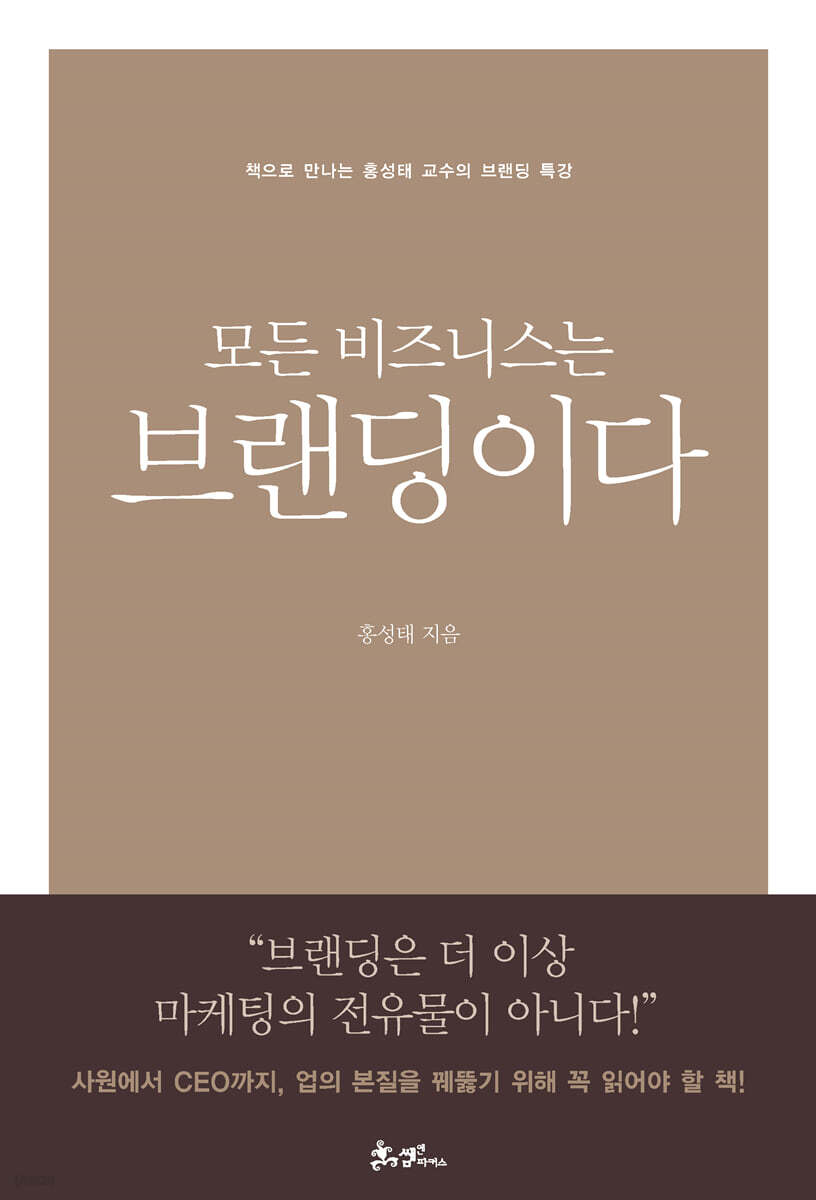
Every business is branding.
 |
Description
Book Introduction
A guide for any business that wants to sell value, not just products!
Brand, branding, personal branding, branding strategy, emotional branding… When you search for the word “branding” on a portal site, a slew of similar-looking related search terms appear.
It is no exaggeration to say that the discourse on brands is already saturated.
The same goes for books about brands.
Perhaps readers of this book may also frown and say, “Again, about brands?”
Because we live in an age where books about brands are overflowing.
However, the importance of a brand cannot be overemphasized.
Moreover, wouldn't it be difficult for even a small neighborhood bakery to survive without a 'brand'?
As the quality of products and services offered by companies becomes so similar that it is difficult to distinguish between superior and inferior, the perception a company creates in the minds of consumers is now determining the success or failure of a company.
It is difficult to survive in the fierce global competition if branding is viewed as nothing more than a simple marketing technique or naming.
Many people know the importance of branding, but there are many cases where they just imitate it without understanding the 'Why'.
This book explains in an easy-to-understand and accessible way how successful companies achieve branding success and why branding is important.
In addition, it covers how to integrate brand concepts into corporate culture, making it helpful for any company seeking to enhance its brand value.
Brand, branding, personal branding, branding strategy, emotional branding… When you search for the word “branding” on a portal site, a slew of similar-looking related search terms appear.
It is no exaggeration to say that the discourse on brands is already saturated.
The same goes for books about brands.
Perhaps readers of this book may also frown and say, “Again, about brands?”
Because we live in an age where books about brands are overflowing.
However, the importance of a brand cannot be overemphasized.
Moreover, wouldn't it be difficult for even a small neighborhood bakery to survive without a 'brand'?
As the quality of products and services offered by companies becomes so similar that it is difficult to distinguish between superior and inferior, the perception a company creates in the minds of consumers is now determining the success or failure of a company.
It is difficult to survive in the fierce global competition if branding is viewed as nothing more than a simple marketing technique or naming.
Many people know the importance of branding, but there are many cases where they just imitate it without understanding the 'Why'.
This book explains in an easy-to-understand and accessible way how successful companies achieve branding success and why branding is important.
In addition, it covers how to integrate brand concepts into corporate culture, making it helpful for any company seeking to enhance its brand value.
- You can preview some of the book's contents.
Preview
index
Every business is branding.
time
Introduction
prolog.
How to win the hearts of consumers
Marketing is a battle of perception, not quality.
- Branding, giving meaning and making it fun
Part 1.
Brand Birth: Imbuing Products with Meaning
Chapter 1.
The essence of business: Customer-Orientation
What are we selling now?
Think about 'why' you buy, not 'what' you buy.
Chapter 2.
Condensation is the key to seeing the essence: Condensation
Find an impactful 'one word'
Just because it's shortened doesn't mean it's condensed.
Chapter 3.
Flowers arise from invisible roots: Creativity
Strategy must lead creativity.
If you want to be creative, learn the basics first.
Chapter 4.
Water wears away at a rock: Continuity
Once you've decided on a concept, stick with it.
Maintain the basics, but constantly change.
Chapter 5.
Lure them with a hamburger and sell them a cola: Combination
Any business needs harmony between items.
Brand extension should be based on the concept.
Chapter 6.
A concept is the mental compass of a business: Consistency
Quantitative goals are not vision.
A good vision contains a concept.
Chapter 7.
A solid concept breeds a sense of ownership: Complementarity
Draw a big picture of the concept
Concepts are the spiritual pillars of a business.
Concluding Part 1.
The concept is the 'soul' of the brand.
Checklist
A product without a concept is like a human being without a soul.
Part 2.
Brand Experience: Adding Fun to Meaning
Chapter 8.
Extrinsic Marketing: Buying More Than Just What You Need
The desire to express social status
The desire to express individuality
The need to feel a sense of belonging
The need for self-satisfaction
The desire to give joy
Chapter 9.
Appeal to the heart, not the head: Emotional Marketing
It is the heart, not the head, that drives action.
How to reach consumers
Appeal to the Eight Emotions
Examples of the use of Paljeong
Find the emotional void
Chapter 10.
Marketers are from Mars, Customers are from Venus: Emotional Marketing
Marketers from Mars
Empathy, the source of attraction that attracts people
Empathy, perception, and communication are the answers.
The Four-Step Process of Empathy
Increase your EQ
Chapter 11.
Beauty is Power: Esthetics Marketing
Aesthetic design, from function to feeling
National competitiveness, design
Design that makes or breaks a business
The design should vary depending on the concept.
Engineering design makes consumer experience easier
Use design as a marketing point
Chapter 12.
Tigers leave their skins, brands leave their stories: Episode Marketing
The story stimulates emotions.
Maximize your message with episodes
Understand the principles of the episode effect
Things to keep in mind when using the story
Story material is everywhere
Chapter 13.
Share your customers' joys and sorrows: Entertainment Marketing
Dig into your customers' daily lives
Values and Lifestyle
Chapter 14.
Infuse Your Brand with Humanity: Ego Marketing
What attracts consumers is personality.
Personality and Persona
Five representative personas
Concluding Part 2.
Turn your eyes to the invisible elements
Checklist
Imagine and practice beyond knowledge.
Epilogue.
Marketing is the magic of happiness
In the end, it all comes down to the mind.
time
Introduction
prolog.
How to win the hearts of consumers
Marketing is a battle of perception, not quality.
- Branding, giving meaning and making it fun
Part 1.
Brand Birth: Imbuing Products with Meaning
Chapter 1.
The essence of business: Customer-Orientation
What are we selling now?
Think about 'why' you buy, not 'what' you buy.
Chapter 2.
Condensation is the key to seeing the essence: Condensation
Find an impactful 'one word'
Just because it's shortened doesn't mean it's condensed.
Chapter 3.
Flowers arise from invisible roots: Creativity
Strategy must lead creativity.
If you want to be creative, learn the basics first.
Chapter 4.
Water wears away at a rock: Continuity
Once you've decided on a concept, stick with it.
Maintain the basics, but constantly change.
Chapter 5.
Lure them with a hamburger and sell them a cola: Combination
Any business needs harmony between items.
Brand extension should be based on the concept.
Chapter 6.
A concept is the mental compass of a business: Consistency
Quantitative goals are not vision.
A good vision contains a concept.
Chapter 7.
A solid concept breeds a sense of ownership: Complementarity
Draw a big picture of the concept
Concepts are the spiritual pillars of a business.
Concluding Part 1.
The concept is the 'soul' of the brand.
Checklist
A product without a concept is like a human being without a soul.
Part 2.
Brand Experience: Adding Fun to Meaning
Chapter 8.
Extrinsic Marketing: Buying More Than Just What You Need
The desire to express social status
The desire to express individuality
The need to feel a sense of belonging
The need for self-satisfaction
The desire to give joy
Chapter 9.
Appeal to the heart, not the head: Emotional Marketing
It is the heart, not the head, that drives action.
How to reach consumers
Appeal to the Eight Emotions
Examples of the use of Paljeong
Find the emotional void
Chapter 10.
Marketers are from Mars, Customers are from Venus: Emotional Marketing
Marketers from Mars
Empathy, the source of attraction that attracts people
Empathy, perception, and communication are the answers.
The Four-Step Process of Empathy
Increase your EQ
Chapter 11.
Beauty is Power: Esthetics Marketing
Aesthetic design, from function to feeling
National competitiveness, design
Design that makes or breaks a business
The design should vary depending on the concept.
Engineering design makes consumer experience easier
Use design as a marketing point
Chapter 12.
Tigers leave their skins, brands leave their stories: Episode Marketing
The story stimulates emotions.
Maximize your message with episodes
Understand the principles of the episode effect
Things to keep in mind when using the story
Story material is everywhere
Chapter 13.
Share your customers' joys and sorrows: Entertainment Marketing
Dig into your customers' daily lives
Values and Lifestyle
Chapter 14.
Infuse Your Brand with Humanity: Ego Marketing
What attracts consumers is personality.
Personality and Persona
Five representative personas
Concluding Part 2.
Turn your eyes to the invisible elements
Checklist
Imagine and practice beyond knowledge.
Epilogue.
Marketing is the magic of happiness
In the end, it all comes down to the mind.
Into the book
Every business is branding.
Ultimately, I think all businesses are a process of branding.
The most important thing to understand about branding is that a brand is a verb, not a noun.
A brand isn't simply a product name; it's a living entity with emotions, something that requires constant management from all employees. From the CEO and executives, to middle managers and even the lowest-ranking employees, it's a crucial element for everyone, regardless of rank, to share a common goal across the company and speak with one voice to consumers.
---From the 'Introductory Note'
These days, most products have similar technological standards, so there isn't much to differentiate them from each other.
Even when it comes to televisions, there isn't much difference between LG and Samsung.
Whether it's a refrigerator or a car, there isn't much difference in quality in a similar price range.
But why do some products sell well while others don't? It's all about brand awareness.
In other words, it is important to set the brand concept and what kind of experience customers have through the brand.
The process of instilling brand awareness in consumers is called 'branding'.
In this book, I will explain seven key elements that are crucial for creating a brand concept and managing a brand experience. --- From the prologue, "How to Enter the Minds of Consumers"
It is said that the following three words are written in large letters at the entrance to the headquarters of Revlon, an American cosmetics company.
“We Sell ____ .
"What do you think is written in the blank space? It probably won't say Cosmetics.
Beauty? Yes.
That's a very plausible answer.
Let's think about the characteristics of the American people here.
Americans often sue over trivial things.
If a woman like Pumpkin Flower puts it on her face and says, 'Aha, Revlon sells beauty...' and it doesn't turn out like a rose, she might sue for it.
If you sell 'beauty' and then sue someone asking why they're not becoming more beautiful, it's going to be a big deal.
At the entrance to this company, it says, “We Sell Hope.”
It's about selling 'expectations and hopes'.
At Revlon, salespeople don't think they're selling cosmetics, which are "chemicals," or "beauty."
“Massage with this product, go to sleep, and wake up in the morning.
“Do you know how smooth and youthful your face looks?” they say, selling ‘hope and expectation.’
If you define the essence of your business from the customer's perspective, the mindset of the employees selling your products will change. --- From "Look at the essence of business from the customer's perspective."
This is what I heard from a planner at an advertising agency.
It seems that the president of the client (advertiser) company liked the advertisement he happened to see on the hotel TV while on a business trip abroad.
Then, he brought the recording tape of the commercial to the agency and asked them to do the same for his company's commercial.
It's not uncommon to see cases like this where strategy is forgotten for a moment and only creative is imitated.
If that happens, marketing will lose its direction and drift.
Great advertisements, product designs, and hit models that are on people's lips are like beautiful flowers that catch people's eyes.
But if you imitate that flower exactly because it is beautiful, it will be nothing more than a dead artificial flower.
Where do flowers come from? They grow from invisible roots.
Flowers are the expression, the creativity.
The root is a strategy.
You can benchmark the strategies that people use to understand why they did something, but you can't succeed by imitating creatives.
When Hyundai Card brought up the issue of design, which was unexpected for a credit card company, many companies tried to imitate it under the name of 'design management.'
However, you cannot succeed by simply imitating without understanding 'why they did it that way.'
It's sad to see companies trying to copy their creativity without even thinking about why the cards are divided into alphabetical, numerical, and color categories. --- From 'Flowers grow from invisible roots'
When you think of a lion, what image comes to mind? Most people picture a lion, its mane billowing, hunting.
When we say 'eagle', we always think of something flying powerfully.
But lions sleep almost all day.
Even when awake, they mostly loiter, only jumping briefly when hunting.
Even eagles sit much more often than they fly.
But the image people have in mind is different.
In this way, people like to remember characteristics.
The same goes for brands.
To become a strong brand, you need to plant the characteristics of your signature product in people's minds.
Because people remember the brand by the concept of the signboard product, that is, the image of the promotional product.
Choco Pie played a major role in Orion's establishment as a confectionery company.
'With the halo effect of the affectionate image, the product line was expanded (brand extension), and now various items such as snacks, biscuits, chocolate, candy, and chicle gum are selling well under the Orion brand. --- From 'Luring with hamburgers and selling cola'
Stimulating desires doesn't necessarily have to be limited to expensive luxury goods.
You know Cheongsimhwan, right? It's a pill made from various herbal medicines, including bezoar and sanyak, and is used as an emergency medicine for conditions like stroke or cerebral apoplexy.
It's a medication we take occasionally, but in which month of the year is demand the highest? It seems demand is higher in November, when it starts to get colder, than in December, which is very cold. But then when do you think sales are the lowest? In extremely hot months like August, demand is actually higher due to heatstroke and other factors, and demand is lowest in May, when the weather starts to warm up.
So, sales would be lowest in May, right? But that's not the case.
If we look at it by month, May has the highest sales.
Why is that?
When grandfather collapses in November, the grandson runs to the pharmacy and buys one or two pills at most.
However, although there is little use for them right now, I buy them in packs of 10 in May to buy as gifts for Parents' Day or Teachers' Day.
When you try to sell something by only thinking about its functionality, a market that wasn't visible before is created.
By looking at wants rather than needs like this, we see new markets.
Marketing can now be seen as an idea game: finding ideas that will stimulate desire.
In the movie "Love Actually," the main character asks the woman he's interested in what she'd like for Christmas.
Then the woman says this.
“Give me what I want, not what I need.”
Isn't this a saying that represents the value of this era as 'want' rather than 'need'? --- From 'You don't buy only what you absolutely need'
The most important thing in design marketing is to effectively utilize design in marketing.
In 2002, when design was a hot issue worldwide, the global economic magazine Forbes ranked luxury brands around the world.
Just getting into this ranking is amazing.
These are luxury brands that most people know.
From Armani in 20th place to Lancome, Johnnie Walker, Louis Vuitton, Mercedes-Benz, Rolex, Chanel, etc… all the well-known luxury brands are there.
But among them, there is one brand that stands out.
The one that took first place is 'Absolut Vodka'.
In fact, Absolute isn't even the best.
There are vodkas that are highly regarded by people in Northern Europe and Russia.
The bottle shape is unique and has a great design.
Unlike other liquor bottles, it doesn't have a paper label attached, but rather the brand is engraved in relief, and the color of the bottle and the letters are beautifully coordinated.
However, it is not true that the unique design of the liquor bottle alone won first place over world-class luxury brands.
They took full advantage of their unique bottle design in their marketing.
Through advertisements such as the Absolut art campaign, city campaign, and seasonal campaign that parodied the shape of bottles, the interest of consumers was greatly aroused.
For example, the city series has piqued people's interest with ingenious advertisements that link the characteristics of each city to the shape of a bottle.
Absolute Edinburgh appears to be an advertisement that utilizes traditional Scottish clothing.
If you go to Amsterdam, you will see the house where Anne Frank lived. If you look closely, you will see that it looks like an Absolut bottle.
In the case of Rome, the famous scooter from the movie “Roman Holiday” was cleverly depicted in the shape of a bottle.
It is no exaggeration to say that Barcelona, Spain, is the city of architect Gaudi.
Absolut Barcelona stands out with its vodka bottles painted in the shape of Gaudí's building murals.
Ultimately, I think all businesses are a process of branding.
The most important thing to understand about branding is that a brand is a verb, not a noun.
A brand isn't simply a product name; it's a living entity with emotions, something that requires constant management from all employees. From the CEO and executives, to middle managers and even the lowest-ranking employees, it's a crucial element for everyone, regardless of rank, to share a common goal across the company and speak with one voice to consumers.
---From the 'Introductory Note'
These days, most products have similar technological standards, so there isn't much to differentiate them from each other.
Even when it comes to televisions, there isn't much difference between LG and Samsung.
Whether it's a refrigerator or a car, there isn't much difference in quality in a similar price range.
But why do some products sell well while others don't? It's all about brand awareness.
In other words, it is important to set the brand concept and what kind of experience customers have through the brand.
The process of instilling brand awareness in consumers is called 'branding'.
In this book, I will explain seven key elements that are crucial for creating a brand concept and managing a brand experience. --- From the prologue, "How to Enter the Minds of Consumers"
It is said that the following three words are written in large letters at the entrance to the headquarters of Revlon, an American cosmetics company.
“We Sell ____ .
"What do you think is written in the blank space? It probably won't say Cosmetics.
Beauty? Yes.
That's a very plausible answer.
Let's think about the characteristics of the American people here.
Americans often sue over trivial things.
If a woman like Pumpkin Flower puts it on her face and says, 'Aha, Revlon sells beauty...' and it doesn't turn out like a rose, she might sue for it.
If you sell 'beauty' and then sue someone asking why they're not becoming more beautiful, it's going to be a big deal.
At the entrance to this company, it says, “We Sell Hope.”
It's about selling 'expectations and hopes'.
At Revlon, salespeople don't think they're selling cosmetics, which are "chemicals," or "beauty."
“Massage with this product, go to sleep, and wake up in the morning.
“Do you know how smooth and youthful your face looks?” they say, selling ‘hope and expectation.’
If you define the essence of your business from the customer's perspective, the mindset of the employees selling your products will change. --- From "Look at the essence of business from the customer's perspective."
This is what I heard from a planner at an advertising agency.
It seems that the president of the client (advertiser) company liked the advertisement he happened to see on the hotel TV while on a business trip abroad.
Then, he brought the recording tape of the commercial to the agency and asked them to do the same for his company's commercial.
It's not uncommon to see cases like this where strategy is forgotten for a moment and only creative is imitated.
If that happens, marketing will lose its direction and drift.
Great advertisements, product designs, and hit models that are on people's lips are like beautiful flowers that catch people's eyes.
But if you imitate that flower exactly because it is beautiful, it will be nothing more than a dead artificial flower.
Where do flowers come from? They grow from invisible roots.
Flowers are the expression, the creativity.
The root is a strategy.
You can benchmark the strategies that people use to understand why they did something, but you can't succeed by imitating creatives.
When Hyundai Card brought up the issue of design, which was unexpected for a credit card company, many companies tried to imitate it under the name of 'design management.'
However, you cannot succeed by simply imitating without understanding 'why they did it that way.'
It's sad to see companies trying to copy their creativity without even thinking about why the cards are divided into alphabetical, numerical, and color categories. --- From 'Flowers grow from invisible roots'
When you think of a lion, what image comes to mind? Most people picture a lion, its mane billowing, hunting.
When we say 'eagle', we always think of something flying powerfully.
But lions sleep almost all day.
Even when awake, they mostly loiter, only jumping briefly when hunting.
Even eagles sit much more often than they fly.
But the image people have in mind is different.
In this way, people like to remember characteristics.
The same goes for brands.
To become a strong brand, you need to plant the characteristics of your signature product in people's minds.
Because people remember the brand by the concept of the signboard product, that is, the image of the promotional product.
Choco Pie played a major role in Orion's establishment as a confectionery company.
'With the halo effect of the affectionate image, the product line was expanded (brand extension), and now various items such as snacks, biscuits, chocolate, candy, and chicle gum are selling well under the Orion brand. --- From 'Luring with hamburgers and selling cola'
Stimulating desires doesn't necessarily have to be limited to expensive luxury goods.
You know Cheongsimhwan, right? It's a pill made from various herbal medicines, including bezoar and sanyak, and is used as an emergency medicine for conditions like stroke or cerebral apoplexy.
It's a medication we take occasionally, but in which month of the year is demand the highest? It seems demand is higher in November, when it starts to get colder, than in December, which is very cold. But then when do you think sales are the lowest? In extremely hot months like August, demand is actually higher due to heatstroke and other factors, and demand is lowest in May, when the weather starts to warm up.
So, sales would be lowest in May, right? But that's not the case.
If we look at it by month, May has the highest sales.
Why is that?
When grandfather collapses in November, the grandson runs to the pharmacy and buys one or two pills at most.
However, although there is little use for them right now, I buy them in packs of 10 in May to buy as gifts for Parents' Day or Teachers' Day.
When you try to sell something by only thinking about its functionality, a market that wasn't visible before is created.
By looking at wants rather than needs like this, we see new markets.
Marketing can now be seen as an idea game: finding ideas that will stimulate desire.
In the movie "Love Actually," the main character asks the woman he's interested in what she'd like for Christmas.
Then the woman says this.
“Give me what I want, not what I need.”
Isn't this a saying that represents the value of this era as 'want' rather than 'need'? --- From 'You don't buy only what you absolutely need'
The most important thing in design marketing is to effectively utilize design in marketing.
In 2002, when design was a hot issue worldwide, the global economic magazine Forbes ranked luxury brands around the world.
Just getting into this ranking is amazing.
These are luxury brands that most people know.
From Armani in 20th place to Lancome, Johnnie Walker, Louis Vuitton, Mercedes-Benz, Rolex, Chanel, etc… all the well-known luxury brands are there.
But among them, there is one brand that stands out.
The one that took first place is 'Absolut Vodka'.
In fact, Absolute isn't even the best.
There are vodkas that are highly regarded by people in Northern Europe and Russia.
The bottle shape is unique and has a great design.
Unlike other liquor bottles, it doesn't have a paper label attached, but rather the brand is engraved in relief, and the color of the bottle and the letters are beautifully coordinated.
However, it is not true that the unique design of the liquor bottle alone won first place over world-class luxury brands.
They took full advantage of their unique bottle design in their marketing.
Through advertisements such as the Absolut art campaign, city campaign, and seasonal campaign that parodied the shape of bottles, the interest of consumers was greatly aroused.
For example, the city series has piqued people's interest with ingenious advertisements that link the characteristics of each city to the shape of a bottle.
Absolute Edinburgh appears to be an advertisement that utilizes traditional Scottish clothing.
If you go to Amsterdam, you will see the house where Anne Frank lived. If you look closely, you will see that it looks like an Absolut bottle.
In the case of Rome, the famous scooter from the movie “Roman Holiday” was cleverly depicted in the shape of a bottle.
It is no exaggeration to say that Barcelona, Spain, is the city of architect Gaudi.
Absolut Barcelona stands out with its vodka bottles painted in the shape of Gaudí's building murals.
---From 'Beauty is Power'
Publisher's Review
Every business is branding.
“Why branding again!”
Brand, branding, personal branding, branding strategy, emotional branding… When you search for the word “branding” on a portal site, a slew of similar-looking related search terms appear.
It is no exaggeration to say that the discourse on brands is already saturated.
The same goes for books about brands.
Perhaps readers of this book may also frown and say, “Again, about brands?”
Because we live in an age where books about brands are overflowing.
However, the importance of a brand cannot be overemphasized.
Moreover, wouldn't it be difficult for even a small neighborhood bakery to survive without a 'brand'?
As the quality of products and services offered by companies becomes so similar that it is difficult to distinguish between superior and inferior, the perception a company creates in the minds of consumers is now determining the success or failure of a company.
It is difficult to survive in the fierce global competition if branding is viewed as nothing more than a simple marketing technique or naming.
As the title suggests, "All Business is Branding," this book provides an easy and friendly guide to the importance of branding, which no businessperson can afford to neglect.
By presenting the various meanings of branding and systematically covering the entire branding process, after reading the book, you will realize why branding is a core area of every business.
From employees to CEOs, a must-read to understand the essence of business!
The author of this book is Professor Hong Seong-tae of Hanyang University's College of Business Administration, who is considered a leading authority in the field of marketing for his outstanding teaching skills and writing.
Drawing on his solid academic background and consulting experience with numerous companies, he reveals the secrets of brands that have successfully captured the hearts of customers.
The various cases presented in this book, including Apple, Absolut Vodka, and McDonald's, clearly show the difference between brands that survive and those that disappear.
However, it would be a mistake to view this book as a simple collection of brand success stories.
This book systematically analyzes the essence of branding, based on the premise that a brand is a verb, not a noun.
The author divides branding into two axes: the 'birth' of a brand and the 'experience'.
Part 1, ‘Brand Birth’, is about deriving and utilizing the brand concept.
To capture customers, you need to be able to come up with and utilize the right brand concept.
Part 2, ‘Brand Experience’, is a process that helps consumers better experience the brand.
It is about effectively managing the process that consumers feel and experience while considering purchasing a brand and while using it after purchase.
As the author is a marketing professor with a background in psychology, this book is structured in a lecture format that provides detailed explanations from the perspective of consumer psychology.
Additionally, by organizing a checklist of each of the seven key elements for deriving a brand concept and managing the brand experience at the end of each section, we made it easy to embody the process of giving meaning to the brand and enjoying it.
Furthermore, the author emphasizes that branding is no longer a simple marketing tool, but rather an essential core area for revealing a company's value and establishing strategies.
Here, a brand goes beyond a product or service and encompasses the company's concept, vision, members' sense of ownership, and even corporate culture.
This serves as a reminder that branding is a core management element that cannot be neglected in any business, not just consumer goods.
As this book applies to anyone in business, it will be an invaluable guide not only for marketers but also for everyone from ordinary employees to CEOs and anyone interested in branding.
“Why branding again!”
Brand, branding, personal branding, branding strategy, emotional branding… When you search for the word “branding” on a portal site, a slew of similar-looking related search terms appear.
It is no exaggeration to say that the discourse on brands is already saturated.
The same goes for books about brands.
Perhaps readers of this book may also frown and say, “Again, about brands?”
Because we live in an age where books about brands are overflowing.
However, the importance of a brand cannot be overemphasized.
Moreover, wouldn't it be difficult for even a small neighborhood bakery to survive without a 'brand'?
As the quality of products and services offered by companies becomes so similar that it is difficult to distinguish between superior and inferior, the perception a company creates in the minds of consumers is now determining the success or failure of a company.
It is difficult to survive in the fierce global competition if branding is viewed as nothing more than a simple marketing technique or naming.
As the title suggests, "All Business is Branding," this book provides an easy and friendly guide to the importance of branding, which no businessperson can afford to neglect.
By presenting the various meanings of branding and systematically covering the entire branding process, after reading the book, you will realize why branding is a core area of every business.
From employees to CEOs, a must-read to understand the essence of business!
The author of this book is Professor Hong Seong-tae of Hanyang University's College of Business Administration, who is considered a leading authority in the field of marketing for his outstanding teaching skills and writing.
Drawing on his solid academic background and consulting experience with numerous companies, he reveals the secrets of brands that have successfully captured the hearts of customers.
The various cases presented in this book, including Apple, Absolut Vodka, and McDonald's, clearly show the difference between brands that survive and those that disappear.
However, it would be a mistake to view this book as a simple collection of brand success stories.
This book systematically analyzes the essence of branding, based on the premise that a brand is a verb, not a noun.
The author divides branding into two axes: the 'birth' of a brand and the 'experience'.
Part 1, ‘Brand Birth’, is about deriving and utilizing the brand concept.
To capture customers, you need to be able to come up with and utilize the right brand concept.
Part 2, ‘Brand Experience’, is a process that helps consumers better experience the brand.
It is about effectively managing the process that consumers feel and experience while considering purchasing a brand and while using it after purchase.
As the author is a marketing professor with a background in psychology, this book is structured in a lecture format that provides detailed explanations from the perspective of consumer psychology.
Additionally, by organizing a checklist of each of the seven key elements for deriving a brand concept and managing the brand experience at the end of each section, we made it easy to embody the process of giving meaning to the brand and enjoying it.
Furthermore, the author emphasizes that branding is no longer a simple marketing tool, but rather an essential core area for revealing a company's value and establishing strategies.
Here, a brand goes beyond a product or service and encompasses the company's concept, vision, members' sense of ownership, and even corporate culture.
This serves as a reminder that branding is a core management element that cannot be neglected in any business, not just consumer goods.
As this book applies to anyone in business, it will be an invaluable guide not only for marketers but also for everyone from ordinary employees to CEOs and anyone interested in branding.
GOODS SPECIFICS
- Date of publication: July 15, 2012
- Page count, weight, size: 320 pages | 642g | 160*235*30mm
- ISBN13: 9788965700784
- ISBN10: 8965700787
You may also like
카테고리
korean


korean

![ELLE 엘르 스페셜 에디션 A형 : 12월 [2025]](http://librairie.coreenne.fr/cdn/shop/files/b8e27a3de6c9538896439686c6b0e8fb.jpg?v=1766436872&width=3840)


