

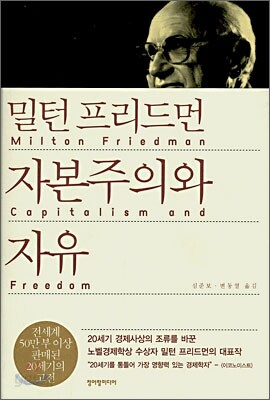
Milton Friedman: Capitalism and Freedom
 |
Description
Book Introduction
A book compiled from lectures on liberalism given to young people at a summer seminar sponsored by the Volker Foundation in the mid-1950s.
After the Great Depression and World War II, Keynesian economics, which supports strong government intervention and role, became established as mainstream economics, but Friedman emphasized the role of individuals and the market instead of reducing the role of government. From a liberal perspective, he presents a liberal alternative by verifying reality on the role of government, monetary policy, international trade, fiscal policy, education, discrimination, monopolies, licensing system, income distribution, social welfare, and poverty eradication.
After the Great Depression and World War II, Keynesian economics, which supports strong government intervention and role, became established as mainstream economics, but Friedman emphasized the role of individuals and the market instead of reducing the role of government. From a liberal perspective, he presents a liberal alternative by verifying reality on the role of government, monetary policy, international trade, fiscal policy, education, discrimination, monopolies, licensing system, income distribution, social welfare, and poverty eradication.
- You can preview some of the book's contents.
Preview
index
Preface to the 2002 edition
Preface to the 1982 edition
Preface to the first edition
introduction
Chapter 1: The Relationship Between Economic and Political Freedom
Chapter 2 The Role of Government in a Free Society
Chapter 3 Control of Currency
Chapter 4 International Financial and Trade Systems
Chapter 5 Fiscal Policy
Chapter 6 Government Role in Education
Chapter 7: Capitalism and Discrimination
Chapter 8 Monopolies and the Social Responsibility of Businesses and Workers
Chapter 9 Licensing System
Chapter 10 Income Distribution
Chapter 11 Social Welfare Policy
Chapter 12 Alleviating Poverty
Chapter 13 Conclusion
Translator's Note
Search
Preface to the 1982 edition
Preface to the first edition
introduction
Chapter 1: The Relationship Between Economic and Political Freedom
Chapter 2 The Role of Government in a Free Society
Chapter 3 Control of Currency
Chapter 4 International Financial and Trade Systems
Chapter 5 Fiscal Policy
Chapter 6 Government Role in Education
Chapter 7: Capitalism and Discrimination
Chapter 8 Monopolies and the Social Responsibility of Businesses and Workers
Chapter 9 Licensing System
Chapter 10 Income Distribution
Chapter 11 Social Welfare Policy
Chapter 12 Alleviating Poverty
Chapter 13 Conclusion
Translator's Note
Search
Publisher's Review
"Capitalism and Freedom" vs. "The Role of the State": Why We Should Read Milton Friedman Now
Milton Friedman, a defender of the free market economy who valued individual and market freedom.
Our country is suffering from a free trade agreement, which can be said to be the reality of Friedman's theory.
Even now that the Korea-US FTA has been concluded, we continue to debate the dilemma between "free trade" and "domestic demand protection."
Moving towards a system of unlimited free competition in step with globalization will, as Friedman argued, "expand the choices of consumers, that is, individuals." However, the inevitable result of unprepared, hasty opening up, the elimination of certain industries, is a shadow of the modern economy that even Friedman could not prevent.
What message does Friedman's philosophy, which advocated for less government intervention and more freedom and expansion of the market, convey to our economy following the conclusion of the Korea-U.S. FTA?
You can't discuss modern economics without reading "Capitalism and Freedom"!
Government intervention only hinders the autonomous flow of the market.
"Capitalism and Freedom" is a book that concisely contains the ideas of Milton Friedman, who opposed government intervention in the market and advocated for the revitalization of a free market economy.
At the time this book was written, Keynesian economic theory was dominant, but eventually, as Milton Friedman argued, the free market economy flourished, and it came to be regarded as one of the most important economic classics of the 20th century.
His simple, clear, and logical arguments, such as “Companies fulfill their social responsibility by maximizing their profits,” “Government intervention should be minimized and its power should be widely distributed,” and “Competitive capitalism is a system of economic freedom and a necessary condition for political freedom,” will serve as an important guide for understanding modern economics.
This new book, 『Capitalism and Freedom』 by Cheongoram Media, is a translation of the 40th anniversary edition published by the University of Chicago Press in 2002.
The Chicago School, which defeated Keynes, had Milton Friedman at its center.
Friedman, considered the father of monetarism and a leading figure in modern economics, spent his entire life emphasizing the role of individuals and markets while minimizing the role of government.
Friedman's reputation was established in the late 1960s when he correctly predicted that Keynesian economic policies, which advocated active government intervention in the market and economy, would lead to stagflation.
As the world economy fell into a recession due to stagflation that continued without end, people realized the limitations of Keynesian theory and became interested in Friedman's argument that government spending should be reduced and the money supply increased to fight inflation.
Most of Friedman's theories, which were even called radical, began to be adopted as government policies.
Examples include the United States abolishing the fixed exchange rate system and adopting a floating exchange rate system in 1971 and converting the conscription system to a volunteer system in 1973.
For this achievement, based on the concept of the natural rate of unemployment, he received the Nobel Prize in Economics in 1976.
The Chicago School, also known as the "Chicago Boys," formed during their time at the University of Chicago, defeated Keynesianism and exported neoliberal economics based on free markets to the world.
Although he was harshly criticized for supporting dictatorships in South America in the 1970s, today's market economic model proves that the theories Friedman advocated throughout his life were not wrong.
Milton Friedman, who advocated for a reduction in the role of government and an expansion of free markets, was the theoretical pillar of the neoconservative policies of the Ronald Reagan administration in the United States and the Thatcher administration in the United Kingdom since the 1980s.
Along with Hayek, he is considered one of the scholars who had the greatest influence on modern economics and real economy theory, and his economic philosophy was theoretically supported by monetary research.
Friedman's greatest achievement is considered to be establishing monetarism, which limits the government's role to supplying money in line with the growth rate, through empirical research on the impact of money supply on economic fluctuations.
Since its first edition in 1962, this classic economics book has been translated into 18 languages and sold over 500,000 copies worldwide.
In his monumental work, Capitalism and Freedom, Milton Friedman focuses on the role of competitive capitalism as a mechanism for achieving economic freedom and a necessary condition for political freedom.
When Capitalism and Freedom was first published, the press described him as "a brilliant economist and a very extreme libertarian" (The Economist).
He also described his monetary and fiscal policies as "very challenging."
However, 『Capitalism and Freedom』 became a steady seller, being translated into 18 languages and selling 500,000 copies.
This is because Friedman's arguments for reducing government intervention, establishing market freedom, and emphasizing the importance of monetary policy are increasingly coming true.
Friedman examines the role of government in modern capitalist society and, based on this, presents realistic alternatives for major issues such as monetary policy, international trade, fiscal policy, education system, discrimination, monopolies, licensing system, income distribution, social welfare, and poverty alleviation.
Milton Friedman, a defender of the free market economy who valued individual and market freedom.
Our country is suffering from a free trade agreement, which can be said to be the reality of Friedman's theory.
Even now that the Korea-US FTA has been concluded, we continue to debate the dilemma between "free trade" and "domestic demand protection."
Moving towards a system of unlimited free competition in step with globalization will, as Friedman argued, "expand the choices of consumers, that is, individuals." However, the inevitable result of unprepared, hasty opening up, the elimination of certain industries, is a shadow of the modern economy that even Friedman could not prevent.
What message does Friedman's philosophy, which advocated for less government intervention and more freedom and expansion of the market, convey to our economy following the conclusion of the Korea-U.S. FTA?
You can't discuss modern economics without reading "Capitalism and Freedom"!
Government intervention only hinders the autonomous flow of the market.
"Capitalism and Freedom" is a book that concisely contains the ideas of Milton Friedman, who opposed government intervention in the market and advocated for the revitalization of a free market economy.
At the time this book was written, Keynesian economic theory was dominant, but eventually, as Milton Friedman argued, the free market economy flourished, and it came to be regarded as one of the most important economic classics of the 20th century.
His simple, clear, and logical arguments, such as “Companies fulfill their social responsibility by maximizing their profits,” “Government intervention should be minimized and its power should be widely distributed,” and “Competitive capitalism is a system of economic freedom and a necessary condition for political freedom,” will serve as an important guide for understanding modern economics.
This new book, 『Capitalism and Freedom』 by Cheongoram Media, is a translation of the 40th anniversary edition published by the University of Chicago Press in 2002.
The Chicago School, which defeated Keynes, had Milton Friedman at its center.
Friedman, considered the father of monetarism and a leading figure in modern economics, spent his entire life emphasizing the role of individuals and markets while minimizing the role of government.
Friedman's reputation was established in the late 1960s when he correctly predicted that Keynesian economic policies, which advocated active government intervention in the market and economy, would lead to stagflation.
As the world economy fell into a recession due to stagflation that continued without end, people realized the limitations of Keynesian theory and became interested in Friedman's argument that government spending should be reduced and the money supply increased to fight inflation.
Most of Friedman's theories, which were even called radical, began to be adopted as government policies.
Examples include the United States abolishing the fixed exchange rate system and adopting a floating exchange rate system in 1971 and converting the conscription system to a volunteer system in 1973.
For this achievement, based on the concept of the natural rate of unemployment, he received the Nobel Prize in Economics in 1976.
The Chicago School, also known as the "Chicago Boys," formed during their time at the University of Chicago, defeated Keynesianism and exported neoliberal economics based on free markets to the world.
Although he was harshly criticized for supporting dictatorships in South America in the 1970s, today's market economic model proves that the theories Friedman advocated throughout his life were not wrong.
Milton Friedman, who advocated for a reduction in the role of government and an expansion of free markets, was the theoretical pillar of the neoconservative policies of the Ronald Reagan administration in the United States and the Thatcher administration in the United Kingdom since the 1980s.
Along with Hayek, he is considered one of the scholars who had the greatest influence on modern economics and real economy theory, and his economic philosophy was theoretically supported by monetary research.
Friedman's greatest achievement is considered to be establishing monetarism, which limits the government's role to supplying money in line with the growth rate, through empirical research on the impact of money supply on economic fluctuations.
Since its first edition in 1962, this classic economics book has been translated into 18 languages and sold over 500,000 copies worldwide.
In his monumental work, Capitalism and Freedom, Milton Friedman focuses on the role of competitive capitalism as a mechanism for achieving economic freedom and a necessary condition for political freedom.
When Capitalism and Freedom was first published, the press described him as "a brilliant economist and a very extreme libertarian" (The Economist).
He also described his monetary and fiscal policies as "very challenging."
However, 『Capitalism and Freedom』 became a steady seller, being translated into 18 languages and selling 500,000 copies.
This is because Friedman's arguments for reducing government intervention, establishing market freedom, and emphasizing the importance of monetary policy are increasingly coming true.
Friedman examines the role of government in modern capitalist society and, based on this, presents realistic alternatives for major issues such as monetary policy, international trade, fiscal policy, education system, discrimination, monopolies, licensing system, income distribution, social welfare, and poverty alleviation.
GOODS SPECIFICS
- Date of issue: April 14, 2007
- Format: Hardcover book binding method guide
- Page count, weight, size: 335 pages | 596g | 147*223*30mm
- ISBN13: 9788992492058
- ISBN10: 8992492057
You may also like
카테고리
korean


korean

![ELLE 엘르 스페셜 에디션 A형 : 12월 [2025]](http://librairie.coreenne.fr/cdn/shop/files/b8e27a3de6c9538896439686c6b0e8fb.jpg?v=1766436872&width=3840)


