

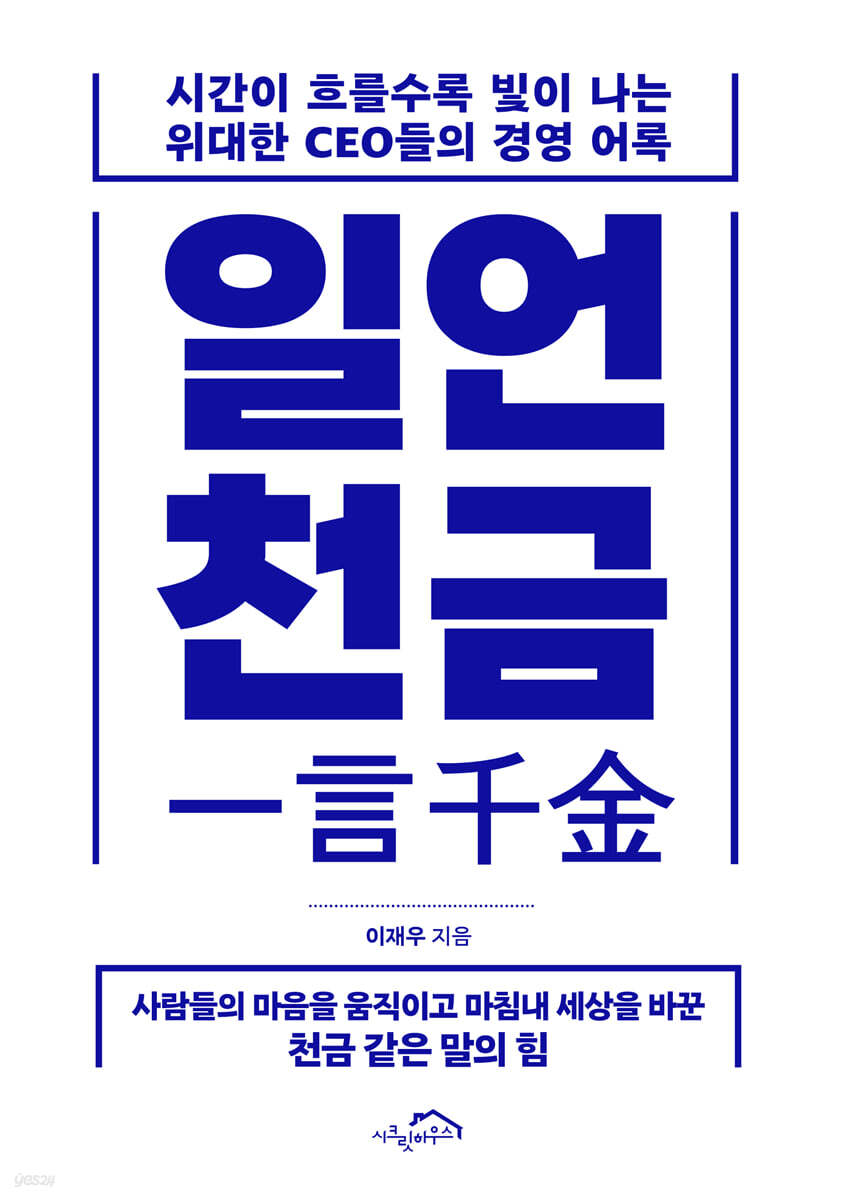
A word is worth a thousand words
 |
Description
Book Introduction
Stronger than any other management strategy,
The power of one sentence to shake your heart more deeply than dozens of reports!
Invaluable Management Quotes from 42 of Japan's Top CEOs
“There is nothing in this world that can be achieved by doing things roughly.
Whether it's work or life.
“There is nothing to be gained without taking one step further.” _Tokushichi Nomura
“No one knows what will happen to humanity in the future.
If I could say just one thing
“There is no useless experience in life.” _Tadamitsu Matsui
For managers who have to make dozens of decisions a day, what they need most is not information, but insight, not words, but the 'weight of language.'
The book "One Word, One Thousand Gold" is a collection of management quotes from 42 Japanese CEOs who led their companies with their own principles and language even in the face of numerous crises.
But this book is not just a collection of quotes.
Behind that short sentence lies decades of trial and error, rigorous training, and a philosophy of survival cultivated in times of crisis.
As the title suggests, “A Word Worth a Thousand Gold (一言千金),” the author asks what the essence of leadership is through each and every sentence of managers who changed an era.
The quotes in this book are not management tips learned from textbooks or theories.
“Make something that will cut your hand” (Kazuo Inamori) and “You can’t be a successful manager if you’ve never seen blood and urine” (Konosuke Matsushita) are phrases that remain as the spirit of a company and the DNA of its founder.
The author doesn't simply quote these words; he unravels them, tracing the context in which they were born: their crisis, their downfall, and their moment of revival.
Therefore, the quotes in “A Word is a Thousand Golds” are not simply lessons, but rather come across as “compressed survival strategies gleaned from the field.”
Author Lee Jae-woo describes their words as 'water drawn from the reservoir of quotations.'
Just as the sayings of Japanese managers have been passed down through generations, inspiring new managers, the author of this book once again urges today's leaders to "redefine the language of management."
Whether you're a founder, a small business owner, or a leader leading a team of dozens, you'll find a sentence in this book that illuminates your present.
Management begins with language, not strategy.
《One Word, One Thousand Gold》 is a book that seeks to restore the power of those words.
The power of one sentence to shake your heart more deeply than dozens of reports!
Invaluable Management Quotes from 42 of Japan's Top CEOs
“There is nothing in this world that can be achieved by doing things roughly.
Whether it's work or life.
“There is nothing to be gained without taking one step further.” _Tokushichi Nomura
“No one knows what will happen to humanity in the future.
If I could say just one thing
“There is no useless experience in life.” _Tadamitsu Matsui
For managers who have to make dozens of decisions a day, what they need most is not information, but insight, not words, but the 'weight of language.'
The book "One Word, One Thousand Gold" is a collection of management quotes from 42 Japanese CEOs who led their companies with their own principles and language even in the face of numerous crises.
But this book is not just a collection of quotes.
Behind that short sentence lies decades of trial and error, rigorous training, and a philosophy of survival cultivated in times of crisis.
As the title suggests, “A Word Worth a Thousand Gold (一言千金),” the author asks what the essence of leadership is through each and every sentence of managers who changed an era.
The quotes in this book are not management tips learned from textbooks or theories.
“Make something that will cut your hand” (Kazuo Inamori) and “You can’t be a successful manager if you’ve never seen blood and urine” (Konosuke Matsushita) are phrases that remain as the spirit of a company and the DNA of its founder.
The author doesn't simply quote these words; he unravels them, tracing the context in which they were born: their crisis, their downfall, and their moment of revival.
Therefore, the quotes in “A Word is a Thousand Golds” are not simply lessons, but rather come across as “compressed survival strategies gleaned from the field.”
Author Lee Jae-woo describes their words as 'water drawn from the reservoir of quotations.'
Just as the sayings of Japanese managers have been passed down through generations, inspiring new managers, the author of this book once again urges today's leaders to "redefine the language of management."
Whether you're a founder, a small business owner, or a leader leading a team of dozens, you'll find a sentence in this book that illuminates your present.
Management begins with language, not strategy.
《One Word, One Thousand Gold》 is a book that seeks to restore the power of those words.
- You can preview some of the book's contents.
Preview
index
Preface | A single word that benefits others is as precious, as precious, as a thousand pieces of gold.
Chapter 1.
challenge
Turn what you're doing upside down
Don't hesitate when making a decision
The diligent beginner is the scariest
Learn the fisherman's intuition
Do-type people succeed
Step on the accelerator with confidence
Train, train again
Don't make what the customer wants
You must live like a willow tree
Chapter 2.
growth
The match is decided in the scabbard.
The most difficult moment is right now.
Experience the chaos
Harsh environments make people stronger.
There's a reason why things don't sell.
Pride, flush it down the toilet
Have luck, dullness, and strength
Management is like tree rings.
Chapter 3.
Breakthrough
If there's an insurmountable wall, break through it.
Even the narrow path can be squeezed through
Business is war
Put wheels on the beams
There are no grand slams in business.
Get rid of negative mindset
Always look under your feet
The 0.5% Rule Determines Success
Chapter 4.
Eyes
Become a square stone
Have an eagle eye
Don't neglect the little things
Don't look at the price, look at the value
Leaders must be psychologists.
Illuminate your opponent's feet
I take full responsibility.
Chapter 5.
Sincerity
Whatever you do, risk your life
Be a devil even in small things
It's boring if you're similar to others.
Fun is the engine of work
Build strong muscles
The interests of others are my interests.
Raise your antenna of trust
Conscience comes before profit
Business and honesty go hand in hand.
Walk the walk
Chapter 1.
challenge
Turn what you're doing upside down
Don't hesitate when making a decision
The diligent beginner is the scariest
Learn the fisherman's intuition
Do-type people succeed
Step on the accelerator with confidence
Train, train again
Don't make what the customer wants
You must live like a willow tree
Chapter 2.
growth
The match is decided in the scabbard.
The most difficult moment is right now.
Experience the chaos
Harsh environments make people stronger.
There's a reason why things don't sell.
Pride, flush it down the toilet
Have luck, dullness, and strength
Management is like tree rings.
Chapter 3.
Breakthrough
If there's an insurmountable wall, break through it.
Even the narrow path can be squeezed through
Business is war
Put wheels on the beams
There are no grand slams in business.
Get rid of negative mindset
Always look under your feet
The 0.5% Rule Determines Success
Chapter 4.
Eyes
Become a square stone
Have an eagle eye
Don't neglect the little things
Don't look at the price, look at the value
Leaders must be psychologists.
Illuminate your opponent's feet
I take full responsibility.
Chapter 5.
Sincerity
Whatever you do, risk your life
Be a devil even in small things
It's boring if you're similar to others.
Fun is the engine of work
Build strong muscles
The interests of others are my interests.
Raise your antenna of trust
Conscience comes before profit
Business and honesty go hand in hand.
Walk the walk
Into the book
Managers need to learn more about the fisherman's spirit.
When a fisherman doesn't catch any fish, he changes the fish he's targeting, his fishing gear, and his fishing point (location).
It's useless to always stay in the same place and lament, "There are no fish."
The state of ocean currents and fish is constantly changing.
A good fisherman can quickly read these changes and decide whether to stick to a point or move.
It's not much different whether it's fishing or business.
Secom founder Mako Iida believes that managers must learn the fisherman's "intuition."
It's a discussion tip.
--- p.42, from “Chapter 1: Challenge, Learn the Fisherman’s Intuition”
A Serengeti without its rivals is no longer a Serengeti.
Instead of tension, a 'terrifying arrogance' sprouts there.
Ultimately, such arrogance leads to the downfall of the company.
Arrogant companies ignore the voice of their customers and underestimate the need for innovation.
They ignore even the warnings from within and settle down within the walls they have built.
From that moment on, the company slowly rots away, leaving only memories of its former glory.
Kazuchika Okura's advice that "arrogance should be flushed down the toilet" is also applicable to today's businesses.
Still valid.
--- p.96~97, from “Chapter 2 Growth, Arrogance Must Be Flushed in the Toilet”
While everyone else was digging multiple wells, former Chairman Inaba insisted on 'one well': robotics research.
While everyone was busy promoting the company, he kept Hwanak in the dark.
His 'stubborn management' may have created the Hwanak of today.
Former Chairman Inaba, an engineer by training, said, “It is important for engineers to move forward straight even if it is a narrow path.”
We should take his words to heart.
Even if the road is narrow, do not turn back, even if the road is narrow, do not stop.
It's like walking step by step.
--- p.120~121, from "Chapter 3 Breaking Through, Squeezing Through Even the Narrow Path"
“Business is about taking one step forward, then another, like a caterpillar, and adding one step at a time to reach success.
To succeed in business, you must realize that ‘time × effort’ is a huge source of energy.”
There is no 'one shot' in business.
Rather than dreaming of a grand slam, the idea is to take a long-term approach and gradually accumulate hits.
Also, there is no such thing as luck in baseball or business.
‘Time × Effort’ is an absolute necessity.
--- p.133, from "Chapter 3 Breakthrough: There is no grand slam in business"
“Price is visible, but value is visible only to those who see it.” Price and value are like a Möbius strip.
So, isn't this an era where the relationship between value and price is confused?
I can confidently say that there are not many people who can properly see the value of a person, a product, or a company.
Even fewer people are able to see through the invisible value.
An eye that only looks at price and not value is never a good eye.
Yoshiharu's advice is that you need to have a 'good eye' in business.
Whether it is a person or a company, the measure of their value can only be determined by the ‘total amount of credit (trust)’.
While it's important to be able to read the values of other people (or companies), it's even more important to build your own credibility and be trusted.
--- p.168~169, from “Chapter 4: Discernment, Don’t Look at the Price, Look at the Value”
Toshio Toko was also the owner of great sayings.
One of the most representative quotes is, “There is no great difference in human ability.
If there is, it is a difference in guts.”
While some see the difference between success and failure as "how far you consider planning your life," Toshio Toko emphasizes that the difference in tenacity determines success and failure.
Even if you don't have far-sighted vision, if you dig deep into something, you can get closer to success.
In fact, the above sentence by Toshio Toko is followed by these words:
“If you have decided what you need to do, push through it with tenacity.
“The problem is not a lack of ability, but a lack of commitment.”
When a fisherman doesn't catch any fish, he changes the fish he's targeting, his fishing gear, and his fishing point (location).
It's useless to always stay in the same place and lament, "There are no fish."
The state of ocean currents and fish is constantly changing.
A good fisherman can quickly read these changes and decide whether to stick to a point or move.
It's not much different whether it's fishing or business.
Secom founder Mako Iida believes that managers must learn the fisherman's "intuition."
It's a discussion tip.
--- p.42, from “Chapter 1: Challenge, Learn the Fisherman’s Intuition”
A Serengeti without its rivals is no longer a Serengeti.
Instead of tension, a 'terrifying arrogance' sprouts there.
Ultimately, such arrogance leads to the downfall of the company.
Arrogant companies ignore the voice of their customers and underestimate the need for innovation.
They ignore even the warnings from within and settle down within the walls they have built.
From that moment on, the company slowly rots away, leaving only memories of its former glory.
Kazuchika Okura's advice that "arrogance should be flushed down the toilet" is also applicable to today's businesses.
Still valid.
--- p.96~97, from “Chapter 2 Growth, Arrogance Must Be Flushed in the Toilet”
While everyone else was digging multiple wells, former Chairman Inaba insisted on 'one well': robotics research.
While everyone was busy promoting the company, he kept Hwanak in the dark.
His 'stubborn management' may have created the Hwanak of today.
Former Chairman Inaba, an engineer by training, said, “It is important for engineers to move forward straight even if it is a narrow path.”
We should take his words to heart.
Even if the road is narrow, do not turn back, even if the road is narrow, do not stop.
It's like walking step by step.
--- p.120~121, from "Chapter 3 Breaking Through, Squeezing Through Even the Narrow Path"
“Business is about taking one step forward, then another, like a caterpillar, and adding one step at a time to reach success.
To succeed in business, you must realize that ‘time × effort’ is a huge source of energy.”
There is no 'one shot' in business.
Rather than dreaming of a grand slam, the idea is to take a long-term approach and gradually accumulate hits.
Also, there is no such thing as luck in baseball or business.
‘Time × Effort’ is an absolute necessity.
--- p.133, from "Chapter 3 Breakthrough: There is no grand slam in business"
“Price is visible, but value is visible only to those who see it.” Price and value are like a Möbius strip.
So, isn't this an era where the relationship between value and price is confused?
I can confidently say that there are not many people who can properly see the value of a person, a product, or a company.
Even fewer people are able to see through the invisible value.
An eye that only looks at price and not value is never a good eye.
Yoshiharu's advice is that you need to have a 'good eye' in business.
Whether it is a person or a company, the measure of their value can only be determined by the ‘total amount of credit (trust)’.
While it's important to be able to read the values of other people (or companies), it's even more important to build your own credibility and be trusted.
--- p.168~169, from “Chapter 4: Discernment, Don’t Look at the Price, Look at the Value”
Toshio Toko was also the owner of great sayings.
One of the most representative quotes is, “There is no great difference in human ability.
If there is, it is a difference in guts.”
While some see the difference between success and failure as "how far you consider planning your life," Toshio Toko emphasizes that the difference in tenacity determines success and failure.
Even if you don't have far-sighted vision, if you dig deep into something, you can get closer to success.
In fact, the above sentence by Toshio Toko is followed by these words:
“If you have decided what you need to do, push through it with tenacity.
“The problem is not a lack of ability, but a lack of commitment.”
--- p.214~215, from “Chapter 5: Build Your Sincerity and Tenacity Muscles”
Publisher's Review
A word from managers who overcame crises
Awakening Today's Leaders
Let's assume that a company is in a management crisis.
The urgent task is to find a breakthrough quickly.
But it is not easy to find the cause of the crisis.
Managers cannot help but be troubled.
Osamu Suzuki, founder of Suzuki, a global manufacturer of compact cars and motorcycles, might offer this advice to his managers.
“Turn around what you’re doing now.” This means that there is no answer if the current situation remains the same.
The first key to breaking out of the prison of the status quo is to 'think the opposite.'
The moment you turn it over, opportunities trapped in familiarity reveal a new face.
Conversely, the saying “turn it around” also applies when a company is doing well.
Crisis is always lurking.
It means that you should always have an 'eye' that can turn the table in case you get caught in a dilemma.
Turn what you're doing around.
If your company is facing a management crisis due to difficult domestic and international economic conditions, this is a management quote worth pondering.
In this way, Japanese managers did not hesitate to record and disseminate their own philosophy.
Management quotes are like compressed files containing the spirit of an era and a company.
A few lines of language contain the philosophy, dedication, and energy that built a company and transformed an industry.
Strategies change with the times, but sayings never fade.
Rather, it shines brighter as time passes.
It moves people's hearts, inspires them, and moves them to action.
It is finally a force that can change the world.
Author Lee Jae-woo of the book "A Word, a Thousand Gold" defined this culture of Japanese businessmen as the "reservoir of quotations."
The sayings left by managers have gathered like small streams to form a large reservoir.
Whenever new CEOs faced crises and challenges, they would draw from the reservoir of wisdom from their predecessors, internalize these wisdom, or even devour it, to find new breakthroughs.
And they created another saying, and so the reservoir continued to fill up without drying up.
The title of the book, “One Word, One Thousand Gold,” which contains the precious words of 42 Japanese CEOs, comes from the phrase “One word is worth a thousand gold” in Chapter 17 (Language) of the Myungsim Bogam.
The meaning is, 'A single word that benefits others is as heavy, precious, and as valuable as a thousand pieces of gold.'
A single word that benefits others
It's heavy, it's precious, it's like a thousand pieces of gold
Among the senior executives who have tried to compile their experiences into concise sayings and make them an asset for their juniors, the most representative figures are Kazuo Inamori, the founder of Kyocera, who was called the "god of corporate revitalization," and Konosuke Matsushita of Panasonic, who was revered as the "god of management."
They tried to align their words with their lives while running their business.
Their sayings were a 'compressed survival strategy' that emerged from the agony of the field and the storms of the times.
Kazuo Inamori's words, "Make something that will cut your hand," were not said in vain.
He considered it a sin to put an ordinary product on the market.
What exactly is a "hand-cutting object"? In the words of artistic entrepreneur Steve Jobs, it's a "product with edge" that's unlike anything the world has ever seen. In the words of world-renowned marketing guru Seth Godin, it's a "purple cow."
Purple Cow is not an ordinary cow, but a product that catches the eye of consumers in the market.
Inamori believed that such a product should be created through technology and design.
Such thoughts and will became Kyocera's DNA and led to its growth and success.
Konosuke Matsushita, a senior entrepreneur whom Kazuo Inamori admired, once said, “If you have never seen blood or urine, you cannot become a successful manager.”
The manager's dedication was preached in the extreme expression 'blood urine'.
He confessed that his experience of starting a business while overcoming poverty and illness was a 'year of blood and urine.'
For him, 'blood urine' was not a metaphor, but a language of actual experience.
Such powerful sayings are not born on a desk.
Most are born in the valley of failure or in the field of pain.
So you can feel the 'vibration of blood and sweat'.
It smells of something 'raw' that you can't find in textbooks or papers.
Quotations are the life of a manager.
Words are assets and heritage.
Awakening Today's Leaders
Let's assume that a company is in a management crisis.
The urgent task is to find a breakthrough quickly.
But it is not easy to find the cause of the crisis.
Managers cannot help but be troubled.
Osamu Suzuki, founder of Suzuki, a global manufacturer of compact cars and motorcycles, might offer this advice to his managers.
“Turn around what you’re doing now.” This means that there is no answer if the current situation remains the same.
The first key to breaking out of the prison of the status quo is to 'think the opposite.'
The moment you turn it over, opportunities trapped in familiarity reveal a new face.
Conversely, the saying “turn it around” also applies when a company is doing well.
Crisis is always lurking.
It means that you should always have an 'eye' that can turn the table in case you get caught in a dilemma.
Turn what you're doing around.
If your company is facing a management crisis due to difficult domestic and international economic conditions, this is a management quote worth pondering.
In this way, Japanese managers did not hesitate to record and disseminate their own philosophy.
Management quotes are like compressed files containing the spirit of an era and a company.
A few lines of language contain the philosophy, dedication, and energy that built a company and transformed an industry.
Strategies change with the times, but sayings never fade.
Rather, it shines brighter as time passes.
It moves people's hearts, inspires them, and moves them to action.
It is finally a force that can change the world.
Author Lee Jae-woo of the book "A Word, a Thousand Gold" defined this culture of Japanese businessmen as the "reservoir of quotations."
The sayings left by managers have gathered like small streams to form a large reservoir.
Whenever new CEOs faced crises and challenges, they would draw from the reservoir of wisdom from their predecessors, internalize these wisdom, or even devour it, to find new breakthroughs.
And they created another saying, and so the reservoir continued to fill up without drying up.
The title of the book, “One Word, One Thousand Gold,” which contains the precious words of 42 Japanese CEOs, comes from the phrase “One word is worth a thousand gold” in Chapter 17 (Language) of the Myungsim Bogam.
The meaning is, 'A single word that benefits others is as heavy, precious, and as valuable as a thousand pieces of gold.'
A single word that benefits others
It's heavy, it's precious, it's like a thousand pieces of gold
Among the senior executives who have tried to compile their experiences into concise sayings and make them an asset for their juniors, the most representative figures are Kazuo Inamori, the founder of Kyocera, who was called the "god of corporate revitalization," and Konosuke Matsushita of Panasonic, who was revered as the "god of management."
They tried to align their words with their lives while running their business.
Their sayings were a 'compressed survival strategy' that emerged from the agony of the field and the storms of the times.
Kazuo Inamori's words, "Make something that will cut your hand," were not said in vain.
He considered it a sin to put an ordinary product on the market.
What exactly is a "hand-cutting object"? In the words of artistic entrepreneur Steve Jobs, it's a "product with edge" that's unlike anything the world has ever seen. In the words of world-renowned marketing guru Seth Godin, it's a "purple cow."
Purple Cow is not an ordinary cow, but a product that catches the eye of consumers in the market.
Inamori believed that such a product should be created through technology and design.
Such thoughts and will became Kyocera's DNA and led to its growth and success.
Konosuke Matsushita, a senior entrepreneur whom Kazuo Inamori admired, once said, “If you have never seen blood or urine, you cannot become a successful manager.”
The manager's dedication was preached in the extreme expression 'blood urine'.
He confessed that his experience of starting a business while overcoming poverty and illness was a 'year of blood and urine.'
For him, 'blood urine' was not a metaphor, but a language of actual experience.
Such powerful sayings are not born on a desk.
Most are born in the valley of failure or in the field of pain.
So you can feel the 'vibration of blood and sweat'.
It smells of something 'raw' that you can't find in textbooks or papers.
Quotations are the life of a manager.
Words are assets and heritage.
GOODS SPECIFICS
- Date of issue: November 3, 2025
- Page count, weight, size: 236 pages | 348g | 140*200*15mm
- ISBN13: 9791194522157
- ISBN10: 1194522157
You may also like
카테고리
korean


korean

![ELLE 엘르 스페셜 에디션 A형 : 12월 [2025]](http://librairie.coreenne.fr/cdn/shop/files/b8e27a3de6c9538896439686c6b0e8fb.jpg?v=1766436872&width=3840)


