

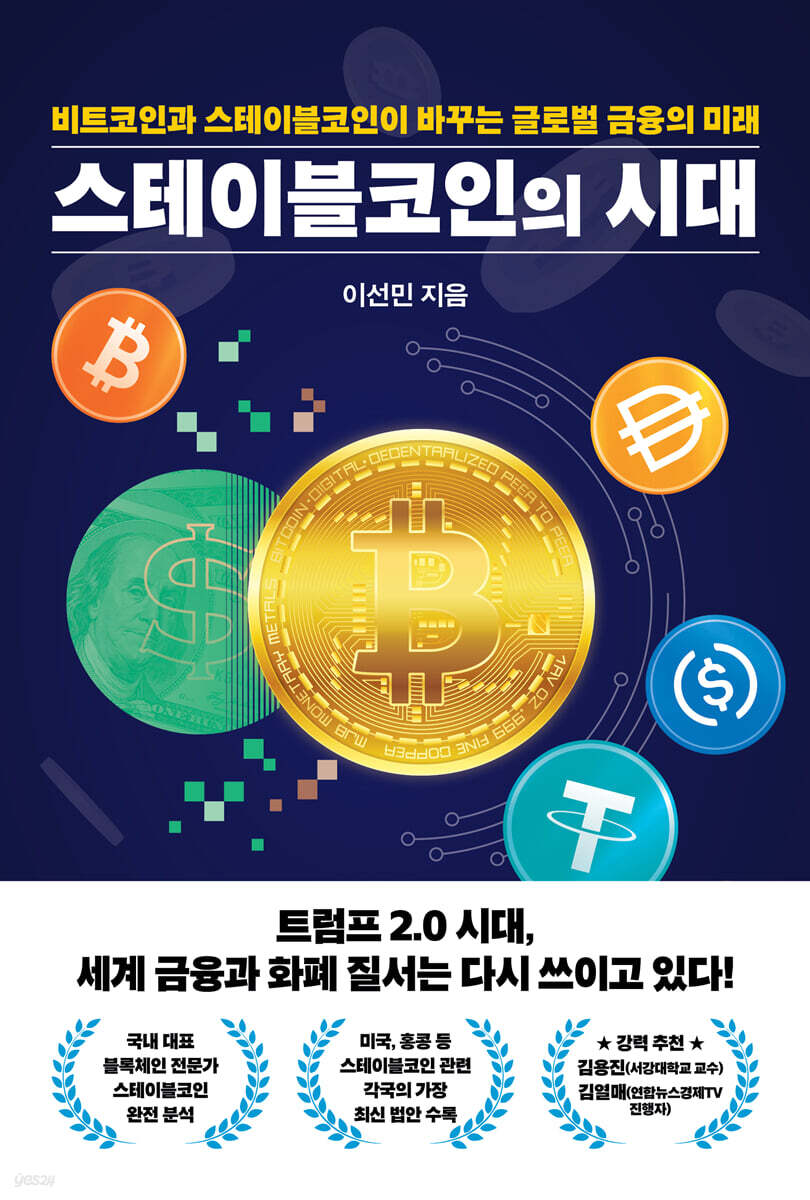
The Era of Stablecoins
 |
Description
Book Introduction
In the era of Trump 2.0, the global financial and monetary order is being rewritten.
A thorough analysis of stablecoins, the key to the financial revolution, from Korea's leading digital currency expert!
Bitcoin is no longer the only keyword that will determine the future of digital finance.
Stablecoins are emerging as a key driver of global payment infrastructure and financial system transformation.
[The Age of Stablecoins] insightfully explores why countries around the world are focusing on stablecoins in an era where the boundaries between traditional finance and digital assets are collapsing.
The United States announced the full-fledged start of the digital asset era by issuing an executive order designating Bitcoin as a strategic national asset by 2025.
At the same time, the US is implementing legislation and deregulation related to stablecoins, and is deploying a new financial strategy to strengthen the dollar's hegemony.
Stablecoins are expanding beyond simple digital assets to become payment infrastructure that connects the global economy.
In emerging countries struggling with inflation, it is attracting attention as a means of replacing currency, and in the financial sectors of developed countries, it is attracting attention as an innovative means of payment, remittance, and asset management.
This book presents a clear vision of how stablecoins will reshape finance and shift the balance of power between nations.
Furthermore, through stablecoins, which have become a core part of the digital financial order, it provides deep insight into the choices individuals, businesses, and nations must make.
The race for digital financial hegemony has already begun.
At the heart of it all are stablecoins.
A thorough analysis of stablecoins, the key to the financial revolution, from Korea's leading digital currency expert!
Bitcoin is no longer the only keyword that will determine the future of digital finance.
Stablecoins are emerging as a key driver of global payment infrastructure and financial system transformation.
[The Age of Stablecoins] insightfully explores why countries around the world are focusing on stablecoins in an era where the boundaries between traditional finance and digital assets are collapsing.
The United States announced the full-fledged start of the digital asset era by issuing an executive order designating Bitcoin as a strategic national asset by 2025.
At the same time, the US is implementing legislation and deregulation related to stablecoins, and is deploying a new financial strategy to strengthen the dollar's hegemony.
Stablecoins are expanding beyond simple digital assets to become payment infrastructure that connects the global economy.
In emerging countries struggling with inflation, it is attracting attention as a means of replacing currency, and in the financial sectors of developed countries, it is attracting attention as an innovative means of payment, remittance, and asset management.
This book presents a clear vision of how stablecoins will reshape finance and shift the balance of power between nations.
Furthermore, through stablecoins, which have become a core part of the digital financial order, it provides deep insight into the choices individuals, businesses, and nations must make.
The race for digital financial hegemony has already begun.
At the heart of it all are stablecoins.
- You can preview some of the book's contents.
Preview
index
Introduction: The Era of New Financial Hegemony
Part 1: Bitcoin's Evolution into a National Strategic Asset
Chapter 1: The Essence and Strategic Value of Bitcoin
Bitcoin's Technical Foundations: The Power of Decentralization and Scarcity
Ending the Digital Gold vs. Speculative Asset Debate
The process of institutional investor inflow and mainstream financial inclusion
The changing macroeconomic environment and the emerging role of Bitcoin
Chapter 2: The Bitcoin Strategic Reserve (SBR) Revolution in the United States
The Trump Administration's Paradigm Shift: From Regulation to Strategic Accommodation
Key Concepts of Bitcoin Holding Strategy
Bitcoin holdings in each country
Chapter 3: The Economic Impact of Bitcoin Holdings
Financial stability and portfolio diversification effects
Analysis of the dollar hegemony debate: strengthening vs. threatening it
Global Bitcoin Holding Competition Scenario
The Geopolitics of Bitcoin Mining: Energy Security and National Competitiveness
Part 2: Stablecoins: The Dollar's Digital Expansion Strategy
Chapter 4: Understanding the Stablecoin Ecosystem
Types of Stablecoins and How They Work
Top 10 Stablecoins by Market Size
The Overwhelming Dominance of Dollar-Pegged Stablecoins: A Deep Dive into USDT and USDC
Utilization of Stablecoins
Chapter 5: The Master Plan for Regulating Stablecoins in the United States
A Complete Anatomy of the GENIUS Act and the STABLE Act
Issuer Authorization Requirements and Reserve Regulations
Measures to Strengthen Repayment Obligations and Transparency
Consumer Protection and System Risk Management
Chapter 6: Global Stablecoin Adoption Strategies and Regulatory Competition
Stablecoin Strategies of Major US Financial Institutions
Stablecoin Promotion Strategies and Regulations in Each Country
Central Bank-issued Stablecoins: CBDCs
Chapter 7: The Global Hegemony Structure of Stablecoins and the US's Strategic Calculations
Mechanisms to Strengthen Dollar Hegemony Through Stablecoins
Stablecoins' Response to De-dollarization
The Complementary Relationship Between CBDCs and Stablecoins
Part 3: The Geopolitical Implications of U.S. Financial Strategy
Chapter 8: The Digital Cold War: Currency Wars on Blockchain
US vs. China: The Reality of the Digital Hegemony Race
A New Financial Order Created by Bitcoin Strategic Holdings and Stablecoins
The Middle Powers' Choice: The Potential of a Digital Non-Aligned Movement
Chapter 9: Korea's Strategic Choices and Response Plans
The direct impact of US policy on Korea
Possibility of issuing a Korean-style stablecoin (KRW)
Growth Strategies for Korea's Financial Industry in the Digital Asset Era
Conclusion: Korea's Vision in a New Era of Financial Geopolitics
Part 4: Future Outlook and Investment Implications
Chapter 10: The Global Financial Revolution of 2030
Scenarios for a Financial Revolution Driven by Bitcoin and Stablecoins
Opportunities and risks for financial institutions, corporations, and individuals
Practical Investment Strategy Guidelines
Preparing for the Coming Financial Revolution: Seizing Opportunities and Managing Risk
Chapter 11 Conclusion: The Prelude to a New Hegemonic Competition
The Future Order Implied by America's Digital Finance Strategy
Challenges and Opportunities in the Digital Financial Era for Korea to Prepare
Advice for Future Generations: Building a Sustainable Digital Financial Ecosystem
Conclusion: The Last Chance: Monetary Sovereignty and the Digital Inflection Point
Part 1: Bitcoin's Evolution into a National Strategic Asset
Chapter 1: The Essence and Strategic Value of Bitcoin
Bitcoin's Technical Foundations: The Power of Decentralization and Scarcity
Ending the Digital Gold vs. Speculative Asset Debate
The process of institutional investor inflow and mainstream financial inclusion
The changing macroeconomic environment and the emerging role of Bitcoin
Chapter 2: The Bitcoin Strategic Reserve (SBR) Revolution in the United States
The Trump Administration's Paradigm Shift: From Regulation to Strategic Accommodation
Key Concepts of Bitcoin Holding Strategy
Bitcoin holdings in each country
Chapter 3: The Economic Impact of Bitcoin Holdings
Financial stability and portfolio diversification effects
Analysis of the dollar hegemony debate: strengthening vs. threatening it
Global Bitcoin Holding Competition Scenario
The Geopolitics of Bitcoin Mining: Energy Security and National Competitiveness
Part 2: Stablecoins: The Dollar's Digital Expansion Strategy
Chapter 4: Understanding the Stablecoin Ecosystem
Types of Stablecoins and How They Work
Top 10 Stablecoins by Market Size
The Overwhelming Dominance of Dollar-Pegged Stablecoins: A Deep Dive into USDT and USDC
Utilization of Stablecoins
Chapter 5: The Master Plan for Regulating Stablecoins in the United States
A Complete Anatomy of the GENIUS Act and the STABLE Act
Issuer Authorization Requirements and Reserve Regulations
Measures to Strengthen Repayment Obligations and Transparency
Consumer Protection and System Risk Management
Chapter 6: Global Stablecoin Adoption Strategies and Regulatory Competition
Stablecoin Strategies of Major US Financial Institutions
Stablecoin Promotion Strategies and Regulations in Each Country
Central Bank-issued Stablecoins: CBDCs
Chapter 7: The Global Hegemony Structure of Stablecoins and the US's Strategic Calculations
Mechanisms to Strengthen Dollar Hegemony Through Stablecoins
Stablecoins' Response to De-dollarization
The Complementary Relationship Between CBDCs and Stablecoins
Part 3: The Geopolitical Implications of U.S. Financial Strategy
Chapter 8: The Digital Cold War: Currency Wars on Blockchain
US vs. China: The Reality of the Digital Hegemony Race
A New Financial Order Created by Bitcoin Strategic Holdings and Stablecoins
The Middle Powers' Choice: The Potential of a Digital Non-Aligned Movement
Chapter 9: Korea's Strategic Choices and Response Plans
The direct impact of US policy on Korea
Possibility of issuing a Korean-style stablecoin (KRW)
Growth Strategies for Korea's Financial Industry in the Digital Asset Era
Conclusion: Korea's Vision in a New Era of Financial Geopolitics
Part 4: Future Outlook and Investment Implications
Chapter 10: The Global Financial Revolution of 2030
Scenarios for a Financial Revolution Driven by Bitcoin and Stablecoins
Opportunities and risks for financial institutions, corporations, and individuals
Practical Investment Strategy Guidelines
Preparing for the Coming Financial Revolution: Seizing Opportunities and Managing Risk
Chapter 11 Conclusion: The Prelude to a New Hegemonic Competition
The Future Order Implied by America's Digital Finance Strategy
Challenges and Opportunities in the Digital Financial Era for Korea to Prepare
Advice for Future Generations: Building a Sustainable Digital Financial Ecosystem
Conclusion: The Last Chance: Monetary Sovereignty and the Digital Inflection Point
Detailed image

Into the book
One of the major problems facing the United States is the decline in purchases by traditional demanders of Treasury securities.
Japan and China have long been top holders of U.S. Treasuries, but their buying patterns have changed in recent years.
China has significantly reduced its purchases of U.S. Treasury securities amid the U.S.-China trade dispute, and Japan is also not as aggressive in its purchases as before due to pressure from a weak yen and changes in its interest rate policy.
In this situation, the U.S. government desperately needed a new source of demand for Treasury bonds.
And this is where stablecoin issuers come into the spotlight.
---「Part 2.
From "Stablecoins, the Dollar's Digital Expansion Strategy"
Stablecoins are digital tokens designed to maintain price stability in the digital asset world, typically pegged 1:1 to the value of a fiat currency, such as the US dollar.
In short, stablecoins are digital currencies whose value remains constant, unlike highly volatile digital assets like Bitcoin.
While early digital assets were too volatile to be used as currencies, stablecoins, pegged to the dollar and representing a digital dollar, have gained traction as a medium of exchange and store of value.
---「Part 2.
From "Stablecoins, the Dollar's Digital Expansion Strategy"
In reality, the dollar stablecoin is like a dollar that circulates without borders on the blockchain, so even if China sells its government bonds, global investors can issue stablecoins to absorb the amount, ultimately supporting demand for U.S. Treasury bonds.
In other words, if stablecoins become large enough, the US will have a private sector bulwark that is immune to Chinese Treasury sales.
This explains why the United States has recently been actively pursuing legislation for stablecoins.
---「Part 3.
From “The Geopolitical Implications of U.S. Financial Strategy”
The dollar stablecoin and Bitcoin, two pillars of America's digital financial hegemony policy, are having a direct impact on Korea.
The proliferation of dollar tokens is putting pressure on the sovereignty of the Korean won and the autonomy of financial policy, and the establishment of US laws and systems is shaking the rudder of Korean regulations.
Furthermore, the rise of Bitcoin, an emerging strategic asset, is impacting Korea's asset management and security strategies.
South Korea can no longer remain a bystander; it must accurately perceive the waves of change that U.S. policy will bring and proactively develop a response strategy.
---「Part 3.
From “The Geopolitical Implications of U.S. Financial Strategy”
The mainstream adoption of stablecoins and a revolution in payments.
According to Citibank's Digital Dollar Report, if the regulatory environment is supportive over the next five years, the supply of dollar-pegged stablecoins could grow rapidly, reaching $1.6 trillion in a base case and $3.7 trillion in an optimistic scenario by 2030.
This is equivalent to the current total cryptocurrency market capitalization, meaning that stablecoins will replace some of the cash role in the existing financial system.
As explained in the previous chapter, stablecoins are already finding increasing use beyond their role as a means of settlement on cryptocurrency exchanges, extending their reach to areas such as international remittances, overseas payments, and alternatives to local currencies.
Japan and China have long been top holders of U.S. Treasuries, but their buying patterns have changed in recent years.
China has significantly reduced its purchases of U.S. Treasury securities amid the U.S.-China trade dispute, and Japan is also not as aggressive in its purchases as before due to pressure from a weak yen and changes in its interest rate policy.
In this situation, the U.S. government desperately needed a new source of demand for Treasury bonds.
And this is where stablecoin issuers come into the spotlight.
---「Part 2.
From "Stablecoins, the Dollar's Digital Expansion Strategy"
Stablecoins are digital tokens designed to maintain price stability in the digital asset world, typically pegged 1:1 to the value of a fiat currency, such as the US dollar.
In short, stablecoins are digital currencies whose value remains constant, unlike highly volatile digital assets like Bitcoin.
While early digital assets were too volatile to be used as currencies, stablecoins, pegged to the dollar and representing a digital dollar, have gained traction as a medium of exchange and store of value.
---「Part 2.
From "Stablecoins, the Dollar's Digital Expansion Strategy"
In reality, the dollar stablecoin is like a dollar that circulates without borders on the blockchain, so even if China sells its government bonds, global investors can issue stablecoins to absorb the amount, ultimately supporting demand for U.S. Treasury bonds.
In other words, if stablecoins become large enough, the US will have a private sector bulwark that is immune to Chinese Treasury sales.
This explains why the United States has recently been actively pursuing legislation for stablecoins.
---「Part 3.
From “The Geopolitical Implications of U.S. Financial Strategy”
The dollar stablecoin and Bitcoin, two pillars of America's digital financial hegemony policy, are having a direct impact on Korea.
The proliferation of dollar tokens is putting pressure on the sovereignty of the Korean won and the autonomy of financial policy, and the establishment of US laws and systems is shaking the rudder of Korean regulations.
Furthermore, the rise of Bitcoin, an emerging strategic asset, is impacting Korea's asset management and security strategies.
South Korea can no longer remain a bystander; it must accurately perceive the waves of change that U.S. policy will bring and proactively develop a response strategy.
---「Part 3.
From “The Geopolitical Implications of U.S. Financial Strategy”
The mainstream adoption of stablecoins and a revolution in payments.
According to Citibank's Digital Dollar Report, if the regulatory environment is supportive over the next five years, the supply of dollar-pegged stablecoins could grow rapidly, reaching $1.6 trillion in a base case and $3.7 trillion in an optimistic scenario by 2030.
This is equivalent to the current total cryptocurrency market capitalization, meaning that stablecoins will replace some of the cash role in the existing financial system.
As explained in the previous chapter, stablecoins are already finding increasing use beyond their role as a means of settlement on cryptocurrency exchanges, extending their reach to areas such as international remittances, overseas payments, and alternatives to local currencies.
---「Part 4.
From “Future Outlook and Investment Implications”
From “Future Outlook and Investment Implications”
Publisher's Review
Stablecoins: The Prelude to a New Financial Paradigm!
Since the advent of blockchain technology, the financial system has undergone faster and more fundamental changes than ever before.
The perception of cryptocurrencies as mere speculative assets is rapidly fading, and stablecoins, in particular, which have secured value stability, are now playing a practical role across the global financial ecosystem.
Major countries, including the US, Europe, and China, already recognize stablecoins as an alternative and competitor to existing monetary systems and are rapidly developing digital currency strategies and regulatory legislation to address them.
"The Age of Stablecoins" meticulously tracks and analyzes this massive shift.
This book doesn't simply introduce stablecoins as a type of cryptocurrency.
Rather, stablecoins are viewed as a political and economic tool linked to the power structure of the reserve currency, from the perspective of "digitalization of currency."
This book comprehensively examines the strategic implications of stablecoins within the complexly intertwined international order, including dollar hegemony, global payment system reform, and US stablecoin regulatory legislation (GENIUS Act, STABLE Act).
As an expert with years of experience in the blockchain industry and digital asset policy, the author insightfully connects actual policy trends with industry practices, grounded in a critical awareness of cryptocurrency as a structure, not a technology, and finance as an order, not a market.
Notably, this book goes beyond short-term market outlooks and technology-focused introductions, encompassing macro-currency restructuring scenarios surrounding stablecoins and corresponding investment and policy response strategies.
The global market is currently in a transitional phase between the existing fiat currency-centric system and decentralized digital currencies.
"The Age of Stablecoins" provides essential guidance for understanding this turbulent time and responding to the fundamental shifts in the financial landscape that lie ahead.
This is a must-read for anyone interested in the future of digital assets, the evolving role of central banks, and the reshaping of global governance.
Through this book, readers will gain insight into the restructuring of the global financial structure surrounding stablecoins and acquire the policy acumen and strategic thinking required in the digital currency era.
Understanding stablecoins is now more than just understanding cryptocurrencies; it's becoming a starting point for insight into the future monetary order.
Since the advent of blockchain technology, the financial system has undergone faster and more fundamental changes than ever before.
The perception of cryptocurrencies as mere speculative assets is rapidly fading, and stablecoins, in particular, which have secured value stability, are now playing a practical role across the global financial ecosystem.
Major countries, including the US, Europe, and China, already recognize stablecoins as an alternative and competitor to existing monetary systems and are rapidly developing digital currency strategies and regulatory legislation to address them.
"The Age of Stablecoins" meticulously tracks and analyzes this massive shift.
This book doesn't simply introduce stablecoins as a type of cryptocurrency.
Rather, stablecoins are viewed as a political and economic tool linked to the power structure of the reserve currency, from the perspective of "digitalization of currency."
This book comprehensively examines the strategic implications of stablecoins within the complexly intertwined international order, including dollar hegemony, global payment system reform, and US stablecoin regulatory legislation (GENIUS Act, STABLE Act).
As an expert with years of experience in the blockchain industry and digital asset policy, the author insightfully connects actual policy trends with industry practices, grounded in a critical awareness of cryptocurrency as a structure, not a technology, and finance as an order, not a market.
Notably, this book goes beyond short-term market outlooks and technology-focused introductions, encompassing macro-currency restructuring scenarios surrounding stablecoins and corresponding investment and policy response strategies.
The global market is currently in a transitional phase between the existing fiat currency-centric system and decentralized digital currencies.
"The Age of Stablecoins" provides essential guidance for understanding this turbulent time and responding to the fundamental shifts in the financial landscape that lie ahead.
This is a must-read for anyone interested in the future of digital assets, the evolving role of central banks, and the reshaping of global governance.
Through this book, readers will gain insight into the restructuring of the global financial structure surrounding stablecoins and acquire the policy acumen and strategic thinking required in the digital currency era.
Understanding stablecoins is now more than just understanding cryptocurrencies; it's becoming a starting point for insight into the future monetary order.
GOODS SPECIFICS
- Date of issue: August 14, 2025
- Page count, weight, size: 282 pages | 526g | 152*225*18mm
- ISBN13: 9791194773054
- ISBN10: 1194773052
You may also like
카테고리
korean


korean

![ELLE 엘르 스페셜 에디션 A형 : 12월 [2025]](http://librairie.coreenne.fr/cdn/shop/files/b8e27a3de6c9538896439686c6b0e8fb.jpg?v=1766436872&width=3840)


