

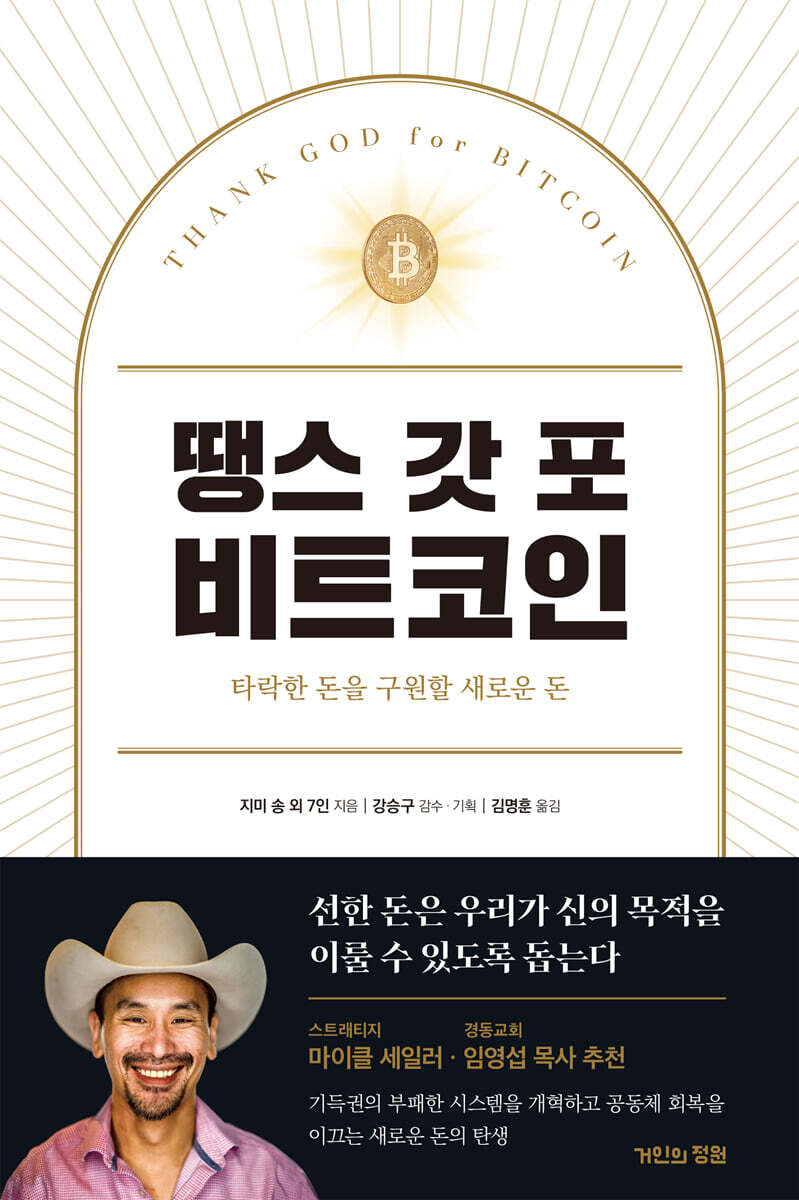
Thanks God for Bitcoin
 |
Description
Book Introduction
Bitcoin is a gift from God.
The Birth of Moral Money: Reforming the System of Established Interests
A masterpiece analyzing the philosophical and ethical values of Bitcoin.
☆ Recommended by Strategy Michael Saylor, Pastor Lim Young-seop of Kyungdong Church ☆
☆ Includes 1-month Bitsaving pass ☆
Many people worship money.
But money brings greed, jealousy, and desire, and some people even commit sins because of money.
That's why many people treat money as a frivolous and worldly thing.
Especially for those who believe in God, money is often treated as something sinful that should not be spoken of carelessly.
But this is a wrong idea.
Money plays an important role in enabling humans to form communities and live as members of one another.
In other words, money is absolutely necessary for society and is an essential tool for realizing the purpose for which God created humans.
The problem isn't money, it's how money works.
This book explores what money is and how today's fiat currency system creates inflation and inequality.
And we look at what role Bitcoin can play.
The greatest value of this book lies in its analysis of Bitcoin's philosophical and ethical values, rather than simply viewing it as an investment asset.
The authors demonstrate how money, corrupted by the fiat currency system, corrupts and destroys the church, and demonstrate that Bitcoin, as "moral money," can be an alternative to fiat currency and a tool for achieving God's purposes.
This book will serve as a significant milestone for those who are facing confusion about money and faith in the face of the wave of change that is Bitcoin.
The Birth of Moral Money: Reforming the System of Established Interests
A masterpiece analyzing the philosophical and ethical values of Bitcoin.
☆ Recommended by Strategy Michael Saylor, Pastor Lim Young-seop of Kyungdong Church ☆
☆ Includes 1-month Bitsaving pass ☆
Many people worship money.
But money brings greed, jealousy, and desire, and some people even commit sins because of money.
That's why many people treat money as a frivolous and worldly thing.
Especially for those who believe in God, money is often treated as something sinful that should not be spoken of carelessly.
But this is a wrong idea.
Money plays an important role in enabling humans to form communities and live as members of one another.
In other words, money is absolutely necessary for society and is an essential tool for realizing the purpose for which God created humans.
The problem isn't money, it's how money works.
This book explores what money is and how today's fiat currency system creates inflation and inequality.
And we look at what role Bitcoin can play.
The greatest value of this book lies in its analysis of Bitcoin's philosophical and ethical values, rather than simply viewing it as an investment asset.
The authors demonstrate how money, corrupted by the fiat currency system, corrupts and destroys the church, and demonstrate that Bitcoin, as "moral money," can be an alternative to fiat currency and a tool for achieving God's purposes.
This book will serve as a significant milestone for those who are facing confusion about money and faith in the face of the wave of change that is Bitcoin.
- You can preview some of the book's contents.
Preview
index
Recommendation
preface
Introduction
Chapter 1.
Understanding Money
Chapter 2.
History of Money
Chapter 3.
inflation
Chapter 4.
The problem of fiat currency
Chapter 5.
Money and Politics
Chapter 6.
The Moral Consequences of Corrupt Money
Chapter 7.
How Evil Money Corrupted the Church
Chapter 8.
Bitcoin: A More Moral Money
Chapter 9.
Salvation of money
Acknowledgements
A word from the editor and publisher
Translator's Note
About the Author
References
preface
Introduction
Chapter 1.
Understanding Money
Chapter 2.
History of Money
Chapter 3.
inflation
Chapter 4.
The problem of fiat currency
Chapter 5.
Money and Politics
Chapter 6.
The Moral Consequences of Corrupt Money
Chapter 7.
How Evil Money Corrupted the Church
Chapter 8.
Bitcoin: A More Moral Money
Chapter 9.
Salvation of money
Acknowledgements
A word from the editor and publisher
Translator's Note
About the Author
References
Detailed image

Into the book
Gold-backed paper money solved many of gold's problems, but it also introduced a fatal flaw: it left the state in control of its most important attribute: scarcity.
As expected, the United States printed far more dollars than it held in its vaults.
This situation came to a head in 1971 when U.S. President Richard Nixon “temporarily” suspended the convertibility of the dollar into gold.
This temporary suspension of the exchange rate soon became permanent.
Although the dollar is no longer exchangeable for gold, it is still held as a reserve asset in the vaults of central banks around the world.
This immoral action by the United States severed the link between money and gold, leading people around the world into financial slavery.
--- p.71, from “The History of Money”
When a church is in financial deficit, it cuts its budget.
As a result, people leave the church and the church's budget is further reduced.
Through this process, many churches die slowly and painfully.
Therefore, these churches are under pressure to retain as many giving members as possible.
Because we know that the departure of a saint is the beginning of a vicious cycle.
Churches may seek to generate income through other means.
For example, the church could be leased for other purposes or even part of the building could be sold.
A church that behaves like this is more like a real estate speculator working for a bank than a church.
When a church becomes more focused on paying off debt than on ministry, it becomes a slave to its creditors.
--- p.185, from “How Evil Money Corrupted the Church”
When the money supply expands, the value of the currency decreases, which hinders people's long-term financial planning and saving.
As discussed in Chapter 3, monetary inflation is a tool through which governments steal the community's wealth through hidden taxes without representation, legal basis, or transparency.
The existence of central banks makes this theft possible.
A monetary system without a central authority that can increase the supply does not have this problem.
In other words, in a moral monetary system, there is no central authority that prints money.
--- p.212, from “Bitcoin, a More Moral Money”
The bigger the government, the less responsibility it has.
The reason governments can grow without limits is because of fiat money.
The government creates inflation to fund its policies, which in turn makes the government bigger.
In an economy built on lies and theft, policies are determined by intentions, not outcomes.
Because it's much easier to publicize intentions than to take responsibility for the results.
Even if the intentions are good, the results are rarely evaluated.
So ineffective policies are mass-produced.
Corruption and bribery creep in because the results are not important.
In other words, money stolen from the community is used however it pleases.
The fiat currency system encourages us to solve all our problems with money.
--- p.234, from “Salvation of Money”
Money is a means of exchange, and exchange is a means of creating something useful for the community.
In other words, money is an essential tool for fully realizing the purpose for which God created us.
Evil money distracts us from its purpose and makes us serve the creature rather than the Creator.
Good money brings us closer to God and helps us achieve His purpose.
As expected, the United States printed far more dollars than it held in its vaults.
This situation came to a head in 1971 when U.S. President Richard Nixon “temporarily” suspended the convertibility of the dollar into gold.
This temporary suspension of the exchange rate soon became permanent.
Although the dollar is no longer exchangeable for gold, it is still held as a reserve asset in the vaults of central banks around the world.
This immoral action by the United States severed the link between money and gold, leading people around the world into financial slavery.
--- p.71, from “The History of Money”
When a church is in financial deficit, it cuts its budget.
As a result, people leave the church and the church's budget is further reduced.
Through this process, many churches die slowly and painfully.
Therefore, these churches are under pressure to retain as many giving members as possible.
Because we know that the departure of a saint is the beginning of a vicious cycle.
Churches may seek to generate income through other means.
For example, the church could be leased for other purposes or even part of the building could be sold.
A church that behaves like this is more like a real estate speculator working for a bank than a church.
When a church becomes more focused on paying off debt than on ministry, it becomes a slave to its creditors.
--- p.185, from “How Evil Money Corrupted the Church”
When the money supply expands, the value of the currency decreases, which hinders people's long-term financial planning and saving.
As discussed in Chapter 3, monetary inflation is a tool through which governments steal the community's wealth through hidden taxes without representation, legal basis, or transparency.
The existence of central banks makes this theft possible.
A monetary system without a central authority that can increase the supply does not have this problem.
In other words, in a moral monetary system, there is no central authority that prints money.
--- p.212, from “Bitcoin, a More Moral Money”
The bigger the government, the less responsibility it has.
The reason governments can grow without limits is because of fiat money.
The government creates inflation to fund its policies, which in turn makes the government bigger.
In an economy built on lies and theft, policies are determined by intentions, not outcomes.
Because it's much easier to publicize intentions than to take responsibility for the results.
Even if the intentions are good, the results are rarely evaluated.
So ineffective policies are mass-produced.
Corruption and bribery creep in because the results are not important.
In other words, money stolen from the community is used however it pleases.
The fiat currency system encourages us to solve all our problems with money.
--- p.234, from “Salvation of Money”
Money is a means of exchange, and exchange is a means of creating something useful for the community.
In other words, money is an essential tool for fully realizing the purpose for which God created us.
Evil money distracts us from its purpose and makes us serve the creature rather than the Creator.
Good money brings us closer to God and helps us achieve His purpose.
--- p.265, from “Salvation of Money”
Publisher's Review
“Good money helps us achieve God’s purposes.”
Achieving individual freedom and social prosperity
Bitcoin, the new money that drives community recovery
What is Money? Governments, Central Banks, and Victims
“Even those who think themselves quite free from outside intellectual influence are in fact slaves to dead economists.” This is a quote from John Maynard Keynes, the British economist and a pillar of macroeconomics.
People believe that money works rationally and democratically.
But this is a misconception.
Today's money operates under the strict control of governments, central banks, and vested interests.
Most ordinary people are exploited by the fiat currency system controlled by vested interests and suffer from inflation.
If money is an essential necessity in life, then you must understand the monetary system that drives today's global economy to avoid being oppressed by it any longer.
Why does fiat money corrupt society and religion?
The unfair system of fiat currency inevitably causes problems in society and creates victims.
The most representative problem with the fiat currency system is that the supply can increase indefinitely.
When the central bank expands the money supply, the value of the currency tends to decline, which has a negative impact on people's long-term financial planning and savings.
Governments can also control businesses and individuals by forcibly restricting the movement of money.
For example, a government can impose sanctions or freeze assets on banks that do business with certain groups at its discretion.
This 'censorship' is not a problem when the government is fair.
However, most censorship starts with good intentions and then degenerates into something that can be used for evil.
We witness countless instances of censorship being abused for political favors, concealment of truth, or collusion with vested interests.
And in this process, countless people are forced to play the role of victims without even knowing it.
Historically, even the most pure and honest religions have not been free from corruption through censorship.
In the past, the Catholic Church committed the injustice of selling indulgences, and today, many churches are led astray by debts owed to banks.
How Bitcoin Saves Evil Money
So, is there no way to save this fiat currency system? The authors of this book argue that Bitcoin could be an alternative to the corrupt fiat currency system.
Bitcoin has a predictable supply, transactions are transparent and public, and no one can forcibly control the movement of Bitcoin.
And because it is not a real thing, there is no risk of it being altered.
These characteristics provide the basis for Bitcoin to establish itself as a store of value trusted by the community.
Today's corrupt monetary system is like a great flood, sweeping over countries like Zimbabwe and Venezuela, taking lives and property from their citizens.
It's not just a matter of a specific country.
It's something that can happen to anyone living in this world.
Bitcoin's role as a store of value as an investment asset isn't all it's cracked up to be.
Analyzing the philosophical and ethical values of Bitcoin, this book demonstrates that Bitcoin, as a moral currency, can be a means to achieve individual freedom and prosperity and restore crumbling communities.
Achieving individual freedom and social prosperity
Bitcoin, the new money that drives community recovery
What is Money? Governments, Central Banks, and Victims
“Even those who think themselves quite free from outside intellectual influence are in fact slaves to dead economists.” This is a quote from John Maynard Keynes, the British economist and a pillar of macroeconomics.
People believe that money works rationally and democratically.
But this is a misconception.
Today's money operates under the strict control of governments, central banks, and vested interests.
Most ordinary people are exploited by the fiat currency system controlled by vested interests and suffer from inflation.
If money is an essential necessity in life, then you must understand the monetary system that drives today's global economy to avoid being oppressed by it any longer.
Why does fiat money corrupt society and religion?
The unfair system of fiat currency inevitably causes problems in society and creates victims.
The most representative problem with the fiat currency system is that the supply can increase indefinitely.
When the central bank expands the money supply, the value of the currency tends to decline, which has a negative impact on people's long-term financial planning and savings.
Governments can also control businesses and individuals by forcibly restricting the movement of money.
For example, a government can impose sanctions or freeze assets on banks that do business with certain groups at its discretion.
This 'censorship' is not a problem when the government is fair.
However, most censorship starts with good intentions and then degenerates into something that can be used for evil.
We witness countless instances of censorship being abused for political favors, concealment of truth, or collusion with vested interests.
And in this process, countless people are forced to play the role of victims without even knowing it.
Historically, even the most pure and honest religions have not been free from corruption through censorship.
In the past, the Catholic Church committed the injustice of selling indulgences, and today, many churches are led astray by debts owed to banks.
How Bitcoin Saves Evil Money
So, is there no way to save this fiat currency system? The authors of this book argue that Bitcoin could be an alternative to the corrupt fiat currency system.
Bitcoin has a predictable supply, transactions are transparent and public, and no one can forcibly control the movement of Bitcoin.
And because it is not a real thing, there is no risk of it being altered.
These characteristics provide the basis for Bitcoin to establish itself as a store of value trusted by the community.
Today's corrupt monetary system is like a great flood, sweeping over countries like Zimbabwe and Venezuela, taking lives and property from their citizens.
It's not just a matter of a specific country.
It's something that can happen to anyone living in this world.
Bitcoin's role as a store of value as an investment asset isn't all it's cracked up to be.
Analyzing the philosophical and ethical values of Bitcoin, this book demonstrates that Bitcoin, as a moral currency, can be a means to achieve individual freedom and prosperity and restore crumbling communities.
GOODS SPECIFICS
- Date of issue: April 25, 2025
- Page count, weight, size: 284 pages | 464g | 140*210*18mm
- ISBN13: 9791193869253
You may also like
카테고리
korean


korean

![ELLE 엘르 스페셜 에디션 A형 : 12월 [2025]](http://librairie.coreenne.fr/cdn/shop/files/b8e27a3de6c9538896439686c6b0e8fb.jpg?v=1766436872&width=3840)


