

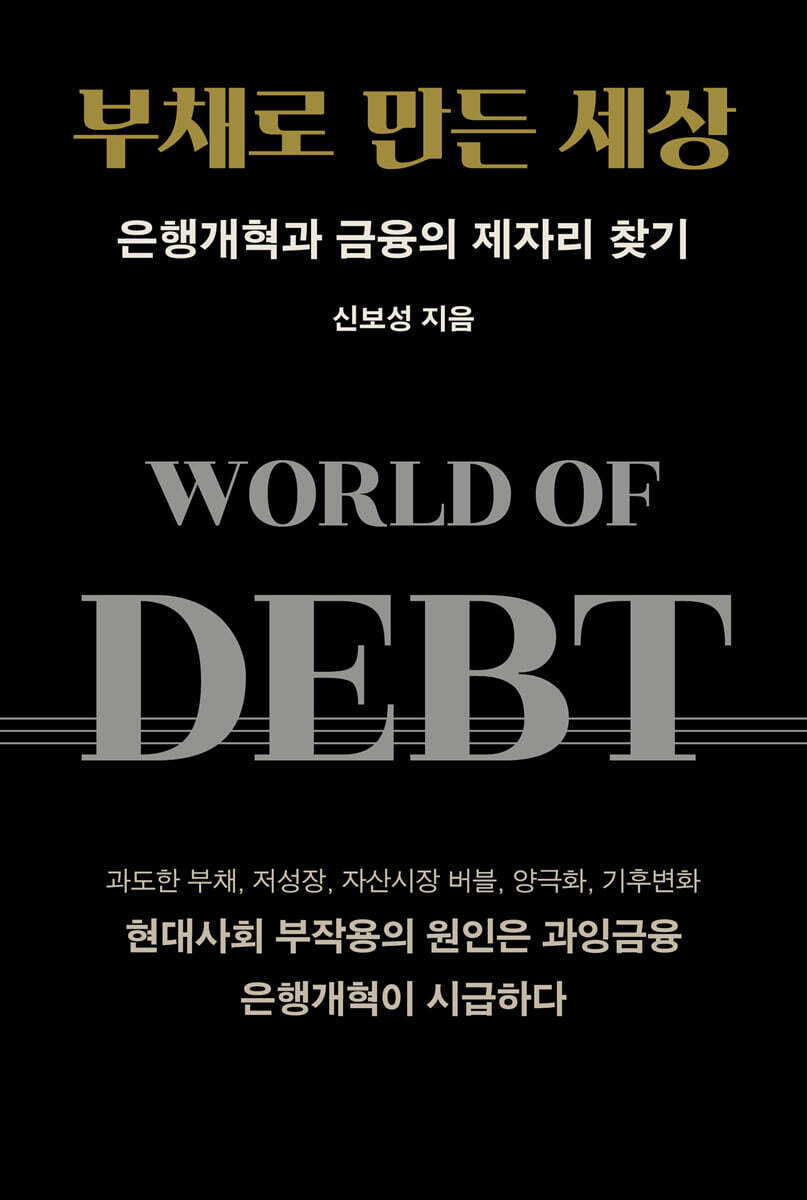
A world made of debt
 |
Description
Book Introduction
The Big History of Jangguhan Bank
An intuitive explanation of extensive financial theory
A book that reveals the truth about the distorted banking system
"The banking system is a failed system."
Extensive historical evidence and meticulous theoretical analysis,
A book that exposes the contradictions of the modern banking system.
Banks are something we encounter all the time in our daily lives.
How much do we know about banks?
Would you believe me if I told you that the modern banking system, which we consider indispensable, is the cause of countless negative consequences of modern society, such as excessive debt, low growth, polarization, social division, and the climate crisis?
Surprisingly, the author says yes.
Given that banks are essential, and even special, entities in our economy, and that we are mobilizing various policies to rescue them, isn't the author's argument wrong?
Even in 2022, a scholar who theoretically established the special nature of banks and the legitimacy of bank rescue received the Nobel Prize in Economics.
The author bluntly exposes the fundamental contradictions inherent in the modern banking system and the numerous side effects that arise from them.
If you are a reader expecting a book based on shallow conspiracy theories or sentiments that are abundant in the market, you need not read this book.
This book stands in stark contrast to indiscriminate, emotional bank-bashing and criticism without alternatives.
The author's writing boldly breaks our conventional wisdom.
However, the author's work of breaking conventional wisdom is never hasty or reckless.
The author, who has dedicated himself to financial research for many years, meticulously, yet easily, and above all, clearly reveals the contradictions and side effects of the banking system, building on a solid foundation of historical evidence and theoretical analysis.
An intuitive explanation of extensive financial theory
A book that reveals the truth about the distorted banking system
"The banking system is a failed system."
Extensive historical evidence and meticulous theoretical analysis,
A book that exposes the contradictions of the modern banking system.
Banks are something we encounter all the time in our daily lives.
How much do we know about banks?
Would you believe me if I told you that the modern banking system, which we consider indispensable, is the cause of countless negative consequences of modern society, such as excessive debt, low growth, polarization, social division, and the climate crisis?
Surprisingly, the author says yes.
Given that banks are essential, and even special, entities in our economy, and that we are mobilizing various policies to rescue them, isn't the author's argument wrong?
Even in 2022, a scholar who theoretically established the special nature of banks and the legitimacy of bank rescue received the Nobel Prize in Economics.
The author bluntly exposes the fundamental contradictions inherent in the modern banking system and the numerous side effects that arise from them.
If you are a reader expecting a book based on shallow conspiracy theories or sentiments that are abundant in the market, you need not read this book.
This book stands in stark contrast to indiscriminate, emotional bank-bashing and criticism without alternatives.
The author's writing boldly breaks our conventional wisdom.
However, the author's work of breaking conventional wisdom is never hasty or reckless.
The author, who has dedicated himself to financial research for many years, meticulously, yet easily, and above all, clearly reveals the contradictions and side effects of the banking system, building on a solid foundation of historical evidence and theoretical analysis.
- You can preview some of the book's contents.
Preview
index
prolog
Part 1: The Birth of Fractional Reserve Banks
Chapter 1: An Opportunity That Came by Chance
Charles I's provocation
custodian's gold
From storage to payment
overdraft, the beginning of a loan
Making money with fake depository receipts
Do you take deposits and lend them out, or do you create deposits by lending them out?
Beyond current account loans
Chapter 2: The Blacksmith, Standing at the Center of the World
Information Asymmetry: Adverse Selection and Moral Hazard
efficient information producer
The emergence of strong authenticators
Storage fees are eliminated and interest is paid.
Partial preparation becomes the trend
Chapter 3 Transformer Gold
The Law of Large Numbers: Turning Risky Loans into Safe Deposits
The Law of Large Numbers: Risk Sharing Among Depositors
Liquidity provision, maturity conversion
Are banks jacks of all trades?
The shadow of the bank
The history of the second bank is a history of crisis.
Chapter 4: Fragile Banks
Balance Sheet, a snapshot of corporate information
Shareholders vs. Creditors
Equity capital and insolvency risk
Liquidity risk
From liquidity crisis to insolvency crisis
The bank's precarious solvency
Banks are liquidity risk itself
Chapter 5: Banks in Crisis
Bank Runs, the Trigger of a Banking Crisis
Banks and money changers in ancient Greece and Rome
Banking crises in ancient Greece and Rome
Banking crises in Southern Europe in the 14th to 16th centuries
Banks, synonymous with bankruptcy
17th-19th century, British banking crisis
Banking crises in the United States in the late 18th and early 20th centuries
The Great Depression and the American Banking Crisis
Part 3: Stop credit inflation
Chapter 6: Credit Expansion and Banking Crisis
Credit inflation: the prelude to a banking crisis
Señor, Bank
Between Greed and Fear: The Tragedy of the Commons
Asset markets fuel credit expansion
Inefficient bank run?
Where did the law of large numbers go?
The nexus of money and credit: the source of banking vulnerability
Chapter 7 The Costs of Banking Crisis
Moment of Truth
A sharp decline in money supply
Depletion of financial assets, bankruptcy of blue chip companies
Risk-averse, volatility-hating humans
Credit expansion and economic fluctuations
Asymmetry of boom and bust
polarization
The swamp of debt deflation and recession
Fractional Reserve Banking and Externalities
Chapter 8: Fix the Bank or Save It?
Britain's attempt at reform, the Banking Licensing Act of 1844
America's Attempt at Reform: The Chicago Plan
The Bank of England, the government's military procurement window
The leader of the banking club
The Birth of the Fed: A Triumph for Bankers
An unexpected gift: the deposit insurance system
Establishment of new anti-competitive regulations
Britain opts for implicit regulation
The era of financial repression
Part 4: Accumulation of Systemic Risk and the Great Collapse
Chapter 9: The End of Financial Repression, the Beginning of the Financial Crisis
3/6/3 model
The advent of the competitive era
The wave of deregulation spreads
Deregulation: [Safety Net + Anti-Competitive Regulation] Breaking Down the Consolidation
The British non-mainstream banking crisis of the 1970s
The US banking crisis of the 1970s and 1980s
The Nordic banking crisis of the early 1990s
Japan's banking crisis and zombie economy in the 1990s
The simultaneous spread of banking crises and safety nets
Chapter 10: Accumulation of Systemic Risk
The bank that became a dinosaur
Economies of scale vs. subsidy-seeking
The gap between banks and capital markets opens.
Increasing systemic risk
Standardized regulations amplify systemic risk.
Chapter 11: The Great Collapse
Financial Innovation: Securitization
Disguised Innovation: Securitization of Subprime Mortgages
Shadow Banking: Replicating Banks Outside of Banks
The Great Depression and the Global Financial Crisis
Safety Net: The Root of the Financial Crisis
Part 5: The Age of Overfinance
Chapter 12: Beyond Credit Expansion to Overfinancing
Credit expansion and overfinancing
Evidence of overfinancing
Overfinancing, illusory claims
Global Imbalances, the Global Version of Overfinancing
Another factor driving overfinancing: the asset market
A tribute to finance
The Reality of Financial Utopia
Chapter 13: The Harmful Effects of Excessive Finance
Finance that does not contribute to the real economy
Excessive finance, the cause of climate change and environmental pollution
The prosperity of intermediaries and the disappearance of the intermediary function
Chronic low growth and low resilience
Declining quality of household life
bloated distribution market
Overfinance and Debt-dependent Economy
Part 6: The Emergence of a Debt-Dependent Economy
Chapter 14: In Asset We Trust
The dogma of efficient markets
Interest rates and time preference
Central Bank, the Last Socialist
Interest rates and asset prices
Supporting asset prices with low interest rates
Chapter 15: A World Where Many Things Have Been Transformed
Stock price support: the ultimate imperative for a debt-dependent economy
Deepening polarization due to winner-take-all
The unfortunate elite and the poor middle class
The reversal of reality and imagination
Reversal of main and side jobs
The reversal of real and financial markets
Part 7: Finding Finance's Place
Chapter 16 Upstream
Upstream
Why Regulation Fails
Heuristics: A Means of Overcoming Complexity
System Risk and Modularization
Universal legal principles, standards for modularization
Chapter 17 Structural Reform: Separation of Currency and Credit
Storage vs. Loan
Illegality of the banking system
Legalization of partial preparation
Privileges for banks only
Restoration of universal legal principles
Separation of currency and credit
Chapter 18: Breaking Free from Myth
Reduction in economic fluctuations and elimination of bank runs
Reduce regulatory burden and regulatory costs
Restoring intermediary functions and promoting fair competition
Loan size and interest rate that reflect actual conditions
Restoration of currency status
The myth of elastic money supply
The Myth of Central Bank Independence
The Gold Standard, a Legacy of Barbarism?
Finding Finance's Place
Epilogue
main
References
Part 1: The Birth of Fractional Reserve Banks
Chapter 1: An Opportunity That Came by Chance
Charles I's provocation
custodian's gold
From storage to payment
overdraft, the beginning of a loan
Making money with fake depository receipts
Do you take deposits and lend them out, or do you create deposits by lending them out?
Beyond current account loans
Chapter 2: The Blacksmith, Standing at the Center of the World
Information Asymmetry: Adverse Selection and Moral Hazard
efficient information producer
The emergence of strong authenticators
Storage fees are eliminated and interest is paid.
Partial preparation becomes the trend
Chapter 3 Transformer Gold
The Law of Large Numbers: Turning Risky Loans into Safe Deposits
The Law of Large Numbers: Risk Sharing Among Depositors
Liquidity provision, maturity conversion
Are banks jacks of all trades?
The shadow of the bank
The history of the second bank is a history of crisis.
Chapter 4: Fragile Banks
Balance Sheet, a snapshot of corporate information
Shareholders vs. Creditors
Equity capital and insolvency risk
Liquidity risk
From liquidity crisis to insolvency crisis
The bank's precarious solvency
Banks are liquidity risk itself
Chapter 5: Banks in Crisis
Bank Runs, the Trigger of a Banking Crisis
Banks and money changers in ancient Greece and Rome
Banking crises in ancient Greece and Rome
Banking crises in Southern Europe in the 14th to 16th centuries
Banks, synonymous with bankruptcy
17th-19th century, British banking crisis
Banking crises in the United States in the late 18th and early 20th centuries
The Great Depression and the American Banking Crisis
Part 3: Stop credit inflation
Chapter 6: Credit Expansion and Banking Crisis
Credit inflation: the prelude to a banking crisis
Señor, Bank
Between Greed and Fear: The Tragedy of the Commons
Asset markets fuel credit expansion
Inefficient bank run?
Where did the law of large numbers go?
The nexus of money and credit: the source of banking vulnerability
Chapter 7 The Costs of Banking Crisis
Moment of Truth
A sharp decline in money supply
Depletion of financial assets, bankruptcy of blue chip companies
Risk-averse, volatility-hating humans
Credit expansion and economic fluctuations
Asymmetry of boom and bust
polarization
The swamp of debt deflation and recession
Fractional Reserve Banking and Externalities
Chapter 8: Fix the Bank or Save It?
Britain's attempt at reform, the Banking Licensing Act of 1844
America's Attempt at Reform: The Chicago Plan
The Bank of England, the government's military procurement window
The leader of the banking club
The Birth of the Fed: A Triumph for Bankers
An unexpected gift: the deposit insurance system
Establishment of new anti-competitive regulations
Britain opts for implicit regulation
The era of financial repression
Part 4: Accumulation of Systemic Risk and the Great Collapse
Chapter 9: The End of Financial Repression, the Beginning of the Financial Crisis
3/6/3 model
The advent of the competitive era
The wave of deregulation spreads
Deregulation: [Safety Net + Anti-Competitive Regulation] Breaking Down the Consolidation
The British non-mainstream banking crisis of the 1970s
The US banking crisis of the 1970s and 1980s
The Nordic banking crisis of the early 1990s
Japan's banking crisis and zombie economy in the 1990s
The simultaneous spread of banking crises and safety nets
Chapter 10: Accumulation of Systemic Risk
The bank that became a dinosaur
Economies of scale vs. subsidy-seeking
The gap between banks and capital markets opens.
Increasing systemic risk
Standardized regulations amplify systemic risk.
Chapter 11: The Great Collapse
Financial Innovation: Securitization
Disguised Innovation: Securitization of Subprime Mortgages
Shadow Banking: Replicating Banks Outside of Banks
The Great Depression and the Global Financial Crisis
Safety Net: The Root of the Financial Crisis
Part 5: The Age of Overfinance
Chapter 12: Beyond Credit Expansion to Overfinancing
Credit expansion and overfinancing
Evidence of overfinancing
Overfinancing, illusory claims
Global Imbalances, the Global Version of Overfinancing
Another factor driving overfinancing: the asset market
A tribute to finance
The Reality of Financial Utopia
Chapter 13: The Harmful Effects of Excessive Finance
Finance that does not contribute to the real economy
Excessive finance, the cause of climate change and environmental pollution
The prosperity of intermediaries and the disappearance of the intermediary function
Chronic low growth and low resilience
Declining quality of household life
bloated distribution market
Overfinance and Debt-dependent Economy
Part 6: The Emergence of a Debt-Dependent Economy
Chapter 14: In Asset We Trust
The dogma of efficient markets
Interest rates and time preference
Central Bank, the Last Socialist
Interest rates and asset prices
Supporting asset prices with low interest rates
Chapter 15: A World Where Many Things Have Been Transformed
Stock price support: the ultimate imperative for a debt-dependent economy
Deepening polarization due to winner-take-all
The unfortunate elite and the poor middle class
The reversal of reality and imagination
Reversal of main and side jobs
The reversal of real and financial markets
Part 7: Finding Finance's Place
Chapter 16 Upstream
Upstream
Why Regulation Fails
Heuristics: A Means of Overcoming Complexity
System Risk and Modularization
Universal legal principles, standards for modularization
Chapter 17 Structural Reform: Separation of Currency and Credit
Storage vs. Loan
Illegality of the banking system
Legalization of partial preparation
Privileges for banks only
Restoration of universal legal principles
Separation of currency and credit
Chapter 18: Breaking Free from Myth
Reduction in economic fluctuations and elimination of bank runs
Reduce regulatory burden and regulatory costs
Restoring intermediary functions and promoting fair competition
Loan size and interest rate that reflect actual conditions
Restoration of currency status
The myth of elastic money supply
The Myth of Central Bank Independence
The Gold Standard, a Legacy of Barbarism?
Finding Finance's Place
Epilogue
main
References
Detailed image
Into the book
The banking system is, in a word, a failed one. From BC to the mid-20th century, countless banks were established around the world, but they all ended in bankruptcy.
--- p.14
Almost every country, without exception, is bailing out its banks.
We must ask:
If a company cannot survive on its own and can only survive with the support of third parties, can it really be considered a complete company?
--- p.15
The idea that banks lend out money they receive as deposits is a misunderstanding of the banking system.
The essence of the fractional reserve system is to create deposits out of thin air through lending.
--- p.39
When we invest money somewhere, it means that we have to wait for a certain period of time and, of course, we cannot get the money back during that time.
However, among the numerous financial assets, bank deposits are not like that.
It is a truly peculiar financial asset that is both a source of income and can be immediately converted into cash when needed.
--- p.75
Almost without exception, banking crises preceded credit expansion, i.e., a large increase in lending.
This is also the consistent conclusion of numerous studies on banking crises.
--- p.121
There are countless examples of credit expansion leading to asset bubbles, including the South Sea bubble in England in the early 18th century, the Mississippi bubble in France around the same time, the British railway bubble in the mid-19th century, the stock market bubble in the United States that recurred throughout the late 19th century, and the Great Depression.
--- p.128
Banks in ancient Greece and Rome, and in European cities since the Middle Ages, have faded from the stage of history because they could not overcome the limitations of the fractional reserve system itself.
However, the British gold reserve bank has survived to this day by having the central bank as head of the club.
It is no exaggeration to say that the origin of modern banking was entirely thanks to central banks.
--- p.165
The tight bond between safety nets and anti-competitive regulations was torn apart by the tsunami of deregulation.
The monster called credit inflation, which had been locked in an underground prison for a long time, has been unsealed.
It was clear as day that credit expansion would soon resume and a banking crisis would ensue.
The end of financial repression was the beginning of a banking crisis.
--- p.190
It has been confirmed that the privilege of a safety net is granted more quickly and more broadly as the size of the insolvent bank increases (too big to fail) and the number of banks facing insolvency increases (systemic risk).
Now the path forward for banks is clearly defined.
The strategy was to grow as large as possible while at the same time being as similar as possible to the competitors.
--- p.202
As the big banks aggressively entered the capital market, it became necessary to save the capital market to save the banks.
--- p.211
In today's world where banks are the market, mutual complementarity between banks and markets can no longer be expected.
When banks collapse, the market collapses, and when markets collapse, banks collapse. In other words, when a crisis occurs, the entire financial system collapses.
--- p.214
The essence of overfinancing is the continuous accumulation of loan claims on borrowers who cannot repay, by banks relying on safety nets.
--- p.243
The claim that finance can become an independent growth engine is nothing more than a dreamlike tale chasing a nonexistent financial utopia.
Asymmetric growth in the financial sector, disconnected from the real economy, is nothing more than overfinancing.
--- p.255
The lifeline of a debt-dependent economy is asset prices.
To sustain the debt-dependent economy engendered by excessive financial overload, all economic entities unite to achieve the goal of supporting asset prices.
Asset prices have risen to the level of gods.
--- p.275
In a free market economy, the prices of all goods are determined by market supply and demand.
However, the central bank has decided to directly determine interest rates, the price of money that has a broad impact on all parts of the economy, rather than the price of a single good.
The era has arrived in which the central bank determines interest rates, which should be determined by the total amount of savings existing in society and the will and prospects of numerous economic entities.
--- p.282
The current situation, where the proportion of intangible assets is increasing and their importance is being emphasized, may be something that the debt-dependent economy has created for its own survival.
However, assets that do not generate profits are nothing more than illusions and fantasies, no matter how much you try to explain them.
It is only a matter of time before illusions and fantasies crumble.
--- p.303
In the face of the reality of suddenly rising asset prices, income from sound production activities appears infinitely shabby.
It is no longer possible to maintain one's position and focus on one's original production activities.
The so-called FIRE (Financial Independence, Retire Early) has become the goal of young people.
--- p.304
Unless finance changes first—unless we fundamentally reform the financial sector to end over-financing and a debt-dependent economy—achieving ESG will remain an empty promise.
--- p.309
It is time to acknowledge that the combination of expanding the safety net and adding regulations has failed.
Rather than repeating the emergency measures of adding safety nets and regulations after a crisis has erupted, we must identify the root causes of the crisis.
Instead of wasting resources and energy sending more rescuers downstream, we should go upstream to catch the "guy" who is throwing the kids into the water.
--- p.316
In a world dominated by uncertainty, the government's attempt to become omnipotent by creating a dense set of regulations and thereby regulating the regulated person's every move will only lead to disaster.
In an uncertain world, a somewhat crude but simple approach of setting a few dos and don'ts may be far more effective than issuing a plethora of prescriptions.
--- p.320
Universal principles of law are based on common sense and form a deep empathy within us.
Ultimately, to restore the robustness of the financial system through modularization, we must first examine whether there is anything in the current banking system that we cannot sympathize with, deviates from common sense, or violates universal legal principles.
--- p.327
The fractional reserve system has not stood the test of time because it distorted the very nature of finance.
Finance is essentially about patience.
If you want to invest your money and see results, you will need to wait for a certain period of time.
However, the fractional reserve system eliminated the need for waiting, or patience, in finance by allowing deposits to be withdrawn at any time.
Nevertheless, depositors receive a reward in the form of interest.
--- p.369
Finance, which used to provide equal economic opportunity, has now become the opposite, an obstacle that blocks equal economic opportunity.
As a result, today's finance is hindering economic growth and, furthermore, causing political and social divisions, jeopardizing the democracy that humanity has worked so hard to achieve.
--- p.14
Almost every country, without exception, is bailing out its banks.
We must ask:
If a company cannot survive on its own and can only survive with the support of third parties, can it really be considered a complete company?
--- p.15
The idea that banks lend out money they receive as deposits is a misunderstanding of the banking system.
The essence of the fractional reserve system is to create deposits out of thin air through lending.
--- p.39
When we invest money somewhere, it means that we have to wait for a certain period of time and, of course, we cannot get the money back during that time.
However, among the numerous financial assets, bank deposits are not like that.
It is a truly peculiar financial asset that is both a source of income and can be immediately converted into cash when needed.
--- p.75
Almost without exception, banking crises preceded credit expansion, i.e., a large increase in lending.
This is also the consistent conclusion of numerous studies on banking crises.
--- p.121
There are countless examples of credit expansion leading to asset bubbles, including the South Sea bubble in England in the early 18th century, the Mississippi bubble in France around the same time, the British railway bubble in the mid-19th century, the stock market bubble in the United States that recurred throughout the late 19th century, and the Great Depression.
--- p.128
Banks in ancient Greece and Rome, and in European cities since the Middle Ages, have faded from the stage of history because they could not overcome the limitations of the fractional reserve system itself.
However, the British gold reserve bank has survived to this day by having the central bank as head of the club.
It is no exaggeration to say that the origin of modern banking was entirely thanks to central banks.
--- p.165
The tight bond between safety nets and anti-competitive regulations was torn apart by the tsunami of deregulation.
The monster called credit inflation, which had been locked in an underground prison for a long time, has been unsealed.
It was clear as day that credit expansion would soon resume and a banking crisis would ensue.
The end of financial repression was the beginning of a banking crisis.
--- p.190
It has been confirmed that the privilege of a safety net is granted more quickly and more broadly as the size of the insolvent bank increases (too big to fail) and the number of banks facing insolvency increases (systemic risk).
Now the path forward for banks is clearly defined.
The strategy was to grow as large as possible while at the same time being as similar as possible to the competitors.
--- p.202
As the big banks aggressively entered the capital market, it became necessary to save the capital market to save the banks.
--- p.211
In today's world where banks are the market, mutual complementarity between banks and markets can no longer be expected.
When banks collapse, the market collapses, and when markets collapse, banks collapse. In other words, when a crisis occurs, the entire financial system collapses.
--- p.214
The essence of overfinancing is the continuous accumulation of loan claims on borrowers who cannot repay, by banks relying on safety nets.
--- p.243
The claim that finance can become an independent growth engine is nothing more than a dreamlike tale chasing a nonexistent financial utopia.
Asymmetric growth in the financial sector, disconnected from the real economy, is nothing more than overfinancing.
--- p.255
The lifeline of a debt-dependent economy is asset prices.
To sustain the debt-dependent economy engendered by excessive financial overload, all economic entities unite to achieve the goal of supporting asset prices.
Asset prices have risen to the level of gods.
--- p.275
In a free market economy, the prices of all goods are determined by market supply and demand.
However, the central bank has decided to directly determine interest rates, the price of money that has a broad impact on all parts of the economy, rather than the price of a single good.
The era has arrived in which the central bank determines interest rates, which should be determined by the total amount of savings existing in society and the will and prospects of numerous economic entities.
--- p.282
The current situation, where the proportion of intangible assets is increasing and their importance is being emphasized, may be something that the debt-dependent economy has created for its own survival.
However, assets that do not generate profits are nothing more than illusions and fantasies, no matter how much you try to explain them.
It is only a matter of time before illusions and fantasies crumble.
--- p.303
In the face of the reality of suddenly rising asset prices, income from sound production activities appears infinitely shabby.
It is no longer possible to maintain one's position and focus on one's original production activities.
The so-called FIRE (Financial Independence, Retire Early) has become the goal of young people.
--- p.304
Unless finance changes first—unless we fundamentally reform the financial sector to end over-financing and a debt-dependent economy—achieving ESG will remain an empty promise.
--- p.309
It is time to acknowledge that the combination of expanding the safety net and adding regulations has failed.
Rather than repeating the emergency measures of adding safety nets and regulations after a crisis has erupted, we must identify the root causes of the crisis.
Instead of wasting resources and energy sending more rescuers downstream, we should go upstream to catch the "guy" who is throwing the kids into the water.
--- p.316
In a world dominated by uncertainty, the government's attempt to become omnipotent by creating a dense set of regulations and thereby regulating the regulated person's every move will only lead to disaster.
In an uncertain world, a somewhat crude but simple approach of setting a few dos and don'ts may be far more effective than issuing a plethora of prescriptions.
--- p.320
Universal principles of law are based on common sense and form a deep empathy within us.
Ultimately, to restore the robustness of the financial system through modularization, we must first examine whether there is anything in the current banking system that we cannot sympathize with, deviates from common sense, or violates universal legal principles.
--- p.327
The fractional reserve system has not stood the test of time because it distorted the very nature of finance.
Finance is essentially about patience.
If you want to invest your money and see results, you will need to wait for a certain period of time.
However, the fractional reserve system eliminated the need for waiting, or patience, in finance by allowing deposits to be withdrawn at any time.
Nevertheless, depositors receive a reward in the form of interest.
--- p.369
Finance, which used to provide equal economic opportunity, has now become the opposite, an obstacle that blocks equal economic opportunity.
As a result, today's finance is hindering economic growth and, furthermore, causing political and social divisions, jeopardizing the democracy that humanity has worked so hard to achieve.
--- p.370
Publisher's Review
A bank is a place that creates deposits by lending money.
Most people know that banks take deposits and use that money to lend out.
But the reality is quite the opposite.
Banks create deposits ex nihilo out of thin air through loans.
It may be hard to believe, but this is what actually happens when you go to a bank and take out a loan.
The bank teller simply records the loan amount on the monitor displaying your deposit account and presses the Enter key.
Every time you hit the Enter key, the bank loses profit equal to the difference between the lending rate and the deposit rate.
The more times you hit the Enter key, the more the bank's profits increase.
This is why banks cannot help but be desperate to increase lending competitively.
The current reality of the global economy groaning under excessive debt cannot be explained without considering the modern banking system.
The history of banking is a history of crises.
Deposits, which are liabilities of banks, have no maturity date.
The same goes for demand deposits as well as time deposits.
Even if it is a three-year term deposit, the bank will return the entire principal as soon as you say you want to cancel it.
Among debts, bank deposits are the only debt that does not have a maturity date.
It is extremely convenient for depositors.
But debt with no maturity date is a source of bank vulnerability.
When banks compete to expand lending, that is, when credit expansion occurs, the number of bad borrowers inevitably increases, damaging the soundness of banks.
And as soon as news of the erosion of soundness spreads to the market, depositors engage in a fierce race to withdraw funds.
It's a bank run.
Bank runs occur because deposits have no maturity date.
Massive credit expansion by banks, followed by mass bank runs, is a phenomenon commonly found across time and space.
The result of a bank run is 100% bankruptcy.
There are no exceptions.
This is evidenced by the fact that numerous European banks, since the times of ancient Greece, Rome, and the Middle Ages, have consistently failed to avoid collective bankruptcy.
So the history of banking is a history of bankruptcy.
This is why the word 'bankruptcy', which means bankruptcy, has become a word that encompasses the entirety of bankruptcy.
The bank that became immortal
Since the dawn of time, banks have disappeared into the annals of history after experiencing mass credit expansion and mass bank runs.
Things began to change in the mid-19th century, when Britain began bailing out banks through its central bank.
Since then, major developed countries have followed Britain's example, and since the 20th century, most countries have been bailing out their banks through their central banks.
In addition, various safety nets, including deposit insurance and government payment guarantees, have been continuously expanded for banks.
Thanks to this, banks today, especially the big banks, are virtually immortal.
As a result, bank runs are gradually becoming a thing of the past.
The Age of Overfinance and the Advent of a Debt-Driven Economy
What would our lives be like if we could do anything without facing death?
The very fact that we cannot escape death makes us humble and makes us strive to live a life that is at least a little meaningful in our limited time.
Banks don't.
It is impossible to expect humility and careful asset management from a bank that has become immortal thanks to its infinite safety net.
This is because the size of banks has grown to an unmanageable level in line with the expansion of the safety net provided to banks.
In fact, the assets of JPMorgan Chase, the largest bank in the United States, are 7.4 times larger than those of Amazon, the largest corporation in the world.
The situation is similar in the UK.
Even China's largest banks and largest corporations have asset ratios as high as 15 times.
The list of the world's top 100 companies by assets is littered with bank names.
This is because the banks, which have become immortal, have grown in size through endless competition to expand lending.
And as a result, today we live in so-called debt-dependent economies, where excessive debt accumulates.
Asset prices ascend to the throne of gods (In Asset We Trust)
In a debt-dependent economy, asset prices take the place of gods.
This is because if asset prices, which have risen by using debt as fuel, fall, the economy will collapse as debt repayment becomes impossible.
As a result, in a debt-dependent economy, all economic entities form a single line to protect asset prices.
Actually, everyone talks about stock prices.
Everyone is talking about house prices.
Supporting stock prices is a fundamental imperative for a debt-dependent economy.
Excessive stock buybacks and workforce reductions to boost short-term stock prices are widespread, undermining the strength of companies.
The polarization of income is deepening as the power to give high compensation to executives who take the lead in supporting stock prices and low compensation to ordinary employees is strong.
In addition, the central bank's asset price support policy has led to extreme asset polarization.
Income polarization and even asset polarization.
An impassable economic chasm has now emerged between the haves and have-nots, the middle-aged and the young.
Economic polarization soon leads to political polarization.
The political divisions we see around the world are merely a mirror image of the economic polarization fostered by a debt-dependent economy.
Banking reform: A starting point for restoring finance to its rightful place.
As history over the past 2,000 years has shown, the banking system is not self-sustaining.
The modern banking system is a system that should have long ago disappeared due to lack of self-reliance, but has been revived by granting privileges as a safety net.
However, in a free market economy, granting privileges always leads to distortions.
The author argues that asset price worship, income polarization, asset polarization, political polarization, and even the climate crisis and the crisis of democracy, which seem unrelated to the banking system at first glance, are all deeply intertwined with the banking system.
Although this argument may seem somewhat provocative, the author's extensive historical evidence and meticulous theoretical analysis will find you nodding along.
The author argues that reforming the banking system is essential to escape from over-financing and a debt-dependent economy.
The alternative to reform is a 100% reserve system.
Under the new system, banks are not allowed to create money, that is, create deposits out of thin air by lending money.
Instead, to make a loan, savings must first come in.
The changes brought about by reform measures that seem simple and even obvious are truly astonishing.
Through this book, readers will witness a concrete blueprint for a world transformed by banking reform.
Who Should Read This Book
1.
Those who want to understand the modern banking system and the essence of finance
2.
People who want to broaden their understanding of banking history and financial theory.
3.
People curious about the causes and solutions to the financial crisis, debt accumulation, and polarization.
4.
People who are interested in economics
5.
People working in the financial sector
Most people know that banks take deposits and use that money to lend out.
But the reality is quite the opposite.
Banks create deposits ex nihilo out of thin air through loans.
It may be hard to believe, but this is what actually happens when you go to a bank and take out a loan.
The bank teller simply records the loan amount on the monitor displaying your deposit account and presses the Enter key.
Every time you hit the Enter key, the bank loses profit equal to the difference between the lending rate and the deposit rate.
The more times you hit the Enter key, the more the bank's profits increase.
This is why banks cannot help but be desperate to increase lending competitively.
The current reality of the global economy groaning under excessive debt cannot be explained without considering the modern banking system.
The history of banking is a history of crises.
Deposits, which are liabilities of banks, have no maturity date.
The same goes for demand deposits as well as time deposits.
Even if it is a three-year term deposit, the bank will return the entire principal as soon as you say you want to cancel it.
Among debts, bank deposits are the only debt that does not have a maturity date.
It is extremely convenient for depositors.
But debt with no maturity date is a source of bank vulnerability.
When banks compete to expand lending, that is, when credit expansion occurs, the number of bad borrowers inevitably increases, damaging the soundness of banks.
And as soon as news of the erosion of soundness spreads to the market, depositors engage in a fierce race to withdraw funds.
It's a bank run.
Bank runs occur because deposits have no maturity date.
Massive credit expansion by banks, followed by mass bank runs, is a phenomenon commonly found across time and space.
The result of a bank run is 100% bankruptcy.
There are no exceptions.
This is evidenced by the fact that numerous European banks, since the times of ancient Greece, Rome, and the Middle Ages, have consistently failed to avoid collective bankruptcy.
So the history of banking is a history of bankruptcy.
This is why the word 'bankruptcy', which means bankruptcy, has become a word that encompasses the entirety of bankruptcy.
The bank that became immortal
Since the dawn of time, banks have disappeared into the annals of history after experiencing mass credit expansion and mass bank runs.
Things began to change in the mid-19th century, when Britain began bailing out banks through its central bank.
Since then, major developed countries have followed Britain's example, and since the 20th century, most countries have been bailing out their banks through their central banks.
In addition, various safety nets, including deposit insurance and government payment guarantees, have been continuously expanded for banks.
Thanks to this, banks today, especially the big banks, are virtually immortal.
As a result, bank runs are gradually becoming a thing of the past.
The Age of Overfinance and the Advent of a Debt-Driven Economy
What would our lives be like if we could do anything without facing death?
The very fact that we cannot escape death makes us humble and makes us strive to live a life that is at least a little meaningful in our limited time.
Banks don't.
It is impossible to expect humility and careful asset management from a bank that has become immortal thanks to its infinite safety net.
This is because the size of banks has grown to an unmanageable level in line with the expansion of the safety net provided to banks.
In fact, the assets of JPMorgan Chase, the largest bank in the United States, are 7.4 times larger than those of Amazon, the largest corporation in the world.
The situation is similar in the UK.
Even China's largest banks and largest corporations have asset ratios as high as 15 times.
The list of the world's top 100 companies by assets is littered with bank names.
This is because the banks, which have become immortal, have grown in size through endless competition to expand lending.
And as a result, today we live in so-called debt-dependent economies, where excessive debt accumulates.
Asset prices ascend to the throne of gods (In Asset We Trust)
In a debt-dependent economy, asset prices take the place of gods.
This is because if asset prices, which have risen by using debt as fuel, fall, the economy will collapse as debt repayment becomes impossible.
As a result, in a debt-dependent economy, all economic entities form a single line to protect asset prices.
Actually, everyone talks about stock prices.
Everyone is talking about house prices.
Supporting stock prices is a fundamental imperative for a debt-dependent economy.
Excessive stock buybacks and workforce reductions to boost short-term stock prices are widespread, undermining the strength of companies.
The polarization of income is deepening as the power to give high compensation to executives who take the lead in supporting stock prices and low compensation to ordinary employees is strong.
In addition, the central bank's asset price support policy has led to extreme asset polarization.
Income polarization and even asset polarization.
An impassable economic chasm has now emerged between the haves and have-nots, the middle-aged and the young.
Economic polarization soon leads to political polarization.
The political divisions we see around the world are merely a mirror image of the economic polarization fostered by a debt-dependent economy.
Banking reform: A starting point for restoring finance to its rightful place.
As history over the past 2,000 years has shown, the banking system is not self-sustaining.
The modern banking system is a system that should have long ago disappeared due to lack of self-reliance, but has been revived by granting privileges as a safety net.
However, in a free market economy, granting privileges always leads to distortions.
The author argues that asset price worship, income polarization, asset polarization, political polarization, and even the climate crisis and the crisis of democracy, which seem unrelated to the banking system at first glance, are all deeply intertwined with the banking system.
Although this argument may seem somewhat provocative, the author's extensive historical evidence and meticulous theoretical analysis will find you nodding along.
The author argues that reforming the banking system is essential to escape from over-financing and a debt-dependent economy.
The alternative to reform is a 100% reserve system.
Under the new system, banks are not allowed to create money, that is, create deposits out of thin air by lending money.
Instead, to make a loan, savings must first come in.
The changes brought about by reform measures that seem simple and even obvious are truly astonishing.
Through this book, readers will witness a concrete blueprint for a world transformed by banking reform.
Who Should Read This Book
1.
Those who want to understand the modern banking system and the essence of finance
2.
People who want to broaden their understanding of banking history and financial theory.
3.
People curious about the causes and solutions to the financial crisis, debt accumulation, and polarization.
4.
People who are interested in economics
5.
People working in the financial sector
GOODS SPECIFICS
- Date of issue: June 24, 2024
- Format: Hardcover book binding method guide
- Page count, weight, size: 424 pages | 672g | 143*215*30mm
- ISBN13: 9791189318567
- ISBN10: 1189318563
You may also like
카테고리
korean


korean

![ELLE 엘르 스페셜 에디션 A형 : 12월 [2025]](http://librairie.coreenne.fr/cdn/shop/files/b8e27a3de6c9538896439686c6b0e8fb.jpg?v=1766436872&width=3840)


