

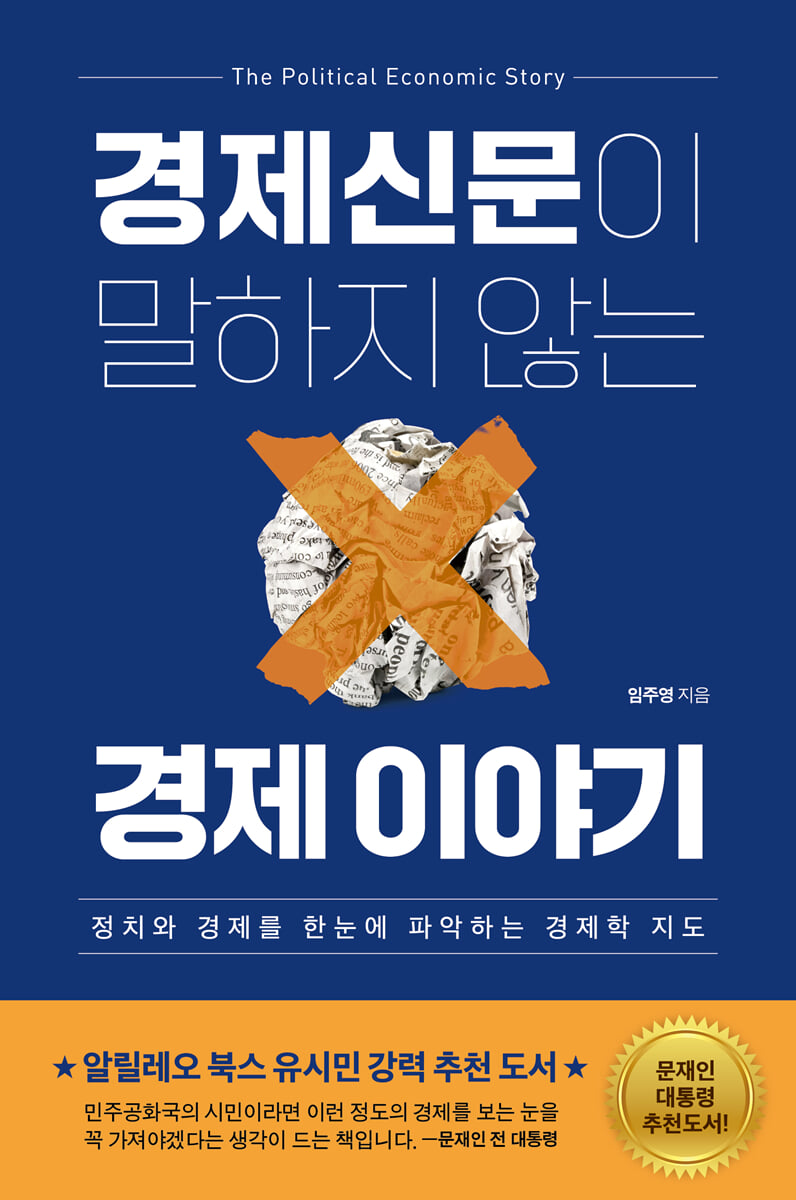
Economic Stories Not Told in Economic Newspapers
 |
Description
Book Introduction
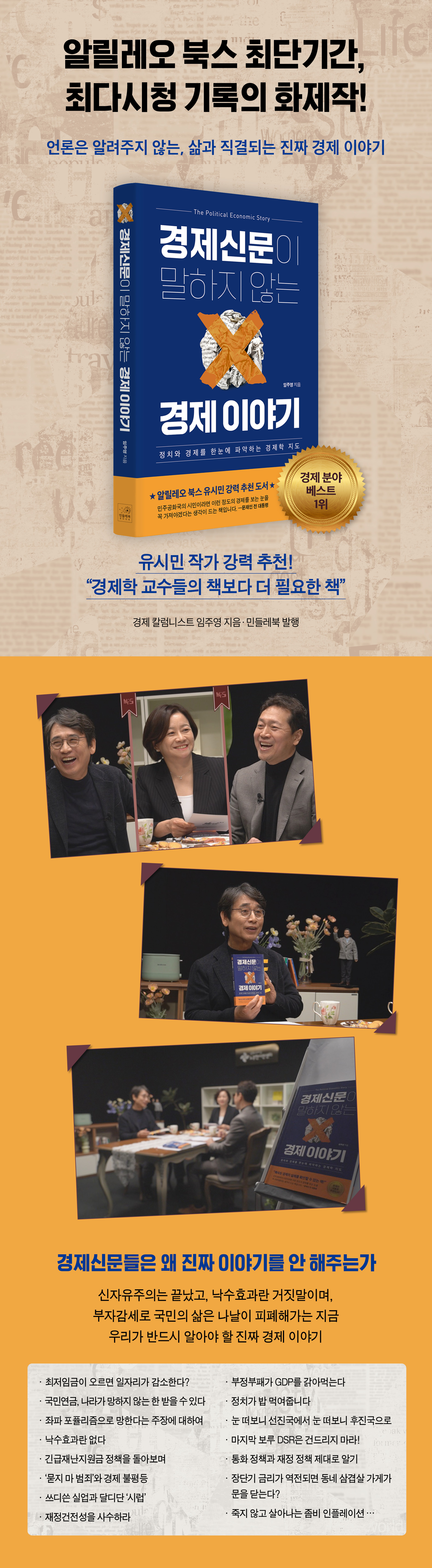
“Those who understand economics survive.” The real economic story that is directly related to my life, not told by the media. There are no set answers in economics. People think that economics is a social science and that it mainly presents numbers and data as the basis for its theories, so it must have correct answers like mathematics, but that is not the case at all. If that were the case, would we have repeatedly experienced numerous economic crises such as the IMF national bankruptcy and the Great Depression? In economics, there are countless theories that are created based on assumptions that are completely inconsistent with reality. Ceteris paraverse. It is an economic term that refers to the calculation that assumes that there are no other variables when there are countless variables that affect the result. To put it simply, it means that you will just roughly calculate it as you wish. The author, an economic columnist, examines countless economic claims around us calculated as ceteris parabolic and refutes them one by one based on facts. ‘Moving the presidential office to Yongsan will have the effect of increasing GDP by 3.3 trillion won’, ‘If the minimum wage becomes 10,000 won, 69,000 jobs will be lost’, ‘We will perish like Venezuela due to left-wing populism’, ‘Life was better during the Chun Doo-hwan era’, ‘You can travel abroad with unemployment benefits’, ‘If we keep handing out emergency disaster relief funds, the country will go bankrupt’, ‘The national pension will soon be depleted and we will not be able to receive it’… … These are all familiar contents. You need to know properly to respond properly. In this cruel "era of great disparity," this book contains the true economic story that each of us must know to survive. |
- You can preview some of the book's contents.
Preview
index
prolog
Chapter 1.
Kick away the shamanistic economics talisman.
· Is trickle-down economics a shamanistic economics? - The end of neoliberalism, there is no trickle-down effect.
· GDP per capita is wrong—a meaningless number that doesn't reflect life as it is.
· Did the Basic Income Experiment Fail? - A Look at the Final Report on Finland's Basic Income Experiment
· The corporate tax debate: What's more important? People come before corporations.
Misconception #1: Raising the minimum wage leads to fewer jobs.
Misconception 2 about the minimum wage: When the minimum wage rises, low-income earners' incomes decrease.
· National Pension: Please Stop the Threat Marketing! - You Can Receive It Unless the Country Collapses
Venezuela, a country that suddenly disappeared from the media - Regarding claims that it is ruined by left-wing populism
· You say the economy was good during Chun Doo-hwan's time? - Democracy must develop for the economy to grow.
Chapter 2.
For the economics of people
Is South Korea a democratic republic? - Daewoo Shipbuilding & Marine Engineering: Who is being saved and who is being suppressed?
Please stop using the term "industrial warrior"! - Promoting a 69-hour workweek and forcing long working hours.
· Parasites and Inequality: A Look Back at Emergency Disaster Relief Fund Policies
· 'Blind Crime' and Economic Inequality - The Scars of Neoliberalism
· The bitterness of unemployment and the sweetness of "syrup" - Understanding unemployment benefits
· The problem of youth only showing favoritism during elections - We need real policies for young people.
· Wildfires are raging, but don't touch the reservoir water? - A look at the fiscal soundness debate.
Chapter 3.
Politics feeds us
Corruption Eats Away GDP: Lessons from the Elliott and Mason Trials
· Eating alone in China? Being neglected? - Who is jeopardizing trade with China?
· Japan's Own Eyes: Unconventional Export Regulations, Before and After
Politics Feeds Us - Lessons from Hanjin Shipping's Bankruptcy
· Following the failing Japanese shipbuilding industry - South Korea's shipbuilding industry is at risk.
· I woke up in a developed country - a historic feat that should not be dismissed as a coincidence.
· I woke up to find myself in a developing country 1 - Repeated large-scale disasters
· When I opened my eyes, I was in a developing country 2 - Is there a difference between progressive and conservative in the sun and wind?
· I woke up to find myself in a developing country 3 - strategic ambiguity and economic failure.
Chapter 4.
A government that encourages speculation vs. a government that suppresses speculation
Are We Really Rational? - Looking Back at the Tulip Bubble and the Real Estate Bubble
· Governments that encourage speculation, governments that suppress speculation—all policies have a lag.
· The Fallacy of Housing Prices and Survivorship Bias: A Look Back at the Moon Jae-in Administration's Real Estate Policy
· A truly strange lease system - the effects of building public rental apartments
· Don't Touch the Last Bastion, DSR! - DSR Relaxation, the Risk of Special Savings Theory
· Is the Foreign Exchange Stabilization Fund a Real Estate Stabilization Fund? - Using expedient methods instead of issuing deficit-funding bonds, a contradiction in tax cut policies.
· Does rising real estate prices benefit elections? - Policies that solely aim for victory in general elections are unacceptable.
Chapter 5.
Letting go of familiar things
· Money that is lent and money that is simply given - Understanding monetary and fiscal policy properly
· If short-term and long-term interest rates invert, will your local pork belly shop close? - Keep an eye on the inversion of short-term and long-term interest rates.
· Zombie Inflation: The Undying Resurrection of Inflation: Can We Beat It?
· Letting go of the familiar 1
· Parting with the familiar 2
Chapter 1.
Kick away the shamanistic economics talisman.
· Is trickle-down economics a shamanistic economics? - The end of neoliberalism, there is no trickle-down effect.
· GDP per capita is wrong—a meaningless number that doesn't reflect life as it is.
· Did the Basic Income Experiment Fail? - A Look at the Final Report on Finland's Basic Income Experiment
· The corporate tax debate: What's more important? People come before corporations.
Misconception #1: Raising the minimum wage leads to fewer jobs.
Misconception 2 about the minimum wage: When the minimum wage rises, low-income earners' incomes decrease.
· National Pension: Please Stop the Threat Marketing! - You Can Receive It Unless the Country Collapses
Venezuela, a country that suddenly disappeared from the media - Regarding claims that it is ruined by left-wing populism
· You say the economy was good during Chun Doo-hwan's time? - Democracy must develop for the economy to grow.
Chapter 2.
For the economics of people
Is South Korea a democratic republic? - Daewoo Shipbuilding & Marine Engineering: Who is being saved and who is being suppressed?
Please stop using the term "industrial warrior"! - Promoting a 69-hour workweek and forcing long working hours.
· Parasites and Inequality: A Look Back at Emergency Disaster Relief Fund Policies
· 'Blind Crime' and Economic Inequality - The Scars of Neoliberalism
· The bitterness of unemployment and the sweetness of "syrup" - Understanding unemployment benefits
· The problem of youth only showing favoritism during elections - We need real policies for young people.
· Wildfires are raging, but don't touch the reservoir water? - A look at the fiscal soundness debate.
Chapter 3.
Politics feeds us
Corruption Eats Away GDP: Lessons from the Elliott and Mason Trials
· Eating alone in China? Being neglected? - Who is jeopardizing trade with China?
· Japan's Own Eyes: Unconventional Export Regulations, Before and After
Politics Feeds Us - Lessons from Hanjin Shipping's Bankruptcy
· Following the failing Japanese shipbuilding industry - South Korea's shipbuilding industry is at risk.
· I woke up in a developed country - a historic feat that should not be dismissed as a coincidence.
· I woke up to find myself in a developing country 1 - Repeated large-scale disasters
· When I opened my eyes, I was in a developing country 2 - Is there a difference between progressive and conservative in the sun and wind?
· I woke up to find myself in a developing country 3 - strategic ambiguity and economic failure.
Chapter 4.
A government that encourages speculation vs. a government that suppresses speculation
Are We Really Rational? - Looking Back at the Tulip Bubble and the Real Estate Bubble
· Governments that encourage speculation, governments that suppress speculation—all policies have a lag.
· The Fallacy of Housing Prices and Survivorship Bias: A Look Back at the Moon Jae-in Administration's Real Estate Policy
· A truly strange lease system - the effects of building public rental apartments
· Don't Touch the Last Bastion, DSR! - DSR Relaxation, the Risk of Special Savings Theory
· Is the Foreign Exchange Stabilization Fund a Real Estate Stabilization Fund? - Using expedient methods instead of issuing deficit-funding bonds, a contradiction in tax cut policies.
· Does rising real estate prices benefit elections? - Policies that solely aim for victory in general elections are unacceptable.
Chapter 5.
Letting go of familiar things
· Money that is lent and money that is simply given - Understanding monetary and fiscal policy properly
· If short-term and long-term interest rates invert, will your local pork belly shop close? - Keep an eye on the inversion of short-term and long-term interest rates.
· Zombie Inflation: The Undying Resurrection of Inflation: Can We Beat It?
· Letting go of the familiar 1
· Parting with the familiar 2
Detailed image
Into the book
Even American Nobel Prize winner in economics Professor Joseph Stiglitz once said that the belief that cutting corporate taxes will lead to more economic growth is close to superstition.
In fact, he criticized the idea of lowering corporate taxes based on the belief in the trickle-down effect as nothing more than shamanistic economics.
In reality, there are few empirical cases or research results that prove that corporate tax cuts have contributed to increased corporate investment.
Moreover, even the IMF and OECD, which are known for their conservative nature, recently released reports that policies such as corporate tax cuts and tax cuts for the wealthy have actually led to a decrease in tax revenue, worsening national finances and increasing economic inequality, ultimately making the economy more difficult.
--- p.19∼20
Now we are trying to follow in the footsteps of Britain.
The Bank of Korea is raising the base interest rate to combat inflation, but the government is effectively sticking to tax cuts, including corporate tax cuts and tax cuts for the wealthy.
These are all policies that encourage inflation.
The tax revenue shortfall in 2023 due to tax cuts is expected to exceed 60 trillion won.
A government that emphasized fiscal soundness as a cherished principle should have pursued a policy of tax increases rather than tax cuts.
Because if tax revenue decreases, fiscal soundness will inevitably worsen.
It's like shouting that you're going forward but then running backwards.
--- p.23
But something is strange.
In 2018 and 2019, when the minimum wage was raised by double digits, the income growth rate of wage earners exceeded the economic growth rate.
This means that the income of lower-income earners has increased.
This can be confirmed immediately by looking at the proportion of low-wage workers.
The proportion of low-wage workers, which had been at 23-24% under the Lee Myung-bak and Park Geun-hye administrations, plummeted to 19% in 2018, when the minimum wage was significantly raised.
Even looking at this far, the Korea Economic Research Institute's claim that raising the minimum wage will lead to a decrease in the income of low-income earners is wrong.
--- p.57~58
It's not a made-up story or a ghost story.
All numbers are based on facts.
What these numbers indicate is clear.
Raising the minimum wage increased the income of low-income workers and significantly reduced income inequality.
(Omitted) Every time the minimum wage is decided, media articles with the same content are published.
This time too, it's no different.
Most articles say that if the minimum wage increases, self-employed people will have to close their businesses or take out loans to pay their employees.
The media, which has been indifferent to the lives of small business owners and only interested in the profits of conglomerates and large corporations, suddenly pretends to be long-time friends of small business owners when the minimum wage is decided.
It's a transformation that I can't understand at all.
--- p.59
As long as the country does not collapse, you will definitely be able to receive national pension.
And there is still plenty of time before the fund runs out, so we can explore various measures to ensure the fund's financial soundness.
Even when the fund eventually runs out, the funding for pension payments can be changed from an accrual-based to a levy-based model.
And when the time comes, we will definitely pay the national pension, even if it means using national finances.
--- p.70
Considering the size of the economy, our country's national debt-to-GDP ratio of 47% is actually good, but it is excessively good.
Excluding financial debt that is backed by financial assets, that is, debt that can be repaid immediately by repaying financial assets, the national debt ratio is at a much better level.
80% of our national bonds are held by the public, most of them denominated in Korean won.
Not only is the debt ratio very good, but the debt structure is also very sound.
Why else would even the conservative IMF and OECD insist that South Korea should spend significantly more? This is practically a dereliction of fiscal duty.
--- p.137
If we were the only ones to suffer serious injuries and fall down without being able to get up, there would be no greater harm to our national interests.
Perhaps now is the time when the wisest national diplomatic strategy in history is needed.
This is a time when the strategic wisdom of Seohee, who was able to repel the Khitan invasion and gain control of the six provinces east of the river, is desperately needed, rather than a charging force armed with ideology and charging forward.
--- p.155
Politics and economics are not separate.
Our economy also had the opportunity to make a great leap forward by achieving both procedural and substantive democracy after the democratization movement of the 1980s, and as a result, we were able to rise to become an economically advanced nation today.
Conversely, if democracy collapses and corruption from vested interest cartels spreads throughout society, or if a dictator emerges and a predatory government takes over that squeezes the national economy with taxes and bribes, the economy could collapse in an instant.
In fact, he criticized the idea of lowering corporate taxes based on the belief in the trickle-down effect as nothing more than shamanistic economics.
In reality, there are few empirical cases or research results that prove that corporate tax cuts have contributed to increased corporate investment.
Moreover, even the IMF and OECD, which are known for their conservative nature, recently released reports that policies such as corporate tax cuts and tax cuts for the wealthy have actually led to a decrease in tax revenue, worsening national finances and increasing economic inequality, ultimately making the economy more difficult.
--- p.19∼20
Now we are trying to follow in the footsteps of Britain.
The Bank of Korea is raising the base interest rate to combat inflation, but the government is effectively sticking to tax cuts, including corporate tax cuts and tax cuts for the wealthy.
These are all policies that encourage inflation.
The tax revenue shortfall in 2023 due to tax cuts is expected to exceed 60 trillion won.
A government that emphasized fiscal soundness as a cherished principle should have pursued a policy of tax increases rather than tax cuts.
Because if tax revenue decreases, fiscal soundness will inevitably worsen.
It's like shouting that you're going forward but then running backwards.
--- p.23
But something is strange.
In 2018 and 2019, when the minimum wage was raised by double digits, the income growth rate of wage earners exceeded the economic growth rate.
This means that the income of lower-income earners has increased.
This can be confirmed immediately by looking at the proportion of low-wage workers.
The proportion of low-wage workers, which had been at 23-24% under the Lee Myung-bak and Park Geun-hye administrations, plummeted to 19% in 2018, when the minimum wage was significantly raised.
Even looking at this far, the Korea Economic Research Institute's claim that raising the minimum wage will lead to a decrease in the income of low-income earners is wrong.
--- p.57~58
It's not a made-up story or a ghost story.
All numbers are based on facts.
What these numbers indicate is clear.
Raising the minimum wage increased the income of low-income workers and significantly reduced income inequality.
(Omitted) Every time the minimum wage is decided, media articles with the same content are published.
This time too, it's no different.
Most articles say that if the minimum wage increases, self-employed people will have to close their businesses or take out loans to pay their employees.
The media, which has been indifferent to the lives of small business owners and only interested in the profits of conglomerates and large corporations, suddenly pretends to be long-time friends of small business owners when the minimum wage is decided.
It's a transformation that I can't understand at all.
--- p.59
As long as the country does not collapse, you will definitely be able to receive national pension.
And there is still plenty of time before the fund runs out, so we can explore various measures to ensure the fund's financial soundness.
Even when the fund eventually runs out, the funding for pension payments can be changed from an accrual-based to a levy-based model.
And when the time comes, we will definitely pay the national pension, even if it means using national finances.
--- p.70
Considering the size of the economy, our country's national debt-to-GDP ratio of 47% is actually good, but it is excessively good.
Excluding financial debt that is backed by financial assets, that is, debt that can be repaid immediately by repaying financial assets, the national debt ratio is at a much better level.
80% of our national bonds are held by the public, most of them denominated in Korean won.
Not only is the debt ratio very good, but the debt structure is also very sound.
Why else would even the conservative IMF and OECD insist that South Korea should spend significantly more? This is practically a dereliction of fiscal duty.
--- p.137
If we were the only ones to suffer serious injuries and fall down without being able to get up, there would be no greater harm to our national interests.
Perhaps now is the time when the wisest national diplomatic strategy in history is needed.
This is a time when the strategic wisdom of Seohee, who was able to repel the Khitan invasion and gain control of the six provinces east of the river, is desperately needed, rather than a charging force armed with ideology and charging forward.
--- p.155
Politics and economics are not separate.
Our economy also had the opportunity to make a great leap forward by achieving both procedural and substantive democracy after the democratization movement of the 1980s, and as a result, we were able to rise to become an economically advanced nation today.
Conversely, if democracy collapses and corruption from vested interest cartels spreads throughout society, or if a dictator emerges and a predatory government takes over that squeezes the national economy with taxes and bribes, the economy could collapse in an instant.
--- p.171
Publisher's Review
■ Shouldn't we know why we've become a developing country?
According to behavioral economist Daniel Kahneman, people don't always make rational choices.
To be more precise, the choices are likely to be wrong and the decision-making process is messy.
The human brain prefers to skip the thought process and just guess to survive, and in behavioral economics, this brain habit is called a 'heuristic.'
A prime example is Brexit, which is considered one of the most foolish decisions in British economic history.
As neoliberalism widened economic inequality and the lives of ordinary citizens became increasingly impoverished, conservatives incited the crisis by claiming that refugees from the Middle East and Africa were influxing and stealing jobs. The sensationalist claim that leaving the EU would both block refugees and protect jobs played a role in the heuristic.
This wasn't true, of course, but it didn't matter what was true.
In the end, the British people themselves decided to leave.
Are the British people stupid enough to make such a decision?
Considering the media environment at the time, where there were four to five times more media outlets supporting Brexit than those supporting Remain, we can guess the background to the public's decision.
The author decided to write this book out of a sense of urgency that a decision like Brexit must never happen in South Korea.
Because our current media situation is no different from that of Britain at that time.
There are many important and sensitive economic issues in our society.
These are issues that require urgent social consensus and cannot be delayed any longer.
Yet, it is becoming increasingly difficult to know the substantive truth.
Partisan and ideological statements obscure the truth and exaggerate numbers and data.
The media constantly amplifies and reproduces that interpretation, adding to it, so now we can't even tell what the essence is.
If facts are distorted and the essence is distorted, the economy cannot advance even a single step.
Only by seeing the economy as it is can we correct its mistakes and develop its strengths.
If we do not properly reflect on the present, where we have suddenly fallen from a dreamlike era of being a developed country to a developing country, we will end up falling into an even deeper abyss.
In this book, the author critically examines the economic issues we face today, including heated debates in our society, incomprehensible economic policies, politically motivated distortions, and alarming global trends.
Through his eyes, I can encounter real economic stories that are directly related to my life, stories that the media does not tell.
■ Don't be fooled by shaman economics any longer.
Economics talks are full of numbers and graphs, unfamiliar terms, and difficult content.
Economic articles in the media are so difficult that you have to read them with the determination to study.
That's why we shouldn't give up on understanding it and just ignore it, because the economy is an issue that is directly related to our lives.
Since the minimum wage, weekly work hours, national pension, emergency disaster relief funds, unemployment benefits, household loans, real estate regulations, basic income, short-term and long-term interest rates, and DSR are all influenced by economic policy, it is dangerous to be swayed by the unilateral claims of any one side.
This book explains complex economic issues through concrete, case-by-case explanations, enabling a thorough understanding of the critical policies and controversial issues that shape our lives.
This book explains in detail issues that everyone living in Korea should know more accurately and correctly, such as the blind faith in the 'trickle-down effect', which is nothing more than a baseless slogan, also known as shaman economics, the reality of GDP, which is an empty number that does not reflect life as it is, the misconception that the country will collapse if the minimum wage is raised, intimidation marketing related to the national pension, the inside story of the '69-hour workweek system', the correlation between emergency disaster relief funds and fiscal soundness, the national crisis that tax cuts for the rich will bring, and support policies for the youth who are on the verge of collapse.
Furthermore, since the economy and politics are intertwined and flow in the same direction, it is essential to understand economic policies that vary depending on the ruling party.
The author outlines the trends in policies that vary depending on whether they are progressive or conservative, and presents critical cases that prove that the saying, “politics feeds the people” is no joke.
This film shows the process by which politics influences the economy and ultimately determines the lives of the people through the reality that the people will ultimately have to pay astronomical damages caused by the illegal and fraudulent management succession of the conglomerates, the scale of economic loss that will have to be endured as trade with China becomes endangered, the humiliation of the Korean government giving up on Japan's export restrictions that it had overcome with difficulty, and the status of the Korean shipping industry whose fate changes depending on the government.
Knowing the background circumstances of each incident, the way it unfolded, and the resulting losses and repercussions, we, as economic actors, cannot help but be vigilant about the perspective from which we should monitor policies and implementation going forward.
As one phrase in the recommendation says, "Through this book, I learned that the real economy is what makes the world a warmer place," the author places "people" at the center throughout the book.
He emphasizes that people must come first before any other value, that the foundation of our economy begins with people, and that both politics and the economy must ultimately be designed and implemented so that people can all live well together.
That is why we are examining in detail the structural problems of the rental housing fraud scandal that shook the nation, the deep concerns about the relaxation of DSR regulations, and the aftereffects of government policies that will increase household debt and bring about inflation.
We can see everywhere the determination and sense of mission to prevent the shock and unfortunate events that the people will have to endure if wrong policies are enforced.
“Evil comes not from poverty, but from inequality.
“Economy and politics should be oriented towards people, not capital.”
According to behavioral economist Daniel Kahneman, people don't always make rational choices.
To be more precise, the choices are likely to be wrong and the decision-making process is messy.
The human brain prefers to skip the thought process and just guess to survive, and in behavioral economics, this brain habit is called a 'heuristic.'
A prime example is Brexit, which is considered one of the most foolish decisions in British economic history.
As neoliberalism widened economic inequality and the lives of ordinary citizens became increasingly impoverished, conservatives incited the crisis by claiming that refugees from the Middle East and Africa were influxing and stealing jobs. The sensationalist claim that leaving the EU would both block refugees and protect jobs played a role in the heuristic.
This wasn't true, of course, but it didn't matter what was true.
In the end, the British people themselves decided to leave.
Are the British people stupid enough to make such a decision?
Considering the media environment at the time, where there were four to five times more media outlets supporting Brexit than those supporting Remain, we can guess the background to the public's decision.
The author decided to write this book out of a sense of urgency that a decision like Brexit must never happen in South Korea.
Because our current media situation is no different from that of Britain at that time.
There are many important and sensitive economic issues in our society.
These are issues that require urgent social consensus and cannot be delayed any longer.
Yet, it is becoming increasingly difficult to know the substantive truth.
Partisan and ideological statements obscure the truth and exaggerate numbers and data.
The media constantly amplifies and reproduces that interpretation, adding to it, so now we can't even tell what the essence is.
If facts are distorted and the essence is distorted, the economy cannot advance even a single step.
Only by seeing the economy as it is can we correct its mistakes and develop its strengths.
If we do not properly reflect on the present, where we have suddenly fallen from a dreamlike era of being a developed country to a developing country, we will end up falling into an even deeper abyss.
In this book, the author critically examines the economic issues we face today, including heated debates in our society, incomprehensible economic policies, politically motivated distortions, and alarming global trends.
Through his eyes, I can encounter real economic stories that are directly related to my life, stories that the media does not tell.
■ Don't be fooled by shaman economics any longer.
Economics talks are full of numbers and graphs, unfamiliar terms, and difficult content.
Economic articles in the media are so difficult that you have to read them with the determination to study.
That's why we shouldn't give up on understanding it and just ignore it, because the economy is an issue that is directly related to our lives.
Since the minimum wage, weekly work hours, national pension, emergency disaster relief funds, unemployment benefits, household loans, real estate regulations, basic income, short-term and long-term interest rates, and DSR are all influenced by economic policy, it is dangerous to be swayed by the unilateral claims of any one side.
This book explains complex economic issues through concrete, case-by-case explanations, enabling a thorough understanding of the critical policies and controversial issues that shape our lives.
This book explains in detail issues that everyone living in Korea should know more accurately and correctly, such as the blind faith in the 'trickle-down effect', which is nothing more than a baseless slogan, also known as shaman economics, the reality of GDP, which is an empty number that does not reflect life as it is, the misconception that the country will collapse if the minimum wage is raised, intimidation marketing related to the national pension, the inside story of the '69-hour workweek system', the correlation between emergency disaster relief funds and fiscal soundness, the national crisis that tax cuts for the rich will bring, and support policies for the youth who are on the verge of collapse.
Furthermore, since the economy and politics are intertwined and flow in the same direction, it is essential to understand economic policies that vary depending on the ruling party.
The author outlines the trends in policies that vary depending on whether they are progressive or conservative, and presents critical cases that prove that the saying, “politics feeds the people” is no joke.
This film shows the process by which politics influences the economy and ultimately determines the lives of the people through the reality that the people will ultimately have to pay astronomical damages caused by the illegal and fraudulent management succession of the conglomerates, the scale of economic loss that will have to be endured as trade with China becomes endangered, the humiliation of the Korean government giving up on Japan's export restrictions that it had overcome with difficulty, and the status of the Korean shipping industry whose fate changes depending on the government.
Knowing the background circumstances of each incident, the way it unfolded, and the resulting losses and repercussions, we, as economic actors, cannot help but be vigilant about the perspective from which we should monitor policies and implementation going forward.
As one phrase in the recommendation says, "Through this book, I learned that the real economy is what makes the world a warmer place," the author places "people" at the center throughout the book.
He emphasizes that people must come first before any other value, that the foundation of our economy begins with people, and that both politics and the economy must ultimately be designed and implemented so that people can all live well together.
That is why we are examining in detail the structural problems of the rental housing fraud scandal that shook the nation, the deep concerns about the relaxation of DSR regulations, and the aftereffects of government policies that will increase household debt and bring about inflation.
We can see everywhere the determination and sense of mission to prevent the shock and unfortunate events that the people will have to endure if wrong policies are enforced.
“Evil comes not from poverty, but from inequality.
“Economy and politics should be oriented towards people, not capital.”
GOODS SPECIFICS
- Date of issue: January 15, 2024
- Page count, weight, size: 312 pages | 442g | 146*220*20mm
- ISBN13: 9791198362841
- ISBN10: 1198362847
You may also like
카테고리
korean


korean

![ELLE 엘르 스페셜 에디션 A형 : 12월 [2025]](http://librairie.coreenne.fr/cdn/shop/files/b8e27a3de6c9538896439686c6b0e8fb.jpg?v=1766436872&width=3840)


