

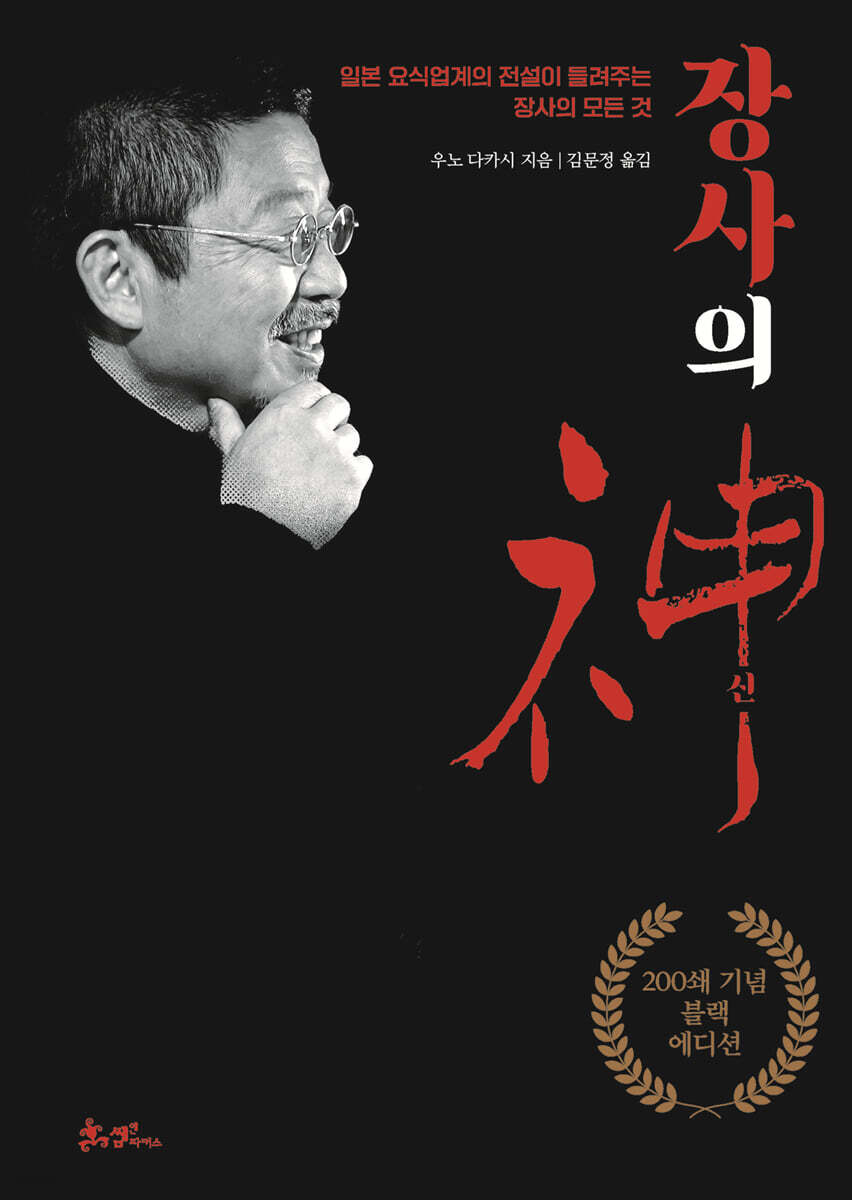
The God of Business: 200th Printing Commemorative Black Edition
 |
Description
Book Introduction
200th printing commemorative black edition!
“A must-read for business people, a book that has become the bible of business!”
"The God of Business," a book that has served as a great inspiration and guide for the past 10 years not only to those who are starting a business but also to those who are already in business, has been republished in a black edition to commemorate its 200th printing.
"The God of Business" is all about business, told by Takashi Uno, a legend in the Japanese restaurant industry and known as the "God of Business."
Starting out as a coffee shop manager, he turned his staff of over 200 into the owners of an izakaya, revealing the secrets to success that apply to any business.
From how to select a location for your store to the secrets of creating a successful menu, how to increase sales through customer service, and how to efficiently expand your store, this book offers sharp insights and thorough guidance to help you build a strong store that will withstand any recession.
In this book, the author advises that rather than being prepared to fail, we should rush in with the determination to succeed, and that we should think carefully before making a reckless attempt to increase our success rate.
If you have no money and open a store in a remote area, he says, you should create a unique charm that will draw people from far and wide. If you can't cook, you should create a menu that has strong customer service. If you can't create a variety of menus, he says, you should become an owner who leaves a strong impression with one visit.
“A must-read for business people, a book that has become the bible of business!”
"The God of Business," a book that has served as a great inspiration and guide for the past 10 years not only to those who are starting a business but also to those who are already in business, has been republished in a black edition to commemorate its 200th printing.
"The God of Business" is all about business, told by Takashi Uno, a legend in the Japanese restaurant industry and known as the "God of Business."
Starting out as a coffee shop manager, he turned his staff of over 200 into the owners of an izakaya, revealing the secrets to success that apply to any business.
From how to select a location for your store to the secrets of creating a successful menu, how to increase sales through customer service, and how to efficiently expand your store, this book offers sharp insights and thorough guidance to help you build a strong store that will withstand any recession.
In this book, the author advises that rather than being prepared to fail, we should rush in with the determination to succeed, and that we should think carefully before making a reckless attempt to increase our success rate.
If you have no money and open a store in a remote area, he says, you should create a unique charm that will draw people from far and wide. If you can't cook, you should create a menu that has strong customer service. If you can't create a variety of menus, he says, you should become an owner who leaves a strong impression with one visit.
- You can preview some of the book's contents.
Preview
index
Recommendation_Welcome to the apprenticeship of Takashi Uno, the god of izakaya and legend of the Japanese restaurant industry!
Prologue_If you can cut tomatoes, you can open a restaurant, and if you can open bottle caps, you can open a bar!
Part 1.
There can be no store that doesn't do business.
"The #1 Small Store Strategy": Creating a Fun Store for Both Customers and You
There is no store that is not successful from the beginning!
Don't follow trends; create a store that you can enjoy yourself.
You can open a successful store even if you're not good at studying.
When investing your opening funds, leave room for "fun."
A recession is a great opportunity to start a business.
Store managers don't need practical know-how.
The ability to visualize is essential when running a store.
Only when you have weaknesses can you develop your skills.
A store that is strong regardless of the times!
Go to a 'proper' store
An idea is meaningless if it can't be put into action.
How to Gather Ideas Without Money
Everyone but yourself is a 'guest'!
The "Winning Method" for Self-Employed Businesses, Different from Large Corporations
Part 2.
Open a store in a place where there are few people.
-The 'God of Izakaya' reveals his tips for selecting a location.
Why Stores in Off-the-beaten-path Places Do Well
How to get introduced to good stores in real estate
Why "No People, No Money" Becomes the Ultimate Weapon
How to win the hearts of local residents
Don't choose a store hastily
It's possible because it's local
Buying from your neighbors is the first step toward success.
Part 3.
Even if you can't cook, you can make popular dishes.
How to create a menu that is guaranteed to be a success
How to Make an Ordinary Menu Special
Imitation creates popular menu items.
How to increase guest satisfaction while reducing costs
Recession-resistant, easy-to-understand signboard menu
If you have a "store face" that says, "This is it," you can create a long-lasting store.
Create a menu that increases the 'unit price' that guests will like.
Create a menu that speaks to your customers!
Create a sensible menu and provide simple yet impressive service.
Part 4.
The way to please your guests is simple.
-The secret to hospitality that will make any guest fall in love with you
Simple customer service conversation tips that work even without a speaking partner
First of all, memorize the guest's name.
The reason Kinoshita Tokichiro's "The Tale of the Straw Sandals" is passed down
Just one act of good service can make guests feel like they've hit the jackpot.
Don't even mention the word 'free'
The key is to be able to welcome even one guest.
The genius of hospitality is created through experience.
Good relationships with guests can reduce claims
Part 5.
If you think about it, it will sell like wings.
-The secret to selling regardless of the reason
Even if you hand out flyers, no customers will come.
Loss is not something I do, it's something I pay for.
Beginners have their own way of selling!
How to recommend a menu that is sure to sell out
The secret to turning customers into regulars
Don't do anything special during the year-end party season.
Stores that people go to because they're cheap can't survive a recession.
Developing the power to sell
Prologue_If you can cut tomatoes, you can open a restaurant, and if you can open bottle caps, you can open a bar!
Part 1.
There can be no store that doesn't do business.
"The #1 Small Store Strategy": Creating a Fun Store for Both Customers and You
There is no store that is not successful from the beginning!
Don't follow trends; create a store that you can enjoy yourself.
You can open a successful store even if you're not good at studying.
When investing your opening funds, leave room for "fun."
A recession is a great opportunity to start a business.
Store managers don't need practical know-how.
The ability to visualize is essential when running a store.
Only when you have weaknesses can you develop your skills.
A store that is strong regardless of the times!
Go to a 'proper' store
An idea is meaningless if it can't be put into action.
How to Gather Ideas Without Money
Everyone but yourself is a 'guest'!
The "Winning Method" for Self-Employed Businesses, Different from Large Corporations
Part 2.
Open a store in a place where there are few people.
-The 'God of Izakaya' reveals his tips for selecting a location.
Why Stores in Off-the-beaten-path Places Do Well
How to get introduced to good stores in real estate
Why "No People, No Money" Becomes the Ultimate Weapon
How to win the hearts of local residents
Don't choose a store hastily
It's possible because it's local
Buying from your neighbors is the first step toward success.
Part 3.
Even if you can't cook, you can make popular dishes.
How to create a menu that is guaranteed to be a success
How to Make an Ordinary Menu Special
Imitation creates popular menu items.
How to increase guest satisfaction while reducing costs
Recession-resistant, easy-to-understand signboard menu
If you have a "store face" that says, "This is it," you can create a long-lasting store.
Create a menu that increases the 'unit price' that guests will like.
Create a menu that speaks to your customers!
Create a sensible menu and provide simple yet impressive service.
Part 4.
The way to please your guests is simple.
-The secret to hospitality that will make any guest fall in love with you
Simple customer service conversation tips that work even without a speaking partner
First of all, memorize the guest's name.
The reason Kinoshita Tokichiro's "The Tale of the Straw Sandals" is passed down
Just one act of good service can make guests feel like they've hit the jackpot.
Don't even mention the word 'free'
The key is to be able to welcome even one guest.
The genius of hospitality is created through experience.
Good relationships with guests can reduce claims
Part 5.
If you think about it, it will sell like wings.
-The secret to selling regardless of the reason
Even if you hand out flyers, no customers will come.
Loss is not something I do, it's something I pay for.
Beginners have their own way of selling!
How to recommend a menu that is sure to sell out
The secret to turning customers into regulars
Don't do anything special during the year-end party season.
Stores that people go to because they're cheap can't survive a recession.
Developing the power to sell
Into the book
"What kind of customers should I target when creating a store?" This is a question we usually think about before starting a business, but it's different from the question, "What kind of customers should I target to make business successful?"
Rather than thinking like that, I think it's a matter of considering 'what kind of store do I want to open?' and 'what kind of store can I run for a long time?'
In my case, I always thought about stores that girls would want to go to.
It's not because I thought, 'A store that attracts girls will do well,' but because I thought, 'If it's a store like that, I can run it on my own for a long time.'
…syncopation…
But I don't think I can continue running a $3 store like that.
I'm the type of person who pleases guests with hospitality rather than price.
So I thought it would be nice to have a store where girls come.
I love serving customers, so just thinking about running a business while greeting girls makes me happy and excited.
If you run a store this happily, the store employees and part-time workers will also think, "Isn't the food service industry okay?"
If those employees later become independent and open another enjoyable store, that too will become my asset.
I don't think this is a question of good or bad from the store's perspective, but rather a question of what you want to pursue in your life.
So, when you open a store, don't just think about 'what kind of store will do well?' but also think about 'what kind of store will make me truly happy?'
I think that's the basis for being able to run a business for a long time.
---From "Don't follow trends, create a store that you can enjoy yourself"
The kids who come to our store saying they want to open their own store someday aren't all 'good-looking guys' from the beginning.
There are countless children who are problem students or who are bad at studying at school.
Among them, there are cases where a guy who looks a bit rough around the edges comes for an interview.
But I'm a person who 'doesn't stop anyone from coming', so I accept anyone.
Since you chose our restaurant out of all the other restaurants, I think it was fate.
Since ancient times, izakayas have had a hard time making a restaurant successful if the owner is too sincere.
The qualities that allow you to faithfully perform the duties of a store manager in a chain store with numerous stores are not the same as the qualities that allow you to become a manager who can make a small store prosper.
Of course, you have to be meticulous when running a store within a corporate structure.
Otherwise, the staff won't be able to follow along properly.
But when you run your own store, working flawlessly isn't the only thing that's important.
If you can entertain the customers who come to your store, you can make a profit.
Since you have a meticulous personality, it would be good to always keep the store's image neat and tidy.
But that's something anyone can do, like washing their uniforms every day to keep them crisp and starched, or keeping their hair neatly shaved.
I think it's much more important whether a child can develop the ability to think, 'How can I make my guests happy?'
Of course, if you're running more than two stores, it's going to be tough unless you hire people who can provide solid support.
It would be even more difficult if the owner is someone who believes in 'working at a leisurely pace'.
However, even people with a leisurely pace can expand their store from 5-6 pyeong to around 20 pyeong.
If you run a store of about 20 pyeong well, you can make a pretty good living.
Any izakaya has that kind of goal.
I guess that's the beauty of this business.
On the other hand, what I think is too much is opening a store with a colleague.
Sometimes, I think about going into business with a partner because I don't have enough money, but a store can't run properly unless you become the owner of a country and a castle yourself.
Even minor complaints like, “I clean the bathroom when we meet!” tend to pile up.
So I tell them that if the two of them are going to open a 10-pyeong store, it would be better to open a 5-pyeong store each.
And then you activate it and then you expand the store or open a second branch.
As the saying goes, if you don't do everything yourself, you won't develop the real skills to run a store.
Only when you feel the burden of having to take responsibility for and pay off your debt on your own can you gain the driving force to make your store a success.
---From "You can open a successful store even if you're not good at studying"
This happened the other day when I went to an independent children's store.
That restaurant had boiled pig's feet on the menu.
A customer ordered it, but it seemed like it was hard to eat, so he asked, “Can I have some scissors?”
Then the child just said, “Yes, here you go,” and handed me the scissors.
Was that being kind to the guest? I thought that kind of hospitality was ridiculous.
In times like this, you should say, “Oh, is it too difficult to eat? I’ll cut it for you here.” and cut it for you.
If you just lend them scissors, it'll end with, "This restaurant's pig's feet are so uncomfortable to eat." But if you cut them up and give them to them, it becomes a chance to appeal to the customer by saying, "This is a really friendly restaurant."
Besides, the customer came alone, and the pig's feet were a pretty large portion, with two large pieces.
I thought it might be too much for me to eat all by myself.
In such cases, it is much more polite to say something like, “I think this is too much for one person. Would you like half?” or to suggest a different dish, even if it is not on the menu.
To make a store successful, you need to always think about 'how can we make our customers enjoy their time here more?' and you need to have that kind of greed to appeal to them without missing even the smallest opportunity.
By the way, just to give that kid some credit, when I went back there later, the store had undergone a complete makeover.
You put in a lot of effort based on my advice.
There were also a lot of regular customers.
---From "Only when you have weaknesses can you develop your skills"
I happened to see it while passing through the city.
I noticed that flowers were planted and hung on a bumpy jug instead of a flower pot at the edge of the house's yard.
I was so happy.
I thought it would have a big impact if we put something like this in the store.
In a small shop like ours, a teapot is dozens of times more attractive than an expensive vase found in a fancy restaurant.
The important thing is to act on an idea that strikes you as "this is it!" right away.
If you are satisfied with just putting it in a file in your head, you will be wasting your treasure.
In my case, when an idea comes to mind, I try to test it right away, even if it's the next day.
…syncopation…
To gather ideas, I often go on inspections, looking at information from acquaintances, word-of-mouth, and weekly magazines and comics about good restaurants.
Among the magazine information, if there's something I think is 'this is it', I tear out the page and save it as a scrapbook.
Sometimes it doesn't work out that well when you actually try to follow it, but when it hits the mark, it has such an impact that you can talk about it forever.
The commonality between the stores I choose is that they are all 'stores that are right for me.'
For example, even if I go to Kyoto, I don't go to a kaiseki (high-class Japanese course meal) restaurant.
Don't go to a store that's run by a sloppy old lady, has a poor interior, and is incredibly crowded.
For 300 yen, you get a mountain of fried food and the alcohol is cheap.
It's a restaurant where you can eat for a few thousand yen, even if you only have a few thousand yen.
Whenever I go to a place like that, I am moved by the tremendous energy.
So, if you organize 'why you were moved' again and 'file' it in your head thinking 'how can I apply this to my store', it will lead to business the next day.
Rather than thinking like that, I think it's a matter of considering 'what kind of store do I want to open?' and 'what kind of store can I run for a long time?'
In my case, I always thought about stores that girls would want to go to.
It's not because I thought, 'A store that attracts girls will do well,' but because I thought, 'If it's a store like that, I can run it on my own for a long time.'
…syncopation…
But I don't think I can continue running a $3 store like that.
I'm the type of person who pleases guests with hospitality rather than price.
So I thought it would be nice to have a store where girls come.
I love serving customers, so just thinking about running a business while greeting girls makes me happy and excited.
If you run a store this happily, the store employees and part-time workers will also think, "Isn't the food service industry okay?"
If those employees later become independent and open another enjoyable store, that too will become my asset.
I don't think this is a question of good or bad from the store's perspective, but rather a question of what you want to pursue in your life.
So, when you open a store, don't just think about 'what kind of store will do well?' but also think about 'what kind of store will make me truly happy?'
I think that's the basis for being able to run a business for a long time.
---From "Don't follow trends, create a store that you can enjoy yourself"
The kids who come to our store saying they want to open their own store someday aren't all 'good-looking guys' from the beginning.
There are countless children who are problem students or who are bad at studying at school.
Among them, there are cases where a guy who looks a bit rough around the edges comes for an interview.
But I'm a person who 'doesn't stop anyone from coming', so I accept anyone.
Since you chose our restaurant out of all the other restaurants, I think it was fate.
Since ancient times, izakayas have had a hard time making a restaurant successful if the owner is too sincere.
The qualities that allow you to faithfully perform the duties of a store manager in a chain store with numerous stores are not the same as the qualities that allow you to become a manager who can make a small store prosper.
Of course, you have to be meticulous when running a store within a corporate structure.
Otherwise, the staff won't be able to follow along properly.
But when you run your own store, working flawlessly isn't the only thing that's important.
If you can entertain the customers who come to your store, you can make a profit.
Since you have a meticulous personality, it would be good to always keep the store's image neat and tidy.
But that's something anyone can do, like washing their uniforms every day to keep them crisp and starched, or keeping their hair neatly shaved.
I think it's much more important whether a child can develop the ability to think, 'How can I make my guests happy?'
Of course, if you're running more than two stores, it's going to be tough unless you hire people who can provide solid support.
It would be even more difficult if the owner is someone who believes in 'working at a leisurely pace'.
However, even people with a leisurely pace can expand their store from 5-6 pyeong to around 20 pyeong.
If you run a store of about 20 pyeong well, you can make a pretty good living.
Any izakaya has that kind of goal.
I guess that's the beauty of this business.
On the other hand, what I think is too much is opening a store with a colleague.
Sometimes, I think about going into business with a partner because I don't have enough money, but a store can't run properly unless you become the owner of a country and a castle yourself.
Even minor complaints like, “I clean the bathroom when we meet!” tend to pile up.
So I tell them that if the two of them are going to open a 10-pyeong store, it would be better to open a 5-pyeong store each.
And then you activate it and then you expand the store or open a second branch.
As the saying goes, if you don't do everything yourself, you won't develop the real skills to run a store.
Only when you feel the burden of having to take responsibility for and pay off your debt on your own can you gain the driving force to make your store a success.
---From "You can open a successful store even if you're not good at studying"
This happened the other day when I went to an independent children's store.
That restaurant had boiled pig's feet on the menu.
A customer ordered it, but it seemed like it was hard to eat, so he asked, “Can I have some scissors?”
Then the child just said, “Yes, here you go,” and handed me the scissors.
Was that being kind to the guest? I thought that kind of hospitality was ridiculous.
In times like this, you should say, “Oh, is it too difficult to eat? I’ll cut it for you here.” and cut it for you.
If you just lend them scissors, it'll end with, "This restaurant's pig's feet are so uncomfortable to eat." But if you cut them up and give them to them, it becomes a chance to appeal to the customer by saying, "This is a really friendly restaurant."
Besides, the customer came alone, and the pig's feet were a pretty large portion, with two large pieces.
I thought it might be too much for me to eat all by myself.
In such cases, it is much more polite to say something like, “I think this is too much for one person. Would you like half?” or to suggest a different dish, even if it is not on the menu.
To make a store successful, you need to always think about 'how can we make our customers enjoy their time here more?' and you need to have that kind of greed to appeal to them without missing even the smallest opportunity.
By the way, just to give that kid some credit, when I went back there later, the store had undergone a complete makeover.
You put in a lot of effort based on my advice.
There were also a lot of regular customers.
---From "Only when you have weaknesses can you develop your skills"
I happened to see it while passing through the city.
I noticed that flowers were planted and hung on a bumpy jug instead of a flower pot at the edge of the house's yard.
I was so happy.
I thought it would have a big impact if we put something like this in the store.
In a small shop like ours, a teapot is dozens of times more attractive than an expensive vase found in a fancy restaurant.
The important thing is to act on an idea that strikes you as "this is it!" right away.
If you are satisfied with just putting it in a file in your head, you will be wasting your treasure.
In my case, when an idea comes to mind, I try to test it right away, even if it's the next day.
…syncopation…
To gather ideas, I often go on inspections, looking at information from acquaintances, word-of-mouth, and weekly magazines and comics about good restaurants.
Among the magazine information, if there's something I think is 'this is it', I tear out the page and save it as a scrapbook.
Sometimes it doesn't work out that well when you actually try to follow it, but when it hits the mark, it has such an impact that you can talk about it forever.
The commonality between the stores I choose is that they are all 'stores that are right for me.'
For example, even if I go to Kyoto, I don't go to a kaiseki (high-class Japanese course meal) restaurant.
Don't go to a store that's run by a sloppy old lady, has a poor interior, and is incredibly crowded.
For 300 yen, you get a mountain of fried food and the alcohol is cheap.
It's a restaurant where you can eat for a few thousand yen, even if you only have a few thousand yen.
Whenever I go to a place like that, I am moved by the tremendous energy.
So, if you organize 'why you were moved' again and 'file' it in your head thinking 'how can I apply this to my store', it will lead to business the next day.
---From "An idea is meaningless if it cannot be put into action"
Publisher's Review
“Everything about business from a legend in the Japanese restaurant industry!”
“If you can cut a tomato, you can open a restaurant. If you can open a bottle, you can open a bar!”
The reason why everyone calls him the 'God of Business' is simple.
Because when he does something, it's different, and when he does it, it's guaranteed to succeed! All the know-how contained in this book is truly "practical."
From how to choose a location for your store to creating a guaranteed hit menu and the absolute secret to turning one-time customers into lifelong regulars... there are countless core secrets that anyone who truly wants to start a business should read and memorize ten or twenty times.
If you're considering "business" as your final project in life, I highly recommend picking up this book and completely immersing yourself in the vivid, on-the-ground voices of the business god!
The essence of business that is preached like flowing water but never light
The secret to selling without fail, learn it properly from the god of business!
"Now my final path is business!" From small pubs to restaurants and cafes with their own unique character... Quitting your job or quitting your current career to choose business as a lifelong career is becoming a growing trend.
But why do we choose that path, thinking it's our last investment, and give it our all, yet nine out of ten times we fail? The god of business, Takashi Uno, asks all such people this question.
“Are you really doing business properly?”
There's a royal road to business! It's important to work hard and risk failure, and it's important to experiment with various methods. But the key is to know how to do it "properly."
The author of this book, Takashi Uno, is a legend in the Japanese restaurant industry and is known as the “God of Business.”
The protagonist, who started out as a coffee shop manager and turned his 200+ employees into the president of a successful izakaya.
The business secrets he pours out in this book are extraordinary!
From how to select a store location in real estate to the secrets to creating a consistently successful menu, to increasing sales through customer service and efficiently expanding your store... The sharp insights and thorough guidance, delivered as if in a one-on-one coaching session, completely immerse readers.
These are stories that have already attracted a large number of loyal readers through the famous Japanese trend magazine Nikkei Restaurant, but are too good to be contained in one volume.
Anyone who truly wants to succeed in business must master Uno's secrets, which apply to any business.
Sharp advice, sharp insights, but a surefire hit-or-miss secret to success.
There's a reason why merchants can't help but be captivated by his story!
"I started this because I loved business and wanted to be a store owner, but why would people who immediately complain that business isn't going well want to start a business? If you don't even know the first thing about customer service and can't even make a proper menu, what's the point of blowing all your money to make your store look nice? If it's a "cheap price strategy" that won't even compete with big stores or a tactic to make a profit by lowering the quality of ingredients, don't do business!"
Takashi Uno, who has trained more than 200 izakaya owners, has a sharp point.
Every time I list the mistakes most beginner traders make, my heart sinks.
But his point is always grounded in reason, alternatives, and answers! His argument is that rather than risking failure, we should dive in with the resolve to succeed, and that we should think carefully before making reckless attempts to increase our success rate!
If you have no money and open a shop in a remote area, create a unique charm that will draw people from far and wide. If you can't cook, create a menu that has strong customer service. If you can't create a variety of menus, become an owner who leaves a strong impression with one try.
Instead of thinking about competing with big stores, create a store that maximizes the strengths of a small store!
From really small business tips to strategies for building a strong store that will withstand any recession.
A life plan that looks further ahead, nurturing second and third-generation presidents as a true businessman and becoming a role model for others... "The God of Business" contains the vivid voice of "Takashi Uno," whom all businessmen call "father."
This book contains his unwavering success story and the know-how he offers to anyone dreaming of success in business, all in a completely different way than existing books!
"Secrets to Small Business Success" You Can Use Today
- [Hankyoreh]
When you need a turning point in your life, a book that will help you become more productive.
- [Art Insight]
Self-employed people struggling with the recession will share practical business secrets that can be put to use right away, as if they were talking about it in real life.
- [Maeil Business Newspaper]
The man known as the "Father of Izakaya," Takashi Uno, reveals the fundamentals of business.
- [Korea Economic Daily]
“If you can cut a tomato, you can open a restaurant. If you can open a bottle, you can open a bar!”
The reason why everyone calls him the 'God of Business' is simple.
Because when he does something, it's different, and when he does it, it's guaranteed to succeed! All the know-how contained in this book is truly "practical."
From how to choose a location for your store to creating a guaranteed hit menu and the absolute secret to turning one-time customers into lifelong regulars... there are countless core secrets that anyone who truly wants to start a business should read and memorize ten or twenty times.
If you're considering "business" as your final project in life, I highly recommend picking up this book and completely immersing yourself in the vivid, on-the-ground voices of the business god!
The essence of business that is preached like flowing water but never light
The secret to selling without fail, learn it properly from the god of business!
"Now my final path is business!" From small pubs to restaurants and cafes with their own unique character... Quitting your job or quitting your current career to choose business as a lifelong career is becoming a growing trend.
But why do we choose that path, thinking it's our last investment, and give it our all, yet nine out of ten times we fail? The god of business, Takashi Uno, asks all such people this question.
“Are you really doing business properly?”
There's a royal road to business! It's important to work hard and risk failure, and it's important to experiment with various methods. But the key is to know how to do it "properly."
The author of this book, Takashi Uno, is a legend in the Japanese restaurant industry and is known as the “God of Business.”
The protagonist, who started out as a coffee shop manager and turned his 200+ employees into the president of a successful izakaya.
The business secrets he pours out in this book are extraordinary!
From how to select a store location in real estate to the secrets to creating a consistently successful menu, to increasing sales through customer service and efficiently expanding your store... The sharp insights and thorough guidance, delivered as if in a one-on-one coaching session, completely immerse readers.
These are stories that have already attracted a large number of loyal readers through the famous Japanese trend magazine Nikkei Restaurant, but are too good to be contained in one volume.
Anyone who truly wants to succeed in business must master Uno's secrets, which apply to any business.
Sharp advice, sharp insights, but a surefire hit-or-miss secret to success.
There's a reason why merchants can't help but be captivated by his story!
"I started this because I loved business and wanted to be a store owner, but why would people who immediately complain that business isn't going well want to start a business? If you don't even know the first thing about customer service and can't even make a proper menu, what's the point of blowing all your money to make your store look nice? If it's a "cheap price strategy" that won't even compete with big stores or a tactic to make a profit by lowering the quality of ingredients, don't do business!"
Takashi Uno, who has trained more than 200 izakaya owners, has a sharp point.
Every time I list the mistakes most beginner traders make, my heart sinks.
But his point is always grounded in reason, alternatives, and answers! His argument is that rather than risking failure, we should dive in with the resolve to succeed, and that we should think carefully before making reckless attempts to increase our success rate!
If you have no money and open a shop in a remote area, create a unique charm that will draw people from far and wide. If you can't cook, create a menu that has strong customer service. If you can't create a variety of menus, become an owner who leaves a strong impression with one try.
Instead of thinking about competing with big stores, create a store that maximizes the strengths of a small store!
From really small business tips to strategies for building a strong store that will withstand any recession.
A life plan that looks further ahead, nurturing second and third-generation presidents as a true businessman and becoming a role model for others... "The God of Business" contains the vivid voice of "Takashi Uno," whom all businessmen call "father."
This book contains his unwavering success story and the know-how he offers to anyone dreaming of success in business, all in a completely different way than existing books!
"Secrets to Small Business Success" You Can Use Today
- [Hankyoreh]
When you need a turning point in your life, a book that will help you become more productive.
- [Art Insight]
Self-employed people struggling with the recession will share practical business secrets that can be put to use right away, as if they were talking about it in real life.
- [Maeil Business Newspaper]
The man known as the "Father of Izakaya," Takashi Uno, reveals the fundamentals of business.
- [Korea Economic Daily]
GOODS SPECIFICS
- Date of issue: January 30, 2023
- Format: Hardcover book binding method guide
- Page count, weight, size: 264 pages | 536g | 158*220*22mm
- ISBN13: 9791165346652
- ISBN10: 1165346656
You may also like
카테고리
korean


korean

![ELLE 엘르 스페셜 에디션 A형 : 12월 [2025]](http://librairie.coreenne.fr/cdn/shop/files/b8e27a3de6c9538896439686c6b0e8fb.jpg?v=1766436872&width=3840)


