

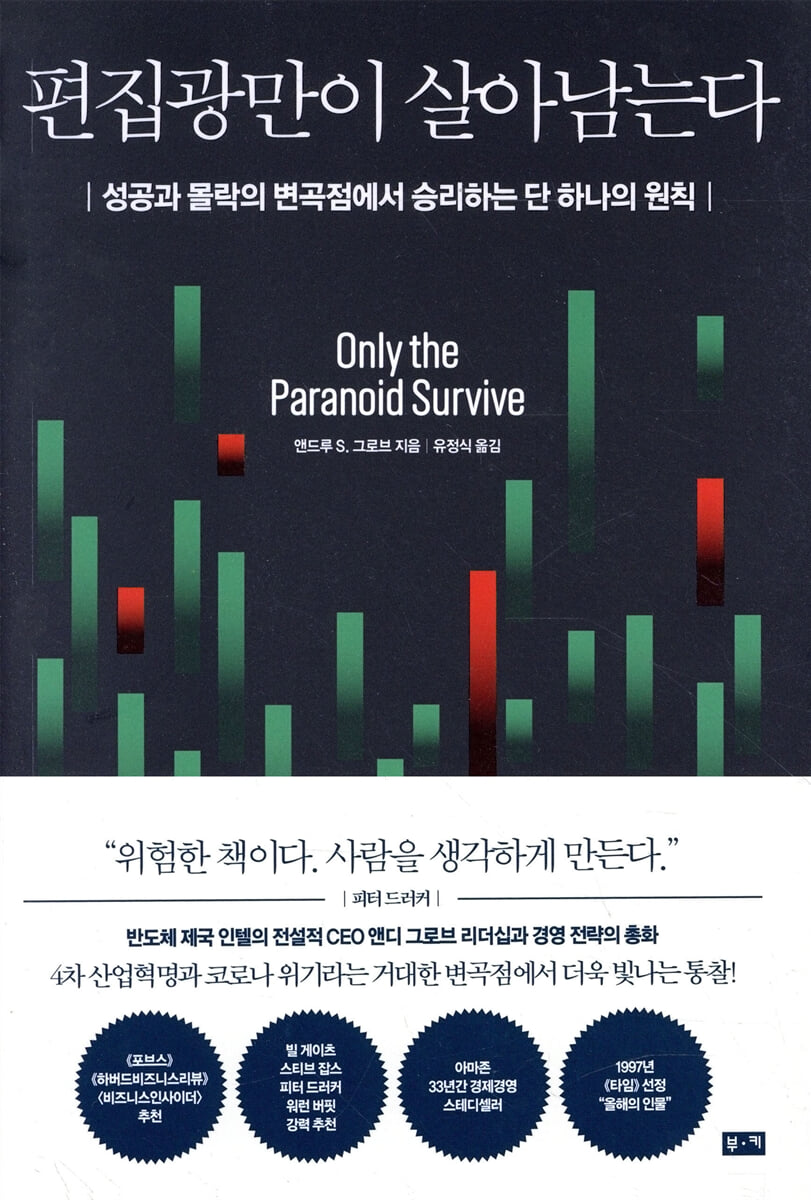
Only the maniacs survive
 |
Description
Book Introduction
A turning point, a crossroads between business and career success and downfall!
How can we survive this desperate situation and emerge victorious?
A modern management classic written by Andrew Grove, the legendary CEO who built the semiconductor empire Intel and a “legend” of Silicon Valley and the computer industry who led the digital revolution.
Based on the motto “Only the fanatics survive” and the concept of “strategic inflection point,” it contains the summary of the management philosophy, management strategy, leadership principles, organizational management, and corporate culture that he pursues.
A paranoid person is someone who is always alert and on guard, or has that attitude.
A strategic inflection point is a point in time when everything fundamental about a business, from its competitive approach to its industry structure, changes.
In "Only the Paranoid Survive," Grove clearly explains why strategic inflection points are crucial and how managing them effectively can determine the rise and fall of companies and individuals.
Furthermore, it presents practical methods for recognizing strategic inflection points—crises and opportunities, but also crossroads that determine success and failure—how to discern whether they are genuine signals or trivial noise, and what mindset, actions, and strategies to adopt when the inflection point actually occurs to navigate the chaos.
Through Intel's journey of overcoming crises such as the onslaught of Japanese memory companies in the 1980s and the Pentium chip failure in the 1990s, as well as through examples from various industries, companies, and individuals, this book reveals the core principles for turning crises into opportunities for survival and success in business and career management.
How can we survive this desperate situation and emerge victorious?
A modern management classic written by Andrew Grove, the legendary CEO who built the semiconductor empire Intel and a “legend” of Silicon Valley and the computer industry who led the digital revolution.
Based on the motto “Only the fanatics survive” and the concept of “strategic inflection point,” it contains the summary of the management philosophy, management strategy, leadership principles, organizational management, and corporate culture that he pursues.
A paranoid person is someone who is always alert and on guard, or has that attitude.
A strategic inflection point is a point in time when everything fundamental about a business, from its competitive approach to its industry structure, changes.
In "Only the Paranoid Survive," Grove clearly explains why strategic inflection points are crucial and how managing them effectively can determine the rise and fall of companies and individuals.
Furthermore, it presents practical methods for recognizing strategic inflection points—crises and opportunities, but also crossroads that determine success and failure—how to discern whether they are genuine signals or trivial noise, and what mindset, actions, and strategies to adopt when the inflection point actually occurs to navigate the chaos.
Through Intel's journey of overcoming crises such as the onslaught of Japanese memory companies in the 1980s and the Pentium chip failure in the 1990s, as well as through examples from various industries, companies, and individuals, this book reveals the core principles for turning crises into opportunities for survival and success in business and career management.
- You can preview some of the book's contents.
Preview
index
Recommendation_Kwon Oh-hyun, Senior Advisor and Former Chairman of Samsung Electronics
Recommendation_ Sang-Kyun Cha, Dean of the Graduate School of Data Science, Seoul National University
Why this book? _ Park So-ryeong, CEO of Publy
Preface_ Why I Became a Maniac
Chapter 1 Something Has Changed
A minor error that only happens once every 27,000 years? | The massive change that befell Intel, which was once thriving | What threw us into a whirlpool of turmoil | The person who always realizes things too late
Chapter 2: The Power of '10x' Change
6 Forces That Impact Business | 10X Forces Bring 10X Change | What is a Strategic Inflection Point? | Steps to Recognizing a Strategic Inflection Point
Chapter 3: Fundamental Changes in the Computer Industry
Before the Strategic Inflection Point | After the Strategic Inflection Point: Mass Production, Mass Distribution, and Interoperability | The Crossroads of Winners and Losers | The New Rules of Horizontal Industries
Chapter 4: Strategic Inflection Points Everywhere
10x Change Is Universal | 10x Change in Competitors | 10x Change in Technology | 10x Change in Customers | 10x Change in Suppliers | 10x Change in Complementors | 10x Change in Regulation
Chapter 5: How We Overcame the Inflection Point and Built a Semiconductor Empire
Intel's History: From Founding to Rise | The Strategic Inflection Points We've Facing | Finding a Path to Survival | Transforming from a Memory Company to a Microprocessor Company
Chapter 6 Signal or Noise?
Is X-ray technology a 10x powerhouse? | The RISC vs. CISC debate | 3 ways to identify strategic inflection points | Listen to Cassandra on the front lines | Avoid the first version trap | Argue without hesitation | Don't forget the fear of defeat.
Chapter 7: Let Chaos Reign
Emotions drive actions | Break free from the emotional swamp | Don't settle for the inertia of success | Test for strategic misalignment | Experiment constantly | Act early | Draw a mental map of a new industry
Chapter 8: Master the Chaos
How to Cross the Valley of Death | Establish a Clear Direction with Mental Imagery | Allocation of Resources to New Businesses | Leading the Organization with Strategic Action | Why Setting a Clear Direction is Important | Adapting to a New World | Finding Common Ground Between Top-Down and Bottom-Up | Crossing the Valley of Death
Chapter 9: The Internet: A Threat or an Opportunity?
The Impact of the Internet | Transforming the Telecommunications, Software, and Media Industries | The Impact of New Connectivity on Intel | Is This a Strategic Inflection Point? | What to Do
Chapter 10: Coping with Career Turning Points
The Power of Change to Shake Up Your Career | Your Career Is Your Business | Train Yourself to Turn Off the Mental Fire | Timing is Everything | Prepare Yourself for Change | Don't Look Back, Step Into a New World
Acknowledgments | Translator's Note | Notes | Index
Recommendation_ Sang-Kyun Cha, Dean of the Graduate School of Data Science, Seoul National University
Why this book? _ Park So-ryeong, CEO of Publy
Preface_ Why I Became a Maniac
Chapter 1 Something Has Changed
A minor error that only happens once every 27,000 years? | The massive change that befell Intel, which was once thriving | What threw us into a whirlpool of turmoil | The person who always realizes things too late
Chapter 2: The Power of '10x' Change
6 Forces That Impact Business | 10X Forces Bring 10X Change | What is a Strategic Inflection Point? | Steps to Recognizing a Strategic Inflection Point
Chapter 3: Fundamental Changes in the Computer Industry
Before the Strategic Inflection Point | After the Strategic Inflection Point: Mass Production, Mass Distribution, and Interoperability | The Crossroads of Winners and Losers | The New Rules of Horizontal Industries
Chapter 4: Strategic Inflection Points Everywhere
10x Change Is Universal | 10x Change in Competitors | 10x Change in Technology | 10x Change in Customers | 10x Change in Suppliers | 10x Change in Complementors | 10x Change in Regulation
Chapter 5: How We Overcame the Inflection Point and Built a Semiconductor Empire
Intel's History: From Founding to Rise | The Strategic Inflection Points We've Facing | Finding a Path to Survival | Transforming from a Memory Company to a Microprocessor Company
Chapter 6 Signal or Noise?
Is X-ray technology a 10x powerhouse? | The RISC vs. CISC debate | 3 ways to identify strategic inflection points | Listen to Cassandra on the front lines | Avoid the first version trap | Argue without hesitation | Don't forget the fear of defeat.
Chapter 7: Let Chaos Reign
Emotions drive actions | Break free from the emotional swamp | Don't settle for the inertia of success | Test for strategic misalignment | Experiment constantly | Act early | Draw a mental map of a new industry
Chapter 8: Master the Chaos
How to Cross the Valley of Death | Establish a Clear Direction with Mental Imagery | Allocation of Resources to New Businesses | Leading the Organization with Strategic Action | Why Setting a Clear Direction is Important | Adapting to a New World | Finding Common Ground Between Top-Down and Bottom-Up | Crossing the Valley of Death
Chapter 9: The Internet: A Threat or an Opportunity?
The Impact of the Internet | Transforming the Telecommunications, Software, and Media Industries | The Impact of New Connectivity on Intel | Is This a Strategic Inflection Point? | What to Do
Chapter 10: Coping with Career Turning Points
The Power of Change to Shake Up Your Career | Your Career Is Your Business | Train Yourself to Turn Off the Mental Fire | Timing is Everything | Prepare Yourself for Change | Don't Look Back, Step Into a New World
Acknowledgments | Translator's Note | Notes | Index
Detailed image

Into the book
Preface_ Why I Became a Maniac
Of course, I also worry about my competitors.
I'm afraid that our competitors will figure out our way of making things better and cheaper and steal our customers away.
But those concerns are minor compared to what I call a "strategic inflection point."
I'll explain what a strategic inflection point is later, but for now, I want you to understand it as a point where fundamental things in a business begin to change.
The change could be an opportunity for new growth, but it could also be a sign of the end.
Strategic inflection points may stem from technological change, but they are actually more than technological change.
Strategic inflection points may arise because of competitors, but not solely because of competition.
A strategic inflection point is a complete change in the way business is done.
--- p.31
Chapter 1_ Something Has Changed
The old rules of business were no longer valid because of the enormous changes that had accumulated over a long period of time.
The new rules that govern the world were so powerful that they cost us $500 million.
The problem wasn't just that they didn't realize the rules had changed.
The bigger problem was that I didn't know what the new rules were.
(…)
What happened to us surrounding this incident often happens in other businesses as well.
All businesses operate according to unspoken rules, which sometimes become quite serious.
But there are no warning lights to signal the beginning of such a change.
It approaches us slowly without warning and covers us.
We can only tell that something big and important has changed, but we can't figure out exactly what it is.
It's like sailing with the wind.
If you are in a cabin below deck, you only realize that the wind is strong when the ship starts to list.
Methods that worked in the past no longer work.
If you want to quickly change course before problems arise and ensure the ship sails smoothly on its new course, you need to accurately detect the direction and strength of the changing wind.
The most difficult thing about this is that it requires decisive and difficult action.
--- p.53~54
Leaders are often the last to know.
(…) The lesson to be learned here is that ‘we must expose ourselves to the winds of change.’
We need to open ourselves up to our customers, not just our existing customers, but also those we might be missing out on if we were obsessed with the past.
We must listen to the voices of frontline workers who are delivering warning messages to us.
We should always welcome comments from those who continually evaluate and criticize us, such as journalists and people in the financial community.
Change your perspective and ask them.
Competitors, industry trends, issues we should be concerned about, etc.
When you expose yourself to change, your business acumen and instincts will quickly regain their sharpness.
--- p.56~57
Chapter 2_ The Power of '10x' Change
Running a business is 'very, very, very' difficult when you're up against '10x the power'.
If you take action the way you've always done, your business will react in a completely different way, leaving you feeling out of control and at a loss.
Eventually, the industry reaches a new equilibrium.
Some companies will become stronger and others will become weaker.
The transition periods shown in Figure [2-3] will be particularly confusing and dangerous.
No one warns you that you are entering a transition period.
This transition is a 'gradual process' in which certain forces become increasingly stronger and the characteristics of the business begin to change accordingly.
Only the starting point and the end point are clear, and the transition between them is gradual.
So we realize it too late and get embarrassed.
The impact of these changes on business is enormous.
And how you respond to these changes will determine the future of your business.
(…) In other words, a strategic inflection point refers to a time when the balance of power shifts as structures, business methods, and competitive methods change from old to new.
--- p.66~68
Chapter 3: Fundamental Changes in the Computer Industry
Horizontal industries have their own rules.
Companies that have succeeded in the highly competitive, horizontal computer industry have learned these implicit rules.
By following the rules, you create opportunities for competition and success.
On the other hand, if you reject the rules, you're in for a rough ride, no matter how good your product is or how well you execute your plan.
So what are those rules?
First, don't differentiate without being universal.
If your sole purpose is to appear superior to competitors without providing any tangible benefit to customers, don't release an improved product. The annals of the PC industry are filled with stories of manufacturers obsessed with building "better PCs" who, driven by the desire to create a better PC, deviated from prevailing industry standards and ultimately failed. When discussing PC excellence, compatibility should not be overlooked.
Therefore, from a technical perspective, it can be said that a 'better PC' that is different from other PCs is a contradiction.
Second, move first.
In highly competitive horizontal industries, opportunities arise when new technologies emerge or fundamental changes occur.
Don't miss this opportunity.
Only the "first mover" who acts first when other companies hesitate will have the opportunity to gain a time advantage over their competitors.
Time advantage is the surest way to increase market share in a horizontal business.
On the other hand, companies that resist the flow of new technologies will only waste precious time and fail, no matter how hard they try.
--- p.91~92
Chapter 4_ Strategic Inflection Points Exist Everywhere
As NeXT's financial situation continued to deteriorate, Jobs was finally forced to accept the ungraceful and trashy PC industry as his environment.
He gave in to a proposal he had previously opposed.
He closed all hardware divisions and automated factories and laid off half the workforce. Succumbing to the "tenfold" power of the PC industry, NeXT was reborn as a software company.
Clearly, Steve Jobs was a genius who predicted at the age of 20 that the PC industry would grow into a $100 billion global market in the next century.
But ten years later, at the age of 30, Jobs was unable to escape his past.
Previously, the phrase "crazy good computer" that he liked to use was popular in the market.
The graphical user interface was a powerful differentiator because PC software was clunky.
But now that things had changed, and the managers he worked with sensed the shift, Jobs couldn't easily give up the beliefs that had made him such a passionate and driven pioneer.
As a result, we had to kneel before the harsh reality that we could not survive in the competition unless we abandoned our long-held beliefs.
--- p.103~104
Strategic inflection points are not temporary phenomena.
This isn't something that's limited to high-tech industries, nor is it something that only happens in other companies.
All strategic inflection points have similar characteristics.
Table [4-2] summarizes the examples given in this chapter.
Every time I look at this chart, I'm reminded of how diverse and common strategic inflection points are.
Remember that there are winners and losers everywhere.
Also, remember that whether a company wins or loses depends largely on its degree of adaptability.
Strategic inflection points bring not only crisis but also the possibility of success.
A strategic inflection point is a point of fundamental change where the cliché “adapt or die” takes on real meaning.
--- p.126
Chapter 5: How We Overcame the Inflection Point and Built a Semiconductor Empire
I remember it was mid-1985.
After nearly a year of feeling lost and lost, I was in my office discussing a dilemma with Intel Chairman and CEO Gordon Moore.
The atmosphere of the discussion was gloomy.
(…) “If we were kicked out and the board brought in a new CEO, what would that new CEO do?” Moore answered without hesitation.
“I’ll make you take your hands off my memory,” I said, looking at him blankly for a moment.
"Why don't you and I just step outside and come back as new people? Why don't we finish the memory?"
--- p.143
The word "point" in strategic inflection point is not really an accurate expression.
It is not a point, but a long and painful struggle.
Japan began to overtake us in the memory business in the early 1980s.
Intel's performance began to decline suddenly in the mid-1980s, when the industry as a whole was facing difficulties.
It was in 1985 that Gordon Moore and I made the decision, and it wasn't until 1986 that we actually started to get out of the memory business.
Then it took another year for profitability to improve.
It took a total of three years to pass through all the strategic turning points.
From the perspective of today, ten years later, it seems like a short and intense period, but at the time, three years were truly long, difficult, and exhausting.
We fought the inevitable change, tried every marketing tactic we could think of, wasted time trying to find niches in the everyday market, sunk deep into the red, and ultimately forced ourselves to take even more drastic measures to fix the situation.
Only then could we take the right step of withdrawing from the business.
The realization of the reality we faced was a fleeting intuition that occurred during a brief conversation with Moore, but it took years to put the conclusions of that conversation into practice.
--- p.150~151
Chapter 6_ Signal or Noise?
There is no surefire formula for determining what is signal and what is noise.
Because there is no set formula, you must continually carefully review and double-check every decision you make.
Ten years ago, Intel concluded that X-ray technology wasn't a "10x" factor.
But we remained vigilant and continued to monitor whether the threat would grow or remain the same.
(…)
In one, three, or five years, when all the cost-effective measures we currently have in place have been exhausted, the balance point may shift, and what we once dismissed as noise may emerge as a signal that we need to pay attention to.
Nothing is confirmed.
Even if it is like that now, the situation can change at any time.
Therefore, we must constantly focus on technological advancements that could be a '10x' factor in our business.
--- p.159
Most strategic inflection points come creeping in like a cat rather than exploding with a bang.
It's only after looking back on events that we often realize, 'Oh, that was a strategic inflection point.'
(…) So how can we tell which changes signal a strategic inflection point? To distinguish signal from noise, ask yourself the following questions:
Are your key competitors changing?
(…) If the answer to the question is different from before, or if the silver bullet is aimed at a competitor who previously received no attention, then this is the time to pay special attention.
When a competitor's importance changes, it's usually a sign that something serious is going on.
(…)
Do people around you seem to be at a loss?
(…) It could be a sign that people around you suddenly seem to be ‘losing track of things’.
Or you might find yourself confused and not knowing what's going on.
It's not age that's eating away at youth that's keeping them or you from making ends meet.
Because 'what' surrounding you has changed.
--- p.165~167
If you're a manager, you don't have to go looking for Cassandra.
They will come for you.
Just like people who are passionate about selling their products, they will come to you to 'sell' their judgments and concerns.
Don't argue with them.
Even if you think it's a waste of time, listen to what they have to say to find out what they found out and why it affected them.
Consider the time you spend listening to their stories an investment in understanding what's happening on the farthest reaches of your business, whether geographically or technologically.
When spring comes, the snow melts from the edges.
Because the area exposed to air is the largest.
Interpreting the message coming from the edge is a crucial part of separating signal from noise.
--- p.169~170
The important thing is to be clear about what is and is not the purpose of the argument.
Don't expect the debate to end with all participants reaching a unanimous conclusion.
This kind of thinking is so naive.
(…) The debate is similar to the process a photographer goes through to adjust the contrast when developing a photograph.
As the image becomes clearer through debate, managers gain more information and can make better decisions.
In short, strategic inflection points are rarely clearly evident.
Even people who are well-intentioned and knowledgeable about the subject matter can come to completely different interpretations of the same picture.
Therefore, it is very important to gather the wisdom of all involved in the debate process.
I fully understand that you are afraid of the intensity of the debate.
Leading an organization through a strategic inflection point is exhausting for everyone involved, including senior executives.
However, if no action is taken, the business will lead to bad results.
Isn't this truly terrifying?
--- p.178~179
The most important role of a manager or supervisor is to create an environment where employees can be passionately engaged and engaged to win in the marketplace.
Fear plays a vital role in creating and sustaining this passion.
Fear of competition, fear of bankruptcy, fear of failure, and fear of defeat can all be powerful motivators.
(…)
Simply put, fear is the opposite of complacency.
--- p.180~181
Chapter 7_ Let Chaos Reign
This is the key.
Corporate leadership changes are often driven by a desire to attract people who aren't stuck in the past, rather than simply seeking better managers or more capable leaders.
Senior executives got to where they are because they did their jobs well.
They have long learned how to lead organizations on their own.
So it's no surprise that senior executives will continue to employ the same strategic and tactical methods that have proven effective throughout their careers (especially when they were "champions").
I call this phenomenon the 'inertia of success.'
This is extremely dangerous and can reinforce 'denial'.
--- p.194
I've seen many companies fall into this trap of "word-and-deed inconsistency" as they navigate strategic inflection points.
I call this gap between statements and actions “strategic dissonance.”
Strategic misalignment is one clear sign that a company is struggling with a strategic inflection point.
--- p.195
Resolving strategic dissonance doesn't happen overnight, like a lightbulb turning on.
This is done through the following 'experiment':
Relax the level of control normally imposed on the organization.
Let your employees try new technologies, explore new products, explore new sales channels, and find new customers.
While management has always strived to maintain order in the organization, times of strategic dissonance require a more generous view of new and different approaches.
Only by breaking free from the mold of old habits can we gain new insights.
The motto for running an organization now must be “Let chaos reign.”
Chaos is generally not a good thing.
Chaos is highly inefficient and very draining for all members.
But without going through a period of experimentation and chaos, the old order will not give way to the new.
--- p.198
As we see in many sports, timing is everything.
Early action pays off.
However, even if the same action is taken late, it often results in inadequate results.
"Early" doesn't just mean "quickly," it means taking action while the existing business is still strong, while cash flow is still active, and while the organization is still intact.
If the business continues to perform well, a positive "bubble" forms that helps the company reposition itself.
Under the protection of this bubble, it is easier to push for change than when all signs point to a negative business outcome.
In other words, it is best for senior management to recognize and accept the inevitability of a strategic inflection point early and take action before the business's vitality is eroded by a "10x" force.
If appropriate action is taken early and decisively, the inevitable changes in business will be much less painful and much more successful.
But unfortunately, we tend to do the exact opposite.
Because of the emotional factors mentioned earlier, most executives act "too little, too late," blowing away the protective shield provided by the bubble of their existing business.
The reason is easy to see.
Because in the early stages of the turning point, you don't feel fear.
--- p.200~201
Managers always have a mental map of the industry structure in their heads.
This map is made up of a number of implicit rules and relationships, ways and means of doing business, what was done and what was not done, who was important and who was not, whose opinions can be trusted and whose opinions are often wrong, and so on.
If you've been working in the industry for a long time, you probably already know these things like second nature.
Even if you don't try to think about it, you instinctively know that's the situation.
But as the structure of the industry changes, all of these factors also change.
The mental map that you've been carrying around for a long time and using as a reference to determine the company's course of action suddenly becomes blurred.
If you don't seize the opportunity to replace your mental map with a new one, you won't have a clear idea of why things are the way they are and who is important.
--- p.203~204
Chapter 8_ Master the Chaos
The first task necessary to successfully navigate the Valley of Death is to clearly create a mental image of what the company should look like when it passes through and looks back.
(…) Management scholars use the word ‘vision’ to mean mental image.
I feel this word is too noble.
What we need to do is understand the nature of the company and the focus of its business.
To define 'the direction our company will take,' we must define 'the direction our company will not take.'
--- p.210~211
Passing through a strategic inflection point means fundamentally transforming a company from “us of the past” to “us of the future.”
What makes this transformation so difficult is that every part of the company is shaped by the accumulation of the past.
(…) Therefore, it is not surprising that the process of transformation to survive a strategic inflection point involves some kind of change in management.
I remember an executive meeting where Intel was discussing its new direction as a "microcomputer company."
Chairman Gordon Moore said:
"You know, if we're serious about this direction, we'd better have half of our executives shifting to software within the next five years." This meant that if they didn't shift their expertise to software, they could be replaced by someone else.
I looked around the conference room and thought.
'Who can stay, and who should go?' In hindsight, Moore was right.
Half of Intel's management team was able to join the new direction by transforming themselves.
And the rest had to leave the company.
--- p.215
As Drucker pointed out, the key activity required in the process of organizational transformation is to comprehensively shift resources from places that fit the old business concept to places that fit the new business concept.
For three years, Intel's production planners had been reducing the allocation of wafers to memory and increasing the allocation to microprocessors, shifting scarce and valuable resources from low-value areas to high-value areas.
--- p.217
If you are in a leadership position, how you use your time has a very symbolic value.
Because it conveys what is important and what is not much more powerfully than any speech.
Strategic change doesn't start at a high level.
It starts right on your calendar.
--- p.219
Deploying or reallocating resources to achieve strategic objectives is an example of 'strategic action'.
I am convinced that corporate strategy is not created through a traditional top-down strategic plan, but rather through a series of strategic actions.
In my experience, top-down strategic plans are always empty rhetoric that fails to address the real business needs of the organization.
Strategic actions, on the other hand, have real impact.
What's the difference? A "strategic plan" is a description of what you intend to do going forward.
On the other hand, 'strategic actions' are actual movements that signal long-term intentions that have been or are being taken.
Strategic plans sound like political speeches, while strategic actions show concrete movements.
--- p.219
If an individual makes a wrong judgment, he or she can die.
But most companies don't die because they make a mistake.
Most companies die because they don't sell out.
Even while struggling to make a decision, momentum and precious resources are wasted.
The greatest danger comes from remaining still and not moving.
--- p.226
Setting a clear direction that explains what we are pursuing and what we are not pursuing is crucial in the later stages of a strategic transformation.
While in the midst of a strategic inflection point, chaos must reign to explore alternatives, in the latter stages, the organization must emerge from the resulting ambiguity and empower employees to move in a new direction.
Now you must “master the chaos.”
--- p.228
In short, you can't change a company without changing its management.
This is not to say that we should pack up the management and replace them with others.
The story is that each and every one of them must change themselves to better suit the demands of the new environment.
This may require going back to school, being reassigned to a different field, or spending a few years in a foreign branch.
Management must adapt to the new environment.
If they fail to adapt or refuse to adapt, their positions will have to be filled by those who are suited to the new world the company is pursuing.
--- p.234
Chapter 10: How to Deal with Turning Points in Your Career
I have long held the belief that each individual, whether employed or self-employed, is a separate business entity.
Your career is your business, and you are the CEO of that business.
Like any CEO of a major corporation, you must deal with market forces, contend with competitors, leverage the strengths of complementors, and constantly be alert to the possibility that things could be done differently.
It is your responsibility to ensure that your career is not damaged and to guide yourself to benefit from changes in the business environment.
--- p.275
Sharpen your "alert system" to stay alert to potential strategic inflection points in your business.
Anticipate potential fires and practice 'mental firefighting drills'.
In short, be a little obsessive about your career.
--- p.278
The period from when you sense an ominous sign to when a career turning point occurs is a precious time.
Just as a runner prepares his body for a race, this period is a time to prepare your body for change.
Picture yourself in a different role than you do now.
Let's take a closer look at what that role is.
Talk to the people who perform that role.
Ask yourself questions about that role.
Have a conversation with yourself about how you can fit into that role.
Train your brain to prepare for big changes.
--- p.282
It's like immigrating to a new country.
It's like leaving a place where you have a familiar language, culture, and people, and where you can predict what will happen, good or bad.
It is entering a new land with new habits, a new language, new risks and uncertainties.
Of course, I also worry about my competitors.
I'm afraid that our competitors will figure out our way of making things better and cheaper and steal our customers away.
But those concerns are minor compared to what I call a "strategic inflection point."
I'll explain what a strategic inflection point is later, but for now, I want you to understand it as a point where fundamental things in a business begin to change.
The change could be an opportunity for new growth, but it could also be a sign of the end.
Strategic inflection points may stem from technological change, but they are actually more than technological change.
Strategic inflection points may arise because of competitors, but not solely because of competition.
A strategic inflection point is a complete change in the way business is done.
--- p.31
Chapter 1_ Something Has Changed
The old rules of business were no longer valid because of the enormous changes that had accumulated over a long period of time.
The new rules that govern the world were so powerful that they cost us $500 million.
The problem wasn't just that they didn't realize the rules had changed.
The bigger problem was that I didn't know what the new rules were.
(…)
What happened to us surrounding this incident often happens in other businesses as well.
All businesses operate according to unspoken rules, which sometimes become quite serious.
But there are no warning lights to signal the beginning of such a change.
It approaches us slowly without warning and covers us.
We can only tell that something big and important has changed, but we can't figure out exactly what it is.
It's like sailing with the wind.
If you are in a cabin below deck, you only realize that the wind is strong when the ship starts to list.
Methods that worked in the past no longer work.
If you want to quickly change course before problems arise and ensure the ship sails smoothly on its new course, you need to accurately detect the direction and strength of the changing wind.
The most difficult thing about this is that it requires decisive and difficult action.
--- p.53~54
Leaders are often the last to know.
(…) The lesson to be learned here is that ‘we must expose ourselves to the winds of change.’
We need to open ourselves up to our customers, not just our existing customers, but also those we might be missing out on if we were obsessed with the past.
We must listen to the voices of frontline workers who are delivering warning messages to us.
We should always welcome comments from those who continually evaluate and criticize us, such as journalists and people in the financial community.
Change your perspective and ask them.
Competitors, industry trends, issues we should be concerned about, etc.
When you expose yourself to change, your business acumen and instincts will quickly regain their sharpness.
--- p.56~57
Chapter 2_ The Power of '10x' Change
Running a business is 'very, very, very' difficult when you're up against '10x the power'.
If you take action the way you've always done, your business will react in a completely different way, leaving you feeling out of control and at a loss.
Eventually, the industry reaches a new equilibrium.
Some companies will become stronger and others will become weaker.
The transition periods shown in Figure [2-3] will be particularly confusing and dangerous.
No one warns you that you are entering a transition period.
This transition is a 'gradual process' in which certain forces become increasingly stronger and the characteristics of the business begin to change accordingly.
Only the starting point and the end point are clear, and the transition between them is gradual.
So we realize it too late and get embarrassed.
The impact of these changes on business is enormous.
And how you respond to these changes will determine the future of your business.
(…) In other words, a strategic inflection point refers to a time when the balance of power shifts as structures, business methods, and competitive methods change from old to new.
--- p.66~68
Chapter 3: Fundamental Changes in the Computer Industry
Horizontal industries have their own rules.
Companies that have succeeded in the highly competitive, horizontal computer industry have learned these implicit rules.
By following the rules, you create opportunities for competition and success.
On the other hand, if you reject the rules, you're in for a rough ride, no matter how good your product is or how well you execute your plan.
So what are those rules?
First, don't differentiate without being universal.
If your sole purpose is to appear superior to competitors without providing any tangible benefit to customers, don't release an improved product. The annals of the PC industry are filled with stories of manufacturers obsessed with building "better PCs" who, driven by the desire to create a better PC, deviated from prevailing industry standards and ultimately failed. When discussing PC excellence, compatibility should not be overlooked.
Therefore, from a technical perspective, it can be said that a 'better PC' that is different from other PCs is a contradiction.
Second, move first.
In highly competitive horizontal industries, opportunities arise when new technologies emerge or fundamental changes occur.
Don't miss this opportunity.
Only the "first mover" who acts first when other companies hesitate will have the opportunity to gain a time advantage over their competitors.
Time advantage is the surest way to increase market share in a horizontal business.
On the other hand, companies that resist the flow of new technologies will only waste precious time and fail, no matter how hard they try.
--- p.91~92
Chapter 4_ Strategic Inflection Points Exist Everywhere
As NeXT's financial situation continued to deteriorate, Jobs was finally forced to accept the ungraceful and trashy PC industry as his environment.
He gave in to a proposal he had previously opposed.
He closed all hardware divisions and automated factories and laid off half the workforce. Succumbing to the "tenfold" power of the PC industry, NeXT was reborn as a software company.
Clearly, Steve Jobs was a genius who predicted at the age of 20 that the PC industry would grow into a $100 billion global market in the next century.
But ten years later, at the age of 30, Jobs was unable to escape his past.
Previously, the phrase "crazy good computer" that he liked to use was popular in the market.
The graphical user interface was a powerful differentiator because PC software was clunky.
But now that things had changed, and the managers he worked with sensed the shift, Jobs couldn't easily give up the beliefs that had made him such a passionate and driven pioneer.
As a result, we had to kneel before the harsh reality that we could not survive in the competition unless we abandoned our long-held beliefs.
--- p.103~104
Strategic inflection points are not temporary phenomena.
This isn't something that's limited to high-tech industries, nor is it something that only happens in other companies.
All strategic inflection points have similar characteristics.
Table [4-2] summarizes the examples given in this chapter.
Every time I look at this chart, I'm reminded of how diverse and common strategic inflection points are.
Remember that there are winners and losers everywhere.
Also, remember that whether a company wins or loses depends largely on its degree of adaptability.
Strategic inflection points bring not only crisis but also the possibility of success.
A strategic inflection point is a point of fundamental change where the cliché “adapt or die” takes on real meaning.
--- p.126
Chapter 5: How We Overcame the Inflection Point and Built a Semiconductor Empire
I remember it was mid-1985.
After nearly a year of feeling lost and lost, I was in my office discussing a dilemma with Intel Chairman and CEO Gordon Moore.
The atmosphere of the discussion was gloomy.
(…) “If we were kicked out and the board brought in a new CEO, what would that new CEO do?” Moore answered without hesitation.
“I’ll make you take your hands off my memory,” I said, looking at him blankly for a moment.
"Why don't you and I just step outside and come back as new people? Why don't we finish the memory?"
--- p.143
The word "point" in strategic inflection point is not really an accurate expression.
It is not a point, but a long and painful struggle.
Japan began to overtake us in the memory business in the early 1980s.
Intel's performance began to decline suddenly in the mid-1980s, when the industry as a whole was facing difficulties.
It was in 1985 that Gordon Moore and I made the decision, and it wasn't until 1986 that we actually started to get out of the memory business.
Then it took another year for profitability to improve.
It took a total of three years to pass through all the strategic turning points.
From the perspective of today, ten years later, it seems like a short and intense period, but at the time, three years were truly long, difficult, and exhausting.
We fought the inevitable change, tried every marketing tactic we could think of, wasted time trying to find niches in the everyday market, sunk deep into the red, and ultimately forced ourselves to take even more drastic measures to fix the situation.
Only then could we take the right step of withdrawing from the business.
The realization of the reality we faced was a fleeting intuition that occurred during a brief conversation with Moore, but it took years to put the conclusions of that conversation into practice.
--- p.150~151
Chapter 6_ Signal or Noise?
There is no surefire formula for determining what is signal and what is noise.
Because there is no set formula, you must continually carefully review and double-check every decision you make.
Ten years ago, Intel concluded that X-ray technology wasn't a "10x" factor.
But we remained vigilant and continued to monitor whether the threat would grow or remain the same.
(…)
In one, three, or five years, when all the cost-effective measures we currently have in place have been exhausted, the balance point may shift, and what we once dismissed as noise may emerge as a signal that we need to pay attention to.
Nothing is confirmed.
Even if it is like that now, the situation can change at any time.
Therefore, we must constantly focus on technological advancements that could be a '10x' factor in our business.
--- p.159
Most strategic inflection points come creeping in like a cat rather than exploding with a bang.
It's only after looking back on events that we often realize, 'Oh, that was a strategic inflection point.'
(…) So how can we tell which changes signal a strategic inflection point? To distinguish signal from noise, ask yourself the following questions:
Are your key competitors changing?
(…) If the answer to the question is different from before, or if the silver bullet is aimed at a competitor who previously received no attention, then this is the time to pay special attention.
When a competitor's importance changes, it's usually a sign that something serious is going on.
(…)
Do people around you seem to be at a loss?
(…) It could be a sign that people around you suddenly seem to be ‘losing track of things’.
Or you might find yourself confused and not knowing what's going on.
It's not age that's eating away at youth that's keeping them or you from making ends meet.
Because 'what' surrounding you has changed.
--- p.165~167
If you're a manager, you don't have to go looking for Cassandra.
They will come for you.
Just like people who are passionate about selling their products, they will come to you to 'sell' their judgments and concerns.
Don't argue with them.
Even if you think it's a waste of time, listen to what they have to say to find out what they found out and why it affected them.
Consider the time you spend listening to their stories an investment in understanding what's happening on the farthest reaches of your business, whether geographically or technologically.
When spring comes, the snow melts from the edges.
Because the area exposed to air is the largest.
Interpreting the message coming from the edge is a crucial part of separating signal from noise.
--- p.169~170
The important thing is to be clear about what is and is not the purpose of the argument.
Don't expect the debate to end with all participants reaching a unanimous conclusion.
This kind of thinking is so naive.
(…) The debate is similar to the process a photographer goes through to adjust the contrast when developing a photograph.
As the image becomes clearer through debate, managers gain more information and can make better decisions.
In short, strategic inflection points are rarely clearly evident.
Even people who are well-intentioned and knowledgeable about the subject matter can come to completely different interpretations of the same picture.
Therefore, it is very important to gather the wisdom of all involved in the debate process.
I fully understand that you are afraid of the intensity of the debate.
Leading an organization through a strategic inflection point is exhausting for everyone involved, including senior executives.
However, if no action is taken, the business will lead to bad results.
Isn't this truly terrifying?
--- p.178~179
The most important role of a manager or supervisor is to create an environment where employees can be passionately engaged and engaged to win in the marketplace.
Fear plays a vital role in creating and sustaining this passion.
Fear of competition, fear of bankruptcy, fear of failure, and fear of defeat can all be powerful motivators.
(…)
Simply put, fear is the opposite of complacency.
--- p.180~181
Chapter 7_ Let Chaos Reign
This is the key.
Corporate leadership changes are often driven by a desire to attract people who aren't stuck in the past, rather than simply seeking better managers or more capable leaders.
Senior executives got to where they are because they did their jobs well.
They have long learned how to lead organizations on their own.
So it's no surprise that senior executives will continue to employ the same strategic and tactical methods that have proven effective throughout their careers (especially when they were "champions").
I call this phenomenon the 'inertia of success.'
This is extremely dangerous and can reinforce 'denial'.
--- p.194
I've seen many companies fall into this trap of "word-and-deed inconsistency" as they navigate strategic inflection points.
I call this gap between statements and actions “strategic dissonance.”
Strategic misalignment is one clear sign that a company is struggling with a strategic inflection point.
--- p.195
Resolving strategic dissonance doesn't happen overnight, like a lightbulb turning on.
This is done through the following 'experiment':
Relax the level of control normally imposed on the organization.
Let your employees try new technologies, explore new products, explore new sales channels, and find new customers.
While management has always strived to maintain order in the organization, times of strategic dissonance require a more generous view of new and different approaches.
Only by breaking free from the mold of old habits can we gain new insights.
The motto for running an organization now must be “Let chaos reign.”
Chaos is generally not a good thing.
Chaos is highly inefficient and very draining for all members.
But without going through a period of experimentation and chaos, the old order will not give way to the new.
--- p.198
As we see in many sports, timing is everything.
Early action pays off.
However, even if the same action is taken late, it often results in inadequate results.
"Early" doesn't just mean "quickly," it means taking action while the existing business is still strong, while cash flow is still active, and while the organization is still intact.
If the business continues to perform well, a positive "bubble" forms that helps the company reposition itself.
Under the protection of this bubble, it is easier to push for change than when all signs point to a negative business outcome.
In other words, it is best for senior management to recognize and accept the inevitability of a strategic inflection point early and take action before the business's vitality is eroded by a "10x" force.
If appropriate action is taken early and decisively, the inevitable changes in business will be much less painful and much more successful.
But unfortunately, we tend to do the exact opposite.
Because of the emotional factors mentioned earlier, most executives act "too little, too late," blowing away the protective shield provided by the bubble of their existing business.
The reason is easy to see.
Because in the early stages of the turning point, you don't feel fear.
--- p.200~201
Managers always have a mental map of the industry structure in their heads.
This map is made up of a number of implicit rules and relationships, ways and means of doing business, what was done and what was not done, who was important and who was not, whose opinions can be trusted and whose opinions are often wrong, and so on.
If you've been working in the industry for a long time, you probably already know these things like second nature.
Even if you don't try to think about it, you instinctively know that's the situation.
But as the structure of the industry changes, all of these factors also change.
The mental map that you've been carrying around for a long time and using as a reference to determine the company's course of action suddenly becomes blurred.
If you don't seize the opportunity to replace your mental map with a new one, you won't have a clear idea of why things are the way they are and who is important.
--- p.203~204
Chapter 8_ Master the Chaos
The first task necessary to successfully navigate the Valley of Death is to clearly create a mental image of what the company should look like when it passes through and looks back.
(…) Management scholars use the word ‘vision’ to mean mental image.
I feel this word is too noble.
What we need to do is understand the nature of the company and the focus of its business.
To define 'the direction our company will take,' we must define 'the direction our company will not take.'
--- p.210~211
Passing through a strategic inflection point means fundamentally transforming a company from “us of the past” to “us of the future.”
What makes this transformation so difficult is that every part of the company is shaped by the accumulation of the past.
(…) Therefore, it is not surprising that the process of transformation to survive a strategic inflection point involves some kind of change in management.
I remember an executive meeting where Intel was discussing its new direction as a "microcomputer company."
Chairman Gordon Moore said:
"You know, if we're serious about this direction, we'd better have half of our executives shifting to software within the next five years." This meant that if they didn't shift their expertise to software, they could be replaced by someone else.
I looked around the conference room and thought.
'Who can stay, and who should go?' In hindsight, Moore was right.
Half of Intel's management team was able to join the new direction by transforming themselves.
And the rest had to leave the company.
--- p.215
As Drucker pointed out, the key activity required in the process of organizational transformation is to comprehensively shift resources from places that fit the old business concept to places that fit the new business concept.
For three years, Intel's production planners had been reducing the allocation of wafers to memory and increasing the allocation to microprocessors, shifting scarce and valuable resources from low-value areas to high-value areas.
--- p.217
If you are in a leadership position, how you use your time has a very symbolic value.
Because it conveys what is important and what is not much more powerfully than any speech.
Strategic change doesn't start at a high level.
It starts right on your calendar.
--- p.219
Deploying or reallocating resources to achieve strategic objectives is an example of 'strategic action'.
I am convinced that corporate strategy is not created through a traditional top-down strategic plan, but rather through a series of strategic actions.
In my experience, top-down strategic plans are always empty rhetoric that fails to address the real business needs of the organization.
Strategic actions, on the other hand, have real impact.
What's the difference? A "strategic plan" is a description of what you intend to do going forward.
On the other hand, 'strategic actions' are actual movements that signal long-term intentions that have been or are being taken.
Strategic plans sound like political speeches, while strategic actions show concrete movements.
--- p.219
If an individual makes a wrong judgment, he or she can die.
But most companies don't die because they make a mistake.
Most companies die because they don't sell out.
Even while struggling to make a decision, momentum and precious resources are wasted.
The greatest danger comes from remaining still and not moving.
--- p.226
Setting a clear direction that explains what we are pursuing and what we are not pursuing is crucial in the later stages of a strategic transformation.
While in the midst of a strategic inflection point, chaos must reign to explore alternatives, in the latter stages, the organization must emerge from the resulting ambiguity and empower employees to move in a new direction.
Now you must “master the chaos.”
--- p.228
In short, you can't change a company without changing its management.
This is not to say that we should pack up the management and replace them with others.
The story is that each and every one of them must change themselves to better suit the demands of the new environment.
This may require going back to school, being reassigned to a different field, or spending a few years in a foreign branch.
Management must adapt to the new environment.
If they fail to adapt or refuse to adapt, their positions will have to be filled by those who are suited to the new world the company is pursuing.
--- p.234
Chapter 10: How to Deal with Turning Points in Your Career
I have long held the belief that each individual, whether employed or self-employed, is a separate business entity.
Your career is your business, and you are the CEO of that business.
Like any CEO of a major corporation, you must deal with market forces, contend with competitors, leverage the strengths of complementors, and constantly be alert to the possibility that things could be done differently.
It is your responsibility to ensure that your career is not damaged and to guide yourself to benefit from changes in the business environment.
--- p.275
Sharpen your "alert system" to stay alert to potential strategic inflection points in your business.
Anticipate potential fires and practice 'mental firefighting drills'.
In short, be a little obsessive about your career.
--- p.278
The period from when you sense an ominous sign to when a career turning point occurs is a precious time.
Just as a runner prepares his body for a race, this period is a time to prepare your body for change.
Picture yourself in a different role than you do now.
Let's take a closer look at what that role is.
Talk to the people who perform that role.
Ask yourself questions about that role.
Have a conversation with yourself about how you can fit into that role.
Train your brain to prepare for big changes.
--- p.282
It's like immigrating to a new country.
It's like leaving a place where you have a familiar language, culture, and people, and where you can predict what will happen, good or bad.
It is entering a new land with new habits, a new language, new risks and uncertainties.
--- p.286
Publisher's Review
- Highly recommended by Bill Gates, Steve Jobs, Peter Drucker, and Warren Buffett.
- Highly recommended by Kwon Oh-hyun, Cha Sang-gyun, and Park So-ryeong
- Recommended by [Forbes], [Harvard Business Review], and [Business Insider]
- Amazon's 33-year bestseller in economics and management
- Charlie Munger's 40 Best Business Books
- [Business Insider] 15 Must-Read Books for Technology CEOs
- 1997 [Time] “Person of the Year”
- The Greatest Figures of the Computer and Internet Age _[New York Times]
All About the Leadership and Management Strategies of the Legendary Andy Grove
There is a person whose leadership and management principles are referenced, learned from, practiced, and even surpassed by the world's top companies and their leaders, including Microsoft, Apple, Google, Amazon, Facebook, Netflix, Tesla, Airbnb, Uber, Twitter, and LinkedIn.
Intel's legendary CEO, Andrew S., who is called the "pillar of Silicon Valley" and "leader of the digital revolution,"
It's Grove.
He served as president, CEO, chairman, and board chairman of the startup Intel, growing the company into the world's seventh-largest dinosaur company.
In addition, the concepts, principles, and methodologies he created, such as “editing mania,” “inflection point,” “OKR,” and “disagree and commit,” had a profound impact on management and the industry as a whole.
This book is the bible of modern management, encompassing the management strategies and leadership principles of the 'legend' Andy Grove.
In this book, he shares wisdom, insights, and advice derived from decades of experience, centered around the motto "Only the paranoid survive" and the concept of "strategic inflection points."
"How can we cope with the fundamental changes and crises in business and career that every organization, manager, and individual must face?" In this book, Grove presents vivid, practical solutions to this question.
When a huge change comes to your business and career
There comes a time when a complete change occurs in business and none of the old methods work.
Things that never happened before are happening, and it is no longer possible to run a business using the same response methods as before.
This is a "strategic inflection point," the point at which a "superpower" or "10-fold change" occurs, not a minor change, but a massive change, a point at which all fundamental things begin to change.
Strategic inflection points are important because they are the watershed that separates success from failure, winners from losers.
If your business starts to decline because you don't respond well to strategic inflection points, it's nearly impossible to recover.
On the other hand, for those who can navigate the inflection point successfully, whether they are a new entrepreneur or an existing manager, it is a good opportunity for success and a new leap forward.
In fact, Intel also faced a crisis in the mid-1980s, pushed back by the onslaught of Japanese companies. However, by shifting its business from memory to CPUs, it turned the crisis into an opportunity and rose to become the world's largest semiconductor company.
These strategic inflection points exist not only in high-tech industries and businesses, but in all industries and businesses.
This even applies to individuals.
“Each individual, whether employed or self-employed, is an individual business,” and “your career is your business, and you are the CEO of that business.”
Just as a company's success or failure depends on whether it passes a strategic inflection point, an individual's future also depends on how they respond to career inflection points.
The problem, however, is that we don't know exactly when this turning point begins or what the nature of the change is.
I just vaguely feel like something has changed.
That's why the principle that 'only the paranoid survive' is important.
Just as a fire department must build a strong and effective team to deal with unforeseen fires, we must maintain a 'always alert and prepared attitude.'
We can't prevent or avoid inflection points, but we can manage them.
You can do that by becoming a complete nerd, says Grove.
How to survive and become a winner
So how can we recognize a change as a strategic inflection point? How can we distinguish between a signal of a true strategic inflection point and noise? Grove advises, above all, to "listen to the Cassandras working on the front lines."
This is because frontline employees, especially middle managers in sales, are most sensitive to change.
“The snow melts from the edges.”
It's also a good idea to ask yourself questions like, "Are your key competitors changing?" "Are your key complementors changing?" "Do people around you seem confused?"
“Don’t fall into the trap of the first version,” “Argue fiercely regardless of status and field,” and “Don’t forget the fear of defeat” are also useful solutions.
Now that you've recognized the turning point, you need to know how to deal with it and navigate it.
Grove says the process of passing through an inflection point consists of two steps: “let chaos reign” and “rule chaos.”
Because “without going through a stage of chaos, the old order will not give way to a new order.”
Some tips for coping with the inflection point of a "chaos-ridden situation" include: "Get out of the emotional swamp," "Don't rest on your laurels," "Test for strategic dissonance between words and actions," "Constantly experiment," "Act early," and "Draw a new mental map of the industrial structure."
If the first half of a strategic inflection point was supposed to be a time of chaos to explore alternatives, the second half should be a time to guide the organization out of the resulting ambiguity and into a new direction.
That is, chaos must be mastered.
Solutions for this time include: "Establish a clear direction for the organization through a mental image," "Reallocate physical and human resources to new businesses," and "Lead the organization through strategic action rather than strategic planning."
“The word ‘point’ in strategic inflection point is not really an accurate expression.
“It is not a point, but a long and painful struggle.” “Timing is everything.” “New insights can only be gained by breaking out of the mold of old habits.” “The greatest danger comes from standing still without moving.” These pearls of advice from Grove in this book will serve as invaluable guidance in turning crises into opportunities and leading our businesses and lives to leap forward and prosperity as we face the huge inflection points of the Fourth Industrial Revolution and the pandemic crisis.
- Highly recommended by Kwon Oh-hyun, Cha Sang-gyun, and Park So-ryeong
- Recommended by [Forbes], [Harvard Business Review], and [Business Insider]
- Amazon's 33-year bestseller in economics and management
- Charlie Munger's 40 Best Business Books
- [Business Insider] 15 Must-Read Books for Technology CEOs
- 1997 [Time] “Person of the Year”
- The Greatest Figures of the Computer and Internet Age _[New York Times]
All About the Leadership and Management Strategies of the Legendary Andy Grove
There is a person whose leadership and management principles are referenced, learned from, practiced, and even surpassed by the world's top companies and their leaders, including Microsoft, Apple, Google, Amazon, Facebook, Netflix, Tesla, Airbnb, Uber, Twitter, and LinkedIn.
Intel's legendary CEO, Andrew S., who is called the "pillar of Silicon Valley" and "leader of the digital revolution,"
It's Grove.
He served as president, CEO, chairman, and board chairman of the startup Intel, growing the company into the world's seventh-largest dinosaur company.
In addition, the concepts, principles, and methodologies he created, such as “editing mania,” “inflection point,” “OKR,” and “disagree and commit,” had a profound impact on management and the industry as a whole.
This book is the bible of modern management, encompassing the management strategies and leadership principles of the 'legend' Andy Grove.
In this book, he shares wisdom, insights, and advice derived from decades of experience, centered around the motto "Only the paranoid survive" and the concept of "strategic inflection points."
"How can we cope with the fundamental changes and crises in business and career that every organization, manager, and individual must face?" In this book, Grove presents vivid, practical solutions to this question.
When a huge change comes to your business and career
There comes a time when a complete change occurs in business and none of the old methods work.
Things that never happened before are happening, and it is no longer possible to run a business using the same response methods as before.
This is a "strategic inflection point," the point at which a "superpower" or "10-fold change" occurs, not a minor change, but a massive change, a point at which all fundamental things begin to change.
Strategic inflection points are important because they are the watershed that separates success from failure, winners from losers.
If your business starts to decline because you don't respond well to strategic inflection points, it's nearly impossible to recover.
On the other hand, for those who can navigate the inflection point successfully, whether they are a new entrepreneur or an existing manager, it is a good opportunity for success and a new leap forward.
In fact, Intel also faced a crisis in the mid-1980s, pushed back by the onslaught of Japanese companies. However, by shifting its business from memory to CPUs, it turned the crisis into an opportunity and rose to become the world's largest semiconductor company.
These strategic inflection points exist not only in high-tech industries and businesses, but in all industries and businesses.
This even applies to individuals.
“Each individual, whether employed or self-employed, is an individual business,” and “your career is your business, and you are the CEO of that business.”
Just as a company's success or failure depends on whether it passes a strategic inflection point, an individual's future also depends on how they respond to career inflection points.
The problem, however, is that we don't know exactly when this turning point begins or what the nature of the change is.
I just vaguely feel like something has changed.
That's why the principle that 'only the paranoid survive' is important.
Just as a fire department must build a strong and effective team to deal with unforeseen fires, we must maintain a 'always alert and prepared attitude.'
We can't prevent or avoid inflection points, but we can manage them.
You can do that by becoming a complete nerd, says Grove.
How to survive and become a winner
So how can we recognize a change as a strategic inflection point? How can we distinguish between a signal of a true strategic inflection point and noise? Grove advises, above all, to "listen to the Cassandras working on the front lines."
This is because frontline employees, especially middle managers in sales, are most sensitive to change.
“The snow melts from the edges.”
It's also a good idea to ask yourself questions like, "Are your key competitors changing?" "Are your key complementors changing?" "Do people around you seem confused?"
“Don’t fall into the trap of the first version,” “Argue fiercely regardless of status and field,” and “Don’t forget the fear of defeat” are also useful solutions.
Now that you've recognized the turning point, you need to know how to deal with it and navigate it.
Grove says the process of passing through an inflection point consists of two steps: “let chaos reign” and “rule chaos.”
Because “without going through a stage of chaos, the old order will not give way to a new order.”
Some tips for coping with the inflection point of a "chaos-ridden situation" include: "Get out of the emotional swamp," "Don't rest on your laurels," "Test for strategic dissonance between words and actions," "Constantly experiment," "Act early," and "Draw a new mental map of the industrial structure."
If the first half of a strategic inflection point was supposed to be a time of chaos to explore alternatives, the second half should be a time to guide the organization out of the resulting ambiguity and into a new direction.
That is, chaos must be mastered.
Solutions for this time include: "Establish a clear direction for the organization through a mental image," "Reallocate physical and human resources to new businesses," and "Lead the organization through strategic action rather than strategic planning."
“The word ‘point’ in strategic inflection point is not really an accurate expression.
“It is not a point, but a long and painful struggle.” “Timing is everything.” “New insights can only be gained by breaking out of the mold of old habits.” “The greatest danger comes from standing still without moving.” These pearls of advice from Grove in this book will serve as invaluable guidance in turning crises into opportunities and leading our businesses and lives to leap forward and prosperity as we face the huge inflection points of the Fourth Industrial Revolution and the pandemic crisis.
GOODS SPECIFICS
- Publication date: June 29, 2021
- Page count, weight, size: 320 pages | 536g | 147*218*20mm
- ISBN13: 9788960518711
- ISBN10: 8960518719
You may also like
카테고리
korean


korean

![ELLE 엘르 스페셜 에디션 A형 : 12월 [2025]](http://librairie.coreenne.fr/cdn/shop/files/b8e27a3de6c9538896439686c6b0e8fb.jpg?v=1766436872&width=3840)


