

Blitzscaling
 |
Description
Book Introduction
|
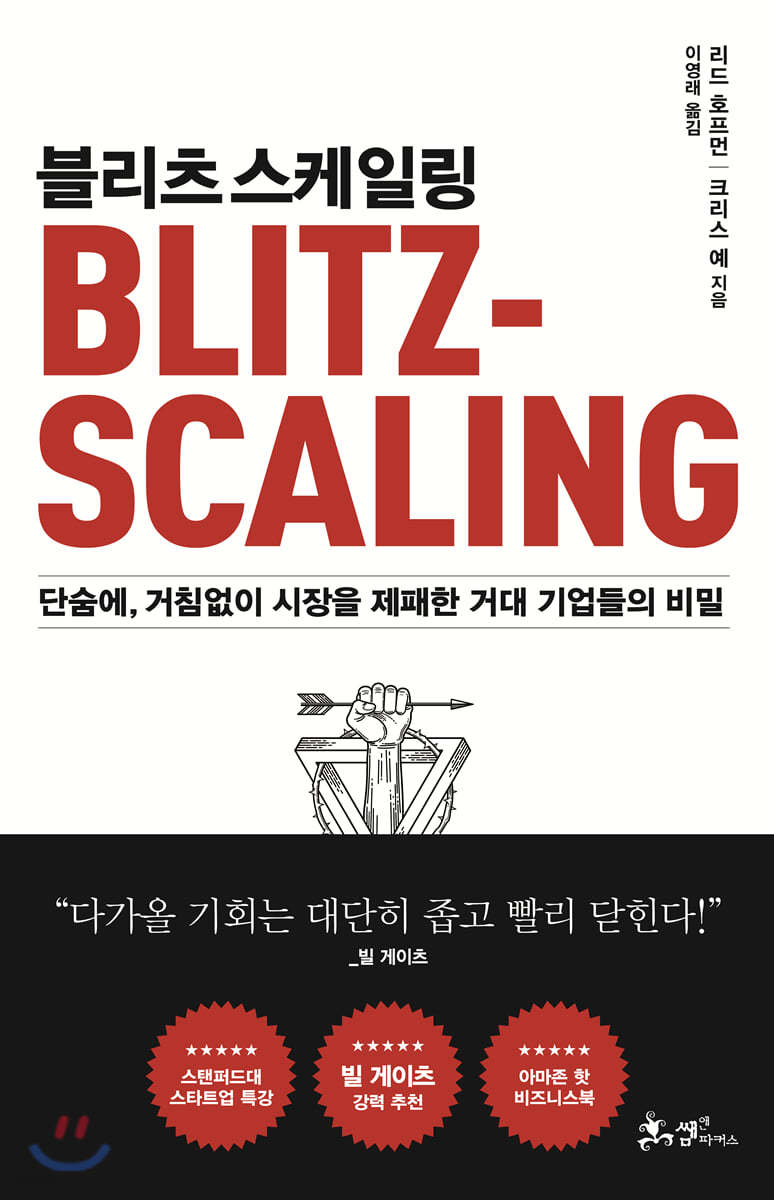
Highly recommended by Bill Gates Stanford University's Top Startup Lectures, Selected by CEOs Amazon's Top 10 Business Books Blitzscaling is a high-growth strategy for companies that take risks in uncertain situations and grow the company at an incredible rate to gain an overwhelming competitive advantage. It is a portmanteau of 'Blitzkrieg', meaning surprise attack, and 'scale up', meaning expansion of scale. It is an aggressive business concept that became widely known when LinkedIn founder Reid Hoffman gave a special lecture on startups at Stanford University, which became a hot topic across the United States. This strategy, already proven by Amazon, Google, and Airbnb, aims to rapidly overpower competitors, absorb the market's superior human and material resources, establish brand awareness, and ultimately monopolize the market. In a market that has become 'jungled' and where copycats appear almost every day, it has become impossible to guarantee a company's survival based on technological prowess alone. The concept of being a first mover or a fast follower is also becoming outdated. Rapid technological advancements are constantly changing the positions of leaders and followers, and as if to prove this, countless followers are working tirelessly day and night to become the new market leaders, while leaders are working tirelessly to maintain their market share. Blitzscaling is becoming a popular choice for all of these players as a key strategy in this fierce market battle. This book covers everything about blitzscaling, from how to design a business, to managing the risks involved in a speed war, to a step-by-step system for each organization's size. It also helps you develop an eye for timing when to start and stop blitzscaling. This book is very impressive, with vivid business insights from Reid Hoffman, who has experience in major blitzscaling in Silicon Valley as an investor, including founding LinkedIn. |
- You can preview some of the book's contents.
Preview
index
|Recommendation| The opportunities ahead are very narrow and close quickly. _Bill Gates · 004
|Prologue| Get Big Fast! · 013
San Francisco, Airbnb Headquarters┃Shenzhen, China, Tencent Headquarters┃The Secret Weapon to Instantly Outpace Your Competitors┃You Must Strike First┃The Secrets of Silicon Valley┃It's Your Turn Now┃Forget the Retreat Path and Go for a Speed Battle
PART 1 | Blitzkrieg | Risk It All · 045
The wave of innovation is creating radical opportunities. Speed is more important than efficiency. 3 ways to move faster. Just 5 steps to remember. 3 keys to achieving monopoly status.
PART 2 | BUSINESS MODEL | Preemption Comes Before Optimization · 083
Four Highlands | Two Obstacles to Preemptive Dominance | Proven Business Patterns | Four Laws for Creating New Patterns | Insights in Blitzscaling
PART 3 | STRATEGY | The Noisy Gap Is 'That Time' · 181
When to Move┃When to Stop┃Is This a Market Worth Entering?┃Ignore the Process┃Step-by-Step Strategy┃Entrepreneurs Must Be Chameleons┃From Strategy to Management
PART 4 |MANAGEMENT| LET THE FIRE BURN · 217
8 Strategies for Blitzscaling | 9 Counterintuitive Strategies | Adapt to the Times
PART 5 | Big Business | 'Goliath' is defeated by a bigger 'Goliath' · 357
Strike the weak links of traditional industries┃“Even large corporations are blitzscaling!”┃Blitzscaling works everywhere┃Regional dominance is a clear strength┃An ecosystem that scalers can easily conquer┃China, a land of vast opportunity┃Three ‘offensive strategies’ that are part of a ‘defensive strategy’
PART 6 | PROSPERITY | From the First to the Last Scaler · 413
Influence is a bonus. The unavoidable risk is a constant. Unpredictable situations. Responsibility and speed are proportional.
|Epilogue| The Market 'Punishes' Stagnation and Complacency · 435
|Appendix| Blitzscalers in this book · 445
|Prologue| Get Big Fast! · 013
San Francisco, Airbnb Headquarters┃Shenzhen, China, Tencent Headquarters┃The Secret Weapon to Instantly Outpace Your Competitors┃You Must Strike First┃The Secrets of Silicon Valley┃It's Your Turn Now┃Forget the Retreat Path and Go for a Speed Battle
PART 1 | Blitzkrieg | Risk It All · 045
The wave of innovation is creating radical opportunities. Speed is more important than efficiency. 3 ways to move faster. Just 5 steps to remember. 3 keys to achieving monopoly status.
PART 2 | BUSINESS MODEL | Preemption Comes Before Optimization · 083
Four Highlands | Two Obstacles to Preemptive Dominance | Proven Business Patterns | Four Laws for Creating New Patterns | Insights in Blitzscaling
PART 3 | STRATEGY | The Noisy Gap Is 'That Time' · 181
When to Move┃When to Stop┃Is This a Market Worth Entering?┃Ignore the Process┃Step-by-Step Strategy┃Entrepreneurs Must Be Chameleons┃From Strategy to Management
PART 4 |MANAGEMENT| LET THE FIRE BURN · 217
8 Strategies for Blitzscaling | 9 Counterintuitive Strategies | Adapt to the Times
PART 5 | Big Business | 'Goliath' is defeated by a bigger 'Goliath' · 357
Strike the weak links of traditional industries┃“Even large corporations are blitzscaling!”┃Blitzscaling works everywhere┃Regional dominance is a clear strength┃An ecosystem that scalers can easily conquer┃China, a land of vast opportunity┃Three ‘offensive strategies’ that are part of a ‘defensive strategy’
PART 6 | PROSPERITY | From the First to the Last Scaler · 413
Influence is a bonus. The unavoidable risk is a constant. Unpredictable situations. Responsibility and speed are proportional.
|Epilogue| The Market 'Punishes' Stagnation and Complacency · 435
|Appendix| Blitzscalers in this book · 445
Detailed image

Into the book
When developing a strategy, we usually gather information and then make decisions when we feel reasonably confident about the predicted outcome.
This is the typical way.
These theories tell us to take risks.
However, the risks they speak of are limited to measurable or predictable risks.
This technique also implies that accuracy and efficiency should be prioritized over speed.
Unfortunately, this cautious and cautious approach can lead to a loss of power when new technologies create new markets or disrupt existing ones.
--- p.48
“Why risk blowing up a successful, growing company?” Blitzscaling companies typically operate in winner-take-all markets.
A greater risk for a growing, successful company is moving too slowly, allowing competitors to take the lead and enjoy first-scaler advantage.
--- p.78
When starting a new business, there are some questions you must ask yourself about product-market fit.
Have you discovered an unconventional market opportunity?
Does the opportunity have any unique advantages or approaches?
So is this an opportunity that competitors won't find until you're way ahead?
It is difficult to find opportunities like this in a 'cutthroat' market.
If the opportunity is obvious to everyone, the chances of success are extremely low.
--- p.119~120
The reason why understanding and applying the principles of blitzscaling is difficult is because it requires abandoning the norms that are commonly followed when doing business.
This is even more difficult for experienced managers.
Because it means throwing away everything you've learned over the years, in business school, or while running a small startup in its early days.
Careful planning, careful investment, courteous service, and strictly controlled burn rates are all necessary, but quick estimates, angry customers, and inefficient capital expenditures must be ignored.
Why pursue such a risky and counterintuitive course of action? Speed.
Remember, the goal of blitzscaling is to grow very quickly, even if it means increasing risk and costs.
--- p.183~184
How to use blitzscaling to create a sustainable competitive advantage.
Another way is to be the first company to create a steep learning curve.
Some opportunities, such as self-driving cars, require solving complex and difficult problems.
If you want to scale faster, you need to train your machine learning on more data.
This leads to product improvements that make it easier to scale in the market, while competitors who are just starting to learn fall far behind.
--- p.190
It is dangerous to blitzscale when the market has reached its limit and cannot grow any further.
Just as a company is nearing its peak, it may hit a market limit and suddenly lose speed and momentum.
Besides a sudden slowdown in growth, a common sign that growth has reached its limits is internal conflict.
Managers and investors accustomed to sustained growth begin to ask these questions when faced with this situation:
"What went wrong?" "Who is to blame?" If a company fails to address the root cause, the most common (and unhelpful) course of action is to replace the CEO, the top management, or both (the VP of Revenue is usually the most vulnerable, as they are often blamed for the slowdown). How many times has replacing a CEO actually reignited rapid growth? The only example we can think of is Steve Jobs at Apple.
If Jobs is waiting, it's okay to replace the CEO.
Otherwise, replacing the CEO or management will not help.
--- p.201~202
Kalanick is absolutely right when he says that being small helps an organization stay innovative and agile.
But staying small doesn't always lead to faster innovation and speed.
Rather than trying to avoid growing the organization as much as possible and waiting for a big leap forward 'someday' to change things, it's better to build an organizational structure that can be repeated many times.
In other words, it means establishing a management strategy that is appropriate for the scale.
Even a smart guy like Page learned this in the early days of Google.
This is the typical way.
These theories tell us to take risks.
However, the risks they speak of are limited to measurable or predictable risks.
This technique also implies that accuracy and efficiency should be prioritized over speed.
Unfortunately, this cautious and cautious approach can lead to a loss of power when new technologies create new markets or disrupt existing ones.
--- p.48
“Why risk blowing up a successful, growing company?” Blitzscaling companies typically operate in winner-take-all markets.
A greater risk for a growing, successful company is moving too slowly, allowing competitors to take the lead and enjoy first-scaler advantage.
--- p.78
When starting a new business, there are some questions you must ask yourself about product-market fit.
Have you discovered an unconventional market opportunity?
Does the opportunity have any unique advantages or approaches?
So is this an opportunity that competitors won't find until you're way ahead?
It is difficult to find opportunities like this in a 'cutthroat' market.
If the opportunity is obvious to everyone, the chances of success are extremely low.
--- p.119~120
The reason why understanding and applying the principles of blitzscaling is difficult is because it requires abandoning the norms that are commonly followed when doing business.
This is even more difficult for experienced managers.
Because it means throwing away everything you've learned over the years, in business school, or while running a small startup in its early days.
Careful planning, careful investment, courteous service, and strictly controlled burn rates are all necessary, but quick estimates, angry customers, and inefficient capital expenditures must be ignored.
Why pursue such a risky and counterintuitive course of action? Speed.
Remember, the goal of blitzscaling is to grow very quickly, even if it means increasing risk and costs.
--- p.183~184
How to use blitzscaling to create a sustainable competitive advantage.
Another way is to be the first company to create a steep learning curve.
Some opportunities, such as self-driving cars, require solving complex and difficult problems.
If you want to scale faster, you need to train your machine learning on more data.
This leads to product improvements that make it easier to scale in the market, while competitors who are just starting to learn fall far behind.
--- p.190
It is dangerous to blitzscale when the market has reached its limit and cannot grow any further.
Just as a company is nearing its peak, it may hit a market limit and suddenly lose speed and momentum.
Besides a sudden slowdown in growth, a common sign that growth has reached its limits is internal conflict.
Managers and investors accustomed to sustained growth begin to ask these questions when faced with this situation:
"What went wrong?" "Who is to blame?" If a company fails to address the root cause, the most common (and unhelpful) course of action is to replace the CEO, the top management, or both (the VP of Revenue is usually the most vulnerable, as they are often blamed for the slowdown). How many times has replacing a CEO actually reignited rapid growth? The only example we can think of is Steve Jobs at Apple.
If Jobs is waiting, it's okay to replace the CEO.
Otherwise, replacing the CEO or management will not help.
--- p.201~202
Kalanick is absolutely right when he says that being small helps an organization stay innovative and agile.
But staying small doesn't always lead to faster innovation and speed.
Rather than trying to avoid growing the organization as much as possible and waiting for a big leap forward 'someday' to change things, it's better to build an organizational structure that can be repeated many times.
In other words, it means establishing a management strategy that is appropriate for the scale.
Even a smart guy like Page learned this in the early days of Google.
--- p.286
Publisher's Review
A must-read book strongly recommended by Bill Gates!
Stanford University's best startup lecture!
The only surefire strategy to monopolize an uncertain market
The world is facing an unprecedented crisis due to COVID-19.
News reports are emerging that the situation is difficult to predict both domestically and internationally, with threats to life, disruption of daily life, and economic crises, and international economic organizations such as the WTO, IMF, and OECD have pointed out that the situation will be more serious than the financial crisis.
A frozen economy, a market in chaos.
Companies that have been driven to the brink of collapse are now faced with the difficult decision of how to prepare for the future.
But let's think about it differently.
When has business ever been easy?
The market has always been fraught with unpredictable risks, and its rapid pace of change has been a constant for some time.
Facebook, Google, and Amazon have instead exploited this chaotic gap to disrupt existing markets, defeating giants and seizing leadership in hyper-competitive markets.
Now, with the market uncertain, may be the only time when latecomers can overtake the established players and snatch the top spot.
From that perspective, Blitzscaling, which introduces a strategy for dominating the market in an uncertain environment, is truly worth reading.
The authors of this book define the critical success strategy of market monopolists as "blitzscaling."
Blitzscaling is a portmanteau of "blitzkrieg," meaning surprise attack, and "scale up," meaning expansion. It refers to a high-growth strategy for companies to take risks in uncertain situations and grow the company at an incredible speed to gain an overwhelming competitive advantage.
The authors gave a lecture of the same name at Stanford University, based on real-life examples of companies that achieved rapid growth through blitzscaling strategies, and wrote this book after receiving enthusiastic responses from students and CEOs.
“The opportunities that come are very limited and close quickly.”
The only answer is to move quickly, fill the gaps, and take over the whole thing.
In a situation where you can't see even an inch ahead, it may sound absurd to ask people to take the risk of a speed war.
Nevertheless, the authors assert that we will inevitably face critical situations where we must risk everything and pursue overwhelming speed.
The reason is simple.
It's not a question of being first or second, it's because survival cannot be guaranteed.
Only the company that monopolizes the market, that is, the number one, has the advantage of securing the market's excellent human and material resources, and can even enjoy the bandwagon effect of comparative advantage.
Moreover, the market is changing at an increasingly unpredictable pace.
Bill Gates once pointed out that “the opportunities that come are very narrow and close quickly.”
The only surefire strategy to counter this is to quickly capture the market and create a huge gap that will be difficult for competitors to catch up with.
There is no market today that is not competitive.
In that respect, blitzscaling is the most rational and only strategy.
It's worth noting how Airbnb, a "small startup" with just 40 employees and a single headquarters, countered its European copycat, Wimdo, which copied their business model.
Wimdu has made a bold proposal to swap Airbnb's shares for their own company.
Airbnb's response to this is blitzscaling.
They ultimately rejected the rude offer from Wimdu, which was eating away at their market share, and instead opted for an aggressive expansion strategy, opening nine branches across Europe in just a few months and announcing that they had achieved 10 million reservations.
That boldness allowed the company to grow into a multi-billion dollar company in just a few years, establishing it as a unique player in its industry.
If Airbnb had accepted Wimdu's proposal or adopted a gradual growth strategy, not only would it have lost the European market at the time, we might not even be talking about the company called 'Airbnb' today.
Do you still believe that rushing forward is dangerous? If you prioritize efficiency and move cautiously, you'll end up on the periphery of the market or even disappear altogether.
It is a truth that the market has shown throughout history that second place is not maintained for long.
Moderate growth can be a far greater threat than the enormous costs or management risks associated with radical scale-up.
Grow your company in one fell swoop, without hesitation, risking everything.
Be bold, the more risks you take, the greater the rewards!
So, how do we move so quickly, what do we observe, and how do we make these decisions? And when do we start and when do we stop? These are the biggest questions facing countless companies that have adopted blitzscaling as their strategy.
As befitting the world's leading Silicon Valley veterans, the authors offer compelling case studies and insightful solutions to answer even the most in-depth questions about blitzscaling.
This book systematically explains the steps required to create and maintain a speed that competitors cannot match, from assessing the size of the market to designing a unique business model and managing the risks associated with blitzscaling, based on the size of your organization.
You'll also gain insight into when blitzscaling begins, when it stagnates, and when to optimally stop.
Blitzscaling is a risky strategy, but it's a necessary option in today's market conditions.
It is also just as charming and sweet.
It's strange and scary to watch a fire burn before your eyes, but if it's not a fire that will immediately engulf your company, you should boldly let it burn.
If you decide to focus on speed, grow your company at a relentless pace, risking all your resources and the very existence of your company.
It is important to remember that the bolder you are, the greater the reward.
This book will make the unfinished business burn even bigger in that flame.
Stanford University's best startup lecture!
The only surefire strategy to monopolize an uncertain market
The world is facing an unprecedented crisis due to COVID-19.
News reports are emerging that the situation is difficult to predict both domestically and internationally, with threats to life, disruption of daily life, and economic crises, and international economic organizations such as the WTO, IMF, and OECD have pointed out that the situation will be more serious than the financial crisis.
A frozen economy, a market in chaos.
Companies that have been driven to the brink of collapse are now faced with the difficult decision of how to prepare for the future.
But let's think about it differently.
When has business ever been easy?
The market has always been fraught with unpredictable risks, and its rapid pace of change has been a constant for some time.
Facebook, Google, and Amazon have instead exploited this chaotic gap to disrupt existing markets, defeating giants and seizing leadership in hyper-competitive markets.
Now, with the market uncertain, may be the only time when latecomers can overtake the established players and snatch the top spot.
From that perspective, Blitzscaling, which introduces a strategy for dominating the market in an uncertain environment, is truly worth reading.
The authors of this book define the critical success strategy of market monopolists as "blitzscaling."
Blitzscaling is a portmanteau of "blitzkrieg," meaning surprise attack, and "scale up," meaning expansion. It refers to a high-growth strategy for companies to take risks in uncertain situations and grow the company at an incredible speed to gain an overwhelming competitive advantage.
The authors gave a lecture of the same name at Stanford University, based on real-life examples of companies that achieved rapid growth through blitzscaling strategies, and wrote this book after receiving enthusiastic responses from students and CEOs.
“The opportunities that come are very limited and close quickly.”
The only answer is to move quickly, fill the gaps, and take over the whole thing.
In a situation where you can't see even an inch ahead, it may sound absurd to ask people to take the risk of a speed war.
Nevertheless, the authors assert that we will inevitably face critical situations where we must risk everything and pursue overwhelming speed.
The reason is simple.
It's not a question of being first or second, it's because survival cannot be guaranteed.
Only the company that monopolizes the market, that is, the number one, has the advantage of securing the market's excellent human and material resources, and can even enjoy the bandwagon effect of comparative advantage.
Moreover, the market is changing at an increasingly unpredictable pace.
Bill Gates once pointed out that “the opportunities that come are very narrow and close quickly.”
The only surefire strategy to counter this is to quickly capture the market and create a huge gap that will be difficult for competitors to catch up with.
There is no market today that is not competitive.
In that respect, blitzscaling is the most rational and only strategy.
It's worth noting how Airbnb, a "small startup" with just 40 employees and a single headquarters, countered its European copycat, Wimdo, which copied their business model.
Wimdu has made a bold proposal to swap Airbnb's shares for their own company.
Airbnb's response to this is blitzscaling.
They ultimately rejected the rude offer from Wimdu, which was eating away at their market share, and instead opted for an aggressive expansion strategy, opening nine branches across Europe in just a few months and announcing that they had achieved 10 million reservations.
That boldness allowed the company to grow into a multi-billion dollar company in just a few years, establishing it as a unique player in its industry.
If Airbnb had accepted Wimdu's proposal or adopted a gradual growth strategy, not only would it have lost the European market at the time, we might not even be talking about the company called 'Airbnb' today.
Do you still believe that rushing forward is dangerous? If you prioritize efficiency and move cautiously, you'll end up on the periphery of the market or even disappear altogether.
It is a truth that the market has shown throughout history that second place is not maintained for long.
Moderate growth can be a far greater threat than the enormous costs or management risks associated with radical scale-up.
Grow your company in one fell swoop, without hesitation, risking everything.
Be bold, the more risks you take, the greater the rewards!
So, how do we move so quickly, what do we observe, and how do we make these decisions? And when do we start and when do we stop? These are the biggest questions facing countless companies that have adopted blitzscaling as their strategy.
As befitting the world's leading Silicon Valley veterans, the authors offer compelling case studies and insightful solutions to answer even the most in-depth questions about blitzscaling.
This book systematically explains the steps required to create and maintain a speed that competitors cannot match, from assessing the size of the market to designing a unique business model and managing the risks associated with blitzscaling, based on the size of your organization.
You'll also gain insight into when blitzscaling begins, when it stagnates, and when to optimally stop.
Blitzscaling is a risky strategy, but it's a necessary option in today's market conditions.
It is also just as charming and sweet.
It's strange and scary to watch a fire burn before your eyes, but if it's not a fire that will immediately engulf your company, you should boldly let it burn.
If you decide to focus on speed, grow your company at a relentless pace, risking all your resources and the very existence of your company.
It is important to remember that the bolder you are, the greater the reward.
This book will make the unfinished business burn even bigger in that flame.
GOODS SPECIFICS
- Date of issue: April 10, 2020
- Format: Hardcover book binding method guide
- Page count, weight, size: 452 pages | 640g | 135*208*30mm
- ISBN13: 9791165340728
- ISBN10: 1165340720
You may also like
카테고리
korean


korean

![GQ KOREA Mark (Monthly): December [2025]](http://librairie.coreenne.fr/cdn/shop/files/8ef265dbbfbf186523ed75ba7319009d.jpg?v=1765340328&width=3840)


