

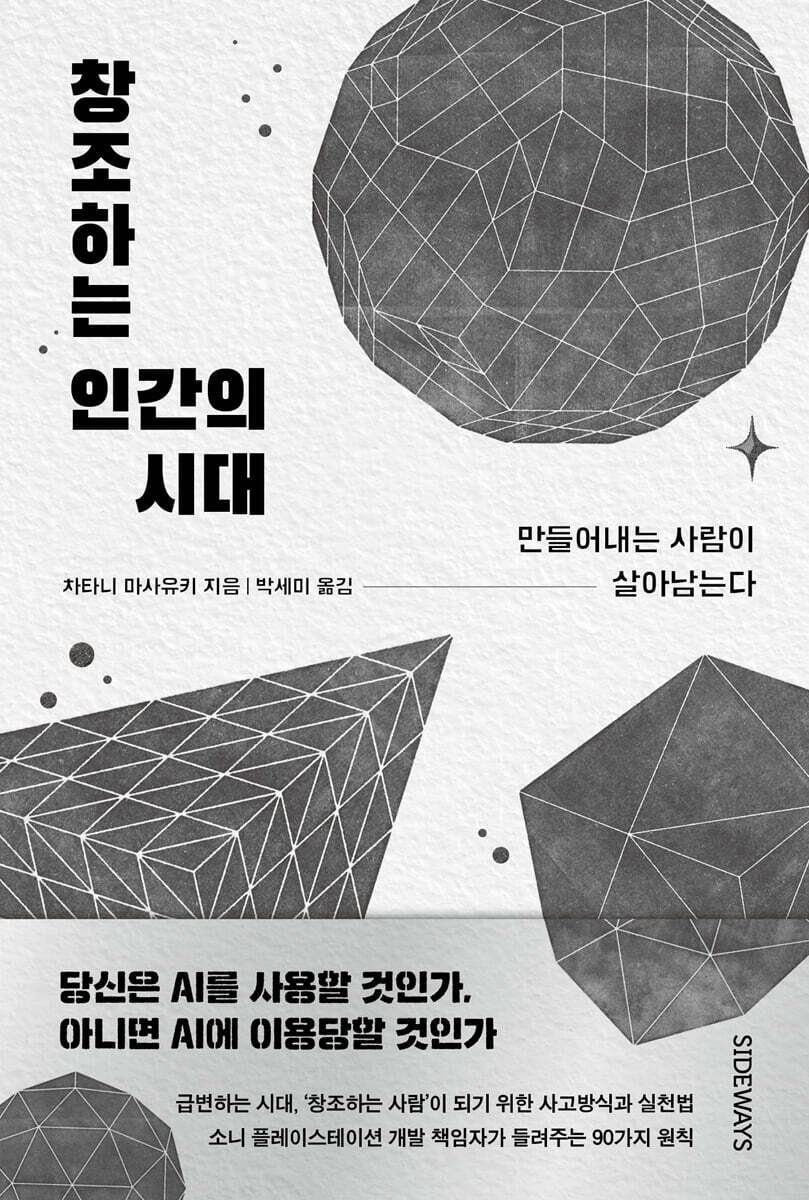
The Age of Creative Humans
 |
Description
Book Introduction
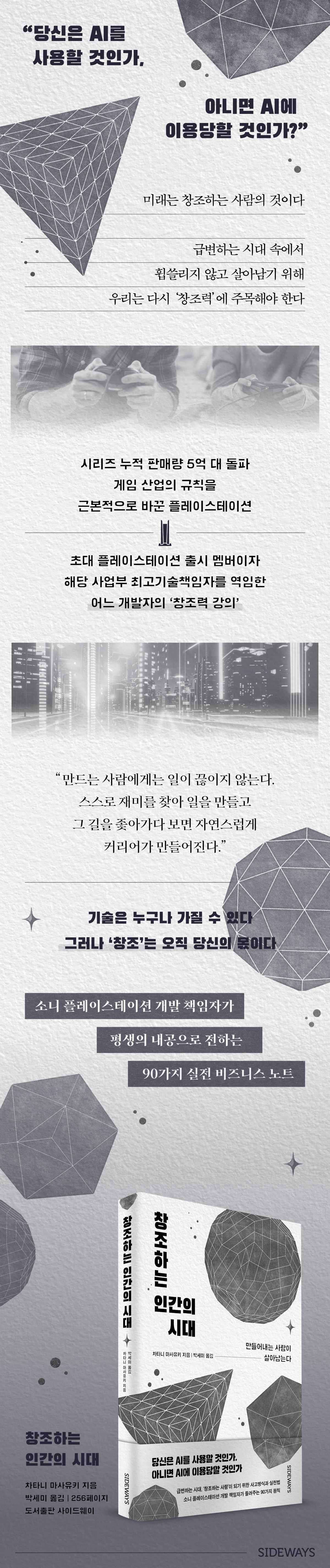
In the AI era, creators are ultimately the main characters.
Cumulative series sales exceed 500 million units
PlayStation, which fundamentally changed the rules of the gaming industry
He was a member of the original PlayStation launch team.
He served as the Chief Technology Officer of the business division.
A developer's 'creativity lecture'
Practical business notes from his lifelong experience
When Sony, then an electronics company, entered the gaming industry, no one could have predicted the success it would achieve.
The atmosphere within Sony was similar.
Sony's PlayStation is a game console that was not developed directly by the group's headquarters, but rather created by a separate joint venture.
What was the result? The PlayStation series grew into a core business, accounting for a quarter of Sony's total sales, and cumulative sales of the series surpassed 500 million units.
It was also listed in the Guinness Book of World Records as the 'best-selling home video game console brand in history.'
The author, a veteran developer and a member of the original PlayStation launch team, has been in charge of planning, platform development, and new business planning and operation for the series for 16 years, and served as the Chief Technology Officer (CTO) of the PlayStation business unit for 7 years.
What kind of mindset and business aspirations led him to create this console? What advice would he offer to those contemplating their future in this dizzyingly competitive world? What inspiration does author Masayuki Chatani, who developed conversational AI at Rakuten after leaving Sony, hope to offer to those facing the AI era?
The answer lies in the ‘creator.’
Those who create something can ultimately become the main characters of the AI era.
This book presents 90 clear and solid ways of thinking and practicing to become a creative person in a rapidly changing era.
What matters to us is not abstract theories or business 'right answers'.
If only that had been the case, the PlayStation would never have been released in the first place.
So now it's time to hear from the author, drawing on his extensive experience, long-standing insights, and concrete advice.
Let's delve into the secret of the 'power of creation' that he has passed down through his lifelong practice.
Cumulative series sales exceed 500 million units
PlayStation, which fundamentally changed the rules of the gaming industry
He was a member of the original PlayStation launch team.
He served as the Chief Technology Officer of the business division.
A developer's 'creativity lecture'
Practical business notes from his lifelong experience
When Sony, then an electronics company, entered the gaming industry, no one could have predicted the success it would achieve.
The atmosphere within Sony was similar.
Sony's PlayStation is a game console that was not developed directly by the group's headquarters, but rather created by a separate joint venture.
What was the result? The PlayStation series grew into a core business, accounting for a quarter of Sony's total sales, and cumulative sales of the series surpassed 500 million units.
It was also listed in the Guinness Book of World Records as the 'best-selling home video game console brand in history.'
The author, a veteran developer and a member of the original PlayStation launch team, has been in charge of planning, platform development, and new business planning and operation for the series for 16 years, and served as the Chief Technology Officer (CTO) of the PlayStation business unit for 7 years.
What kind of mindset and business aspirations led him to create this console? What advice would he offer to those contemplating their future in this dizzyingly competitive world? What inspiration does author Masayuki Chatani, who developed conversational AI at Rakuten after leaving Sony, hope to offer to those facing the AI era?
The answer lies in the ‘creator.’
Those who create something can ultimately become the main characters of the AI era.
This book presents 90 clear and solid ways of thinking and practicing to become a creative person in a rapidly changing era.
What matters to us is not abstract theories or business 'right answers'.
If only that had been the case, the PlayStation would never have been released in the first place.
So now it's time to hear from the author, drawing on his extensive experience, long-standing insights, and concrete advice.
Let's delve into the secret of the 'power of creation' that he has passed down through his lifelong practice.
- You can preview some of the book's contents.
Preview
index
■ Introduction
Chapter 1: Let's start with useless imagination.
Know, Use, Make
Creators are people who take on challenges
An era in which it is difficult for a 'maker' to emerge
Three Secrets to Becoming a Maker
Learn from the eccentric who rejects the ordinary.
In the AI era, creators are ultimately the main characters.
AI makes the world look different than before.
Walk your own path without being conscious of other people's gaze.
Let's become people who have useless imaginations.
A positive attitude is necessary to seize opportunities.
We should ask 'why', not 'how'.
Let's have our own special talent
To find your specialty, you need to find a field you can be passionate about.
A way of thinking that starts with useless imagination
Instead of following the rules, create your own.
It's not easy to live in an ecosystem created by others.
Have the perspective of a manager, not an operator
Let's broaden our horizons and explore information.
Let's prepare for various cases
Let's clarify the area of expertise that will secure our right to survive.
The power of creation is essential for living happily in the 100-year era.
Pay attention to information recommended by people connected to social media.
What I create creates a new society.
Let's be teachers, not learners from AI.
Imagine a huge amount of money burning every day.
Chapter 2: Let's start with useless imagination.
Success in challenges of any size
Whether a project succeeds or not depends on the persistence of its members.
Don't stop
Don't give up halfway through, in case you're too far ahead of your time.
Things to keep, even if they seem useless right now
It's easy to start, but hard to quit.
Software is taking over the world
Learn on the spot
An era where experience is far more valuable than knowledge
Let's study while being conscious of the big picture.
Let's figure out whether it's a temporary change or a new way of life.
Don't be fooled by status-based stories.
A building with a poor foundation will later become a big problem.
Let's set big goals first
Understanding your colleagues' needs is just as important as your consumers'.
Two Keys to Developing a Foresightful Vision
The habit of asking "Why?" is much more important than you might think.
Why did they adopt that technology and method?
Keep track of your competitors' trends and pay attention to their personnel information.
An era where you can start making things easily without any initial costs.
AI Eyes and Virtual Reality: The Second Cambrian Explosion
Virtual Reality: Infinite Opportunities to Transform Your Lifestyle
Behind the scenes of big technology lies a benefit for us.
Chapter 3: How to Use Knowledge and Ideas
Communication is much more important than you think.
It's difficult for people with different backgrounds to share the same premise.
Understand trends and proactively think about how to utilize them.
Let's keep checking information in our field.
Small talk is an important element in refining ideas.
Success is born from new combinations of existing elements.
Even if you've never tried it before, it's okay to try if an expert tells you to.
Let's seek success by combining resources and technologies from other companies.
To move from science to business
Deliberately breaking empty rules and past success formulas.
[Column 1] Open source must break free from the illusion of being "free."
Those who envision a diverse future with AI will move ahead.
From airplane parts to cultured meat, 3D printing is the way to go.
Networks are now a relic of the past.
The diverse future possibilities that 5G will open up
5G will bring a completely different look to the entertainment industry.
The day robots become your colleagues
Autonomous driving is a paradigm shift.
A business born in a world where autonomous driving is a given
The Internet of Things (IoT) is changing the world.
Chapter 4: If you imagine it thoroughly, you can create it.
Let's run 'Supari'
Japan's aging society is full of opportunities.
Age is just a number if you can make it.
Always have a backup plan
[Column 2] Create an exit, even if it's small, for your project.
The feeling that "it would be great if I could do it" transcends reason.
[Column 3] Overcoming the "Wall of Trials" to Create a New "Business"
To create a successful product, think of your users as children.
Let's imagine from the user's perspective as much as possible.
Choose the one that makes your heart beat
Innovation starts at the periphery, not the center.
[Column 4] Is Your Department Core, Peripheral, or Declining?
Let's stop the rigid PDCA process.
Colleagues are essential infrastructure.
[Column 5] PlayStation's Social Contribution
Even if there are no immediate profits, investments for the future must continue.
If you don't have it, make it yourself
Things to cherish even if they don't help you right away
Only professionals who love their work become first-class.
Even for the same product, the recipe keeps changing.
The product verification process should never be neglected.
Practice finding unnecessary things in what you are doing now.
■ Conclusion
Chapter 1: Let's start with useless imagination.
Know, Use, Make
Creators are people who take on challenges
An era in which it is difficult for a 'maker' to emerge
Three Secrets to Becoming a Maker
Learn from the eccentric who rejects the ordinary.
In the AI era, creators are ultimately the main characters.
AI makes the world look different than before.
Walk your own path without being conscious of other people's gaze.
Let's become people who have useless imaginations.
A positive attitude is necessary to seize opportunities.
We should ask 'why', not 'how'.
Let's have our own special talent
To find your specialty, you need to find a field you can be passionate about.
A way of thinking that starts with useless imagination
Instead of following the rules, create your own.
It's not easy to live in an ecosystem created by others.
Have the perspective of a manager, not an operator
Let's broaden our horizons and explore information.
Let's prepare for various cases
Let's clarify the area of expertise that will secure our right to survive.
The power of creation is essential for living happily in the 100-year era.
Pay attention to information recommended by people connected to social media.
What I create creates a new society.
Let's be teachers, not learners from AI.
Imagine a huge amount of money burning every day.
Chapter 2: Let's start with useless imagination.
Success in challenges of any size
Whether a project succeeds or not depends on the persistence of its members.
Don't stop
Don't give up halfway through, in case you're too far ahead of your time.
Things to keep, even if they seem useless right now
It's easy to start, but hard to quit.
Software is taking over the world
Learn on the spot
An era where experience is far more valuable than knowledge
Let's study while being conscious of the big picture.
Let's figure out whether it's a temporary change or a new way of life.
Don't be fooled by status-based stories.
A building with a poor foundation will later become a big problem.
Let's set big goals first
Understanding your colleagues' needs is just as important as your consumers'.
Two Keys to Developing a Foresightful Vision
The habit of asking "Why?" is much more important than you might think.
Why did they adopt that technology and method?
Keep track of your competitors' trends and pay attention to their personnel information.
An era where you can start making things easily without any initial costs.
AI Eyes and Virtual Reality: The Second Cambrian Explosion
Virtual Reality: Infinite Opportunities to Transform Your Lifestyle
Behind the scenes of big technology lies a benefit for us.
Chapter 3: How to Use Knowledge and Ideas
Communication is much more important than you think.
It's difficult for people with different backgrounds to share the same premise.
Understand trends and proactively think about how to utilize them.
Let's keep checking information in our field.
Small talk is an important element in refining ideas.
Success is born from new combinations of existing elements.
Even if you've never tried it before, it's okay to try if an expert tells you to.
Let's seek success by combining resources and technologies from other companies.
To move from science to business
Deliberately breaking empty rules and past success formulas.
[Column 1] Open source must break free from the illusion of being "free."
Those who envision a diverse future with AI will move ahead.
From airplane parts to cultured meat, 3D printing is the way to go.
Networks are now a relic of the past.
The diverse future possibilities that 5G will open up
5G will bring a completely different look to the entertainment industry.
The day robots become your colleagues
Autonomous driving is a paradigm shift.
A business born in a world where autonomous driving is a given
The Internet of Things (IoT) is changing the world.
Chapter 4: If you imagine it thoroughly, you can create it.
Let's run 'Supari'
Japan's aging society is full of opportunities.
Age is just a number if you can make it.
Always have a backup plan
[Column 2] Create an exit, even if it's small, for your project.
The feeling that "it would be great if I could do it" transcends reason.
[Column 3] Overcoming the "Wall of Trials" to Create a New "Business"
To create a successful product, think of your users as children.
Let's imagine from the user's perspective as much as possible.
Choose the one that makes your heart beat
Innovation starts at the periphery, not the center.
[Column 4] Is Your Department Core, Peripheral, or Declining?
Let's stop the rigid PDCA process.
Colleagues are essential infrastructure.
[Column 5] PlayStation's Social Contribution
Even if there are no immediate profits, investments for the future must continue.
If you don't have it, make it yourself
Things to cherish even if they don't help you right away
Only professionals who love their work become first-class.
Even for the same product, the recipe keeps changing.
The product verification process should never be neglected.
Practice finding unnecessary things in what you are doing now.
■ Conclusion
Detailed image
Into the book
In this situation, I believe that the path we must take to survive and develop is ultimately to become 'makers.'
Humans are inherently creatures who create things.
Design new products or services, create structures, and create values that never existed before in the world.
Although some jobs may disappear due to technological advancements, the only way for humans to surpass technology is through the power of creation.
No matter how much AI advances, the creative activity of conceiving and realizing new values will remain a uniquely human domain.
--- From "Entering"
One of the essential conditions for creating something new is the ‘spirit of challenge.’
It is perhaps natural to hear opposition from those around you when trying something new.
Most people try to dissuade them, saying, "The risk is too great" or "There's no precedent for this in the past," and few people welcome it with open arms from the beginning.
This may be because many people are familiar with the stage of 'knowing' existing knowledge and 'using' it, but they do not know how to 'create' something new that has never existed in the world before.
--- From Chapter 1, "Let's Start with Useless Imagination"
From what I've observed over the years of my work, the most powerful people in any field are those who are 'immersed in what they do.'
No matter how hard you try, it's difficult to catch up with these people.
They love their work so much that they think about it all day long, and even their breaks are treated as an extension of their work.
To get over those people, rather than forcing yourself to do things you don't want to do, you need to find something you truly enjoy doing that you can immerse yourself in more deeply than them.
After all, people are most immersed when they are doing something fun.
--- From Chapter 1, "Let's Start with Useless Imagination"
In these changing times, the value of creative people who break the mold and think of new things, like 'eccentrics', is increasing.
Instead of computers and AI taking on tasks that require machine-like precision and efficiency, humans will play a role and demonstrate value in more informal and creative areas, such as conceiving new ideas, creating original stories, and empathizing with people.
--- From Chapter 1, "Let's Start with Useless Imagination"
On the other hand, members of successful projects are fundamentally optimistic and do not worry much about failure itself.
Rather, it creates a positive atmosphere by feeling anticipation and excitement for new challenges.
Of course, this is not unfounded optimism.
They have their own reasons, logic, and outlook on the future, believing that the goals they are challenging are achievable and have a high probability of success.
--- From Chapter 1, "Let's Start with Useless Imagination"
Because knowledge is already systematically structured, it is relatively easy to learn and follow.
Especially in modern society, knowledge is copied and disseminated at a very fast pace thanks to digital technology.
On the other hand, wisdom is closer to an inner ability to deeply understand the essence and truth of things through one's direct experience and reflection, so it cannot be easily imitated or followed by others.
This is also a unique human competitive edge that even artificial intelligence (AI) cannot easily imitate in the digital economy era.
--- From Chapter 1, "Let's Start with Useless Imagination"
In my experience, the 'persistence' of the members involved in the project is the key to making this difference.
The will to solve a problem, the determination to find meaning in a challenge and to see it through, determines the fate of a project.
How can such persistence be born? It depends on whether the members have properly defined the problem they want to solve.
--- From Chapter 2, "Let's study while thinking about the big picture"
If you focus only on the immediate problems, your vision for the future will naturally become clouded.
Of course, short-term performance tasks form the basis of daily income.
However, if we only react reflexively to the tasks in front of us, it is easy to neglect the training to think from a mid- to long-term perspective.
Even if you know it in your head, if you don't develop the habit of thinking with a long-term perspective, it's difficult to suddenly have that perspective when needed.
--- From Chapter 2, "Let's study while thinking about the big picture"
There's an old adage in the software industry that "lazy people make good developers."
Software development involves a lot of simple, repetitive tasks.
It's something that everyone finds annoying, but those who find it especially annoying are actively thinking about ways to automate or handle it more efficiently.
Ultimately, these efforts contribute to improving the efficiency of the entire organization.
--- From Chapter 2, "Let's study while thinking about the big picture"
As virtual reality technology continues to evolve, the opportunities to fundamentally change our lifestyles remain endless, provided we have innovative ideas.
Especially in societies with a high proportion of elderly people like Japan, customized lifestyle and business opportunities are being actively explored, such as utilizing virtual reality to improve the quality of life of the elderly and provide new communication methods.
--- From Chapter 2, "Let's study while thinking about the big picture"
Building relationships where you can have small talk is essential to keeping things running smoothly.
Especially for those who 'make' things.
The seeds of innovation often sprout from the combination of various elements rather than from a single person's brilliant idea.
--- From Chapter 3, “How to Use Knowledge and Ideas”
But there are certainly times when creating new value requires deliberately breaking existing rules.
There's something I often said on the PlayStation development team in the past.
"Rather than being driven out by another company's new business model, we'd rather break our own conventions." "Falling because of another company" means being pushed out of the market by a competitor's aggressive strategy.
If there is even the slightest possibility of encountering such a situation, I believe it is more advantageous in the medium to long term to destroy the existing success model and move on to the next stage.
--- From Chapter 3, “How to Use Knowledge and Ideas”
Autonomous driving technology can also be applied to various services that improve the convenience of life.
In many areas of Japan, outside of major cities like Tokyo and Osaka, it is difficult to get around on a daily basis without a car.
However, in these small cities and rural areas, where the aging population is severe, it is often difficult for the elderly to drive themselves.
If you can't drive, you'll have a hard time even going to the store to buy necessities, creating the so-called "shopping refugee" problem.
Even the public transportation network is shrinking as bus and subway lines are being shut down due to deteriorating profitability.
--- From Chapter 3, “How to Use Knowledge and Ideas”
French composer Debussy said, “Works of art create rules, but rules do not create works of art.”
If we are overly bound by past rules or common sense, it will inevitably lead to decline.
It's time to break away from the stereotype that existing rules must be unconditionally followed and think about how to creatively utilize new technologies.
--- From Chapter 3, “How to Use Knowledge and Ideas”
The company responsible for the PlayStation business, Sony Computer Entertainment (SCE, now Sony Interactive Entertainment SIE), literally translates the term "computer entertainment" to mean "entertainment using a calculator."
The founding members often said, "This is a company that plays with computers, so play more freely."
We have inherited this spirit and are determined to uphold the core principle of 'making users happy and making creators enjoy new challenges.'
--- From Chapter 4, "If you imagine thoroughly, you can create it"
Of course, other countries are also paying attention to the business opportunities that an aging society will bring.
But Japan's greatest strength is its large elderly population, which is directly affected by the problem.
As I get older, I often feel the inconveniences of everyday life that I didn't know when I was younger.
Small print is hard to see, and moving around feels more cumbersome than before.
You can only truly experience this discomfort by experiencing it firsthand.
In societies with relatively young populations, these issues may not yet be considered significant.
--- From Chapter 4, "If you imagine thoroughly, you can create it"
Let's look at the example of a digital camera.
Early digital cameras didn't have LCD screens like we have today.
But in 1995, Japanese camera manufacturer CASIO released a digital camera with a liquid crystal display.
At the time, it was common to take pictures by looking through the camera's small viewfinder, so it is said that the response to the LCD screen in the preliminary customer survey was very negative.
However, Casio boldly added an LCD screen to the camera despite the results of the investigation.
As a result, it is well known that LCD screens became the standard for later digital cameras and changed the market landscape.
--- From Chapter 4, "If you imagine thoroughly, you can create it"
If Sony had remained within the framework of an electronics company, it might not have grown into the company it is today.
Instead of limiting the company to just an electronics company, they redefined it with a broader vision: "A company that brings joy and inspiration to people around the world."
As a result, various fields such as movies, games, music, and finance have become established as Sony's core businesses.
--- From Chapter 4, "If you imagine thoroughly, you can create it"
There may be detailed differences depending on the type of product, but it is fundamentally good for the creator to have the perspective that 'users are like children.'
It is rare for any product to be purchased only by experts who are skilled in its use.
If you create a product or service with children as the user's reference point, the result is that anyone, regardless of age or gender, can use it easily and enjoyably.
Whether you're an adult or a child, you can intuitively learn how to use it without having to read complicated instructions, and the more you use it, the more fun it becomes, keeping you hooked. These are the key elements needed for a successful product.
Humans are inherently creatures who create things.
Design new products or services, create structures, and create values that never existed before in the world.
Although some jobs may disappear due to technological advancements, the only way for humans to surpass technology is through the power of creation.
No matter how much AI advances, the creative activity of conceiving and realizing new values will remain a uniquely human domain.
--- From "Entering"
One of the essential conditions for creating something new is the ‘spirit of challenge.’
It is perhaps natural to hear opposition from those around you when trying something new.
Most people try to dissuade them, saying, "The risk is too great" or "There's no precedent for this in the past," and few people welcome it with open arms from the beginning.
This may be because many people are familiar with the stage of 'knowing' existing knowledge and 'using' it, but they do not know how to 'create' something new that has never existed in the world before.
--- From Chapter 1, "Let's Start with Useless Imagination"
From what I've observed over the years of my work, the most powerful people in any field are those who are 'immersed in what they do.'
No matter how hard you try, it's difficult to catch up with these people.
They love their work so much that they think about it all day long, and even their breaks are treated as an extension of their work.
To get over those people, rather than forcing yourself to do things you don't want to do, you need to find something you truly enjoy doing that you can immerse yourself in more deeply than them.
After all, people are most immersed when they are doing something fun.
--- From Chapter 1, "Let's Start with Useless Imagination"
In these changing times, the value of creative people who break the mold and think of new things, like 'eccentrics', is increasing.
Instead of computers and AI taking on tasks that require machine-like precision and efficiency, humans will play a role and demonstrate value in more informal and creative areas, such as conceiving new ideas, creating original stories, and empathizing with people.
--- From Chapter 1, "Let's Start with Useless Imagination"
On the other hand, members of successful projects are fundamentally optimistic and do not worry much about failure itself.
Rather, it creates a positive atmosphere by feeling anticipation and excitement for new challenges.
Of course, this is not unfounded optimism.
They have their own reasons, logic, and outlook on the future, believing that the goals they are challenging are achievable and have a high probability of success.
--- From Chapter 1, "Let's Start with Useless Imagination"
Because knowledge is already systematically structured, it is relatively easy to learn and follow.
Especially in modern society, knowledge is copied and disseminated at a very fast pace thanks to digital technology.
On the other hand, wisdom is closer to an inner ability to deeply understand the essence and truth of things through one's direct experience and reflection, so it cannot be easily imitated or followed by others.
This is also a unique human competitive edge that even artificial intelligence (AI) cannot easily imitate in the digital economy era.
--- From Chapter 1, "Let's Start with Useless Imagination"
In my experience, the 'persistence' of the members involved in the project is the key to making this difference.
The will to solve a problem, the determination to find meaning in a challenge and to see it through, determines the fate of a project.
How can such persistence be born? It depends on whether the members have properly defined the problem they want to solve.
--- From Chapter 2, "Let's study while thinking about the big picture"
If you focus only on the immediate problems, your vision for the future will naturally become clouded.
Of course, short-term performance tasks form the basis of daily income.
However, if we only react reflexively to the tasks in front of us, it is easy to neglect the training to think from a mid- to long-term perspective.
Even if you know it in your head, if you don't develop the habit of thinking with a long-term perspective, it's difficult to suddenly have that perspective when needed.
--- From Chapter 2, "Let's study while thinking about the big picture"
There's an old adage in the software industry that "lazy people make good developers."
Software development involves a lot of simple, repetitive tasks.
It's something that everyone finds annoying, but those who find it especially annoying are actively thinking about ways to automate or handle it more efficiently.
Ultimately, these efforts contribute to improving the efficiency of the entire organization.
--- From Chapter 2, "Let's study while thinking about the big picture"
As virtual reality technology continues to evolve, the opportunities to fundamentally change our lifestyles remain endless, provided we have innovative ideas.
Especially in societies with a high proportion of elderly people like Japan, customized lifestyle and business opportunities are being actively explored, such as utilizing virtual reality to improve the quality of life of the elderly and provide new communication methods.
--- From Chapter 2, "Let's study while thinking about the big picture"
Building relationships where you can have small talk is essential to keeping things running smoothly.
Especially for those who 'make' things.
The seeds of innovation often sprout from the combination of various elements rather than from a single person's brilliant idea.
--- From Chapter 3, “How to Use Knowledge and Ideas”
But there are certainly times when creating new value requires deliberately breaking existing rules.
There's something I often said on the PlayStation development team in the past.
"Rather than being driven out by another company's new business model, we'd rather break our own conventions." "Falling because of another company" means being pushed out of the market by a competitor's aggressive strategy.
If there is even the slightest possibility of encountering such a situation, I believe it is more advantageous in the medium to long term to destroy the existing success model and move on to the next stage.
--- From Chapter 3, “How to Use Knowledge and Ideas”
Autonomous driving technology can also be applied to various services that improve the convenience of life.
In many areas of Japan, outside of major cities like Tokyo and Osaka, it is difficult to get around on a daily basis without a car.
However, in these small cities and rural areas, where the aging population is severe, it is often difficult for the elderly to drive themselves.
If you can't drive, you'll have a hard time even going to the store to buy necessities, creating the so-called "shopping refugee" problem.
Even the public transportation network is shrinking as bus and subway lines are being shut down due to deteriorating profitability.
--- From Chapter 3, “How to Use Knowledge and Ideas”
French composer Debussy said, “Works of art create rules, but rules do not create works of art.”
If we are overly bound by past rules or common sense, it will inevitably lead to decline.
It's time to break away from the stereotype that existing rules must be unconditionally followed and think about how to creatively utilize new technologies.
--- From Chapter 3, “How to Use Knowledge and Ideas”
The company responsible for the PlayStation business, Sony Computer Entertainment (SCE, now Sony Interactive Entertainment SIE), literally translates the term "computer entertainment" to mean "entertainment using a calculator."
The founding members often said, "This is a company that plays with computers, so play more freely."
We have inherited this spirit and are determined to uphold the core principle of 'making users happy and making creators enjoy new challenges.'
--- From Chapter 4, "If you imagine thoroughly, you can create it"
Of course, other countries are also paying attention to the business opportunities that an aging society will bring.
But Japan's greatest strength is its large elderly population, which is directly affected by the problem.
As I get older, I often feel the inconveniences of everyday life that I didn't know when I was younger.
Small print is hard to see, and moving around feels more cumbersome than before.
You can only truly experience this discomfort by experiencing it firsthand.
In societies with relatively young populations, these issues may not yet be considered significant.
--- From Chapter 4, "If you imagine thoroughly, you can create it"
Let's look at the example of a digital camera.
Early digital cameras didn't have LCD screens like we have today.
But in 1995, Japanese camera manufacturer CASIO released a digital camera with a liquid crystal display.
At the time, it was common to take pictures by looking through the camera's small viewfinder, so it is said that the response to the LCD screen in the preliminary customer survey was very negative.
However, Casio boldly added an LCD screen to the camera despite the results of the investigation.
As a result, it is well known that LCD screens became the standard for later digital cameras and changed the market landscape.
--- From Chapter 4, "If you imagine thoroughly, you can create it"
If Sony had remained within the framework of an electronics company, it might not have grown into the company it is today.
Instead of limiting the company to just an electronics company, they redefined it with a broader vision: "A company that brings joy and inspiration to people around the world."
As a result, various fields such as movies, games, music, and finance have become established as Sony's core businesses.
--- From Chapter 4, "If you imagine thoroughly, you can create it"
There may be detailed differences depending on the type of product, but it is fundamentally good for the creator to have the perspective that 'users are like children.'
It is rare for any product to be purchased only by experts who are skilled in its use.
If you create a product or service with children as the user's reference point, the result is that anyone, regardless of age or gender, can use it easily and enjoyably.
Whether you're an adult or a child, you can intuitively learn how to use it without having to read complicated instructions, and the more you use it, the more fun it becomes, keeping you hooked. These are the key elements needed for a successful product.
--- From Chapter 4, "If you imagine thoroughly, you can create it"
Publisher's Review
Sony PlayStation development manager shares his lifelong expertise.
90 Golden Words for Becoming a Creative Person
The future belongs to those who create it.
“Will you use AI,
Or will we be exploited by AI?”
The influence of games is enormous.
The global gaming industry's revenue is three times that of movies and music combined.
Games captivate, immerse, and addict us.
It dominates many people's childhood and their entire lives.
Characters like Super Mario, Lara Croft, Angry Birds, and Pikachu symbolize the culture and atmosphere of an era in their own right.
Like a living icon.
Where does the power of a game come from? A high-quality story, compelling characters, matching visuals and music, repetitive practice, the joy and happiness of challenging and completing difficult missions, or even winning against someone as obsessed with the game as I am…
These are all elements that make a great game.
Games are a technological achievement that combines these diverse elements into software and hardware (console or PC and smartphone).
That's why games are called a comprehensive art form that combines technology, engineering, and art.
An endless amount of content, armed with all sorts of 'artistic' elements, housed in a vessel of cutting-edge technology, awaits us.
Among them, Sony's PlayStation series became a watershed.
First of all, it sold incredibly well.
With over 500 million units sold worldwide, it became the best-selling console in history.
It also brought about important changes industrially.
The PlayStation was also a game changer in the mid-1990s, firmly establishing a new standard in the gaming market: CD-ROMs, rather than ROM cartridges.
Not to mention the technical aspect.
The PlayStation's outstanding computing capabilities have been well-known from early on.
The US Air Force and Sony actually had a lawsuit over the use of multiple consoles connected to form a supercomputer.
This is what Masayuki Chatani, a true developer who was a member of the PlayStation launch team and served as the company's CTO for seven years, says.
“For a creator, work never stops.
If you find fun in something and create work for yourself and follow that path, your career will naturally develop.
Even if you don't set grand goals from the beginning, if you consistently engage in creative activities, unexpectedly good results often follow.
Anything is fine.
First, let's start with 'imagination'.
The thoughts in your head become concrete plans, and the plans become real results.
"The vague yearning and curiosity I had as a child eventually led to the creation of the PlayStation at Sony."
Given the dazzling success of the PlayStation, isn't this advice too simplistic and unpretentious? You might think so.
However, the important message of 『The Age of Creative Man』 is contained in the advice above.
Try to create something, and don't stop thinking and imagining.
In this book, he meticulously reveals his 30-year career at Sony, particularly his lifelong experience leading the PlayStation business for 16 years.
Above all, it provides kind and clear advice on how we should think and live in the rapidly changing world of the AI era.
Masayuki Chatani teaches us the mindset and practical methods to become a "creative person."
This book, consisting of 90 topics, is full of surprises.
He speaks in a calm and unadorned tone, but his words powerfully touch on a point where we must fundamentally rethink our work.
The message is simple, but the examples and advice in the book are vivid and detailed.
"The Age of Creative Humans" is different from other business books.
This book is not a book that tells you the right answer.
This is not a book that preaches abstract and normative theories.
This book is more like a confession book in which the author honestly shares his experiences and insights over a long period of time.
He has 'lived' the life he pursues. For example, Masayuki Chatani was assigned to the handwriting recognition algorithm development team when he first joined Sony 30 years ago, and later returned to the United States to study computer graphics (CG) and user interface (UI).
At the time, artificial intelligence was considered cutting-edge technology, but its potential had yet to be fully demonstrated. CG was even more so.
He said that because it was a technology that had been treated as minor until then, there were people around him who looked at the research he was doing with skepticism.
Not to mention the PlayStation.
The office was located quite a distance from Sony's headquarters in central Tokyo and the offices of Sony Music (a joint venture between the two companies that developed the PlayStation).
He has faithfully walked the path of the 'non-mainstream' within the company.
But the author says:
This experience later became a crucial foundation for building his own unique capabilities, and the expertise he delved into with pure enjoyment became an irreplaceable asset over time.
What about PlayStation, once the company's "fringe business"? It achieved operating profits of 100 billion yen within three years of its release, and annual sales of 1 trillion won within seven years.
It is now a core business of Sony, accounting for more than a quarter of its total sales.
In this book, the author does not list 'words for words', but twists our common sense and presents specific action guidelines for carrying out his beliefs.
He was the one who made PlayStation a success because he refused to think what others thought and predict what others predicted.
How can we, like the author, create something that captivates people (even if it's not quite the PlayStation)? The author emphasizes that we must pursue what truly excites us, learn from extraordinary people, and forge our own path with unwavering determination and persistence.
He explains why:
“In these times of change, the value of creative people who break the mold and think of new things, like ‘eccentrics,’ is increasing even more.
“Because instead of computers or AI handling tasks that require machine-like precision and efficiency, humans will be able to demonstrate their value in more informal and creative areas, such as conceiving new ideas, creating original stories, and empathizing with people.”
Now it's time to talk about AI.
As the author cites, Sony founder Akio Morita told his juniors, “Always be a positive person to the core.”
Masayuki Chatani is the person who fits that saying better than anyone else.
He believes we can all become 'makers' and is confident that AI will ultimately serve humanity.
But if we don't stop thinking and imagining.
And if you don't neglect to translate those thoughts into concrete plans.
This is because the process of realizing that imagination is a uniquely human creative activity and art that AI cannot imitate.
Of course, our anxiety is well-founded.
The author also knows that many jobs will disappear in the future.
There is no need to mention today's global business environment where 'the winner takes all'.
The gap between the market leaders and the second-place and lower-ranking entrants has become overwhelmingly wider than in the past.
How will everyone, except a tiny techno-elite, earn a living in the future? Given this situation, how can we not fear the uncertain future that AI will open up?
But as I said before, the author is positive to the core.
If we can become creators—people who “conceive new ideas, create original stories, and empathize with people”—then we can become users and teachers of AI, rather than being used and learned by AI.
“If we look ahead to the next five or ten years, it is clear that we will enter a society where humanity is clearly divided into those who ‘teach’ AI and those who ‘learn’ from AI,” is the author’s view.
How, exactly? According to the author, you need to constantly envision the values you pursue, remind yourself of your work's goals, and think about your ideas over and over again.
It is also necessary to confront the world solely through the power of one's own experience, intuition, and wisdom, without being bound by things like data, knowledge, common sense, and principles (which are AI's specialized areas).
No matter what others say, go your own way.
If you have thought about it for a long time and made a plan to put those thoughts into practice.
Just like in 1995, Japanese camera manufacturer CASIO changed the market landscape by adding a large LCD screen to its digital cameras.
Until then, it was common to take pictures by looking through the camera's small viewfinder.
Casio's adventurous challenge completely changed the industry's 'standard'.
Masayuki Chatani urges us to become people who can do away with the viewfinder.
We emphasize that we must become like a 'nail that stands out', like the famous job advertisement copy from Sony's early days.
He says the following about how we can survive as 'nails sticking out' in this AI storm:
“There’s an old adage in the software industry that ‘lazy people make good developers.’
Software development involves a lot of simple, repetitive tasks.
It's something that everyone finds annoying, but those who find it especially annoying are actively thinking about ways to automate or handle it more efficiently.
Ultimately, these efforts contribute to improving the efficiency of the entire organization.”
It may sound like a joke, but the author believes that starting from one's own inner desire ('I'm dying from boredom') and consistently pushing forward to achieve it are very important.
Such a generous heart is essential for someone who wants to create something.
To create is to bring something new into the world that does not yet exist.
Most people cannot properly evaluate what is not yet there.
As the above quote reveals, this book is by no means a stiff or grandiose economics and management book.
The author's business insight, gained through his involvement in the planning and development of the PlayStation series and his long-term experience in overseeing the business, is the most important point to enjoy in this book.
For example, Sony has long had a saying: “Give the work to the busiest person.”
People who are overwhelmed by work think about work efficiency and find ways to reuse existing results, which leads to better results faster.
It is a virtuous cycle that we all experience in our companies and organizations.
How about the saying, “Work is about dedicating yourself to the work itself”?
Isn't this a piercing quote that things go well when you focus on the work itself, not people or other secondary things? "Rather than being destroyed by another company's new business model, it's better to break our own conventions," a phrase the author often used at PlayStation, doesn't it brilliantly capture the nature of companies that can easily fall into complacency? Similarly, the book is brimming with inspiration: job changes across multiple companies aren't necessarily a bad thing; an aging society is actually full of business opportunities; everyone, whether employee, manager, or freelancer, needs to adopt a managerial perspective; small talk is far more important than you think; colleagues are your vital infrastructure; creators should maintain the attitude that "users are like children."
Earlier in this article, I used the expression, “This book is full of surprises.”
Surprising means that something is beyond patterned prediction and that it deeply touches the essence and truth of something.
It is also an essential difference between humans and AI.
For now (and hopefully always), only humans can be amazed.
Great games can be surprising too.
The same goes for great books, of course.
In that respect, 『The Age of Creative Man』 is truly an amazing book.
90 Golden Words for Becoming a Creative Person
The future belongs to those who create it.
“Will you use AI,
Or will we be exploited by AI?”
The influence of games is enormous.
The global gaming industry's revenue is three times that of movies and music combined.
Games captivate, immerse, and addict us.
It dominates many people's childhood and their entire lives.
Characters like Super Mario, Lara Croft, Angry Birds, and Pikachu symbolize the culture and atmosphere of an era in their own right.
Like a living icon.
Where does the power of a game come from? A high-quality story, compelling characters, matching visuals and music, repetitive practice, the joy and happiness of challenging and completing difficult missions, or even winning against someone as obsessed with the game as I am…
These are all elements that make a great game.
Games are a technological achievement that combines these diverse elements into software and hardware (console or PC and smartphone).
That's why games are called a comprehensive art form that combines technology, engineering, and art.
An endless amount of content, armed with all sorts of 'artistic' elements, housed in a vessel of cutting-edge technology, awaits us.
Among them, Sony's PlayStation series became a watershed.
First of all, it sold incredibly well.
With over 500 million units sold worldwide, it became the best-selling console in history.
It also brought about important changes industrially.
The PlayStation was also a game changer in the mid-1990s, firmly establishing a new standard in the gaming market: CD-ROMs, rather than ROM cartridges.
Not to mention the technical aspect.
The PlayStation's outstanding computing capabilities have been well-known from early on.
The US Air Force and Sony actually had a lawsuit over the use of multiple consoles connected to form a supercomputer.
This is what Masayuki Chatani, a true developer who was a member of the PlayStation launch team and served as the company's CTO for seven years, says.
“For a creator, work never stops.
If you find fun in something and create work for yourself and follow that path, your career will naturally develop.
Even if you don't set grand goals from the beginning, if you consistently engage in creative activities, unexpectedly good results often follow.
Anything is fine.
First, let's start with 'imagination'.
The thoughts in your head become concrete plans, and the plans become real results.
"The vague yearning and curiosity I had as a child eventually led to the creation of the PlayStation at Sony."
Given the dazzling success of the PlayStation, isn't this advice too simplistic and unpretentious? You might think so.
However, the important message of 『The Age of Creative Man』 is contained in the advice above.
Try to create something, and don't stop thinking and imagining.
In this book, he meticulously reveals his 30-year career at Sony, particularly his lifelong experience leading the PlayStation business for 16 years.
Above all, it provides kind and clear advice on how we should think and live in the rapidly changing world of the AI era.
Masayuki Chatani teaches us the mindset and practical methods to become a "creative person."
This book, consisting of 90 topics, is full of surprises.
He speaks in a calm and unadorned tone, but his words powerfully touch on a point where we must fundamentally rethink our work.
The message is simple, but the examples and advice in the book are vivid and detailed.
"The Age of Creative Humans" is different from other business books.
This book is not a book that tells you the right answer.
This is not a book that preaches abstract and normative theories.
This book is more like a confession book in which the author honestly shares his experiences and insights over a long period of time.
He has 'lived' the life he pursues. For example, Masayuki Chatani was assigned to the handwriting recognition algorithm development team when he first joined Sony 30 years ago, and later returned to the United States to study computer graphics (CG) and user interface (UI).
At the time, artificial intelligence was considered cutting-edge technology, but its potential had yet to be fully demonstrated. CG was even more so.
He said that because it was a technology that had been treated as minor until then, there were people around him who looked at the research he was doing with skepticism.
Not to mention the PlayStation.
The office was located quite a distance from Sony's headquarters in central Tokyo and the offices of Sony Music (a joint venture between the two companies that developed the PlayStation).
He has faithfully walked the path of the 'non-mainstream' within the company.
But the author says:
This experience later became a crucial foundation for building his own unique capabilities, and the expertise he delved into with pure enjoyment became an irreplaceable asset over time.
What about PlayStation, once the company's "fringe business"? It achieved operating profits of 100 billion yen within three years of its release, and annual sales of 1 trillion won within seven years.
It is now a core business of Sony, accounting for more than a quarter of its total sales.
In this book, the author does not list 'words for words', but twists our common sense and presents specific action guidelines for carrying out his beliefs.
He was the one who made PlayStation a success because he refused to think what others thought and predict what others predicted.
How can we, like the author, create something that captivates people (even if it's not quite the PlayStation)? The author emphasizes that we must pursue what truly excites us, learn from extraordinary people, and forge our own path with unwavering determination and persistence.
He explains why:
“In these times of change, the value of creative people who break the mold and think of new things, like ‘eccentrics,’ is increasing even more.
“Because instead of computers or AI handling tasks that require machine-like precision and efficiency, humans will be able to demonstrate their value in more informal and creative areas, such as conceiving new ideas, creating original stories, and empathizing with people.”
Now it's time to talk about AI.
As the author cites, Sony founder Akio Morita told his juniors, “Always be a positive person to the core.”
Masayuki Chatani is the person who fits that saying better than anyone else.
He believes we can all become 'makers' and is confident that AI will ultimately serve humanity.
But if we don't stop thinking and imagining.
And if you don't neglect to translate those thoughts into concrete plans.
This is because the process of realizing that imagination is a uniquely human creative activity and art that AI cannot imitate.
Of course, our anxiety is well-founded.
The author also knows that many jobs will disappear in the future.
There is no need to mention today's global business environment where 'the winner takes all'.
The gap between the market leaders and the second-place and lower-ranking entrants has become overwhelmingly wider than in the past.
How will everyone, except a tiny techno-elite, earn a living in the future? Given this situation, how can we not fear the uncertain future that AI will open up?
But as I said before, the author is positive to the core.
If we can become creators—people who “conceive new ideas, create original stories, and empathize with people”—then we can become users and teachers of AI, rather than being used and learned by AI.
“If we look ahead to the next five or ten years, it is clear that we will enter a society where humanity is clearly divided into those who ‘teach’ AI and those who ‘learn’ from AI,” is the author’s view.
How, exactly? According to the author, you need to constantly envision the values you pursue, remind yourself of your work's goals, and think about your ideas over and over again.
It is also necessary to confront the world solely through the power of one's own experience, intuition, and wisdom, without being bound by things like data, knowledge, common sense, and principles (which are AI's specialized areas).
No matter what others say, go your own way.
If you have thought about it for a long time and made a plan to put those thoughts into practice.
Just like in 1995, Japanese camera manufacturer CASIO changed the market landscape by adding a large LCD screen to its digital cameras.
Until then, it was common to take pictures by looking through the camera's small viewfinder.
Casio's adventurous challenge completely changed the industry's 'standard'.
Masayuki Chatani urges us to become people who can do away with the viewfinder.
We emphasize that we must become like a 'nail that stands out', like the famous job advertisement copy from Sony's early days.
He says the following about how we can survive as 'nails sticking out' in this AI storm:
“There’s an old adage in the software industry that ‘lazy people make good developers.’
Software development involves a lot of simple, repetitive tasks.
It's something that everyone finds annoying, but those who find it especially annoying are actively thinking about ways to automate or handle it more efficiently.
Ultimately, these efforts contribute to improving the efficiency of the entire organization.”
It may sound like a joke, but the author believes that starting from one's own inner desire ('I'm dying from boredom') and consistently pushing forward to achieve it are very important.
Such a generous heart is essential for someone who wants to create something.
To create is to bring something new into the world that does not yet exist.
Most people cannot properly evaluate what is not yet there.
As the above quote reveals, this book is by no means a stiff or grandiose economics and management book.
The author's business insight, gained through his involvement in the planning and development of the PlayStation series and his long-term experience in overseeing the business, is the most important point to enjoy in this book.
For example, Sony has long had a saying: “Give the work to the busiest person.”
People who are overwhelmed by work think about work efficiency and find ways to reuse existing results, which leads to better results faster.
It is a virtuous cycle that we all experience in our companies and organizations.
How about the saying, “Work is about dedicating yourself to the work itself”?
Isn't this a piercing quote that things go well when you focus on the work itself, not people or other secondary things? "Rather than being destroyed by another company's new business model, it's better to break our own conventions," a phrase the author often used at PlayStation, doesn't it brilliantly capture the nature of companies that can easily fall into complacency? Similarly, the book is brimming with inspiration: job changes across multiple companies aren't necessarily a bad thing; an aging society is actually full of business opportunities; everyone, whether employee, manager, or freelancer, needs to adopt a managerial perspective; small talk is far more important than you think; colleagues are your vital infrastructure; creators should maintain the attitude that "users are like children."
Earlier in this article, I used the expression, “This book is full of surprises.”
Surprising means that something is beyond patterned prediction and that it deeply touches the essence and truth of something.
It is also an essential difference between humans and AI.
For now (and hopefully always), only humans can be amazed.
Great games can be surprising too.
The same goes for great books, of course.
In that respect, 『The Age of Creative Man』 is truly an amazing book.
GOODS SPECIFICS
- Date of issue: October 20, 2025
- Page count, weight, size: 256 pages | 318g | 135*200*17mm
- ISBN13: 9791191998542
- ISBN10: 1191998541
You may also like
카테고리
korean


korean

![GQ KOREA Mark (Monthly): December [2025]](http://librairie.coreenne.fr/cdn/shop/files/8ef265dbbfbf186523ed75ba7319009d.jpg?v=1765340328&width=3840)


