

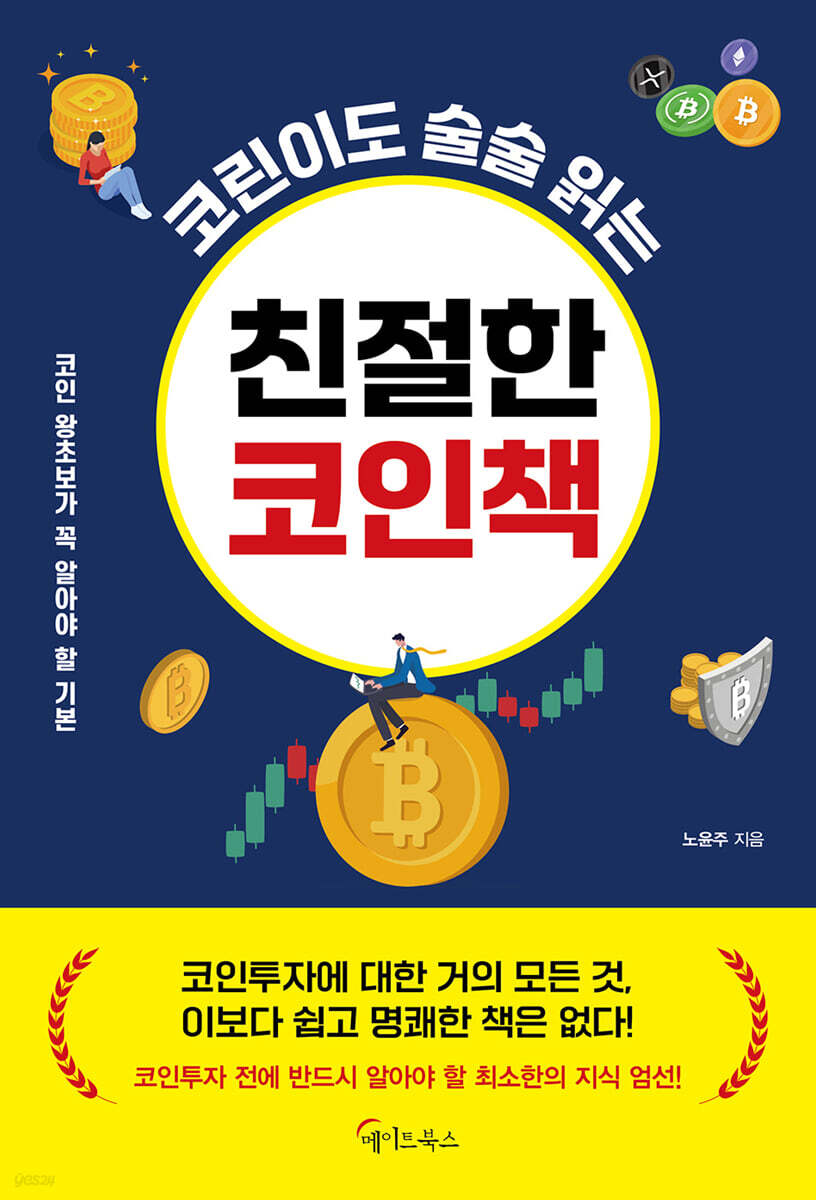
A friendly coin book that even Corin can read easily.
 |
Description
Book Introduction
Coin investment is still for those who are anxious.
A book that gives courage!
The threshold for entering the digital asset market remains high.
With countless terms, complex concepts, and constantly changing trends, novice investors often feel overwhelmed by where to start.
"Coin Book, a Friendly Book Even Corin Can Read Easily" is the book that helps relieve that feeling of helplessness.
Reporter Noh Yoon-joo, who has been working as a blockchain specialist for eight years, has been covering the field more closely than anyone else, and has completed an "introductory book on coins, explained through the reporter's own experience," from the basic structure of coins to practical investment sense.
He offers a first step to beginners in the field of coin investment with the message, “Coin investment is not complicated, it’s just that few people know how to do it properly.”
His philosophy that fundamentals are crucial in a rapidly changing market runs through the entire book as a consistent theme: "A solid foundation is the key to survival."
This book is not just a simple manual, but a practical guide that teaches you how to become "information-free" in the coin market.
It is no exaggeration to say that this is a 'beginner's guide' that provides the most friendly interpretation of the unfamiliar world of coins.
Bitcoin has now moved beyond being a speculative asset and established itself as a new investment vehicle attracting the attention of institutional finance.
With global corporations, governments, and institutional investors entering the market, coins are no longer just a "minority experiment."
It's not too late now.
However, if you are starting to invest in coins, you must understand and approach it properly.
This book will serve as a reliable compass from that starting point.
It examines the structure of exchanges and projects, investor psychology, and even the illusions created by the media from the perspective of a field reporter, functioning as a "practical coin literacy textbook" rather than a simple theoretical book.
As Upbit Investor Protection Center Director Lee Hae-boong and Coinone founder Cha Myung-hoon emphasize in their recommendations, “The biggest risk in investing is ignorance, and this book is a guide to reducing that ignorance.”
For coin beginners, this will be a first textbook that breaks down the wall of terminology, and for existing investors, it will be a basic book that will help them reorganize the market.
Coins, once difficult and unfamiliar, become familiar and accessible through this book as a real-life story.
A book that gives courage!
The threshold for entering the digital asset market remains high.
With countless terms, complex concepts, and constantly changing trends, novice investors often feel overwhelmed by where to start.
"Coin Book, a Friendly Book Even Corin Can Read Easily" is the book that helps relieve that feeling of helplessness.
Reporter Noh Yoon-joo, who has been working as a blockchain specialist for eight years, has been covering the field more closely than anyone else, and has completed an "introductory book on coins, explained through the reporter's own experience," from the basic structure of coins to practical investment sense.
He offers a first step to beginners in the field of coin investment with the message, “Coin investment is not complicated, it’s just that few people know how to do it properly.”
His philosophy that fundamentals are crucial in a rapidly changing market runs through the entire book as a consistent theme: "A solid foundation is the key to survival."
This book is not just a simple manual, but a practical guide that teaches you how to become "information-free" in the coin market.
It is no exaggeration to say that this is a 'beginner's guide' that provides the most friendly interpretation of the unfamiliar world of coins.
Bitcoin has now moved beyond being a speculative asset and established itself as a new investment vehicle attracting the attention of institutional finance.
With global corporations, governments, and institutional investors entering the market, coins are no longer just a "minority experiment."
It's not too late now.
However, if you are starting to invest in coins, you must understand and approach it properly.
This book will serve as a reliable compass from that starting point.
It examines the structure of exchanges and projects, investor psychology, and even the illusions created by the media from the perspective of a field reporter, functioning as a "practical coin literacy textbook" rather than a simple theoretical book.
As Upbit Investor Protection Center Director Lee Hae-boong and Coinone founder Cha Myung-hoon emphasize in their recommendations, “The biggest risk in investing is ignorance, and this book is a guide to reducing that ignorance.”
For coin beginners, this will be a first textbook that breaks down the wall of terminology, and for existing investors, it will be a basic book that will help them reorganize the market.
Coins, once difficult and unfamiliar, become familiar and accessible through this book as a real-life story.
- You can preview some of the book's contents.
Preview
index
Author's Note: For those who are still unsure about investing in coins
Chapter 1 | Bitcoin Basics for Corin
Is it true that 'virtual assets = Bitcoin'?
Before Bitcoin was born, who laid the foundation?
Is Bitcoin's goal "bankless finance"?
What's the connection between blockchain and Bitcoin?
I keep seeing the word decentralization.
Why is it important?
Bitcoin's value has reached 100 million won. Why does its value continue to rise?
Intermission Corner_I saw the news that the blockchain was hacked.
Chapter 2 | Altcoin Basics for Korin
What does it mean that Ethereum has ushered in a new era for virtual assets?
Intermission Corner_What are Proof of Work (PoW) and Proof of Stake (PoS)?
Why do Koreans like Ripple (XRP) so much?
Why don't 'stablecoins' change in value?
Dogecoin, Shiba Inu… What is the identity of 'memecoin'?
BNB, Solana, Avalanche… Are they the next Ethereum?
Intermission Corner_What is a subtest?
Chapter 3 | A "Must-Know" Checklist Before Trading Bitcoin
Where and how can I buy Bitcoin and trade safely?
Intermission Corner: Understanding the Exchange Registration Process Through Checkpoints
Do I need to check my primary bank account when buying Bitcoin?
Bitcoin transactions are made in decimals. What does that mean?
It's the same Bitcoin, so why are the prices different on different exchanges?
Why are there coins on Bithumb but not on Upbit?
I bought 1 million won worth of Bitcoin, but why is my balance less than 1 million won?
Should I choose a limit order or a market order?
Does the virtual asset market also have a closing price?
Can I buy foreign coins separately like US stocks?
How do coin futures and margin trading work?
Intermission Corner_What is Travel Rule?
Chapter 4 | How to Choose a Good Coin
Is the white paper of the coin market like a business report of the stock market?
Mainnet, utility… Are there different types of coins?
Coin Issuance and Circulation: Why Are They Important?
Where can I find scattered coin information?
Can the 'community' of the coin market become a driving force for coin growth?
Are there any 'zombie coins' that can be traded even after death?
How do 'coin scams' actually work in the marketplace?
Intermission Corner: Anatomy of Tokenomics
Chapter 5 | I bought Bitcoin! Now what?
What 'signals' does the trading volume in the coin market indicate?
Why is staking called the coin world's regular savings?
Who is giving me this free airdrop that suddenly appeared?
Which is more advantageous: Bitcoin long-term investment or altcoin short-term investment?
I cashed out my coins, do I need to withdraw them to my bank account?
Intermission Corner_What is HODL?
Chapter 6 | How Bitcoin Investors Can Manage Themselves
How do I use my Bitcoin 'private wallet'?
Can I withdraw Bitcoin from an exchange?
Why are there so many fees for withdrawing Bitcoin?
I sent Bitcoin, but I might never receive it?
Intermission Corner_Essential Checklist Before Sending Coins
Chapter 7 | News to Watch When Investing in Coins
They say a kimchi premium has emerged. What kind of signal is this?
Are virtual assets now considered financial products?
If I make a profit by selling virtual assets, do I have to pay taxes?
Are NFTs (Non-Fungible Tokens) also included in virtual assets?
Intermission Corner_FOMO vs FUD
Appendix: Must-Know Coin Terms
Chapter 1 | Bitcoin Basics for Corin
Is it true that 'virtual assets = Bitcoin'?
Before Bitcoin was born, who laid the foundation?
Is Bitcoin's goal "bankless finance"?
What's the connection between blockchain and Bitcoin?
I keep seeing the word decentralization.
Why is it important?
Bitcoin's value has reached 100 million won. Why does its value continue to rise?
Intermission Corner_I saw the news that the blockchain was hacked.
Chapter 2 | Altcoin Basics for Korin
What does it mean that Ethereum has ushered in a new era for virtual assets?
Intermission Corner_What are Proof of Work (PoW) and Proof of Stake (PoS)?
Why do Koreans like Ripple (XRP) so much?
Why don't 'stablecoins' change in value?
Dogecoin, Shiba Inu… What is the identity of 'memecoin'?
BNB, Solana, Avalanche… Are they the next Ethereum?
Intermission Corner_What is a subtest?
Chapter 3 | A "Must-Know" Checklist Before Trading Bitcoin
Where and how can I buy Bitcoin and trade safely?
Intermission Corner: Understanding the Exchange Registration Process Through Checkpoints
Do I need to check my primary bank account when buying Bitcoin?
Bitcoin transactions are made in decimals. What does that mean?
It's the same Bitcoin, so why are the prices different on different exchanges?
Why are there coins on Bithumb but not on Upbit?
I bought 1 million won worth of Bitcoin, but why is my balance less than 1 million won?
Should I choose a limit order or a market order?
Does the virtual asset market also have a closing price?
Can I buy foreign coins separately like US stocks?
How do coin futures and margin trading work?
Intermission Corner_What is Travel Rule?
Chapter 4 | How to Choose a Good Coin
Is the white paper of the coin market like a business report of the stock market?
Mainnet, utility… Are there different types of coins?
Coin Issuance and Circulation: Why Are They Important?
Where can I find scattered coin information?
Can the 'community' of the coin market become a driving force for coin growth?
Are there any 'zombie coins' that can be traded even after death?
How do 'coin scams' actually work in the marketplace?
Intermission Corner: Anatomy of Tokenomics
Chapter 5 | I bought Bitcoin! Now what?
What 'signals' does the trading volume in the coin market indicate?
Why is staking called the coin world's regular savings?
Who is giving me this free airdrop that suddenly appeared?
Which is more advantageous: Bitcoin long-term investment or altcoin short-term investment?
I cashed out my coins, do I need to withdraw them to my bank account?
Intermission Corner_What is HODL?
Chapter 6 | How Bitcoin Investors Can Manage Themselves
How do I use my Bitcoin 'private wallet'?
Can I withdraw Bitcoin from an exchange?
Why are there so many fees for withdrawing Bitcoin?
I sent Bitcoin, but I might never receive it?
Intermission Corner_Essential Checklist Before Sending Coins
Chapter 7 | News to Watch When Investing in Coins
They say a kimchi premium has emerged. What kind of signal is this?
Are virtual assets now considered financial products?
If I make a profit by selling virtual assets, do I have to pay taxes?
Are NFTs (Non-Fungible Tokens) also included in virtual assets?
Intermission Corner_FOMO vs FUD
Appendix: Must-Know Coin Terms
Detailed image

Into the book
The genesis block provides a clearer understanding of why Satoshi created Bitcoin.
Every Bitcoin transaction that utilizes blockchain technology can be engraved with a simple message.
Satoshi, the founder and first Bitcoin miner, said: 'The Times: UK banks face second bailout
The message included the front page headline of The Times (London Times) titled 'Chancellor on brink of second bailout for banks' (The Times 03/Jan/2009).
It was a criticism of the government and the existing financial system for bailing out banks and financial institutions during the financial crisis by injecting taxpayer money while ignoring the losses suffered by countless people.
This passage gives us a glimpse into his goal of creating a 'decentralized' financial system that could operate without banks or governments.
--- From "Chapter 1: Bitcoin Basics for Corin"
There is a saying that says, 'Don't engage in financial transactions even between family and close friends.'
Financial transactions are what can destroy the trust and confidence that has been built up over time.
But in the blockchain ecosystem, you can also lend money to complete strangers.
Accordingly, blockchain is sometimes described as a ‘trustless’ technology.
Trust is a very important axis in our financial lives.
What's the most important thing when depositing money in a bank? Trust.
I save money on the premise that the bank will keep my money safe.
The same applies when signing up for financial products.
--- From "Chapter 1: Bitcoin Basics for Corin"
If Bitcoin's purpose was 'remittance,' Ethereum opened up the great possibility of a 'broad blockchain ecosystem.'
Just as various web and app services were created under the Internet technology, blockchain has become a fundamental technology.
As briefly mentioned before, Ethereum, developed by genius developer Vitalik Buterin in 2015, is a 'programmable blockchain' that can implement various services on top of the blockchain.
What made this possible was a technology called ‘smart contract’.
In Korean, it is expressed as an 'automatic contract', and it is a blockchain program code that executes a specific action when a pre-set condition is met.
--- From "Chapter 2: Basic Altcoin Knowledge for Corin"
Some say that the process by which memecoins, which are worthless in themselves, gain value is a form of humor and a reflection of a social phenomenon.
Memecoin has proven that value is something that is created by people who believe in value.
It's been a long time since the gold standard was abolished, but people still trust and value the paper called dollar.
However, you should always be cautious when investing in memcoins.
Hundreds of new memecoins are created every day, but most are issued purely for fun.
Therefore, future value cannot be guaranteed.
--- From "Chapter 2: Basic Altcoin Knowledge for Corin"
The future isn't all rosy for Ethereum killers.
Ethereum is also continuously improving its problems through developments such as the transition to proof-of-stake.
However, if they each target niche markets by leveraging their own unique characteristics, there is a high possibility that they will coexist and grow with Ethereum.
The blockchain ecosystem is now entering a "multi-chain" era, where multiple chains each play their own role, rather than a single winner.
Just as the dollar, euro, and yen are used in their own spheres of influence in the real world, it is expected that different blockchain chains will be used for different purposes.
--- From "Chapter 2: Basic Altcoin Knowledge for Corin"
Someone contacts you via messenger saying they are personally selling Bitcoin.
They tempt you by saying that they will sell it 10 million won cheaper than the average market price, and if you transfer cash to them, they will send you the same amount of Bitcoin.
Astute investors will have already figured it out here.
Most of these approaches are scams.
In fact, it is said that the number of cases where people impersonate celebrities and approach people through messengers under the pretext of providing personal coin investment consulting is continuously increasing.
To protect our precious money, we must trade coins at a safe exchange.
--- From "Chapter 3: A 'Must-Know' Checklist Before Bitcoin Trading"
Some exchanges charge lower fees for maker orders.
This is because maker orders provide liquidity to the market and activate trading.
Investors can trade freely only when orders of various price ranges are piled up in the order book, which is directly related to the competitiveness of the exchange.
Therefore, exchanges encourage maker orders by offering fee discounts.
However, even if a limit order is placed, if there is a price that can be executed immediately, it is not considered a maker order.
It is also important to note that ‘specified price = maker’ is not always the case.
--- From "Chapter 3: A 'Must-Know' Checklist Before Bitcoin Trading"
White papers also serve as a criterion for judging the reliability of a project.
Of course, not all projects will 100% implement the plans in the white paper.
We always set goals to achieve grand plans in a short period of time, but when we actually try to do them, it takes more time and things don't always go smoothly.
There are also cases where market conditions deteriorate rapidly during the development phase, leading to deliberate delays in achieving milestones.
It's a strategy to reveal it with a 'ta-da' when the market is good.
--- From "Chapter 4: How to Choose a Good Coin"
We can get a hint from the explanation of why Bitcoin is called digital gold.
What supports Bitcoin's value is its 'scarcity'.
Bitcoin's total supply is fixed at 21 million, and cannot be increased any further.
It's as if the gold reserves on Earth are limited.
As such, the issuance volume is a very important investment indicator in the virtual asset market.
No matter how good a project's technology and vision are, if the issuance amount is unlimited or unclear, you should be cautious about investing.
Each virtual asset specifies its issuance plan in a white paper prior to issuance.
--- From "Chapter 4: How to Choose a Good Coin"
If you are considering staking, here are some things to check:
You should carefully check the annual compensation rate, lockup period, and minimum deposit amount.
If a compensation rate is offered that is too high, you should be suspicious.
If the compensation rate exceeds 20% per year, sustainability may decrease.
Staking is a new option for investing in virtual assets.
It is suitable for investors who seek steady returns from a long-term perspective, rather than those seeking short-term price fluctuations.
However, we must not forget that we are not free from the risk of fluctuations in coin prices.
--- From "I bought 5 Bitcoins! What should I do now?"
You might think, "Free money? Isn't that too good to be true?" but the truth is, airdrops aren't always welcome gifts.
This is because there are many cases where worthless ‘spam tokens’ are indiscriminately distributed.
Although the Bithumb token has been listed on an exchange and has gained value, the majority of virtual assets being airdropped are not listed on exchanges, making it impossible to determine their value.
It goes without saying that you can't buy or sell them, but it actually makes your list of assets messy and causes frustration.
--- From "I bought 5 Bitcoins! What should I do now?"
Many experts do not recommend using a personal wallet from the beginning for beginners in coin investing.
Managing private keys and mnemonic phrases may seem simple, but they are easier to forget than you might think.
This is especially true for investors who often find themselves clicking on the Forgot Password button on websites because they can't remember their passwords.
First, we recommend that you store your assets while gaining trading experience on an exchange. Then, when you gain a better understanding of the market and want to use decentralized exchanges or decentralized finance (DeFi), we recommend that you consider using a personal wallet.
--- From "Chapter 6: How Investors Can Manage Bitcoin on Their Own"
Blockchain has no central controlling authority.
This is because of the decentralized nature that has been mentioned over and over again.
This allows you to freely send money to anyone, but conversely, this means that there is no one or institution to help you if you make a mistake.
Coins sent to the wrong wallet address will drift on the network forever and disappear.
The most common mistake investors make is address generation.
This is a mistake that can occur when receiving coins from someone or moving coins from my personal wallet to an exchange wallet.
This is because I only have one exchange ID, but I need to create multiple wallet addresses depending on the type of coin.
--- From "Chapter 6: How Investors Manage Bitcoin on Their Own"
You shouldn't make an investment decision just by looking at the kimchi premium.
It should only be used as a supplementary indicator.
When investing in virtual assets, it's important to comprehensively consider global market conditions, domestic regulatory environments, and investor sentiment.
In particular, it is advisable to closely monitor regulatory announcements from governments at home and abroad.
The kimchi premium can suddenly disappear due to regulations.
During the Bitcoin boom in late 2017, the kimchi premium soared to 50%, making the domestic Bitcoin price more than 20 million won higher than overseas.
However, as administrative regulations continued, such as the Ministry of Justice's declaration to close virtual asset exchanges and the introduction of real-name accounts for large virtual asset exchanges, the kimchi premium was reduced to the 5% range, resulting in losses for many investors.
--- From "News to Watch Out for When Investing in Chapter 7 Coins"
Investing in NFTs requires more caution than investing in general virtual assets.
Because it is difficult to value and trading is limited.
In particular, NFTs that promise profits or guarantee resale are usually red flags.
Instead, it is important to look at the intrinsic value of NFTs.
Rather than simply expecting to sell for a high price, we should consider the actual benefits or meaning that the NFT provides.
It's wise to choose NFTs that feature your favorite artist's work or have practical membership benefits.
Every Bitcoin transaction that utilizes blockchain technology can be engraved with a simple message.
Satoshi, the founder and first Bitcoin miner, said: 'The Times: UK banks face second bailout
The message included the front page headline of The Times (London Times) titled 'Chancellor on brink of second bailout for banks' (The Times 03/Jan/2009).
It was a criticism of the government and the existing financial system for bailing out banks and financial institutions during the financial crisis by injecting taxpayer money while ignoring the losses suffered by countless people.
This passage gives us a glimpse into his goal of creating a 'decentralized' financial system that could operate without banks or governments.
--- From "Chapter 1: Bitcoin Basics for Corin"
There is a saying that says, 'Don't engage in financial transactions even between family and close friends.'
Financial transactions are what can destroy the trust and confidence that has been built up over time.
But in the blockchain ecosystem, you can also lend money to complete strangers.
Accordingly, blockchain is sometimes described as a ‘trustless’ technology.
Trust is a very important axis in our financial lives.
What's the most important thing when depositing money in a bank? Trust.
I save money on the premise that the bank will keep my money safe.
The same applies when signing up for financial products.
--- From "Chapter 1: Bitcoin Basics for Corin"
If Bitcoin's purpose was 'remittance,' Ethereum opened up the great possibility of a 'broad blockchain ecosystem.'
Just as various web and app services were created under the Internet technology, blockchain has become a fundamental technology.
As briefly mentioned before, Ethereum, developed by genius developer Vitalik Buterin in 2015, is a 'programmable blockchain' that can implement various services on top of the blockchain.
What made this possible was a technology called ‘smart contract’.
In Korean, it is expressed as an 'automatic contract', and it is a blockchain program code that executes a specific action when a pre-set condition is met.
--- From "Chapter 2: Basic Altcoin Knowledge for Corin"
Some say that the process by which memecoins, which are worthless in themselves, gain value is a form of humor and a reflection of a social phenomenon.
Memecoin has proven that value is something that is created by people who believe in value.
It's been a long time since the gold standard was abolished, but people still trust and value the paper called dollar.
However, you should always be cautious when investing in memcoins.
Hundreds of new memecoins are created every day, but most are issued purely for fun.
Therefore, future value cannot be guaranteed.
--- From "Chapter 2: Basic Altcoin Knowledge for Corin"
The future isn't all rosy for Ethereum killers.
Ethereum is also continuously improving its problems through developments such as the transition to proof-of-stake.
However, if they each target niche markets by leveraging their own unique characteristics, there is a high possibility that they will coexist and grow with Ethereum.
The blockchain ecosystem is now entering a "multi-chain" era, where multiple chains each play their own role, rather than a single winner.
Just as the dollar, euro, and yen are used in their own spheres of influence in the real world, it is expected that different blockchain chains will be used for different purposes.
--- From "Chapter 2: Basic Altcoin Knowledge for Corin"
Someone contacts you via messenger saying they are personally selling Bitcoin.
They tempt you by saying that they will sell it 10 million won cheaper than the average market price, and if you transfer cash to them, they will send you the same amount of Bitcoin.
Astute investors will have already figured it out here.
Most of these approaches are scams.
In fact, it is said that the number of cases where people impersonate celebrities and approach people through messengers under the pretext of providing personal coin investment consulting is continuously increasing.
To protect our precious money, we must trade coins at a safe exchange.
--- From "Chapter 3: A 'Must-Know' Checklist Before Bitcoin Trading"
Some exchanges charge lower fees for maker orders.
This is because maker orders provide liquidity to the market and activate trading.
Investors can trade freely only when orders of various price ranges are piled up in the order book, which is directly related to the competitiveness of the exchange.
Therefore, exchanges encourage maker orders by offering fee discounts.
However, even if a limit order is placed, if there is a price that can be executed immediately, it is not considered a maker order.
It is also important to note that ‘specified price = maker’ is not always the case.
--- From "Chapter 3: A 'Must-Know' Checklist Before Bitcoin Trading"
White papers also serve as a criterion for judging the reliability of a project.
Of course, not all projects will 100% implement the plans in the white paper.
We always set goals to achieve grand plans in a short period of time, but when we actually try to do them, it takes more time and things don't always go smoothly.
There are also cases where market conditions deteriorate rapidly during the development phase, leading to deliberate delays in achieving milestones.
It's a strategy to reveal it with a 'ta-da' when the market is good.
--- From "Chapter 4: How to Choose a Good Coin"
We can get a hint from the explanation of why Bitcoin is called digital gold.
What supports Bitcoin's value is its 'scarcity'.
Bitcoin's total supply is fixed at 21 million, and cannot be increased any further.
It's as if the gold reserves on Earth are limited.
As such, the issuance volume is a very important investment indicator in the virtual asset market.
No matter how good a project's technology and vision are, if the issuance amount is unlimited or unclear, you should be cautious about investing.
Each virtual asset specifies its issuance plan in a white paper prior to issuance.
--- From "Chapter 4: How to Choose a Good Coin"
If you are considering staking, here are some things to check:
You should carefully check the annual compensation rate, lockup period, and minimum deposit amount.
If a compensation rate is offered that is too high, you should be suspicious.
If the compensation rate exceeds 20% per year, sustainability may decrease.
Staking is a new option for investing in virtual assets.
It is suitable for investors who seek steady returns from a long-term perspective, rather than those seeking short-term price fluctuations.
However, we must not forget that we are not free from the risk of fluctuations in coin prices.
--- From "I bought 5 Bitcoins! What should I do now?"
You might think, "Free money? Isn't that too good to be true?" but the truth is, airdrops aren't always welcome gifts.
This is because there are many cases where worthless ‘spam tokens’ are indiscriminately distributed.
Although the Bithumb token has been listed on an exchange and has gained value, the majority of virtual assets being airdropped are not listed on exchanges, making it impossible to determine their value.
It goes without saying that you can't buy or sell them, but it actually makes your list of assets messy and causes frustration.
--- From "I bought 5 Bitcoins! What should I do now?"
Many experts do not recommend using a personal wallet from the beginning for beginners in coin investing.
Managing private keys and mnemonic phrases may seem simple, but they are easier to forget than you might think.
This is especially true for investors who often find themselves clicking on the Forgot Password button on websites because they can't remember their passwords.
First, we recommend that you store your assets while gaining trading experience on an exchange. Then, when you gain a better understanding of the market and want to use decentralized exchanges or decentralized finance (DeFi), we recommend that you consider using a personal wallet.
--- From "Chapter 6: How Investors Can Manage Bitcoin on Their Own"
Blockchain has no central controlling authority.
This is because of the decentralized nature that has been mentioned over and over again.
This allows you to freely send money to anyone, but conversely, this means that there is no one or institution to help you if you make a mistake.
Coins sent to the wrong wallet address will drift on the network forever and disappear.
The most common mistake investors make is address generation.
This is a mistake that can occur when receiving coins from someone or moving coins from my personal wallet to an exchange wallet.
This is because I only have one exchange ID, but I need to create multiple wallet addresses depending on the type of coin.
--- From "Chapter 6: How Investors Manage Bitcoin on Their Own"
You shouldn't make an investment decision just by looking at the kimchi premium.
It should only be used as a supplementary indicator.
When investing in virtual assets, it's important to comprehensively consider global market conditions, domestic regulatory environments, and investor sentiment.
In particular, it is advisable to closely monitor regulatory announcements from governments at home and abroad.
The kimchi premium can suddenly disappear due to regulations.
During the Bitcoin boom in late 2017, the kimchi premium soared to 50%, making the domestic Bitcoin price more than 20 million won higher than overseas.
However, as administrative regulations continued, such as the Ministry of Justice's declaration to close virtual asset exchanges and the introduction of real-name accounts for large virtual asset exchanges, the kimchi premium was reduced to the 5% range, resulting in losses for many investors.
--- From "News to Watch Out for When Investing in Chapter 7 Coins"
Investing in NFTs requires more caution than investing in general virtual assets.
Because it is difficult to value and trading is limited.
In particular, NFTs that promise profits or guarantee resale are usually red flags.
Instead, it is important to look at the intrinsic value of NFTs.
Rather than simply expecting to sell for a high price, we should consider the actual benefits or meaning that the NFT provides.
It's wise to choose NFTs that feature your favorite artist's work or have practical membership benefits.
--- From "News to Watch Out for When Investing in Chapter 7 Coins"
Publisher's Review
The first thing Corin should read
Coin investment guide!
This book consists of seven chapters and an appendix, and is organized in the order of 'Basics → Practice → Application' to help beginners naturally enter the world of coins.
Each chapter is organically connected, so even first-time readers can naturally understand the overall picture of the coin market by the time they finish the book.
Chapter 1, "Bitcoin Basics for Corin," easily explains how blockchain and Bitcoin work.
From the evolution of currency to the value of Bitcoin, dubbed "digital gold," you'll learn the basics you need to know before the news.
Chapter 2, "Altcoin Basics for Korin," introduces the characteristics and use cases of major altcoins, such as Ethereum, Ripple, and Solana.
Rather than simply comparing 'coins other than Bitcoin,' it shows the diversity of the coin industry by comparing and explaining how their technologies and structures differ.
Chapter 3, "A 'Must-Know' Checklist Before Trading Bitcoin," contains essential information to review before engaging in actual trading.
It is organized step-by-step, including exchange registration, deposits and withdrawals, fees, wallet management, and even the 'minimum security rules to protect my assets.'
It provides practical help by presenting examples of mistakes that beginner investors actually make.
In Chapter 4, "How to Choose a Good Coin," you'll learn how to analyze a coin's intrinsic value, focusing on the project's white paper and tokenomics.
It explains how to read key data such as issuance, lock-up, and distribution structure, and reveals the author's consistent philosophy that "there is no harm in reading a white paper."
Chapter 5, "I Bought Bitcoin! What Now?" covers practical strategies for post-purchase trading.
We will cover key points that beginners often overlook, such as an investment attitude that is unshakable by volatility, the principle of split buying and split selling, and a long-term holding strategy.
In particular, the message that 'invest with strategy, not emotion' is central.
Chapter 6, "How to Manage Your Bitcoin Yourself," explains how to manage your own wallet and keys (private keys) without relying solely on exchanges.
It emphasizes the importance of security and also provides detailed explanations of practical usage methods, such as hardware wallets.
Chapter 7, "News to Watch When Investing in Coins," teaches you how to interpret market trends. It provides context for information often overlooked in the news, such as ETF approvals, global regulations, institutional changes in each country, and the movements of major exchanges.
We help you grow from being a simple news consumer to becoming an “investor who reads news.”
The appendix, "Must-Know This! 32 Key Coin Terms," is a dictionary that summarizes key concepts such as Bitcoin, altcoins, blockchain, and DeFi at a glance.
With just this one book, Corin will gain the power to understand the language of the market and make her own decisions.
This book is more than just a simple introductory guide; it's a "map" that helps novice investors navigate uncertain markets.
Coin investment guide!
This book consists of seven chapters and an appendix, and is organized in the order of 'Basics → Practice → Application' to help beginners naturally enter the world of coins.
Each chapter is organically connected, so even first-time readers can naturally understand the overall picture of the coin market by the time they finish the book.
Chapter 1, "Bitcoin Basics for Corin," easily explains how blockchain and Bitcoin work.
From the evolution of currency to the value of Bitcoin, dubbed "digital gold," you'll learn the basics you need to know before the news.
Chapter 2, "Altcoin Basics for Korin," introduces the characteristics and use cases of major altcoins, such as Ethereum, Ripple, and Solana.
Rather than simply comparing 'coins other than Bitcoin,' it shows the diversity of the coin industry by comparing and explaining how their technologies and structures differ.
Chapter 3, "A 'Must-Know' Checklist Before Trading Bitcoin," contains essential information to review before engaging in actual trading.
It is organized step-by-step, including exchange registration, deposits and withdrawals, fees, wallet management, and even the 'minimum security rules to protect my assets.'
It provides practical help by presenting examples of mistakes that beginner investors actually make.
In Chapter 4, "How to Choose a Good Coin," you'll learn how to analyze a coin's intrinsic value, focusing on the project's white paper and tokenomics.
It explains how to read key data such as issuance, lock-up, and distribution structure, and reveals the author's consistent philosophy that "there is no harm in reading a white paper."
Chapter 5, "I Bought Bitcoin! What Now?" covers practical strategies for post-purchase trading.
We will cover key points that beginners often overlook, such as an investment attitude that is unshakable by volatility, the principle of split buying and split selling, and a long-term holding strategy.
In particular, the message that 'invest with strategy, not emotion' is central.
Chapter 6, "How to Manage Your Bitcoin Yourself," explains how to manage your own wallet and keys (private keys) without relying solely on exchanges.
It emphasizes the importance of security and also provides detailed explanations of practical usage methods, such as hardware wallets.
Chapter 7, "News to Watch When Investing in Coins," teaches you how to interpret market trends. It provides context for information often overlooked in the news, such as ETF approvals, global regulations, institutional changes in each country, and the movements of major exchanges.
We help you grow from being a simple news consumer to becoming an “investor who reads news.”
The appendix, "Must-Know This! 32 Key Coin Terms," is a dictionary that summarizes key concepts such as Bitcoin, altcoins, blockchain, and DeFi at a glance.
With just this one book, Corin will gain the power to understand the language of the market and make her own decisions.
This book is more than just a simple introductory guide; it's a "map" that helps novice investors navigate uncertain markets.
GOODS SPECIFICS
- Date of issue: October 25, 2025
- Page count, weight, size: 268 pages | 416g | 153*225*17mm
- ISBN13: 9791160029697
- ISBN10: 1160029695
You may also like
카테고리
korean


korean

![ELLE 엘르 스페셜 에디션 A형 : 12월 [2025]](http://librairie.coreenne.fr/cdn/shop/files/b8e27a3de6c9538896439686c6b0e8fb.jpg?v=1766436872&width=3840)


