

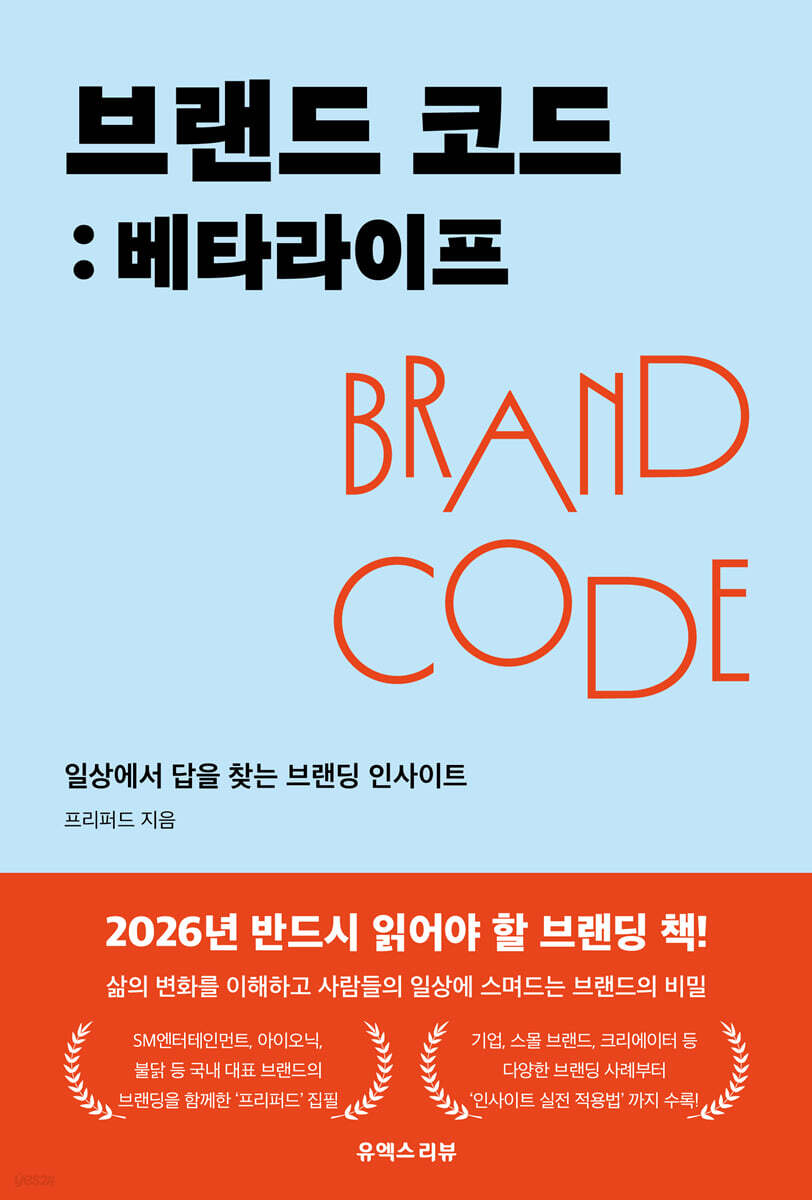
Brand Code: Beta Life
 |
Description
Book Introduction
★★ Branding Trends for 2026! ★★
Find opportunities beyond trends and in everyday contexts!
Curated branding insights for planners, marketers, entrepreneurs, and creators.
In 2026, a must-read branding insight book for anyone looking to grow their brand has been published.
"Brand Code: Beta Life" is a book that compiles branding insights based on the experience accumulated by "Preferred," a branding strategy boutique that collaborates with leading domestic brands.
Many brands try to find "trends," but to become a beloved brand, you need to read the context of change beyond trends.
The author explains the context of the new change with the keyword 'Beta Life'.
'Beta Life' is a new era of lifestyle that enjoys the uncertain process rather than the perfect result, views life itself as a process of growth, and lives with an experimental attitude.
This book contains not only various branding cases such as FabCafe, a making space that allows you to enjoy the process rather than the result; Habitica, which makes the process of habit formation into a fun game; Toggle Track, which helps you to meticulously data-ify your daily life; Verci, which designs chance encounters; and Montana, which helps you freely change space depending on your perspective, but also the strategies that brands should have and practical application methods of insights.
Ultimately, the brands that penetrate the public's heart and are loved are those that understand people's minds well and build genuine relationships.
By referring to "Brand Code: Beta Life," you will be able to understand people's lifestyles and grow into a brand that is essential to their lives.
Find opportunities beyond trends and in everyday contexts!
Curated branding insights for planners, marketers, entrepreneurs, and creators.
In 2026, a must-read branding insight book for anyone looking to grow their brand has been published.
"Brand Code: Beta Life" is a book that compiles branding insights based on the experience accumulated by "Preferred," a branding strategy boutique that collaborates with leading domestic brands.
Many brands try to find "trends," but to become a beloved brand, you need to read the context of change beyond trends.
The author explains the context of the new change with the keyword 'Beta Life'.
'Beta Life' is a new era of lifestyle that enjoys the uncertain process rather than the perfect result, views life itself as a process of growth, and lives with an experimental attitude.
This book contains not only various branding cases such as FabCafe, a making space that allows you to enjoy the process rather than the result; Habitica, which makes the process of habit formation into a fun game; Toggle Track, which helps you to meticulously data-ify your daily life; Verci, which designs chance encounters; and Montana, which helps you freely change space depending on your perspective, but also the strategies that brands should have and practical application methods of insights.
Ultimately, the brands that penetrate the public's heart and are loved are those that understand people's minds well and build genuine relationships.
By referring to "Brand Code: Beta Life," you will be able to understand people's lifestyles and grow into a brand that is essential to their lives.
- You can preview some of the book's contents.
Preview
index
Entering
How to Read Beyond Trends
Beyond Response to Insight: The Power of Context
- Beta Life
First Code: The Utility of Traces
- The power of records and processes
- A brand that accompanies you through the process of achievement
Feb Cafe│iPhone Diary App│Vireal│Habitica│Matt D'Abella│Craig Mode
Second Code: Data Ritual
- Optimizing daily life with data
- A brand that helps data rituals by solving problems
Stride│Hoop│Park Run│Quantified Self Meetup│Toggle Track
Third Code: Instant Networking
- The relationship I need right now
- A brand that fosters meaningful connections
Versi and Localstitch│Body│20VC│Slowly│AI Companion Service
Fourth Code: The Aesthetics of Immaturity
- Self-expression through failure
- A brand that turns immaturity into specialness
"I've Been Single Since Birth, But I Want to Date" | Bloody Pottery | Brussels' City Branding | Puck Up Night and Puck My Life | The 'Messy Girl' and 'Normal Home' Trends
Fifth Code: The Country is a Space
- A space that transcends taste and becomes your identity
- A brand that provides space
Europe's Digital Nomad System│〈Moving Alone〉│Montana│The Evolving Third Space│Wes Anderson and Ramona Jones Coincidentally
What kind of brand should we be in the beta life era?
- How to survive in a changing world
Beta Life, the brand's three strategies
How to Apply BetaLife Insights in Practice
References and Reference Websites
How to Read Beyond Trends
Beyond Response to Insight: The Power of Context
- Beta Life
First Code: The Utility of Traces
- The power of records and processes
- A brand that accompanies you through the process of achievement
Feb Cafe│iPhone Diary App│Vireal│Habitica│Matt D'Abella│Craig Mode
Second Code: Data Ritual
- Optimizing daily life with data
- A brand that helps data rituals by solving problems
Stride│Hoop│Park Run│Quantified Self Meetup│Toggle Track
Third Code: Instant Networking
- The relationship I need right now
- A brand that fosters meaningful connections
Versi and Localstitch│Body│20VC│Slowly│AI Companion Service
Fourth Code: The Aesthetics of Immaturity
- Self-expression through failure
- A brand that turns immaturity into specialness
"I've Been Single Since Birth, But I Want to Date" | Bloody Pottery | Brussels' City Branding | Puck Up Night and Puck My Life | The 'Messy Girl' and 'Normal Home' Trends
Fifth Code: The Country is a Space
- A space that transcends taste and becomes your identity
- A brand that provides space
Europe's Digital Nomad System│〈Moving Alone〉│Montana│The Evolving Third Space│Wes Anderson and Ramona Jones Coincidentally
What kind of brand should we be in the beta life era?
- How to survive in a changing world
Beta Life, the brand's three strategies
How to Apply BetaLife Insights in Practice
References and Reference Websites
Detailed image

Into the book
Although the forms and reasons may be different, in the end, what everyone wants is the same.
It's about becoming a truly loved brand.
So what separates strong brands from weak ones? Innovative technology? Creative marketing? Sufficient capital? Of course, it matters.
But there is a more fundamental difference.
The question is whether you understand people properly.
We need to understand how people actually live, what they are worried about, what brings them joy and what makes them uncomfortable.
And above all, the key is to be able to build a genuine relationship with them.
--- p.5, from “Introduction”
AI allows anyone to try and implement new things, even without knowledge or experience.
Of course, it is also true that AI has led to a decrease in jobs and increased competition.
But at the same time, the possibility of being self-sufficient in one's own way without being tied to a job has increased.
It feels like being thrown into a barren wilderness, but you learn how to live more freely and creatively within it.
These changes encourage people to experiment more actively.
The path that seemed like the right answer has long since disappeared.
It became possible to start small, see how it worked, and if it worked, grow it, and if it didn't, try something else.
--- p.22, from “How to Read Trends and Beyond”
Whereas in the past success was only achieved when a big goal was achieved, these people find value in the small, everyday efforts and the traces left behind in between.
The 'utility of traces' refers to a new lifestyle pattern that gains self-efficacy from the accumulated effort and growth over a steady process, rather than from grand results.
What matters to them is not 'what they achieved', but 'how consistently they tried' and 'what they learned in the process'.
The evidence of achievement is the new things we learn every day, the experiences of trial and error, the small realizations, the signs of growth like the slightly improved sensation in our fingertips than yesterday.
--- p.27-28, from “The First Code: The Utility of Traces”
Ultimately, Habitica's success lies in its ability to transform everyday success and failure into a new framework called gaming.
By providing immediate rewards in the form of experience points for small successes and recoverable feedback in the form of HP loss rather than game over for failures, users are empowered to try again without guilt.
Positive habits like exercising and reading books are recorded as 'traces of growth' that help develop the character, while negative habits like smoking are recorded as 'traces of challenges' that must be overcome.
It is a beta-life tool that helps you acknowledge and enjoy the sincere process itself, and changes the idea that "it has to be perfect to be meaningful" to "if you try consistently, it already has meaning."
--- p.43, from “The First Code: The Utility of Traces”
Seventeen years later, the Quantified Self philosophy and this simple presentation format still hold true.
In a room in each city equipped with a projector, people learn to read the rhythm of their own lives with a few graphs and heartfelt questions, and prepare for a slightly different experiment the following month.
Data rituals ultimately grow from the question, "Who am I? What drives me? How can I live better?"
Quantified Self Meetup is a small classroom where you can solve that question with numbers and words at the same time.
And the textbook for that class is always my day.
--- p.75-76, from “The Second Code: Data Ritual”
This change in relationship building, which is a step away from the networking style of the older generation, has been named 'instant networking.'
Instant networking is a way of connecting that involves meeting casually on the spot, according to need and situation, and then letting go neatly when the purpose is complete.
What matters to them is not 'how long have you known each other' but 'what can you give and receive now'.
Current interests, goals, and values are stronger ties than past ties like the same elementary school or the same region.
It may feel cold or selfish, but it actually creates more effective and healthier relationships.
Because we can help each other out when we need it, but we can live comfortably without excessive expectations or obligations.
We have deep conversations with people we meet online for the first time, and we share our hearts even in one-time meetings.
The background is Beta Life's unique experimental attitude.
--- p.86, from “The Third Code: Instant Networking”
The five examples above also demonstrate that the aesthetics of immaturity is not simply a change in personal attitude, but rather a paradigm shift across society.
The awkwardness of dating reality shows, the intentional imperfection of ceramics, the acceptance of contradictions in city branding, the public celebration of failure stories, and the confident display of unorganized daily life.
All of these examples seek true connection through vulnerability.
While perfection used to be the basis of trust and respect, now being honest about imperfections is becoming the foundation of deeper trust and empathy.
--- p.148, from “The Fourth Code: The Aesthetics of Immaturity”
There's a reason Montana's system is perfect for those living the beta life.
If you need a creative workspace today, you can add more shelving and brighter lighting. If you need a focus area for a learner tomorrow, you can add partitions and rearrange the space around bookshelves.
If you want to invite friends and use it as a communication space, you can change it to another combination.
Even in an 8-pyeong studio apartment, one Montana system can solve the problem of bedroom, living room, study, and storage space.
Another great attraction is that you can start from an unfinished state and expand the space by adding pieces one by one.
--- p.169, from “The Fifth Code: The Space of the Country”
Many brands want to be in the spotlight themselves.
The brand itself wants to create the perception that it is cool and trendy.
But the real winners in the Beta Life era are the brands that brighten their customers' lives and act as "invisible helpers."
To be a platform or tool that helps customers experiment better, manage more efficiently, and connect more meaningfully with their lives.
It's about becoming a truly loved brand.
So what separates strong brands from weak ones? Innovative technology? Creative marketing? Sufficient capital? Of course, it matters.
But there is a more fundamental difference.
The question is whether you understand people properly.
We need to understand how people actually live, what they are worried about, what brings them joy and what makes them uncomfortable.
And above all, the key is to be able to build a genuine relationship with them.
--- p.5, from “Introduction”
AI allows anyone to try and implement new things, even without knowledge or experience.
Of course, it is also true that AI has led to a decrease in jobs and increased competition.
But at the same time, the possibility of being self-sufficient in one's own way without being tied to a job has increased.
It feels like being thrown into a barren wilderness, but you learn how to live more freely and creatively within it.
These changes encourage people to experiment more actively.
The path that seemed like the right answer has long since disappeared.
It became possible to start small, see how it worked, and if it worked, grow it, and if it didn't, try something else.
--- p.22, from “How to Read Trends and Beyond”
Whereas in the past success was only achieved when a big goal was achieved, these people find value in the small, everyday efforts and the traces left behind in between.
The 'utility of traces' refers to a new lifestyle pattern that gains self-efficacy from the accumulated effort and growth over a steady process, rather than from grand results.
What matters to them is not 'what they achieved', but 'how consistently they tried' and 'what they learned in the process'.
The evidence of achievement is the new things we learn every day, the experiences of trial and error, the small realizations, the signs of growth like the slightly improved sensation in our fingertips than yesterday.
--- p.27-28, from “The First Code: The Utility of Traces”
Ultimately, Habitica's success lies in its ability to transform everyday success and failure into a new framework called gaming.
By providing immediate rewards in the form of experience points for small successes and recoverable feedback in the form of HP loss rather than game over for failures, users are empowered to try again without guilt.
Positive habits like exercising and reading books are recorded as 'traces of growth' that help develop the character, while negative habits like smoking are recorded as 'traces of challenges' that must be overcome.
It is a beta-life tool that helps you acknowledge and enjoy the sincere process itself, and changes the idea that "it has to be perfect to be meaningful" to "if you try consistently, it already has meaning."
--- p.43, from “The First Code: The Utility of Traces”
Seventeen years later, the Quantified Self philosophy and this simple presentation format still hold true.
In a room in each city equipped with a projector, people learn to read the rhythm of their own lives with a few graphs and heartfelt questions, and prepare for a slightly different experiment the following month.
Data rituals ultimately grow from the question, "Who am I? What drives me? How can I live better?"
Quantified Self Meetup is a small classroom where you can solve that question with numbers and words at the same time.
And the textbook for that class is always my day.
--- p.75-76, from “The Second Code: Data Ritual”
This change in relationship building, which is a step away from the networking style of the older generation, has been named 'instant networking.'
Instant networking is a way of connecting that involves meeting casually on the spot, according to need and situation, and then letting go neatly when the purpose is complete.
What matters to them is not 'how long have you known each other' but 'what can you give and receive now'.
Current interests, goals, and values are stronger ties than past ties like the same elementary school or the same region.
It may feel cold or selfish, but it actually creates more effective and healthier relationships.
Because we can help each other out when we need it, but we can live comfortably without excessive expectations or obligations.
We have deep conversations with people we meet online for the first time, and we share our hearts even in one-time meetings.
The background is Beta Life's unique experimental attitude.
--- p.86, from “The Third Code: Instant Networking”
The five examples above also demonstrate that the aesthetics of immaturity is not simply a change in personal attitude, but rather a paradigm shift across society.
The awkwardness of dating reality shows, the intentional imperfection of ceramics, the acceptance of contradictions in city branding, the public celebration of failure stories, and the confident display of unorganized daily life.
All of these examples seek true connection through vulnerability.
While perfection used to be the basis of trust and respect, now being honest about imperfections is becoming the foundation of deeper trust and empathy.
--- p.148, from “The Fourth Code: The Aesthetics of Immaturity”
There's a reason Montana's system is perfect for those living the beta life.
If you need a creative workspace today, you can add more shelving and brighter lighting. If you need a focus area for a learner tomorrow, you can add partitions and rearrange the space around bookshelves.
If you want to invite friends and use it as a communication space, you can change it to another combination.
Even in an 8-pyeong studio apartment, one Montana system can solve the problem of bedroom, living room, study, and storage space.
Another great attraction is that you can start from an unfinished state and expand the space by adding pieces one by one.
--- p.169, from “The Fifth Code: The Space of the Country”
Many brands want to be in the spotlight themselves.
The brand itself wants to create the perception that it is cool and trendy.
But the real winners in the Beta Life era are the brands that brighten their customers' lives and act as "invisible helpers."
To be a platform or tool that helps customers experiment better, manage more efficiently, and connect more meaningfully with their lives.
--- p.195, from “What kind of brand should we become in the era of Beta Life?”
Publisher's Review
★★ Consulting for major domestic brands such as SM Entertainment, Ionic, and Buldak ★★
★★ Includes various brand cases including corporations, small brands, and creators ★★
The “real” stories of people your brand needs to know!
How to become a brand that understands new lifestyles and moves people's hearts
What's the secret behind beloved brands that transform people's daily lives, regardless of size? Many trend books focus on "what's hot this year."
But behind the fleeting trends, there are hidden changes in everyday life.
《Brand Code: Beta Life》 explores the question, "Why does it mean something to people today?" rather than focusing on fragmented trends.
The 'Beta-Life' presented in this book is a new change in daily life that values experimentation over perfection and process over completion.
People living in the beta life era embrace immaturity, leave traces in records, manage their days with data, enjoy light connections, and make any place their own space.
We are not afraid of small experiments, we repeat rapid trials and improvements, and we flexibly adjust direction according to the situation.
《Brand Code: Beta Life》 defines the flow of this era with five codes: 'Utility of Traces,' 'Data Ritual,' 'Instant Networking,' 'Aesthetics of Immaturity,' and 'Space as a Country,' and analyzes various cases of beloved brands that reflect the characteristics of each keyword.
We also provide personalized advice for your brand.
Even in the rapidly changing market, what remains constant is the human heart.
Nowadays, brands that are imperfect but still human are loved more than perfect brands, and brands that ask questions rather than providing answers are loved.
Knowing the real stories of the people in this book will help you build your brand into one that's loved, a positive influence, and a force for change in everyday life.
'Feb Cafe', 'Bercy', 'Montana', etc.
The secrets of powerful brands learned from domestic and international examples!
In the era of beta life, strategies for becoming a beloved brand
Position-specific guides to help you apply insights to practice
《Brand Code: Beta Life》 analyzes various cases such as FabCafe, Verci, Slowly, Montana, and coincidentally Wes Anderson, and shows in detail how global and Korean brands reflect the changing times and how their strategies can be applied in practice.
For example, Peb Cafe is a brand that makes good use of the "usefulness of traces," a characteristic of the Beta Life era that values steady growth over grand results.
Unlike typical makerspaces that focus on providing tools and technology, FabCafé designs the creative process itself, with its inherent uncertainty, as a brand experience.
The concept of a comfortable café lowers the barrier to entry and provides an experience of growth and discovery through a consistent process such as writing a 'making diary' together.
'Bush' is a co-working space brand that understands 'instant networking', a new way of connecting where people meet and part ways when needed, beyond traditional relationship-building methods, and provides an experience that fits that.
The building's structure, intentionally designed to encourage chance encounters, encourages conversations between people taking a break from work or stopping for coffee.
By leveraging this structure and regularly scheduled sessions, you can create opportunities to connect with a variety of people immediately, without the need for separate appointments or introductions.
Looking at these cases, we can see the strategies that brands in the beta life era should adopt.
It's about soothing anxiety and building a sense of efficacy, empowering clients to complete their narratives, and being the best facilitator, not the center.
In addition to simply analyzing and explaining brand cases, we summarize the insights that can be gained from these brands at the end of each chapter.
The appendix provides a practical guide to putting the book's insights into practice, including three-step practical application methods for each position, including brand marketers, corporate executives, entrepreneurs, and individual influencers.
Ultimately, the secret to a powerful brand loved in the beta life era is to allow customers to experience a fulfilling process rather than a perfect result, and to show that the brand also accepts failure and constantly updates itself.
SM Entertainment, Ionic, Buldak, etc.
Insights from 'Preferred', which helped brand leading domestic brands!
A brand strategy book filled with insights from the field experienced by a branding strategy boutique.
《Brand Code: Beta Life》 is a book that compiles brand data and insights accumulated over a long period of time by PRFD, a branding consulting boutique that has collaborated with leading domestic brands such as SM Entertainment, LG U+, Ionic, Buldak, and Bibigo.
The authors have conducted numerous brand research and consumer interviews every year to analyze how brands are perceived emotionally in people's daily lives.
Their point of view is clear.
The point is that “a good brand is a brand that understands the human mind.”
Based on insights gleaned from the field, this book suggests that brands should become interpreters of "context," not consumers of "trends."
It specifically explains how a brand gains sympathy from the public through its approach, and the process through which authentic branding is achieved.
Branding is ultimately about understanding people and reaching them.
Let's explore new opportunities with "Brand Code: Beta Life," the result of long-term research from an expert's perspective.
★★ Includes various brand cases including corporations, small brands, and creators ★★
The “real” stories of people your brand needs to know!
How to become a brand that understands new lifestyles and moves people's hearts
What's the secret behind beloved brands that transform people's daily lives, regardless of size? Many trend books focus on "what's hot this year."
But behind the fleeting trends, there are hidden changes in everyday life.
《Brand Code: Beta Life》 explores the question, "Why does it mean something to people today?" rather than focusing on fragmented trends.
The 'Beta-Life' presented in this book is a new change in daily life that values experimentation over perfection and process over completion.
People living in the beta life era embrace immaturity, leave traces in records, manage their days with data, enjoy light connections, and make any place their own space.
We are not afraid of small experiments, we repeat rapid trials and improvements, and we flexibly adjust direction according to the situation.
《Brand Code: Beta Life》 defines the flow of this era with five codes: 'Utility of Traces,' 'Data Ritual,' 'Instant Networking,' 'Aesthetics of Immaturity,' and 'Space as a Country,' and analyzes various cases of beloved brands that reflect the characteristics of each keyword.
We also provide personalized advice for your brand.
Even in the rapidly changing market, what remains constant is the human heart.
Nowadays, brands that are imperfect but still human are loved more than perfect brands, and brands that ask questions rather than providing answers are loved.
Knowing the real stories of the people in this book will help you build your brand into one that's loved, a positive influence, and a force for change in everyday life.
'Feb Cafe', 'Bercy', 'Montana', etc.
The secrets of powerful brands learned from domestic and international examples!
In the era of beta life, strategies for becoming a beloved brand
Position-specific guides to help you apply insights to practice
《Brand Code: Beta Life》 analyzes various cases such as FabCafe, Verci, Slowly, Montana, and coincidentally Wes Anderson, and shows in detail how global and Korean brands reflect the changing times and how their strategies can be applied in practice.
For example, Peb Cafe is a brand that makes good use of the "usefulness of traces," a characteristic of the Beta Life era that values steady growth over grand results.
Unlike typical makerspaces that focus on providing tools and technology, FabCafé designs the creative process itself, with its inherent uncertainty, as a brand experience.
The concept of a comfortable café lowers the barrier to entry and provides an experience of growth and discovery through a consistent process such as writing a 'making diary' together.
'Bush' is a co-working space brand that understands 'instant networking', a new way of connecting where people meet and part ways when needed, beyond traditional relationship-building methods, and provides an experience that fits that.
The building's structure, intentionally designed to encourage chance encounters, encourages conversations between people taking a break from work or stopping for coffee.
By leveraging this structure and regularly scheduled sessions, you can create opportunities to connect with a variety of people immediately, without the need for separate appointments or introductions.
Looking at these cases, we can see the strategies that brands in the beta life era should adopt.
It's about soothing anxiety and building a sense of efficacy, empowering clients to complete their narratives, and being the best facilitator, not the center.
In addition to simply analyzing and explaining brand cases, we summarize the insights that can be gained from these brands at the end of each chapter.
The appendix provides a practical guide to putting the book's insights into practice, including three-step practical application methods for each position, including brand marketers, corporate executives, entrepreneurs, and individual influencers.
Ultimately, the secret to a powerful brand loved in the beta life era is to allow customers to experience a fulfilling process rather than a perfect result, and to show that the brand also accepts failure and constantly updates itself.
SM Entertainment, Ionic, Buldak, etc.
Insights from 'Preferred', which helped brand leading domestic brands!
A brand strategy book filled with insights from the field experienced by a branding strategy boutique.
《Brand Code: Beta Life》 is a book that compiles brand data and insights accumulated over a long period of time by PRFD, a branding consulting boutique that has collaborated with leading domestic brands such as SM Entertainment, LG U+, Ionic, Buldak, and Bibigo.
The authors have conducted numerous brand research and consumer interviews every year to analyze how brands are perceived emotionally in people's daily lives.
Their point of view is clear.
The point is that “a good brand is a brand that understands the human mind.”
Based on insights gleaned from the field, this book suggests that brands should become interpreters of "context," not consumers of "trends."
It specifically explains how a brand gains sympathy from the public through its approach, and the process through which authentic branding is achieved.
Branding is ultimately about understanding people and reaching them.
Let's explore new opportunities with "Brand Code: Beta Life," the result of long-term research from an expert's perspective.
GOODS SPECIFICS
- Date of issue: November 17, 2025
- Page count, weight, size: 208 pages | 149*220*20mm
- ISBN13: 9791194793397
- ISBN10: 1194793398
You may also like
카테고리
korean


korean

![GQ KOREA Mark (Monthly): December [2025]](http://librairie.coreenne.fr/cdn/shop/files/8ef265dbbfbf186523ed75ba7319009d.jpg?v=1765340328&width=3840)


