

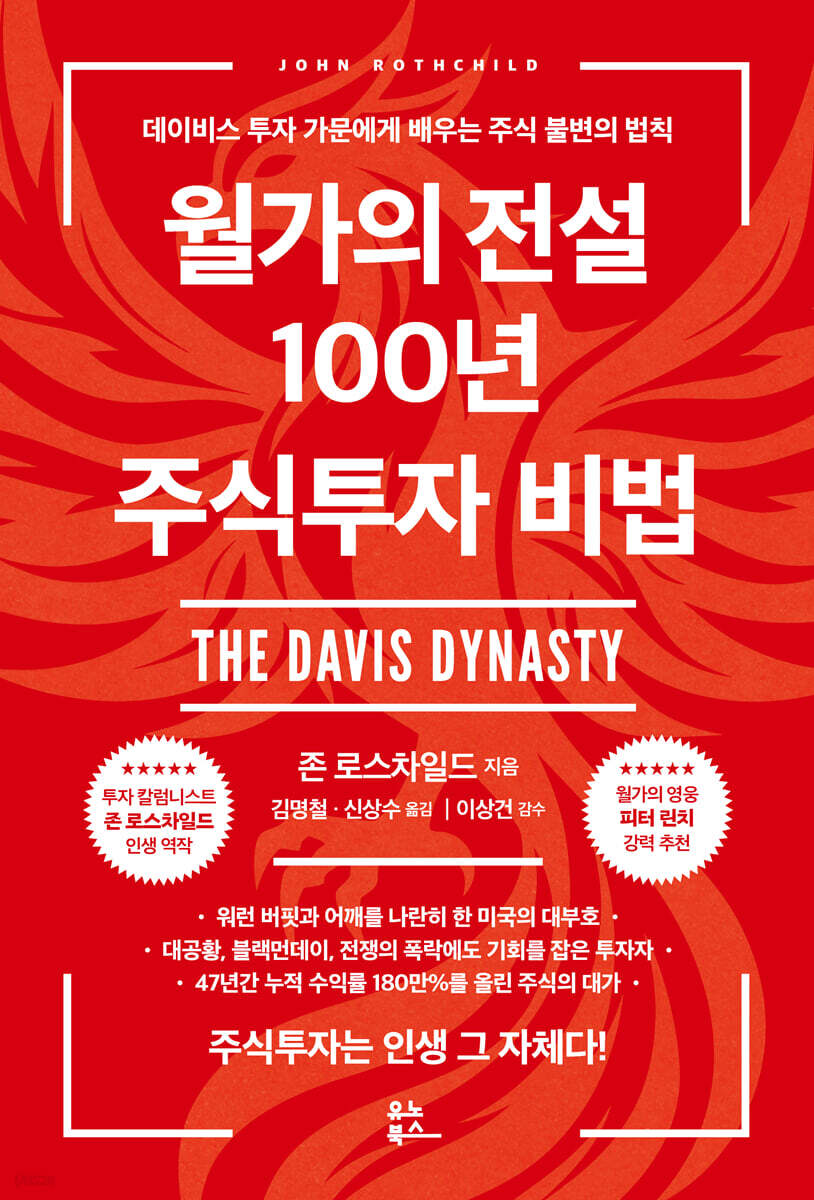
Wall Street Legend: 100 Years of Stock Investment Secrets
 |
Description
Book Introduction
★Investment columnist John Rothschild's life's work★
★Highly recommended by Wall Street hero Peter Lynch★
America's richest man, on par with Warren Buffett
Investors who seized opportunities even during the Great Depression, Black Monday, and the downturn of war.
The master of stocks that have achieved cumulative returns of 1.8 million percent over 47 years
Even if the stock market changes
Investment principles don't change!
The Great Depression, Black Monday, the IT bubble burst, the financial crisis…
Stocks always go up and down.
Just because your current investment performance is good doesn't mean you can be reassured.
There is one investment family that has remained unshaken through all the crises.
For 100 years and three generations, they have beaten the stock market solely on principle.
The cumulative return recorded over 47 years is a whopping 1.8 million percent.
The name is the Davis family.
Their story is vividly portrayed by John Rothschild, the legendary Wall Street columnist and storyteller with a penetrating insight into human psychology.
Let's delve into the life of an investor who became a legend on Wall Street with the attitude that "stock investing is life itself."
In the midst of the Great Depression, Davis saved $10,000 to invest in stocks.
And when fear was at its peak, I bought insurance stocks that no one else was buying.
The stock has jumped dozens of times in just a few years.
He never stopped investing, saying, “The market always rises after screaming.”
Davis was most calculating when the market was at its darkest.
As the news grew more fearful and people's attention drifted away, they quietly bought.
He bought time, not money, and believed in principles, not anxiety.
The Davis family, passed down from father to son and grandson, became a legend on Wall Street not just because they made a lot of money.
They did not pass down their legacy from generation to generation.
Instead, he inherited the skill of controlling emotions in a crisis.
The habit of enduring fear and guarding against greed was their true legacy.
That philosophy has outlived the bank balance.
John Rothschild said, “They didn’t make money in the market, they beat themselves,” showing the value and quality of the investments that this family maintained.
There are always two groups in the stock market.
Those who are afraid and those who wait.
Investing is a matter of direction, not speed.
Loss is temporary, but philosophy is eternal.
"The Legend of Wall Street: 100 Years of Stock Investment Secrets" conveys the philosophy of long-term survival in the stock market.
Those who have survived long enough already know.
That even if the market shakes, the principles do not.
This book is not just a simple investment textbook.
It teaches you how to learn about life through investing.
Thorough analysis, long-term vision, and rational wealth accumulation methods.
All your investing starts with this one book.
★Highly recommended by Wall Street hero Peter Lynch★
America's richest man, on par with Warren Buffett
Investors who seized opportunities even during the Great Depression, Black Monday, and the downturn of war.
The master of stocks that have achieved cumulative returns of 1.8 million percent over 47 years
Even if the stock market changes
Investment principles don't change!
The Great Depression, Black Monday, the IT bubble burst, the financial crisis…
Stocks always go up and down.
Just because your current investment performance is good doesn't mean you can be reassured.
There is one investment family that has remained unshaken through all the crises.
For 100 years and three generations, they have beaten the stock market solely on principle.
The cumulative return recorded over 47 years is a whopping 1.8 million percent.
The name is the Davis family.
Their story is vividly portrayed by John Rothschild, the legendary Wall Street columnist and storyteller with a penetrating insight into human psychology.
Let's delve into the life of an investor who became a legend on Wall Street with the attitude that "stock investing is life itself."
In the midst of the Great Depression, Davis saved $10,000 to invest in stocks.
And when fear was at its peak, I bought insurance stocks that no one else was buying.
The stock has jumped dozens of times in just a few years.
He never stopped investing, saying, “The market always rises after screaming.”
Davis was most calculating when the market was at its darkest.
As the news grew more fearful and people's attention drifted away, they quietly bought.
He bought time, not money, and believed in principles, not anxiety.
The Davis family, passed down from father to son and grandson, became a legend on Wall Street not just because they made a lot of money.
They did not pass down their legacy from generation to generation.
Instead, he inherited the skill of controlling emotions in a crisis.
The habit of enduring fear and guarding against greed was their true legacy.
That philosophy has outlived the bank balance.
John Rothschild said, “They didn’t make money in the market, they beat themselves,” showing the value and quality of the investments that this family maintained.
There are always two groups in the stock market.
Those who are afraid and those who wait.
Investing is a matter of direction, not speed.
Loss is temporary, but philosophy is eternal.
"The Legend of Wall Street: 100 Years of Stock Investment Secrets" conveys the philosophy of long-term survival in the stock market.
Those who have survived long enough already know.
That even if the market shakes, the principles do not.
This book is not just a simple investment textbook.
It teaches you how to learn about life through investing.
Thorough analysis, long-term vision, and rational wealth accumulation methods.
All your investing starts with this one book.
- You can preview some of the book's contents.
Preview
index
A Global Investment Myth: Long-Term Vision and Execution _ Peter Lynch
A Grand Panorama of Modern Economic History and Investment History _ Lee Sang-geon
The investment philosophy of a 100-year-old prestigious family that overcame time and anxiety
CHAPTER 1.
The basic principles of stock investment
: Beat yourself before the market
CHAPTER 2.
Habits of making investment funds
: Learn how to protect your capital in a crisis.
CHAPTER 3.
An investor's eye for reading market cycles
: Read the flow from the market's ups and downs.
CHAPTER 4.
You must also know how to go against the trend.
: Learn to stop when everyone lives and live when everyone stops.
CHAPTER 5.
Learn investment principles from long-standing industries.
: Read people's minds before numbers
CHAPTER 6.
The power to penetrate the essence of value
: Trust the timing of the stock, not its price.
CHAPTER 7.
An attitude that is not swayed by market noise
: Keep your cool in a hot market
CHAPTER 8.
Global Diversification Investment Strategy and Insights
: As your investment scope expands, invest according to your standards.
CHAPTER 9.
The courage to stop when everyone is alive
: Learn to control your greed when it comes.
CHAPTER 10.
An investor's habits determine his or her wealth.
: Have the right attitude toward money
CHAPTER 11.
Pass your investment philosophy on to future generations.
: Even if times change, always believe in absolute principles.
CHAPTER 12.
Survival investing tips learned from the market's turbulent times
: If the market is shaky, look far ahead.
CHAPTER 13.
The Rules of Winning Investors in a Crash
: Don't lose your judgment in the face of fear.
CHAPTER 14.
Long-term investment never betrays time.
: Remember that profits are made with patience.
CHAPTER 15.
If you see value, profits will follow.
: He who pursues value laughs last.
CHAPTER 16.
Practice your investment sense in everyday life.
: If you want to protect your assets, protect your habits.
CHAPTER 17.
The Essence of Davis's Investment Philosophy
: Develop the strength of your mind
CHAPTER 18.
The unwavering attitude of a long-term investor
: Focus on direction over speed
CHAPTER 19.
10 Timeless Principles of Stock Investing for 100 Years
: If you want to beat the market, have courage.
Translator's Note: Those who cannot remember the past are condemned to repeat it.
Appendix: The Davis Family in History and Photos
Americas
A Grand Panorama of Modern Economic History and Investment History _ Lee Sang-geon
The investment philosophy of a 100-year-old prestigious family that overcame time and anxiety
CHAPTER 1.
The basic principles of stock investment
: Beat yourself before the market
CHAPTER 2.
Habits of making investment funds
: Learn how to protect your capital in a crisis.
CHAPTER 3.
An investor's eye for reading market cycles
: Read the flow from the market's ups and downs.
CHAPTER 4.
You must also know how to go against the trend.
: Learn to stop when everyone lives and live when everyone stops.
CHAPTER 5.
Learn investment principles from long-standing industries.
: Read people's minds before numbers
CHAPTER 6.
The power to penetrate the essence of value
: Trust the timing of the stock, not its price.
CHAPTER 7.
An attitude that is not swayed by market noise
: Keep your cool in a hot market
CHAPTER 8.
Global Diversification Investment Strategy and Insights
: As your investment scope expands, invest according to your standards.
CHAPTER 9.
The courage to stop when everyone is alive
: Learn to control your greed when it comes.
CHAPTER 10.
An investor's habits determine his or her wealth.
: Have the right attitude toward money
CHAPTER 11.
Pass your investment philosophy on to future generations.
: Even if times change, always believe in absolute principles.
CHAPTER 12.
Survival investing tips learned from the market's turbulent times
: If the market is shaky, look far ahead.
CHAPTER 13.
The Rules of Winning Investors in a Crash
: Don't lose your judgment in the face of fear.
CHAPTER 14.
Long-term investment never betrays time.
: Remember that profits are made with patience.
CHAPTER 15.
If you see value, profits will follow.
: He who pursues value laughs last.
CHAPTER 16.
Practice your investment sense in everyday life.
: If you want to protect your assets, protect your habits.
CHAPTER 17.
The Essence of Davis's Investment Philosophy
: Develop the strength of your mind
CHAPTER 18.
The unwavering attitude of a long-term investor
: Focus on direction over speed
CHAPTER 19.
10 Timeless Principles of Stock Investing for 100 Years
: If you want to beat the market, have courage.
Translator's Note: Those who cannot remember the past are condemned to repeat it.
Appendix: The Davis Family in History and Photos
Americas
Detailed image

Into the book
Those who are ignorant of history are condemned to repeat it.
The cliched history of Wall Street illustrates this well.
A temporary rebound and bear market will soon turn into a bull market.
Investors who are ignorant of these patterns are more likely to sell their stocks at inopportune moments and lose their assets, although this cannot be guaranteed.
Shake off your ignorance.
At least put into practice the helpful advice in this book, which unfolds like a drama.
--- p.10, from "The Global Investment Myth Completed by Long-Term Vision and Execution - Peter Lynch"
Can investing become a saga?
This book by John Rothschild is vivid proof that this is possible.
Through the window of 'investment,' it tells the story of the turbulent history of the American stock market over the past 100 years and the Davis family's successful investments that amassed enormous wealth.
An example of a family business that has been run for three generations and achieved outstanding results is very rare not only in the United States but also around the world.
--- p.11, from "A Grand Panorama of Modern Economic History and Investment History - Lee Sang-geon"
This book is about long-term investing.
Long-term investing doesn't mean 15 minutes, the next fiscal quarter, or even the next economic cycle.
Long-term investing is not about 5 or 10 years, it's about forever.
--- p.27, from “Investment Philosophy of a 100-Year-Old Family that Overcame Time and Anxiety”
He possessed the optimistic nature that is essential for a stock investor.
Later, when the boom came, brokerage firms said, "Past performance is no guarantee of future success," but after the worst period in modern history, Davis realized that past performance is no guarantee of future failure.
--- p.86
Investors who are completely unaware of the hidden value of their stocks are likely to sell their stocks out of fear.
Investors, especially those whose only measure of value is the stock price, are more likely to sell their stocks as the price falls.
But Davis never wavered.
Wall Street's daily, weekly, monthly, or even annual price movements had no influence on his strategy.
He did not sell his stocks even during a sharp decline because he was convinced that the market was not properly understanding the true value of the stocks he had invested in.
Even in a bear market, his faith remained firm.
--- p.172
Around 1950, dinner tables in most American homes were filled with discussions about the McCarthy hearings, the Korean War, and the invincible New York Yankees.
Other fathers also taught baseball, basketball, and soccer in parks and backyards.
Davis taught his son how insurance companies pay out claims, what causes them to fail, and how to call assets.
In addition to popular sermons like "Honesty is the best policy" and "To save is to earn," Shelby received more in-depth instruction on business and finance.
--- p.230
The easiest thing in the world is to invest based on the latest rumor.
However, such investments are highly inefficient and do not contribute to performance.
You could invest in 200 leading companies, but not a single one would guarantee good results.
--- p.282
“Grandpa doesn’t intend to leave you a single penny.
Instead, you don't have to let me take away the pleasure of earning it yourself.”
--- p.238
To avoid missing out on the boom, you must continue to hold stocks and reinvest profits and dividends.
--- p.358
When I asked my grandfather for a dollar to buy a hot dog, he said, "Don't you know that if you invest it properly, that dollar will double every five years? In 50 years, by the time you're my age, that dollar will be worth $1,024."
"Are you hungry enough to buy a $1,000 hot dog?" he asked.
So I gave up too.
My grandfather taught me three lessons at once: the value of money, the value of compound interest, and the idea that I should never covet any of his money, because it's free.
--- p.391
The best blue chips are discovered through consistent investment throughout life, and it takes many years for the best blue chips to show their true value.
Of course, young, inexperienced investors have one inherent advantage over seasoned, sophisticated investors.
It's about time.
--- p.413
“No investor believes that the stocks they buy are overvalued.
That is the essence of investing, which seeks to realize value.”
--- p.460
“Investing is not as complicated as the general public thinks.
People invest money today in the hope that it will return to them in the future with more money.
That's the basics of investing.
In our case, the entire investment process is determined by two questions:
What types of companies should you invest in and at what price should you purchase their stocks? A company worth investing in should generate profits that exceed its costs, and its profits should be used to maximize shareholder returns.
The answer to the first question is this.
The second question is stock prices, but ordinary investors often don't care about them.”
The cliched history of Wall Street illustrates this well.
A temporary rebound and bear market will soon turn into a bull market.
Investors who are ignorant of these patterns are more likely to sell their stocks at inopportune moments and lose their assets, although this cannot be guaranteed.
Shake off your ignorance.
At least put into practice the helpful advice in this book, which unfolds like a drama.
--- p.10, from "The Global Investment Myth Completed by Long-Term Vision and Execution - Peter Lynch"
Can investing become a saga?
This book by John Rothschild is vivid proof that this is possible.
Through the window of 'investment,' it tells the story of the turbulent history of the American stock market over the past 100 years and the Davis family's successful investments that amassed enormous wealth.
An example of a family business that has been run for three generations and achieved outstanding results is very rare not only in the United States but also around the world.
--- p.11, from "A Grand Panorama of Modern Economic History and Investment History - Lee Sang-geon"
This book is about long-term investing.
Long-term investing doesn't mean 15 minutes, the next fiscal quarter, or even the next economic cycle.
Long-term investing is not about 5 or 10 years, it's about forever.
--- p.27, from “Investment Philosophy of a 100-Year-Old Family that Overcame Time and Anxiety”
He possessed the optimistic nature that is essential for a stock investor.
Later, when the boom came, brokerage firms said, "Past performance is no guarantee of future success," but after the worst period in modern history, Davis realized that past performance is no guarantee of future failure.
--- p.86
Investors who are completely unaware of the hidden value of their stocks are likely to sell their stocks out of fear.
Investors, especially those whose only measure of value is the stock price, are more likely to sell their stocks as the price falls.
But Davis never wavered.
Wall Street's daily, weekly, monthly, or even annual price movements had no influence on his strategy.
He did not sell his stocks even during a sharp decline because he was convinced that the market was not properly understanding the true value of the stocks he had invested in.
Even in a bear market, his faith remained firm.
--- p.172
Around 1950, dinner tables in most American homes were filled with discussions about the McCarthy hearings, the Korean War, and the invincible New York Yankees.
Other fathers also taught baseball, basketball, and soccer in parks and backyards.
Davis taught his son how insurance companies pay out claims, what causes them to fail, and how to call assets.
In addition to popular sermons like "Honesty is the best policy" and "To save is to earn," Shelby received more in-depth instruction on business and finance.
--- p.230
The easiest thing in the world is to invest based on the latest rumor.
However, such investments are highly inefficient and do not contribute to performance.
You could invest in 200 leading companies, but not a single one would guarantee good results.
--- p.282
“Grandpa doesn’t intend to leave you a single penny.
Instead, you don't have to let me take away the pleasure of earning it yourself.”
--- p.238
To avoid missing out on the boom, you must continue to hold stocks and reinvest profits and dividends.
--- p.358
When I asked my grandfather for a dollar to buy a hot dog, he said, "Don't you know that if you invest it properly, that dollar will double every five years? In 50 years, by the time you're my age, that dollar will be worth $1,024."
"Are you hungry enough to buy a $1,000 hot dog?" he asked.
So I gave up too.
My grandfather taught me three lessons at once: the value of money, the value of compound interest, and the idea that I should never covet any of his money, because it's free.
--- p.391
The best blue chips are discovered through consistent investment throughout life, and it takes many years for the best blue chips to show their true value.
Of course, young, inexperienced investors have one inherent advantage over seasoned, sophisticated investors.
It's about time.
--- p.413
“No investor believes that the stocks they buy are overvalued.
That is the essence of investing, which seeks to realize value.”
--- p.460
“Investing is not as complicated as the general public thinks.
People invest money today in the hope that it will return to them in the future with more money.
That's the basics of investing.
In our case, the entire investment process is determined by two questions:
What types of companies should you invest in and at what price should you purchase their stocks? A company worth investing in should generate profits that exceed its costs, and its profits should be used to maximize shareholder returns.
The answer to the first question is this.
The second question is stock prices, but ordinary investors often don't care about them.”
--- p.460
Publisher's Review
★Investment columnist John Rothschild's life's work★
★Highly recommended by Wall Street hero Peter Lynch★
America's richest man, on par with Warren Buffett
Investors who seized opportunities even during the Great Depression, Black Monday, and the downturn of war.
The master of stocks that have achieved cumulative returns of 1.8 million percent over 47 years
Even if the stock market changes
Investment principles don't change!
John Rothschild, a legendary Wall Street columnist and storyteller with a penetrating understanding of human psychology, shares his unchanging philosophy of stock investment through the story of the Davis family, which achieved a cumulative return of 1.8 million percent over 47 years.
Investment columnist John Rothschild's life's work
Markets change, but human nature does not.
Investors' expectations are growing as the stock market rises again.
But behind the market's optimism, there are still concerns: the surge in AI technology, geopolitical risks, and the prolonged high interest rates.
In this complex market where good and bad news are intertwined, investors are curious.
How do you read the psychology of stock investors? How do you make money and invest without losing? How do you establish long-term investment principles? And who will survive long-term? Now is the time when long-term survival principles are more important than short-term profits.
So now, let's take a look at one family that has beaten the stock market for 100 years.
"The Legend of Wall Street: 100 Years of Stock Investment Secrets" is the investment chronicle of the Davis family, who survived every crisis, from the Great Depression to Black Monday and the downturn of the war.
He achieved a cumulative return of 1.8 million percent over 47 years, rivaling Warren Buffett.
The secret lies not in the upward trend of the market, but in human psychology.
When fear sets in, markets fluctuate, and when greed grows, bubbles form.
Davis used that instinct in reverse.
Buy when others are afraid and stop when others are excited.
This book is a report that penetrates investor psychology through market history.
Today's stock market is rising, but the source of its anxiety is no different from that of 100 years ago.
Volatility repeats itself and greed returns.
Reading the major trends of the century will be an opportunity for us to reconsider our current investment approach.
Any investment that you make for one, three, or five years carries a higher risk, but if you plan for 10 or 15 years, the starting point is different.
Do you want to risk your money on an uncertain future, or do you want to make a wise investment that you can pass on to future generations?
Even if the stock market changes
The principles of investment do not change.
#1.
See opportunity in fear
In 1929, the market crashed.
Banks collapsed, and the streets were filled with unemployed people.
Stock prices were crashing every day, and people were losing their assets.
Here Davis observed the peak of terror.
I had a feeling that when everyone was afraid, that was the moment of opportunity.
“Fear always makes the best price.”
He bought railroads, insurance, and consumer goods companies.
It was because of the belief that companies with remaining value would definitely recover.
Five years later, the market slowly recovered and his account doubled and tripled.
#2.
Keep your faith in a volatile market
After World War II, prices rose, interest rates soared, and markets were thrown into turmoil.
People bought bonds.
But Davis took the opposite path.
He focused on the value of insurance.
“The more uncertain the world becomes, the more it tries to protect itself.”
He was not swayed by short-term fluctuations and did not sell stocks for 40 years.
His assets grew little by little, but steadily, every year.
It was a miracle created by moderation and long-term investment.
#3.
Don't lose your cool in the midst of chaos.
The internet bubble and financial crisis followed, and people were buying and selling stocks ten times a day.
It was a time when 'quick profits' became a symbol of success.
“The faster the change, the slower the judgment.”
But the Davis family focused on the essence of the business rather than the noise of the market.
I looked at psychology rather than price, and direction rather than speed.
Even as the bubble burst and the market crashed, his portfolio grew steadily.
This was the shield of wealth that lasted for 100 years.
Stock investing is life itself!
An investment philosophy that spans generations
This book examines investor anxiety through the lens of one family and analyzes market psychology.
Based on this, it teaches you how to establish principles in a crisis and demonstrates emotional skills to control fear.
It shows how a generational investment philosophy, a principled approach, and a strategy for long-term survival are effective in today's market.
The market goes up and down today too.
The charts are complex, the news is noisy.
But what really matters in investing isn't the numbers.
This book asks:
“Are you trying to beat the market or are you trying to beat yourself?”
During the first and second generations of investors, the United States experienced two long bull markets, twenty-five rebounds, two bear markets, and one Great Depression.
In the meantime, the economy and politics have been in constant flux, with nine recessions, three wars, presidential assassinations, resignations, and even impeachments.
Economic conditions have changed constantly due to wars, the Great Depression, recessions, inflation, and government policies.
John Rothschild meticulously blended this American economic history with the story of the Davis family.
This book will allow you to easily understand Davis's values and philosophy, as well as the investment trends of a century.
This book teaches you how to learn about life through investing.
Thorough analysis, long-term vision, and rational wealth accumulation methods.
You will learn everything you need to know about investing in this one book.
Times may change, but investors' minds remain the same.
So this book is still relevant even after 100 years.
★Highly recommended by Wall Street hero Peter Lynch★
America's richest man, on par with Warren Buffett
Investors who seized opportunities even during the Great Depression, Black Monday, and the downturn of war.
The master of stocks that have achieved cumulative returns of 1.8 million percent over 47 years
Even if the stock market changes
Investment principles don't change!
John Rothschild, a legendary Wall Street columnist and storyteller with a penetrating understanding of human psychology, shares his unchanging philosophy of stock investment through the story of the Davis family, which achieved a cumulative return of 1.8 million percent over 47 years.
Investment columnist John Rothschild's life's work
Markets change, but human nature does not.
Investors' expectations are growing as the stock market rises again.
But behind the market's optimism, there are still concerns: the surge in AI technology, geopolitical risks, and the prolonged high interest rates.
In this complex market where good and bad news are intertwined, investors are curious.
How do you read the psychology of stock investors? How do you make money and invest without losing? How do you establish long-term investment principles? And who will survive long-term? Now is the time when long-term survival principles are more important than short-term profits.
So now, let's take a look at one family that has beaten the stock market for 100 years.
"The Legend of Wall Street: 100 Years of Stock Investment Secrets" is the investment chronicle of the Davis family, who survived every crisis, from the Great Depression to Black Monday and the downturn of the war.
He achieved a cumulative return of 1.8 million percent over 47 years, rivaling Warren Buffett.
The secret lies not in the upward trend of the market, but in human psychology.
When fear sets in, markets fluctuate, and when greed grows, bubbles form.
Davis used that instinct in reverse.
Buy when others are afraid and stop when others are excited.
This book is a report that penetrates investor psychology through market history.
Today's stock market is rising, but the source of its anxiety is no different from that of 100 years ago.
Volatility repeats itself and greed returns.
Reading the major trends of the century will be an opportunity for us to reconsider our current investment approach.
Any investment that you make for one, three, or five years carries a higher risk, but if you plan for 10 or 15 years, the starting point is different.
Do you want to risk your money on an uncertain future, or do you want to make a wise investment that you can pass on to future generations?
Even if the stock market changes
The principles of investment do not change.
#1.
See opportunity in fear
In 1929, the market crashed.
Banks collapsed, and the streets were filled with unemployed people.
Stock prices were crashing every day, and people were losing their assets.
Here Davis observed the peak of terror.
I had a feeling that when everyone was afraid, that was the moment of opportunity.
“Fear always makes the best price.”
He bought railroads, insurance, and consumer goods companies.
It was because of the belief that companies with remaining value would definitely recover.
Five years later, the market slowly recovered and his account doubled and tripled.
#2.
Keep your faith in a volatile market
After World War II, prices rose, interest rates soared, and markets were thrown into turmoil.
People bought bonds.
But Davis took the opposite path.
He focused on the value of insurance.
“The more uncertain the world becomes, the more it tries to protect itself.”
He was not swayed by short-term fluctuations and did not sell stocks for 40 years.
His assets grew little by little, but steadily, every year.
It was a miracle created by moderation and long-term investment.
#3.
Don't lose your cool in the midst of chaos.
The internet bubble and financial crisis followed, and people were buying and selling stocks ten times a day.
It was a time when 'quick profits' became a symbol of success.
“The faster the change, the slower the judgment.”
But the Davis family focused on the essence of the business rather than the noise of the market.
I looked at psychology rather than price, and direction rather than speed.
Even as the bubble burst and the market crashed, his portfolio grew steadily.
This was the shield of wealth that lasted for 100 years.
Stock investing is life itself!
An investment philosophy that spans generations
This book examines investor anxiety through the lens of one family and analyzes market psychology.
Based on this, it teaches you how to establish principles in a crisis and demonstrates emotional skills to control fear.
It shows how a generational investment philosophy, a principled approach, and a strategy for long-term survival are effective in today's market.
The market goes up and down today too.
The charts are complex, the news is noisy.
But what really matters in investing isn't the numbers.
This book asks:
“Are you trying to beat the market or are you trying to beat yourself?”
During the first and second generations of investors, the United States experienced two long bull markets, twenty-five rebounds, two bear markets, and one Great Depression.
In the meantime, the economy and politics have been in constant flux, with nine recessions, three wars, presidential assassinations, resignations, and even impeachments.
Economic conditions have changed constantly due to wars, the Great Depression, recessions, inflation, and government policies.
John Rothschild meticulously blended this American economic history with the story of the Davis family.
This book will allow you to easily understand Davis's values and philosophy, as well as the investment trends of a century.
This book teaches you how to learn about life through investing.
Thorough analysis, long-term vision, and rational wealth accumulation methods.
You will learn everything you need to know about investing in this one book.
Times may change, but investors' minds remain the same.
So this book is still relevant even after 100 years.
GOODS SPECIFICS
- Date of issue: October 27, 2025
- Page count, weight, size: 520 pages | 750g | 152*224*27mm
- ISBN13: 9791171831449
- ISBN10: 1171831447
You may also like
카테고리
korean


korean

![ELLE 엘르 스페셜 에디션 A형 : 12월 [2025]](http://librairie.coreenne.fr/cdn/shop/files/b8e27a3de6c9538896439686c6b0e8fb.jpg?v=1766436872&width=3840)


