

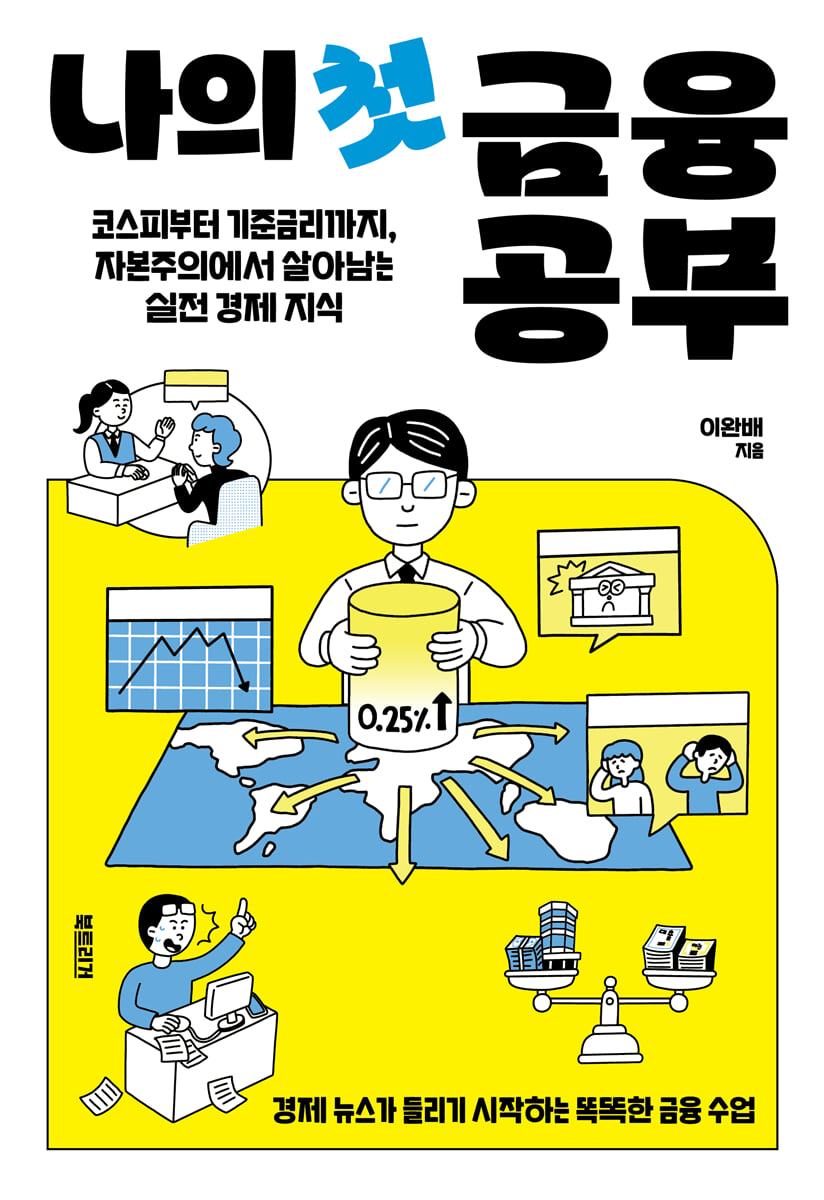
My first financial study
 |
Description
Book Introduction
A formula that applies to finance, you only see as much as you know!
Level up from 'financial ignorance' to 'financial knowledge'!
In modern society, which is developing on the basis of capitalism, the largest and most important industry is undoubtedly ‘finance.’
Finance is not only a closely related industry that deeply permeates our lives, but also a crucial key that holds the pulse of our society and economy.
Even young students are well aware of the importance of finance, but when it comes to actually studying it, they often feel lost as to where and how to begin.
Author Lee Wan-bae, who has delivered economic and management stories closely related to our lives in an easy-to-understand manner through works such as 『The Dark History of Economic War』 and 『Villains of the Market』, has stepped forward.
This book is aimed at young readers who are new to the financial industry.
Starting with "What is Finance?", it covers financial terms with high entry barriers, such as the stock market, composite stock price index, credit score, base interest rate, and exchange rate, which we have clearly heard of but were unsure of, as well as easy-to-understand explanations of their principles, and points out various aspects of our economy.
Using compelling real-world examples and easy-to-understand language, the author provides readers with guidance on how to build a foundation of financial knowledge that will serve as a milestone for the future and society.
This book provides the essential information needed to understand the flow of the global economy, from the essence and background of finance to recent controversies.
Even students who have considered themselves "financially illiterate" will be able to confidently say they "know a little about finance" by the time they finish reading "My First Financial Study."
Level up from 'financial ignorance' to 'financial knowledge'!
In modern society, which is developing on the basis of capitalism, the largest and most important industry is undoubtedly ‘finance.’
Finance is not only a closely related industry that deeply permeates our lives, but also a crucial key that holds the pulse of our society and economy.
Even young students are well aware of the importance of finance, but when it comes to actually studying it, they often feel lost as to where and how to begin.
Author Lee Wan-bae, who has delivered economic and management stories closely related to our lives in an easy-to-understand manner through works such as 『The Dark History of Economic War』 and 『Villains of the Market』, has stepped forward.
This book is aimed at young readers who are new to the financial industry.
Starting with "What is Finance?", it covers financial terms with high entry barriers, such as the stock market, composite stock price index, credit score, base interest rate, and exchange rate, which we have clearly heard of but were unsure of, as well as easy-to-understand explanations of their principles, and points out various aspects of our economy.
Using compelling real-world examples and easy-to-understand language, the author provides readers with guidance on how to build a foundation of financial knowledge that will serve as a milestone for the future and society.
This book provides the essential information needed to understand the flow of the global economy, from the essence and background of finance to recent controversies.
Even students who have considered themselves "financially illiterate" will be able to confidently say they "know a little about finance" by the time they finish reading "My First Financial Study."
- You can preview some of the book's contents.
Preview
index
Introduction: You must begin with what you know.
Part 1: What the Heck Is Money? - A First Look at the World of Finance
Finance, the Big Picture: Your First Step into the World of Finance
What are stock market indices?: The meaning of the KOSPI and KOSDAQ indices.
How are credit scores determined and used?: The importance of credit
Who Sets the Base Rate and Why?: The Role of the Central Bank
Why Debt Is an Asset: The Role of Loans and the Optimal Debt-to-Equity Ratio
Part 2: Let's Go, Into the World of Investment! - The Financial Market: A Coexistence of Risk and Opportunity
Why Do Bond Prices Fall When Interest Rates Rise?: Bond Concepts and Price Formation
Can Future Value Be Bought and Sold Now?: Understanding the Concept of Futures and the Formation of Futures Markets
Is there someone who will grow my money for me?: The basics of indirect investment and funds.
Are there investments that fail even when they yield profits?: The investment principles of index and inverse funds.
Is there a way to move money that isn't moving?: The Greatest Financial Crisis in the US Caused by Asset Securitization
Are there funds that replace corporate executives?: The definition and characteristics of private equity funds.
Selling Empty to Make Money?: Short Selling and Long-Short Strategies
Part 3: Who Holds the Real Power? - The Invisible Hand That Moves the Market
Value or Speed?: Two Popular Perspectives on Stock Investing
Machines Buy and Sell Stocks?: The World of Program Trading
Why Exchange Rates Sway the Stock Market: The Link Between Exchange Rate Fluctuations and the Korean Stock Market
Is Splitting Your Money Less Risky?: The Power of Diversification
A Holding Company, a Company Above a Company?: Understanding the Structure Reveals Value
Are Stock Investments Taxed?: The Debate Surrounding the Gold Investment Tax
★ Appendix: Glossary of Financial Terms for Confidence
Part 1: What the Heck Is Money? - A First Look at the World of Finance
Finance, the Big Picture: Your First Step into the World of Finance
What are stock market indices?: The meaning of the KOSPI and KOSDAQ indices.
How are credit scores determined and used?: The importance of credit
Who Sets the Base Rate and Why?: The Role of the Central Bank
Why Debt Is an Asset: The Role of Loans and the Optimal Debt-to-Equity Ratio
Part 2: Let's Go, Into the World of Investment! - The Financial Market: A Coexistence of Risk and Opportunity
Why Do Bond Prices Fall When Interest Rates Rise?: Bond Concepts and Price Formation
Can Future Value Be Bought and Sold Now?: Understanding the Concept of Futures and the Formation of Futures Markets
Is there someone who will grow my money for me?: The basics of indirect investment and funds.
Are there investments that fail even when they yield profits?: The investment principles of index and inverse funds.
Is there a way to move money that isn't moving?: The Greatest Financial Crisis in the US Caused by Asset Securitization
Are there funds that replace corporate executives?: The definition and characteristics of private equity funds.
Selling Empty to Make Money?: Short Selling and Long-Short Strategies
Part 3: Who Holds the Real Power? - The Invisible Hand That Moves the Market
Value or Speed?: Two Popular Perspectives on Stock Investing
Machines Buy and Sell Stocks?: The World of Program Trading
Why Exchange Rates Sway the Stock Market: The Link Between Exchange Rate Fluctuations and the Korean Stock Market
Is Splitting Your Money Less Risky?: The Power of Diversification
A Holding Company, a Company Above a Company?: Understanding the Structure Reveals Value
Are Stock Investments Taxed?: The Debate Surrounding the Gold Investment Tax
★ Appendix: Glossary of Financial Terms for Confidence
Detailed image

Into the book
In my experience, there is no way to magically make money through investing.
But on the other hand, there is a way to ruin something in an instant, like a mirage.
If you pour in your precious assets after listening to someone else's advice without even knowing what it is and hope for a miracle to happen, you will surely fail.
I can confidently say that such a miracle does not happen.
So what we need is study.
If you've ever thought, "Everyone else is doing it, so why not give stock investing a try?", you need to start with a comprehensive understanding of the market.
And you need to establish your own investment philosophy.
--- p.6, from “Preface: You must start with what you know”
The KOSPI market places a high priority on investor safety, so its listing screening criteria are quite strict.
(…) Given these circumstances, voices have been raised among investors saying that they would like to be able to freely trade stocks of promising companies, even if they are small in size.
Of course, these small businesses are risky because they have a relatively high chance of failing.
But even tigers have a cub stage like a cat.
There are small but promising companies, and naturally, there are investors who want to stake their fate on their future.
The stock market that has significantly relaxed listing screening standards for these investors is the KOSDAQ market.
--- p.26~27, from "Part 1: What on earth is money? - A first look at the world of finance"
Why does the base interest rate have such a profound impact on the economy? Because it completely changes the flow of money.
And when the flow of money changes, the economy and prices dance along with it.
Let's think about it.
The base interest rate has risen.
Then, of course, the deposit and loan interest rates of commercial banks will also rise.
If you were a depositor at this point, would you be more inclined to deposit more or less money in the bank? If you said, "Well, it's only a 0.25 percentage point difference a year, so why hesitate over whether to deposit more?", you'd give yourself a poor answer.
As I've emphasized before, when it comes to economics, you need to know how to value small numbers.
In the real economy, a mere 0.25 percentage point increase in interest rates can change the flow of money.
That too, a lot.
How does it change? Naturally, depositors will shift in a direction where they want to deposit more money in banks.
Because the bank gives you more interest.
Then, a significant amount of money released into the market flows into banks.
It means that money is locked in the bank.
--- p.44~45, from "Part 1: What on earth is money? - A first look at the world of finance"
Let's start by understanding what a bond is.
Simply put, a bond is a piece of paper that proves how much money I lent to whom (most bonds are now traded online as electronic securities, but for the sake of simplicity, I'll use a physical paper bond as an example).
As you know, when you lend money, you receive interest in return.
So, this piece of paper (bond) contains the amount of money lent, the date by which it must be repaid (the repayment date), and the amount of interest to be charged.
Let's say the Korea Expressway Corporation builds a new highway.
Korea Expressway Corporation, which is short on cash, decides to issue bonds.
The bond reads, "100 million won, repayment date 3 years from today, annual interest rate 6 percent."
If you want to lend money to Korea Expressway Corporation and receive interest, just buy this piece of paper.
The Korea Expressway Corporation will give a piece of paper to anyone who donates 100 million won.
If you have this, you will receive back the principal of 100 million won and the promised interest after 3 years.
--- p.63, from "Part 2: Let's Go, Into the World of Investment! - The Financial Market Where Risk and Opportunity Coexist"
As revealed in the Chinese character (先物) and the English word (future), the financial product 'futures' is literally related to the future.
A futures contract is a contract to trade a commodity that will be traded at some point in the future.
For easy understanding, let's look at the 'field trading' that still frequently occurs in rural areas.
There are risks that farmers who grow and sell crops face on a daily basis.
There is a possibility that agricultural product prices will plummet during harvest season due to factors such as weather.
Of course, prices could also skyrocket on the other hand.
It would be fortunate if prices rose during harvest time, but the problem is that no one can guarantee this.
When the prices of agricultural products that farmers need to sell plummet, their plans for the year are completely ruined.
To avoid this risk, farmers make deals with middlemen who will buy their produce in the spring, long before harvest.
It's like a promise to 'transfer all agricultural products to be produced this fall from Mr. Kim's field to wholesaler Mr. Park for 10 million won.'
The act of buying and selling unharvested future agricultural products in advance is called 'futures trading'.
--- p.71~72, from "Part 2: Let's Go, Into the World of Investment! - Financial Markets Where Risk and Opportunity Coexist"
So what is momentum investing? Momentum is a word that carries meanings like momentum, propulsion, and acceleration.
Momentum investing is an investment technique that focuses solely on stock price movements, as claimed by investment experts.
Stocks that are rising tend to accelerate and rise further, and stocks that are falling also tend to accelerate and fall further.
That's why momentum investing is also called 'trend-following investing.'
The point is to follow the trend and not go against it.
The stocks that are considered important for this type of investment are, of course, stocks that are on an upward trend.
There's a stock market adage that says, "Get on the running horse," and that's the essence of momentum investing.
Another important thing in momentum investing is stop loss.
Once a trend starts to fall, it rarely turns upward.
So, whether it's a 5% or 10% loss, you should sell without looking back.
In this process, the reputation of the stock or the performance of the company is given little importance.
--- p.132~133, from “Part 3: Who has the real power? - The invisible hand that moves the market”
The reason I highlight this story is to point out that exchange rates have a huge impact on investment returns.
Our country's stock market is very open to investment by not only our citizens but also foreign investors.
Of the amount invested in our country's stock market, 30 to 40 percent is foreign capital.
So, when foreign investors pour more money into our country's stock market, stock prices tend to rise.
Conversely, if they start selling their stocks, the stock price is likely to fall.
Their proportion is that large.
The problem is that the exchange rate comes into play here.
When Koreans invest in our stock market, they mainly look at the company's prospects or stock price trends.
Since I invest in the Korean stock market with Korean won, I don't think there is much reason to be affected by the exchange rate.
But this is not true.
Even if a Korean invests in the Korean stock market with Korean currency, he or she must carefully monitor the exchange rate trends.
This is because the exchange rate has a direct impact on stock prices.
But on the other hand, there is a way to ruin something in an instant, like a mirage.
If you pour in your precious assets after listening to someone else's advice without even knowing what it is and hope for a miracle to happen, you will surely fail.
I can confidently say that such a miracle does not happen.
So what we need is study.
If you've ever thought, "Everyone else is doing it, so why not give stock investing a try?", you need to start with a comprehensive understanding of the market.
And you need to establish your own investment philosophy.
--- p.6, from “Preface: You must start with what you know”
The KOSPI market places a high priority on investor safety, so its listing screening criteria are quite strict.
(…) Given these circumstances, voices have been raised among investors saying that they would like to be able to freely trade stocks of promising companies, even if they are small in size.
Of course, these small businesses are risky because they have a relatively high chance of failing.
But even tigers have a cub stage like a cat.
There are small but promising companies, and naturally, there are investors who want to stake their fate on their future.
The stock market that has significantly relaxed listing screening standards for these investors is the KOSDAQ market.
--- p.26~27, from "Part 1: What on earth is money? - A first look at the world of finance"
Why does the base interest rate have such a profound impact on the economy? Because it completely changes the flow of money.
And when the flow of money changes, the economy and prices dance along with it.
Let's think about it.
The base interest rate has risen.
Then, of course, the deposit and loan interest rates of commercial banks will also rise.
If you were a depositor at this point, would you be more inclined to deposit more or less money in the bank? If you said, "Well, it's only a 0.25 percentage point difference a year, so why hesitate over whether to deposit more?", you'd give yourself a poor answer.
As I've emphasized before, when it comes to economics, you need to know how to value small numbers.
In the real economy, a mere 0.25 percentage point increase in interest rates can change the flow of money.
That too, a lot.
How does it change? Naturally, depositors will shift in a direction where they want to deposit more money in banks.
Because the bank gives you more interest.
Then, a significant amount of money released into the market flows into banks.
It means that money is locked in the bank.
--- p.44~45, from "Part 1: What on earth is money? - A first look at the world of finance"
Let's start by understanding what a bond is.
Simply put, a bond is a piece of paper that proves how much money I lent to whom (most bonds are now traded online as electronic securities, but for the sake of simplicity, I'll use a physical paper bond as an example).
As you know, when you lend money, you receive interest in return.
So, this piece of paper (bond) contains the amount of money lent, the date by which it must be repaid (the repayment date), and the amount of interest to be charged.
Let's say the Korea Expressway Corporation builds a new highway.
Korea Expressway Corporation, which is short on cash, decides to issue bonds.
The bond reads, "100 million won, repayment date 3 years from today, annual interest rate 6 percent."
If you want to lend money to Korea Expressway Corporation and receive interest, just buy this piece of paper.
The Korea Expressway Corporation will give a piece of paper to anyone who donates 100 million won.
If you have this, you will receive back the principal of 100 million won and the promised interest after 3 years.
--- p.63, from "Part 2: Let's Go, Into the World of Investment! - The Financial Market Where Risk and Opportunity Coexist"
As revealed in the Chinese character (先物) and the English word (future), the financial product 'futures' is literally related to the future.
A futures contract is a contract to trade a commodity that will be traded at some point in the future.
For easy understanding, let's look at the 'field trading' that still frequently occurs in rural areas.
There are risks that farmers who grow and sell crops face on a daily basis.
There is a possibility that agricultural product prices will plummet during harvest season due to factors such as weather.
Of course, prices could also skyrocket on the other hand.
It would be fortunate if prices rose during harvest time, but the problem is that no one can guarantee this.
When the prices of agricultural products that farmers need to sell plummet, their plans for the year are completely ruined.
To avoid this risk, farmers make deals with middlemen who will buy their produce in the spring, long before harvest.
It's like a promise to 'transfer all agricultural products to be produced this fall from Mr. Kim's field to wholesaler Mr. Park for 10 million won.'
The act of buying and selling unharvested future agricultural products in advance is called 'futures trading'.
--- p.71~72, from "Part 2: Let's Go, Into the World of Investment! - Financial Markets Where Risk and Opportunity Coexist"
So what is momentum investing? Momentum is a word that carries meanings like momentum, propulsion, and acceleration.
Momentum investing is an investment technique that focuses solely on stock price movements, as claimed by investment experts.
Stocks that are rising tend to accelerate and rise further, and stocks that are falling also tend to accelerate and fall further.
That's why momentum investing is also called 'trend-following investing.'
The point is to follow the trend and not go against it.
The stocks that are considered important for this type of investment are, of course, stocks that are on an upward trend.
There's a stock market adage that says, "Get on the running horse," and that's the essence of momentum investing.
Another important thing in momentum investing is stop loss.
Once a trend starts to fall, it rarely turns upward.
So, whether it's a 5% or 10% loss, you should sell without looking back.
In this process, the reputation of the stock or the performance of the company is given little importance.
--- p.132~133, from “Part 3: Who has the real power? - The invisible hand that moves the market”
The reason I highlight this story is to point out that exchange rates have a huge impact on investment returns.
Our country's stock market is very open to investment by not only our citizens but also foreign investors.
Of the amount invested in our country's stock market, 30 to 40 percent is foreign capital.
So, when foreign investors pour more money into our country's stock market, stock prices tend to rise.
Conversely, if they start selling their stocks, the stock price is likely to fall.
Their proportion is that large.
The problem is that the exchange rate comes into play here.
When Koreans invest in our stock market, they mainly look at the company's prospects or stock price trends.
Since I invest in the Korean stock market with Korean won, I don't think there is much reason to be affected by the exchange rate.
But this is not true.
Even if a Korean invests in the Korean stock market with Korean currency, he or she must carefully monitor the exchange rate trends.
This is because the exchange rate has a direct impact on stock prices.
--- p.152~153, from “Part 3: Who has the real power? - The invisible hand that moves the market”
Publisher's Review
Financial education is coming to the educational field. Let's prepare in advance!
Complete Study Guide for the New 2026 "Finance and Economic Life" Subject
Starting next year, 'Finance and Economic Life' will be introduced as a new integrated elective subject in high schools.
The goal is to provide students with the necessary financial knowledge and develop financial decision-making skills to help them lead healthy financial lives.
The subject of 'Finance and Economic Life' is largely comprised of four sections: 'Happy and Safe Financial Life', 'Income and Expenditure', 'Savings and Investment', and 'Credit and Risk Management'. Through these sections, students learn what money and finance are, how exchange rates, prices, and interest rates affect our lives, and what financial choices can be made to prepare for the future.
This information and structure are in line with “My First Financial Study.”
In "My First Financial Study," Part 1: What on Earth is Money?, we introduce the basic concepts of finance and the stock market, which we had only vaguely understood.
You'll naturally become familiar with essential terms for understanding today's financial industry, such as the KOSPI and KOSDAQ indices, credit scores, and benchmark interest rates, which appear in every economic news story.
Part 2: Let's Go, Into the World of Investment! provides useful information that will answer your questions about financial investments.
You will gain a broad understanding of finance by learning concepts widely used in the capital markets, such as bonds, futures, funds, and short selling.
In the final episode, "Part 3: Who Holds the Real Power?", we examine the current state of the financial market through contemporary controversies such as exchange rates, holding companies, and the gold investment tax, and consider what our country's investment culture should be like going forward.
Can we live in a capitalist society without finance?
In a rapidly changing financial environment, the bare minimum economics for survival are essential.
Modern society changes rapidly.
The same goes for the financial environment.
But unlike other fields where we can rely on experts, finance is a matter of survival for everyone living today, every single day.
This is why the importance of financial education is being emphasized worldwide.
Living in a capitalist country, you can't ignore finance.
The author recommends that children learn economic principles and become familiar with investment culture from an early age.
The important thing is that your actions should be based on your own knowledge gained through self-study and your own investment philosophy, not on rumors of unknown origin or recommendations from someone else.
The financial industry also needs basic physical strength.
This starts with understanding financial terminology.
Even if you just know the key words, you will be able to look at economic news and newspaper articles without feeling unfamiliar.
The author, drawing on his long-time experience as a securities reporter for a general daily newspaper, presents vivid, real-life examples to convey financial knowledge in an engaging way.
The content includes familiar terms such as stocks, deposits, loans, stock market, and credit scores, as well as somewhat unfamiliar terms such as asset securitization, financial derivatives, corporate bonds, private equity funds, and loss-cutting.
However, these concepts are linked to detailed examples, so you can naturally cover them while reading each chapter.
In particular, if you familiarize yourself with the 'Appendix: Financial Terminology for Confidence' at the end of the book, you will no longer be afraid of current issues in the financial and economic fields.
Smart financial classes that foster safe and healthy financial capabilities
A Guide to Designing a Future that Will Help You Grow into a Prosperous Economic Entity
We often hear that rational consumption is important.
But once you get out into society, you realize that income should come before consumption.
If you are a student, you can receive allowance from your parents and spend it on a regular basis, but you cannot use the allowance forever.
Even these days, it's not uncommon to hear stories of people receiving stocks as birthday gifts or investing their allowance in stocks.
We have entered an era where investing is no longer something that only happens in distant lands.
But somehow, the word ‘investment’ doesn’t make sense.
Where and how should I invest?
The author hopes that young people will grow up to be sound economic actors.
To fill in students' gaps in economic knowledge, we don't just explain key financial terms through real-world examples; we also help them create a sound investment culture and develop their own investment philosophy.
Sometimes, we live in a world where investing in stocks is seen as a form of state-sanctioned gambling.
However, investing in stocks is strictly a matter of supporting valuable companies and playing a proud role as an economic entity that constitutes our economy.
However, it is certain that we must be wary of a situation where it becomes a 'blind investment'.
Thus, the author introduces two representative perspectives on stock investment and explains the relationship between the exchange rate, a sensitive issue, and the Korean stock market.
He also discusses various investment perspectives and provides detailed information on program trading and diversification, which many people find difficult to understand.
It also addresses chronic problems in the Korean economy that are not easily solved, such as corporate structures like cross-shareholdings and circular shareholdings, and financial investment income tax, helping readers taking their first steps into investing safely and healthily develop their "financial capabilities."
Complete Study Guide for the New 2026 "Finance and Economic Life" Subject
Starting next year, 'Finance and Economic Life' will be introduced as a new integrated elective subject in high schools.
The goal is to provide students with the necessary financial knowledge and develop financial decision-making skills to help them lead healthy financial lives.
The subject of 'Finance and Economic Life' is largely comprised of four sections: 'Happy and Safe Financial Life', 'Income and Expenditure', 'Savings and Investment', and 'Credit and Risk Management'. Through these sections, students learn what money and finance are, how exchange rates, prices, and interest rates affect our lives, and what financial choices can be made to prepare for the future.
This information and structure are in line with “My First Financial Study.”
In "My First Financial Study," Part 1: What on Earth is Money?, we introduce the basic concepts of finance and the stock market, which we had only vaguely understood.
You'll naturally become familiar with essential terms for understanding today's financial industry, such as the KOSPI and KOSDAQ indices, credit scores, and benchmark interest rates, which appear in every economic news story.
Part 2: Let's Go, Into the World of Investment! provides useful information that will answer your questions about financial investments.
You will gain a broad understanding of finance by learning concepts widely used in the capital markets, such as bonds, futures, funds, and short selling.
In the final episode, "Part 3: Who Holds the Real Power?", we examine the current state of the financial market through contemporary controversies such as exchange rates, holding companies, and the gold investment tax, and consider what our country's investment culture should be like going forward.
Can we live in a capitalist society without finance?
In a rapidly changing financial environment, the bare minimum economics for survival are essential.
Modern society changes rapidly.
The same goes for the financial environment.
But unlike other fields where we can rely on experts, finance is a matter of survival for everyone living today, every single day.
This is why the importance of financial education is being emphasized worldwide.
Living in a capitalist country, you can't ignore finance.
The author recommends that children learn economic principles and become familiar with investment culture from an early age.
The important thing is that your actions should be based on your own knowledge gained through self-study and your own investment philosophy, not on rumors of unknown origin or recommendations from someone else.
The financial industry also needs basic physical strength.
This starts with understanding financial terminology.
Even if you just know the key words, you will be able to look at economic news and newspaper articles without feeling unfamiliar.
The author, drawing on his long-time experience as a securities reporter for a general daily newspaper, presents vivid, real-life examples to convey financial knowledge in an engaging way.
The content includes familiar terms such as stocks, deposits, loans, stock market, and credit scores, as well as somewhat unfamiliar terms such as asset securitization, financial derivatives, corporate bonds, private equity funds, and loss-cutting.
However, these concepts are linked to detailed examples, so you can naturally cover them while reading each chapter.
In particular, if you familiarize yourself with the 'Appendix: Financial Terminology for Confidence' at the end of the book, you will no longer be afraid of current issues in the financial and economic fields.
Smart financial classes that foster safe and healthy financial capabilities
A Guide to Designing a Future that Will Help You Grow into a Prosperous Economic Entity
We often hear that rational consumption is important.
But once you get out into society, you realize that income should come before consumption.
If you are a student, you can receive allowance from your parents and spend it on a regular basis, but you cannot use the allowance forever.
Even these days, it's not uncommon to hear stories of people receiving stocks as birthday gifts or investing their allowance in stocks.
We have entered an era where investing is no longer something that only happens in distant lands.
But somehow, the word ‘investment’ doesn’t make sense.
Where and how should I invest?
The author hopes that young people will grow up to be sound economic actors.
To fill in students' gaps in economic knowledge, we don't just explain key financial terms through real-world examples; we also help them create a sound investment culture and develop their own investment philosophy.
Sometimes, we live in a world where investing in stocks is seen as a form of state-sanctioned gambling.
However, investing in stocks is strictly a matter of supporting valuable companies and playing a proud role as an economic entity that constitutes our economy.
However, it is certain that we must be wary of a situation where it becomes a 'blind investment'.
Thus, the author introduces two representative perspectives on stock investment and explains the relationship between the exchange rate, a sensitive issue, and the Korean stock market.
He also discusses various investment perspectives and provides detailed information on program trading and diversification, which many people find difficult to understand.
It also addresses chronic problems in the Korean economy that are not easily solved, such as corporate structures like cross-shareholdings and circular shareholdings, and financial investment income tax, helping readers taking their first steps into investing safely and healthily develop their "financial capabilities."
GOODS SPECIFICS
- Date of issue: August 14, 2025
- Page count, weight, size: 200 pages | 325g | 143*208*12mm
- ISBN13: 9791193378519
- ISBN10: 1193378516
You may also like
카테고리
korean


korean

![ELLE 엘르 스페셜 에디션 A형 : 12월 [2025]](http://librairie.coreenne.fr/cdn/shop/files/b8e27a3de6c9538896439686c6b0e8fb.jpg?v=1766436872&width=3840)


