

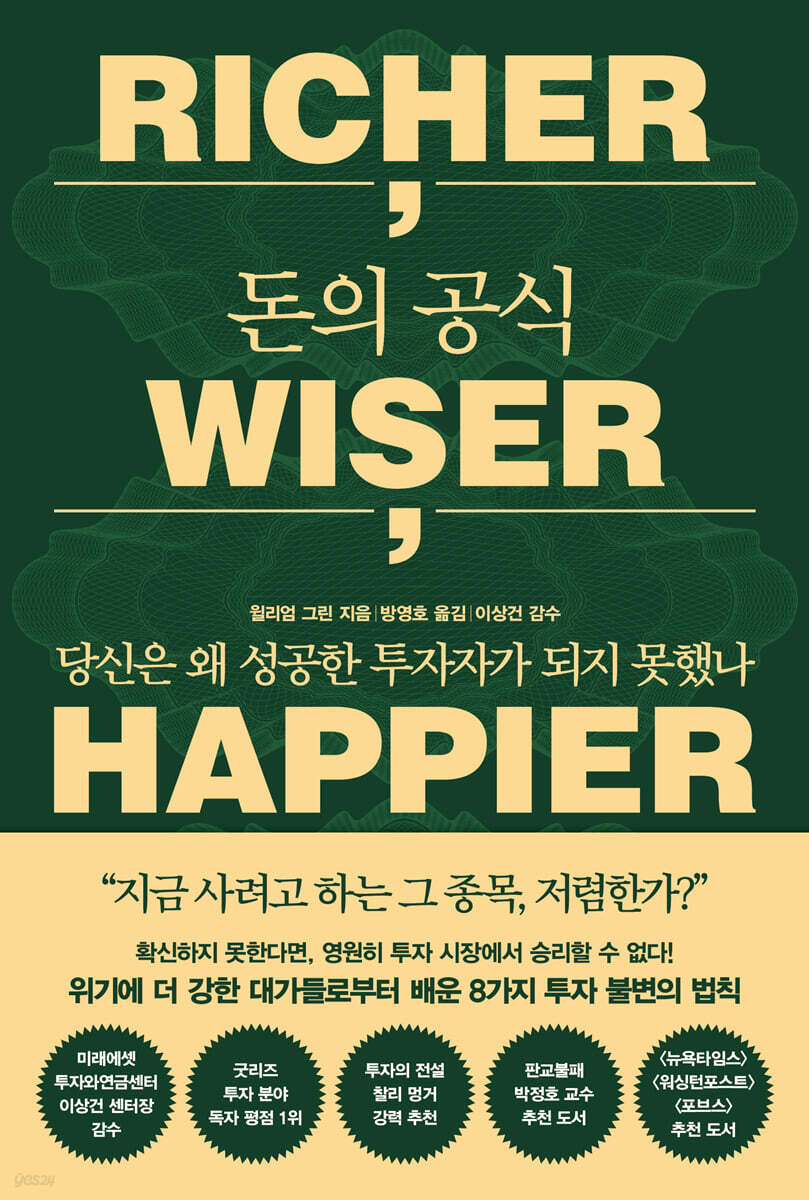
The formula for money
 |
Description
Book Introduction
“The best book I’ve ever read!”_Charlie Munger
8 Immutable Laws of Investing Learned from Crisis-Resilient Masters
★★★ Supervised by Mirae Asset Investment & Pension Center Director Lee Sang-geon
★★★ Pangyo Unbeatable, highly recommended by Professor Park Jeong-ho
★★★ #1 Reader Rating in the Goodreads Investment Category
★★★ Recommended by The New York Times, The Washington Post, and Forbes
The renowned book "The Money Formula," which has been hailed as a "modern-day classic of investing" and has ranked first in Goodreads' investment category reader ratings, is now being revised and republished thanks to readers' continued requests for reprinting.
After its publication in the United States, it became a long-term bestseller through word of mouth among readers, and was also highly recommended as a must-read among domestic investment experts.
This revised edition is presented with the added supervision of Lee Sang-geon, Director of Mirae Asset Investment & Pension Center.
William Green, an American journalist who writes about wealth and achievement for the New York Times, Forbes, and the Washington Post, generously reveals the wealth and life philosophies of 40 of the world's best investors, discovered through exclusive interviews.
The author analyzes from various angles why investment gurus such as Sir John Templeton, Warren Buffett, Charlie Munger, Howard Marks, and Joel Greenblatt were able to become globally respected sages beyond their wealth.
From the smallest habits of betting only on winning investments to their investment principles and attitudes toward life, the author, who has observed and recorded everything about billionaire investors up close, introduces the eight "immutable laws of investment" they share among themselves.
The eight laws, including 'replication', 'courage', 'questioning', 'resilience', 'simplicity', 'information power', 'habit', and 'collection', are further persuasive to readers by incorporating examples directly experienced by investment experts.
"The Money Formula" is more than just an investment book; it offers a guide to living a wiser and happier life.
8 Immutable Laws of Investing Learned from Crisis-Resilient Masters
★★★ Supervised by Mirae Asset Investment & Pension Center Director Lee Sang-geon
★★★ Pangyo Unbeatable, highly recommended by Professor Park Jeong-ho
★★★ #1 Reader Rating in the Goodreads Investment Category
★★★ Recommended by The New York Times, The Washington Post, and Forbes
The renowned book "The Money Formula," which has been hailed as a "modern-day classic of investing" and has ranked first in Goodreads' investment category reader ratings, is now being revised and republished thanks to readers' continued requests for reprinting.
After its publication in the United States, it became a long-term bestseller through word of mouth among readers, and was also highly recommended as a must-read among domestic investment experts.
This revised edition is presented with the added supervision of Lee Sang-geon, Director of Mirae Asset Investment & Pension Center.
William Green, an American journalist who writes about wealth and achievement for the New York Times, Forbes, and the Washington Post, generously reveals the wealth and life philosophies of 40 of the world's best investors, discovered through exclusive interviews.
The author analyzes from various angles why investment gurus such as Sir John Templeton, Warren Buffett, Charlie Munger, Howard Marks, and Joel Greenblatt were able to become globally respected sages beyond their wealth.
From the smallest habits of betting only on winning investments to their investment principles and attitudes toward life, the author, who has observed and recorded everything about billionaire investors up close, introduces the eight "immutable laws of investment" they share among themselves.
The eight laws, including 'replication', 'courage', 'questioning', 'resilience', 'simplicity', 'information power', 'habit', and 'collection', are further persuasive to readers by incorporating examples directly experienced by investment experts.
"The Money Formula" is more than just an investment book; it offers a guide to living a wiser and happier life.
- You can preview some of the book's contents.
Preview
index
Praise poured in for this book
Reviewer's Note
Prologue: How did they acquire wealth?
Chapter 1: The Man Who Clone Warren Buffett
How to Turn $1 Million into $1 Billion | The Physics of Investing | Saying "No" | The $651,000 Lunch | How Billionaires Save the World | Don't Spread the Word!
Chapter 2: Willingness to Be Alone
The Birth of a Freak | The Bet of the Century | Sir John Templeton's Six Guidelines | Investing for the Soul
Chapter 3: Nothing Lasts Forever
First is luck, second is humility | Awaken your ignorance | Booms and busts are predictable | Most of the time, the end of the world doesn't come | Accept 'what is'
Chapter 4: The Resilient Investor
The Pain of Falling Behind | The Kindness of Strangers | How Much Do You Have to Lose? | Nothing Is Constant | Life Is Not Simple | Five Rules for Building Resilience
Chapter 5: Ultimate Sophistication, Simplicity
The Hidden Wisdom of Occam's Razor | Will Danoff's Investment Method | Mr. Market's Short-Term Deal | Remember the Imbalanced Proposition | A Small Theory That Beats the Stock Market | Are You Sure of Magic? | Four Simple Lessons
Chapter 6: Information Distribution Period
A House Built on Sand | Don't Heed the Bullshit | A House Built on Rock | Five Principles of Sustainability
Chapter 7: Habits that Create Outstanding Performance
The Secret to Maximizing Profits | Every Day with Fierce Devotion | Family Devotion | The Art of Subtraction
Chapter 8: If You Just Avoid Foolish Mistakes, You Have a Chance of Winning
How to Live Without Doing Stupid Things | Charlie Munger's Collection | Seven Techniques for Avoiding Foolishness | Lifelong Lessons
Epilogue: Richer, Wiser, Happier
Acknowledgements
main
Reviewer's Note
Prologue: How did they acquire wealth?
Chapter 1: The Man Who Clone Warren Buffett
How to Turn $1 Million into $1 Billion | The Physics of Investing | Saying "No" | The $651,000 Lunch | How Billionaires Save the World | Don't Spread the Word!
Chapter 2: Willingness to Be Alone
The Birth of a Freak | The Bet of the Century | Sir John Templeton's Six Guidelines | Investing for the Soul
Chapter 3: Nothing Lasts Forever
First is luck, second is humility | Awaken your ignorance | Booms and busts are predictable | Most of the time, the end of the world doesn't come | Accept 'what is'
Chapter 4: The Resilient Investor
The Pain of Falling Behind | The Kindness of Strangers | How Much Do You Have to Lose? | Nothing Is Constant | Life Is Not Simple | Five Rules for Building Resilience
Chapter 5: Ultimate Sophistication, Simplicity
The Hidden Wisdom of Occam's Razor | Will Danoff's Investment Method | Mr. Market's Short-Term Deal | Remember the Imbalanced Proposition | A Small Theory That Beats the Stock Market | Are You Sure of Magic? | Four Simple Lessons
Chapter 6: Information Distribution Period
A House Built on Sand | Don't Heed the Bullshit | A House Built on Rock | Five Principles of Sustainability
Chapter 7: Habits that Create Outstanding Performance
The Secret to Maximizing Profits | Every Day with Fierce Devotion | Family Devotion | The Art of Subtraction
Chapter 8: If You Just Avoid Foolish Mistakes, You Have a Chance of Winning
How to Live Without Doing Stupid Things | Charlie Munger's Collection | Seven Techniques for Avoiding Foolishness | Lifelong Lessons
Epilogue: Richer, Wiser, Happier
Acknowledgements
main
Detailed image

Into the book
While writing this book, I was reminded of the precious time I spent with some of the world's greatest investors many years ago.
Meanwhile, I've spent countless hours traveling the world, from Los Angeles to London, from Omaha to Mumbai, talking to over 40 investors for the sole purpose of writing this book.
You will meet people who have managed astronomical amounts of wealth on behalf of millions of people.
I sincerely hope that these great investors will enlighten and enrich our lives.
I'll bet on that.
---From "Prologue: How Did They Acquire Wealth?"
Investing is mostly about waiting for those rare moments when the odds of making money are much greater than the odds of losing money.
As Buffett said:
“You don’t have to swing the bat every time the ball comes in.
We can wait for the right ball to come our way.
The problem comes when you are a fund manager.
“It’s time for our investors to keep yelling, ‘Swing it, you idiot!’”
---From "Chapter 1: The Man Who Clone Warren Buffett"
Sir Templeton then cautioned against his own ignorance.
“It may be a more serious problem than feelings.
Many people make purchases based on very little information, which means they don't really know what they're buying." So it's helpful to remember the simple fact that there are two sides to every investment transaction.
He explained the reason as follows:
“If you have the best information, it will ultimately pay off.
“It takes a lot of hard work, research, and investigation to do that.”
---From "Chapter 2: The Will to Be Alone"
As he sees it, the future is influenced by a virtually infinite number of factors, and with so much randomness, it is impossible to consistently predict future events.
Admitting that you can't predict the future may seem like resignation and an admission of weakness.
In reality, there are tremendous benefits to acknowledging our limitations and operating within the limits of what is possible.
Strength comes from weakness.
---From "Chapter 3: Nothing is Eternal"
Before new beginnings and exquisite opportunities in personal and professional life, there are always moments of extreme pain, McLennan said.
A good example is the late 1990s, which was a brutal time for investors like him and Iveyar.
McClennan shared his experience.
“Nevertheless, a golden age arrived in the early 2000s.
After enduring hardship, a time of tremendous advantage arrives.” As in life, success in the market depends on one's ability to overcome hardship.
---From "Chapter 4: The Resilient Investor"
The behavior patterns of the masters are clear.
They all pursued simplicity in their own way.
We must follow their example.
We all pursue simple and sustainable investment strategies.
Such a strategy is one we understand well enough and are so convinced of that we will stick with it no matter what.
This is a very important concept, so we will come back to it later.
Let's take a deeper look into Greenblatt's mindset and discover his secrets to solving the investment puzzle.
---From "Chapter 5: Ultimate Sophistication and Simplicity"
Sleep says it can be helpful to experiment with "giving yourself a reward in the short term."
It's about enjoying all the amazing benefits that come with ignoring momentary gratification.
Doing so strengthens the tendency to accept delayed gratification, as procrastination becomes associated with satisfaction.
In this regard, Slip says:
“People will find that the more satisfied they are, the richer their lives become.
So I also try to block out immediate gratification and experience delayed gratification.”
---From "Chapter 6: Distribution Period of Information"
All of this suggests important principles that apply to investing and life.
The overwhelming victory is the result of small, incremental improvements and progress over a long period of time.
"Want to know the secret to great success? Just make today better than yesterday, even if it's just a little bit," Gainer said.
“There are many ways to start something like that.
But the key is repetition.”
---From "Chapter 7 Habits that Create Outstanding Results"
The habit of actively collecting other people's foolish actions is a very useful solution for avoiding foolish actions.
In fact, this ingenious method is the second technique we should learn from Munger to avoid foolish behavior.
Munger uses this technique to constantly gain enjoyment and insight.
Meanwhile, I've spent countless hours traveling the world, from Los Angeles to London, from Omaha to Mumbai, talking to over 40 investors for the sole purpose of writing this book.
You will meet people who have managed astronomical amounts of wealth on behalf of millions of people.
I sincerely hope that these great investors will enlighten and enrich our lives.
I'll bet on that.
---From "Prologue: How Did They Acquire Wealth?"
Investing is mostly about waiting for those rare moments when the odds of making money are much greater than the odds of losing money.
As Buffett said:
“You don’t have to swing the bat every time the ball comes in.
We can wait for the right ball to come our way.
The problem comes when you are a fund manager.
“It’s time for our investors to keep yelling, ‘Swing it, you idiot!’”
---From "Chapter 1: The Man Who Clone Warren Buffett"
Sir Templeton then cautioned against his own ignorance.
“It may be a more serious problem than feelings.
Many people make purchases based on very little information, which means they don't really know what they're buying." So it's helpful to remember the simple fact that there are two sides to every investment transaction.
He explained the reason as follows:
“If you have the best information, it will ultimately pay off.
“It takes a lot of hard work, research, and investigation to do that.”
---From "Chapter 2: The Will to Be Alone"
As he sees it, the future is influenced by a virtually infinite number of factors, and with so much randomness, it is impossible to consistently predict future events.
Admitting that you can't predict the future may seem like resignation and an admission of weakness.
In reality, there are tremendous benefits to acknowledging our limitations and operating within the limits of what is possible.
Strength comes from weakness.
---From "Chapter 3: Nothing is Eternal"
Before new beginnings and exquisite opportunities in personal and professional life, there are always moments of extreme pain, McLennan said.
A good example is the late 1990s, which was a brutal time for investors like him and Iveyar.
McClennan shared his experience.
“Nevertheless, a golden age arrived in the early 2000s.
After enduring hardship, a time of tremendous advantage arrives.” As in life, success in the market depends on one's ability to overcome hardship.
---From "Chapter 4: The Resilient Investor"
The behavior patterns of the masters are clear.
They all pursued simplicity in their own way.
We must follow their example.
We all pursue simple and sustainable investment strategies.
Such a strategy is one we understand well enough and are so convinced of that we will stick with it no matter what.
This is a very important concept, so we will come back to it later.
Let's take a deeper look into Greenblatt's mindset and discover his secrets to solving the investment puzzle.
---From "Chapter 5: Ultimate Sophistication and Simplicity"
Sleep says it can be helpful to experiment with "giving yourself a reward in the short term."
It's about enjoying all the amazing benefits that come with ignoring momentary gratification.
Doing so strengthens the tendency to accept delayed gratification, as procrastination becomes associated with satisfaction.
In this regard, Slip says:
“People will find that the more satisfied they are, the richer their lives become.
So I also try to block out immediate gratification and experience delayed gratification.”
---From "Chapter 6: Distribution Period of Information"
All of this suggests important principles that apply to investing and life.
The overwhelming victory is the result of small, incremental improvements and progress over a long period of time.
"Want to know the secret to great success? Just make today better than yesterday, even if it's just a little bit," Gainer said.
“There are many ways to start something like that.
But the key is repetition.”
---From "Chapter 7 Habits that Create Outstanding Results"
The habit of actively collecting other people's foolish actions is a very useful solution for avoiding foolish actions.
In fact, this ingenious method is the second technique we should learn from Munger to avoid foolish behavior.
Munger uses this technique to constantly gain enjoyment and insight.
---From "Chapter 8: If You Just Avoid Foolish Mistakes, You Have a Chance of Winning"
Publisher's Review
Why haven't you become a successful investor?
A report from a correspondent who interviewed 40 of the world's top investors over 25 years.
The author, a former financial reporter for the New York Times, interviewed Sir John Templeton, who donated hundreds of billions of dollars to society, Warren Buffett, one of the world's five richest people, investment legend Charlie Munger, and Howard Marks, a billionaire, and discovered the various aspects of investment sages.
What is particularly noteworthy is that the interviews were conducted in personal settings, such as the business practices of global investors, travel destinations with them, and meals shared with them.
Thanks to this, the author was able to hear honest and intimate stories from investment masters, including even the smallest habits that brought wealth and success not only in business but in all areas of life.
The investment gurus he met say that if you just stick to one thing, wealth and success will follow naturally.
One thing is to think and act in a way that increases the probability of success, whether in investing or in life.
Whether it's how they manage their time, how they learn from their mistakes, how they deal with stress and adversity, or how they choose who to associate with and who to avoid, investing geniuses apply methods to increase their odds of success in every endeavor.
There is no more scientific and effective way to operate than to act on the side with the highest probability.
Masters manage their investments and lives in the most effective way.
“Richer, wiser, happier!”
How can I increase my chances of investment success?
The immutable formula revealed through eight keywords
How on earth could one think and act like these individuals to amass such wealth? William Green realized there was a formula behind their consistent investment performance.
The eight keywords are 'replication, courage, questioning, resilience, simplicity, information power, habit, and collection.'
Chapter 1 introduces a method of 'replicating' the investment methods of the masters.
Mohnish Pabrai, famous for the anecdote of paying $650,000 (about 800 million won) for lunch with Warren Buffett, is such a follower of Warren Buffett that he says that one meal at the time changed his life.
He says that the secret to his becoming a billionaire is that he followed Buffett's investment methods, and emphasizes that replicating his successful methods is the surest way to increase the probability of success.
Chapter 2 explores the secret of investors who stick to their convictions even when everyone else is following the trend: courage.
The author details his previously unknown investment know-how, which he discovered while spending several days with Sir John Templeton, considered the greatest investor of the 20th century, on Lipford Cay in the Caribbean, a place reserved for only the top 0.001% of the population.
Chapter 3 discusses the habits of the wealthy who are always skeptical and 'questioning' in the ever-changing economic market.
Howard Marks, one of Wall Street's most trusted investors, invited the author to a business site where he was analyzing distressed companies and gave him an unfiltered look at his investment methods.
In the process, Max's cool-headed thinking based on his questions shone through.
Chapter 4 reveals how investment giants overcame hardship and adversity, demonstrating their remarkable "resilience" through precedents.
Warren Buffett's mentor, Benjamin Graham, suffered a 70% loss between 1923 and 1932, but he cited a 'margin of safety' as the secret to his survival.
This is a story that investors who need to control panic in a market economy turbulent with issues such as tariffs and commercial law revisions should listen to.
Chapter 5 contains advice on overcoming the challenges of dealing with variables in the investment world, so pay attention.
Value judgment becomes much easier.
Investor Joel Greenblatt, who turned $1 million into $836 million, says that even in the most complex of stock markets, you can instantly decide whether to buy or sell by knowing just two indicators.
This is the moment when the utility of 'simplicity' shines.
Chapter 6 discusses the 'information power' that stands out among top investors.
The author, who regularly accompanied Nick Sleep on his investment journey from a rookie at a construction company to a world-class investor, is amazed by his information prowess.
Nick, unlike the prominent investors on Wall Street, didn't graduate from a prestigious university or work for a famous investment firm, so he was obsessed with information.
Thanks to this, I have developed an eye for useful information that allows me to recognize it faster than others.
If the information collected in this way is not used appropriately for investment, it is no different from building a sand castle.
For the first time, we reveal the secrets of how to utilize this in investment.
Chapter 7 deals with the 'habits' that enable us to put into practice the investment methods discussed above.
The author accompanies investment superstar Jeffrey Vinick from his 6 a.m. commute to work until midnight, and analyzes the investment habits he has consistently maintained for 12 years.
The final eight chapters introduce common mistakes we make, as 'collected' by investment experts.
Charlie Munger, a star investor worldwide, shares in an interview with the author the two mistakes he and Buffett have made, and shares the things you should always keep in mind when investing.
Treat your investments like you treat your life!
Sound principles apply beyond investing to life as well.
The insights of the masters introduced in this book may seem too theoretical and difficult to apply for ordinary individual investors who are just waiting for the next payday.
But surprisingly, their rules are very simple and everyday.
It even applies to life beyond investing.
They don't get caught up in the small successes right in front of them.
I don't even pursue perfection.
Instead, pursue the right direction.
And we act steadily, waiting for the certain and unsurpassable, overwhelming victory of the future.
Tom Gaynor's life, a believer in welfare, proves this.
He said, “Success is the result of small, gradual developments and improvements that are made over a long period of time,” and he acted consistently in both his daily life and his investments.
Go to work earlier than others, create an environment that helps you focus, and exercise for 30 minutes every day to minimize stress.
I apply this same habit to my investing, choosing only stocks that fit my four principles and keeping my investment costs to a minimum.
The principle is simple, but I have never broken it.
This is why Professor Park Jeong-ho said that the success of the investment gurus introduced in the book “is not due to genius, but is based on relentless effort that is faithful to the basics.”
If you've ever jumped into a promising stock like a moth to a flame and been left feeling lost, or if you've ever easily cut your losses with the mindset that "I'll just hit the jackpot with another stock!", reading "The Money Formula" will resonate deeply with you.
Readers who have already read this book have praised it as a philosophy book rather than an investment book, and as the renowned investor Pangyo Bulpae, known for his macroeconomic insights, said, "Whenever you find yourself struggling with investing, you will find yourself turning to this book." You will find yourself turning to this book again at every crucial moment in your life, at every crucial investment moment.
A report from a correspondent who interviewed 40 of the world's top investors over 25 years.
The author, a former financial reporter for the New York Times, interviewed Sir John Templeton, who donated hundreds of billions of dollars to society, Warren Buffett, one of the world's five richest people, investment legend Charlie Munger, and Howard Marks, a billionaire, and discovered the various aspects of investment sages.
What is particularly noteworthy is that the interviews were conducted in personal settings, such as the business practices of global investors, travel destinations with them, and meals shared with them.
Thanks to this, the author was able to hear honest and intimate stories from investment masters, including even the smallest habits that brought wealth and success not only in business but in all areas of life.
The investment gurus he met say that if you just stick to one thing, wealth and success will follow naturally.
One thing is to think and act in a way that increases the probability of success, whether in investing or in life.
Whether it's how they manage their time, how they learn from their mistakes, how they deal with stress and adversity, or how they choose who to associate with and who to avoid, investing geniuses apply methods to increase their odds of success in every endeavor.
There is no more scientific and effective way to operate than to act on the side with the highest probability.
Masters manage their investments and lives in the most effective way.
“Richer, wiser, happier!”
How can I increase my chances of investment success?
The immutable formula revealed through eight keywords
How on earth could one think and act like these individuals to amass such wealth? William Green realized there was a formula behind their consistent investment performance.
The eight keywords are 'replication, courage, questioning, resilience, simplicity, information power, habit, and collection.'
Chapter 1 introduces a method of 'replicating' the investment methods of the masters.
Mohnish Pabrai, famous for the anecdote of paying $650,000 (about 800 million won) for lunch with Warren Buffett, is such a follower of Warren Buffett that he says that one meal at the time changed his life.
He says that the secret to his becoming a billionaire is that he followed Buffett's investment methods, and emphasizes that replicating his successful methods is the surest way to increase the probability of success.
Chapter 2 explores the secret of investors who stick to their convictions even when everyone else is following the trend: courage.
The author details his previously unknown investment know-how, which he discovered while spending several days with Sir John Templeton, considered the greatest investor of the 20th century, on Lipford Cay in the Caribbean, a place reserved for only the top 0.001% of the population.
Chapter 3 discusses the habits of the wealthy who are always skeptical and 'questioning' in the ever-changing economic market.
Howard Marks, one of Wall Street's most trusted investors, invited the author to a business site where he was analyzing distressed companies and gave him an unfiltered look at his investment methods.
In the process, Max's cool-headed thinking based on his questions shone through.
Chapter 4 reveals how investment giants overcame hardship and adversity, demonstrating their remarkable "resilience" through precedents.
Warren Buffett's mentor, Benjamin Graham, suffered a 70% loss between 1923 and 1932, but he cited a 'margin of safety' as the secret to his survival.
This is a story that investors who need to control panic in a market economy turbulent with issues such as tariffs and commercial law revisions should listen to.
Chapter 5 contains advice on overcoming the challenges of dealing with variables in the investment world, so pay attention.
Value judgment becomes much easier.
Investor Joel Greenblatt, who turned $1 million into $836 million, says that even in the most complex of stock markets, you can instantly decide whether to buy or sell by knowing just two indicators.
This is the moment when the utility of 'simplicity' shines.
Chapter 6 discusses the 'information power' that stands out among top investors.
The author, who regularly accompanied Nick Sleep on his investment journey from a rookie at a construction company to a world-class investor, is amazed by his information prowess.
Nick, unlike the prominent investors on Wall Street, didn't graduate from a prestigious university or work for a famous investment firm, so he was obsessed with information.
Thanks to this, I have developed an eye for useful information that allows me to recognize it faster than others.
If the information collected in this way is not used appropriately for investment, it is no different from building a sand castle.
For the first time, we reveal the secrets of how to utilize this in investment.
Chapter 7 deals with the 'habits' that enable us to put into practice the investment methods discussed above.
The author accompanies investment superstar Jeffrey Vinick from his 6 a.m. commute to work until midnight, and analyzes the investment habits he has consistently maintained for 12 years.
The final eight chapters introduce common mistakes we make, as 'collected' by investment experts.
Charlie Munger, a star investor worldwide, shares in an interview with the author the two mistakes he and Buffett have made, and shares the things you should always keep in mind when investing.
Treat your investments like you treat your life!
Sound principles apply beyond investing to life as well.
The insights of the masters introduced in this book may seem too theoretical and difficult to apply for ordinary individual investors who are just waiting for the next payday.
But surprisingly, their rules are very simple and everyday.
It even applies to life beyond investing.
They don't get caught up in the small successes right in front of them.
I don't even pursue perfection.
Instead, pursue the right direction.
And we act steadily, waiting for the certain and unsurpassable, overwhelming victory of the future.
Tom Gaynor's life, a believer in welfare, proves this.
He said, “Success is the result of small, gradual developments and improvements that are made over a long period of time,” and he acted consistently in both his daily life and his investments.
Go to work earlier than others, create an environment that helps you focus, and exercise for 30 minutes every day to minimize stress.
I apply this same habit to my investing, choosing only stocks that fit my four principles and keeping my investment costs to a minimum.
The principle is simple, but I have never broken it.
This is why Professor Park Jeong-ho said that the success of the investment gurus introduced in the book “is not due to genius, but is based on relentless effort that is faithful to the basics.”
If you've ever jumped into a promising stock like a moth to a flame and been left feeling lost, or if you've ever easily cut your losses with the mindset that "I'll just hit the jackpot with another stock!", reading "The Money Formula" will resonate deeply with you.
Readers who have already read this book have praised it as a philosophy book rather than an investment book, and as the renowned investor Pangyo Bulpae, known for his macroeconomic insights, said, "Whenever you find yourself struggling with investing, you will find yourself turning to this book." You will find yourself turning to this book again at every crucial moment in your life, at every crucial investment moment.
GOODS SPECIFICS
- Date of issue: August 14, 2025
- Page count, weight, size: 408 pages | 652g | 145*215*25mm
- ISBN13: 9788925573311
- ISBN10: 8925573318
You may also like
카테고리
korean


korean

![GQ KOREA Mark (Monthly): December [2025]](http://librairie.coreenne.fr/cdn/shop/files/8ef265dbbfbf186523ed75ba7319009d.jpg?v=1765340328&width=3840)


