

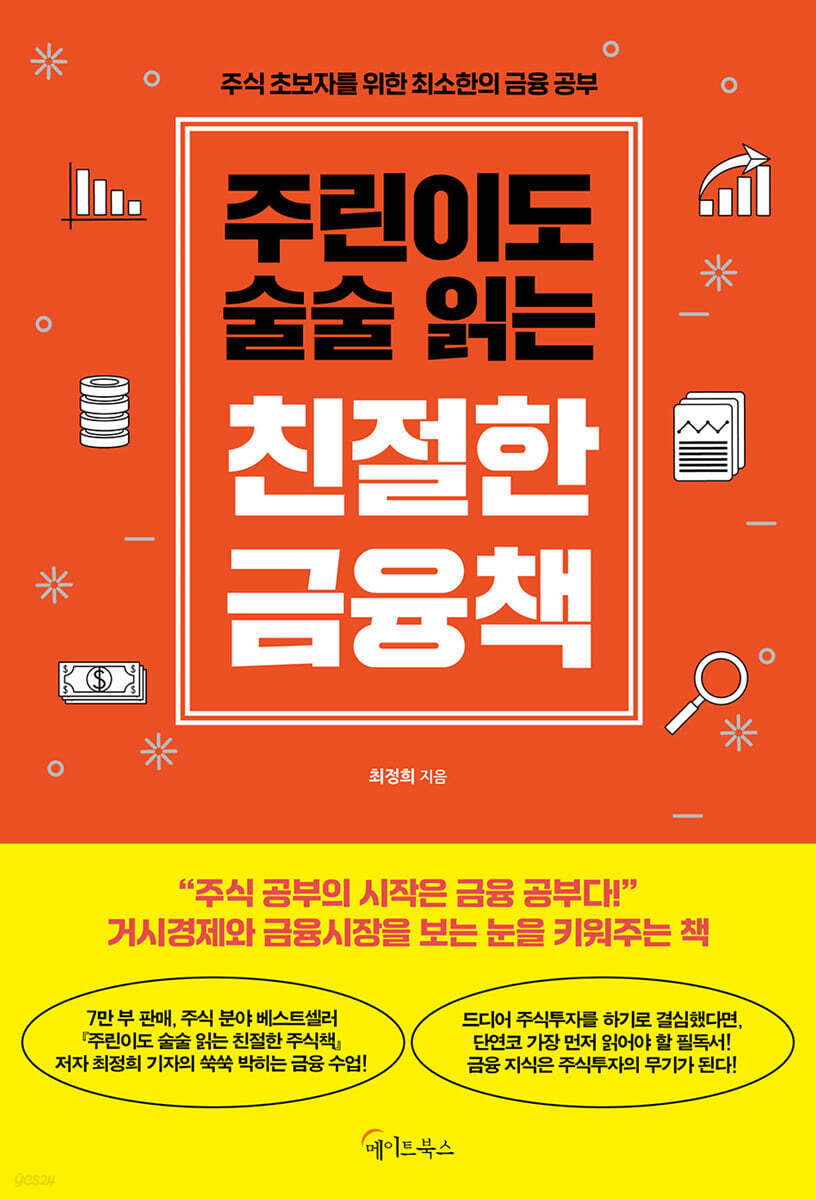
A friendly financial book that even children can read easily.
 |
Description
Book Introduction
“The beginning of studying stocks is studying finance!”
A friendly introductory book that will help you develop an insight into the financial markets!
This book is not simply a book on economics or investment common sense.
This is a practical introductory financial book that translates abstract concepts such as interest rates, exchange rates, and monetary policy into the "language of investment."
Reporter Choi Jeong-hee, author of the best-selling book "A Friendly Stock Book Even Children Can Read Easily," which sold over 70,000 copies, returns to share the fundamentals of financial knowledge essential to stock investors.
This book provides clear answers to questions like, "Why is economic news so difficult?" and "Why do interest rate hikes cause stock prices to fall?" It focuses on explaining financial principles in a practical, easy-to-understand style.
Beyond simple explanations of economic terms and financial issues, it guides readers through the lens of a stock investor, fostering a holistic understanding of economic trends.
This book was written especially with 'anyone who has ever traded stocks' in mind.
This is not an abstract theory book like an economics class, but a must-read for beginners who are just starting out in investing or investors who have hit a wall in their financial studies in the middle of their investment journey.
For example, it addresses questions directly related to real-world investment, such as, "Which stocks will benefit when the base interest rate rises?", "Why do exchange rates and gold prices move in opposite directions?", and "How does the economic cycle indicate the right time to invest?", with specific examples.
This book is a friendly and structured guidebook designed to allow you to naturally internalize the financial knowledge necessary for investing while reading, without having to study it separately.
A friendly introductory book that will help you develop an insight into the financial markets!
This book is not simply a book on economics or investment common sense.
This is a practical introductory financial book that translates abstract concepts such as interest rates, exchange rates, and monetary policy into the "language of investment."
Reporter Choi Jeong-hee, author of the best-selling book "A Friendly Stock Book Even Children Can Read Easily," which sold over 70,000 copies, returns to share the fundamentals of financial knowledge essential to stock investors.
This book provides clear answers to questions like, "Why is economic news so difficult?" and "Why do interest rate hikes cause stock prices to fall?" It focuses on explaining financial principles in a practical, easy-to-understand style.
Beyond simple explanations of economic terms and financial issues, it guides readers through the lens of a stock investor, fostering a holistic understanding of economic trends.
This book was written especially with 'anyone who has ever traded stocks' in mind.
This is not an abstract theory book like an economics class, but a must-read for beginners who are just starting out in investing or investors who have hit a wall in their financial studies in the middle of their investment journey.
For example, it addresses questions directly related to real-world investment, such as, "Which stocks will benefit when the base interest rate rises?", "Why do exchange rates and gold prices move in opposite directions?", and "How does the economic cycle indicate the right time to invest?", with specific examples.
This book is a friendly and structured guidebook designed to allow you to naturally internalize the financial knowledge necessary for investing while reading, without having to study it separately.
- You can preview some of the book's contents.
Preview
index
Author's Note: If only I had studied finance earlier...
PART 1: Understanding the Flow of the Economy Understanding Finance
How on earth do you know if the economy is growing?
Korea, a country that thrives on exports! Look at semiconductors and China.
Should the government print money or borrow money to stimulate the economy?
The Counterattack of High Prices: A Hidden Threat to the Economy
Why are low birth rates and an aging population a concern?
"Has globalization made you happier?" Trumpification around the world
One Point Lesson: Is our country a developed country or an emerging country?
PART 2: You can't go near the financial markets without knowing the United States.
The first Friday of every month, the market is shaking.
The market is also turbulent in the third week of every month.
Why the US Manufacturing and Services PMI is Important
The Fed's formidable power keeps me awake even at dawn.
Even during the financial crisis, they loosened the purse strings, so why weren't there high prices then?
The US, a leader in AI, is growing like an emerging economy.
The SVB incident reveals the stark reality of banking.
One Point Lesson Dollar Smile vs.
The shaky dollar's status
PART 3: The Magic Wand That Moves Money: The Tremendous Power of Interest Rates
Knowing 'interest rates' is half the battle in the financial market.
I didn't know interest rates were so scary.
The base interest rate was raised, so why are market interest rates falling?
Interest rates also predict the economy: signals from short- and long-term interest rates.
Dollar liquidity can also be measured by interest rates.
Where does all that extra money go when there's nowhere to invest it?
One Point Lesson: The 'CDS Premium': A Financial Market Alarm
PART 4: To see the bigger picture and the longer term, you need to look at the 'exchange rate'.
Shaky comfort, no one knows the exchange rate
Is money coming into our country or going out?
Let's not discuss the foreign exchange market without mentioning the foreign exchange authorities.
If it's complicated and difficult, just look at the word 'dollar'.
If interest rates are lower than in the US, the exchange rate will rise?
The won is undervalued? How do you know that?
Currency Wars and Counter-Currency Wars: Why Do They Happen?
One Point Lesson: Are the foreign exchange market and the foreign currency funds market different?
PART 5 If stocks and bonds seemed like friends, you'd be wrong!
When stocks laugh, bonds cry.
Just reading the stock market's keywords is half the battle.
Understanding essential terminology is essential for stock investment!
Find stocks that make a lot of money and have low stock prices.
Corporate financial statements are difficult, but let's just check these.
Bond interest rates and prices move in opposite directions.
Investing in 'national bonds' in Korea Stock Company
One Point Lesson: Inflation-Linked Government Bonds and BEI
PART 6: Raw Materials and Virtual Assets: Why Do They Rise and Fall?
Why is the price of gold soaring? The mystery of gold, the safe haven asset.
Will manufacturing recover? Look at the price of copper.
Will prices rise in our country? Look at oil prices.
Extreme climate change fuels inflation.
What should we think about Bitcoin, one of the world's top 10 assets?
One Point Lesson: Look at China, the world's largest producer and consumer of raw materials.
PART 7: If You Only Know About the National Pension, You'll Be Left with a Broken Heart After Retirement
The Three Major Pensions That Will Protect You After Retirement
How to overcome low pension returns?
If you are paying your taxes at the end of the year, consider 'pension savings' or 'IRP'.
Retirement pensions are also taxed differently.
One Point Lesson: Using the Government-sponsored ISA Account
PART 1: Understanding the Flow of the Economy Understanding Finance
How on earth do you know if the economy is growing?
Korea, a country that thrives on exports! Look at semiconductors and China.
Should the government print money or borrow money to stimulate the economy?
The Counterattack of High Prices: A Hidden Threat to the Economy
Why are low birth rates and an aging population a concern?
"Has globalization made you happier?" Trumpification around the world
One Point Lesson: Is our country a developed country or an emerging country?
PART 2: You can't go near the financial markets without knowing the United States.
The first Friday of every month, the market is shaking.
The market is also turbulent in the third week of every month.
Why the US Manufacturing and Services PMI is Important
The Fed's formidable power keeps me awake even at dawn.
Even during the financial crisis, they loosened the purse strings, so why weren't there high prices then?
The US, a leader in AI, is growing like an emerging economy.
The SVB incident reveals the stark reality of banking.
One Point Lesson Dollar Smile vs.
The shaky dollar's status
PART 3: The Magic Wand That Moves Money: The Tremendous Power of Interest Rates
Knowing 'interest rates' is half the battle in the financial market.
I didn't know interest rates were so scary.
The base interest rate was raised, so why are market interest rates falling?
Interest rates also predict the economy: signals from short- and long-term interest rates.
Dollar liquidity can also be measured by interest rates.
Where does all that extra money go when there's nowhere to invest it?
One Point Lesson: The 'CDS Premium': A Financial Market Alarm
PART 4: To see the bigger picture and the longer term, you need to look at the 'exchange rate'.
Shaky comfort, no one knows the exchange rate
Is money coming into our country or going out?
Let's not discuss the foreign exchange market without mentioning the foreign exchange authorities.
If it's complicated and difficult, just look at the word 'dollar'.
If interest rates are lower than in the US, the exchange rate will rise?
The won is undervalued? How do you know that?
Currency Wars and Counter-Currency Wars: Why Do They Happen?
One Point Lesson: Are the foreign exchange market and the foreign currency funds market different?
PART 5 If stocks and bonds seemed like friends, you'd be wrong!
When stocks laugh, bonds cry.
Just reading the stock market's keywords is half the battle.
Understanding essential terminology is essential for stock investment!
Find stocks that make a lot of money and have low stock prices.
Corporate financial statements are difficult, but let's just check these.
Bond interest rates and prices move in opposite directions.
Investing in 'national bonds' in Korea Stock Company
One Point Lesson: Inflation-Linked Government Bonds and BEI
PART 6: Raw Materials and Virtual Assets: Why Do They Rise and Fall?
Why is the price of gold soaring? The mystery of gold, the safe haven asset.
Will manufacturing recover? Look at the price of copper.
Will prices rise in our country? Look at oil prices.
Extreme climate change fuels inflation.
What should we think about Bitcoin, one of the world's top 10 assets?
One Point Lesson: Look at China, the world's largest producer and consumer of raw materials.
PART 7: If You Only Know About the National Pension, You'll Be Left with a Broken Heart After Retirement
The Three Major Pensions That Will Protect You After Retirement
How to overcome low pension returns?
If you are paying your taxes at the end of the year, consider 'pension savings' or 'IRP'.
Retirement pensions are also taxed differently.
One Point Lesson: Using the Government-sponsored ISA Account
Detailed image

Into the book
What matters is whether you are ‘growing’.
Since 'the economy is psychology', if you believe that the economy is growing and will continue to grow, the economy will do much better.
But why must we grow? Ultimately, it's linked to the happiness of our people.
All of these things are done to make the people happy.
In order for the economy to grow and lead to the happiness of the people, ‘employment’ is the most important thing.
Jobless growth can actually lead to social conflict.
---From "PART 1: Understanding the Flow of the Economy Will Help You Understand Finance"
For our country, which lives on exports, ‘deglobalization’ is like rat poison.
The United States and China are our country's largest export markets.
Their share of our country's exports reaches 38% (as of 2024).
If the US and China fight, the one who will suffer the most is our country.
I already experienced it in 2019.
According to the Korea Institute for International Economic Policy, the US-China trade dispute in 2018-2019 resulted in a decrease of up to 4 trillion won in South Korea's exports.
Now that Trump has taken office, it cannot be ruled out that the United States' target will be not only China but also our country.
The crime our country is accused of is 'making a lot of money from the United States.'
---From "PART 1: Understanding the Flow of the Economy Will Help You Understand Finance"
There are also indicators that can provide an overview of the overall economic situation of American companies.
That is the Purchasing Managers' Index (PMI) for manufacturing and services, released by the Institute for Supply Management (ISM) at the beginning of each month.
The purchasing managers' index is based on a survey of businesses and is closer to a sentiment indicator, but it is considered important in financial markets because it allows companies to see whether or not they expect the U.S. economy to do well and that their goods and services will sell well.
That's understandable, as the United States not only accounts for a quarter of the world's gross domestic product (GDP), but is also a major export destination for our country.
The influence of the U.S. economy on our country is growing by the day.
---From "PART 2: You Can't Go Near the Financial Market Without Knowing America"
You should think twice before depositing your money in the bank.
The bank could fail.
Even if the country doesn't go bankrupt, the bank can go bankrupt.
The government could bail out the banks.
However, even large banks, like Lehman Brothers, have failed before. Don't expect the government to guarantee deposits exceeding the deposit protection limit, as happened during the SVB crisis.
---From "PART 2: You Can't Go Near the Financial Market Without Knowing America"
The purpose of establishing the Bank of Korea is to ensure price stability and financial stability.
That doesn't mean I only look at these two things.
Our country's interest rates are determined by considering several factors, such as whether the economy is growing, whether the exchange rate is stable, whether the interest rate gap with other countries (especially the United States) is not large, and whether people are taking loans too lightly.
Even in the same economic situation, interest rates can be determined differently depending on the thoughts of the monetary policy committee members.
If there is a Monetary Policy Committee member who cares more about economic growth than price stability, there is a high possibility that he or she will be favorable to an interest rate cut.
Conversely, if the monetary policy committee member is more concerned about price stability or a surge in household debt than about economic growth, he or she is more likely to be favorable toward raising interest rates.
If the economy is doing so well that there are signs of rising prices, interest rates will be raised. Conversely, if the economy is in a recession and prices are expected to fall, interest rates will be lowered.
---From "PART 3 The Magic Wand that Moves Money, the Tremendous Power of Interest Rates"
If dollar liquidity becomes scarce, financial markets such as stocks and bonds will plummet in an instant, and the entire country will be shaken.
In the midst of this, no financial company or business will survive.
The national economy is rapidly devastated by massive unemployment, collapsing businesses, and severely shaken households.
Therefore, it is crucial to examine dollar liquidity in global financial markets, especially in the United States, and whether there is a dollar shortage due to the outflow of foreign capital from our country.
---From "PART 3 The Magic Wand that Moves Money, the Tremendous Power of Interest Rates"
The NDF market plays an important role in our country's foreign exchange market.
It provides hints as to whether the exchange rate will rise or fall the next day.
Domestic foreign exchange brokerage firms, including Seoul Foreign Exchange Brokerage, provide daily morning updates on the bid and ask prices for NDFs traded overnight. NDFs are one-month forward contracts, representing the price at which the dollar and Korean won are traded, with a one-month maturity.
Using the forward exchange rate price one month from now, the previous day's spot exchange rate closing price, and the "swap point," which shows the difference between the forward exchange rate and the spot exchange rate, it is possible to predict whether the exchange rate will fall or rise.
It shows how foreign investors viewed the exchange rate while our country's foreign exchange market was closed.
---From "PART 4: To see bigger and longer, you must look at the 'exchange rate'"
When the dollar rises and falls depends on the U.S. economy and policies.
When the U.S. economy does well and grows on its own, the U.S. dollar rises.
When the U.S. Federal Reserve, which prints dollars, raises the base interest rate and collects dollars released into the market, the dollar also rises.
Even if the euro, which accounts for more than half of the dollar index, falls, the dollar rises.
The dollar may strengthen when the euro economy performs worse than the US economy.
It would be common sense that if the US dollar strengthens when the US economy is doing well, the dollar should weaken when the US economy is doing poorly.
But more often than not, that's not the case.
It is not easy for the economies of other countries to be good while the US economy is bad.
---From "PART 4: To see bigger and longer, you must look at the 'exchange rate'"
What stock investors and bond investors have in common is that they 'believe in A to some extent.'
If you are confident that A will do well, you become a stock investor in A. If you are not confident that A will do well, but you still think that you will make a lot of money, you become a bond investor.
So, stock investors and bond investors have different starting points.
When the economy grows and liquidity is abundant, risk-on sentiment is triggered, increasing expectations of rising stock prices, which benefits stock investors.
On the other hand, if the economy is shaky and the market feels cheap, bond investors have the advantage.
Because there is less risk of losing investment money than with stock investors.
But what if a tsunami were to hit the financial markets? In fact, in such a situation, there's no need to distinguish between risky and safe assets.
Cash is the best.
So, as money flees the financial markets, both stocks and bonds fall.
But humans are animals of adaptation.
Once you understand what the problem is and start to see a solution, stocks and bonds think differently.
---From "PART 5: If Stocks and Bonds Look Like Friends, You're Illegible!"
From the perspective of stock investors, dividend payments and stock buybacks/cancellations are generally positive.
This is because it is an expression of the company's intention to give the money it earns to shareholders rather than keeping it within the company.
As we have seen above, free capital increases and paid-in capital reductions can also have a positive effect on the stock market.
However, if a company makes more complex decisions, such as a stock dividend or capital reduction, despite having relatively common shareholder return policies such as dividend payments and stock repurchases, it is necessary to examine whether this may go beyond a simple 'shareholder return policy.'
This is because capital increases and decreases not only affect the company's capital but also affect its capital and largest shareholders.
---From "PART 5: If Stocks and Bonds Look Like Friends, You're Illegible!"
If you are a stock investor, you must at least check whether the company is making money before choosing an investment.
Just because a company is making a lot of money now doesn't necessarily mean it's promising, but at least you can see when it will be able to turn a profit and pay dividends to shareholders.
For this, it is necessary to look at the financial statements.
The biggest reason stock investors should check financial statements is not to find good companies, but to filter out the bad ones.
That doesn't mean you need to look through all the financial statements.
By carefully reviewing just a few financial statements, you can avoid stocks you absolutely must avoid.
---From "PART 5: If Stocks and Bonds Look Like Friends, You're Illegible!"
Gold is the world's oldest asset, having once been used as currency.
But it is also the most difficult asset to understand.
Gold is often referred to as a safe haven asset and an inflation hedge, but that's not all.
Gold and silver are becoming increasingly attractive investments in this era of geopolitics.
Gold is known to appreciate in value when the dollar falls, but gold could gain traction when the dollar is volatile in a geopolitical climate.
This is because the era of geopolitics means that not only can trade disputes, such as tariffs imposed by US President Trump, be triggered frequently, but physical conflicts, such as the Russia-Ukraine war, can break out at any time.
This suggests that gold's appeal as a safe-haven asset and inflation hedge may grow further.
---From "PART 6: Raw Materials and Virtual Assets, Why Do They Rise and Fall?"
The emergence of Bitcoin ETFs has made it easier to invest in Bitcoin, leading to an influx of institutional investors' funds into Bitcoin.
Bitcoin's price soared to $73,000 in March 2024, following the launch of the ETF.
In July, an Ethereum ETF was launched.
It is true that liquidity surrounding Bitcoin has increased as financial products containing Bitcoin have entered the institutional system.
Some wealthy individuals view Bitcoin as a "future asset" and are approaching it from the perspective of diversifying their asset portfolios.
What is clear is that 'Bitcoin is a riskier asset than stocks.'
Because, other than liquidity, it's harder to explain why Bitcoin goes up and down than stocks.
---From "PART 6: Raw Materials and Virtual Assets, Why Do They Rise and Fall?"
In order to enjoy a comfortable retirement, it is very important to secure a structure that provides additional monthly income in addition to the national pension.
This is why it is important to consider how much attention you give to retirement pensions and private pensions.
But unfortunately, the returns on retirement pensions and private pensions are not as good as those of the national pension.
The National Pension Service has an average annual cumulative return of 5.92%.
This means that from 1988 to the end of 2023, the average annual return was close to 6%.
However, the average annual return on retirement pensions and private pensions over the past 10 years is only around 2%.
It is shocking that there is not much difference in the rate of return between principal-guaranteed and non-principal-guaranteed products.
There is no difference in returns between defined contribution (DB) plans, defined benefit (DC) plans, and IRP plans.
---From "PART 7: If you only know about the national pension, you will be broke after retirement"
The Individual Savings Account (ISA) is a key financial product promoted by the government. Tax benefits for ISAs are increasing day by day. ISAs were first introduced in March 2016.
While investment methods and tax benefits vary depending on income and investment style, the underlying principles are similar. An ISA allows you to select and invest in a variety of financial products within a single account, allowing you to manage them in an integrated manner.
Taxes are levied on the total profits and losses of the financial products invested, regardless of whether there is a loss or a profit.
It is also taxed at a low rate of less than 10%.
Considering that the interest and dividend income tax rate is 15.4%, you can save on taxes by applying a lower tax rate.
Since 'the economy is psychology', if you believe that the economy is growing and will continue to grow, the economy will do much better.
But why must we grow? Ultimately, it's linked to the happiness of our people.
All of these things are done to make the people happy.
In order for the economy to grow and lead to the happiness of the people, ‘employment’ is the most important thing.
Jobless growth can actually lead to social conflict.
---From "PART 1: Understanding the Flow of the Economy Will Help You Understand Finance"
For our country, which lives on exports, ‘deglobalization’ is like rat poison.
The United States and China are our country's largest export markets.
Their share of our country's exports reaches 38% (as of 2024).
If the US and China fight, the one who will suffer the most is our country.
I already experienced it in 2019.
According to the Korea Institute for International Economic Policy, the US-China trade dispute in 2018-2019 resulted in a decrease of up to 4 trillion won in South Korea's exports.
Now that Trump has taken office, it cannot be ruled out that the United States' target will be not only China but also our country.
The crime our country is accused of is 'making a lot of money from the United States.'
---From "PART 1: Understanding the Flow of the Economy Will Help You Understand Finance"
There are also indicators that can provide an overview of the overall economic situation of American companies.
That is the Purchasing Managers' Index (PMI) for manufacturing and services, released by the Institute for Supply Management (ISM) at the beginning of each month.
The purchasing managers' index is based on a survey of businesses and is closer to a sentiment indicator, but it is considered important in financial markets because it allows companies to see whether or not they expect the U.S. economy to do well and that their goods and services will sell well.
That's understandable, as the United States not only accounts for a quarter of the world's gross domestic product (GDP), but is also a major export destination for our country.
The influence of the U.S. economy on our country is growing by the day.
---From "PART 2: You Can't Go Near the Financial Market Without Knowing America"
You should think twice before depositing your money in the bank.
The bank could fail.
Even if the country doesn't go bankrupt, the bank can go bankrupt.
The government could bail out the banks.
However, even large banks, like Lehman Brothers, have failed before. Don't expect the government to guarantee deposits exceeding the deposit protection limit, as happened during the SVB crisis.
---From "PART 2: You Can't Go Near the Financial Market Without Knowing America"
The purpose of establishing the Bank of Korea is to ensure price stability and financial stability.
That doesn't mean I only look at these two things.
Our country's interest rates are determined by considering several factors, such as whether the economy is growing, whether the exchange rate is stable, whether the interest rate gap with other countries (especially the United States) is not large, and whether people are taking loans too lightly.
Even in the same economic situation, interest rates can be determined differently depending on the thoughts of the monetary policy committee members.
If there is a Monetary Policy Committee member who cares more about economic growth than price stability, there is a high possibility that he or she will be favorable to an interest rate cut.
Conversely, if the monetary policy committee member is more concerned about price stability or a surge in household debt than about economic growth, he or she is more likely to be favorable toward raising interest rates.
If the economy is doing so well that there are signs of rising prices, interest rates will be raised. Conversely, if the economy is in a recession and prices are expected to fall, interest rates will be lowered.
---From "PART 3 The Magic Wand that Moves Money, the Tremendous Power of Interest Rates"
If dollar liquidity becomes scarce, financial markets such as stocks and bonds will plummet in an instant, and the entire country will be shaken.
In the midst of this, no financial company or business will survive.
The national economy is rapidly devastated by massive unemployment, collapsing businesses, and severely shaken households.
Therefore, it is crucial to examine dollar liquidity in global financial markets, especially in the United States, and whether there is a dollar shortage due to the outflow of foreign capital from our country.
---From "PART 3 The Magic Wand that Moves Money, the Tremendous Power of Interest Rates"
The NDF market plays an important role in our country's foreign exchange market.
It provides hints as to whether the exchange rate will rise or fall the next day.
Domestic foreign exchange brokerage firms, including Seoul Foreign Exchange Brokerage, provide daily morning updates on the bid and ask prices for NDFs traded overnight. NDFs are one-month forward contracts, representing the price at which the dollar and Korean won are traded, with a one-month maturity.
Using the forward exchange rate price one month from now, the previous day's spot exchange rate closing price, and the "swap point," which shows the difference between the forward exchange rate and the spot exchange rate, it is possible to predict whether the exchange rate will fall or rise.
It shows how foreign investors viewed the exchange rate while our country's foreign exchange market was closed.
---From "PART 4: To see bigger and longer, you must look at the 'exchange rate'"
When the dollar rises and falls depends on the U.S. economy and policies.
When the U.S. economy does well and grows on its own, the U.S. dollar rises.
When the U.S. Federal Reserve, which prints dollars, raises the base interest rate and collects dollars released into the market, the dollar also rises.
Even if the euro, which accounts for more than half of the dollar index, falls, the dollar rises.
The dollar may strengthen when the euro economy performs worse than the US economy.
It would be common sense that if the US dollar strengthens when the US economy is doing well, the dollar should weaken when the US economy is doing poorly.
But more often than not, that's not the case.
It is not easy for the economies of other countries to be good while the US economy is bad.
---From "PART 4: To see bigger and longer, you must look at the 'exchange rate'"
What stock investors and bond investors have in common is that they 'believe in A to some extent.'
If you are confident that A will do well, you become a stock investor in A. If you are not confident that A will do well, but you still think that you will make a lot of money, you become a bond investor.
So, stock investors and bond investors have different starting points.
When the economy grows and liquidity is abundant, risk-on sentiment is triggered, increasing expectations of rising stock prices, which benefits stock investors.
On the other hand, if the economy is shaky and the market feels cheap, bond investors have the advantage.
Because there is less risk of losing investment money than with stock investors.
But what if a tsunami were to hit the financial markets? In fact, in such a situation, there's no need to distinguish between risky and safe assets.
Cash is the best.
So, as money flees the financial markets, both stocks and bonds fall.
But humans are animals of adaptation.
Once you understand what the problem is and start to see a solution, stocks and bonds think differently.
---From "PART 5: If Stocks and Bonds Look Like Friends, You're Illegible!"
From the perspective of stock investors, dividend payments and stock buybacks/cancellations are generally positive.
This is because it is an expression of the company's intention to give the money it earns to shareholders rather than keeping it within the company.
As we have seen above, free capital increases and paid-in capital reductions can also have a positive effect on the stock market.
However, if a company makes more complex decisions, such as a stock dividend or capital reduction, despite having relatively common shareholder return policies such as dividend payments and stock repurchases, it is necessary to examine whether this may go beyond a simple 'shareholder return policy.'
This is because capital increases and decreases not only affect the company's capital but also affect its capital and largest shareholders.
---From "PART 5: If Stocks and Bonds Look Like Friends, You're Illegible!"
If you are a stock investor, you must at least check whether the company is making money before choosing an investment.
Just because a company is making a lot of money now doesn't necessarily mean it's promising, but at least you can see when it will be able to turn a profit and pay dividends to shareholders.
For this, it is necessary to look at the financial statements.
The biggest reason stock investors should check financial statements is not to find good companies, but to filter out the bad ones.
That doesn't mean you need to look through all the financial statements.
By carefully reviewing just a few financial statements, you can avoid stocks you absolutely must avoid.
---From "PART 5: If Stocks and Bonds Look Like Friends, You're Illegible!"
Gold is the world's oldest asset, having once been used as currency.
But it is also the most difficult asset to understand.
Gold is often referred to as a safe haven asset and an inflation hedge, but that's not all.
Gold and silver are becoming increasingly attractive investments in this era of geopolitics.
Gold is known to appreciate in value when the dollar falls, but gold could gain traction when the dollar is volatile in a geopolitical climate.
This is because the era of geopolitics means that not only can trade disputes, such as tariffs imposed by US President Trump, be triggered frequently, but physical conflicts, such as the Russia-Ukraine war, can break out at any time.
This suggests that gold's appeal as a safe-haven asset and inflation hedge may grow further.
---From "PART 6: Raw Materials and Virtual Assets, Why Do They Rise and Fall?"
The emergence of Bitcoin ETFs has made it easier to invest in Bitcoin, leading to an influx of institutional investors' funds into Bitcoin.
Bitcoin's price soared to $73,000 in March 2024, following the launch of the ETF.
In July, an Ethereum ETF was launched.
It is true that liquidity surrounding Bitcoin has increased as financial products containing Bitcoin have entered the institutional system.
Some wealthy individuals view Bitcoin as a "future asset" and are approaching it from the perspective of diversifying their asset portfolios.
What is clear is that 'Bitcoin is a riskier asset than stocks.'
Because, other than liquidity, it's harder to explain why Bitcoin goes up and down than stocks.
---From "PART 6: Raw Materials and Virtual Assets, Why Do They Rise and Fall?"
In order to enjoy a comfortable retirement, it is very important to secure a structure that provides additional monthly income in addition to the national pension.
This is why it is important to consider how much attention you give to retirement pensions and private pensions.
But unfortunately, the returns on retirement pensions and private pensions are not as good as those of the national pension.
The National Pension Service has an average annual cumulative return of 5.92%.
This means that from 1988 to the end of 2023, the average annual return was close to 6%.
However, the average annual return on retirement pensions and private pensions over the past 10 years is only around 2%.
It is shocking that there is not much difference in the rate of return between principal-guaranteed and non-principal-guaranteed products.
There is no difference in returns between defined contribution (DB) plans, defined benefit (DC) plans, and IRP plans.
---From "PART 7: If you only know about the national pension, you will be broke after retirement"
The Individual Savings Account (ISA) is a key financial product promoted by the government. Tax benefits for ISAs are increasing day by day. ISAs were first introduced in March 2016.
While investment methods and tax benefits vary depending on income and investment style, the underlying principles are similar. An ISA allows you to select and invest in a variety of financial products within a single account, allowing you to manage them in an integrated manner.
Taxes are levied on the total profits and losses of the financial products invested, regardless of whether there is a loss or a profit.
It is also taxed at a low rate of less than 10%.
Considering that the interest and dividend income tax rate is 15.4%, you can save on taxes by applying a lower tax rate.
---From "PART 7: If you only know about the national pension, you will be broke after retirement"
Publisher's Review
This one book will make your investment decisions clearer!
Read the macroeconomic trends and understand the market direction!
This book's greatest strength lies in its structured explanation, which organizes the complex flow of finance into simple conceptual connections.
It naturally helps students understand the structure of 'interest rates → bonds → money supply → exchange rates → imports and exports → corporate performance → stock prices' and explains in investor language how each indicator affects the market.
For example, it provides easy and accurate contextual explanations of questions like, "Why are banking stocks advantageous during periods of interest rate hikes?", "Which industries are hit by a rising exchange rate?", and "What impact do U.S. interest rate decisions have on the Korean market?"
Hot topics frequently appearing in the market these days, such as the Federal Reserve's interest rate decision, inflation pressures, and the strong dollar and export companies' performance, can be naturally understood within the context of structural trends, rather than as fragmented information.
Above all, this book is clearly different from those 'books that are understandable but not applicable to practice'.
Each chapter is designed to provide a summary from the perspective of a practicing investor, tips on reading the news, and stock selection, ensuring that readers don't just "study" and leave.
This book embodies the expertise I've accumulated as a professional economic journalist, and will be a life-changing resource that provides a solid foundation of financial knowledge for everyone, from beginners to intermediate investors.
Even if you're not an economics expert, after reading this book, you'll feel like the numbers and graphs in the news are speaking to you.
“Stop being swayed by what others say and develop your own ability to read the financial markets.” This book is the perfect guide for taking the first step toward that change.
Read the macroeconomic trends and understand the market direction!
This book's greatest strength lies in its structured explanation, which organizes the complex flow of finance into simple conceptual connections.
It naturally helps students understand the structure of 'interest rates → bonds → money supply → exchange rates → imports and exports → corporate performance → stock prices' and explains in investor language how each indicator affects the market.
For example, it provides easy and accurate contextual explanations of questions like, "Why are banking stocks advantageous during periods of interest rate hikes?", "Which industries are hit by a rising exchange rate?", and "What impact do U.S. interest rate decisions have on the Korean market?"
Hot topics frequently appearing in the market these days, such as the Federal Reserve's interest rate decision, inflation pressures, and the strong dollar and export companies' performance, can be naturally understood within the context of structural trends, rather than as fragmented information.
Above all, this book is clearly different from those 'books that are understandable but not applicable to practice'.
Each chapter is designed to provide a summary from the perspective of a practicing investor, tips on reading the news, and stock selection, ensuring that readers don't just "study" and leave.
This book embodies the expertise I've accumulated as a professional economic journalist, and will be a life-changing resource that provides a solid foundation of financial knowledge for everyone, from beginners to intermediate investors.
Even if you're not an economics expert, after reading this book, you'll feel like the numbers and graphs in the news are speaking to you.
“Stop being swayed by what others say and develop your own ability to read the financial markets.” This book is the perfect guide for taking the first step toward that change.
GOODS SPECIFICS
- Date of issue: July 1, 2025
- Page count, weight, size: 324 pages | 512g | 153*225*22mm
- ISBN13: 9791160029505
- ISBN10: 1160029504
You may also like
카테고리
korean


korean

![GQ KOREA Mark (Monthly): December [2025]](http://librairie.coreenne.fr/cdn/shop/files/8ef265dbbfbf186523ed75ba7319009d.jpg?v=1765340328&width=3840)


