

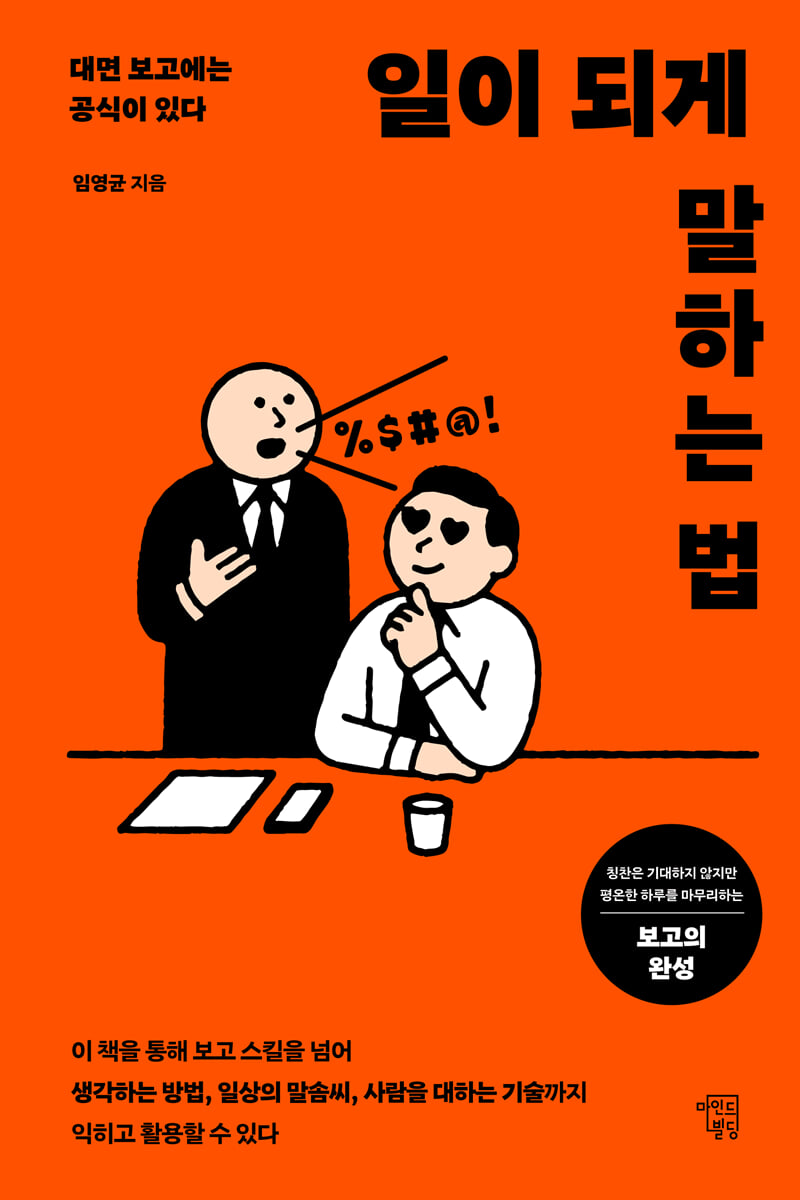
How to say things so that they get done
 |
Description
Book Introduction
There is a formula for face-to-face reporting.
I don't expect compliments, but the report is complete and ends a peaceful day.
Did you have a tough day today because of all the reports? There are layers of superiors at work, but no one kindly teaches you how to report.
It's because they're busy, it's annoying, and maybe even their superiors haven't learned it properly.
Inevitably, each person learns through experience, observing and breaking things themselves, thinking, “So this is how you report.”
If your boss doesn't teach you, you have to learn on your own, but realistically, that's not easy.
If you make a mistake in your report and get scolded by your boss, you will feel a sense of injustice and deep anger(?) at that moment, and you will briefly think about learning properly, but soon you will become complacent with reality and the days will continue where you will face the barrier of reporting again.
Because there is no one to teach you and you have never learned it, reporting always remains an unfamiliar and uncomfortable experience.
This book presents a "reporting formula" that fits perfectly and can be applied directly to practice.
You can learn how to effectively convey your opinions and ideas by utilizing PREP, the most powerful speaking frame, as well as the Gapbang (Conclusion, Evidence, Method), PIE (Point, Issue, Effect), and STAR (Situation, Task, Action, Result) techniques.
Just as you can solve a variety of problems by applying a single mathematical formula to the appropriate situation, this book will help you learn and apply not only reporting skills but also thinking skills, everyday communication skills, and people skills.
I hope that reporting, which used to be daunting and difficult, can now feel like a familiar and comfortable part of everyday work.
I don't expect compliments, but the report is complete and ends a peaceful day.
Did you have a tough day today because of all the reports? There are layers of superiors at work, but no one kindly teaches you how to report.
It's because they're busy, it's annoying, and maybe even their superiors haven't learned it properly.
Inevitably, each person learns through experience, observing and breaking things themselves, thinking, “So this is how you report.”
If your boss doesn't teach you, you have to learn on your own, but realistically, that's not easy.
If you make a mistake in your report and get scolded by your boss, you will feel a sense of injustice and deep anger(?) at that moment, and you will briefly think about learning properly, but soon you will become complacent with reality and the days will continue where you will face the barrier of reporting again.
Because there is no one to teach you and you have never learned it, reporting always remains an unfamiliar and uncomfortable experience.
This book presents a "reporting formula" that fits perfectly and can be applied directly to practice.
You can learn how to effectively convey your opinions and ideas by utilizing PREP, the most powerful speaking frame, as well as the Gapbang (Conclusion, Evidence, Method), PIE (Point, Issue, Effect), and STAR (Situation, Task, Action, Result) techniques.
Just as you can solve a variety of problems by applying a single mathematical formula to the appropriate situation, this book will help you learn and apply not only reporting skills but also thinking skills, everyday communication skills, and people skills.
I hope that reporting, which used to be daunting and difficult, can now feel like a familiar and comfortable part of everyday work.
- You can preview some of the book's contents.
Preview
index
Author's Note: Were you having a hard time because of the report today?
Starting with the language of work, not everyday language
PART.
1 Report Contents
CH.1 Issue Reporting: Report the problem by bundling the solution.
CH.2 The order in which the other person is curious, not the order in which you thought about the idea
CH.3 Work Reporting Let's create a routine for daily work reporting.
PART.
2 Reporting Skills
CH.1 Speaking skills that make your report stand out
CH.2 How to Respond to Feedback: Effectively Responding to Your Boss's Opinions
CH.3 Boss Types Let's understand your boss's personality and provide a customized report.
PART.
3 Reporting Attitude
CH.1 Determining the reporting time of, by, and for the superior
CH.2 Reporting Instructions The beginning and completion of reporting is at the moment of receiving work instructions.
CH.3 Manners in Reporting Manners make reports, and manners determine the completion of reports.
In closing, I look forward to the day when we can continue to share and collaborate.
Starting with the language of work, not everyday language
PART.
1 Report Contents
CH.1 Issue Reporting: Report the problem by bundling the solution.
CH.2 The order in which the other person is curious, not the order in which you thought about the idea
CH.3 Work Reporting Let's create a routine for daily work reporting.
PART.
2 Reporting Skills
CH.1 Speaking skills that make your report stand out
CH.2 How to Respond to Feedback: Effectively Responding to Your Boss's Opinions
CH.3 Boss Types Let's understand your boss's personality and provide a customized report.
PART.
3 Reporting Attitude
CH.1 Determining the reporting time of, by, and for the superior
CH.2 Reporting Instructions The beginning and completion of reporting is at the moment of receiving work instructions.
CH.3 Manners in Reporting Manners make reports, and manners determine the completion of reports.
In closing, I look forward to the day when we can continue to share and collaborate.
Into the book
Having one solution leaves you with no alternatives if it fails, but having multiple solutions gives you the peace of mind that you can respond flexibly to different situations.
In a position of responsibility, you always have to think about Plan B.
It is best to understand the situation and position of these superiors and, if possible, suggest two or three alternatives to give them a chance to choose.
At this time, it would be good to present the characteristics of each alternative by comparing and analyzing them, and the direct comparison method and weighted comparison method are mainly used.
--- p.36
When you first start riding a bike, you're afraid of falling, it's hard to keep your balance, and it's not even easy to put your feet on the pedals.
But once you learn how to ride a bike properly, no one will ever be conscious of how to ride a bike again.
You can freely control your speed and direction, enjoy the surrounding scenery, and fully enjoy riding your bike.
I think the same goes for PREP.
It may feel awkward at first and difficult to fit your thoughts into a set framework.
It is not easy to come up with a conclusion, distinguish between reasons and grounds, and speak while considering logical connections.
However, if you consistently develop the habit of organizing and reporting your thoughts using PREP, at some point, a natural logic and flow will emerge without you even realizing it, and the moment will come when you can report effectively.
--- p.58~59
The habit of hiding behind vague words and confusing the other person when reporting lowers the quality of the report and ultimately causes you to lose your superior's trust.
Speaking in numbers makes it clear and gives power to your reports.
Of course, it takes some effort and practice to be able to express it in numbers.
However, the amount of effort and time spent practicing will ultimately lead to trust and recognition.
It would be no exaggeration to say that the level of reporting depends on one's ability to use numbers.
--- p.106
It doesn't really matter whether you're good at answering questions you don't know or not.
More importantly, it is important to maintain trust with your boss.
Pretending to know the answer to a question you don't know or being overly passive is a quick way to lose your boss's trust.
It is important to appropriately utilize three strategies: being honest and asking questions, laying the groundwork and speaking carefully, or promising to report back later and delaying the conversation.
This way, you will be able to respond effectively to questions you don't know without being flustered, and maintain trust with your boss.
--- p.133
Bosses often use vague language rather than direct expressions.
I want my subordinates to interpret and handle it appropriately, but I don't want to burden them.
The problem arises when employees accept the boss's intentions superficially and do nothing about it.
Of course, if you take your boss's words at face value, you can feel comfortable both physically and mentally.
But if you want to work more proactively and grow, you need to actively interpret what your boss says.
You need to listen carefully and actively interpret to understand your boss's hidden messages.
--- p.182~183
A report is not evaluated solely on its content.
The reporter's facial expressions, gaze, gestures, voice, and distance are also important factors that determine the reliability of the report.
If you pay attention to a trustworthy expression and gaze, a neat posture and natural gestures, a rhythmic voice, and even the reporting distance, the persuasiveness of your report will be greatly enhanced.
In a position of responsibility, you always have to think about Plan B.
It is best to understand the situation and position of these superiors and, if possible, suggest two or three alternatives to give them a chance to choose.
At this time, it would be good to present the characteristics of each alternative by comparing and analyzing them, and the direct comparison method and weighted comparison method are mainly used.
--- p.36
When you first start riding a bike, you're afraid of falling, it's hard to keep your balance, and it's not even easy to put your feet on the pedals.
But once you learn how to ride a bike properly, no one will ever be conscious of how to ride a bike again.
You can freely control your speed and direction, enjoy the surrounding scenery, and fully enjoy riding your bike.
I think the same goes for PREP.
It may feel awkward at first and difficult to fit your thoughts into a set framework.
It is not easy to come up with a conclusion, distinguish between reasons and grounds, and speak while considering logical connections.
However, if you consistently develop the habit of organizing and reporting your thoughts using PREP, at some point, a natural logic and flow will emerge without you even realizing it, and the moment will come when you can report effectively.
--- p.58~59
The habit of hiding behind vague words and confusing the other person when reporting lowers the quality of the report and ultimately causes you to lose your superior's trust.
Speaking in numbers makes it clear and gives power to your reports.
Of course, it takes some effort and practice to be able to express it in numbers.
However, the amount of effort and time spent practicing will ultimately lead to trust and recognition.
It would be no exaggeration to say that the level of reporting depends on one's ability to use numbers.
--- p.106
It doesn't really matter whether you're good at answering questions you don't know or not.
More importantly, it is important to maintain trust with your boss.
Pretending to know the answer to a question you don't know or being overly passive is a quick way to lose your boss's trust.
It is important to appropriately utilize three strategies: being honest and asking questions, laying the groundwork and speaking carefully, or promising to report back later and delaying the conversation.
This way, you will be able to respond effectively to questions you don't know without being flustered, and maintain trust with your boss.
--- p.133
Bosses often use vague language rather than direct expressions.
I want my subordinates to interpret and handle it appropriately, but I don't want to burden them.
The problem arises when employees accept the boss's intentions superficially and do nothing about it.
Of course, if you take your boss's words at face value, you can feel comfortable both physically and mentally.
But if you want to work more proactively and grow, you need to actively interpret what your boss says.
You need to listen carefully and actively interpret to understand your boss's hidden messages.
--- p.182~183
A report is not evaluated solely on its content.
The reporter's facial expressions, gaze, gestures, voice, and distance are also important factors that determine the reliability of the report.
If you pay attention to a trustworthy expression and gaze, a neat posture and natural gestures, a rhythmic voice, and even the reporting distance, the persuasiveness of your report will be greatly enhanced.
--- p.202
Publisher's Review
A book for new employees who don't know how to report!
A must-read for "workaholics" who get scolded by their bosses because of their reports!
A book for "hard workers" who want to improve their work life and careers even more than they do now!
People who need this book right now
· I once got asked a counter-question because I couldn't understand what was being said.
· Have you ever heard someone ask you what you want to say?
· I never thought about how I would say something before I spoke.
· There have been times when work progress was difficult due to communication problems.
· I've said things out loud, without thinking about it in any particular order.
· I have never been able to grasp the main point of a statement.
· I've said everything I wanted to say.
· I've heard people say to get to the point first.
· I've been cursed at for talking too long
The language of work reporting should be different from everyday language.
If your boss asks about the situation, the report should be a concise explanation of the situation, not the background of the work.
The order in which I think and the words I want to say are everyday language, not work language.
The language of work, reporting, is to speak in order, focusing on what the other person wants to know most.
In the language of work, there are verbal and written reports.
A report given verbally is called an “oral report,” and a report given in writing is called a “written report” or “report.”
Of course, at first, writing a report may feel more difficult.
The content must be organized logically, the sentences must be clean, and even the visual presentation must be taken into consideration.
But, in fact, the really difficult thing is the oral report.
Oral reports leave you with little time to organize your thoughts in response to your boss's questions, and the pressure of seeing your boss's diverse(?) reactions unfold before your eyes inevitably increases. It's also difficult to remember everything your boss has reported verbally.
Therefore, oral reports require the skill to be organized and delivered more systematically and concisely than written reports.
Reporting formulas that can be applied to different situations like mathematical formulas
Issue reporting, idea reporting, work reporting.
If the content of the report is different, the reporting method must also be different.
First: Issue Report
① Problem + Solution
- When a problem occurs, report the solution you have thought of as the person in charge (practitioner).
② Multiple alternatives + my choice
- Consider 2-3 alternatives and emphasize the excellence of the alternative you have chosen through an evaluation of the alternatives.
③ Layered speaking style
- End the sentence with a question mark (?) using layered speech to increase the other person's receptivity.
Second: Report the idea
① Organize and report using PREP, and use the remaining three methods depending on the situation.
- Speak in the order of Point (conclusion), Reason (reason), Example (basis), and end with Point (re-emphasize the conclusion).
② Absence method (conclusion, basis, method)
③ PIE (Point · Issue · Effect)
④ STAR (Situation, Task, Action, Result)
Third: Work Report
① Past (Done) → Report results
② Present (Doing) → Status report
③ Future (Will do) → Plan report
Whether it's speech or writing, structure is the answer.
One of the most common complaints from superiors about reports is that they are not organized systematically.
“What’s so complicated?”
“Can’t you organize it into a bigger picture?”
At this time, let's organize and structure the report content systematically and quickly complete the report within working hours.
"Structuring" refers to the method of grouping similar content into chunks rather than individual pieces. Using this in reporting allows you to convey information to the other party more systematically.
This is because our brain uses an important mechanism called “chunking” when processing information.
Chunking is the process of remembering multiple pieces of information by grouping them into larger meaningful units.
Simply put, it is a method of remembering information with similar meanings by grouping them together rather than remembering multiple pieces of information individually.
There are three structuring patterns that are frequently used in reporting: relative (opposite), sequential (time), and domain (person) patterns.
Of course, there are many other patterns, but if you know just three of them, you can organize and report information systematically.
When a lot of information is conveyed to the other person without being organized, it becomes like poison that complicates and confuses the other person's mind.
If you group each item into a chunk and report it in a structured manner, it will be easier on the other person's brain, and the probability of the report being passed will also increase.
A must-read for "workaholics" who get scolded by their bosses because of their reports!
A book for "hard workers" who want to improve their work life and careers even more than they do now!
People who need this book right now
· I once got asked a counter-question because I couldn't understand what was being said.
· Have you ever heard someone ask you what you want to say?
· I never thought about how I would say something before I spoke.
· There have been times when work progress was difficult due to communication problems.
· I've said things out loud, without thinking about it in any particular order.
· I have never been able to grasp the main point of a statement.
· I've said everything I wanted to say.
· I've heard people say to get to the point first.
· I've been cursed at for talking too long
The language of work reporting should be different from everyday language.
If your boss asks about the situation, the report should be a concise explanation of the situation, not the background of the work.
The order in which I think and the words I want to say are everyday language, not work language.
The language of work, reporting, is to speak in order, focusing on what the other person wants to know most.
In the language of work, there are verbal and written reports.
A report given verbally is called an “oral report,” and a report given in writing is called a “written report” or “report.”
Of course, at first, writing a report may feel more difficult.
The content must be organized logically, the sentences must be clean, and even the visual presentation must be taken into consideration.
But, in fact, the really difficult thing is the oral report.
Oral reports leave you with little time to organize your thoughts in response to your boss's questions, and the pressure of seeing your boss's diverse(?) reactions unfold before your eyes inevitably increases. It's also difficult to remember everything your boss has reported verbally.
Therefore, oral reports require the skill to be organized and delivered more systematically and concisely than written reports.
Reporting formulas that can be applied to different situations like mathematical formulas
Issue reporting, idea reporting, work reporting.
If the content of the report is different, the reporting method must also be different.
First: Issue Report
① Problem + Solution
- When a problem occurs, report the solution you have thought of as the person in charge (practitioner).
② Multiple alternatives + my choice
- Consider 2-3 alternatives and emphasize the excellence of the alternative you have chosen through an evaluation of the alternatives.
③ Layered speaking style
- End the sentence with a question mark (?) using layered speech to increase the other person's receptivity.
Second: Report the idea
① Organize and report using PREP, and use the remaining three methods depending on the situation.
- Speak in the order of Point (conclusion), Reason (reason), Example (basis), and end with Point (re-emphasize the conclusion).
② Absence method (conclusion, basis, method)
③ PIE (Point · Issue · Effect)
④ STAR (Situation, Task, Action, Result)
Third: Work Report
① Past (Done) → Report results
② Present (Doing) → Status report
③ Future (Will do) → Plan report
Whether it's speech or writing, structure is the answer.
One of the most common complaints from superiors about reports is that they are not organized systematically.
“What’s so complicated?”
“Can’t you organize it into a bigger picture?”
At this time, let's organize and structure the report content systematically and quickly complete the report within working hours.
"Structuring" refers to the method of grouping similar content into chunks rather than individual pieces. Using this in reporting allows you to convey information to the other party more systematically.
This is because our brain uses an important mechanism called “chunking” when processing information.
Chunking is the process of remembering multiple pieces of information by grouping them into larger meaningful units.
Simply put, it is a method of remembering information with similar meanings by grouping them together rather than remembering multiple pieces of information individually.
There are three structuring patterns that are frequently used in reporting: relative (opposite), sequential (time), and domain (person) patterns.
Of course, there are many other patterns, but if you know just three of them, you can organize and report information systematically.
When a lot of information is conveyed to the other person without being organized, it becomes like poison that complicates and confuses the other person's mind.
If you group each item into a chunk and report it in a structured manner, it will be easier on the other person's brain, and the probability of the report being passed will also increase.
GOODS SPECIFICS
- Date of issue: June 27, 2025
- Page count, weight, size: 204 pages | 140*188*20mm
- ISBN13: 9791192886930
- ISBN10: 1192886933
You may also like
카테고리
korean


korean

![GQ KOREA Mark (Monthly): December [2025]](http://librairie.coreenne.fr/cdn/shop/files/8ef265dbbfbf186523ed75ba7319009d.jpg?v=1765340328&width=3840)


