

The illusion of marketing
 |
Description
Book Introduction
★ Amazon Japan Economics and Management Bestseller
★ Became a hot topic on social media immediately after its release in the local market
★ "A sophisticated compass that helps you see the real market and consumers."
Recommended by Jihye Choi, co-author of "Trend Korea 2025," and Munjeong Jang, author of "Don't Sell, Let People Buy."
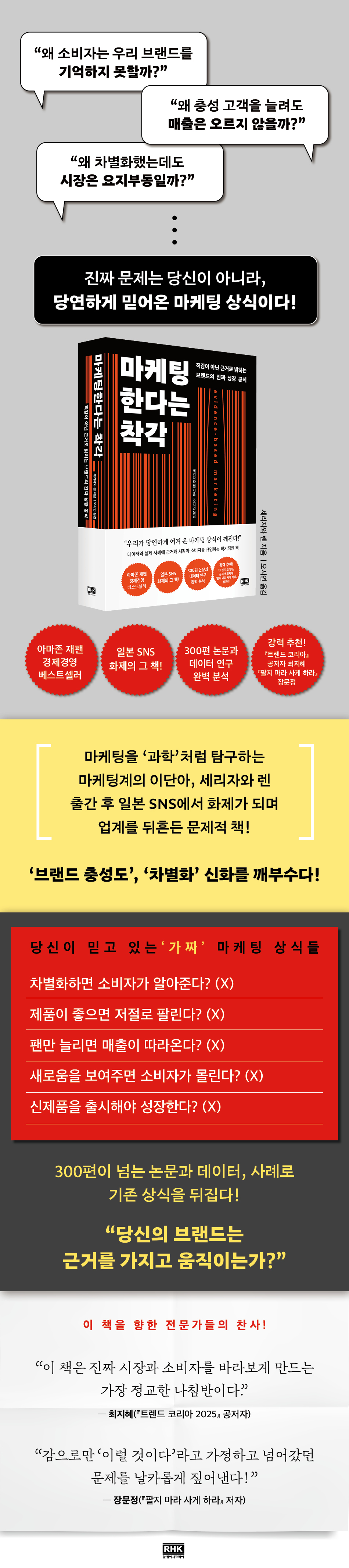
Differentiation leads to sales? A good product will sell itself? Growing your fan base will boost sales? Everyone in marketing has heard these words at least once.
But how effective are these words in practice? "The Marketing Illusion" fundamentally revisits the marketing wisdom we've taken for granted.
It coldly reveals how powerless marketing techniques, often packaged as 'success stories', are in the real market.
To achieve this, the book brings together 300 papers and a vast amount of data.
We look at marketing strategies based on ‘evidence’ rather than ‘feelings’.
In particular, while existing marketing books have emphasized 'differentiation' and 'building a fan base,' 'The Marketing Illusion' persuasively presents, based on evidence, the logic that 'you don't necessarily have to be different from others' and 'it is more effective to spread the word widely than to dig deep.'
Since its publication, the book has become a bestseller on Amazon Japan, sparking both controversy and enthusiastic sympathy among practitioners.
On Japanese social media, responses continued, such as, “My questions have been answered,” “It made me reflect on what marketing I learned,” and “This is the best marketing book I’ve ever read.” Within the marketing industry, it was also praised as “a book that reveals the true nature of the market, hidden behind flashy success stories.”
★ Became a hot topic on social media immediately after its release in the local market
★ "A sophisticated compass that helps you see the real market and consumers."
Recommended by Jihye Choi, co-author of "Trend Korea 2025," and Munjeong Jang, author of "Don't Sell, Let People Buy."
Differentiation leads to sales? A good product will sell itself? Growing your fan base will boost sales? Everyone in marketing has heard these words at least once.
But how effective are these words in practice? "The Marketing Illusion" fundamentally revisits the marketing wisdom we've taken for granted.
It coldly reveals how powerless marketing techniques, often packaged as 'success stories', are in the real market.
To achieve this, the book brings together 300 papers and a vast amount of data.
We look at marketing strategies based on ‘evidence’ rather than ‘feelings’.
In particular, while existing marketing books have emphasized 'differentiation' and 'building a fan base,' 'The Marketing Illusion' persuasively presents, based on evidence, the logic that 'you don't necessarily have to be different from others' and 'it is more effective to spread the word widely than to dig deep.'
Since its publication, the book has become a bestseller on Amazon Japan, sparking both controversy and enthusiastic sympathy among practitioners.
On Japanese social media, responses continued, such as, “My questions have been answered,” “It made me reflect on what marketing I learned,” and “This is the best marketing book I’ve ever read.” Within the marketing industry, it was also praised as “a book that reveals the true nature of the market, hidden behind flashy success stories.”
- You can preview some of the book's contents.
Preview
index
Praise from those who read this book first
Before we discuss WHO, WHAT, and HOW, here's what we'll talk about.
How well-founded is the marketing theory of the introduction?
Part 1: Do consumers really move like that?
: Problems before WHO
Chapter 1: New Customers, Existing Customers: Where Are the Keys to Growth?
1-1 The very question, "Which is more important, new customers or existing customers?" is flawed.
1-2 How well can a brand prevent customer defection?
1-3 Acquiring new customers, preventing churn, somewhere in between
1-4 Growth factors vary depending on market share
| Practical Points | Is Following Success Stories the Right Answer?
Chapter 2: Is there evidence that customers are loyal to the brand?
2-1 The actual Pareto share is 50-60%.
2-2 Understanding the Reality of Heavy and Light Users
2-3 How many people love our brand and buy it a lot?
2-4 Is having a lot of heavy users really a strength?
2-5 Is the niche strategy you are talking about really a strategy?
2-6 Don't confuse variables with constants, cause with effect.
2-7 The target market varies depending on the market.
2-8 Understand why ordinary consumers choose your brand.
Chapter 3: How is a customer's 'want to buy' created?
3-1 Is it enough to just give consumers a positive perception?
3-2 Does attitude change behavior, or does behavior change attitude?
3-3 The Trap of Saying 'I'm Interested in Buying This Brand'
3-4 The Pitfalls of Saying "I Would Recommend This Brand"
| Practical Points | Should I address the 'reasons for not buying' or provide 'reasons for buying'?
3-5 How much can marketing actually increase sales?
3-6 It is important to connect with consumers' daily lives.
3-7 Even if you like it today, you don't know about tomorrow.
| Practical Points | The Problems with Marketing as It Has Been Done
Part 2: Is your product price justified?
: WHAT Previous Problem
Chapter 4 Have you ever doubted your differentiation strategy?
4-1 Avoiding competition is different from winning competition.
4-2 Will people who have been indifferent until now buy the product?
4-3 Differentiation is not a strategy to create nonexistent demand.
4-4 The Difference Between 'Differentiating' and 'Being Differentiated'
4-5 Most brands grow along this 'line'
How to Distinguish Between a 4-6 Niche Market and a Simple White Space
Even if you change the 4-7 images, the 'fighting location' and 'fighting opponent' do not change.
| Practical Points | What Differentiates Consumers Is Context, Not Brand
Chapter 5: Reevaluate Your Price Promotions
5-1 What is the basis for setting your prices?
5-2 Set a price that matches the value of the product.
5-3 When and what do consumers most readily open their wallets for?
5-4 How do we determine the price that maximizes profits?
What 5-5 Price Promotions Can and Can't Do
5-6 You must not be swayed by unreasonable demands from consumers.
| Practical Points | Volume Strategy vs. Margin Strategy: Where Should You Focus?
Chapter 6: The Real Way for New Products to Survive
6-1 What are the success and survival rates of new products?
6-2 Understand incremental penetration, the key to a brand portfolio.
6-3 The success and failure of new products: the facts at the crossroads
6-4 Is it really a problem of product power or planning ability?
6-5 Post-launch strategy for new products as seen through evidence
6-6 The main product is always the one that needs to be pushed.
6-7 How to distinguish between products to keep in your portfolio and those to eliminate
How should brands 6-8 become premium?
6-9 How to find a new subcategory to enter
The Pitfall of 6-10 Renewal: Wasn't 'Newness' the Goal?
6-11 logo and packaging do not need profound meaning.
Part 3: How Strategic Is Your Advertising?
: HOW Previous problem
Chapter 7: Surprising Facts About Brand Image and Positioning
7-1 Brand Image is a Consequence, Not a Cause
| Practical Tips | How to Change Consumer Perception
7-2 Is brand personality a product of marketers' imagination?
7-3 Positioning Strategy: The Illusion of "Independent Positioning"
7-4 Why 'That Brand' Appears to Succeed with One Positioning
7-5 Manage Category Entry Points to Grow
7-6 6W 1H Framework, Exploring CEP
| Practical Tips | Hints for Finding Your Brand's CEP
7-7 Mental Availability, Prioritize CEP
7-8 Retrieval Design: Designing Customer Recall
7-9 Reinterpret your brand to deliver the value customers want.
7-10 Misconceptions About Brand Consistency: Consumers Don't Get Confused
Chapter 8: Is there a strategy for creativity?
8-1 How would sales and market share change if advertising were stopped?
8-2 What Advertising Can and Can't Do
| Practical Points | Can an advertisement that persuades bosses also persuade consumers?
8-3 How many times should an advertisement contact the customer?
| Practical Tips | The 95:5 Rule: Why Non-Customers Matter in B2B and Service Industries
8-4 Can creative advertising be effective even if the advertising scope is narrow?
8-5 Are messages and expressions consistent or can they be varied?
It is a priority to secure a spot in the 8-6 category.
8-7 Funnel, aren't you calculating meaningless percentages and setting them as KPIs?
8-8 Advertising Design Methods to Promote Purchases and Increase Sales
| Practical Tips | Why People Line Up to Buy Limited Edition Sneakers
8-9 Evidence that creative advertising is linked to sales
Chapter 9: Do You Know Your Advertising Budget and Marketing ROI?
9-1 How should the advertising budget be determined?
9-2 How much should you invest in advertising during a recession?
9-3 Business Growth: "Effectiveness" Comes First, "Efficiency" Comes Later
9-4 Can you accurately calculate the ROI of your marketing?
If you only focus on 9-5 ROI, you will go bankrupt?
The Pitfall of Diminishing Returns: Profits and ROI Can Be Inversely Proportional
9-7 Should I just choose the strategy that is most cost-effective?
9-8 Let's approach it with the mindset of 'Where should I spend my next 1 won?'
Going Out_But Is That All There Is to It?
References
Before we discuss WHO, WHAT, and HOW, here's what we'll talk about.
How well-founded is the marketing theory of the introduction?
Part 1: Do consumers really move like that?
: Problems before WHO
Chapter 1: New Customers, Existing Customers: Where Are the Keys to Growth?
1-1 The very question, "Which is more important, new customers or existing customers?" is flawed.
1-2 How well can a brand prevent customer defection?
1-3 Acquiring new customers, preventing churn, somewhere in between
1-4 Growth factors vary depending on market share
| Practical Points | Is Following Success Stories the Right Answer?
Chapter 2: Is there evidence that customers are loyal to the brand?
2-1 The actual Pareto share is 50-60%.
2-2 Understanding the Reality of Heavy and Light Users
2-3 How many people love our brand and buy it a lot?
2-4 Is having a lot of heavy users really a strength?
2-5 Is the niche strategy you are talking about really a strategy?
2-6 Don't confuse variables with constants, cause with effect.
2-7 The target market varies depending on the market.
2-8 Understand why ordinary consumers choose your brand.
Chapter 3: How is a customer's 'want to buy' created?
3-1 Is it enough to just give consumers a positive perception?
3-2 Does attitude change behavior, or does behavior change attitude?
3-3 The Trap of Saying 'I'm Interested in Buying This Brand'
3-4 The Pitfalls of Saying "I Would Recommend This Brand"
| Practical Points | Should I address the 'reasons for not buying' or provide 'reasons for buying'?
3-5 How much can marketing actually increase sales?
3-6 It is important to connect with consumers' daily lives.
3-7 Even if you like it today, you don't know about tomorrow.
| Practical Points | The Problems with Marketing as It Has Been Done
Part 2: Is your product price justified?
: WHAT Previous Problem
Chapter 4 Have you ever doubted your differentiation strategy?
4-1 Avoiding competition is different from winning competition.
4-2 Will people who have been indifferent until now buy the product?
4-3 Differentiation is not a strategy to create nonexistent demand.
4-4 The Difference Between 'Differentiating' and 'Being Differentiated'
4-5 Most brands grow along this 'line'
How to Distinguish Between a 4-6 Niche Market and a Simple White Space
Even if you change the 4-7 images, the 'fighting location' and 'fighting opponent' do not change.
| Practical Points | What Differentiates Consumers Is Context, Not Brand
Chapter 5: Reevaluate Your Price Promotions
5-1 What is the basis for setting your prices?
5-2 Set a price that matches the value of the product.
5-3 When and what do consumers most readily open their wallets for?
5-4 How do we determine the price that maximizes profits?
What 5-5 Price Promotions Can and Can't Do
5-6 You must not be swayed by unreasonable demands from consumers.
| Practical Points | Volume Strategy vs. Margin Strategy: Where Should You Focus?
Chapter 6: The Real Way for New Products to Survive
6-1 What are the success and survival rates of new products?
6-2 Understand incremental penetration, the key to a brand portfolio.
6-3 The success and failure of new products: the facts at the crossroads
6-4 Is it really a problem of product power or planning ability?
6-5 Post-launch strategy for new products as seen through evidence
6-6 The main product is always the one that needs to be pushed.
6-7 How to distinguish between products to keep in your portfolio and those to eliminate
How should brands 6-8 become premium?
6-9 How to find a new subcategory to enter
The Pitfall of 6-10 Renewal: Wasn't 'Newness' the Goal?
6-11 logo and packaging do not need profound meaning.
Part 3: How Strategic Is Your Advertising?
: HOW Previous problem
Chapter 7: Surprising Facts About Brand Image and Positioning
7-1 Brand Image is a Consequence, Not a Cause
| Practical Tips | How to Change Consumer Perception
7-2 Is brand personality a product of marketers' imagination?
7-3 Positioning Strategy: The Illusion of "Independent Positioning"
7-4 Why 'That Brand' Appears to Succeed with One Positioning
7-5 Manage Category Entry Points to Grow
7-6 6W 1H Framework, Exploring CEP
| Practical Tips | Hints for Finding Your Brand's CEP
7-7 Mental Availability, Prioritize CEP
7-8 Retrieval Design: Designing Customer Recall
7-9 Reinterpret your brand to deliver the value customers want.
7-10 Misconceptions About Brand Consistency: Consumers Don't Get Confused
Chapter 8: Is there a strategy for creativity?
8-1 How would sales and market share change if advertising were stopped?
8-2 What Advertising Can and Can't Do
| Practical Points | Can an advertisement that persuades bosses also persuade consumers?
8-3 How many times should an advertisement contact the customer?
| Practical Tips | The 95:5 Rule: Why Non-Customers Matter in B2B and Service Industries
8-4 Can creative advertising be effective even if the advertising scope is narrow?
8-5 Are messages and expressions consistent or can they be varied?
It is a priority to secure a spot in the 8-6 category.
8-7 Funnel, aren't you calculating meaningless percentages and setting them as KPIs?
8-8 Advertising Design Methods to Promote Purchases and Increase Sales
| Practical Tips | Why People Line Up to Buy Limited Edition Sneakers
8-9 Evidence that creative advertising is linked to sales
Chapter 9: Do You Know Your Advertising Budget and Marketing ROI?
9-1 How should the advertising budget be determined?
9-2 How much should you invest in advertising during a recession?
9-3 Business Growth: "Effectiveness" Comes First, "Efficiency" Comes Later
9-4 Can you accurately calculate the ROI of your marketing?
If you only focus on 9-5 ROI, you will go bankrupt?
The Pitfall of Diminishing Returns: Profits and ROI Can Be Inversely Proportional
9-7 Should I just choose the strategy that is most cost-effective?
9-8 Let's approach it with the mindset of 'Where should I spend my next 1 won?'
Going Out_But Is That All There Is to It?
References
Detailed image
Into the book
Few people verify these views with data to see if they are true.
This is somewhat to be expected.
This is because it has been known for a long time, it is explained in marketing books and textbooks, and it is naturally accepted through personal experience and feeling.
So, when having work-related conversations or creating presentations, you may have taken this for granted without much question.
Some marketers may be accustomed to formulating strategies, developing countermeasures, and evaluating projects based on these implicit understandings.
But from that point on, we need to review again.
--- p.13~14
Surprisingly, many marketers are drawn to stories rather than facts.
Any ideas put forward to explain markets and consumer behavior are merely hypotheses.
But once it is given a name and solidified into a plausible story or example, it soon becomes recognized as a real causal relationship.
The same goes for the plan.
Evaluation is determined by whether it is persuasive rather than whether it is true or not, and whether it has a 'plausibility' that the public can easily accept.
--- p.38
There is something to note here.
Just because big companies strive to build customer loyalty doesn't mean smaller companies can do the same and grow.
When I read news articles about famous and fast-growing brands achieving success through effective fan marketing and loyalty-building strategies, I sometimes think, "Look, isn't loyalty and fan development really important? Even small brands like us should follow suit."
This thinking can lead you to choose the wrong tool.
Because loyalty-enhancing policies are designed to drive behavior from existing customers, they are more effective when the customer base is large.
But that's not the case for small brands.
First, we need to focus on acquiring new customers and expanding our customer base.
--- p.81
Let's say an experienced marketer has some framework in mind based on experience or theory.
These frameworks are naturally over-optimized for the market environment, category purchasing process, and customer base of the brand, and may not be flexibly applicable in other markets.
This is precisely why, despite adopting techniques and practices, the expected results aren't achieved. Long-established consumer goods brands have tried to replicate the methods used by successful IT startups, but to no avail.
Conversely, when a framework that had proven effective in general consumer goods was applied to the field of innovative technologies, the results were significantly different from expectations.
There are too many such 'failures of success stories' to list them all.
--- p.84
'Targeting a niche market from the beginning' and 'initially aiming for scale but ultimately remaining in a niche market' are two entirely different stories.
In the former case, there is no particular problem, but the problem is in the latter case.
Despite clearly failing to scale their business, there are many who act as if their goal was a niche market from the beginning.
They interpret reality as, 'We're aiming to grow in a niche market,' 'We have a solid core fan base and a solid positioning,' and 'That's okay.'
--- p.109~110
Existing customers remember a brand's advertising twice as much as non-customers, but non-customers respond less than half as well to brand differentiation as existing customers.
Research has shown that price promotions primarily target existing customers or consumers with previous experience with the brand, and do not significantly attract new customers.
Likewise, the reason you feel the value of the premium line is because you know the existing regular line.
Also, the reason people react to lower-priced subcategories or discount policies is because they have a reference price formed based on past purchasing experiences or memories.
However, research results show that even among such existing customers, only about 10% of them purchase the product while being aware of the fact that it is differentiated.
--- p.202~203
Another way to look at this is that successful groups invest a year in developing new products, while unsuccessful groups may simply have had their new products quickly identified or not given enough time.
For example, when launching a new product, promotions are often conducted in the form of 'running a lot of advertising in the beginning and then observing the response.'
As we'll discuss in more detail later, advertising response is highest immediately after launch, so leveraging sales promotion strategies during this time may be a good choice.
However, if marketing activities stop here, the problem arises that marketing ends before reaching the light user base that will drive growth.
This is somewhat to be expected.
This is because it has been known for a long time, it is explained in marketing books and textbooks, and it is naturally accepted through personal experience and feeling.
So, when having work-related conversations or creating presentations, you may have taken this for granted without much question.
Some marketers may be accustomed to formulating strategies, developing countermeasures, and evaluating projects based on these implicit understandings.
But from that point on, we need to review again.
--- p.13~14
Surprisingly, many marketers are drawn to stories rather than facts.
Any ideas put forward to explain markets and consumer behavior are merely hypotheses.
But once it is given a name and solidified into a plausible story or example, it soon becomes recognized as a real causal relationship.
The same goes for the plan.
Evaluation is determined by whether it is persuasive rather than whether it is true or not, and whether it has a 'plausibility' that the public can easily accept.
--- p.38
There is something to note here.
Just because big companies strive to build customer loyalty doesn't mean smaller companies can do the same and grow.
When I read news articles about famous and fast-growing brands achieving success through effective fan marketing and loyalty-building strategies, I sometimes think, "Look, isn't loyalty and fan development really important? Even small brands like us should follow suit."
This thinking can lead you to choose the wrong tool.
Because loyalty-enhancing policies are designed to drive behavior from existing customers, they are more effective when the customer base is large.
But that's not the case for small brands.
First, we need to focus on acquiring new customers and expanding our customer base.
--- p.81
Let's say an experienced marketer has some framework in mind based on experience or theory.
These frameworks are naturally over-optimized for the market environment, category purchasing process, and customer base of the brand, and may not be flexibly applicable in other markets.
This is precisely why, despite adopting techniques and practices, the expected results aren't achieved. Long-established consumer goods brands have tried to replicate the methods used by successful IT startups, but to no avail.
Conversely, when a framework that had proven effective in general consumer goods was applied to the field of innovative technologies, the results were significantly different from expectations.
There are too many such 'failures of success stories' to list them all.
--- p.84
'Targeting a niche market from the beginning' and 'initially aiming for scale but ultimately remaining in a niche market' are two entirely different stories.
In the former case, there is no particular problem, but the problem is in the latter case.
Despite clearly failing to scale their business, there are many who act as if their goal was a niche market from the beginning.
They interpret reality as, 'We're aiming to grow in a niche market,' 'We have a solid core fan base and a solid positioning,' and 'That's okay.'
--- p.109~110
Existing customers remember a brand's advertising twice as much as non-customers, but non-customers respond less than half as well to brand differentiation as existing customers.
Research has shown that price promotions primarily target existing customers or consumers with previous experience with the brand, and do not significantly attract new customers.
Likewise, the reason you feel the value of the premium line is because you know the existing regular line.
Also, the reason people react to lower-priced subcategories or discount policies is because they have a reference price formed based on past purchasing experiences or memories.
However, research results show that even among such existing customers, only about 10% of them purchase the product while being aware of the fact that it is differentiated.
--- p.202~203
Another way to look at this is that successful groups invest a year in developing new products, while unsuccessful groups may simply have had their new products quickly identified or not given enough time.
For example, when launching a new product, promotions are often conducted in the form of 'running a lot of advertising in the beginning and then observing the response.'
As we'll discuss in more detail later, advertising response is highest immediately after launch, so leveraging sales promotion strategies during this time may be a good choice.
However, if marketing activities stop here, the problem arises that marketing ends before reaching the light user base that will drive growth.
--- p.288
Publisher's Review
Over 300 papers, data, and case studies
The gap between 'illusion' and 'reality' revealed through empirical data!
"Why doesn't my painstaking marketing work meet expectations?" "The Marketing Illusion" points out that the marketing laws we take for granted may actually be illusions, and examines the reasons through over 300 papers and data.
This book, which identifies the fundamental reasons why marketing strategies fail and provides clear insights to practitioners, was called a "problem book that shook the marketing world" in Japan after its publication and became a hot topic among practitioners.
Author Ren Serizawa is a marketing scientist who explores "marketing like a science."
It combines a scientific approach based on mathematics and statistics with a humanistic perspective encompassing psychology and cultural anthropology.
This book also asks the following questions through numerous data and examples:
Is brand loyalty truly the driving force behind growth? Why isn't differentiation crucial to consumer choice? Do more fans lead to higher sales? Is new product launches the only way to achieve growth?
This is the most realistic and radical guide for today's marketers, as it dismantles the rigid framework of marketing and presents new standards based on empirical data.
Consumers don't care about brands.
The marketing common sense we took for granted is being shattered!
Looking at marketing with evidence opens up new perspectives.
For example, in marketing strategy, ‘differentiation’ has long been considered the right answer.
The belief is that consumers will remember me and ultimately choose my product if I appear different from my competitors.
This is partly due to the structure in which marketing tends to be centered around 'success stories'.
Once a campaign hits the jackpot, it's often replicated as a surefire strategy.
But data shows that only 10% of consumers recognize the differentiation and purchase the product.
Most consumers simply choose brands they are familiar with, brands they see often.
Even if marketers spend days agonizing over creating a differentiated message, consumers will often put the "familiar" in their shopping carts without even realizing it.
So, a truly effective strategy might be to focus on making your brand easily recognizable, rather than focusing on highlighting what makes you "unique."
The same goes for belief in loyalty.
The expectation that a brand will naturally grow as it gains more loyal customers has long been taken for granted.
The belief is that loyal fans will continue to purchase your products and recommend them to others.
But decades of accumulated data show that this expectation is far from reality.
Half of heavy users will no longer be heavy users within a year, and heavy users of a category are completely different from heavy users of a specific brand.
The brands that actually grew weren't the ones that reached loyal customers, but the "indifferent people" who make up 80% of all customers.
From consumer behavior to products and advertising
Revisiting all areas of marketing with 'foundation'
The book is structured in line with the 'WHO, WHAT, HOW' thought process commonly used in marketing.
Covering all areas of marketing, from consumers to products to advertising, each chapter is structured independently, allowing practitioners to quickly explore the topic of their choice as needed.
Part 1, "Do Consumers Really Act That Way?", highlights how brand loyalty is more volatile than you might think, why acquiring new customers is more important than retaining them, and why strategies aimed at growing "fans" often fail.
Part 2, "Is Your Product Price Justified?", notes that the premise that consumers recognize and purchase differentiated brands has not been empirically proven.
We review differentiation, pricing, and repositioning strategies to suggest more effective marketing plans.
Part 3, "How Strategic Is Your Advertising?", points out that many brands advertise to existing customers and then stop marketing before reaching their light users.
This chapter explores communication strategies for expanding brand penetration, brand design based on category entry points (CEPs), and misconceptions about ROI.
A challenge to the conventional wisdom of traditional marketing
A Practical Guide to Evidence-Based Marketing
This approach of questioning conventional wisdom, verifying with data, and paying attention to actual market reactions is called "evidence-based marketing."
Although it is still an unfamiliar concept in Korea, it is already forming a strong trend in the global marketing world, led by Byron Sharp of the Ehrenberg-Bass Institute.
Traditionally, marketing theories have been dominated by approaches that emphasize ‘differentiation’ and ‘positioning’, such as those of Philip Kotler and Al Ries.
But Byron Sharpe is adamant in his opposition to this.
He says that indicators such as 'awareness', 'penetration', and 'expanding light users' are far more crucial to brand growth than brand loyalty or fandom.
"The Marketing Illusion" is a book that falls into this "evidence-based marketing" trend, and contains an attempt to design marketing strategies based on research and statistics rather than on intuition or sense.
It consistently delivers the message that a 'scientific attitude' is necessary in marketing, and makes us rethink our strategies.
Amidst the constant cycle of strategy meetings, campaigns that don't live up to expectations, and stagnant sales, what should marketers be questioning now? This book is an essential reference for marketers who want to design strategies based on verifiable criteria, rather than experience and intuition. It will also serve as a guide to leading a paradigm shift in marketing.
The gap between 'illusion' and 'reality' revealed through empirical data!
"Why doesn't my painstaking marketing work meet expectations?" "The Marketing Illusion" points out that the marketing laws we take for granted may actually be illusions, and examines the reasons through over 300 papers and data.
This book, which identifies the fundamental reasons why marketing strategies fail and provides clear insights to practitioners, was called a "problem book that shook the marketing world" in Japan after its publication and became a hot topic among practitioners.
Author Ren Serizawa is a marketing scientist who explores "marketing like a science."
It combines a scientific approach based on mathematics and statistics with a humanistic perspective encompassing psychology and cultural anthropology.
This book also asks the following questions through numerous data and examples:
Is brand loyalty truly the driving force behind growth? Why isn't differentiation crucial to consumer choice? Do more fans lead to higher sales? Is new product launches the only way to achieve growth?
This is the most realistic and radical guide for today's marketers, as it dismantles the rigid framework of marketing and presents new standards based on empirical data.
Consumers don't care about brands.
The marketing common sense we took for granted is being shattered!
Looking at marketing with evidence opens up new perspectives.
For example, in marketing strategy, ‘differentiation’ has long been considered the right answer.
The belief is that consumers will remember me and ultimately choose my product if I appear different from my competitors.
This is partly due to the structure in which marketing tends to be centered around 'success stories'.
Once a campaign hits the jackpot, it's often replicated as a surefire strategy.
But data shows that only 10% of consumers recognize the differentiation and purchase the product.
Most consumers simply choose brands they are familiar with, brands they see often.
Even if marketers spend days agonizing over creating a differentiated message, consumers will often put the "familiar" in their shopping carts without even realizing it.
So, a truly effective strategy might be to focus on making your brand easily recognizable, rather than focusing on highlighting what makes you "unique."
The same goes for belief in loyalty.
The expectation that a brand will naturally grow as it gains more loyal customers has long been taken for granted.
The belief is that loyal fans will continue to purchase your products and recommend them to others.
But decades of accumulated data show that this expectation is far from reality.
Half of heavy users will no longer be heavy users within a year, and heavy users of a category are completely different from heavy users of a specific brand.
The brands that actually grew weren't the ones that reached loyal customers, but the "indifferent people" who make up 80% of all customers.
From consumer behavior to products and advertising
Revisiting all areas of marketing with 'foundation'
The book is structured in line with the 'WHO, WHAT, HOW' thought process commonly used in marketing.
Covering all areas of marketing, from consumers to products to advertising, each chapter is structured independently, allowing practitioners to quickly explore the topic of their choice as needed.
Part 1, "Do Consumers Really Act That Way?", highlights how brand loyalty is more volatile than you might think, why acquiring new customers is more important than retaining them, and why strategies aimed at growing "fans" often fail.
Part 2, "Is Your Product Price Justified?", notes that the premise that consumers recognize and purchase differentiated brands has not been empirically proven.
We review differentiation, pricing, and repositioning strategies to suggest more effective marketing plans.
Part 3, "How Strategic Is Your Advertising?", points out that many brands advertise to existing customers and then stop marketing before reaching their light users.
This chapter explores communication strategies for expanding brand penetration, brand design based on category entry points (CEPs), and misconceptions about ROI.
A challenge to the conventional wisdom of traditional marketing
A Practical Guide to Evidence-Based Marketing
This approach of questioning conventional wisdom, verifying with data, and paying attention to actual market reactions is called "evidence-based marketing."
Although it is still an unfamiliar concept in Korea, it is already forming a strong trend in the global marketing world, led by Byron Sharp of the Ehrenberg-Bass Institute.
Traditionally, marketing theories have been dominated by approaches that emphasize ‘differentiation’ and ‘positioning’, such as those of Philip Kotler and Al Ries.
But Byron Sharpe is adamant in his opposition to this.
He says that indicators such as 'awareness', 'penetration', and 'expanding light users' are far more crucial to brand growth than brand loyalty or fandom.
"The Marketing Illusion" is a book that falls into this "evidence-based marketing" trend, and contains an attempt to design marketing strategies based on research and statistics rather than on intuition or sense.
It consistently delivers the message that a 'scientific attitude' is necessary in marketing, and makes us rethink our strategies.
Amidst the constant cycle of strategy meetings, campaigns that don't live up to expectations, and stagnant sales, what should marketers be questioning now? This book is an essential reference for marketers who want to design strategies based on verifiable criteria, rather than experience and intuition. It will also serve as a guide to leading a paradigm shift in marketing.
GOODS SPECIFICS
- Date of issue: May 26, 2025
- Page count, weight, size: 544 pages | 148*218*35mm
- ISBN13: 9788925573731
- ISBN10: 8925573733
You may also like
카테고리
korean


korean

![ELLE 엘르 스페셜 에디션 A형 : 12월 [2025]](http://librairie.coreenne.fr/cdn/shop/files/b8e27a3de6c9538896439686c6b0e8fb.jpg?v=1766436872&width=3840)


