

Almost all of IT's history
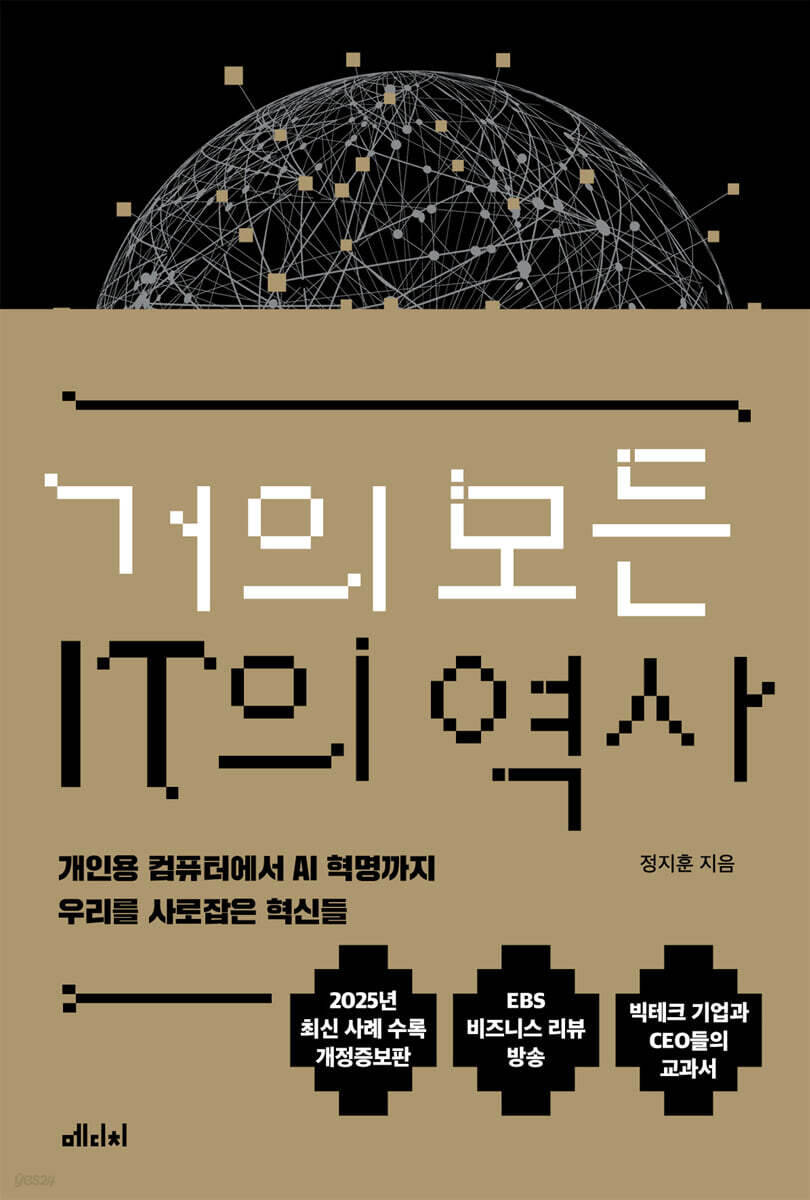 |
Description
Book Introduction
The story of IT innovation over the past 50 years rivals the entire history of mankind.
A revised and expanded edition of ChatGPIT and DeepSec's AI clash, including the chip war between big tech companies.
The history of IT is a history of great technological innovation, a history of business filled with rise and fall and heroic tales, with countless innovators, researchers, and companies emerging and writing stories of success and failure, collaboration and competition.
First published in 2010, "Almost Everything in IT" begins with the stories of Steve Jobs (Apple), Bill Gates (Microsoft), and Eric Schmidt (Google), all born in 1955, and introduces the key figures in IT history and the innovations and successes they achieved.
In 2020, the first revised and expanded edition was published as a 10th-anniversary special edition, covering the global digital transformation driven by COVID-19 and new players such as Amazon, Facebook (now Meta), and Elon Musk.
The second revised and expanded edition for 2025 delves into the era of artificial intelligence (AI).
From the shocking clash between AlphaGo and Lee Sedol to the recent surge of ChatGPIT and DeepSec, this book offers a comprehensive overview of who is leading the AI era with what innovative ideas and technologies. The AI revolution is not simply a technological advancement; it is a momentous event that fundamentally redefines the paradigms of human labor, creativity, and knowledge.
Even established powerhouses are seeking change, and the stories of newcomers like OpenAI's Sam Altman and Nvidia's Jensen Huang are fascinating.
IT is both a story of the present and a history of the future.
The 2025 revised and expanded edition of "Almost All IT History" is not just a look back at the past, but is also rich in important lessons and visions that allow us to look forward to the future.
This book provides insights for transforming our society into a more future-oriented one and maintaining our status as an IT powerhouse so as not to fall behind in the AI revolution.
A revised and expanded edition of ChatGPIT and DeepSec's AI clash, including the chip war between big tech companies.
The history of IT is a history of great technological innovation, a history of business filled with rise and fall and heroic tales, with countless innovators, researchers, and companies emerging and writing stories of success and failure, collaboration and competition.
First published in 2010, "Almost Everything in IT" begins with the stories of Steve Jobs (Apple), Bill Gates (Microsoft), and Eric Schmidt (Google), all born in 1955, and introduces the key figures in IT history and the innovations and successes they achieved.
In 2020, the first revised and expanded edition was published as a 10th-anniversary special edition, covering the global digital transformation driven by COVID-19 and new players such as Amazon, Facebook (now Meta), and Elon Musk.
The second revised and expanded edition for 2025 delves into the era of artificial intelligence (AI).
From the shocking clash between AlphaGo and Lee Sedol to the recent surge of ChatGPIT and DeepSec, this book offers a comprehensive overview of who is leading the AI era with what innovative ideas and technologies. The AI revolution is not simply a technological advancement; it is a momentous event that fundamentally redefines the paradigms of human labor, creativity, and knowledge.
Even established powerhouses are seeking change, and the stories of newcomers like OpenAI's Sam Altman and Nvidia's Jensen Huang are fascinating.
IT is both a story of the present and a history of the future.
The 2025 revised and expanded edition of "Almost All IT History" is not just a look back at the past, but is also rich in important lessons and visions that allow us to look forward to the future.
This book provides insights for transforming our society into a more future-oriented one and maintaining our status as an IT powerhouse so as not to fall behind in the AI revolution.
- You can preview some of the book's contents.
Preview
index
Preface to the 2025 Revised and Expanded Edition: Beyond the 15th Anniversary: Prologue to the AI Era: The History of Humanity is the History of IT
Characters
Chapter 1: You Can Change the World by Looking at People
The problem isn't technology, it's people.
Towards a culture brimming with creativity and originality
Chapter 2_The First Transition: The Personal Computer Revolution (1976–1985)
Two fated rivals, and the birth of a future rival.
Steve Jobs Meets Steve Wozniak
Computer geniuses found Microsoft
Apple Computers, Born at the Center of Revolution
Apple and Microsoft Join Hands
Apple II Takes Flight with VisiCalc
Gary Kildall, the ill-fated genius who shed tears over his failed IBM contract.
The advent of the IBM PC and the great leap forward of MS-DOS
Macintosh, born wearing the GUI
Marketing Guru Steve Jobs is ousted.
And the rest of the story | Paul Allen and Steve Wozniak
Chapter 3_The Second Transition: The Software Revolution (1985–1995)
Microsoft unveils the first Windows
HP and Dell Computers Emerge as Powerhouses in the PC Market
Steve Jobs' New Challenge: Launching NeXT and Pixar
And the rest of the story | The women who captivated two weirdos
Chapter 4_The Third Transition: The Internet Revolution (1993–1999)
The advent of the web world with the advent of the Navigator.
The rise of internet startups, accompanied by the dot-com bubble.
Apple's Failing Reintroduces Steve Jobs
IBM Jumps into the Open Source Camp
Two of Silicon Valley's leading venture capital firms invest in Google.
And the rest of the story | Venture Capital and Sun Microsystems
Chapter 5_The Fourth Transition: Search and the Social Revolution (1999–2006)
Talented individuals flock to Google.
The Returning Emperor Saves Apple
Steve Ballmer becomes Microsoft CEO
The dot-com bubble bursts, and Eric Schmidt emerges.
Digital Hub vs. Digital Lifestyle
Yahoo! Acquires Overture, Ends Relationship with Google
Google Takes Off with a Revenue Model
Apple shakes up the music industry with the iTunes Music Store.
Google's groundbreaking IPO and innovative services.
Facebook, the social web's powerhouse, opens
Apple's No. 2 Tim Cook is active
Google acquires YouTube
Microsoft in crisis
Chapter 6_The Fifth Transition: The Smartphone Revolution (2007–2010)
Apple redefines the iPhone
Google completely dominates the advertising market
Google Swallows Android and Enters the Battleground
Special Chapter_Almost the entire history of IT in East Asia
Japan, which gave birth to world-class electronics hardware companies
The Vulnerable History of East Asian Software
The beginning of the Internet revolution, the dynamic SoftBank and Korea's advancement
The evolution of Line Games
The Beginning of the Mobile Revolution: Samsung Electronics' Rise
Chapter 7_The Sixth Transition: The Cloud and Social Web Revolution (2010–2016)
Google Lost in the Social Web
Microsoft Joins the Social Web
PayPal Mafia Takes the World by storm
Amazon Challenges Three Giants with Web Operating Systems and E-Books
Microsoft Bet its Future on Windows 7 and Cloud Services
Apple Targets Content-Service Convergence Market with iPad
Google, Running with Android and Chrome
Chapter 8: Accelerating Digital Transformation: The Changes Driven by AI and COVID-19 (2016-2021)
Transforming from an information society to a hyper-connected society
The Evolution of the Platform Economy: A New Balance of Openness and Control
Artificial Intelligence: A New Turning Point in IT History
Accelerating Digital Transformation: The Legacy of COVID-19
Chapter 9: A New Era Ushered in by Generative AI: A Major Transformation in IT History (2022~)
ChatGPT Moment: An Inflection Point in AI History
The Epic of AI Innovation and Hegemony: From the Open Source Era to the Emergence of the DeepSeek-R1 Model
The AI Infrastructure War: A Battle Between Nations and Big Tech, the Dawn of a New Hegemony
Big Tech's New Challenges: Challenges and Tasks in the AI Era
A New Era: AI, the Metaverse, and Robots Shaping Humanity's Future
Epilogue: The Beginning of the AI Era, History Continues Timeline
Characters
Chapter 1: You Can Change the World by Looking at People
The problem isn't technology, it's people.
Towards a culture brimming with creativity and originality
Chapter 2_The First Transition: The Personal Computer Revolution (1976–1985)
Two fated rivals, and the birth of a future rival.
Steve Jobs Meets Steve Wozniak
Computer geniuses found Microsoft
Apple Computers, Born at the Center of Revolution
Apple and Microsoft Join Hands
Apple II Takes Flight with VisiCalc
Gary Kildall, the ill-fated genius who shed tears over his failed IBM contract.
The advent of the IBM PC and the great leap forward of MS-DOS
Macintosh, born wearing the GUI
Marketing Guru Steve Jobs is ousted.
And the rest of the story | Paul Allen and Steve Wozniak
Chapter 3_The Second Transition: The Software Revolution (1985–1995)
Microsoft unveils the first Windows
HP and Dell Computers Emerge as Powerhouses in the PC Market
Steve Jobs' New Challenge: Launching NeXT and Pixar
And the rest of the story | The women who captivated two weirdos
Chapter 4_The Third Transition: The Internet Revolution (1993–1999)
The advent of the web world with the advent of the Navigator.
The rise of internet startups, accompanied by the dot-com bubble.
Apple's Failing Reintroduces Steve Jobs
IBM Jumps into the Open Source Camp
Two of Silicon Valley's leading venture capital firms invest in Google.
And the rest of the story | Venture Capital and Sun Microsystems
Chapter 5_The Fourth Transition: Search and the Social Revolution (1999–2006)
Talented individuals flock to Google.
The Returning Emperor Saves Apple
Steve Ballmer becomes Microsoft CEO
The dot-com bubble bursts, and Eric Schmidt emerges.
Digital Hub vs. Digital Lifestyle
Yahoo! Acquires Overture, Ends Relationship with Google
Google Takes Off with a Revenue Model
Apple shakes up the music industry with the iTunes Music Store.
Google's groundbreaking IPO and innovative services.
Facebook, the social web's powerhouse, opens
Apple's No. 2 Tim Cook is active
Google acquires YouTube
Microsoft in crisis
Chapter 6_The Fifth Transition: The Smartphone Revolution (2007–2010)
Apple redefines the iPhone
Google completely dominates the advertising market
Google Swallows Android and Enters the Battleground
Special Chapter_Almost the entire history of IT in East Asia
Japan, which gave birth to world-class electronics hardware companies
The Vulnerable History of East Asian Software
The beginning of the Internet revolution, the dynamic SoftBank and Korea's advancement
The evolution of Line Games
The Beginning of the Mobile Revolution: Samsung Electronics' Rise
Chapter 7_The Sixth Transition: The Cloud and Social Web Revolution (2010–2016)
Google Lost in the Social Web
Microsoft Joins the Social Web
PayPal Mafia Takes the World by storm
Amazon Challenges Three Giants with Web Operating Systems and E-Books
Microsoft Bet its Future on Windows 7 and Cloud Services
Apple Targets Content-Service Convergence Market with iPad
Google, Running with Android and Chrome
Chapter 8: Accelerating Digital Transformation: The Changes Driven by AI and COVID-19 (2016-2021)
Transforming from an information society to a hyper-connected society
The Evolution of the Platform Economy: A New Balance of Openness and Control
Artificial Intelligence: A New Turning Point in IT History
Accelerating Digital Transformation: The Legacy of COVID-19
Chapter 9: A New Era Ushered in by Generative AI: A Major Transformation in IT History (2022~)
ChatGPT Moment: An Inflection Point in AI History
The Epic of AI Innovation and Hegemony: From the Open Source Era to the Emergence of the DeepSeek-R1 Model
The AI Infrastructure War: A Battle Between Nations and Big Tech, the Dawn of a New Hegemony
Big Tech's New Challenges: Challenges and Tasks in the AI Era
A New Era: AI, the Metaverse, and Robots Shaping Humanity's Future
Epilogue: The Beginning of the AI Era, History Continues Timeline
Into the book
America's greatest strength is its tolerance for risk and failure, and its robust recovery system.
Startups are inherently risky.
Of course, there are many failures.
In the US, when a young engineer fails at a startup and the company closes, it is assumed that the young person has gained experience and learned a lot, and that he or she has laid the foundation for success next time.
Of course, even big companies don't hesitate to hire people who have failed.
If our country's economy is to survive, we must create an environment where talented young people can boldly start businesses and succeed in their businesses, and at the same time, we must create an environment where their experiences are valued and they can bounce back even if they fail.
There are many ways to solve youth unemployment, but the most fundamental solution will come from rediscovering this entrepreneurial spirit and recreating the ecosystem of large corporations, small and medium-sized enterprises, and startups.
If we do not create an environment where young people can continuously create new industries based on their energy, the future of our country, where people are our greatest asset, will not be very bright.
--- p.29, from “Chapter 1: You Can Change the World by Looking at People”
Apple, barely hanging on like a dying dinosaur under a few CEOs who were well-versed in traditional industries, exploded with energy once again with the return of Steve Jobs.
Of course, the Steve Jobs who returned to Apple was not the same person he was when he was kicked out of Apple.
Apple was able to take flight again because Steve Jobs had returned as a fully-fledged CEO, possessing almost everything from vision and creativity to his signature charisma, as well as management skills, teamwork, and experience in management itself.
If John Sculley had been ousted from Apple in 1985 instead of Steve Jobs, would Apple be where it is today? If so, Steve Jobs and Apple might have fallen into failure long ago.
Would it be an exaggeration to say that today's Apple exists because John Sculley took charge of Apple at the time and handled the situation, and because there was a series of processes during which Steve Jobs returned after gaining new experiences?
--- pp.105-106, from 「Chapter 2 The First Transition: The Personal Computer Revolution」
Ideas seem to develop by biting each other.
Only Park and Xerox were unaware that the GUI, invented by Park Research, would change the world. Apple, recognizing the true value of the GUI, began commercializing it, and Microsoft, recognizing its true value again, ushered in its golden age.
It's a shame about intellectual property rights, but without them, we might still be computing by typing text commands one by one.
--- p.124, from “Chapter 3 The Second Transition: Software Revolution”
The 90s were a world dominated by the absolute power of Microsoft, but with the discovery of the new continent called the Internet, new powers emerged to quickly establish a bridgehead in the new land and expand their influence.
Apple almost lost its reputation, buried in the glory of the past, but by bringing in Steve Jobs, it laid the foundation for the future.
Microsoft was still drunk on power and was more interested in taking over territory that others had already developed than in pioneering new ones.
The declaration of entry into the war by Google, a young but powerful military force, foreshadows that the coming war will become even more intense.
--- p.198, from “Chapter 4 The Third Transition: The Internet Revolution”
The founders of Google, who dominated the most important search engine in the Internet world and even solved the long-standing problem of finding a business model, did not want to go public like other founders of other companies.
However, the IPO was now a situation that could not be postponed, and Larry Page and Sergey Brin, who wanted to do it their way if they were going to do it, pushed for an IPO in a way that was unprecedented in the history of NASDAQ.
--- p.270, from “Chapter 5 The Fourth Transition: Search and the Social Revolution”
With the iPhone's massive success, the PC-centric computing environment finally shifted to a mobile-centric one, and it seemed like Google's long-held dream of a consumer-centric computing environment was finally coming to fruition.
But Google's concerns grew along with this great success.
Google wanted to be at the center of the mobile computing era, finding and delivering the most relevant ads, but in a world dominated by iPhones, Google began to fear that it would end up playing within Apple's grasp.
Google had already acquired Android in 2005, so it had the manpower and resources to work on it.
Seeing the success of the iPhone, Google began secretly focusing its support on the Android project.
It was decided that we could not continue to allow the iPhone to dominate the world.
Google decided that it would be better for them to have the web dominate the mobile environment rather than a world dominated by hardware and software, while Apple tried to create a system that operated only at the device level whenever possible.
--- pp.313-314, from 「Chapter 6 The Fifth Transition: The Smartphone Revolution」
The main stage for almost all of IT history has been the United States.
Since multinational corporations within the United States still dominate the world, it is inevitably inevitable that we will talk about large corporations centered around the United States.
However, recently, the number of major companies in Korea, China, and Japan that have a significant impact on global IT history has been increasing, so I would like to cover the IT history of the three East Asian countries in a separate chapter.
The overall flow of IT history among the three East Asian countries can be summarized as follows: Japan, which was the first to join the ranks of advanced nations, led the way with global electronics companies such as Sony and Panasonic; however, Korea quickly caught up with Samsung Electronics' rapid growth and the spread of high-speed Internet networks; and China, which has recently experienced tremendous growth armed with its huge market size and capital, is now advancing to a level where it can compete with the United States.
--- p.318, from 「Special Chapter: Almost All of East Asian IT History」
New things keep coming out on SNS services.
Even Cyworld, which was once extremely popular, could not maintain that popularity for long, and no one knows how much longer Facebook can last.
It is only recently that new social media platforms like Instagram and TikTok have become extremely popular, especially among teenagers.
However, people's desire for 'empathy', which is the reason for the existence of SNS, will continue.
This is because the need for empathy, such as feeling joy and sorrow, pouring out angry stories, and expressing happiness and anticipation, will continue as long as we are human.
As virtual worlds proliferate and digital technologies become more widespread, people may crave more warmth and empathy.
--- p.372, from 「Special Chapter: Almost All History of IT in East Asia」
Despite all these efforts and acquisitions, Google has continued to invest in the social web.
The territory secured in the world of the social web does not seem that large (one might ask why YouTube was so successful because it also has the characteristics of the social web, but YouTube should be seen as opening up a completely different genre).
What on earth is the problem?
There are many reasons, but the biggest one is that Google is a company steeped in engineering culture and technology supremacy, making it vulnerable to social web services that require a human and emotional approach.
Social skills are necessary to effectively utilize and provide social web services, but engineers often lack social skills and are not particularly interested in them.
In other words, if Google fails to adapt to the coming social web era, one reason will be its inability to overcome its "engineer DNA."
--- p.378, from “Chapter 7 The Sixth Transition: Cloud and Social Web Revolution”
This change became an important opportunity for the 'company'-centered way of thinking and behavior, which had been maintained for a long time since the Industrial Revolution, to shift to the 'individual'.
This is a major change in society as a whole, which can be expressed as the dawn of a new era.
However, this does not mean that the power of an individual is stronger than the power of a group.
However, compared to closed groups represented by 'companies', the power of open groups in which individuals dynamically combine based on human energy is more likely to be expressed more strongly.
The power of an open group ultimately comes from the strength of each individual, and a group where each individual strengthens their capabilities and generates more creative innovation will gain a significant competitive advantage.
This is what fundamentally differentiates social web-centric innovation from the information society that preceded it.
If existing companies do not recognize these changes and transform into open groups where each member of the organization can maximize their creativity and innovation, they will inevitably be eliminated by other innovative organizations.
--- p.425, from “Chapter 8 Accelerating Digital Transformation: Changes Created by Artificial Intelligence and COVID-19”
The history of IT does not stop at the success of one era.
For a technology to truly change the world, it must first demonstrate its value and then demonstrate the potential for widespread application across a wide range of fields.
Finally, the technology must be distributed to a large number of people as a service, undergo an initial monetization process, and then spread across industries. This developmental stage is clearly evident in the AI field.
From the moment the SuperVision team demonstrated the utility of deep learning through the ImageNet Challenge in 2012 to the case of AlphaGo in 2016 showing that artificial intelligence can solve complex human problems, the evolution of technology has gradually permeated the real world.
And ChatGPT, born in 2022 by the founders of OpenAI and their adventurous spirit, symbolizes this final stage: the moment when technology actually reaches the public and becomes established as an industry.
Startups are inherently risky.
Of course, there are many failures.
In the US, when a young engineer fails at a startup and the company closes, it is assumed that the young person has gained experience and learned a lot, and that he or she has laid the foundation for success next time.
Of course, even big companies don't hesitate to hire people who have failed.
If our country's economy is to survive, we must create an environment where talented young people can boldly start businesses and succeed in their businesses, and at the same time, we must create an environment where their experiences are valued and they can bounce back even if they fail.
There are many ways to solve youth unemployment, but the most fundamental solution will come from rediscovering this entrepreneurial spirit and recreating the ecosystem of large corporations, small and medium-sized enterprises, and startups.
If we do not create an environment where young people can continuously create new industries based on their energy, the future of our country, where people are our greatest asset, will not be very bright.
--- p.29, from “Chapter 1: You Can Change the World by Looking at People”
Apple, barely hanging on like a dying dinosaur under a few CEOs who were well-versed in traditional industries, exploded with energy once again with the return of Steve Jobs.
Of course, the Steve Jobs who returned to Apple was not the same person he was when he was kicked out of Apple.
Apple was able to take flight again because Steve Jobs had returned as a fully-fledged CEO, possessing almost everything from vision and creativity to his signature charisma, as well as management skills, teamwork, and experience in management itself.
If John Sculley had been ousted from Apple in 1985 instead of Steve Jobs, would Apple be where it is today? If so, Steve Jobs and Apple might have fallen into failure long ago.
Would it be an exaggeration to say that today's Apple exists because John Sculley took charge of Apple at the time and handled the situation, and because there was a series of processes during which Steve Jobs returned after gaining new experiences?
--- pp.105-106, from 「Chapter 2 The First Transition: The Personal Computer Revolution」
Ideas seem to develop by biting each other.
Only Park and Xerox were unaware that the GUI, invented by Park Research, would change the world. Apple, recognizing the true value of the GUI, began commercializing it, and Microsoft, recognizing its true value again, ushered in its golden age.
It's a shame about intellectual property rights, but without them, we might still be computing by typing text commands one by one.
--- p.124, from “Chapter 3 The Second Transition: Software Revolution”
The 90s were a world dominated by the absolute power of Microsoft, but with the discovery of the new continent called the Internet, new powers emerged to quickly establish a bridgehead in the new land and expand their influence.
Apple almost lost its reputation, buried in the glory of the past, but by bringing in Steve Jobs, it laid the foundation for the future.
Microsoft was still drunk on power and was more interested in taking over territory that others had already developed than in pioneering new ones.
The declaration of entry into the war by Google, a young but powerful military force, foreshadows that the coming war will become even more intense.
--- p.198, from “Chapter 4 The Third Transition: The Internet Revolution”
The founders of Google, who dominated the most important search engine in the Internet world and even solved the long-standing problem of finding a business model, did not want to go public like other founders of other companies.
However, the IPO was now a situation that could not be postponed, and Larry Page and Sergey Brin, who wanted to do it their way if they were going to do it, pushed for an IPO in a way that was unprecedented in the history of NASDAQ.
--- p.270, from “Chapter 5 The Fourth Transition: Search and the Social Revolution”
With the iPhone's massive success, the PC-centric computing environment finally shifted to a mobile-centric one, and it seemed like Google's long-held dream of a consumer-centric computing environment was finally coming to fruition.
But Google's concerns grew along with this great success.
Google wanted to be at the center of the mobile computing era, finding and delivering the most relevant ads, but in a world dominated by iPhones, Google began to fear that it would end up playing within Apple's grasp.
Google had already acquired Android in 2005, so it had the manpower and resources to work on it.
Seeing the success of the iPhone, Google began secretly focusing its support on the Android project.
It was decided that we could not continue to allow the iPhone to dominate the world.
Google decided that it would be better for them to have the web dominate the mobile environment rather than a world dominated by hardware and software, while Apple tried to create a system that operated only at the device level whenever possible.
--- pp.313-314, from 「Chapter 6 The Fifth Transition: The Smartphone Revolution」
The main stage for almost all of IT history has been the United States.
Since multinational corporations within the United States still dominate the world, it is inevitably inevitable that we will talk about large corporations centered around the United States.
However, recently, the number of major companies in Korea, China, and Japan that have a significant impact on global IT history has been increasing, so I would like to cover the IT history of the three East Asian countries in a separate chapter.
The overall flow of IT history among the three East Asian countries can be summarized as follows: Japan, which was the first to join the ranks of advanced nations, led the way with global electronics companies such as Sony and Panasonic; however, Korea quickly caught up with Samsung Electronics' rapid growth and the spread of high-speed Internet networks; and China, which has recently experienced tremendous growth armed with its huge market size and capital, is now advancing to a level where it can compete with the United States.
--- p.318, from 「Special Chapter: Almost All of East Asian IT History」
New things keep coming out on SNS services.
Even Cyworld, which was once extremely popular, could not maintain that popularity for long, and no one knows how much longer Facebook can last.
It is only recently that new social media platforms like Instagram and TikTok have become extremely popular, especially among teenagers.
However, people's desire for 'empathy', which is the reason for the existence of SNS, will continue.
This is because the need for empathy, such as feeling joy and sorrow, pouring out angry stories, and expressing happiness and anticipation, will continue as long as we are human.
As virtual worlds proliferate and digital technologies become more widespread, people may crave more warmth and empathy.
--- p.372, from 「Special Chapter: Almost All History of IT in East Asia」
Despite all these efforts and acquisitions, Google has continued to invest in the social web.
The territory secured in the world of the social web does not seem that large (one might ask why YouTube was so successful because it also has the characteristics of the social web, but YouTube should be seen as opening up a completely different genre).
What on earth is the problem?
There are many reasons, but the biggest one is that Google is a company steeped in engineering culture and technology supremacy, making it vulnerable to social web services that require a human and emotional approach.
Social skills are necessary to effectively utilize and provide social web services, but engineers often lack social skills and are not particularly interested in them.
In other words, if Google fails to adapt to the coming social web era, one reason will be its inability to overcome its "engineer DNA."
--- p.378, from “Chapter 7 The Sixth Transition: Cloud and Social Web Revolution”
This change became an important opportunity for the 'company'-centered way of thinking and behavior, which had been maintained for a long time since the Industrial Revolution, to shift to the 'individual'.
This is a major change in society as a whole, which can be expressed as the dawn of a new era.
However, this does not mean that the power of an individual is stronger than the power of a group.
However, compared to closed groups represented by 'companies', the power of open groups in which individuals dynamically combine based on human energy is more likely to be expressed more strongly.
The power of an open group ultimately comes from the strength of each individual, and a group where each individual strengthens their capabilities and generates more creative innovation will gain a significant competitive advantage.
This is what fundamentally differentiates social web-centric innovation from the information society that preceded it.
If existing companies do not recognize these changes and transform into open groups where each member of the organization can maximize their creativity and innovation, they will inevitably be eliminated by other innovative organizations.
--- p.425, from “Chapter 8 Accelerating Digital Transformation: Changes Created by Artificial Intelligence and COVID-19”
The history of IT does not stop at the success of one era.
For a technology to truly change the world, it must first demonstrate its value and then demonstrate the potential for widespread application across a wide range of fields.
Finally, the technology must be distributed to a large number of people as a service, undergo an initial monetization process, and then spread across industries. This developmental stage is clearly evident in the AI field.
From the moment the SuperVision team demonstrated the utility of deep learning through the ImageNet Challenge in 2012 to the case of AlphaGo in 2016 showing that artificial intelligence can solve complex human problems, the evolution of technology has gradually permeated the real world.
And ChatGPT, born in 2022 by the founders of OpenAI and their adventurous spirit, symbolizes this final stage: the moment when technology actually reaches the public and becomes established as an industry.
--- p.458, from “Chapter 9 A New Era Opened by Generative AI: A Great Turning Point in IT History”
Publisher's Review
From PCs to the AI revolution, the innovations that have captivated us.
《Almost All of IT History》
A must-read for Korean IT companies and CEOs: "Almost the History of IT"!
The story of IT innovation over the past 50 years, which is comparable to almost the entire history of mankind, from the AI clash between ChatGPIT and DeepSec to the chip war between big tech companies.
Publication of a revised and expanded edition containing the most recent cases
The history of IT is a history of great technological innovation, a history of business filled with rise and fall and heroic tales, with countless innovators, researchers, and companies emerging and writing stories of success and failure, collaboration and competition.
Professor Ji-Hoon Jeong, Korea's top IT convergence expert and futurist, has compiled the history and management strategies of IT giants around the world into a book titled "Almost All IT History," which has become a steady seller that readers continue to seek out even now, which is unusual in the field of economics and management.
In the 15 years since its first publication in 2010, the IT world has changed rapidly at a rate that surpasses that of other fields in the past 100 years.
Professor Jeong Ji-hoon and Medici Media published the first revised and expanded edition in 2020 as a special edition commemorating the 10th anniversary of the publication, and will publish the second revised and expanded edition in 2025, faithfully reinforcing the stories of the innovations of revolutionaries who changed the world's paradigm and the new challengers.
The 2025 revised and expanded edition consists of 10 chapters, including a special chapter, and updates the history of the existing IT giants in great detail to the present.
Apple and Microsoft, which are writing a new history with new CEOs after the end of the era of Steve Jobs and Bill Gates, Google and Amazon, which have rapidly expanded their influence over the past 15 years, SpaceX and Tesla, which are writing a new chapter in IT history, and even the clash of generative AI such as ChatzyPT and DeepSec and the war on chips such as Nvidia and TSMC. If you are curious about the strategies that global big tech companies and their CEOs use to innovate, create new markets, and become leaders, you must read this book.
Above all, the revised and expanded edition for 2025 deals with the era of artificial intelligence (AI) in earnest.
From the shockwave of the AlphaGo-Lee Sedol clash to the recent surge of ChatGPIT and DeepSec, this book offers a comprehensive overview of who is leading the AI era with what innovative ideas and technologies. The AI revolution is not simply a technological advancement; it is a momentous event that fundamentally redefines the paradigms of human labor, creativity, and knowledge.
Even established powerhouses are seeking change, and the stories of newcomers like OpenAI's Sam Altman and Nvidia's Jensen Huang are also fascinating.
IT is both a story of the present and a history of the future.
The 2025 revised and expanded edition of "Almost All IT History" is not just a look back at the past, but is also rich in important lessons and visions that allow us to look forward to the future.
This book provides insights to transform our society into a more future-oriented one and maintain our status as an IT powerhouse so as not to fall behind in the AI revolution.
Three East Asian countries leap from Asia to the world.
Emerging powers are catching up with established powers and advancing into space.
We examine the IT industry's past, confront the revolutionaries of today, and envision our future.
Over the past 15 years, from 2010 to 2025, the IT industry has once again undergone tremendous change.
Traditional powerhouses such as Microsoft, Apple, and Google have ended the era of their founders and have entered a competition to seize market leadership before they are overshadowed by each other and become obsolete as the next generation of CEOs emerges like comets, following a complete generational shift.
Here, IT companies from three East Asian countries—Korea, Japan, and China—are rapidly rising, leveraging their technological prowess, innovative ideas, and massive market reach, proving that the IT industry is no longer solely dominated by the United States.
It is true that the IT industry has been dominated by large corporations centered in the United States, and the three East Asian countries of Korea, Japan, and China have been left out of the center.
However, those who have steadily built up their technological prowess and established an Internet environment have now leaped forward as global companies that are active in the global market beyond East Asia, based on their ability to compete with global IT giants in their home countries and win with confidence and protect their domestic markets.
While Japan, the first country in East Asia to join the ranks of advanced nations, is showing signs of "Galapagosization" and faltering, and China, boasting of its huge market size and enormous financial power, is also making a bold move these days, the path of growth that Korea, which is rising step by step, has taken is truly dazzling.
Semiconductor technology led by Samsung Electronics and Hynix has reached a world-class level, and Naver has demonstrated the power of ‘native search’ by pushing Google, which dominated the global search market, to second place.
The gaming market, which has grown thanks to the success of PC rooms and internet cafes, boasts the second largest market in the world.
This clearly organized history of IT faithfully serves as a helmsman who moves forward into the future without remaining stuck in the past.
Amidst the heated interest in artificial intelligence following the match between Lee Sedol, 9th Dan of Korea, and Google DeepMind's AlphaGo, Jeff Bezos of Amazon and Elon Musk of Tesla, two businessmen who are making a strong presence by personally embracing the hyper-connected era of the social web where the subject of information is shifting from corporations to individuals, cannot be left out.
Those who have left their mark on the IT industry through e-commerce are reading the times and engaging in constant innovation and bold investment, influencing not only the IT industry but all industries, and advancing into the age of artificial intelligence and space.
With the internet proliferating and AI becoming the norm, it's interesting to observe what these companies, which must prepare for the post-COVID-19 era, envision and what actions they take.
In addition to these existing powerhouses, the stories of new figures leading the new era of AI, such as Professor Geoffrey Hinton, Sam Altman of OpenAI, Ilya Sutskever, Yann LeCun of Meta, and Jensen Huang of Nvidia, are also exciting.
Because this book has been faithfully verified and supplemented with countless changes and new contents that have emerged and disappeared over the past 15 years, not only those reading this book for the first time but also readers who have already encountered the 2010 edition and the 2020 10th Anniversary Special Edition can gain completely new knowledge and insights.
“The problem is not technology, it’s people.
“Only by understanding people can we penetrate their essence.”
Since 2016, artificial intelligence technology has been put into full-scale practical use, and the impact of AlphaGo and the COVID-19 pandemic have accelerated the digital transformation and ushered in the AI revolution.
AlphaGo was a symbolic event that signaled that artificial intelligence was beginning to go beyond simple game winning and losing and even encompass human intuition and creativity.
The pandemic crisis that has hit the entire world has created a situation where we cannot maintain our daily lives without relying on digital technology, and paradoxically, this has become an opportunity for AI technology to be rapidly applied to actual industrial sites.
It happened.
This revised and expanded edition delves into how companies responded and what innovations occurred during this period, and how AI technology has reached a critical turning point that is not just a promising technology for the future, but is fundamentally and substantially reshaping our daily lives and industries as a whole.
ChatGPT, unveiled by OpenAI in 2022, was a symbolic event that showed the era in which technology is deeply penetrating the public and industry.
It was a remarkable moment in the evolution of technology.
Since the SuperVision team first demonstrated the potential of deep learning technology in the 2012 ImageNet Challenge, AlphaGo in 2016 confirmed that artificial intelligence can surpass actual human capabilities, and the emergence of ChatGPT in 2022 signaled that this technology is finally within the reach of the public.
And the emergence of China's DeepSeek r1 model, which emerged like a comet in 2025 and ushered in the Cambrian era of popularizing artificial intelligence, showed that the AI race was no longer centered on the United States but had become a truly global phenomenon.
This revised and expanded edition for 2025 explores how the AI-centric paradigm has fundamentally transformed industry and society as a whole.
We also looked at how AI's influence is expanding across all areas, from job changes to education, healthcare, finance, and the arts, and the ethical, legal, and social issues that arise as a result.
The history of IT will now be recorded as the history of the global AI revolution that spanned Silicon Valley and East Asia.
Faced with these changes and innovations, the author emphasizes, "To understand future industries and societies, we must understand the birth and growth of companies from a historical perspective, as well as the culture and DNA of the people who make them up." Ultimately, it's people who shape the IT industry and utilize IT technology. Therefore, understanding people and history, rather than focusing on money and business, is essential to truly grasping the essence.
This is why 《Almost All of IT》 focuses on people and events to unfold the history.
Read the spirit of the times, innovate, and imagine boldly.
Those who seize the future are those who dream and put those dreams into action. What we take for granted today didn't happen overnight!
This book provides a panoramic view of the strategies and vision of an entrepreneur who started a business with a single idea in a humble environment and managed and overcame numerous crises and the rise and fall of product lines to build an outstanding company.
For example, companies like HP, Apple, and Google, which now dominate the world beyond Silicon Valley, started out in garages.
What investors discovered from these people, who were working hard in a cramped garage, was not grand ambitions or a fantastic future, but rather their technological prowess and burning passion.
Those who succeed in attracting initial investment in this way expand their business by recruiting talented people, listing on the stock market in unique ways, and engaging in aggressive M&A.
It is fundamental that we have consistently developed technological prowess and corporate competitiveness.
Of course, not all companies in Silicon Valley are successful.
However, it is an undeniable fact that the soil of Silicon Valley has been laid through the process of countless companies being created and disappearing.
This book also tells the life stories of giants who changed the world's paradigm and the people who built the IT ecosystem by standing on their shoulders, writing about the moments of frustration and joy that came together.
It is a coincidence of history that Steve Jobs, Bill Gates, and Eric Schmidt, who led the IT industry giants Apple, Microsoft, and Google, respectively, were all born in 1955.
These two, who are competitors and industry colleagues at the same time, live in the same era, weathering the waves and walking their own paths, but when faced with ruin, like Microsoft did when Apple was struggling, they join hands, and when competition becomes fierce and they need to secure the future, like Apple and Google, they turn their backs on each other.
However, the sight of Google's Eric Schmidt serving on Apple's board of directors is noteworthy because it is a rare sight in Korean companies.
The breathless war waged by the giants of the century, who are active as colleagues, competitors, and investors, to seize the initiative of the future, is reminiscent of a biography of people.
In that sense, "Almost Everything in IT" is also a challenge for passionate individuals, brimming with the struggles of those striving for innovation. This is why its readers are so important, not only those in IT and big tech, but also CEOs of general corporations.
Finally, this book provides a chronological overview of how things we take for granted today in relation to computers and the Internet came to exist as they do today.
We wake up in the morning, check the news on our phones, send emails, work with Excel and PowerPoint, upload news and photos to social media, and build virtual networks. We live our daily lives as one with our IT devices, never leaving them until we fall asleep again at night.
But what we now take for granted was not achieved in an instant.
This was made possible by the emergence and disappearance of numerous technologies, which became the foundation for technological advancement.
The author lovingly captures the rise and fall of IT technology and Internet services, organizes them in chronological order, and uses this information to forecast the near future.
This book successfully captures the spirit of challenge and creativity of these entrepreneurs who are attempting to overcome human limitations with artificial intelligence, implementing virtual and augmented reality, and moving beyond Earth into space.
I hope that readers will read this book and be inspired to change not only the history of IT, but also the history of our entire society.
《Almost All of IT History》
A must-read for Korean IT companies and CEOs: "Almost the History of IT"!
The story of IT innovation over the past 50 years, which is comparable to almost the entire history of mankind, from the AI clash between ChatGPIT and DeepSec to the chip war between big tech companies.
Publication of a revised and expanded edition containing the most recent cases
The history of IT is a history of great technological innovation, a history of business filled with rise and fall and heroic tales, with countless innovators, researchers, and companies emerging and writing stories of success and failure, collaboration and competition.
Professor Ji-Hoon Jeong, Korea's top IT convergence expert and futurist, has compiled the history and management strategies of IT giants around the world into a book titled "Almost All IT History," which has become a steady seller that readers continue to seek out even now, which is unusual in the field of economics and management.
In the 15 years since its first publication in 2010, the IT world has changed rapidly at a rate that surpasses that of other fields in the past 100 years.
Professor Jeong Ji-hoon and Medici Media published the first revised and expanded edition in 2020 as a special edition commemorating the 10th anniversary of the publication, and will publish the second revised and expanded edition in 2025, faithfully reinforcing the stories of the innovations of revolutionaries who changed the world's paradigm and the new challengers.
The 2025 revised and expanded edition consists of 10 chapters, including a special chapter, and updates the history of the existing IT giants in great detail to the present.
Apple and Microsoft, which are writing a new history with new CEOs after the end of the era of Steve Jobs and Bill Gates, Google and Amazon, which have rapidly expanded their influence over the past 15 years, SpaceX and Tesla, which are writing a new chapter in IT history, and even the clash of generative AI such as ChatzyPT and DeepSec and the war on chips such as Nvidia and TSMC. If you are curious about the strategies that global big tech companies and their CEOs use to innovate, create new markets, and become leaders, you must read this book.
Above all, the revised and expanded edition for 2025 deals with the era of artificial intelligence (AI) in earnest.
From the shockwave of the AlphaGo-Lee Sedol clash to the recent surge of ChatGPIT and DeepSec, this book offers a comprehensive overview of who is leading the AI era with what innovative ideas and technologies. The AI revolution is not simply a technological advancement; it is a momentous event that fundamentally redefines the paradigms of human labor, creativity, and knowledge.
Even established powerhouses are seeking change, and the stories of newcomers like OpenAI's Sam Altman and Nvidia's Jensen Huang are also fascinating.
IT is both a story of the present and a history of the future.
The 2025 revised and expanded edition of "Almost All IT History" is not just a look back at the past, but is also rich in important lessons and visions that allow us to look forward to the future.
This book provides insights to transform our society into a more future-oriented one and maintain our status as an IT powerhouse so as not to fall behind in the AI revolution.
Three East Asian countries leap from Asia to the world.
Emerging powers are catching up with established powers and advancing into space.
We examine the IT industry's past, confront the revolutionaries of today, and envision our future.
Over the past 15 years, from 2010 to 2025, the IT industry has once again undergone tremendous change.
Traditional powerhouses such as Microsoft, Apple, and Google have ended the era of their founders and have entered a competition to seize market leadership before they are overshadowed by each other and become obsolete as the next generation of CEOs emerges like comets, following a complete generational shift.
Here, IT companies from three East Asian countries—Korea, Japan, and China—are rapidly rising, leveraging their technological prowess, innovative ideas, and massive market reach, proving that the IT industry is no longer solely dominated by the United States.
It is true that the IT industry has been dominated by large corporations centered in the United States, and the three East Asian countries of Korea, Japan, and China have been left out of the center.
However, those who have steadily built up their technological prowess and established an Internet environment have now leaped forward as global companies that are active in the global market beyond East Asia, based on their ability to compete with global IT giants in their home countries and win with confidence and protect their domestic markets.
While Japan, the first country in East Asia to join the ranks of advanced nations, is showing signs of "Galapagosization" and faltering, and China, boasting of its huge market size and enormous financial power, is also making a bold move these days, the path of growth that Korea, which is rising step by step, has taken is truly dazzling.
Semiconductor technology led by Samsung Electronics and Hynix has reached a world-class level, and Naver has demonstrated the power of ‘native search’ by pushing Google, which dominated the global search market, to second place.
The gaming market, which has grown thanks to the success of PC rooms and internet cafes, boasts the second largest market in the world.
This clearly organized history of IT faithfully serves as a helmsman who moves forward into the future without remaining stuck in the past.
Amidst the heated interest in artificial intelligence following the match between Lee Sedol, 9th Dan of Korea, and Google DeepMind's AlphaGo, Jeff Bezos of Amazon and Elon Musk of Tesla, two businessmen who are making a strong presence by personally embracing the hyper-connected era of the social web where the subject of information is shifting from corporations to individuals, cannot be left out.
Those who have left their mark on the IT industry through e-commerce are reading the times and engaging in constant innovation and bold investment, influencing not only the IT industry but all industries, and advancing into the age of artificial intelligence and space.
With the internet proliferating and AI becoming the norm, it's interesting to observe what these companies, which must prepare for the post-COVID-19 era, envision and what actions they take.
In addition to these existing powerhouses, the stories of new figures leading the new era of AI, such as Professor Geoffrey Hinton, Sam Altman of OpenAI, Ilya Sutskever, Yann LeCun of Meta, and Jensen Huang of Nvidia, are also exciting.
Because this book has been faithfully verified and supplemented with countless changes and new contents that have emerged and disappeared over the past 15 years, not only those reading this book for the first time but also readers who have already encountered the 2010 edition and the 2020 10th Anniversary Special Edition can gain completely new knowledge and insights.
“The problem is not technology, it’s people.
“Only by understanding people can we penetrate their essence.”
Since 2016, artificial intelligence technology has been put into full-scale practical use, and the impact of AlphaGo and the COVID-19 pandemic have accelerated the digital transformation and ushered in the AI revolution.
AlphaGo was a symbolic event that signaled that artificial intelligence was beginning to go beyond simple game winning and losing and even encompass human intuition and creativity.
The pandemic crisis that has hit the entire world has created a situation where we cannot maintain our daily lives without relying on digital technology, and paradoxically, this has become an opportunity for AI technology to be rapidly applied to actual industrial sites.
It happened.
This revised and expanded edition delves into how companies responded and what innovations occurred during this period, and how AI technology has reached a critical turning point that is not just a promising technology for the future, but is fundamentally and substantially reshaping our daily lives and industries as a whole.
ChatGPT, unveiled by OpenAI in 2022, was a symbolic event that showed the era in which technology is deeply penetrating the public and industry.
It was a remarkable moment in the evolution of technology.
Since the SuperVision team first demonstrated the potential of deep learning technology in the 2012 ImageNet Challenge, AlphaGo in 2016 confirmed that artificial intelligence can surpass actual human capabilities, and the emergence of ChatGPT in 2022 signaled that this technology is finally within the reach of the public.
And the emergence of China's DeepSeek r1 model, which emerged like a comet in 2025 and ushered in the Cambrian era of popularizing artificial intelligence, showed that the AI race was no longer centered on the United States but had become a truly global phenomenon.
This revised and expanded edition for 2025 explores how the AI-centric paradigm has fundamentally transformed industry and society as a whole.
We also looked at how AI's influence is expanding across all areas, from job changes to education, healthcare, finance, and the arts, and the ethical, legal, and social issues that arise as a result.
The history of IT will now be recorded as the history of the global AI revolution that spanned Silicon Valley and East Asia.
Faced with these changes and innovations, the author emphasizes, "To understand future industries and societies, we must understand the birth and growth of companies from a historical perspective, as well as the culture and DNA of the people who make them up." Ultimately, it's people who shape the IT industry and utilize IT technology. Therefore, understanding people and history, rather than focusing on money and business, is essential to truly grasping the essence.
This is why 《Almost All of IT》 focuses on people and events to unfold the history.
Read the spirit of the times, innovate, and imagine boldly.
Those who seize the future are those who dream and put those dreams into action. What we take for granted today didn't happen overnight!
This book provides a panoramic view of the strategies and vision of an entrepreneur who started a business with a single idea in a humble environment and managed and overcame numerous crises and the rise and fall of product lines to build an outstanding company.
For example, companies like HP, Apple, and Google, which now dominate the world beyond Silicon Valley, started out in garages.
What investors discovered from these people, who were working hard in a cramped garage, was not grand ambitions or a fantastic future, but rather their technological prowess and burning passion.
Those who succeed in attracting initial investment in this way expand their business by recruiting talented people, listing on the stock market in unique ways, and engaging in aggressive M&A.
It is fundamental that we have consistently developed technological prowess and corporate competitiveness.
Of course, not all companies in Silicon Valley are successful.
However, it is an undeniable fact that the soil of Silicon Valley has been laid through the process of countless companies being created and disappearing.
This book also tells the life stories of giants who changed the world's paradigm and the people who built the IT ecosystem by standing on their shoulders, writing about the moments of frustration and joy that came together.
It is a coincidence of history that Steve Jobs, Bill Gates, and Eric Schmidt, who led the IT industry giants Apple, Microsoft, and Google, respectively, were all born in 1955.
These two, who are competitors and industry colleagues at the same time, live in the same era, weathering the waves and walking their own paths, but when faced with ruin, like Microsoft did when Apple was struggling, they join hands, and when competition becomes fierce and they need to secure the future, like Apple and Google, they turn their backs on each other.
However, the sight of Google's Eric Schmidt serving on Apple's board of directors is noteworthy because it is a rare sight in Korean companies.
The breathless war waged by the giants of the century, who are active as colleagues, competitors, and investors, to seize the initiative of the future, is reminiscent of a biography of people.
In that sense, "Almost Everything in IT" is also a challenge for passionate individuals, brimming with the struggles of those striving for innovation. This is why its readers are so important, not only those in IT and big tech, but also CEOs of general corporations.
Finally, this book provides a chronological overview of how things we take for granted today in relation to computers and the Internet came to exist as they do today.
We wake up in the morning, check the news on our phones, send emails, work with Excel and PowerPoint, upload news and photos to social media, and build virtual networks. We live our daily lives as one with our IT devices, never leaving them until we fall asleep again at night.
But what we now take for granted was not achieved in an instant.
This was made possible by the emergence and disappearance of numerous technologies, which became the foundation for technological advancement.
The author lovingly captures the rise and fall of IT technology and Internet services, organizes them in chronological order, and uses this information to forecast the near future.
This book successfully captures the spirit of challenge and creativity of these entrepreneurs who are attempting to overcome human limitations with artificial intelligence, implementing virtual and augmented reality, and moving beyond Earth into space.
I hope that readers will read this book and be inspired to change not only the history of IT, but also the history of our entire society.
GOODS SPECIFICS
- Date of issue: April 30, 2025
- Page count, weight, size: 544 pages | 698g | 152*225*27mm
- ISBN13: 9791157064298
You may also like
카테고리
korean


korean

![ELLE 엘르 스페셜 에디션 A형 : 12월 [2025]](http://librairie.coreenne.fr/cdn/shop/files/b8e27a3de6c9538896439686c6b0e8fb.jpg?v=1766436872&width=3840)


