

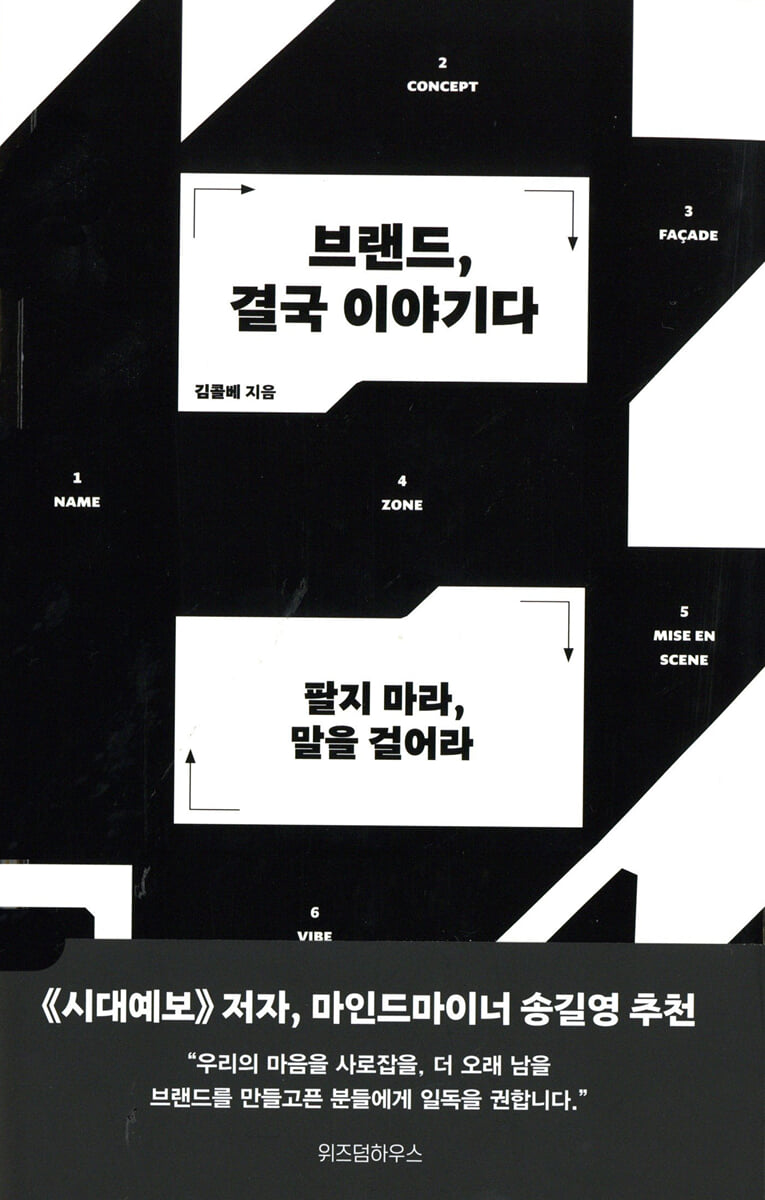
Brands are ultimately about stories
 |
Description
Book Introduction
Kim Kolbe, a brand story builder with over 15 years of experience.
His first book, "Brand, Ultimately, It's a Story," which compiles his experiences from the shared office brand "Jipmusil" he has been running and insights from YouTube and Instagram, has been published.
This book is not simply a theoretical book.
This is a strategy book that can be applied immediately in the brand war, based on Kim Kolbe's vivid experience and know-how accumulated through countless successes and failures.
'Office', founded by Kim Kolbe, is evaluated as the only shared office space that has formed a fandom with a differentiated brand story and design concept for each branch.
How did the office capture the hearts of customers? There were several factors that contributed to its success, including a pandemic-focused concept, space design, service, and promotional approach. But its most powerful weapon was a brand story that resonated deeply with customers.
Since then, Kim Kolbe has started sharing his brand story design know-how through YouTube and Instagram, and these channels have become a bible that planners, designers, marketers, solo entrepreneurs, self-employed people, and other practitioners who desperately need to attract customers' attention.
And the core of all these insights, the brand story design structure, 'BSA', is revealed for the first time in this book, 'Brand, Ultimately, It's a Story'.
Rather than simply ‘analyzing’ successful brands, it presents specific methods for ‘creating’ brands.
His first book, "Brand, Ultimately, It's a Story," which compiles his experiences from the shared office brand "Jipmusil" he has been running and insights from YouTube and Instagram, has been published.
This book is not simply a theoretical book.
This is a strategy book that can be applied immediately in the brand war, based on Kim Kolbe's vivid experience and know-how accumulated through countless successes and failures.
'Office', founded by Kim Kolbe, is evaluated as the only shared office space that has formed a fandom with a differentiated brand story and design concept for each branch.
How did the office capture the hearts of customers? There were several factors that contributed to its success, including a pandemic-focused concept, space design, service, and promotional approach. But its most powerful weapon was a brand story that resonated deeply with customers.
Since then, Kim Kolbe has started sharing his brand story design know-how through YouTube and Instagram, and these channels have become a bible that planners, designers, marketers, solo entrepreneurs, self-employed people, and other practitioners who desperately need to attract customers' attention.
And the core of all these insights, the brand story design structure, 'BSA', is revealed for the first time in this book, 'Brand, Ultimately, It's a Story'.
Rather than simply ‘analyzing’ successful brands, it presents specific methods for ‘creating’ brands.
- You can preview some of the book's contents.
Preview
index
Prologue: A brand that 100 people visit only once vs. a brand that one person visits 100 times.
STEP 1.
Understanding the Structure of a Brand Story
A brand without a story is unstable.
Conditions for a brand that spreads word of mouth on its own
The story resembles architecture
The Importance of Story Design
Six Key Steps to Story Structure
The most powerful story design tool, BSA
STEP 2. BSA's Beginning: Designing the Six W Principles Concept
All stories begin with the six principles of harmony.
Design with a clear concept and six principles of questioning.
Building a worldview
Creating a concept with 'Who (WH0)?'
WHO Case: Ido Mansion
Creating a concept with 'WHEN?'
WHEN Case: Seongsu Federation
Creating a concept with 'WHERE?'
Creating a concept with 'WHAT?'
WHERE+WHAT Case: Office
Creating a concept with 'HOW?'
HOW Case Study: Maxim Docent
Creating a concept with 'WHY?'
STEP 3. Designing Story Details with BSA
Façade: Creating a Brand's First Impression
Zoning, marking out where to plant stories
Mise-en-scène, planting a story
Vibe: Designing the Invisible
Naming: Creating a Brand Name That Lasts in the Mind
STEP 4. BSA Practical Exercise: Creating a Virtual Brand
Creating a Cafe Brand Story with "Who?"
Creating an Interior Brand Story with "WHEN?"
Creating a Beauty Brand Story with "HOW?"
Creating a Sauna Brand Story with "WHAT?"
Epilogue: Why Your "Empty Brand" Needs This Book
STEP 1.
Understanding the Structure of a Brand Story
A brand without a story is unstable.
Conditions for a brand that spreads word of mouth on its own
The story resembles architecture
The Importance of Story Design
Six Key Steps to Story Structure
The most powerful story design tool, BSA
STEP 2. BSA's Beginning: Designing the Six W Principles Concept
All stories begin with the six principles of harmony.
Design with a clear concept and six principles of questioning.
Building a worldview
Creating a concept with 'Who (WH0)?'
WHO Case: Ido Mansion
Creating a concept with 'WHEN?'
WHEN Case: Seongsu Federation
Creating a concept with 'WHERE?'
Creating a concept with 'WHAT?'
WHERE+WHAT Case: Office
Creating a concept with 'HOW?'
HOW Case Study: Maxim Docent
Creating a concept with 'WHY?'
STEP 3. Designing Story Details with BSA
Façade: Creating a Brand's First Impression
Zoning, marking out where to plant stories
Mise-en-scène, planting a story
Vibe: Designing the Invisible
Naming: Creating a Brand Name That Lasts in the Mind
STEP 4. BSA Practical Exercise: Creating a Virtual Brand
Creating a Cafe Brand Story with "Who?"
Creating an Interior Brand Story with "WHEN?"
Creating a Beauty Brand Story with "HOW?"
Creating a Sauna Brand Story with "WHAT?"
Epilogue: Why Your "Empty Brand" Needs This Book
Detailed image

Into the book
If you have your own unique entity ready to stimulate people's five senses, think of it as building a building and design the story (concept) structure.
How do you build and fill a story structure? This book proposes a tool called "BSA (Brand Story Architecture)" to design a brand's narrative.
BSA is like a framework for a brand story (concept).
The more systematically you fill out this framework, the more robust and compelling your brand story will become.
Then, customers will be able to see and enjoy the true nature of the brand in a richer way.
--- p.9, from "Prologue"
As a "brand story builder," I felt it was necessary to go beyond simply discovering commonalities in the stories successful brands tell their customers, and instead provide useful tools to help "create" good stories.
Unless we're descendants of a brand steeped in history and stories, passed down for three generations, most of us living ordinary lives feel like our stories are lacking, or even absent.
From my perspective, it seems more accurate to say that I'm not used to 'designing' stories.
In my experience, at least in the branding world, it's often easier to create a compelling story structure first and then flesh it out.
--- p.22, from “Conditions for a Brand That Spreads Word of Mouth”
The story resembles architecture.
Just as architecture isn't simply a collection of bricks and steel, but rather a narrative spatial experience that fills the minds of visitors, creating a brand story isn't simply a series of information; it's a design process that immerses the listener in a narrative structure.
The better the story, the more it arouses curiosity with just a single word or a single sentence, and the detailed stories support the underlying structure in a dense and solid manner.
It resembles a pyramid structure.
--- p.30, from “Stories Resemble Architecture”
Brands that are generally considered to have good concepts often identify themselves by focusing on one element of the six principles.
There are also cases where up to two are mixed.
In particular, in the case of 'what (WHAT)' and 'how (HOW)', since they often involve innovating 'a specific object in a specific way', they are often found in a combined form rather than being clearly distinguished.
However, even in this case, the hierarchy between the two elements is clearly established to prevent the blade from becoming dull.
There are many things I would like to emphasize, but I suppress those desires and focus on one point.
The remaining elements that were unfortunately not selected are refined into a form that can strengthen the concept and incorporated into the substructure of the BSA.
How do you build and fill a story structure? This book proposes a tool called "BSA (Brand Story Architecture)" to design a brand's narrative.
BSA is like a framework for a brand story (concept).
The more systematically you fill out this framework, the more robust and compelling your brand story will become.
Then, customers will be able to see and enjoy the true nature of the brand in a richer way.
--- p.9, from "Prologue"
As a "brand story builder," I felt it was necessary to go beyond simply discovering commonalities in the stories successful brands tell their customers, and instead provide useful tools to help "create" good stories.
Unless we're descendants of a brand steeped in history and stories, passed down for three generations, most of us living ordinary lives feel like our stories are lacking, or even absent.
From my perspective, it seems more accurate to say that I'm not used to 'designing' stories.
In my experience, at least in the branding world, it's often easier to create a compelling story structure first and then flesh it out.
--- p.22, from “Conditions for a Brand That Spreads Word of Mouth”
The story resembles architecture.
Just as architecture isn't simply a collection of bricks and steel, but rather a narrative spatial experience that fills the minds of visitors, creating a brand story isn't simply a series of information; it's a design process that immerses the listener in a narrative structure.
The better the story, the more it arouses curiosity with just a single word or a single sentence, and the detailed stories support the underlying structure in a dense and solid manner.
It resembles a pyramid structure.
--- p.30, from “Stories Resemble Architecture”
Brands that are generally considered to have good concepts often identify themselves by focusing on one element of the six principles.
There are also cases where up to two are mixed.
In particular, in the case of 'what (WHAT)' and 'how (HOW)', since they often involve innovating 'a specific object in a specific way', they are often found in a combined form rather than being clearly distinguished.
However, even in this case, the hierarchy between the two elements is clearly established to prevent the blade from becoming dull.
There are many things I would like to emphasize, but I suppress those desires and focus on one point.
The remaining elements that were unfortunately not selected are refined into a form that can strengthen the concept and incorporated into the substructure of the BSA.
--- p.84, from “Design with a Clear Concept and Six W Principles”
Publisher's Review
★ Highly recommended by Mindminer Song Gil-young, author of the best-selling book "Sidae Yebo"!
“It will capture our hearts and last longer
“I highly recommend this book to anyone who wants to build a brand.”
★ A must-read for brand planners, founders, designers, and marketers.
“Don’t sell the product first.
“What customers remember is the story!”
★ The branding know-how of Kim Kolbe, the branding mentor sought out by practitioners first.
BSA: The Law of Brand Story Design that Turns Regular Customers into Loyal Fans
Kim Kolbe, a brand story builder with over 15 years of experience.
His first book, "Brand, Ultimately, It's a Story," which compiles his experiences from the shared office brand "Jipmusil" he has been running and insights from YouTube and Instagram, has been published.
This book is not simply a theoretical book.
This is a strategy book that can be applied immediately in the brand war, based on Kim Kolbe's vivid experience and know-how accumulated through countless successes and failures.
'Office', founded by Kim Kolbe, is evaluated as the only shared office space that has formed a fandom with a differentiated brand story and design concept for each branch.
How did the office capture the hearts of customers? There were several factors that contributed to its success, including a pandemic-focused concept, space design, service, and promotional approach. But its most powerful weapon was a brand story that resonated deeply with customers.
Since then, Kim Kolbe has started sharing his brand story design know-how through YouTube and Instagram, and these channels have become a bible that planners, designers, marketers, solo entrepreneurs, self-employed people, and other practitioners who desperately need to attract customers' attention.
And the core of all these insights, the brand story design structure, 'BSA', is revealed for the first time in this book, 'Brand, Ultimately, It's a Story'.
Rather than simply ‘analyzing’ successful brands, it presents specific methods for ‘creating’ brands.
“Can’t I instill a compelling story into my ordinary brand?”
The most realistic guide to saving your money and time, as your brand desperately needs you.
Do you want to create a story that will remain long and deeply in your customers' hearts?
Follow the BSA, the rules of brand story design!
What's the difference between a brand that spreads word of mouth on its own and one that remains unknown no matter how much marketing effort is spent? The former has a brand story that naturally circulates among customers, while the latter employs a product-first approach to promotion.
"Brands, Ultimately, Are Stories" observes that "a brand's success depends on its narrative design structure," and that brands without a story will eventually disappear from consumers' memories.
This book compares a brand to a 'building'.
Just as a building cannot be built without a design, a brand also requires a structural narrative design.
Kim Kolbe's proposed brand story design structure, 'BSA (Brand Story Architecture),' is divided into the following six stages.
- Brand name (NAME): A brand name that encompasses all the images and values that the brand pursues.
- CONCEPT: A powerful sentence that encapsulates the brand's purpose and characteristics.
- FACADE: A story that can expand the brand concept and raise customer expectations.
- ZONE: A place where stories are planted among the numerous contact points with customers (store exterior, interior, menu, uniform, SNS, app, etc.)
- Mise-en-scène: A detailed story to tell to customers in each zone.
- VIBE: The intangible story that creates the brand's atmosphere (scent, BGM, taste, etc.)
All six stages are concerns that any practitioner who thinks about a brand has experienced at least once.
This book provides concrete and practical guidance on how to design a brand story, rather than vague advice or abstract theories.
By following the BSA template developed by the author, readers will be able to complete their own brand story surprisingly naturally.
This book never recommends reckless methods like 'banging eggs against rocks'.
Starting with the one-line concept of the brand based on the Six Ws principle, it leads to the façade, zone, mise-en-scène, and vibe stages, where detailed stories are designed, including product packaging, interior, service, and SNS operation guides.
When all of these design processes are meticulously accumulated, the final step is to decide on a brand name.
Based on Kim Kolbe's 15 years of practical experience, 'BSA' is a brand story blueprint and a must-read practical manual for those planning a brand for the first time.
“Will it become a brand that 100 people visit once a year?
“Will it become a brand that one person searches for 100 times?”
If you want to be a winner in the brand war, this is a must-read textbook and practical guide!
★ Startup CEO, entrepreneur preparing to launch a brand
★ Marketer, Brand Designer, Creative Director
★ Content planner, writer, aspiring creator
The unique feature of this book is that it goes beyond simply conveying the concept of BSA.
Rather, it stands out in that it focuses on actual cases and practical applications rather than theory.
The author accurately captures the most pressing concerns of entrepreneurs just starting their brand, and provides a wealth of case studies from actual projects at each stage.
His practical and fascinating insights instantly overturn readers' preconceptions that "books are just theories, reality is different!"
Moreover, it doesn't stop at simply listing examples. STEP 4's practical practice section includes a worksheet based on the BSA template, allowing readers to develop their own brand story.
Thanks to the friendly structure that makes it seem as if the author is planning the brand one-on-one, readers can design the brand from its birth to its identity with just this one book.
For anyone who wants to build a brand but feels overwhelmed by where to start, this branding textbook and practical guide has finally arrived! Remember the most powerful weapon in brand design: the Brand Strategy Analysis (BSA).
The beginning and end of all branding is ultimately a story.
“It will capture our hearts and last longer
“I highly recommend this book to anyone who wants to build a brand.”
★ A must-read for brand planners, founders, designers, and marketers.
“Don’t sell the product first.
“What customers remember is the story!”
★ The branding know-how of Kim Kolbe, the branding mentor sought out by practitioners first.
BSA: The Law of Brand Story Design that Turns Regular Customers into Loyal Fans
Kim Kolbe, a brand story builder with over 15 years of experience.
His first book, "Brand, Ultimately, It's a Story," which compiles his experiences from the shared office brand "Jipmusil" he has been running and insights from YouTube and Instagram, has been published.
This book is not simply a theoretical book.
This is a strategy book that can be applied immediately in the brand war, based on Kim Kolbe's vivid experience and know-how accumulated through countless successes and failures.
'Office', founded by Kim Kolbe, is evaluated as the only shared office space that has formed a fandom with a differentiated brand story and design concept for each branch.
How did the office capture the hearts of customers? There were several factors that contributed to its success, including a pandemic-focused concept, space design, service, and promotional approach. But its most powerful weapon was a brand story that resonated deeply with customers.
Since then, Kim Kolbe has started sharing his brand story design know-how through YouTube and Instagram, and these channels have become a bible that planners, designers, marketers, solo entrepreneurs, self-employed people, and other practitioners who desperately need to attract customers' attention.
And the core of all these insights, the brand story design structure, 'BSA', is revealed for the first time in this book, 'Brand, Ultimately, It's a Story'.
Rather than simply ‘analyzing’ successful brands, it presents specific methods for ‘creating’ brands.
“Can’t I instill a compelling story into my ordinary brand?”
The most realistic guide to saving your money and time, as your brand desperately needs you.
Do you want to create a story that will remain long and deeply in your customers' hearts?
Follow the BSA, the rules of brand story design!
What's the difference between a brand that spreads word of mouth on its own and one that remains unknown no matter how much marketing effort is spent? The former has a brand story that naturally circulates among customers, while the latter employs a product-first approach to promotion.
"Brands, Ultimately, Are Stories" observes that "a brand's success depends on its narrative design structure," and that brands without a story will eventually disappear from consumers' memories.
This book compares a brand to a 'building'.
Just as a building cannot be built without a design, a brand also requires a structural narrative design.
Kim Kolbe's proposed brand story design structure, 'BSA (Brand Story Architecture),' is divided into the following six stages.
- Brand name (NAME): A brand name that encompasses all the images and values that the brand pursues.
- CONCEPT: A powerful sentence that encapsulates the brand's purpose and characteristics.
- FACADE: A story that can expand the brand concept and raise customer expectations.
- ZONE: A place where stories are planted among the numerous contact points with customers (store exterior, interior, menu, uniform, SNS, app, etc.)
- Mise-en-scène: A detailed story to tell to customers in each zone.
- VIBE: The intangible story that creates the brand's atmosphere (scent, BGM, taste, etc.)
All six stages are concerns that any practitioner who thinks about a brand has experienced at least once.
This book provides concrete and practical guidance on how to design a brand story, rather than vague advice or abstract theories.
By following the BSA template developed by the author, readers will be able to complete their own brand story surprisingly naturally.
This book never recommends reckless methods like 'banging eggs against rocks'.
Starting with the one-line concept of the brand based on the Six Ws principle, it leads to the façade, zone, mise-en-scène, and vibe stages, where detailed stories are designed, including product packaging, interior, service, and SNS operation guides.
When all of these design processes are meticulously accumulated, the final step is to decide on a brand name.
Based on Kim Kolbe's 15 years of practical experience, 'BSA' is a brand story blueprint and a must-read practical manual for those planning a brand for the first time.
“Will it become a brand that 100 people visit once a year?
“Will it become a brand that one person searches for 100 times?”
If you want to be a winner in the brand war, this is a must-read textbook and practical guide!
★ Startup CEO, entrepreneur preparing to launch a brand
★ Marketer, Brand Designer, Creative Director
★ Content planner, writer, aspiring creator
The unique feature of this book is that it goes beyond simply conveying the concept of BSA.
Rather, it stands out in that it focuses on actual cases and practical applications rather than theory.
The author accurately captures the most pressing concerns of entrepreneurs just starting their brand, and provides a wealth of case studies from actual projects at each stage.
His practical and fascinating insights instantly overturn readers' preconceptions that "books are just theories, reality is different!"
Moreover, it doesn't stop at simply listing examples. STEP 4's practical practice section includes a worksheet based on the BSA template, allowing readers to develop their own brand story.
Thanks to the friendly structure that makes it seem as if the author is planning the brand one-on-one, readers can design the brand from its birth to its identity with just this one book.
For anyone who wants to build a brand but feels overwhelmed by where to start, this branding textbook and practical guide has finally arrived! Remember the most powerful weapon in brand design: the Brand Strategy Analysis (BSA).
The beginning and end of all branding is ultimately a story.
GOODS SPECIFICS
- Date of issue: April 16, 2025
- Page count, weight, size: 284 pages | 352g | 120*188*18mm
- ISBN13: 9791171714063
- ISBN10: 1171714068
You may also like
카테고리
korean


korean

![ELLE 엘르 스페셜 에디션 A형 : 12월 [2025]](http://librairie.coreenne.fr/cdn/shop/files/b8e27a3de6c9538896439686c6b0e8fb.jpg?v=1766436872&width=3840)


