

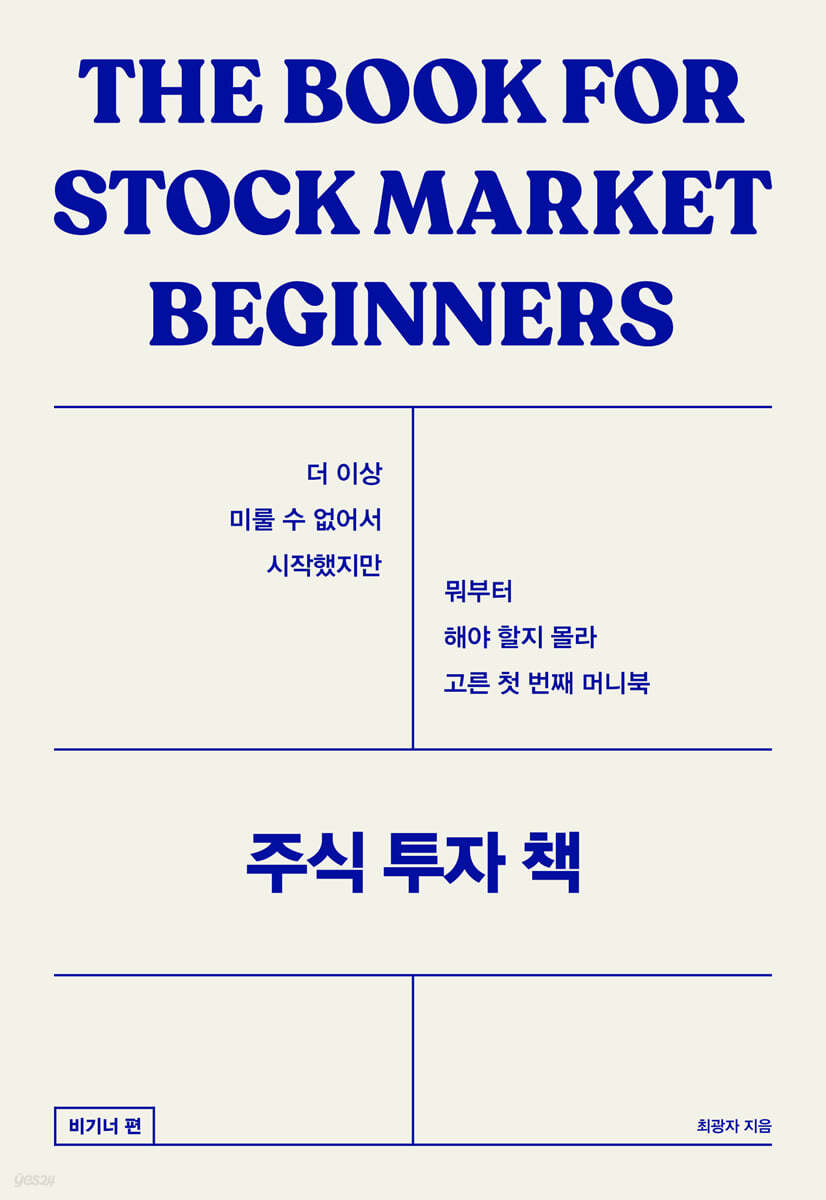
Stock Investment Book: Beginner Edition
 |
Description
Book Introduction
"A well-organized stock book I just want to read one book!" For those new to investing The Most Basic Stock Investment Guide A book has been published for stock investors who have been putting off studying investment, even though they have always thought they should, because they don't know where to start. "Stock Investment Book: Beginner Edition," written by Choi Kwang-ja, an economics expert influencer and the top blogger on Naver Blog, is a very basic stock book that summarizes the content you should read first when deciding to invest. The author of this book made a fortune in stocks during the height of the coronavirus pandemic in 2020. I made a lot of money as soon as I invested without any difficulty, so I believed that it was all my own ability. Then, when the stock market entered a recession, the true face of his skills was revealed. After experiencing several losses, I realized that I had never studied the stock market before and started studying it properly. I studied whatever I could, not even knowing what I knew or didn't know. I studied how to choose a good company and how to choose a good stock. I also studied the similarities and differences between the domestic and US markets, stocks, and ETFs. I also studied the taxes I have to pay when earning income from stocks, and pension products that allow me to prepare for retirement with stocks and ETFs. Whenever I came across something I didn't know, I looked it up and thought this. "We need a book that covers the fundamentals investors need to know, rather than personal investment success stories or difficult trading techniques." That's how "Stock Investment Book: Beginner's Edition" was born. This book is not about investment mindset, trading techniques, or strategies, but rather organizes the concepts and basic knowledge that stock investors need to know, focusing on the questions that beginners face. Because it contains the minimum essential content that you need to know if you are going to invest in stocks, reading this book alone is enough to build a solid foundation. |
- You can preview some of the book's contents.
Preview
index
Prologue_ Step-by-step, a guide to first steps in stock investing
Part 1.
Let's study stocks properly.
What is a stock?
-The beginning of stocks
Differences between KOSPI and KOSDAQ
-KOSPI
-KOSDAQ
Understanding Stock Accounts
-Differences between bank accounts and stock accounts
-Stock trading fees
-Criteria for choosing a securities firm
-Open an account
Trading stocks with your smartphone
-Take a look at MTS
- Conditional search method to find good stocks
Buying and selling stocks
-3 elements of stock trading
-Order stocks
-What is deposit money?
-Understanding the D+2 Day System
- Margin and receivables
-Short sale
Stock trading hours
-Regular trading hours
-Simultaneous pre-market and post-market quotations
-After-hours trading
-After-hours trading
-Single price after hours
Good concepts to know when investing in stocks
-Upper and lower limits
-Face split and face value consolidation
-Circuit breaker
-sidecar
-Stock trading suspended
- Delisting of stocks
-Cleanup sale
Stock investment tax
-Securities transaction tax
-Capital gains tax
-Dividend income tax
-Comprehensive taxation on financial income and comprehensive income tax
Part 2.
Finding Good Stocks
What is a stock?
Financial statements become easy if you know just five things.
Market capitalization
EPS: Earnings per share
PER: Price-to-Earnings Ratio
PBR: Price-to-book ratio
ROE: Return on Equity
What indicators should I look at?
-Evaluation indicators and corporate valuation
-Why stock prices change
-Is there a magic indicator?
Part 3.
Peace of mind dividend stock investment
What is a dividend?
-Reason for paying dividends
-Do all companies pay dividends?
Common stock and preferred stock
-ordinary
-preferred stock
-What are some representative dividend stocks?
How do I check dividends?
-Check dividend payment
Dividend income tax
How to invest in dividend stocks using an ISA account
-Differences between IRP and ISA
Check the dividend indicator
-Dividend yield
-Annual dividend
-Dividend payout ratio
-Dividend base date
- Ex-dividend date
Is it always good to pay a lot of dividends?
-The trap of high-dividend stocks
-Sustainability of dividends
-Reasons for increased dividend yield
Part 4.
Investing in public offerings that have been with the company from the beginning
Why Companies Go Public
-IPO and listing
-Check the securities report
- Essential information to be reviewed in the securities report
Flow of investment in public offering stocks
-The desired bid amount of the company and the organizer is determined
- Predicting institutional investor demand and determining the offering price
-Public subscription -Allocation and refund of shares
-Stock deposit and listing
-Sell
-Subscription fee
Will all IPO investments be successful?
-'Ttasang' and 'Ttattabul'
Part 5.
A good ETF investment to get you started
What is an ETF?
-Fund
-ETF
Types of ETFs
-Structure of ETF product names
-Types of ETFs
Check ETF information
-Tracking index
-Check investment composition items
-NAV and deviation rate, tracking error
-Total compensation
-Yield
Overseas ETFs
- Domestically listed overseas ETFs
-Overseas listed overseas ETFs
US stock market index
-S&P 500
-Nasdaq
-Dow Jones
Leveraged and Inverse ETFs
-Leveraged ETFs
-Inverse ETF
ETF delisting
ETF Tax
-Capital gains tax
-Dividend income tax
Tax-saving methods for ETF investments
-How to invest in ETFs using IRP
Part 1.
Let's study stocks properly.
What is a stock?
-The beginning of stocks
Differences between KOSPI and KOSDAQ
-KOSPI
-KOSDAQ
Understanding Stock Accounts
-Differences between bank accounts and stock accounts
-Stock trading fees
-Criteria for choosing a securities firm
-Open an account
Trading stocks with your smartphone
-Take a look at MTS
- Conditional search method to find good stocks
Buying and selling stocks
-3 elements of stock trading
-Order stocks
-What is deposit money?
-Understanding the D+2 Day System
- Margin and receivables
-Short sale
Stock trading hours
-Regular trading hours
-Simultaneous pre-market and post-market quotations
-After-hours trading
-After-hours trading
-Single price after hours
Good concepts to know when investing in stocks
-Upper and lower limits
-Face split and face value consolidation
-Circuit breaker
-sidecar
-Stock trading suspended
- Delisting of stocks
-Cleanup sale
Stock investment tax
-Securities transaction tax
-Capital gains tax
-Dividend income tax
-Comprehensive taxation on financial income and comprehensive income tax
Part 2.
Finding Good Stocks
What is a stock?
Financial statements become easy if you know just five things.
Market capitalization
EPS: Earnings per share
PER: Price-to-Earnings Ratio
PBR: Price-to-book ratio
ROE: Return on Equity
What indicators should I look at?
-Evaluation indicators and corporate valuation
-Why stock prices change
-Is there a magic indicator?
Part 3.
Peace of mind dividend stock investment
What is a dividend?
-Reason for paying dividends
-Do all companies pay dividends?
Common stock and preferred stock
-ordinary
-preferred stock
-What are some representative dividend stocks?
How do I check dividends?
-Check dividend payment
Dividend income tax
How to invest in dividend stocks using an ISA account
-Differences between IRP and ISA
Check the dividend indicator
-Dividend yield
-Annual dividend
-Dividend payout ratio
-Dividend base date
- Ex-dividend date
Is it always good to pay a lot of dividends?
-The trap of high-dividend stocks
-Sustainability of dividends
-Reasons for increased dividend yield
Part 4.
Investing in public offerings that have been with the company from the beginning
Why Companies Go Public
-IPO and listing
-Check the securities report
- Essential information to be reviewed in the securities report
Flow of investment in public offering stocks
-The desired bid amount of the company and the organizer is determined
- Predicting institutional investor demand and determining the offering price
-Public subscription -Allocation and refund of shares
-Stock deposit and listing
-Sell
-Subscription fee
Will all IPO investments be successful?
-'Ttasang' and 'Ttattabul'
Part 5.
A good ETF investment to get you started
What is an ETF?
-Fund
-ETF
Types of ETFs
-Structure of ETF product names
-Types of ETFs
Check ETF information
-Tracking index
-Check investment composition items
-NAV and deviation rate, tracking error
-Total compensation
-Yield
Overseas ETFs
- Domestically listed overseas ETFs
-Overseas listed overseas ETFs
US stock market index
-S&P 500
-Nasdaq
-Dow Jones
Leveraged and Inverse ETFs
-Leveraged ETFs
-Inverse ETF
ETF delisting
ETF Tax
-Capital gains tax
-Dividend income tax
Tax-saving methods for ETF investments
-How to invest in ETFs using IRP
Detailed image

Into the book
The first criterion for connecting sellers and buyers and making a deal is price.
The lowest selling price will be executed first, and the highest buying price will be executed first.
This is a principle that applies not only to the stock market but also to general markets.
When there are many people selling one pound of pork, the one selling for 9,000 won sells faster than the one selling for 10,000 won.
It is also the same principle as when there are many people trying to buy a pound of pork, the person who wants to buy it for 11,000 won can buy the meat before the person who wants to buy it for 10,000 won.
The second criterion is time.
If the prices are the same, the principle is that the person who placed the order first will be given priority.
This applies regardless of whether you are selling or buying stocks.
The third criterion is quantity.
If the prices are the same and the order times are the same, the transaction between the person who wants to buy more or sell more will be executed first.
This means that the meat of a person selling 10 geun worth of pork will be traded before that of a person selling only 1 geun worth 10,000 won.
If you've read this far, you've essentially learned all three principles of trading that investors need to know.
I hope this answers the question, "Why isn't my order being filled when I placed it at the same price?"
--- pp.49-50
After-hours trading takes place for approximately 10 minutes, from 8:30 AM to 8:40 AM, before the market opens. A separate price cannot be specified, and transactions are concluded at the previous day's closing price.
The biggest difference between after-hours trading and other trading hours is that the person placing the order cannot directly specify the price.
In after-hours trading, the stock price is automatically determined by the previous day's closing price or the current day's closing price.
This is a system where, without having to submit a separate price, if I say I want to buy or sell, the previous day's transaction price becomes the bid price and the transaction is completed if there is volume.
--- p.73
If you're interested in investing, you've probably heard the phrase, "Use IRP and ISA accounts to save on taxes!"
The two financial products have something in common, starting from their names: they are difficult.
They all have one thing in common: they are all used to increase the assets of ordinary people.
Although the names are similar, there is a big difference in how they are operated.
You can think of them as completely different products with similar names.
An IRP is a system that allows individuals to accumulate and manage assets in preparation for retirement.
You can pay up to 18 million won per year, and you can enjoy tax savings by receiving a tax deduction at a certain rate for the amount paid.
Direct investment in stocks is not possible, but you can invest in indirect products such as ETFs.
The operating income and principal paid here can be received as a pension after age 55.
On the other hand, ISA is a comprehensive account created for the purpose of increasing personal assets.
The annual payment limit is set at 20 million won, and the total limit is 100 million won.
This is a tax-exempt investment product that allows you to hold multiple products in a single account, with the profits generated from these products being tax-exempt. While an IRP offers tax savings through tax deductions, an ISA offers tax savings through tax exemptions on profits.
Additionally, a low tax rate of 9.9% is applied to amounts exceeding the tax-free limit of 2 million won, and taxation can be deferred for up to 3 years from the time of occurrence, allowing you to enjoy tax savings.
The lowest selling price will be executed first, and the highest buying price will be executed first.
This is a principle that applies not only to the stock market but also to general markets.
When there are many people selling one pound of pork, the one selling for 9,000 won sells faster than the one selling for 10,000 won.
It is also the same principle as when there are many people trying to buy a pound of pork, the person who wants to buy it for 11,000 won can buy the meat before the person who wants to buy it for 10,000 won.
The second criterion is time.
If the prices are the same, the principle is that the person who placed the order first will be given priority.
This applies regardless of whether you are selling or buying stocks.
The third criterion is quantity.
If the prices are the same and the order times are the same, the transaction between the person who wants to buy more or sell more will be executed first.
This means that the meat of a person selling 10 geun worth of pork will be traded before that of a person selling only 1 geun worth 10,000 won.
If you've read this far, you've essentially learned all three principles of trading that investors need to know.
I hope this answers the question, "Why isn't my order being filled when I placed it at the same price?"
--- pp.49-50
After-hours trading takes place for approximately 10 minutes, from 8:30 AM to 8:40 AM, before the market opens. A separate price cannot be specified, and transactions are concluded at the previous day's closing price.
The biggest difference between after-hours trading and other trading hours is that the person placing the order cannot directly specify the price.
In after-hours trading, the stock price is automatically determined by the previous day's closing price or the current day's closing price.
This is a system where, without having to submit a separate price, if I say I want to buy or sell, the previous day's transaction price becomes the bid price and the transaction is completed if there is volume.
--- p.73
If you're interested in investing, you've probably heard the phrase, "Use IRP and ISA accounts to save on taxes!"
The two financial products have something in common, starting from their names: they are difficult.
They all have one thing in common: they are all used to increase the assets of ordinary people.
Although the names are similar, there is a big difference in how they are operated.
You can think of them as completely different products with similar names.
An IRP is a system that allows individuals to accumulate and manage assets in preparation for retirement.
You can pay up to 18 million won per year, and you can enjoy tax savings by receiving a tax deduction at a certain rate for the amount paid.
Direct investment in stocks is not possible, but you can invest in indirect products such as ETFs.
The operating income and principal paid here can be received as a pension after age 55.
On the other hand, ISA is a comprehensive account created for the purpose of increasing personal assets.
The annual payment limit is set at 20 million won, and the total limit is 100 million won.
This is a tax-exempt investment product that allows you to hold multiple products in a single account, with the profits generated from these products being tax-exempt. While an IRP offers tax savings through tax deductions, an ISA offers tax savings through tax exemptions on profits.
Additionally, a low tax rate of 9.9% is applied to amounts exceeding the tax-free limit of 2 million won, and taxation can be deferred for up to 3 years from the time of occurrence, allowing you to enjoy tax savings.
--- pp.197-198
Publisher's Review
“This is totally the book for me!”
The most notable feature of this book is that it is written from the perspective of an extremely realistic investor.
The "realistic investor" we're talking about here is "an investor who studies to avoid losing money, but only studies the bare essentials."
Almost all investors, except perhaps a few professional investors, would think similarly.
The process of deciding to study stocks is as follows.
First, because everyone else is doing it, or because we are preparing for an uncertain future, we start investing in stocks without thinking.
The first few times you make a decent profit, you will gain confidence.
The investment amount increases little by little, but the stock price continues to fall.
You find out later why the stock price is falling, but you don't know the reason.
I decided to study stocks properly, so I subscribed to popular YouTube channels and looked up books, but the scope of my studies was so broad and deep that I felt overwhelmed.
"Stock Investment Book: Beginner Edition" is for investors who ask, "When will I ever learn all this? Is there a book that just leaves out all the difficult content and lets me say, 'Just by reading this, I know the basics of stock investing,' like "The Essentials of Mathematics"?"
In other words, in terms of games, it is the stage where level 1 beginners learn the basic rules and skills before starting the full-fledged game.
Therefore, you can build a solid foundation with 『Stock Investment Book: Beginner Edition』 and then choose your desired investment strategy, mindset, trading technique, etc. for in-depth study.
Because knowing the most basic things will give you a sense of what you know within the overall framework and give you direction on what you need to study more.
I hope this book will help you take your first, small but significant step toward successful investing.
The most notable feature of this book is that it is written from the perspective of an extremely realistic investor.
The "realistic investor" we're talking about here is "an investor who studies to avoid losing money, but only studies the bare essentials."
Almost all investors, except perhaps a few professional investors, would think similarly.
The process of deciding to study stocks is as follows.
First, because everyone else is doing it, or because we are preparing for an uncertain future, we start investing in stocks without thinking.
The first few times you make a decent profit, you will gain confidence.
The investment amount increases little by little, but the stock price continues to fall.
You find out later why the stock price is falling, but you don't know the reason.
I decided to study stocks properly, so I subscribed to popular YouTube channels and looked up books, but the scope of my studies was so broad and deep that I felt overwhelmed.
"Stock Investment Book: Beginner Edition" is for investors who ask, "When will I ever learn all this? Is there a book that just leaves out all the difficult content and lets me say, 'Just by reading this, I know the basics of stock investing,' like "The Essentials of Mathematics"?"
In other words, in terms of games, it is the stage where level 1 beginners learn the basic rules and skills before starting the full-fledged game.
Therefore, you can build a solid foundation with 『Stock Investment Book: Beginner Edition』 and then choose your desired investment strategy, mindset, trading technique, etc. for in-depth study.
Because knowing the most basic things will give you a sense of what you know within the overall framework and give you direction on what you need to study more.
I hope this book will help you take your first, small but significant step toward successful investing.
GOODS SPECIFICS
- Date of issue: November 15, 2024
- Page count, weight, size: 360 pages | 612g | 148*215*23mm
- ISBN13: 9791192445922
- ISBN10: 1192445929
You may also like
카테고리
korean


korean

![GQ KOREA Mark (Monthly): December [2025]](http://librairie.coreenne.fr/cdn/shop/files/8ef265dbbfbf186523ed75ba7319009d.jpg?v=1765340328&width=3840)


