

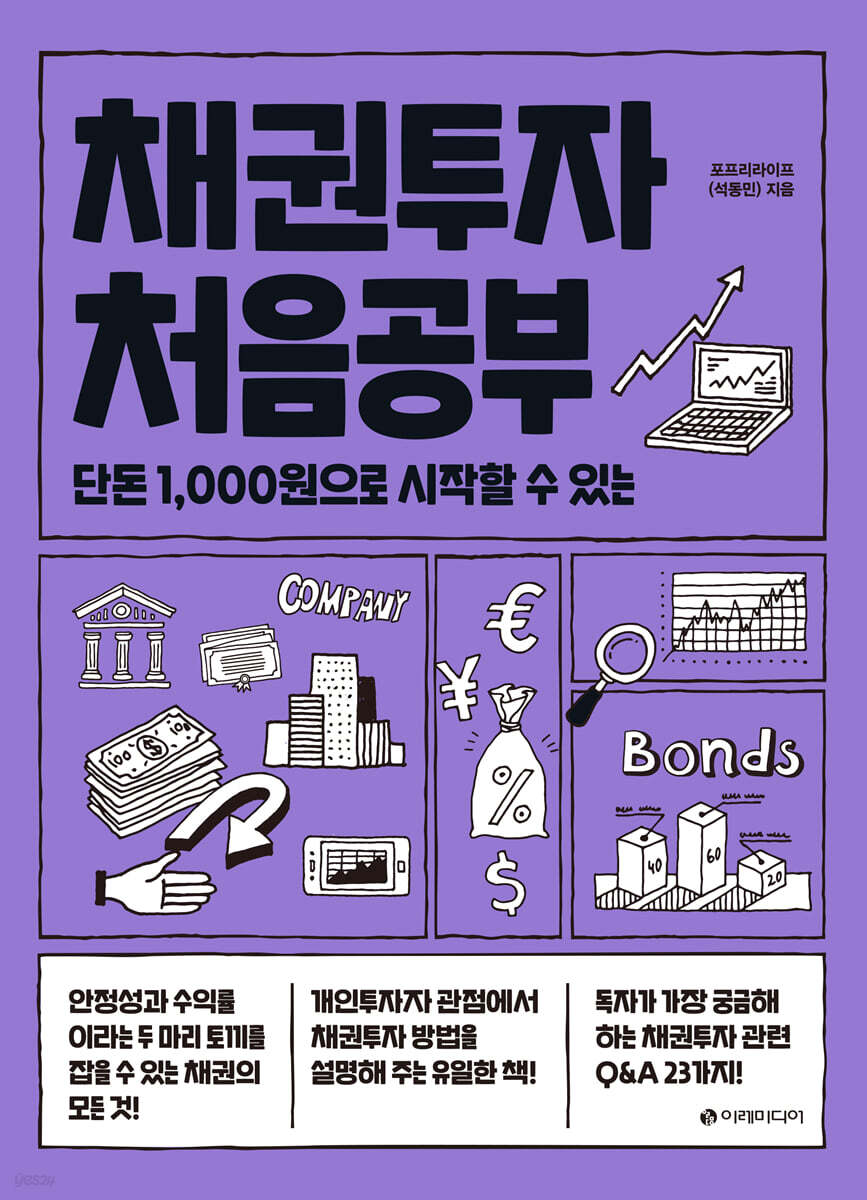
First study of bond investment
 |
Description
Book Introduction
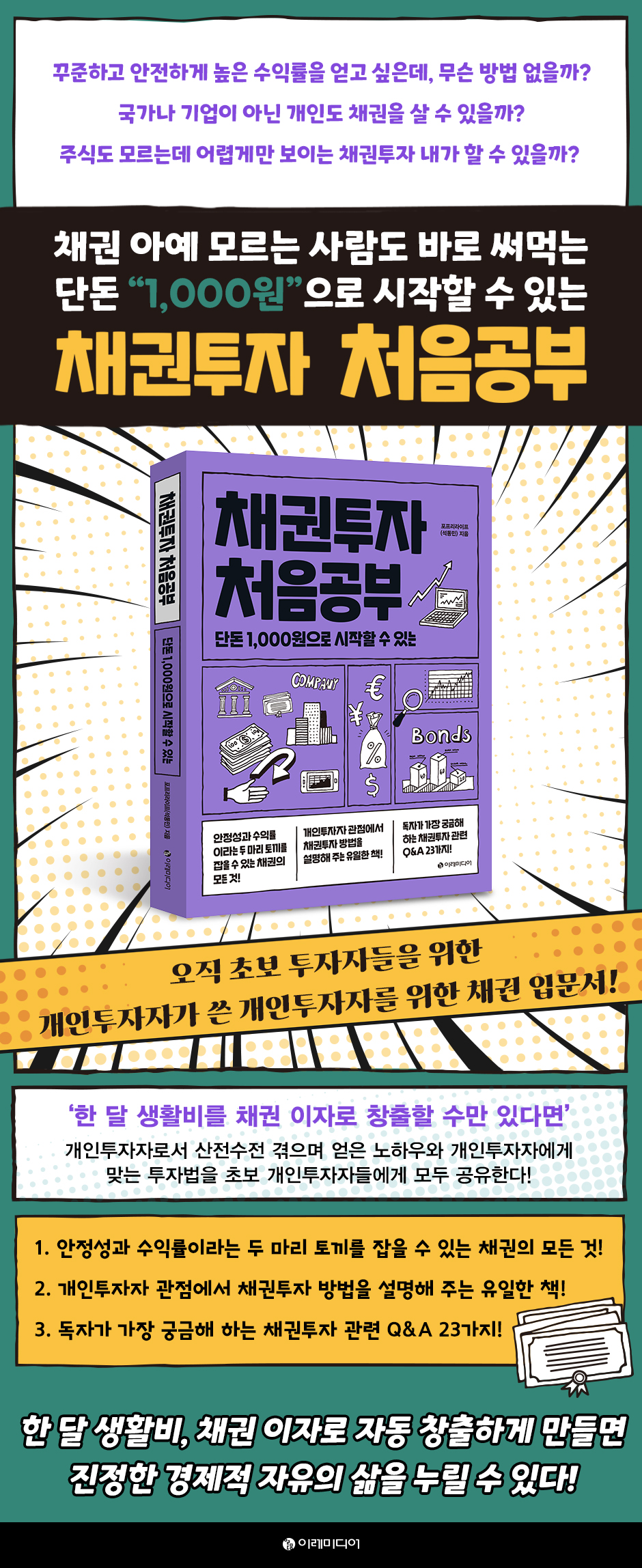
Even people who know nothing about bonds can use it right away.
Only the essential information!
An introductory guide to bonds for individual investors, written by individual investors!
There are many books and YouTube videos about bonds, but they are often not targeted at individual investors, but rather at intermediate or advanced investors.
This book is different in that respect.
This is because "Bond Investment: A Beginner's Guide" was written for individual investors who are new to bond investing or want to get started.
It is also special in that it is an introductory book for individual investors written by an individual investor.
While working as a semiconductor equipment engineer, the author stumbled upon a knowledge of bonds and began to wonder whether individual investors could make money through bond investing. He concluded that it was possible to achieve returns.
By following my own philosophy of 'automatically generating monthly living expenses through bond interest,' I now earn much more than my living expenses.
This book contains the author's know-how.
Unlike investment vehicles that carry significant risks depending on numerous economic variables, bond investment is easy and safe for anyone to learn and achieve efficient returns.
In today's uncertain investment environment, this book will be especially welcome to anyone seeking a safer investment, anyone looking to break away from bank deposits or savings, or anyone who wants to leverage bond investments but struggles to find the right approach.
Only the essential information!
An introductory guide to bonds for individual investors, written by individual investors!
There are many books and YouTube videos about bonds, but they are often not targeted at individual investors, but rather at intermediate or advanced investors.
This book is different in that respect.
This is because "Bond Investment: A Beginner's Guide" was written for individual investors who are new to bond investing or want to get started.
It is also special in that it is an introductory book for individual investors written by an individual investor.
While working as a semiconductor equipment engineer, the author stumbled upon a knowledge of bonds and began to wonder whether individual investors could make money through bond investing. He concluded that it was possible to achieve returns.
By following my own philosophy of 'automatically generating monthly living expenses through bond interest,' I now earn much more than my living expenses.
This book contains the author's know-how.
Unlike investment vehicles that carry significant risks depending on numerous economic variables, bond investment is easy and safe for anyone to learn and achieve efficient returns.
In today's uncertain investment environment, this book will be especially welcome to anyone seeking a safer investment, anyone looking to break away from bank deposits or savings, or anyone who wants to leverage bond investments but struggles to find the right approach.
- You can preview some of the book's contents.
Preview
index
Author's Note
[Chapter 1] What is a bond?
1. First exposure to bonds and bond investment
① Unknown investment area, bonds
② Know before you start studying bond investment
③ Bond investment is extremely easy and efficient.
④ Safe asset bonds
⑤ Why bond investment is not widely known
⑥ My efforts and experience in bond investment
⑦ Bond investment that doesn't require difficult theoretical knowledge
2 What is a bond?
① The right to lend money and receive interest
② Differences between bonds and debentures
③ An efficient means of managing funds
④ Bank and bond investment
⑤ Bond investment with a wide range of amount and period options
⑥ Pitfalls of banking products
⑦ Safety of bonds
3 Types and characteristics of bonds
① Types of bonds
② Bond interest payment method
③ Average yield of bonds
④ Credit rating of bonds
⑤ Characteristics of bond market trading
⑥ Properties of bonds
⑦ Bond options
4. What are the risks of investing in bonds?
① Risk of default, court receivership, or bankruptcy of the company issuing the bond
② Credit rating limitations
③ Limitations in bond market trading
④ Interest rate risk
[Chapter 2] Easy Bond Investment Utilization
1. Bond Investment: Just Follow the Guide - Beginner
Step 1: Visit a brokerage or create a securities account through the brokerage app.
Step 2: Install HTS on your computer
Step 3: Introduction to Bond Investment: From Login to Stock Selection
Step 4: Buy bonds and earn interest
2. Using Bond Investment HTS
① Using HTS basic functions
② Using the 'Overall Bond Order' window
③ Using the 'All Bond Prices' window
④ Using the 'Bond Issuance Information' window
⑤ Using the 'Projected Statement of Cash Flows for Bonds' Window
3 Practical Bond Investment Knowledge - Introduction
① Characteristics of direct investment in bonds
② Presenting a bid or ask price as a buy or sell price
③ What if I order more quantity than the remaining quantity in the first order?
④ Listed bond issuance information in the KRX information data system
[Chapter 3] Bond Investment: A Tool for Economic Freedom
1. Create a Vending Machine for Financial Freedom with Bonds
2 How to Get the Same Effect as Having a Lot of Capital Without Having a Penny
[Chapter 4] Full-scale Bond Investment Utilization
1. Bond Investment: Blindly Following - Advanced
① Method for calculating the rate of return when selling bonds mid-term
② Using bonds with call options
③ Using bonds with put options
2. Various ways to use bonds
① Compound interest bonds
② Bokdanchae
③ Discount bonds
④ Floating rate bonds
⑤ ABS bonds
⑥ Mezzanine bonds
⑦ Green bonds
3 Practical Bond Investment Knowledge - Advanced
① Should I only purchase bonds at prices below 10,000 won?
② How to check bond securities report in Dart
③ How to use credit rating agency websites
[Chapter 5] Limitations of Bond Investment Using MTS
① Yield of bonds displayed in MTS quotes
② MTS Bond Yield Calculator
③ Lack of display of MTS option information
④ Other insufficient functions
⑤ Personal thoughts on using MTS
[Chapter 6] Bond Investment Expertise
1. Clean and dirty prices of bonds
2. Intensification of taxation of bonds
① Taxation on bond surface interest rates
② Taxation on bond holding period
③ Taxation when selling bonds in the middle
④ Financial investment income tax starting in 2025
3. Occurrence of rights of bonds
4. A deeper dive into the properties of bonds
① Capital and debt
② Why companies issue bonds instead of stocks
③ Priority and subordination
5 Contingent Capital Securities
① New capital securities
② Subordinated Coco Bonds
6. Characteristics of the 'Bond Type' Display
[Chapter 7] Practical Bond Investment Know-How
1 Know-how for Safer Bond Investment
① Bond investment assuming intermediate sale rather than repayment date
② Bonds with a long remaining repayment date
③ Bonds of companies not listed on the stock market
④ Bonds with good credit ratings but poor financial statements
⑤ What if the credit rating or price goes down after purchasing a bond?
⑥ The need to hold cash
⑦ Company merger and acquisition
2. How to Use Bond Investments Effectively
① Use of civil evaluation
② Determining the average yield of the bond market
③ Manage bonds like savings
④ Managing bonds with compound interest
⑤ Managing bonds with leverage
⑥ What if the bond trading volume is low or the amount to be invested in the bond is too large?
⑦ Is there a right time to invest in bonds?
⑧ Should I sell my bonds mid-term when the bond price rises?
⑨ What if there is a bond that is more attractive than the one I bought?
[Chapter 8] Bond Investment: Not-So-Bonus-Like Bonds
1 Securities company's over-the-counter bonds
2 Bond Subscription
3 Bond Funds and ETFs
4. Investment in government bonds
5 Foreign bonds
① Emerging market foreign bonds
② US bonds
6. CP and electronic short-term bonds
[Chapter 9] The Truth About Bond Investment
1 Are stocks and bonds complementary and inversely proportional assets?
2 Long-term yields of bonds outperforming stocks
3 Reasons I Invest in Bonds Instead of Stocks
[Chapter 10] Bond Investment Q&A
Q1 If bonds are truly safe, why do their prices fluctuate?
Q2 What is the substitute price for bonds?
Q3 Have you ever personally felt at risk while investing in bonds?
Q4 If this kind of knowledge sharing increases individual demand for bonds, won't bond investment returns fall?
Q5 Is investing in Coco bonds safe?
Q6 I'm curious whether Poprilife considers not only interest but also profits from intermediate sales when investing in bonds.
Q7 What is the bond with a maturity date of 9999?
Q8 When calculating bond yields using the bond yield calculator, are the brokerage firm's transaction fees automatically applied?
Q9 I have already sold a bond in the past. How can I find out the price at which I purchased it?
Q10 The yields on the bonds currently available for purchase are too low.
In this case, should I wait instead of buying?
Q11 Aren't bonds too low in yield compared to other investment vehicles such as stocks?
Q12 Are call and put options for bonds that must be exercised unconditionally upon request by the bond issuer or bond investor?
Q13 Are credit rating agencies government agencies or private companies?
Q14 Bonds issued by a company are considered liabilities, but why are stocks issued by the company included in capital?
Q15 Even though the bonds were issued by the same company on the same day, the detailed terms of the bonds are different. Why is this?
Q16 If inflation or stagflation is expected in the future, are there any bond investment scenarios to prepare for it?
Q17 What is the coupon rate of a bond?
Q18 What is the difference between duration and bond maturity?
Q19 Can I calculate bond yields without HTS's bond yield calculator?
Q20 Recently, bonds with a one-month interest payment cycle have been issued without any special options.
How should these bonds be judged?
Q21 I heard that the Legoland PF loan issue that recently became an issue had a negative impact on the bond market.
Would it be okay if I mainly invested in safe bonds?
Q22 I understand that perpetual bonds are bonds that do not have a maturity date and only pay interest.
Why do we try to repay early, and why do we have a foreign currency debt crisis when early repayment is not possible?
Q23: What is your outlook for the bond market going forward, and what kind of mindset should you have in this situation?
Appendix Popuri Life Bond Investment Interest Note
[Chapter 1] What is a bond?
1. First exposure to bonds and bond investment
① Unknown investment area, bonds
② Know before you start studying bond investment
③ Bond investment is extremely easy and efficient.
④ Safe asset bonds
⑤ Why bond investment is not widely known
⑥ My efforts and experience in bond investment
⑦ Bond investment that doesn't require difficult theoretical knowledge
2 What is a bond?
① The right to lend money and receive interest
② Differences between bonds and debentures
③ An efficient means of managing funds
④ Bank and bond investment
⑤ Bond investment with a wide range of amount and period options
⑥ Pitfalls of banking products
⑦ Safety of bonds
3 Types and characteristics of bonds
① Types of bonds
② Bond interest payment method
③ Average yield of bonds
④ Credit rating of bonds
⑤ Characteristics of bond market trading
⑥ Properties of bonds
⑦ Bond options
4. What are the risks of investing in bonds?
① Risk of default, court receivership, or bankruptcy of the company issuing the bond
② Credit rating limitations
③ Limitations in bond market trading
④ Interest rate risk
[Chapter 2] Easy Bond Investment Utilization
1. Bond Investment: Just Follow the Guide - Beginner
Step 1: Visit a brokerage or create a securities account through the brokerage app.
Step 2: Install HTS on your computer
Step 3: Introduction to Bond Investment: From Login to Stock Selection
Step 4: Buy bonds and earn interest
2. Using Bond Investment HTS
① Using HTS basic functions
② Using the 'Overall Bond Order' window
③ Using the 'All Bond Prices' window
④ Using the 'Bond Issuance Information' window
⑤ Using the 'Projected Statement of Cash Flows for Bonds' Window
3 Practical Bond Investment Knowledge - Introduction
① Characteristics of direct investment in bonds
② Presenting a bid or ask price as a buy or sell price
③ What if I order more quantity than the remaining quantity in the first order?
④ Listed bond issuance information in the KRX information data system
[Chapter 3] Bond Investment: A Tool for Economic Freedom
1. Create a Vending Machine for Financial Freedom with Bonds
2 How to Get the Same Effect as Having a Lot of Capital Without Having a Penny
[Chapter 4] Full-scale Bond Investment Utilization
1. Bond Investment: Blindly Following - Advanced
① Method for calculating the rate of return when selling bonds mid-term
② Using bonds with call options
③ Using bonds with put options
2. Various ways to use bonds
① Compound interest bonds
② Bokdanchae
③ Discount bonds
④ Floating rate bonds
⑤ ABS bonds
⑥ Mezzanine bonds
⑦ Green bonds
3 Practical Bond Investment Knowledge - Advanced
① Should I only purchase bonds at prices below 10,000 won?
② How to check bond securities report in Dart
③ How to use credit rating agency websites
[Chapter 5] Limitations of Bond Investment Using MTS
① Yield of bonds displayed in MTS quotes
② MTS Bond Yield Calculator
③ Lack of display of MTS option information
④ Other insufficient functions
⑤ Personal thoughts on using MTS
[Chapter 6] Bond Investment Expertise
1. Clean and dirty prices of bonds
2. Intensification of taxation of bonds
① Taxation on bond surface interest rates
② Taxation on bond holding period
③ Taxation when selling bonds in the middle
④ Financial investment income tax starting in 2025
3. Occurrence of rights of bonds
4. A deeper dive into the properties of bonds
① Capital and debt
② Why companies issue bonds instead of stocks
③ Priority and subordination
5 Contingent Capital Securities
① New capital securities
② Subordinated Coco Bonds
6. Characteristics of the 'Bond Type' Display
[Chapter 7] Practical Bond Investment Know-How
1 Know-how for Safer Bond Investment
① Bond investment assuming intermediate sale rather than repayment date
② Bonds with a long remaining repayment date
③ Bonds of companies not listed on the stock market
④ Bonds with good credit ratings but poor financial statements
⑤ What if the credit rating or price goes down after purchasing a bond?
⑥ The need to hold cash
⑦ Company merger and acquisition
2. How to Use Bond Investments Effectively
① Use of civil evaluation
② Determining the average yield of the bond market
③ Manage bonds like savings
④ Managing bonds with compound interest
⑤ Managing bonds with leverage
⑥ What if the bond trading volume is low or the amount to be invested in the bond is too large?
⑦ Is there a right time to invest in bonds?
⑧ Should I sell my bonds mid-term when the bond price rises?
⑨ What if there is a bond that is more attractive than the one I bought?
[Chapter 8] Bond Investment: Not-So-Bonus-Like Bonds
1 Securities company's over-the-counter bonds
2 Bond Subscription
3 Bond Funds and ETFs
4. Investment in government bonds
5 Foreign bonds
① Emerging market foreign bonds
② US bonds
6. CP and electronic short-term bonds
[Chapter 9] The Truth About Bond Investment
1 Are stocks and bonds complementary and inversely proportional assets?
2 Long-term yields of bonds outperforming stocks
3 Reasons I Invest in Bonds Instead of Stocks
[Chapter 10] Bond Investment Q&A
Q1 If bonds are truly safe, why do their prices fluctuate?
Q2 What is the substitute price for bonds?
Q3 Have you ever personally felt at risk while investing in bonds?
Q4 If this kind of knowledge sharing increases individual demand for bonds, won't bond investment returns fall?
Q5 Is investing in Coco bonds safe?
Q6 I'm curious whether Poprilife considers not only interest but also profits from intermediate sales when investing in bonds.
Q7 What is the bond with a maturity date of 9999?
Q8 When calculating bond yields using the bond yield calculator, are the brokerage firm's transaction fees automatically applied?
Q9 I have already sold a bond in the past. How can I find out the price at which I purchased it?
Q10 The yields on the bonds currently available for purchase are too low.
In this case, should I wait instead of buying?
Q11 Aren't bonds too low in yield compared to other investment vehicles such as stocks?
Q12 Are call and put options for bonds that must be exercised unconditionally upon request by the bond issuer or bond investor?
Q13 Are credit rating agencies government agencies or private companies?
Q14 Bonds issued by a company are considered liabilities, but why are stocks issued by the company included in capital?
Q15 Even though the bonds were issued by the same company on the same day, the detailed terms of the bonds are different. Why is this?
Q16 If inflation or stagflation is expected in the future, are there any bond investment scenarios to prepare for it?
Q17 What is the coupon rate of a bond?
Q18 What is the difference between duration and bond maturity?
Q19 Can I calculate bond yields without HTS's bond yield calculator?
Q20 Recently, bonds with a one-month interest payment cycle have been issued without any special options.
How should these bonds be judged?
Q21 I heard that the Legoland PF loan issue that recently became an issue had a negative impact on the bond market.
Would it be okay if I mainly invested in safe bonds?
Q22 I understand that perpetual bonds are bonds that do not have a maturity date and only pay interest.
Why do we try to repay early, and why do we have a foreign currency debt crisis when early repayment is not possible?
Q23: What is your outlook for the bond market going forward, and what kind of mindset should you have in this situation?
Appendix Popuri Life Bond Investment Interest Note
Detailed image
Into the book
I have never worked in a securities firm, nor am I an expert in bond trading systems.
But that's why it's much easier and more reliable to convey knowledge from the perspective of individual investors.
I, who didn't even know the letter 'Chae' in 'bond', achieved financial freedom through studying and upgrading my knowledge of bonds.
Of course, my financial freedom wasn't achieved solely through bond investments.
I was in charge of semiconductor production facilities at a mid-sized semiconductor company, and I was quite diligent about saving and investing the labor income I earned at work.
But what is clear is that knowledge of bond investment has been of great help in building wealth.
The broad economic knowledge and insight I gained while learning and utilizing bond investing has allowed me to achieve good results in a variety of other investment vehicles.
--- p.28
In reality, the more money you earn, the more your consumption tends to increase.
Our desires are constantly pushing us toward the next level: better clothes, tastier food, more luxurious cars, bigger houses, better environments, etc.
If you follow your desires, you will spend your life in a cycle of endless consumption.
For this reason, no matter how much money you earn, you don't actually save any money, and you continue to work endlessly to earn the money you need to live without knowing how long you have to keep working or what the purpose of earning money is.
Bonds are an investment vehicle that offers a very specific solution to this dilemma.
In theory, we can calculate the monthly living expenses we need to live, and then save up the amount to invest in bonds so that the bonds earn interest of that amount.
The interest earned on bonds is automatically and continuously generated with little effort.
It creates a state of economic freedom where we can eat and live freely without doing any work.
--- p.113
As people's interest in bonds has increased recently, the functions of MTS have also been greatly improved.
Moreover, if you utilize alternatives while fully recognizing the problems and limitations of MTS, investing in bonds through MTS will not be a serious problem.
However, in the realm of investment, which involves dealing with money, knowing how to utilize the means more perfectly and handle them in detail is an essential virtue required to protect and grow our precious money in the long term.
Therefore, in order to utilize bond investments 100% efficiently, it can be said that utilizing HTS is a more certain method than MTS, which still has clear limitations in its use.
--- p.165
If you have purchased a bond after thorough analysis of its investment grade, it is safer to hold it rather than sell it.
Even if the credit rating of the bonds you hold is downgraded or the price falls significantly, it is usually much more efficient to stay calm and wait for the price to recover or hold them until maturity.
Of course, I'm not saying you should just wait.
Basically, if such a situation arises, you should check the updated data on the credit rating website to see if there are any issues with the bond in question and make a decision based on that data.
If the bond liquidation is being conducted not simply due to a drop in the bond price but due to serious problems within the bond issuing company itself, then a completely different standard of judgment than that explained above must be applied.
In this case, it is necessary to determine how much of the face value of the bond (10,000 won) can be recovered based on the company's remaining assets (liquidation value).
Based on that judgment, a decision is made as to whether to continue holding the bond or to sell the bond at the current market price.
--- p.201
Q6 I'm curious whether Poprilife considers not only interest but also profits from intermediate sales when investing in bonds.
A I basically invest in bonds based on the fixed rate of return and the expected return until the repayment date.
This means that with the intention of holding the bond until the redemption date, you select several candidates and invest if you like the fixed rate of return. If you don't like the fixed rate of return, you either keep the investment funds in cash or look at other investment vehicles.
This method is the most basic and safest way to invest in bonds.
Of course, there are exceptions.
I invested with the intention of holding it until the redemption date, but most of the bonds I invested in went up in price by the end of the period.
Accordingly, there are many cases where the bonds are sold in the middle and new bonds are purchased at a rate of return higher than the confirmed rate of return.
But that's why it's much easier and more reliable to convey knowledge from the perspective of individual investors.
I, who didn't even know the letter 'Chae' in 'bond', achieved financial freedom through studying and upgrading my knowledge of bonds.
Of course, my financial freedom wasn't achieved solely through bond investments.
I was in charge of semiconductor production facilities at a mid-sized semiconductor company, and I was quite diligent about saving and investing the labor income I earned at work.
But what is clear is that knowledge of bond investment has been of great help in building wealth.
The broad economic knowledge and insight I gained while learning and utilizing bond investing has allowed me to achieve good results in a variety of other investment vehicles.
--- p.28
In reality, the more money you earn, the more your consumption tends to increase.
Our desires are constantly pushing us toward the next level: better clothes, tastier food, more luxurious cars, bigger houses, better environments, etc.
If you follow your desires, you will spend your life in a cycle of endless consumption.
For this reason, no matter how much money you earn, you don't actually save any money, and you continue to work endlessly to earn the money you need to live without knowing how long you have to keep working or what the purpose of earning money is.
Bonds are an investment vehicle that offers a very specific solution to this dilemma.
In theory, we can calculate the monthly living expenses we need to live, and then save up the amount to invest in bonds so that the bonds earn interest of that amount.
The interest earned on bonds is automatically and continuously generated with little effort.
It creates a state of economic freedom where we can eat and live freely without doing any work.
--- p.113
As people's interest in bonds has increased recently, the functions of MTS have also been greatly improved.
Moreover, if you utilize alternatives while fully recognizing the problems and limitations of MTS, investing in bonds through MTS will not be a serious problem.
However, in the realm of investment, which involves dealing with money, knowing how to utilize the means more perfectly and handle them in detail is an essential virtue required to protect and grow our precious money in the long term.
Therefore, in order to utilize bond investments 100% efficiently, it can be said that utilizing HTS is a more certain method than MTS, which still has clear limitations in its use.
--- p.165
If you have purchased a bond after thorough analysis of its investment grade, it is safer to hold it rather than sell it.
Even if the credit rating of the bonds you hold is downgraded or the price falls significantly, it is usually much more efficient to stay calm and wait for the price to recover or hold them until maturity.
Of course, I'm not saying you should just wait.
Basically, if such a situation arises, you should check the updated data on the credit rating website to see if there are any issues with the bond in question and make a decision based on that data.
If the bond liquidation is being conducted not simply due to a drop in the bond price but due to serious problems within the bond issuing company itself, then a completely different standard of judgment than that explained above must be applied.
In this case, it is necessary to determine how much of the face value of the bond (10,000 won) can be recovered based on the company's remaining assets (liquidation value).
Based on that judgment, a decision is made as to whether to continue holding the bond or to sell the bond at the current market price.
--- p.201
Q6 I'm curious whether Poprilife considers not only interest but also profits from intermediate sales when investing in bonds.
A I basically invest in bonds based on the fixed rate of return and the expected return until the repayment date.
This means that with the intention of holding the bond until the redemption date, you select several candidates and invest if you like the fixed rate of return. If you don't like the fixed rate of return, you either keep the investment funds in cash or look at other investment vehicles.
This method is the most basic and safest way to invest in bonds.
Of course, there are exceptions.
I invested with the intention of holding it until the redemption date, but most of the bonds I invested in went up in price by the end of the period.
Accordingly, there are many cases where the bonds are sold in the middle and new bonds are purchased at a rate of return higher than the confirmed rate of return.
--- p.206
Publisher's Review
Much safer than stocks
Higher returns than savings and deposit interest rates!
Bond investment can be done with as little as 1,000 won!
Every investor wants to achieve high returns safely.
Of course, that degree of difference is linked to greed.
If you want to consistently achieve a 30% return, safety will inevitably become increasingly distant, and you must secure that safety with a stop loss card.
In other words, stocks are on the rise, but safety cannot be guaranteed.
So what about 7%? While it may seem like a small number, it's a full 2 percentage points higher than the 5% savings interest rate that everyone has been rushing to recently.
In this case, there is a means to obtain high returns safely enough.
It's a bond.
Bonds are often seen as an area in which individuals cannot invest.
It is a means for companies, banks, and businessmen to invest, so I think they need to have a lot of money.
But that's not the case.
You can buy bonds for as little as 1,000 won.
But why not? Ultimately, it's a matter of learning.
It can be seen that there were not many places that provided information.
This book perfectly satisfies the curiosity of readers with such doubts.
Bond investment methods explained by individual investors
Let's make a month's living expenses with bond interest!
When you think about investing in stocks, this is the first question you will ask.
“Where should I invest?” Stocks are a difficult question to answer.
Because there are too many variables.
But bonds are not like that.
The question, “Where should I invest?” can give you several options.
Of course, the choice is yours.
This book takes the approach of explaining things step by step for beginners.
For beginner investors, we also talk about how to invest safely by comparing it to your own investments.
For example, there are various types of bonds, including government bonds, local government bonds, special bonds, and corporate bonds. Among these, the method recommended by the author is corporate bonds.
Government bonds, local government bonds, and special bonds are too safe to have high interest rates, while corporate bonds are moderately safe but have high interest rates.
At this point you might be wondering.
Are bond investments safe? The answer is "yes."
Bonds can be bought and sold mid-term like stocks, but like deposits and savings, the principal is guaranteed as long as you keep it until the repayment date.
That is, as long as the company does not go bankrupt, you can receive the bond interest periodically along with the principal.
With higher interest rates than deposits and savings.
This is the author's method of investing that allows you to enjoy safe, high returns.
The unique feature of this book is that it introduces investment methods tailored to individual investors, with the know-how gained from experiencing all sorts of things as an individual investor.
It explains in detail what to look out for when purchasing bonds, which window to open in the HTS program, and how to use the cash flow calculator.
This book does not contain theories suitable for advanced level courses.
Because it was written only for beginner investors.
The author, who jumped into the idea of 'if only I could generate a month's living expenses with bond interest', is currently generating not only a month's living expenses but also sufficient spare funds through bond interest.
The resulting free funds are then invested back into bonds, benefiting from the compounding effect.
(This process is detailed in the appendix.) I believe that investors who are currently investing in bonds or are considering investing in them will have goals that are not very different from those of the author.
It may not be unrelated to the fact that authors who share their knowledge through YouTube, blogs, e-books, etc. receive enthusiastic responses from readers.
In today's uncertain investment environment, this book will be especially welcome to anyone seeking a safer investment, anyone looking to break away from bank deposits or savings, or anyone who wants to leverage bond investments but struggles to find the right approach.
Recommendation
[E-book & YouTube video comments]
I've been interested in bond investing for over 10 years, and I've read many books, but I've never found one that summarizes the essential information as concisely as this one.
Thank you so much for writing such a great book.
- marc*****
There are many books and YouTube videos about bonds, but they often only talk about theory or fundamentals.
There were no books or YouTube videos that actually told me what to look out for when buying bonds, what windows to open in the HTS program, or how to use the cash flow calculator.
It was a great lecture in that it scratched an itch.
- ni****
I read it all in an instant as soon as I bought it.
It's explained step by step at a basic level, so it's really easy to understand.
In addition, through the advanced course, difficult and complex parts are well covered.
I think this is a must-read book before investing in bonds.
I recommend it.
- alvi*****
When I read books about stock investment, they always mention bonds, but there's not much information about them.
It was easy to understand! The content was great.
I especially like the part written from a complete beginner's perspective.
- chris***
thank you
Instead of hoping for special interest rates from banks, you should invest in bonds to cover your monthly living expenses.
- Kang Chan*
Higher returns than savings and deposit interest rates!
Bond investment can be done with as little as 1,000 won!
Every investor wants to achieve high returns safely.
Of course, that degree of difference is linked to greed.
If you want to consistently achieve a 30% return, safety will inevitably become increasingly distant, and you must secure that safety with a stop loss card.
In other words, stocks are on the rise, but safety cannot be guaranteed.
So what about 7%? While it may seem like a small number, it's a full 2 percentage points higher than the 5% savings interest rate that everyone has been rushing to recently.
In this case, there is a means to obtain high returns safely enough.
It's a bond.
Bonds are often seen as an area in which individuals cannot invest.
It is a means for companies, banks, and businessmen to invest, so I think they need to have a lot of money.
But that's not the case.
You can buy bonds for as little as 1,000 won.
But why not? Ultimately, it's a matter of learning.
It can be seen that there were not many places that provided information.
This book perfectly satisfies the curiosity of readers with such doubts.
Bond investment methods explained by individual investors
Let's make a month's living expenses with bond interest!
When you think about investing in stocks, this is the first question you will ask.
“Where should I invest?” Stocks are a difficult question to answer.
Because there are too many variables.
But bonds are not like that.
The question, “Where should I invest?” can give you several options.
Of course, the choice is yours.
This book takes the approach of explaining things step by step for beginners.
For beginner investors, we also talk about how to invest safely by comparing it to your own investments.
For example, there are various types of bonds, including government bonds, local government bonds, special bonds, and corporate bonds. Among these, the method recommended by the author is corporate bonds.
Government bonds, local government bonds, and special bonds are too safe to have high interest rates, while corporate bonds are moderately safe but have high interest rates.
At this point you might be wondering.
Are bond investments safe? The answer is "yes."
Bonds can be bought and sold mid-term like stocks, but like deposits and savings, the principal is guaranteed as long as you keep it until the repayment date.
That is, as long as the company does not go bankrupt, you can receive the bond interest periodically along with the principal.
With higher interest rates than deposits and savings.
This is the author's method of investing that allows you to enjoy safe, high returns.
The unique feature of this book is that it introduces investment methods tailored to individual investors, with the know-how gained from experiencing all sorts of things as an individual investor.
It explains in detail what to look out for when purchasing bonds, which window to open in the HTS program, and how to use the cash flow calculator.
This book does not contain theories suitable for advanced level courses.
Because it was written only for beginner investors.
The author, who jumped into the idea of 'if only I could generate a month's living expenses with bond interest', is currently generating not only a month's living expenses but also sufficient spare funds through bond interest.
The resulting free funds are then invested back into bonds, benefiting from the compounding effect.
(This process is detailed in the appendix.) I believe that investors who are currently investing in bonds or are considering investing in them will have goals that are not very different from those of the author.
It may not be unrelated to the fact that authors who share their knowledge through YouTube, blogs, e-books, etc. receive enthusiastic responses from readers.
In today's uncertain investment environment, this book will be especially welcome to anyone seeking a safer investment, anyone looking to break away from bank deposits or savings, or anyone who wants to leverage bond investments but struggles to find the right approach.
Recommendation
[E-book & YouTube video comments]
I've been interested in bond investing for over 10 years, and I've read many books, but I've never found one that summarizes the essential information as concisely as this one.
Thank you so much for writing such a great book.
- marc*****
There are many books and YouTube videos about bonds, but they often only talk about theory or fundamentals.
There were no books or YouTube videos that actually told me what to look out for when buying bonds, what windows to open in the HTS program, or how to use the cash flow calculator.
It was a great lecture in that it scratched an itch.
- ni****
I read it all in an instant as soon as I bought it.
It's explained step by step at a basic level, so it's really easy to understand.
In addition, through the advanced course, difficult and complex parts are well covered.
I think this is a must-read book before investing in bonds.
I recommend it.
- alvi*****
When I read books about stock investment, they always mention bonds, but there's not much information about them.
It was easy to understand! The content was great.
I especially like the part written from a complete beginner's perspective.
- chris***
thank you
Instead of hoping for special interest rates from banks, you should invest in bonds to cover your monthly living expenses.
- Kang Chan*
GOODS SPECIFICS
- Date of issue: May 5, 2023
- Page count, weight, size: 300 pages | 624g | 170*235*18mm
- ISBN13: 9791191328868
- ISBN10: 1191328864
You may also like
카테고리
korean


korean

![GQ KOREA Mark (Monthly): December [2025]](http://librairie.coreenne.fr/cdn/shop/files/8ef265dbbfbf186523ed75ba7319009d.jpg?v=1765340328&width=3840)


